Semler, Johann Salomon [Hrsg.]Antiquariat.de

71 résultats
17643520FBHalle, Gebauer Verlag, 1764. 4°. 25 x 20,5 cm. 22, 690 Seiten. Lederband der Zeit mit goldgeprägtem Titel auf rotem Lederrückenschild, goldgeprägten Rückenfileten und Rundum-Rotschnitt. [3 Warenabbildungen]
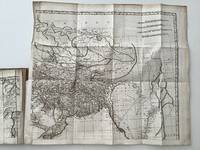
180019106AB1800. Paris Poignee An VIII 1800 Four large folding engraved maps six engraved foloding maps and one plan. The four large folding engraved maps are forming the 'Carte de L'Indostan ou de L'Empire Mogol' the oulines contemporary hand-coloured. First French edition with maps revised by Jean Nicholas Buache incorporating the four maps that compose Rennell's "second great work. the construction of the first approximately correct map of India" DNB. "The Father of Indian Surveying" Gole "Early Maps of India" Rennell charted the currents through the India Ocean and around Africa and later surveyed the Indian interior. He recognized Europe's growing fascination with India: "As almost every particular relating to Hindoostan is become an object of popular curiosity it can hardly be deemed superfluous to lay before the public an improved system of its geography" Rennell Preface. With Rennell's first map of Hindoostan the result of 500 separate surveys and stretching from the Himalayas in the north to Ceylon in the south and the "Great Sandy Deserts" in the west. Born in Chudleigh in Devon England James Rennell who was to become one of the mosst celebrated cartographers of his time joined the British Navy as a midshipman at the age of 14. Amidst the Seven Years' War 1756-1763 he travelled the world and learned marine surveying and hydrography. This led to his appointment at age 24 as surveyor of the British East India Company's dominions in Bengal. In 1765 Rennell began surveying India. By this time the British East India Company had maintained its foothold on the region for over one hundred years but it was still another century before Queen Victoria would set her eyes eastward and Rennell's explorations and accounts helped to fill that gap in time. Rennell combined data from British Army columns with Ain-e-Akbari 1598 a translation of Islamic geography of the empire which helped him acquire information about old divisions he therefore subdivided the country according to the Mughal provinces of 'subas'. unknown
1781PHIL2089Geneve, Pellet 1781. zus. CVIII, 3332 S., 10 Kupfe-Front. (dav. 1 lose), 23 mehrf. gefalt. Tab.; OLdr. m. Rückengoldprägung, Farbschnitt, beschabt, berieb., Ecken tlw. leicht bestoß., etw. stockfleck., insges. dekorative Ausgabe. Guillaume-Thomas François Raynal auch Abbé Raynal ( 1713-1796 ) Priester und französischer Schriftsteller. Wurde durch seine Geschichte zweier Indien (1770) berühmt, welche eine der meistgelesenen Schriften der Spätaufklärung war.
173813108'sGravenhaage Cornelis van Zanten 1738. Cont. full calf. Richly gilt back. Lower part of back slightly rubbed. Engr. frontisp. XXIV184 pp. <br/><br/><em>First edition. </em> unknown
17931158202London, printed for the author and sold by W. Richardson, (1793). 7 Bl., 122 (recte 130) S., 1 Bl., 160 (recte 162) S. u. 4 Bl., S. 151' - 177', S. 151 - 398 (recte 472), S. 516 - 522. Mit 1 kolor. gest. Faltkarte u. 8 (davon 6 gefalt.) Kupfertaf. (The History of Hindostan I). Interims-Ppbde d. Zeit (Einbde fl., berieben. u. bestoßen, ohne die Rücken, Bindung gelockert u. einige Bl. lose, unbeschnitten, etwas braunfl.).
1717576<p>Autograph letter 2pp. folded signed "G. Johnstone" to Sir David Dundas contemporary ink stain not affecting text marginal toning 17 September 1774</p><p>The autograph letter from George Johnstone the Director of the East India Company regarding George Vansittart 1745-1825 "quitting the service of the East India Company". The letter goes on to discuss Warren Hastings the Treaty of Banaras and reformations. Beginning with a politically motivated embezzlement:</p><br /><p>"You will now judge what reformations are likely to take place under such a General who in a very inferior station cut out with 100000£ and endeavoured to support evidence on the reform action attempted by General Claverings besides furthering by his own confession in a manner so very unworthy a public officer…". General Clavering was appointed Commander in Chief in India in 1774 shortly after Warren Hastings was appointed Governor General. By the 1770s Hastings had already made many political enemies in the East India Company. </p><br /><p>The letter goes on to state: </p><p>"I am not surprised that Mr. Hastings and his friends should wish for a success for the only person who was privy to the Treaty at Banaras for exterpating the Rohilla… but why Pitt should adopt him I shall never wonder more." </p><br /><p>The Treaties of Banaras of 1773 was an agreement regulating relations between the British Government of Bengal and the ruler of the Muslim state of Oudh modern day Ayodya. Warren Hastings ceded Allahabad and Kora to the states ruler and promised to support him against the menacing Afghan Rohillas in return for cash payments. This move designed to strengthen Oudh as a buffer state between Bengal and the Marathas led to the Rohilla War of 1774 which later became a major factor in Hastings's impeachment 1788–95.</p><br /><p>The mention of Pitt is referring to Prime Minister William Pitt's Regulating Act of 1773. The Act was intended to overhaul the management of the East India Company's rule in India. Although it was not a long term solution to the concerns over the company's affairs it marked the first step towards parliamentary control over the company and centralised administration in India. </p><br /><p>George Johnson was an officer of the Royal Navy who served during the War of Austrian Succession the Seven Years War and the American War of Independence rising for a time to the position of Commodore of a squadron. Adaptable in his career Johnson also served as a member of Parliament a member of the Carlisle Peace Commission a Director of the East India Company and the first Governor of West Florida from 1763 until 1767. Early in his service he revealed both the positive and negative aspects of his character. He was praised for his bravery when confronting the enemy but censured for disobedience. He rose through the ranks to his own commands and had some success with small cruisers against privateers. Throughout his life he rotated between his political career and his service in the Royal Navy. He became a director of the East India Company towards the end of his life before illness forced him to retire from business and politics shortly before his death in 1787.</p><br /><p>An important letter revealing the Director of the East India Company's concern over the actions of Warren Hastings. </p>
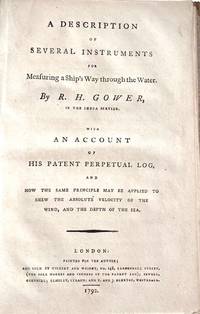
17921325<p><strong> NAUTICAL INSTRUMENTS</strong></p><p><strong>GOWER Richard Hall in the </strong><strong>India</strong><strong> Service. </strong><em> A Description of several instruments for Measuring a Ship's Way through the Water By.With an Account of his Patent Perpetual Log and how the same principle may be applied to shew the absolute velocity of the Wind and the depths of the Sea. </em>8vo modern cloth backed marbled boards half-title title 5-32 2 copper engraved plates. London: Printed for the Author 1792. </p><p>First Edition of author's rare first nautical work with the half-title. <strong>ESTC </strong>locates two copies in England BL & NMM and two copies in this country BA & NYPL. Gower fl. 1767-1833 a sea captain and naval architect "had been shocked by the low standard of navigation which he found in the convoy which took him to the East Indies.He devised a patent log part of the workmanship being entrusted to Alexander Grant and the sole rights of sale vested in Messrs Gilbert & Wright of 148 Leadenhall Street. He refers to "the indefatigable Mr. Stancliff' as cutting the scale on his optical instrument with his dividing machine. He then tried the instrument out with John Adams a mathematical teacher of Edmonton who has been identified as a reviser of textbooks for Mount and Page the chart-sellers."-Taylor <em>The Mathematical Practitioners of Hanoverian </em><em>England</em><em> 1714-1840 </em>#840. "In 1787 he devised an instrument which measured a vessel's way through the water with greater accuracy than had previously been possible."-<strong>O</strong><strong>DNB</strong><strong>.</strong> The followng year he wrote <em>A Treatise on the Theory and Practice of Seamanship </em>which long remained a standard work. We trace no copies at auction. 84574</p> The Author