[India / Missionary Literature].Biblio.com
12 033 résultats
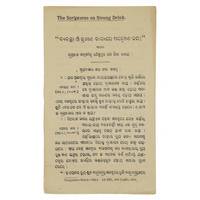
19011047Cuttack: Orissa Mission Press -- C. H. Harvey 1901. First Edition. Wraps. Very Good. One of 500 copies. 7-1/8" x 4-1/4". 12 pp. White self-wrappers. Modest wear short tear to fold of outer bifolium. Text in Oriya. Orissa Mission Press -- C. H. Harvey paperback
200700562Bruxelles, Casterman ligne rouge, 2004 ; in-4, 48 pp., cartonnage de l'éditeur. T 3.
201111282Bruxelles, Casterman ligne rouge, 2002 ; in-4, 8-42 pp., cartonnage de l'éditeur. EO t1 un supplément de8 pages de croquis inédits réservé au premier tirage ( n° 37050).
200700563Bruxelles, Casterman ligne rouge, 2002 ; in-4, 8-42 pp., cartonnage de l'éditeur. T1.
201111285Bruxelles, Casterman ligne rouge, 2005 ; in-4, 48 pp., cartonnage de l'éditeur. EO tome 4 : DL sep 2005 ( n° 41980).
201111284Bruxelles, Casterman ligne rouge, 2004 ; in-4, 48 pp., cartonnage de l'éditeur. EO tome 3 : DO octobre 2004 ( n° 39764).
110971Lahore Allahabad Dehra and Kumbakonam various circa 1909-1922. . Single volume sammelband containing 5 publications 8vo 215 x 135mm; some early inscriptions and markings bound in contemporary green cloth spine worn with loss edges rubbed.<br /> This volume is a sammelband of 5 publications and essays comprising: <br />- S. S. Metha A Consideration of the Position of Women in Primitive Society from the Standpoint of Marriage n.p. c. 1915. <br />- The Proposed Proclamation Pillar and Minto Park at Allahabad The 'Leader' Press Allahabad 1910. <br />- Ram Sharan Ratuire Sharma The Twelfth Annual Report on Total Abstinance and appeal to those interested in the public welfare. Shri Swami Press Dehra Dun 1909. <br />- D. A. Narasimham Kalidasa and Shakespeare: A Parallell Kumbakonam n.d.<br />- Prof. Ruchi Ram Sahni The Present Situation or an appeal to my Modern Friends the Tribune Press Lahore 1922.<br /> Lahore, Allahabad, Dehra and Kumbakonam, [various], circa 1909-1922. hardcover
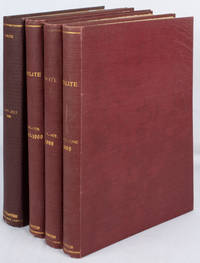
1968173716Baroda.: Light Publications. 1968-1969. Set of four volumes. Broken run of weekly issues from March 9 1968 to July 12 1969 lacking a single issue. Bound in maroon cloth-covered boards. <br> <br>First volume contains March 9 1968 - June 29 1968 issues. Lacking 7 April 1968 issue. <br>Second volume contains July 6 1968 - October 26 1968 issues. <br>Third volume contains November 2 1968 - February 22 1969 issues. <br>Fourth volume contains March 1 1969 - July 12 1969 issues. <br> <br>All volumes: 28 x 23cm. Pages trimmed with no loss to text leaves evenly browned throughout endpapers little worn boards somewhat worn and marked overall in good condition. Broken run of Enlite news magazine issues for mid-1968 through to mid-1969. Includes a wide variety of commentaries and articles relating to current events of the time. Particular focus is given to their cover stories which detail the lives of certain individuals for that week's issue. Also included are a number of interesting advertisements for products ranging from glassware and antibiotics to family planning initiatives and circuit breaker panels. <br> <br>Notable and typical articles include Indian preparations for Expo 70 in Osaka concerns with Indian diplomats in West Germany for failing to highlight India's dominion over Jammu and Kashmir the foreign relations exploits of the Nixon administration in Asia Naxalite activities in Calcutta and the success of Canada's Liberal Party in enlarging their majority under Pierre Trudeau. . Light Publications. hardcover
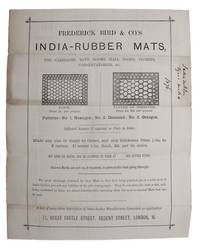
1876AQ21543London: s.n. 1876. Single leaf handbill. Numerous horizontal and vertical folds manuscript docket title to margin lightly creased and dust-soiled. An apparently unrecorded handbill advertising the services of London-based India Rubber mat and tyre manufacturers Frederick Bird & Co. . Dimensions 220 x 280 mm. [s.n.] unknown
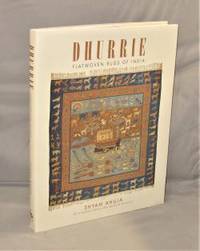
199928032Mumbai:: India Book House Ltd 1999. First edition. A Fine copy in a Fine dust jacket. The traditional flatwoven Indian dhurrie has long been overshadowed by the luxuriant Mughal pile carpets. Transcending social boundaries the dhurrie was used by commoner and royalty alike - at its simplest it was a multi-purpose textile used as floor covering bedding or packaging. At its most elaborate however woven with the finest fibres and enhanced with gold threads it graced the palaces of royalty. This pioneering work traces the dhurrie back into the mists of prehistoric India with beautifully reproduced photographs of extant examples through the centuries. It pays particular attention to the design and colouring of dhurries from classic stripes to ornate geometrical designs as well as pictorial dhurries. The many stages of dhurrie making are comprehensively covered - from the selection and dying of the yarn to the final processes of weaving washing and finishing. Richly illustrated in color. India Book House Ltd, hardcover
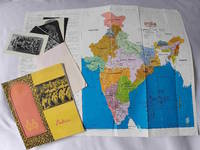
1970223132Government of India. Circa1970s. One booklet in stapled wrappers one large folding brochure and an envelope from the Indian Museum including six postcards with black and white photographic illustrations of which one inscribed by a prior owner. <br> <br>"India": Colour and black and white photographic illustrations 36pp. 21.8 x 20.3cm. Lacking map in envelope at rear a small closed tear near tail of first leaf. <br>"India Tourist Map" brochure: Colour and black and white maps 22.2 x 10.2cm. Several closed tears mended with acid free tape. <br> <br>Overall a little rubbed and browned still a good set. . Government of India. unknown
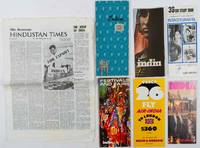
1970219241Circa1970. A collection of 7 items relating to tourism in India late 1960s-1970. 3 Air India folding brochures including advertisements for an "under 26 fly to London $360 from Perth" campaign and a "36 Day Study Tour" to India Ceylon Nepal and Hong Kong. Profusely illustrated "Festivals and Fairs" brochure a large folding brochure and introductory guide to India in stapled wrappers with a loosely inserted folding map published by the Department of Tourism for the "1967 International Tourist Year". A copy of The Overseas Hindustan Times April 25 1970. This collection offers insights into India's tourism industry and its government's efforts to promote inbound tourism in the late 1960s to early 1970s. . unknown
Cooch Behar (India), [s.n.], 1899, due fotografie originali, mm. 187x253, raffiguranti momenti d'una caccia alla tigre; la formazione dei cacciatori in sella agli elefanti alla ricerca della preda (cacciatori e elefanti visti da dietro) e i cacciatori a terra, in posa, dietro alla tigre uccisa. Le due foto inserite entro passepartout che recano la data e il luogo dell'evento manoscritti sui margini inferiori. Ottime condizioni. La coppia:
Bullah Mallah, [s.n.], 1899, una fotografia originale, mm. 187x254, raffigurante un cacciatore europeo e due aiutanti: tengono per le grandi corna il corpo d'una capra di Falconer appena uccisa. La foto è inserita entro un passepartout che reca la data e il luogo dell'evento manoscritti sul margine inferiore. Ottime condizioni.
Mirmilk Valley (India), [s.n.], 1899, una fotografia originale, mm. 187x253, raffigurante un cacciatore europeo e due aiutanti: l'uno seduto, gli altri in piedi su alcune rocce, accanto ad un orso appena ucciso. La foto è inserita entro un passepartout che reca la data e il luogo dell'evento manoscritti sul margine inferiore. Ottime condizioni.
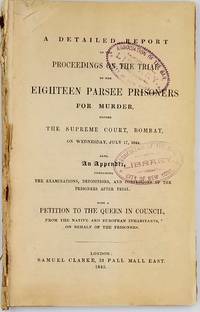
184524004London: Samuel Clarke 1845. First printing. pamphlet. Good overall. 8vo 118pp. Disbound but complete. Deaccessed by the NY Association of the Bar Library with their stamp on the title page.<br /> <br /> An Indian murder tried under British law in which Parsi defendants were accused of murdering another Parsi adherents of Zoroastrianism in Bombay with a rapid and harsh sentence meant to instill fear of British law and punishment in the local people. <br /> <br /> The trial was held at the Supreme Court before the British Chief Justice of Bombay Sir Henry Roper. The all European jury produced a guilty verdict against ten of the eighteen with 8 acquitted. The Chief Justice sentenced 6 of the 10 to transportation for life to Singapore due to a mercy appeal from the jury but sentenced the remaining four to be hanged. <br /> OCLC: 563643483 2 copies British Library. Samuel Clarke unknown
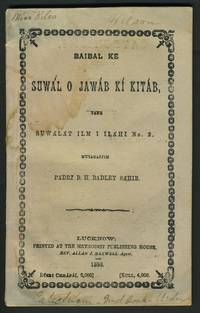
188823582Lucknow India: Methodist Publishing House 1888. Paperback. Very good condition. Methodist pamphlet printed in Urdu in a question and answer format. Owners' signatures at top of front wrapper "Miss Niles" and Mr. "Wilson" and "Catechism 2nd Book Urdu" in ink.<br /> <br /> Brenton Hamline Badley 1849-1891 American missionary was born in Monmouth Indiana in 1849. He was first assigned to the North India Annual Conference. He preached his first sermon in the local dialect within a short period and spent the next four years preaching throughout the countryside. He later returned to Lucknow and served there until the end of his life.<br /> <br /> Badley helped with the development of the Centennial Boys School into Reid Christian College now Lucknow Christian College. Mr. Badley authored books and articles on Indian Missions for American publications and put together the 1876 Indian Missionary Directory. <br /> <br /> 12mo 68pp advertisements 8pp. Printed plum paper wrappers. Wrappers slightly marked; text clean and bright. Methodist Publishing House paperback
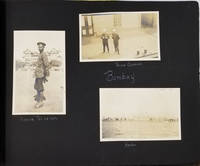
1920238521920. Photography. Very good condition. A wonderful large album of 127 post card size venacular photographs each captioned depicting the everyday life of people in the streets villages and country side; these are authentic images of real life in India at the time. Also includes images of Bombay and the Palace at Amber. The photographer is unidentified; probably an American couple on an Indian tour.<br /> <br /> The majority of the photographs concern life in India from people at work in a wide range of trades to women of different castes to wonderful marketplace scenes including children at play holy men wrestlers a carousel captioned "a Merry-Go-Round" and traveling artists.<br /> <br /> 40 images of rural India include: native houses village streets & centers a potter at work village shops village "bazarrs" sic showing all manner of sidewalk vendors and stalls village wells women walking to market with large baskets carried on their heads holy men sweet and bread sellers selling "pop" soft drinks from a cart burial of a distinguished person "a bride and her maids pay visits to relatives part of the 3 day wedding ceremony".<br /> <br /> 11 images titled "Women of India" show Hindu Jain and Mohammedan women women spinning women carrying goods stacked on their heads women with children and high caste women. <br /> <br /> 28 images of Indian men include an image title rather mysteriously "rural native police English Providence" porters young boys high diver gate keeper cook shoe mender snake charmer street musician clown traveler traveling artist traveling school teacher tobacco seller "by the puff" holy men of India "fakirs" wrestlers and a transvestite the image titled "an efeminate sic gentleman Indian man dressed in a sari.<br /> <br /> 21 images of the stunning Amber Palace and Fort in northwest India the oldest surviving palace in India built of red sandstone and white marble whose architecture shows a blend of Muslim and Hindu influences. Images include walls and grand entrances ceremonial elephants stunning interior views of the palace and its rich alabaster carvings and views of the surrounding landscape taken from the Palace walls. The Jas Mandir is also pictured; this is the most beautiful structure at Amber divided in three parts: the Hall of the Private Audience on the ground floor the Glass Palace and the Hall of Glory on the upper floor.<br /> <br /> 15 images of Bombay with : a native policeman 2 colonial police officials the harbor Bombay city streets including shots of a large double decker tram the "red light" district Hindu Caves at Garapuri and Elephanta Island interiors of the carved caves and vultures "who devour the Parsi's dead in the Towers of silence".<br /> <br /> 12 images titled "Travel in India" include an elephant with howdah for carrying passengers ox drawn carts horse drawn carts and carriages railway carriages including one with a train door marked "Servants" a train station and a colonial postal box.<br /> <br /> A large photograph album 15 x 11 1/2". Black stiff cloth covers cord bound. Hand lettered "No. 5" at upper left corner front cover. Images measure 5 1/2 x 3 1/2" laid down 3 or 4 per page with captions hand lettered in white. The first 2 leaves detached loosely inserted. The photographs in fine condition.<br /> <br /> An album of evocative images of the life experienced by Indians living in colonial India. Images probably taken by an American traveller as soda is referred to as "pop" harbor is spelled without the "u" and the album itself is made in the USA. unknown
1930250591930. Very good condition. Three magnificent large b&w photographic portraits of Indian elephants painted and lavishly dressed for a festival. The elephants have painted faces & trunks and are dressed in rich saddle cloths laden with priceless embroidery.<br /> <br /> Images include a close up view of the head of one elephant with jewels on his tusks and the mahout in white turban on his back; a single elephant full length flanked by attendants exiting the court yard of a stately residence; and two decorated elephants standing side by side on a road presumably at the head of a procession with mahouts on their back and flanked by attendants.<br /> <br /> Each image captioned "India" in period ink at the lower left outside the border of the print. <br /> <br /> The photographs are printed on beautiful thick photographic paper. The images 8 1/4 x 10 1/4 paper 10 3/4 x 13 1/2 unknown
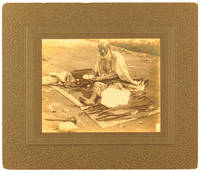
86940Plate sizes are 100 × 150 mm three and 75 × 105 mm or the reverse eight; all are captioned in ink eight on the verso of the mount three on the photograph itself. All depict scenes of rural life most of them identifying Serajgunge in East Bengal. Images include 'Native fisherman' 'Native cobbler at work' 'Hindu holy man with his disciple' 'Wayside umbrella mender' scenes of boat-building and jute preparation and one captioned 'The creature making his creator! Idol making'. Apart from a small light stain to one mount they are all in fine condition. 11 items. unknown
1874B7111Hyderabad India: Residency Press. 1874-5. Bindings rubbed interior generally clean. Binding: 1874 vol in printed paper wraps backed in green cloth. 1875 in publisher’s limp printed paper boards rebacked in blue cloth. Notes: Ex-library ink stamps on titles.<br>Very good example. Rare volumes on India. <br><br>1874 volume with errata slip bound in.<br> Size: 8vo. 240 x 150 mm Volume: 2 volumes. Category: Book Asia Central India & Ceylon / Sri Lanka; Residency Press. paperback
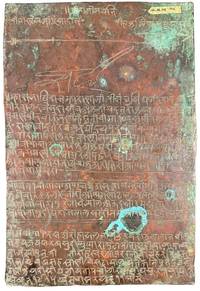
181942798Eastern India possibly Bengal or Assam circa 18th-19th century. Copper plate 13 7/8 x 9 1/8 inches engraved on both sides. The principal face with several lines of incised text at the head followed by a large engraved validating or emblematic mark and below this three dense sections of text divided by ruled horizontal lines. The reverse largely uninscribed with three small engraved seals or validating marks near the edge. An inscribed copper plate of Indian origin possibly Bengal or Assam engraved in a Bengali or Bengali-Assamese script and preserving a formal documentary text in metal.<br/> <br/> This copper plate belongs to the South Asian tradition of preserving legal devotional and administrative records on durable metal supports. Copper plate documents often described as tamrapatra or copper charters were used for grants endowments title rights decrees and other formal acts their material permanence giving them authority beyond that of ordinary manuscript documents. The present example appears to preserve a substantial text arranged in ruled sections and accompanied by validating marks. The script appears close to Bengali or Bengali-Assamese. The letterforms show rounded and looped shapes consistent with scripts used in eastern India. If confirmed this would suggest an origin in Bengal Assam or a neighbouring region where related scripts were used for administrative and religious writing. From their earliest centuries of development copper plate inscriptions have occupied a central place in South Asian documentary culture particularly in the recording of land grants royal edicts temple endowments and other formal transactions. Their durability made them suitable for preserving records intended to endure and they were often deposited in temples or held by families or institutions as proof of rights and privileges. While earlier examples are frequently associated with royal chancelleries the practice continued into the early modern and colonial periods with regional administrations and local authorities maintaining related forms of documentation. The present plate appears to belong to this later phase of the tradition when such documents were still being produced for administrative legal or commemorative purposes. Its relatively large format and the density of inscription suggest a formal text of some substance while the additional engraved devices indicate an effort to authenticate or formalise the record. The copper plate offers a direct example of a documentary practice that bridges manuscript culture and more durable forms preserving both the text itself and the physical conventions of its transmission. unknown
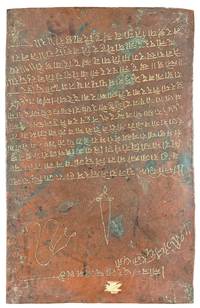
181942797Western or Northern India circa 18th or 19th century. Copper plate 15 1/2 x 9 3/4 inches engraved on both sides one face densely filled with horizontal lines of incised text and with additional marks including a dagger or torch device and other validating or ownership marks. The reverse more sparsely inscribed with two lines of text. An inscribed copper plate of Indian origin engraved on both sides and belonging to the South Asian tradition of preserving legal devotional and commemorative texts.<br/> <br/> A striking survival from the documentary culture of South Asia where copper served as a durable support for records intended to outlast paper and palm leaf. Such copper records often described as tamrapatra or copper charters were valued because they were portable difficult to alter and capable of serving as enduring witnesses to grants decrees endowments title rights and other formal acts. The script appears to belong to the Nagari family possibly Devanagari or a related cursive administrative hand such as Modi the script long used for Marathi official and business writing. From their earliest centuries of development copper plate inscriptions have occupied a central place in South Asian documentary culture particularly in the recording of land grants royal edicts temple endowments and other formal transactions. Their durability made them suitable for preserving records intended to endure and they were often deposited in temples or held by families or institutions as proof of rights and privileges. While earlier examples are frequently associated with royal chancelleries the practice continued into the early modern and colonial periods with regional administrations and local authorities maintaining related forms of documentation. The present plate appears to belong to this later phase of the tradition when such documents were still being produced for administrative legal or commemorative purposes. Its relatively large format and the density of inscription suggest a formal text of some substance while the additional engraved devices indicate an effort to authenticate or formalise the record. The copper plate offers a direct example of a documentary practice that bridges manuscript culture and more durable forms preserving both the text itself and the physical conventions of its transmission. unknown
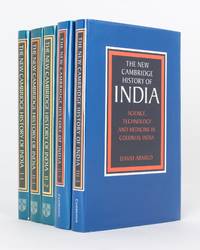
1987118096Cambridge: Cambridge University Press 1987. First Edition. Hardcover. Very Good. Cambridge Cambridge University Press 1987 1988 1987 1998 and 2000 all first editions. Octavo five volumes; cloth; personal bookplate in each volume; text paper in the first three volumes a little tanned; an excellent group with the excellent dustwrappers the first three spines are lightly sunned and there are a few trifling signs of use elsewhere. The first volume has an inscription from the author on the half-title. Titles and authors of the individual volumes are as follows. <p>Volume I Number 1: The Portuguese in India by Michael Naylor PEARSON. <p>Volume II Number 1: Indian Society and the Making of the British Empire by C.A. BAYLY. <p>Volume II Number 2: Bengal. The British Bridgehead. Eastern India 1740-1828 by P.J. MARSHALL. <p>Volume II Number 5: European Commercial Enterprise in Pre-Colonial India by Om PRAKASH. <p>Volume III Number 5: Science Technology and Medicine in Colonial India by David ARNOLD. 5 items. Cambridge University Press hardcover
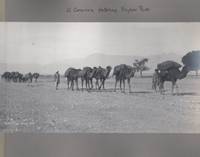
1926D14301926. Very Good. Grey cloth over boards 9.75 x 7.5 with Photographs blindstamped on upper board; 23 grey heavy cardstock leaves 17 of which feature tipped-on black-and-white photographs 90 images in all most of them 3 x 4 though some are a bit larger or smaller with handwritten notations. Fine a careful and tidy collection of photographs all neatly tipped-on labeled and dated by hand. <br/><br/>Images of Agra the Taj Mahal shrines palaces schools streets tombs Sikri Delhi Tughlagabad Lahore camel caravans Peshawar bazaars Khyber Pass Kashmir to list everything in this far-reaching journey would be a disservice to the reader. Comprised mostly of landscapes and images of the Indian people some elements of the personal do crop up here and there: Our author is featured in only one photograph he sits on horseback with traveling companions also on horseback and this 2 x 3 image is labeled Self / Lottery Henry / Tommy Alice / The Wallaby ostensibly identifying his friends and their horses; Henry will appear again tiny against a landscape labeled The End Pavillion Chasma Shahi Henry looking for bear. Where it is light on the candid it remains a diligent record every image is identified and all are crisp and clear studiously photographed. A pleasing and unique volume. hardcover