12 033 résultats
Bari, Editori Laterza, 1979, in-8, br., pp. 44. Con cartine a col. e bibliografia. (“UL” 482).
23811‘The Hague / November 28th. 1860’. An excellent letter in which a serving Victorian ambassador discusses the nature of diplomacy and gives a vivid assessment of his former superior Sir Hamilton Seymour whom he jokingly characterizes ‘the great Elchee’. See both men’s entries in the Oxford DNB. 7pp 4to. On two bifoliums. In good condition lightly aged and with creases from folding into a packet. Minuted on reverse of last leaf. Addressed to ‘The Honble. George Elliot’ he received his KCB in 1862 and headed ‘Private’. Beginning on the subject of his brother-in-law Henry Lockwood 1825-1882 Napier writes: ‘My dear Elliott Many thanks for your kind letter informing me that Lord John Russell had moved Lockwood from Constantinople to Stockholm. It must be in many respects a great advantage to Lockwood and he will be very grateful to Lord John for the change. I hope that my brother in Law did not incur any blame from being involved in the dissensions of the Constantinople Embassy. I do not know all the circumstances indeed I have heard one side much more than the other. The malignant atmosphere of the place could not have been more strikingly shewn than in a musunderstanding between a most amiable Minister and a very devoted and agreeable subordinate. Such at least was Lumley to Sir Hamilton when I knew him.’ Napier had served as first secretary to Sir Hamilton Seymour in St Petersburg with John Lumley-Savile the future Lord Savile as second secretary. Napier considers Lumley as secretary to the Constantinople ambassador Sir Henry Bulwer is in Napier’s view ‘most in the wrong. Bulwer has a natural fondness for the twilight in business matters and this fanciful partiality for secrecy and winding may have led him to keep some things close from his Secretary’. After a comment on Lords Cowley and Shatford he continues: ‘The great Elchee never gave me a key or shewed me a Dispatch but when I wanted to know anything I would go to his room and talk to him about George Canning or the greek Revolution; or Sophocles or the Emperor Nicholas. Shaking such provocations in the face of that furious genius he would rowse up and open the flood gates of his conversation one thing led on another and at length he had disburdened himself of the past the present and the future. I was young and liked the humour of the thing besides I admired the old man angry so intense so handsome so austere so like Cato outside. And we cannot deny them generous sympathies and great services. Cowley Henry Wellesley 1st Earl Cowley who had been Minister Plenipotentiary was older and more than even on a foot of equality. He could not ever abide him. In fact your Secretary seems the natural enemy of his Chief. Please God I may not find it so if I ever become an Ambassador.’ Over two pages he discusses the ‘most just and wise regulations’ of the Foreign Office and what may happen ‘if your Ambassador is as wild as Nebuchadnezar and your Secretary not as discreet as Daniel’ before continuing: ‘You must have observed that Diplomacy is becoming a caste that we are a sort of Brahmins. Every man has a son in the possession. The diplomatic qualities will become progressive and hereditary. The Children will be wiser than their fathers. I have myself a son who is as smooth as Jacob and who never smiles unless he meets another young augur.’ He jokes: ‘You must be prepared to have an application soon for an unpaid attachéship. My second son is turbulent. I intend him for a naval reformer. I suppose your brother Henry has some of the same.’ This leads to a discussion of Elliot’s wider family the Mintos and the jesting reproach: ‘You are allowing Elcho and The Duke of Argyle to run away with the sympathies of Scotland. This must not be. There will not be a piece of bannock left in the land for a true Whig.’ ‘The Hague / November 28th. 1860’. unknown
240968 August 1859. The Hague Holland. See his entry in the Oxford DNB. 4pp 12mo. Bifolium. In good condition with slight discoloration along central fold. Large bold signature ‘Napier’. Addressed to ‘The Honble. George Elliott’ with salutation to ‘My dear Elliott’. As he does not know where Elliott’s sister Lady Dunfermline is ‘residing at this moment’ he is placing in Elliott’s hands ‘for transmission’ a letter from the wife of the Turkish ambassador at the Hague. He expresses to Elliott’s family his sympathy at the loss of their father. ‘I can never forget the kindness which he shewed me when I was unequally associated with him in his duties in Italy. He continued the same goodness and partiality to me afterwards.’ Added to Napier’s ‘personal attachment’ is ‘the highest appreciation of his manly unaffected sincere character and of his great and useful capacity’. He is sure ‘there never was a better father and never one more loved’. He urges Elliott to consider that his ‘distress must be tempered by the reflection that his disorder was incurable and that his life could only be prolonged amidst suffering and infirmity’. He considers that there is ‘no family more united by affection’ than Elliott’s. He concludes in the hope that they ‘may be preserved to each other and see good days and happy homes and that wherever you go you may be gathered to the banks of the Teviot at last’. 8 August 1859. The Hague [Holland]. unknown
2425523 October 1906; 119 The Avenue West Ealing London. See his entry in the Oxford DNB. 11pp 12mo with three of the pages written lengthwise. On three bifoliums. In good condition folded once. The hurried loose handwriting of this long letter presents a considerable challenge: even the signature ‘Geo Birdwood.’ ‘Gen Birdwood.’ and the name of the recipient ‘Fagan’ are doubtful. The letter begins with a reference to the ‘extract from Lady Dorothy Nevills - Reminiscences - given in the cutting from the Globe of yesterday enclosed in your kind note of today’. He states that he had ‘nothing to do with the origination of the Primrose League & I refused to have anything to do with it when asked to join in its constitution. It was Primrose Day I founded’. The passage which follows is opaque. Later on he states ‘I never wd have anything to do with the League. I abominate woman in politics: & I only joined the League when they conferred on me the Grand Cross of the Order in express recognition of my founding P. D.’ In his opinion ‘the Tariff Reform movement & all involved in its success - which I fear - is completely making up our old political & after a period of Chaos the country will settle down with quite a new country with new parties which will be as little interested in the England of Gladstone & D’Israeli & Russell - as we are in the world & politics of the moon’ 23 October 1906; 119 The Avenue, West Ealing [London]. unknown
25095Without date or place. See his entry in the Oxford DNB. A good large bold signature with the autograph valediction of a letter. On one side of a 20 x 9 cm piece of wove paper. In good condition lightly aged. Reads: ‘Your’s sic very truly / V. Lovett Cameron / Commander R. N.’ See Image. Without date or place. unknown
23810‘Trin. Coll. Sunday 12 o’clock’. 24 November 1839; Trinity College Cambridge. See Napier’s entry and that of his sister Maria’s husband John Gellibrand Hubbard 1805-1889 1st Baron Addington in the Oxford DNB. 3pp 4to. In good condition lightly aged and discoloured with small closed tear to a crease. Part of letter torn away on opening and now under small black wax seal good impression of crest with letter N. Folded four times. Addressed with three postmarks on reverse of second leaf to ‘The Rt Honble The Lady Napier Kew Green’. Minuted by Lady Napier: 'Cambridge Novr. 1838’. 64 lines of neatly-written text. He greets his mother as ‘My dear Mamma’ and begins by expressing delight at the arrival of his sister Maria on the previous day ‘though it happened at rather an unfortunate time for my occupations. I am glad to see her looking so very well and wearing her curls but I miss you very much and I wish you had been able to come along with them.’ Despite the fact that ‘Cambridge is particularly wet & dirty’ Maria and ‘Hubbard’ Maria had married John Hubbard the future Lord Addington in 1837 breakfasted with him that morning. ‘Sedgwick and we sat talking till Church time when we got squeezed into St Mary’s and heard Melville preach much worse than usual.’ The letter proceeds with references to ‘Whewell’ Trinity Chapel ‘Thorp’ ‘the Philosophical society’ ‘Ld & Lady Fitzalan’ ‘Lucy’ Lady Kinlock. He reports that ‘Cambridge was very much shocked by the Duke of Wellington's reported stroke and delighted to hear it was only a cold.’ Turning to personal matters he writes: ‘Maria is very much cut up about her cook who after appearing to be a pattern of culinary morality for some months has turned out a peculating thief besides having had several children in the house which she clandestinely conveyed out of the way in the dirty clothes basket’. One of Sedgwick’s dog’s five puppies is mousing for him. ‘Maria says that Sir Alexander has at last gone north and high time it was for I see Mr Ewart has gone down to stand for the boroughs he has been petting so long through Patrick.’ He ends by mentioning ‘Sir Thomas misfortunes whiuch are so very hard upon his old age but Maria declares that he seems to bear it very cheerfully.’ He concludes: ‘I write this dull letter late at night dear Mother it is only to announce Maria’s happy arrival and I intend to despatch a longer one to 9. this week. Lady Fitz. is pale and plain & Maria cust her out.’ The letter is signed ‘Napier / Trin. Coll. Sunday 12 o’clock’. ‘Trin. Coll. Sunday 12 o’clock’. [24 November 1839; Trinity College, Cambridge.] hardcover
1063265Würzburg : Ergon, 2016. 242 S. Fadengehefteter Originalpappband.
1887RELI0665Wien, Gerold 1887. 44 S., OBrosch., Umschlag unschön rissig, m. großen Fehlstellen, gedunkelt, Besitzerstemp. am Innentit., Fadenheftung stark beschäd.
In-8° (cm.21,6), pp. 59. Cartoncino leggero edit. RUBEN, indologo, studioso della storia sociale, letteraria e filosofica dell'India antica. Censito alla sola Biblioteca Nazionale Universitaria, Torino. Censito in 4 bibl. ital.
In-8° (cm. 21,5), pp. 35. Cartoncino edit. RUBEN, indologo, studioso della storia sociale, letteraria e filosofica dell'India antica. Censito alla sola Biblioteca Nazionale Universitaria, Torino.
1882131804Leipzig, Otto Schulze 1882. VIII, 46, (2) Seiten. Breitrandiges unbeschnittenes Exemplar. Originalbroschur. (Gestempelt. Geringere Gebrauchsspuren). 21x13 cm
200699365(Amsterdam), Greenpeace International, [ca. 2006]. [84 n.n.] S. (Perlmuttpapier). Mit zahlr. s/w. Fotos im Duotone-Druck. 4to (29 x 29 cm). OKart. mit SU.
In 8°, brossura editoriale, pp. 283, (5); esemplare molto buono, lieve difetto al dorso. (XC1/B) (XC1/B)
1859PHO-796Paris , imprimerie impériale , 1859 , in-4° (272x225), IV-96p ,relié demi veau époque , dos lisse avec pièce d’auteur et titre , grande marge sur papier vergé , illustré d’une planche dépliante et figure dans le texte , cachet , manque une coiffe , charnières frottées .
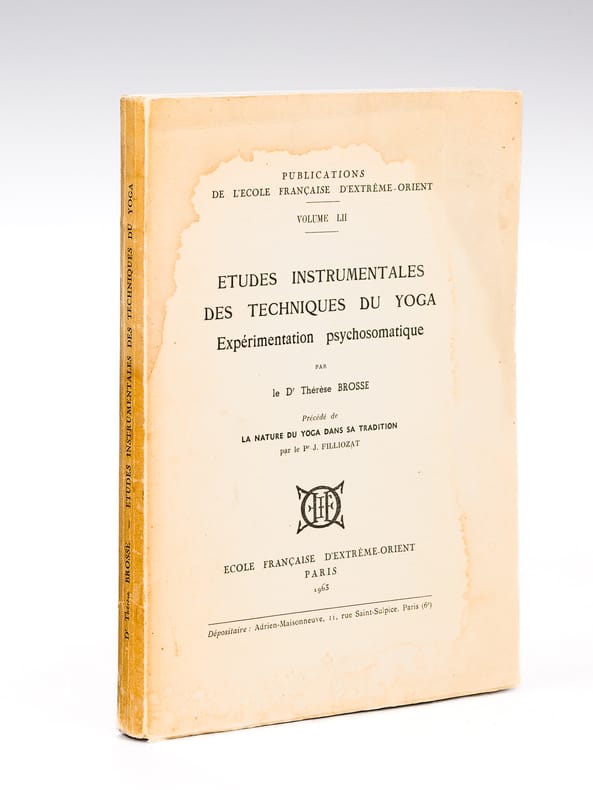
196368051Publications de l'Ecole Française d'Extrême-Orient, Volume LII, 1 vol. in-4 br., Ecole Française d'Extrême-Orient, dépositaire Adrien-Maisonneuve, Paris, 1963, 130 pp. + 66 planches photographiques noir et blanc
172543857Claude-Gilles Lecamus Couverture souple Toulouse 1725
2910828204.Gpaperback. Good. Access codes and supplements are not guaranteed with used items. May be an ex-library book. paperback
IXY-909Traduit de l’anglais par Christian Couvreur et Françoise Duquesne. Villain et Belhomme/Éditions Traditionnelles, Paris, 1976, 346 p. [+ un cahier photographique hors-texte, 2 p.], glossaire, index.
romanzo d'amore ambientato in India
198268767BBMainz., Wergo Schallplatten GmbH., 1982. 31,5 x 31,5 cm. Schallplatte. OKarton-Cover., 68767B Cover leicht berieben, Backcover mit Aufkleber ("PREIS DER DEUTSCHEN ...") und Preisetikett (Very Good+), Schallplatte in sehr gutem Zustand (Near Mint). Insgesamt gutes bis sehr gutes Exemplar. Wergo ? WER 60 098.
Madrid, Editora Nacional. 1978. 4to. menor; 322 pp. Cubiertas suplidas en tela.
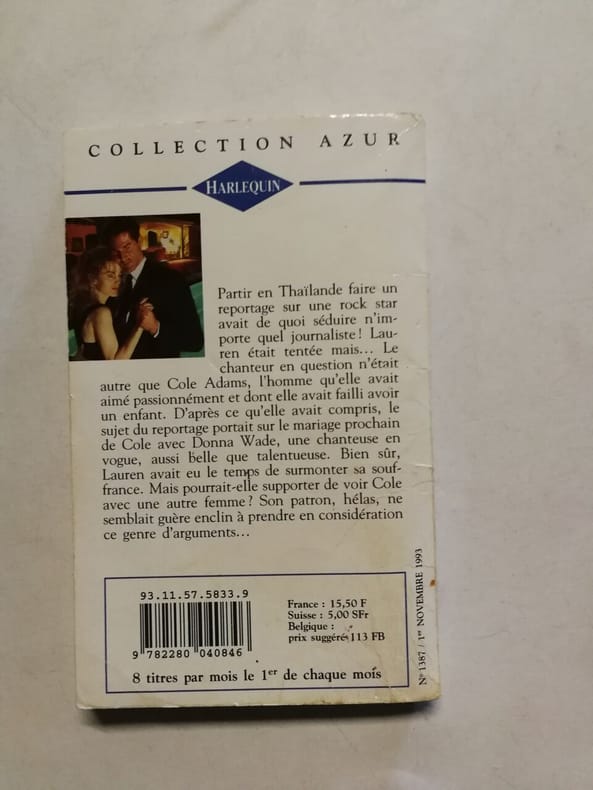
500321845Harlequin Sans date.
199735504229Paris, Kwok On, 1997 ; in-8, cartonnage toile noire de l’éditeur, jaquette illustrée. 126 pp., 1 f.Exemplaire à l’état de neuf.
19661093109Leipzig, Brockhaus, 1966. 266 S., 1 Bl. u. zahlr. Bildtaf. OLwd.