12 033 résultats
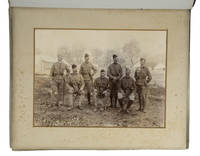
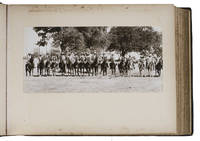
AQ25280s.i.: s.n. 1929-35 I: Oblong quarto. 30 photographs mounted on 30 leaves. Contemporary light green embossed cloth paper label to upper board title in manuscript 'Lahore Cricket Teams Khyber Pass and Family Groups'. Rubbed and marked joints split. II: Oblong quarto. 21 photographs mounted on 12 leaves bound with string in contemporary reversed half-calf beige cloth boards paper label to upper board titled in manuscript 'Kangra Valley'. Rubbed and marked. Two well-presented photograph albums featuring a total of fifty-one images depicting inter-war India. The first contains nine images of Himachal Pradesh state specifically the Uhl Valley and Lamba Dag River; eight photographs of the Khyber pass including Attock Bridge and the Khyber Valley Railway; three of 'The Unbendables' cricket team; two depicting Quetta in the aftermath of the 1935 earthquake; and three photographs of crowds taken at the Lahore session of the Indian National Congress at which was passed the historic 'Purna Swaraj' total independence resolution following the breakdown of negotiations between freedom movement leaders and the British government over the question of dominion status. The second album contains idyllic photographs of the Kangra Valley Himachal Pradesh predominantly of the Uhl and Banganga rivers including one of a gentleman fly fishing and two images of the Khyber Valley Railway. . [s.n.], [1929-35] hardcover
174523144Amsterdam Panckoucke 1745 -in-12 plein-veau 2 volumes, reliure plein veau raciné (binding full calfskin) blond in-douze, dos à nerfs (spine with raised bands), décoré "or" et à froid (gilt and blind stamping decoration), titre frappé "or", pièce de titre sur fond bordeaux avec double filets "or" en encadrement, tomaison frappée "or" avec de part et d'autre de la tomaison une roulette "or" avec double filets "or" en encadrement, roulette "or" en place des nerfs avec un filet à froid de part et d'autre des nerfs, entre-nerfs à fleuron "or" avec double filets "or" en encadrement avec rinceaux "or" aux angles, roulette "or" en tte et en pied, coiffes du tome 2 en partie manquantes, plats légèrement épidermés avec une tache brune de moins de 1 cm2 en partie haute au côté gauche du 1er plat, filet "or" sur les coupes avec légers manques de dorure, toutes tranches lisses rouges, sans illustrations, : 1 frontispice (frontispiece), VI + 456 et 486 pages, 1765 Amsterdam Panckoucke Editeur,
17253Londres [i.e. Paris], s.n., 1738. In-12, , 75 pp., demi-maroquin bleu, double filet à froid, dos à nerfs, tête dorée (taches et épidermures de la reliure, , rousseurs).
200607814Leipzig, F.A. Brockhaus, 1930 ; in-8, 183 pp., cartonnage d'éditeur avec jaquette. Jaquette abîmée nombreuses photos.
23624Printed by J. Edward Francis at the Athenaeum Press". See image for CONTENTS. Wraps paginated i-ii;105-144; iii-iv inc.wraps mainly good condition but rusty round staples one punch-hole with minor loss of text characteristic of material from the papers formerly held at the headquarters of the National Indian Association and the Northbrook Society 21 Cromwell Road later by its former Warden Roland Knaster. Note: "Founded in 1920 by the Australian Josephine Ransom the magazine Britain and India was set up for the Promotion of Friendliness Understanding and Sympathy between Britain and India.""A special interest magazine it included a range of articles on all aspects of Indian life thought and conditions especially related to Britain. Its specific endeavour was the promotion of Indian-British relations by highlighting the deep connection between both countries. It featured news articles features and special interviews with eminent people including the first Indian to win the Nobel Prize Rabindranath Tagore.The magazine also included a book reviews section and a regular round-up of events taking place in Britain of interest to those with a connection to India.The magazine was a small operation funded mainly by subscription but due to a lack of funds it folded at the end of the year." Scarce but four World Libraries appear to have one or more issues including the BL. Printed by J. Edward Francis at the Athenaeum Press". See image for CONTENTS. paperback
167333344London: Printed by the Author at his House in White-Friers 1673. First Edition. Illustrated throughout with 30 finely engraved copperplates generally a third of a folio page in size title page printed in red and black. Large Folio bound in contemporary calf. xii 253 15 A Table 1 pp. A well worn copy lacking the 5 map and the double-page or folding plates the text block and textual engravings all well preserved the paper crisp and unpressed some of the usual mellowing and evidence of age or use and old worm track to the bottom blank area of the leaves again not obtrusive the "Directions to the Binder" leaf not present at the end of the volume otherwise collated complete. FIRST EDITION. John Ogilby was a Scottish translator impresario publisher and cartographer. Ogilby established Ireland's first theatre in Werburgh Street Dublin and following the Restoration that country's first Theatre Royal. Ogilby played a significant part in arrangements for the coronation of King Charles II. Following the Great Fire of 1666 Ogilby's large-scale map of the City of London was founded on precise survey work and his Britannia is the first road atlas of England and Wales to be based on surveys and measurements and drawn to scale. <br> During the Great Fire of London in 1666 Ogilby's house in Shoe Lane together with its printing works and most of his stock was destroyed; he estimated he had lost Å3000. After the Great Fire the Corporation of London appointed Ogilby and his wife's grandson William Morgan as "sworn viewers" members of a group of four trustworthy gentlemen directed by Robert Hooke to plot disputed property in the city. Ogilby later made what he called "the most accurate Survey of the City of London and Libertyes therof that has ever been done". By 1668 he had a new house in Whitefriars and was ready to resume his printing and publishing work.<br> Ogilby's next major venture was a series of atlases of China Japan Africa Asia and America. The first of these was An Embassy from the East India Company of the United Provinces to the Grand Tartar Cham Emperor of China which was published in 1689. This book was substantially a translation of Johan Nieuhof's Dutch publication of the same name with English copies of the Dutch engravings. Ogilby's Africa appeared in 1670 and was followed in rapid succession by Atlas Japanennsis 1670 America 1671 Atlas Chinensis 1671 and Asia 1673. In 1671 in response to his proposal to make a detailed survey and atlas of Great Britain the King appointed Ogilby Royal Cosmographer. Thus at about the age of 70 and with the scientific advice of Robert Hooke58 Ogilby began work on Britannia the project for which he is best known among cartographers. Printed by the Author at his House in White-Friers unknown
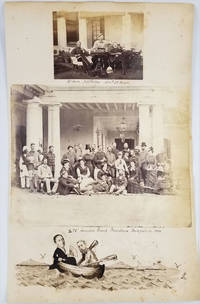
187724159Bangalore India 1877. Very good condition. Four large albumen photographs with pen and ink decoration surrounding them of the famed Victorian light cavalry regiment known as the Hussars in India. <br /> <br /> The albumen photographs on the front are: a portrait of three relaxed officers lounging in uniform on the terrace of a colonial building in India captioned in ink in a period hand "McBurn Capt. Malone and Hon.ble H. G. Gough". The two men at the left wear small round caps; the man at the right sits with one leg flung over the arm of his chair. <br /> <br /> The second image is a large group portrait of the regiment in civilian dress including wives and Indian servants at the colonnaded facade of an imposing building captioned "XIV Hussars Group Mess House Bangalore 1877". Below this image an unidentified member of the regiment and his wife are portrayed in a charming pen and ink cartoon of the couple in a row boat with a clipped photo of their faces pasted in.<br /> <br /> On the verso an impressive private residence with British women waiting in a horse drawn carriage at the portico and Indian servants is captioned in period ink "General Macintyre's House Secunderabad". Below is another image of a grand residence with a curved façade on which is painted a sign "The Deanery 1877". It is captioned in period hand "Mr. Dean's house. North Trimulgherry". Both of these large albumen photographs are decorated with hand drawn pen and ink borders.<br /> <br /> According to an autobiography by Edwin Mole entitled 'A King's Hussar: Being the Military Memoirs for Twenty-five Years of a Troop-sergeant-major of the 14th King's Hussars' the regiment's horses were being newly imported from Australia. The new hardier breed dubbed "Walers" were imported from New South Wales to replace the existing stock from England which was suffering in the harsh climate. Sgt. Mole was sent to Australia as part of a commission to supervise the breeding of the stock of "Walers".<br /> <br /> The four prints laid down on card stock 11 ½ x 18". 3 of the 4 albumen images 11 ¼ x 9; one image 5 1/2 x 4" unknown
1898ABC_457021898. 2 PARK Superintendent. 1898. Catalogue of photographs by Sergeant A.J. Clarke R.E. taken during Tirah Expedition 1897-1898. Kirkee Pune India Sappers and Miners' Press 1898. Small folio 22 x 14.5 cm 4 pp. With a lithographed title-page. Loosely inserted in the album. Collection of photographs taken by a British Indian Army officer who served in the Peshawar Column during the Tirah Expedition in the Northwest Frontier of India from June 1897 to April 1898 including a manuscript Key that identifies seven British officers that are in the first photo of the album and a list of captions to 10 photos in the album.The Tirah Expedition was aimed against the Afridi and Orakzai tribes in British Indias Northwest Frontier modern-day Khyber Pashtunkhwa province of Pakistan. One of many Northwest Frontier campaigns of British India the Tirah campaign concentrated on the area west and south of Peshawar in the mountainous region between the valleys of the Bara and Kohat Rivers. The album primarily documents the actions of the Tirah field forces Peshawar Column under command of Brigadier-General Arthur George Hammond 1843-1919 which followed the route of the Bara Valley.The present photo album contains 8 large albumen photos documenting the movement of the Peshawar Column. The large photos were taken by W. Rahn according to the memoirs of Peshawar Column officer Richard Thomsett we had a photographer named Rahn with the column and he accompanied us until we arrived at Ali Masjid in December 1897 when an accident necessitated his returning to India. Rahn was a German who had come out to the East some twenty years before and seemed to be ubiquitous for wherever we were there he was with his camera ready and I must say he took some very excellent pictures.The present album also includes 43 smaller gelatin photos with manuscript captions for 10 of them on a small piece of paper perfectly describing the photos on leaves 5 and 9 of the album. The album is supplemented with a rare 4-page brochure no doubt produced in a small print-run that lists 99 photos. About 20 have been marked by hand in pencil probably by the albums compiler. The brochure indicates that the present photos could be purchased from the Bombay Sappers and Miners.8 of the large photos have contemporary manuscript captions in ink on the mounts. 2 marks on the front paste-down reading "photographs by British Royal Engineers. Tirah Expedition 1897-1898 North India. Binding slightly rubbed on extremities the original 5 cords replaced with 3 new black cords hinged to stubs . A few images mildly faded. The additional manuscript leaves foxed and worn. Otherwise in good condition.l The navy and army illustrated V no. 53 24 December 1897 pp. 150-152 4 of the 8 large photographs & no. 57 18 February 1898 p. 275; R.G. Thomsett With the Peshawar olumn. Tirah expeditionary force London 1899 pp. 103-104. unknown
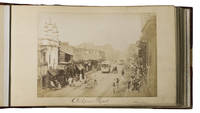
1874ABC_46925Calcutta 1874. Contemporary gold-tooled half red morocco brown cloth sides. Oblong 8vo. With 33 mounted sepia albumen prints ca. 15/15.5 x 10.5/11 cm all captioned. Manuscript title and captions of the pictures in English written in brown ink in a neat 19th-century cursive hand. Photograph album containing 33 albumen prints of buildings important places views and people in Calcutta in the 1870s. The album opens with some architectural photographs including the governor's house the new market the post office St. Paul's cathedral and the high court. Also included are views of roads and streets that are still important today such as Benting Street Chilpore Road Russell Street and Strand Road and 5 albumen prints of the B.Y. Docks. The album also contains views near Kalighat and Barnatore especially of the landscape but also of a Hindu temple. The album concludes with some photographs of people living in Calcutta showing beggars carpenters palki bearers a barber ending the album with a group of Rohillas.The album includes a photograph of the statue of Sir James Outram unveiled in Calcutta on 22 May 1874 an all photographs seem likely to have been made soon after that.Binding a little worn and scuffed endpapers a little dust-soiled some leaves marginally slightly dust-soiled some leaves slightly browned some occasional foxing paper of the last photograph slightly damaged not affecting the image some images a little faded but overall in good condition. A highly interesting album showing life in Calcutta in the 1870s.l For dating the statue of Sir James Outram: Catalogue of the sculpture of J.H. Foley in: Dublin Historical Record 32 3 1979 pp. 108-116. hardcover
1933ABC_45905Cambridge Mumbai New Delhi: Scott & Wilkinson Clifton & Co Hamilton Studios and Kinsey Bros. 1933. Oblong half morocco photograph album by W. Johnson & sons London. With 105 photographs mounted in the album ranging from 16 x 28 cm to 4 x 6 cm 2 photographs loosely inserted and a watercolour mounted at the back 11.5 x 21 cm. Unique photograph album showcasing the vigorous "fox" hunting scene in British India in the early 1930s particularly around Delhi. Most of the photographs show members of the British upper class in India often mounted on horses or posing for a group photograph and accompanied by hounds. The album contains no titles captions or inscriptions and the photographs do not seem to figure recurring individuals which suggests that it was probably compiled to commemorate the hunting and or riding club and its activities in the early 1930s. Numerous photographs show groups of mostly men posing with hounds at lunches and possibly a hunt ball or mounted on horses at jumping events and even a few cup trophies. The very first photograph is by Scott & Wilkinson in Cambridge active before 1933 and was therefore probably taken in England. The other inscribed photographs are by Clifton & Co. and Hamilton Studios from Bombay and Kinsey Bros. which started in New Delhi in 1935.British life in India mirrored life in native Britain and included popular equestrian activities such as hunting. Starting in the second half of the 19th century foxhounds were imported from Britain and subsequently bred in India. Regiments and brigades kept their own packs but at the beginning of the 20th century these had morphed into local hunts. Hounds were kept at over 12 hunting clubs which included Delhi Meerut Narbuda Vale Jaora Poona Bombay Bangalore Ooty Madras Lahore Quetta Peshawar and Karachi. Although the Indian silver fox was sometimes hunted the most common prey was the golden jackal.A different type of hunting popular in India was pig sticking: the chase of a wild boar on horseback with the spear. Several photographs in the album show pig sticking parties either posing or in action and sometimes accompanied by spectators on elephants. In contrast to the jackal-hunt parties the pigstick groups are composed of more military looking men and also include Indian men as opposed to the British-only hound groups.Most photographs show the area around Delhi and include a hunt near Shah Alam's Tomb. A photograph of this event is loosely inserted in the album and dated 1933/34 on the back. Other photographs show the Rashtrapati Bhavan one group shows the Earl later Marquess of Willingdon India's Governor-General from 1931 to 1936. Two images show the monumental Gateway of India completed in 1924 in Bombay Mumbai which can also be seen in an aerial photograph. Several photographs show what is probably the airfield at Karachi as it shows two airplanes loading mail on apparently the first voyage of the Indian Transcontinental Airways. Imperial Airways liner "Hanno" departing from Croydon had left for Karachi on 1 July 1933 via Bahrain and Sharjah. In Karachi the cargo was transferred to the Transcontinental airliner "Arethusa" as can be seen on the photographs.It is unclear why only half of the album was used. It is possible the compiler transferred to Kut in British Mesopotamia Kut al-Imara in modern Iraq. A watercolour on the final page of the album is captioned "A river bank north of Kut".Binding slightly rubbed and worn at the edges. Album leaves foxed throughout but most of the photographs in very good condition. The paper of the large photograph of the group near Shah Alam's Tomb is heavily damaged at the top and left side but the image itself is undamaged. A unique collection of British-Indian hunting photographs in very good condition.l Cf. Hamid "Riding with the Peshawar Vale hunt" thefridaytimes.com; Hunt "Delhi" in: Ten cities that made an empire; "1933 Eastwards: Karachi to Calcutta" indianairmails.com; Lucas Hunt and working terriers pp. 116-120; Mitter et al. The artful pose. Scott & Wilkinson, Clifton & Co, Hamilton Studios and Kinsey Bros., unknown
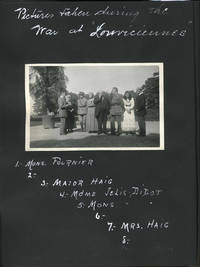
1915231261915. Very good condition. A photograph album memorializing two trips made by an English woman Mrs. K. Haig throughout Europe then to India to visit her son Major W. de W. Haig a British officer and his wife. It concludes with "Pictures taken during the War at 'Louviciennes'" including an image of the Chateau des Voisins now the BNP Paribas campus. <br /> <br /> The first half of the album begins in 1909 with the departure of the ship "Yale" based in Bath with an American flag to the European continent. Another ship listed is possibly the "Bleucher". Places visited include Berlin Potsdam Sans Souci Dresden the Royal Gardens at Nieder-Siedlitz Munich Lucerne Pilatus Berne Murren Zermatt Geneva Lyons Avignon Arles Nimes Montpelier Tours Chenenceaux Chateau de Lude Aise le Rideau Villandry Fontainebleau St. Cloud Chantilly & Versailles. <br /> <br /> The second half of the album is entitled " 'India' From Pictures By Major W. de W. Haig". These include Kashmir Naini Tal Muktesar Srinagar Dehra Dun and the Khyber Pass. Major Haig took some lovely and at times atmospheric images of the people of India including a papier mache worker women grinding corn men sewing with a sewing machine on the curbside; candy shop in the bazaar Mrs. K. Haig "travelling in a 'Dandy' on men's heads" on the way to Muktesar wood gatherers a pair of men using a long bowed saw Indians in small boats at the shore of a lake surrounded by mountains. There are also extensive images of their bungalow at Lucknow and "Beaucaire" the home of Major and Mrs. Haig 31 Rajpur Rd Dehra Dun. looking very grand residences!. The sign at the Khyber Pass taken with their automobile states "It is absolutely forbidden to cross this border into Afghan Territory."<br /> <br /> The last 4 pages are photographs taken at Louviciennes outside of Paris the first a group of 8 with 5 identified as Mons. Fournier Major Haig and his wife Mdme & Mons. Gelis-Didot. Gelis-Didot may be Pierre Gelis-Didot author of "Hotels et Maisons de Paris/ Facadea et Details" published in 1893. He was celebrated for his architectural drawings. There is a picture of the "Chateau des Voisins" now the BNP Paribas campus. and then a series of images of tea at the Fornier's where the visitors pose with a massive bomb shell presumably to emphasize the fire power of the French. They appear content with little recognition of the pain and suffering soon to be rained down on them all. <br /> <br /> Albumen and silver gelatin prints 112 images of Europe generally 3 3/4" square and 4 1/2 x 3 1/2". 54 images of India varying from 4 5/8 x 3 1/2" to 6 x 8 5/8" with most 4 1/2 x 6". 14 images of Louviciennes 11 quite small 2 x 2 1/2" the 1/4 x 3 1/2". Captioned below and sometimes within the margin of images. Album 8 1/4 x 10 1/4" black original cloth gilt "Photographs" on the front board spine slightly faded. 50 leaves photographs on both sides of the pages. unknown
8986Lausanne, La guilde du Livre, Editions Clairefontaine, 1958, 1 vol. in-4 (280 x 220) cartonné, sous jaquette illustrée, de 134 pp. Légers frottements aux coins de la jaquette, très bel exemplaire par ailleurs.
19155787Punjab, 1915. 1915 7 vol. de format in-8° et in-12° (130 x 185 mm à 175 x 270) garnis de 348 tirages albuminés de divers format (de 55 x 35 mm à 145 x 100 mm) : I. 87 photos et [8] ff. in-folio de légende manuscrites à lencre bleue, II. 46 photos. 3 31 photos ; IV. 32 photos, V. 32 photos, VI. 69 photos et [5] ff. in-folio de légendes manuscrites à lencre bleue, VII. 51 photos et [3] ff. in-folio de légende manuscrites à lencre bleue. Les photos des albums I-II-V-VI et VII sont légendées en anglais. (quelques photos manquantes). 3 albums recouverts de toile grise et bordeaux et 4 albums recouverts de papier gris imprimé sur le premier plat " The public schools. Drawing book. Reeves abd Sons, LTD., London". (défauts d'usages et petits manques).
GF20577Gravure originale à l'eau forte et aquatinte - format 13,5 x 13,5 cm sur une feuille de 29,5 x 21 cm - Vers 1820 - bon état malgré quelques petites piqures marginales sans gravité -
200905834Paris, Renaissance du livre , 1933 ; in-8, 489 pp., percaline ou toile verte pièces de titre de basane rouge . Percaline ou toile verte pièces de titre de basane rouge.
First edition, 100,20,70pp., repair to closed tear to inner margin of title-page, title a little soiled, disbound.
In-8 carre de 145 pp.; illustrations n&b, broche, couverture illustree. En très bon etat. [NV-11]
grand in-8°, 247 pp., broché. Bel exemplaire. [NV-20]
200510720Frankfurt, Rütten & Loening, 1919 ; in-8, 258 pp., cartonnage de l'éditeur . Coiffe et coins abîmés.
2009LFA-126716685N° 24 - Janvier-Février 2009 : une revue de 82 pages, format 215 x 285 mm, illustrée, brochée couverture couleurs, bon état
1985845711985 Paris, Autrement, 1985, grand in 8° broché, 228 pages ; illustrations in et hors-texte ; couverture illustrée.
1966LFA-126742141Revue de 52 pages, format 210 x 270 mm, illustrée, brochée, Association des Français Libres, bon état
201008670Paris, Revue des deux mondes, 2001 ; in-8, 192 pp., broché, couverture illustr. Revue des deux mondes septembre octobre 2001 - très bon état.
2005LFA01974Décembre 2005 - format 235 x 145 mm
1982845411982 Europe, 1982, in 8° broché, 248 pages ; couverture illustrée