113 résultats
86443Havana: El Siglo XX. First Edition. hardcover. very good. 9 volumes in one. Very thick 4to 1/2 polished green calf stiff original printed wrappers bound in. Habana: El Siglo XX 1924-1932. Very good .<br/><br/> DIHIGO Y MESTRE Juan Miguel et al.<br/><br/> El Siglo XX unknown books
18491647030th Cong. 2nd Sess. SED33. Washington 1849. 33 pp. Disbound scattered foxing. Good. unknown books
18511368131st Cong. 2d Sess.: SED41. 1851. 90pp Disbound light soil. Very Good. SED41. unknown books
1397523pp disbound and stapled. One small margin tear no text affected. Lightly tanned. Good. unknown books
18701438441st Cong. 2d Sess.: SED99. 1870. 5pp Disbound Very Good. SED99. unknown books
18701700741st Cong. 2d Sess.: SED113. 1870. 24pp disbound. Very Good. SED113. unknown books
1980211912Havana: Editorial Orbe 1980. hardcover. very good-. Many Illus. some in color. Square 8vo pictorial cloth rubbed. La Habana: Editorial Orbe 1980.<br/><br/> Profiles of Cuban culture for the year 1978. Text in Spanish.<br/><br/> Editorial Orbe unknown books
18981745655th Cong. 2d Sess.: HD326. 1898. 43 1 blank pp disbound loosening. Very Good. HD326. unknown books
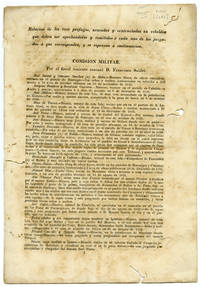
1832WRCAM51901Havana 1832. 18pp. Folio. Loose leaves. Heavy worming mostly marginal but somewhat affecting text in places. Light dampstaining and foxing. Good. An extensive list of fugitives from Cuban courts that covers the period from 1822 to 1832. Each section comprises a catalogue of men tried before a specific court and individual entries provide names brief descriptions mostly of skin color birthplaces likely places of residence and crimes committed together with the sentences handed down. Many men are condemned to the gallows or are facing long sentences in African or other overseas prison camps. This list was also printed as a part of the Oct. 9 1832 issue of DIARIO DE LA HABANA but a separate printing as in the present example is not found in OCLC or the relevant bibliographies. unknown books
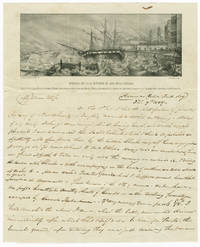
1847WRCAM56260Havana Cuba and onboard ship to New Orleans 1847. 11pp. in black or blue ink on two different Cuban pictorial letter sheets plus a folded sheet of plain paper the latter also used as the enclosure for the entire letter addressed on verso of last page of enclosure. Minor soiling old folds with a few short fold separations and a longer separation in last folded sheet. Last sheet with small abrasion from removed wax seal most of which remains. Overall good plus condition. A lengthy and interesting letter from a Pennsylvania businessman named M.L. Dawson to his "dear wife" back in Philadelphia written over the course of a few weeks during his time in Havana and onboard a ship traveling from Cuba to New Orleans in the spring of 1847. Being written over the course of several entries the letter also acts as a kind of brief diary of Dawson's time in Cuba and the Gulf of Mexico and contains much information on the people and places he saw in and around Havana and much on the ship's activities on the way to Louisiana. Two- thirds of the letter is written on two separate Cuban letter sheets that are themselves rare and desirable printed ephemeral items from mid-19th century Cuba. <br> <br> The eleven-page letter covers Dawson's stay in Havana and his voyage to New Orleans. He writes that he had previously arrived in Havana from Philadelphia. His letter begins on March 7 and Dawson details trips on horseback to the Cuban countryside which he finds beautiful. He comments on odd Cuban funerary practices Cuban agricultural products seeing the home where Santa Anna spent his exile and gives firsthand observations on the effects of slavery. He witnesses a scene in Havana where slaves are chained and forced to make repairs while being overseen by men with whips and muskets. Dawson comments that despite the beauty of the countryside "the evidence of Slavery is every where apparent." Also apparent are "the ravages of the awful storm of the 10th month last" a reference to the devastating October 11 1846 hurricane the effect of which is depicted in each of the letter sheets here. Dawson also reports on being invited to breakfast by a Cuban nobleman but was so taken aback by the food and the experience that he vows never to repeat the experience. <br> <br> After departing Havana for New Orleans on May 9 on the Brig P. Soule Dawson reports on various shipboard activities a disagreeable cursing captain slow progress boredom and seasickness. He comments on claret as the typical drink for breakfast. The letter ends on April 1 when Dawson's ship anchors in New Orleans Road. He closes with a promise to write again soon after he lands in New Orleans and sends kisses and love to his children and relatives. <br> <br> The Cuban letter sheets Dawson employs for more than two-thirds of his letter are interesting and attractive printed items in their own right. The first titled HURACAN DEL 11 DE OCTUBRE DE 1846 EN LA HABANA shows a lithographed scene of various ships in an angry sea being tossed against a breakwater in Havana harbor during the October 11 1846 hurricane. One passenger is being rescued with a breeches buoy while other ships flounder in the distance. The second letter sheet is titled TEATRO PRINCIPAL DE LA HABANA. The scene at the head of this sheet shows further destruction of the October 11 hurricane centered on the damaged ruins of the Teatro Principal Main Theater near the harbor. Two men in top hats survey the damage while an African-American man stands at left center holding long boards. Havana harbor is visible in the background showing two paddlewheel steamers and other ships damaged or sunken in the harbor. <br> <br> Mordecai L. Dawson was the proprietor of M.L. Dawson & Co. a brewery in Philadelphia. Here Dawson addresses the letter to his company noting the letter is specifically intended "for E Dawson" his wife. The Dawson brewery opened in 1820 at 79 Chestnut Street then moved to the corner of 10th and Filbert Streets in 1830 after the company purchased the old Farmers' Brewery in 1829. Dawson apparently closed his brewery in 1849 not long after penning this letter home. Though he does not state it explicitly in his letter Dawson may have been traveling to Cuba to establish an import business. Philadelphia was a pipeline for numerous imports into Cuba in the mid-19th century including beer. <br> <br> An interesting record of one man's sojourn to Cuba in the 1840s with notable observations on slavery and the Cuban situation in the wake of the October 11 1846 hurricane written mostly on two attractive and rare Cuban letter sheets that also memorialize the hurricane. hardcover books
1998199828Havana: n.pub 1998. Pamphlet. 28p. wraps pen note on front wrap and minor rippling very faint from damp on rear wrap else very good condition 5.25x8 inches. Text in English with no indication of location or publisher. Pro-PCC. n.pub unknown books
1998200647Havana: n.pub 1998. Pamphlet. 28p. wraps very good condition 5.25x8 inches. Text in English with no indication of location or publisher. Pro-PCC. n.pub unknown books
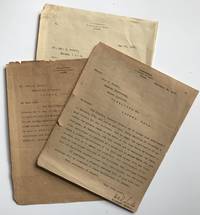
1900542Havana 1900. Good. Three typescript letters 4pp. total. Previously folded light chipping at edges. Evenly tanned. An interesting series of three letters from the Adjutant General W.V. Richards at U.S. Army Headquarters in Havana after the end of the Spanish-American War during the period of American military government. On February 28 1900 the military governor herein authorized the purchase of a book collection owned by heirs of a Don José Maria de Cardenas y Rodriguez from the town of Guanabacoa for the formation of a library at the university in Havana "at a price not to exceed $4000." In the second letter dated April 17 the collection seems to have been sold out from under them at a much lower price which has left the governor wondering why the university could not acquire the books with the allotted funds. In the third letter dated May 23 the collection seems to be for sale again by a third party and the governor again states that he is willing to purchase the collection for the previously stated sum "However to warn you that there has been so much said about the purchase of this Library for the Institute that there is danger that some of the books may have been extracted or that the property is not as valuable as when it was inspected." A neat record of a book deal gone sideways in 1900 Havana. unknown books
188893403Madrid: Manuel Hernandez 1888. First Edition. pamphlet. 27 pages. 8vo original printed wrappers. Madrid: Manuel Hernandez 1888.<br/><br/> Manuel Hernandez unknown books
86083hardcover. 202pp. 8vo modern cloth; orig. wrs. bound in unopened. Madrid: Aurelio Alaria 1881. First Edn.<br/><br/> unknown books
196626557Havana: Ministeres des Affaires Etrangers 1966. First edition. Paperback. Near Fine. Stapled illustrated wrappers. 33 pp. Text in French. Not dates but from 1966. Includes some grainy black and white photographs. A close to fine copy. Author not stated but from other sources we know that Carlos Rafael Rodriguez was involved. Ministeres des Affaires Etrangers paperback books
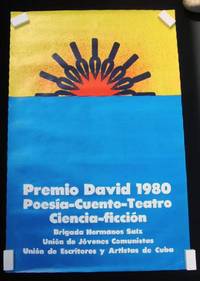
198024677Cuba: Union de Escritores y Artistas de Cuba UNEAC 1980. Poster in colors text in Spanish. Approx. 17 3/4" x 26 3/4" size; in very good condition. Poster. Not Bound. Very Good. Union de Escritores y Artistas de Cuba UNEAC Paperback books
198024691Cuba: Union de Escritores y Artistas de Cuba UNEAC 1980. Poster in colors text in Spanish; Approx. 18 1/2" x 28" size some edge-crinkling roll-creases; in very good condition. Poster. Not Bound. Very Good. Union de Escritores y Artistas de Cuba UNEAC Paperback books
197724689Cuba: Union de Escritores y Artistas de Cuba UNEAC 1977. Poster in colors text in Spanish. Also printed at bottom edge: C.P. "Evelio Rodriguez Curbelo"/Taller experimental. Approx. 20" x 30" size; in very good condition. Poster. Not Bound. Very Good. Union de Escritores y Artistas de Cuba UNEAC Paperback books
198024687Cuba: Union de Escritores y Artistas de Cuba UNEAC 1980. Poster in colors text in Spanish. Approx. 20" x 30" size; crease in lower left corner; little edge-crinkling; in very good condition. Poster. Not Bound. Very Good. Union de Escritores y Artistas de Cuba UNEAC Paperback books
197724690Cuba: Union de Escritores y Artistas de Cuba UNEAC 1977. Poster in colors text in Spanish; Approx. 20" x 29" size horizontal format; some edge-crinkling; in very good condition. Poster. Not Bound. Very Good. Union de Escritores y Artistas de Cuba UNEAC Paperback books
197724673Cuba: Instituto Cubano del Arte y la Industria Cinematográficos ICAIC 1977. Poster in colors for La Ultima Cena The Last Supper 1976 Tomas Gutierrez Alea film. A77 printed in bottom left corner;. Approx. 20" x 30" size; strongly-printed screened image of candelabra color bleed-through on reverse; some edge-creasing and edge-wear; in very good condition. Poster. Not Bound. Very Good. Instituto Cubano del Arte y la Industria Cinematográficos (ICAIC) Paperback books
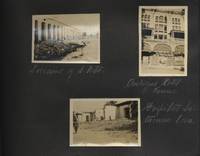
193250120Santiago de Cuba 1932. A unique album of 19 leaves of heavy black stock 7 x 5 1/2 inches with 67 mounted b&w silver photographs of varying sizes 1 3/4 x 2 1/2 inches - 3 1/2 x 5 7/8 inches all captioned in white ink. The album is titled and decorated in gilt on the upper cover "PHOTOGRAPHS: SOUVENIR OF SANTIAGO CUBA and tied with a cloth lace. Very good. An earthquake of 6.7 magnitude struck the city of Santiago de Cuba at dawn on 3 February 1932. Over half the buildings were destroyed or damaged and reports of the deaths range to 1500. These photographs show the destruction to the commercial and residential buildings and the Cathedral and the tents set up as temporary shelters. A few of the photographs were made by local commercial photographers just after the quake and the remainder within days. All captions in Spanish. <br/><br/> hardcover books
38527Washington: Government Printing Office n. d. 1st edition presumed. ca. 1901. Black leather boards gilt stamped lettering to spine. Boards stamped in blind. Glossy marbled endpapers. All boards and spines rubbed chipped and soiled. Vol IX missing boards and spine Vol XI & I boards and spine detached from textblock Vol II boards & spine detaching. Spines and hinges loose. A few leaves and 2 unfolding maps detached soiled or chipped library "Property of Michigan Commandery Loyal Legion" blue stamping throughout volumes. A Good set. Individual volumes divers paginations within each volume. Many inserted plates of b/w images fold-out maps and charts / tables & portraits housed within all volumes. 9-5/8" x 7" <br/><br/>OCLC records 7 institutional holdings of this set. Contents as stated in front pages of Vol. I: Vol I: Personal Report of General Wood Report of Lieutenant McCoy Aide-de-Camp Financial Exhibits accompanying same. Vol II: Civil Orders and Circulars issued during 1900. Vol III: Report of the Secretary of State and Government Reports of the various Civil Governors. Vol IV: Report of the Chief Sanitary Officer Report of the Chief Surgeon of the Department Report ofthe Superintendent Department of Charities. Vol V: Report of the Secretary of Finance Report of the Treasurer of Cuba Report of the Auditor for Cuba Report of the Chief of Customs Service Report of the Director General of Posts. Vol IX: Report of the Secretary of Public Works. Vol X: Report of the Secretary of Public Works continued Report of the Special Commissioner of Railroads Report of the Chief of the Light-House Board Report of the Captain of the Port Havana. Vol XI: Report of the Chief Engineer for the Fiscal Year ending June 30 1900. Vol XII: Report of the Chief Engineer for the six months ending Dec. 31 1900. Wood born on October 9 1860 in Winchester New Hampshire graduated Harvard Medical School in 1884. After working in private practice in Boston for two years he secured a job as army assistant surgeon with the rank of first lieutenant in January 1886. Routine successes and close relationships with political giants Wood formed a close friendship with Theodore Roosevelt and helped Roosevelt organize the 1st Volunteer Calvary Regiment for service in the Spanish-American War in May 1898 allowed for a quick advancement in his military service which eventually aroused some controversy. "Promoted to brigadier general and in December of that year he was promoted again to major general of volunteers and named military governor of Cuba. During his term in that post great strides were taken in improving internal conditions notably through the sanitation work of Maj. William C. Gorgas. Modern school police transportation and communications systems were established and a new constitution and body of laws were drawn up." Webster's American Military Biographies p. 488. In May of 1902 Wood stepped down from his executive position in order for the popularly elected President Tomas Estrada Palma to take over. "Aggressive ambitious and self-righteous Wood was not an easy man to work with; his change from medical doctor to fighting soldier and his rise from captain to brigadier general in the space of five years 1898-1903 aroused considerable distrust and hostility in and out of the army. his single-inded advocacy of the Plattsburgh Idea later to resurface as the ROTC contributed greatly to US readiness in World War I; unquestionably one of the greatest U.S. soldiers." -The Harper Encyclopedia of Military Biography p.807. (Government Printing Office) hardcover books
1999200122Havana: Palcogra/Artes Graficas 1999. Pamphlet. 17p. softbound pamphlet in 7.5x5.5 inch stapled wraps; clean and sound a very good copy. Palcogra/Artes Graficas unknown books