113 résultats
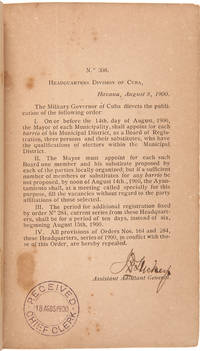
1900WRCAM51843Havana 1900. Approximately 520; 600pp. including several folding charts. Over 200 separate imprints. Original half leather and brown cloth boards spine gilt. Corners and edges worn spine rubbed boards scuffed. Initial leaves of first volume torn away but present. Several other leaves chipped and torn throughout. With many official signatures and docketing stamps. Good. Two volumes of orders promulgated in 1889 and 1900 by the American military government of Cuba after the cessation of hostilities in the Spanish-American War. Under the terms of the Teller Amendment to the Congressional Joint Resolution for war with Spain in 1898 the United States denied the intention of using the conflict as a pretext for the annexation of Cuba and promised to leave the island following the termination of the war. The American military therefore oversaw the creation of the new independent Cuban government before departing in 1902. The documents contained in this collection consist of over two hundred orders in both English and Spanish from the Headquarters Division of Cuba that helped to shape the emerging civilian government. They include instructions for the running of elections the organization of the courts and school system the appointments for various government offices provisions for tax regulations and many other critical issues facing Cuba at its independence. The directives cover two periods from January to July in 1899 and from July to September in 1901. Many of the orders are signed in manuscript by the assistants to the military governor for the island Gen. Leonard Wood including assistant adjutant generals J.B. Hickey and L.W.V. Kennon and Brig. Gen. Chief of Staff Adna R. Chaffee. An interesting documentation of the first American occupation of Cuba. hardcover books
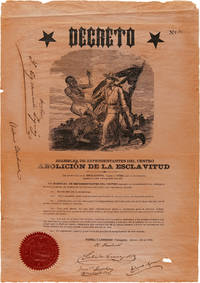
1869WRCAM56566Camagüey Cuba 1869. Pictorial letterpress broadside 18 1/2 x 13 inches. Numbered "54" in manuscript bearing the embossed red seal of the Republica Cubana and signed in ink by Salvador Cisneros y Betancourt Eduardo Agramonte Ignacio Agramonte Loyn áz Francisco Sánchez y Betancourt and Antonio Zambrana. Old horizontal folds minor creasing handful of small edge chips. Small hole in bottom margin just touching one ink signature. Very good condition. A rare and significant pictorial Cuban decree from the provisional rebel government abolishing slavery on the part of the island they controlled issued by the radical faction of the Cuban nationalists fighting against Spanish rule in the first months of the Ten Years' War. <br> <br> This proclamation is illustrated with a dramatic woodcut signed "LFR" depicting an ill-clad but exultant freed slave and a rebel celebrating in front of the Cuban flag. This decree stipulated freedom for all the enslaved people of Cuba in hopes that they would join the revolutionary struggle. The decree also provided for eventual compensation to slaveholders and ordered that freed individuals must serve the revolution either through military service or by continuing with their previous work. Among the important leaders who signed the present document were Salvador Cisneros y Betancourt as president just below the printed text and Ignacio Agramonte y Loynáz as secretary to the left of the engraving. <br> <br> The practical effect of this decree was modest as the rebels only controlled limited territory before their ultimate defeat and their territory was generally under the control of more conservative military commanders but such a proclamation joined a growing chorus of abolitionist sentiment in Cuba which finally realized the end of slavery in 1886. A powerful statement of anti-slavery policy in mid-19th century Cuba with a striking illustration of a jubilant slave celebrating his short-lived freedom. Rare with no copies recorded in OCLC. unknown books
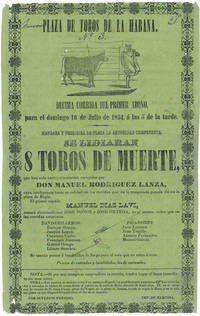
1854WRCAM46994Havana 1854. Broadside 12 1/2 x 8 inches. Printed on green paper. Old fold lines. Light wear and soiling minor separation at some folds. A few contemporary notations. Very good. Cuban broadside advertising a bullfight featuring matador Don Manuel Rodriguez Lanza and the "8 toros de muerte." The top of the sheet features a woodcut of a matador holding his cape out to a bull. The first swordsman for the fight is Manuel Diaz Lavi with two alternates listed. The names of the Banderilleros and Picadores for the fight are also noted. Bullfighting was a popular entertainment in Cuba during the Spanish colonial period though it was done away with after Cuban independence at the beginning of the 20th century. unknown books
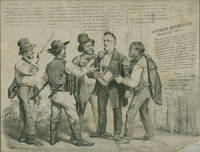
1856WRCAM53452New York: Nathaniel Currier 1856. Broadside 10 x 13 inches. Foxed bottom right corner chipped. Lower margin trimmed costing the title. Good only. Framed under glass. A scarce political cartoon regarding the controversial Ostend Manifesto the initially- secret attempt by the United States to purchase Spanish-controlled Cuba. Earlier President Franklin Pierce had instructed Pierre Soulé upon his appointment as minister to Spain in April 1853 to negotiate to buy Cuba. Three American foreign ministers serving in Europe - James Buchanan John Y. Mason and Soulé - met secretly at Ostend Belgium in late 1854 to draft a plan to either buy Cuba from Spain or force Spain to give up Cuba by inciting a Cuban revolution. The plan met with overwhelming opposition once it was made public in America. <br> <br> In the present political cartoon Buchanan is attacked for his role in the Ostend controversy. He is surrounded by four armed ruffians seeking to rob him of his coat hat watch and money a particularly sharp turn- about on the American minister to Great Britain. The muggers' demands include quotations from the manifesto which is pasted to the fence at right. Buchanan calls out: "Why! Why! This is rank robbery! Help! Help! All honest men!" <br> <br> The fallout from the Ostend controversy was widespread. President Pierce's Democratic Party split asunder after he refused to continue any discussions of the plan or any other expansionist ideas; Soulé understandably resigned; and the international community saw it as a threat to Spanish sovereignty in the region. Oddly enough James Buchanan was not too hurt by the controversy; he was easily elected president in 1856 and still harbored hope for Cuban annexation. He was smart enough however to table the Cuba question for the foreseeable future after meeting with both popular opposition and increasingly bitter sectional conflict the latter only spurred on by incidents such as the Ostend controversy. CURRIER & IVES: CATALOGUE RAISONNÉ 5021. NEVINS & WEITENKAMPF p.72-73. Nathaniel Currier unknown books
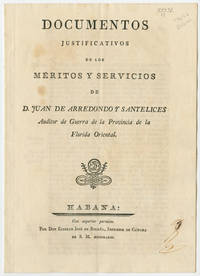
1815WRCAM49642Havana: Esteban José de Boloña 1815. 19pp. Gathered signatures stitched. Stitching mostly perished. Light fold lines minimal foxing ink marginal notations contemporary ink inscription after the text. Very good. An early Cuban imprint printed by Esteban José de Boloña the first printer in Cuba after the 1776 ban on printing. Juan de Arrondo y Santilices was an official in Spanish Florida the Auditor of War of East Florida during the early 19th century. This is a work detailing the deeds of Arrondo y Santilices likely an attempt to secure a pension. Rare with one copy located by OCLC at the John Carter Brown Library. Esteban José de Boloña unknown books
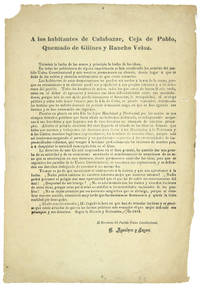
1878WRCAM38237Cuba 1878. Broadside 12 1/2 x 8 3/4 inches. Chip at upper left corner not affecting text. Small tears in all edges several repaired by tape on verso. Good. A rare and fascinating Cuban political broadside calling for an end to armed struggle but a beginning to a "struggle for ideas" at the conclusion of Cuba's "Ten Years' War" the battle for independence from Spain in 1868 to 1878. The broadside is addressed to the residents of the region around the north-central coast of Cuba some 150 miles east of Havana. The text of the broadside is signed in print by Gabriel Aguilera y Zayas Secretary of the Partido Union Constitucional PUC one of the two main political parties that developed out of the Ten Years' War. The PUC which was a conservative pro-Spanish party led by prominent Creoles sought a measure of local political autonomy while favoring continued Spanish control over Cuba. The text exhorts Cubans to partake in the ideological struggle that would succeed the armed rebellion and urges them not to fall into lethargy but to continue the battle of ideas against radicals seeking independence from Spanish colonial rule. <br> <br> Due to their ephemeral nature as well as the climate of the Caribbean any such Cuban broadsides are scarce. No copies of this broadside are located in OCLC. Important evidence of the political factionalism and the strength of pro-Spanish sentiment in Cuba in the late 19th century. Rare and possibly unique. unknown books
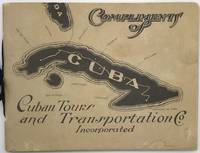
19281489Havana 1928. Very good. 60pp. Oblong 12mo. Original printed pictorial wrappers stapled and tied with ribbon. Minor wear and soiling contemporary ink stamp on rear cover. Internally clean. A handsome promotional booklet for the island of Cuba provided by the Cuban Tours and Transportation Company and extensively illustrated. After the opening leaf of text each page features a full-page photographic half-tone illustration with caption highlighting tourism spots and attractions on the island. These include an aerial view of the capitol which includes a biplane flying at camera-level; the Malecon driveway; a view of Paseo de Marti; San Francisco Machina and the Santa Clara wharves; countryside scenes depicting sugar production and agriculture; a view of the jockey club and grand stands at Oriental Park; street scenes and more. Leading hotels in Havana are shown on the last few leaves. A wonderful illustrated souvenir guide. No copies located in OCLC. unknown books
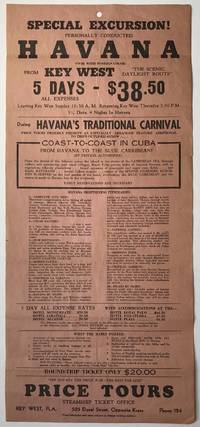
1935848Key West 1935. Very good. Broadside 18 x 8 inches. Printed on pink paper slightly faded. Old folds minor wear. Broadside advertising a steamship cruise offered by Price Tours from Key West to Havana during Carnival with additional sightseeing itineraries available once on the island. The cruise is a five-day all expenses included trip for the reasonable price of $38.50 with four nights in Havana and the option to add a driving tour across the island seeing Cuba from coast to coast. Other potential tours include a cigar factory a rum distillery Morro Castle a shopping tour and more. No copies recorded in OCLC. unknown books
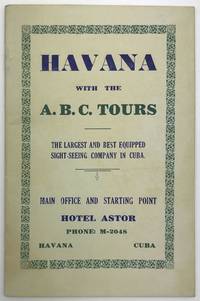
19301471Havana 1930. Very good. 271pp. Printed self wrappers stapled. Light toning and dust soiling. Attractive and detailed promotional for tours of Havana and day trips through Cuba led by ABC Tours from the Hotel Astor. Programs include a tour of Tropical brewery and gardens and an evening experience of the "Slums Chinatown and Grand Casino." With numerous ads for Havana businesses and entertainments and much "useful information" such as telegraph rates and customs regulations on cigars. unknown books
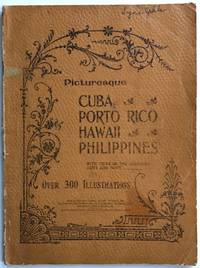
1898535Springfield Oh: Mast Crowell & Kirkpatrick 1898. Good. 121pp. Folio. Original orange printed wrappers. Light wear and soiling spine chipped with some glue repair. Ink ownership inscription at top of front cover. Minor internal soiling several leaves with tape repairs at edges. Extensively illustrated souvenir publication of the Spanish-American War. Images include local street scenes and landmarks photos of the native populations and the American military occupation. "Depicting the natives their costumes habitations and occupations; prominent buildings street scenes mountain and river scenery etc. Also life in the American Army and Navy with portraits of the chief actors in the Spanish-American War. Over three hundred illustrations. Mast, Crowell & Kirkpatrick unknown books
18732024Cuba 1873. About very good. 3 folio leaves. Light wear at edges a couple of small chips at lower left edge of each leaf. Light tanning and foxing. Accomplished in a neat legible script. Scarce manuscript listing of slaves and indentured servants from a Cuban sugar plantation. The present list was made in January 1873 on the Ingenio Tartesio east of Havana near the small village of Las Pozas. On two separate sheets nine Chinese and twenty-eight African or Criollo men are listed as rented to the farm; on a third sheet eighteen slave births for 1873 and 1874 are recorded giving names mothers and dates of birth. The Chinese men are identified simply by first name and owner; the African and other slaves are listed with additional details such as nationality age owner. A section for additional observations notes which slaves have run away and at least one death. A fascinating document of slave hires on an isolated Cuban plantation during the 1870s. unknown books
1865974Santiago de Cuba 1865. Very good. 10 leaves. Removed from a larger volume and restitched. Minor wear and one small area of worming at edges. Light tanning and foxing. Accomplished in several legible hands. A fantastic set of manuscript records for a slave auction house the General Slave Depository in Santiago de Cuba dating to January 1865. Santiago along with Havana and Cienfuegos was one of three major sites for slave sales on the island during the 19th century. The first leaf of the document provides a statement that the documents were assembled in accordance with the rules established for slave auctions which had been updated and approved at the end of the previous year. The second two documents lay out mortgage agreements and financial obligations between the slave house and the Real Sociedad Economica de Amigos de Pais of the city in which the auction owners acknowledge debts and forthcoming payments on the order of several thousand pesos. Following these are two leaves containing a "Relacion de los esclavos ecsistentes en el deposito de esta Ciudad en el dia de la fecha" that is a list of slaves at the depository on the day of the auction and their owners and renters which perhaps were a part of the collateral for securing the loan. A total of twenty-nine slaves are listed and the leaf that follows certifies that the list is correct according the to the director and the auctioneer of the depository. The final two leaves provide official recognition of the loan from two distinct government offices. All documents are signed by the relevant parties and government officials involved in the agreement. In all the present group of documents provides a detailed assessment of debts and human assets of the slave auction house in Santiago de Cuba in the mid-1860s and is a fascinating and valuable document of the bureaucracy and regulation surrounding the financial realities of selling slaves in Cuba during this period. unknown books
18772027Havana 1877. Very good. 1p. on a bifolium. Removed from a a bound volume with unobtrusive stabholes at gutter margin. Light wear at edges; light dust soiling and damp staining. Remarkable bidsheet submitted by a Cuban business in response to a newspaper advertisement for an auction of slaves for hire held in Havana during November 1877. The firm Jado Sarasúa y Compañia writes that "Enterada del anuncio publicado en la Gaceta fecha 9 del corriente para el arrendamineto en publica subasta de los esclavos existentes en el Asilo de San Jose pertenecientesa Bienes Embargados y sujentadose en un todo al pliego de Condiciones inserto en la misma Gaceta hace la siguente proposicion." Below is a list of fourteen slaves mostly women and the prices that the company is willing to offer for the slaves being rented ranging from ten to seventeen pesos per month. Signed and dated at the bottom "Habana Noviembre 14 de 1877. unknown books
18842025Matanzas 1884. Still very good. 3 leaves plus 4pp. pamphlet in original plain wrappers string tied. Light wear at edges. A few very small worm holes. Contemporary ink stamps. Light tanning and foxing. The Spanish Cortes approved a gradual manumission law in 1880 for slaves in Cuba that provided for an eight-year period of patronato tutelage for all slaves liberated according to the law which essentially amounted to indentured servitude. The transition to the patronato system was overseen by a provincial network of government agencies called Juntas de Patronato. Most of the workings of the slave system were preserved but patrocinados as former slaves came to be known received a minimal set of legal rights and were to be paid a token wage. <br/><br/>This fascinating set of Cuban manumission documents from the Junta de Patronato of Matanzas records this process and contains a rare cedula de patrocinado an identification booklet stating a slave is now a freedman with a supporting sponsor. The cedula completed in manuscript states that "Moreno Luis Morejon Natural de Africa.Vecino del Potrero Miraflores.Patrocinado de Da Josefa Morejon de Rodriguez" is "Gratis Sin Enmienda" as of September 15 1881. The second leaf of the pamphlet prints the rights of the freedman and the responsibilities of the sponsor such as the provision of food clothing and nominal salary. <br/><br/>The second document present here is a contemporaneous manuscript letter from Josefa Morejon de Rodriguez confirming that she will act as sponsor for the freedman and the final document dated January 28 1884 and signed by Rodriguez and the relevant local magistrates states that the sponsorship has been completed and is now legally concluded. With the ink stamp of the Matanzas Junta Provincial on first page and the contemporary stamps of several other relevant authorities. An outstanding record of the process of gradual manumission in Cuba during the last years of legal slavery on the island with a rare surviving freedman's identification book. unknown books
18562026Remedios 1856. About very good. 4pp. on a large bifolium. Printed form completed in manuscript. Separated at fold repaired with tissue. Light wear at edges. Light tanning and foxing. Rare Cuban population census form listing the number of residents in and around the town of Remedios located on the northern central coast of Cuba in 1856. The present document completed in manuscript lists the population according to various categories such as ethnicity and race age range occupations marital status location of residence and several others. The census includes slaves of African origin newly arrived Chinese indentured servants "colonos Asiaticos" immigrant laborers from Yucatan freedmen and free white residents "Blancos". In all there are just over 2000 people living in and around Remedios at this time comprising just over 1300 free whites over 300 free people of color 460 slaves and 19 Chinese laborers. One of the most interesting sections records the population by place of residence which shows that the great majority people in the area lived on estancias with a good part of the remaining population living on livestock farms and sugar plantations. On the final page are two additional sections which enumerate the types of property farms and other enterprises in the regions and provide statistics on agricultural and industrial production and land usage along with some manuscript notes with the signatures of the census takers or local magistrates. An interesting document of slavery agriculture and population in rural Cuba during the mid-19th century. unknown books
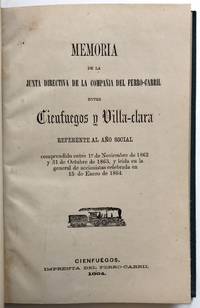
18641312Cienfuegos: Imprenta del Ferro-Carril 1864. About very good. 20pp. plus seven tables two folding. Original green cloth blind stamped and gilt lettered. Light wear at edges and spine ends; minor rubbing to boards. Manuscript letter laid in. Separation along fold and short closed tear at gutter of one plate. Light tanning. A rare annual report on the railroad that connected Cienfuegos to Santa Clara in the central portion of Cuba during the mid-1860s. The text gives details of the company's revenue and shipping totals passenger services work and improvements undertaken and levels of employment including discussion of indentured Chinese labor. The tables at the rear provide more complete statistics on the amount of products shipped number of passengers carried types of repairs carried out and the number of accidents and hospitalizations amongst employees and laborers. This copy was presented to a Señor Enrique Gatke likely a Havana investor in the company with his named lettered in gilt on the front board and with a letter from the company secretary Pedro Fernandez de Castro laid in. A scarce and detailed account of railroad operations in central Cuba during the mid-19th century. We locate only one example of any edition of these reports outside of the National Library of Cuba a copy of the 1862 report at the New York Public Library. Imprenta del Ferro-Carril unknown books
1894106465<p>1894. Pamphlet format 70 pp. Illustrations; map. 14.3x11.8 cm 5½x4½" pictorial wrappers. Some light staining and wear to wrappers spine a little worn very good overall. Rare tourists' guide book produced under the auspices of the Grand Hotel Macotte with much on Havana transportation options sights to see including bull fights prices a Spanish vocabulary etc. with numerous advertisements for Cuban and some Florida businesses and other hotels. One advertisement features cigar maker La Corona. They even include an illustration of Christopher Columbus. OCLC/WorldCat lists only one copy at the California State Library Sutro Branch. </p><p><br /></p> J. Carbonell and P. Montero, Proprietors. books
1864981Havana: Viuda de Barcina y Comp 1864. Good. Twenty-three issues each approximately 32pp. No. 11 with folding chart lacks pp.25-32. No. 13 lacking last few leaves. With title page and half title at start of each volume. Original quarter calf and boards spine gilt. Spine ends chipped and worn some crude glue residue; hinges solid. Boards heavily worn. Light toning and wear to text light scattered worming throughout. A rare run of the first two years of the first Cuban pharmacological magazine and one of the island's earliest medical periodicals. La Emulacion was published from 1863 through 1867 with the present sammelband containing all issues published in 1863 and 1864 a total of twenty-three issues. Their mission statement that heads the first issue here reads in part: "Animados del deseo de ser útiles al pais -- en cuanto nuestras fuerzas lo permitan-- hemos resuelto dar à luz en esta ciudad un periódico que ocupándose preferentemente de todo lo relativo à la Farmacia no descuide por eso la quÃmica é historia natural médicas y la toxicologÃa ciencias de que no pueden prescindir ni los Médicos ni los Farmacéuticos y cuya importancia en el dia pocos podrán desconocer. Procurarémos pues que en nuestro periódico hallen cabida las producciones originales de los que en Cuba cultivan la Farmacia la quÃmica é historia natural médicas y la toxicologÃa; mas no olvidarémos por eso que léjos de nuestro suelo existen los mas célebres y laboriosos de los cultivadores de esas ciencias y que La Emulacion no llenarÃa la mision que nos proponemos si no hiciéramos figurar en ella lo que se dé à luz en Europa y merezca la sancion de las personas ilustradas." The resulting publication contains numerous original articles by Cuban pharmacists doctors and scientists as well as important work published outside of Cuba. Additionally the issues include biographies of significant figures in the field accounts of local scientific societies including the Real Academica de Ciencias de la Habana and publication of new pharmacological formulas discovered in Cuba or "adapted for the needs of the country." As a result the periodical forms an important record of medical and pharmacological developments and thought on the island in the mid-19th century. We locate only one run of this pioneering periodical at the National Library of Cuba with only the present set of issues appearing in auction records. Bound between Volumes I and II is a pamphlet by Fernando Paez "Manual de farmacia practica" Havana 1864 possibly incomplete at 8 pages; no examples of this pamphlet appear in OCLC. Viuda de Barcina y Comp unknown books
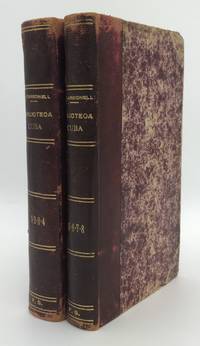
19161505Havana 1916. Good plus. Eight parts in two volumes. Original half calf and marbled boards spine gilt. Calf scuffed at spine ends; light wear to corners and edges; boards rubbed. Rear board with a dime-sized chip at lower fore-edge. Slightly later pencil ownership inscriptions to initial title pages of each volume. Small chip at fore-edge of first title page. Light tanning. The first eight issues of this scarce Cuban literary periodical which published twice monthly during 1916. The editor of the series Nestor Carbonell y Rivera grew up in the United States before returning to Cuba and obtaining his doctorate from the University of Havana; he was active in several prominent intellectual and literary society of Cuba and later served as ambassador to Argentina and Peru. Each issue of the periodical comprises one previously unpublished work by Cuban author including José Martà Manuel Sanguily and Máximo Gómez. We locate runs of the series at seven institutions as well as scattered holdings of individual issues. This set clearly bound by a contemporary Cuban subscriber one F. Gamboa. unknown books
18841574Habana 1884. Good plus. 2496 i.e. 498pp. Quarto. Contemporary calf gilt a.e.g.; rebacked with original spine laid down. Corners repaired with later black buckram; boards scuffed spine chipped. Hinges cracked repaired with later cloth and renewed endpapers. Minor scattered foxing and toning to text. Accomplished in a neat highly legible hand. A very attractive manuscript translation into Spanish of Pierre Larousse's well-known work on eminent and historical personages Fleurs Historiques des Dames et des Gens du Monde in a contemporary Cuban gilt goatskin binding. The manuscript connects three figures in the upper social echelons of Cuban society. José Fernandez Pellon the scribe of this volume is recorded as the Grand Master of Cuba's freemasons lodge the Gran Logia Unida de Colón y la Isla de Cuba. The translator Aurelio Almeida helped to found the organization in 1875 and at this time served as the Lodge Secretary. The initials E.D. gilt at the foot of the spine and the dedicatory inscription "A Eugenia Desvernine" refer to Eugenia Desvernine y Galdós b. 1865 daughter of the famous Cuban pianist Pablo Desvernine and Carolina Galdós y Echániz. She was also the niece of Benito Pérez Galdós the Spanish realist novelist who some authorities consider only second in stature to Cervantes. A contemporary social register remarks that Eugenia was one of the most beautiful women in Cuba perhaps an inspiration for the painstaking production of this manuscript. The original work by Larousse was a loose collection of religious parables classical myths biographies of ancient and modern historical figures. The title of the manuscript advises that is an extract and in the brief introduction Almeida explains his selection process writing that "He suprimido algunos artÃculos sobre cosas muy sabidas de la historia sagrada; y otros sobre la de Francia que mencionan frases ó personas casi ninca citadas ó citades solamente por las escritores francesas." He also notes several alterations and additions more relevant to Spanish history saying "En Cambio he agregado algunos artÃculos sobre historia de España que no están en el original y he tomado unos pocos de otra obra del mismo Mr. Larousse y de libros diversos." The result is an original amalgam of biographies historical episodes and religious parables. Interestingly we find no recorded printed editions of Larousse's work in Spanish so that the present manuscript is also an entirely original work of translation. A fascinating product of the cultural interests and mores of Cuban high society near the end of the Spanish colonial period. unknown books
19301540Havana 1930. 63pp. Small quarto. Original green cloth front board lettered in silver. Cloth and pastedowns separating from boards. Boards lightly rubbed some wear to corners and spine. Scarce issue of the constitution and by-laws of the Havana Country Club printed in Spanish and English on facing pages published in 1930. The country club was established in 1911 after the purchase of a 127-acre property La Finca Lola just outside of the city proper and operated until it was forced to close by the Revolution. Information on the realty company formed to purchase the land and house rules of the club are also printed at the rear. We locate a single copy of a 1937 edition in OCLC. unknown books
1940442581940. Very good with some foxing soiling to the edges and some fading at the corners. 1 sheet. 9 1/4 inches by 50 inches. Mounted to card stock. Built in 1939 to resemble an old Spanish fortress and now part of a UNESCO World Heritage site the Police headquarters and the Radio Patrol had just been outfitted with the latest two-way FM radio system when this image was taken. This new communication technology only adopted by its first police department the Connecticut State Police that same year was invented by an American radio engineer Fred Link 1905-1998 who appears as the white clad figure at the center of this panorama of the fortress fronted by dozens of police cars and officers. Signed by six important Cuban officials including President Federico Laredo Brú 1875-1946 and police chief Bernardo Garcia who has warmly inscribed it Garcia would be ousted by Batista who became president in October less than a year later. Dated Havana 18 June 1940. The picture had hung in Link's office See Dan Bishop "Fred M. Link Goodwill Ambassador" in Proceedings of the Radio Club of America 72:3 Fall 1998 pages 8-13. Original frame available. unknown books
189144433Habana: Imprenta "La Razon" 1891. Paperback. Very Good. table 35p. Wrapper. 22cm. Slight vertical crease and slight wrinkling throughout. Cuban institutional stamp on title-page. Spanish text. Tariffs and taxes on Cuban export commodities mainly sugar and tobacco. <br/><br/> Imprenta "La Razon" paperback books
1905105099<p>Four postcards approximately 3 1/2" x 5 1/2" with stamps. Some writing on image side post marked some aging and browning edges slightly bumped; otherwise very good. This collection of four postcards from Cuba are postmarked stamped and written out. The authors are Anna and Nestor although in one card the author is less clear to a Miss K. Greve. Who lived in the upper West side of New York City. One card features Baby New Year for 1907 and has some color; the other three show La Catedral a promenade and what appears to me some kind of American monument. </p> books
1916100842Tall 8vo stiff paper stapled illustrated some in color 54 pp. Lacks wrappers and last page but the rest of the pamphlet including the double page map of Cuba is present a few small chips some minor aging and soiling. The 9 x 21 folding map of Cuba features its railroads. There are two attractive color photographs and seven full page black and white photographs illustrating the charms of Cuba. Smaller photos including one of a sleeping car are included in the text. A rail schedule some facts about Cuba and a few advertisements for hotels and cruise lines are also included. Cuba Railroad Company, books