CubaABAA
113 résultats
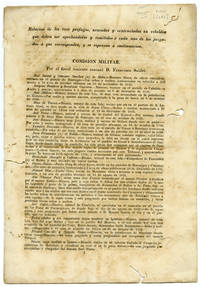
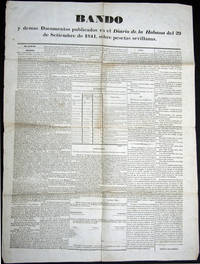
1841WRCAM15527Havana 1841. Broadside 23 x 16 1/2 inches. Splitting on middle fold else very good. A proclamation by the Spanish military government in Cuba concerning legal tender and its circulation and providing a series of regulations for commerce and exchange. unknown books
20189560San Francisco CA: Cuba 2018. Unique. Hardcover. Fine. Minor edge wear else tight bright and unmarred. Loosely bound sheets. 8vo. np. Illus. colored plates. Unique copy. Signed by the artist. <br/><br/>Acrylic paint marker drawings on paper. Artist' shop-book used to test/design work and color schemes. A unique books of acrylic paint marker drawings of graffiti murals most of which have been executed on walls throughout the San Francisco Bay area from 2009– 2012. <br />This is an amazingly beautiful example of urban art and valuable primary research materials for African American studies calligraphy type design urban studies art history and visual art. This an unusual work as he seldom does 'women' focused typically on more political issues. Here he blends women and politics with style and flare. Also unusually he includes a small self portrait. <br />Cuba is one of the grandfathers of the San Francisco Mission School supplying both the aesthetic styles and the radical leftist politics that formed what may be the only coherent new school of American art since the Punk/graf rock art scene of the 1980s. “It was a lot of punk rock shows and stuff like that. There was always graffiti in these places and I was just like "Who is this guy I keep on seeing this guy." There was this one guy Cuba he wrote "Cuba" and it was at all the same hardcore shows in the bathroom on the door and on the street. And then I was like "What who's doing this" It was different than my idea of what graffiti was before that.” - Barry McGee in PBS’s Art of this Century 2005 <br />"We want to flex our skills and make the community look better" says the 41-year-old painter known as Cuba who has been working on walls with and without permission for more than 25 years. "It's our own form of urban renewal." -San Francisco Chronicle Monday March 7 2005 Cuba hardcover books
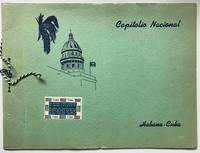
1930537Havana: Imp. "Ninon 1930. 24pp. Oblong quarto. Original green pictorial wrappers string-tied. Cuban Revolution stamp affixed to front cover. Pictorial souvenir of the Capitol Building in Havana which was inaugurated May 20 1929. Each image has bilingual descriptive text in English and Spanish on the verso. Images include the exterior of the building as well as specific locations within such as the Office of the President of the Senate the Reception Hall the Statue of the Republic and the Marti Library. A sticker on the front cover has a border of small Cuban flags around the text "Our Revolution is NOT Communist. Our Revolution is Humanist. The Cubans only want the right to an education the right to work the right to eat without fear the right to PEACE JUSTICE FREEDOM." Presumably affixed to this earlier souvenir after the start of the Cuban Revolution in 1953. An interesting addition to this piece of promotional literature. OCLC locates six copies. Imp. "Ninon unknown books
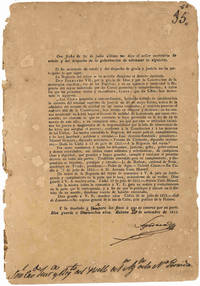
1813WRCAM46892Havana 1813. 1p. plus integral blank. Folio. Old fold lines. Moderately chipped and worn at edges. Lightly and evenly toned. Contemporary manuscript notations. Good. A rare printed decree from Cuba at the beginning of the 19th century as Spanish power in the world was waning but Spain's grip on Cuba was still quite firm. This decree issued by the King on June 14 1813 and printed on September 20 announces new laws regarding the rights to vote and to be elected to hold government positions for professors and scholars from certain universities collegiums and seminars. The decree forbade these rights to the Knights of Justice of the Order of St. John of Jerusalem as well as members of the four military orders of Santiago Calatrava Alcantara and Montesa. It is endorsed in manuscript with the imprint and header also written in by hand. Early Caribbean imprints are rare. unknown books
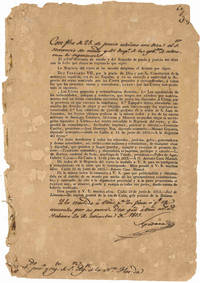
1813WRCAM46891Havana 1813. 1p. plus integral blank. Folio. Old fold lines. Moderately chipped and worn at edges. Evenly tonned. Contemporary manuscript notations. Good. A rare Havana imprint. As Spanish power in the New World was waning its grip on Cuba was threatened by domestic and foreign intruders. This decree issued by Fernando VII on June 17 1813 and printed on September 20 orders the annulment of all criminal cases. This amnesty policy extended to other areas of New Spain as well sought to placate opposition forces. It calls on all levels of government to announce and enforce the decree. It is endorsed in manuscript. unknown books
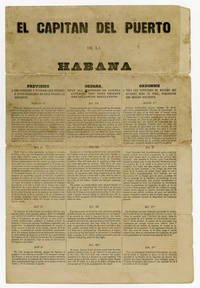
1850WRCAM51706Havana 1850. 4pp. on a bifolium 15 3/4 x 10 1/2 inches. Printed in three columns. Previously folded with some short separations along fold lines and a closed tear to top edge. Somewhat tanned with some dust soiling in upper portion of first leaf recto. Good plus. Bifolium printing of twenty-four directives intended to govern the operation of vessels in the port of Havana. They include provisions for the arrival and departure of ships their docking and mooring the storage of gunpowder while in port fire prevention and penalties for carrying firearms or other deadly weapons ashore. The document is printed in three columns which provide versions of the regulations in Spanish English and French. Daniel Warren mentioned here as the port officer in charge of preventing desertions and illegal transfers of men from ship to ship is also named as Havana shipping master in an 1858 letter from the American Consul Thomas Savage to the Governor of Havana included in a contemporary United States Senate report on foreign trade. "As early as 1828 Irish migrant Daniel Warren established 'a deposit for foreign sailors and artisans' in Havana providing an initial place for them to stay while looking for work"- Curry-Machado. A very rare piece of Cuban maritime ephemera with OCLC noting only one copy at the Harvard Law Library. OCLC 81408661. Curry-Machado CUBAN SUGAR INDUSTRY p.74. unknown books
196723401n.p.: n.p. 1967. Very good. Four photographs ranging in size from 5'' x 7'' to 7'' x 10'' approx. Various press agency stamps to versos. Paper captions mounted to versos of three photos. Slight curling and minor edgewear to photos with creasing and chipping to captions. Very good overall. <br/><br/>Press photographs with agency stamps from Keystone AGIP and United Press Photos taken around the time of the trial and imprisonment of Regis Debray in Muyupampa Bolivia. Debray a Paris-trained philosopher and former professor at the University of Havana was arrested as an associate of Che Guevara in August 1967 and sentenced to 30 years in prison; he was released in 1970 after sustained protests. <br /> <br />Photos show Debray in prison uniform on August 8th; in civilian clothes in front of a bank of microphones at an August 14 press conference following a hunger strike; walking in the prison yard escorted by an armed guard; and with his wife Elizabeth Burgos after his release. Captions all but one in French give descriptions and expanatory context. n.p. hardcover books
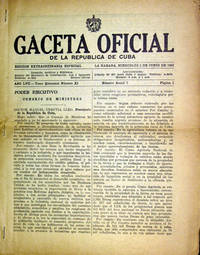
195934285Habana: n.p. 1959. First edition. Stapled self wrappers. A very good copy chip to corner fold throughout leaves browned but clean. 11 pp. Sm. 4to. Special issue devoted to publication of the First Agrarian Reform Law of Cuba Ley de reforma agraria signed into law on May 17 1959. It confiscated all properties over 420 hectares and re-distributed them. Prior to the enactment of this law nearly 80% of Cuban land was owned by foreign primarily American companies. In many quarters domestic and foreign the law was quite unpopular though supported by the peasantry. n.p. unknown books
1838170201838. 8pp disbound. Minor spotting. Good. unknown books
86443Havana: El Siglo XX. First Edition. hardcover. very good. 9 volumes in one. Very thick 4to 1/2 polished green calf stiff original printed wrappers bound in. Habana: El Siglo XX 1924-1932. Very good .<br/><br/> DIHIGO Y MESTRE Juan Miguel et al.<br/><br/> El Siglo XX unknown books
18491647030th Cong. 2nd Sess. SED33. Washington 1849. 33 pp. Disbound scattered foxing. Good. unknown books
18511368131st Cong. 2d Sess.: SED41. 1851. 90pp Disbound light soil. Very Good. SED41. unknown books
1397523pp disbound and stapled. One small margin tear no text affected. Lightly tanned. Good. unknown books
18701438441st Cong. 2d Sess.: SED99. 1870. 5pp Disbound Very Good. SED99. unknown books
18701700741st Cong. 2d Sess.: SED113. 1870. 24pp disbound. Very Good. SED113. unknown books
1980211912Havana: Editorial Orbe 1980. hardcover. very good-. Many Illus. some in color. Square 8vo pictorial cloth rubbed. La Habana: Editorial Orbe 1980.<br/><br/> Profiles of Cuban culture for the year 1978. Text in Spanish.<br/><br/> Editorial Orbe unknown books
18981745655th Cong. 2d Sess.: HD326. 1898. 43 1 blank pp disbound loosening. Very Good. HD326. unknown books
1832WRCAM51901Havana 1832. 18pp. Folio. Loose leaves. Heavy worming mostly marginal but somewhat affecting text in places. Light dampstaining and foxing. Good. An extensive list of fugitives from Cuban courts that covers the period from 1822 to 1832. Each section comprises a catalogue of men tried before a specific court and individual entries provide names brief descriptions mostly of skin color birthplaces likely places of residence and crimes committed together with the sentences handed down. Many men are condemned to the gallows or are facing long sentences in African or other overseas prison camps. This list was also printed as a part of the Oct. 9 1832 issue of DIARIO DE LA HABANA but a separate printing as in the present example is not found in OCLC or the relevant bibliographies. unknown books
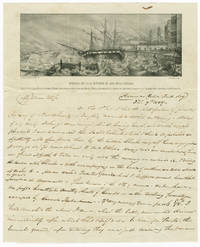
1847WRCAM56260Havana Cuba and onboard ship to New Orleans 1847. 11pp. in black or blue ink on two different Cuban pictorial letter sheets plus a folded sheet of plain paper the latter also used as the enclosure for the entire letter addressed on verso of last page of enclosure. Minor soiling old folds with a few short fold separations and a longer separation in last folded sheet. Last sheet with small abrasion from removed wax seal most of which remains. Overall good plus condition. A lengthy and interesting letter from a Pennsylvania businessman named M.L. Dawson to his "dear wife" back in Philadelphia written over the course of a few weeks during his time in Havana and onboard a ship traveling from Cuba to New Orleans in the spring of 1847. Being written over the course of several entries the letter also acts as a kind of brief diary of Dawson's time in Cuba and the Gulf of Mexico and contains much information on the people and places he saw in and around Havana and much on the ship's activities on the way to Louisiana. Two- thirds of the letter is written on two separate Cuban letter sheets that are themselves rare and desirable printed ephemeral items from mid-19th century Cuba. <br> <br> The eleven-page letter covers Dawson's stay in Havana and his voyage to New Orleans. He writes that he had previously arrived in Havana from Philadelphia. His letter begins on March 7 and Dawson details trips on horseback to the Cuban countryside which he finds beautiful. He comments on odd Cuban funerary practices Cuban agricultural products seeing the home where Santa Anna spent his exile and gives firsthand observations on the effects of slavery. He witnesses a scene in Havana where slaves are chained and forced to make repairs while being overseen by men with whips and muskets. Dawson comments that despite the beauty of the countryside "the evidence of Slavery is every where apparent." Also apparent are "the ravages of the awful storm of the 10th month last" a reference to the devastating October 11 1846 hurricane the effect of which is depicted in each of the letter sheets here. Dawson also reports on being invited to breakfast by a Cuban nobleman but was so taken aback by the food and the experience that he vows never to repeat the experience. <br> <br> After departing Havana for New Orleans on May 9 on the Brig P. Soule Dawson reports on various shipboard activities a disagreeable cursing captain slow progress boredom and seasickness. He comments on claret as the typical drink for breakfast. The letter ends on April 1 when Dawson's ship anchors in New Orleans Road. He closes with a promise to write again soon after he lands in New Orleans and sends kisses and love to his children and relatives. <br> <br> The Cuban letter sheets Dawson employs for more than two-thirds of his letter are interesting and attractive printed items in their own right. The first titled HURACAN DEL 11 DE OCTUBRE DE 1846 EN LA HABANA shows a lithographed scene of various ships in an angry sea being tossed against a breakwater in Havana harbor during the October 11 1846 hurricane. One passenger is being rescued with a breeches buoy while other ships flounder in the distance. The second letter sheet is titled TEATRO PRINCIPAL DE LA HABANA. The scene at the head of this sheet shows further destruction of the October 11 hurricane centered on the damaged ruins of the Teatro Principal Main Theater near the harbor. Two men in top hats survey the damage while an African-American man stands at left center holding long boards. Havana harbor is visible in the background showing two paddlewheel steamers and other ships damaged or sunken in the harbor. <br> <br> Mordecai L. Dawson was the proprietor of M.L. Dawson & Co. a brewery in Philadelphia. Here Dawson addresses the letter to his company noting the letter is specifically intended "for E Dawson" his wife. The Dawson brewery opened in 1820 at 79 Chestnut Street then moved to the corner of 10th and Filbert Streets in 1830 after the company purchased the old Farmers' Brewery in 1829. Dawson apparently closed his brewery in 1849 not long after penning this letter home. Though he does not state it explicitly in his letter Dawson may have been traveling to Cuba to establish an import business. Philadelphia was a pipeline for numerous imports into Cuba in the mid-19th century including beer. <br> <br> An interesting record of one man's sojourn to Cuba in the 1840s with notable observations on slavery and the Cuban situation in the wake of the October 11 1846 hurricane written mostly on two attractive and rare Cuban letter sheets that also memorialize the hurricane. hardcover books
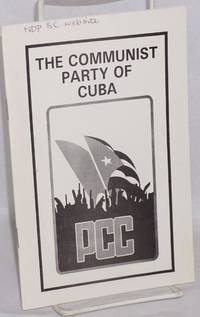
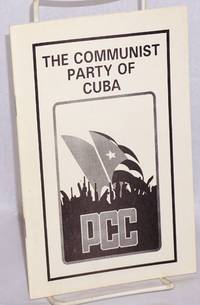
1998199828Havana: n.pub 1998. Pamphlet. 28p. wraps pen note on front wrap and minor rippling very faint from damp on rear wrap else very good condition 5.25x8 inches. Text in English with no indication of location or publisher. Pro-PCC. n.pub unknown books
1998200647Havana: n.pub 1998. Pamphlet. 28p. wraps very good condition 5.25x8 inches. Text in English with no indication of location or publisher. Pro-PCC. n.pub unknown books
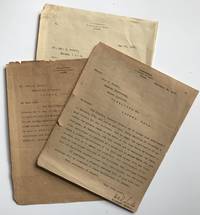
1900542Havana 1900. Good. Three typescript letters 4pp. total. Previously folded light chipping at edges. Evenly tanned. An interesting series of three letters from the Adjutant General W.V. Richards at U.S. Army Headquarters in Havana after the end of the Spanish-American War during the period of American military government. On February 28 1900 the military governor herein authorized the purchase of a book collection owned by heirs of a Don José Maria de Cardenas y Rodriguez from the town of Guanabacoa for the formation of a library at the university in Havana "at a price not to exceed $4000." In the second letter dated April 17 the collection seems to have been sold out from under them at a much lower price which has left the governor wondering why the university could not acquire the books with the allotted funds. In the third letter dated May 23 the collection seems to be for sale again by a third party and the governor again states that he is willing to purchase the collection for the previously stated sum "However to warn you that there has been so much said about the purchase of this Library for the Institute that there is danger that some of the books may have been extracted or that the property is not as valuable as when it was inspected." A neat record of a book deal gone sideways in 1900 Havana. unknown books
188893403Madrid: Manuel Hernandez 1888. First Edition. pamphlet. 27 pages. 8vo original printed wrappers. Madrid: Manuel Hernandez 1888.<br/><br/> Manuel Hernandez unknown books
86083hardcover. 202pp. 8vo modern cloth; orig. wrs. bound in unopened. Madrid: Aurelio Alaria 1881. First Edn.<br/><br/> unknown books
1875WRCAM56107Cuba 1875. Twenty-two partially-printed forms on folio sheets completed in manuscript in a variety of hands. Most printed and accomplished on the recto only though a few with print or manuscript on the verso as well. Some with old folds chipping and small tears to edges of most documents one document with the upper right corner cut away. Occasional foxing tanning and ink offsetting and bleedthrough. Several documents with additional manuscript annotations. About very good overall. An important collection of contracts documenting Chinese indentured servitude in Cuba two signed in Chinese. All but one are from various municipalities in the Matanzas Province usually attested to with an ink or blind stamp from a local official one with paper tax stamps affixed. Each contract stipulates the term of service for the "colono" - one or two years along with wages to be paid food and clothing issued duties and hours to be worked and so forth. The laborers are identified in the contracts by their assigned Spanish names with no surnames though some forms have a section for their "nombre nacional" and place of origin as well. There are provisions for what happens if the servant cannot complete their term of service due to illness pending agreement with the "patrono" and a section on options for contract renewal. The latest of these contracts dated May 24 1875 bears the laborer's signature in Chinese. He is described as "al asiatico José" aged 30 of Macao and is contracted to work for Ignacio de Cardenas for six years. Another contract from Bejucal in the Mayabeque Province is also signed in Chinese this one by "Antonio" "natural del pueblo de Leo Chao en China." This is also the only document in the collection with a signature area labeled: "Firma del interpréte ó de dos personas de confianza del colono ó dos testigos." <br> <br> Formal slavery continued in Cuba until it was abolished by Spanish royal decree in 1886; it was accompanied however by a significant population working in indentured servitude. As sugar exports rose in the mid to late 18th century there was a dramatic increase in the need for enslaved workers. "One of the explicit goals of Spanish reformist policy in the last third of the eighteenth century became the need to emulate other European nations' success with slave plantation development in the Caribbean. Partly because of this slave-based coffee and sugar estates sprang up in increasing numbers in portions of Cuba especially around Havana Santo Domingo and Puerto Rico. An expanded slave trade was a necessary condition of such growth. In Cuba alone approximately seventy thousand slaves were imported between 1763 and 1792 and another three hundred twenty-five thousand were brought in between 1790 and 1820.For the entire nineteenth century imports to Cuba amounted to about seven hundred thousand persons." - Drescher. <br> <br> The abolition of slavery in the British West Indies however meant that from the 1830s onward a new source of labor was necessary. It is this gap that indentured servitude filled. Unlike the earlier waves of European immigrants who travelled to the New World as indentured servants Asia was now the primary source. Between 1848 and 1874 125000 Chinese indentured servants arrived in Cuba alone - a figure outstripped only by the number who indentured themselves in California. "Some contemporaries and later historians.have condemned the servitude of the Asians as a thinly disguised revival of slavery. These critics have pointed to a variety of abuses to which the Asians were subjected both legally - with severe laws governing absenteeism vagrancy and insufficient work - and illegally in the form of harassment by vicious masters. Yet other observers have defended the system as a boon to the Asian workers. Voluntary reindenture at the end of their terms was common among the migrants suggesting that many Asians judged the system to be beneficial to them" - Drescher. <br> <br> Voluntary or not a large number of Chinese migrants were laboring in Cuba in the 19th century; for most of them these contracts are the only existing records of their work if not of their lives. Seymour Drescher & Stanley L. Engerman editors A HISTORICAL GUIDE TO WORLD SLAVERY New York 1998 pp.140-42 239-42. hardcover books