Buchon, Jean Alexandre.Livre Rare Book
1 999 résultats
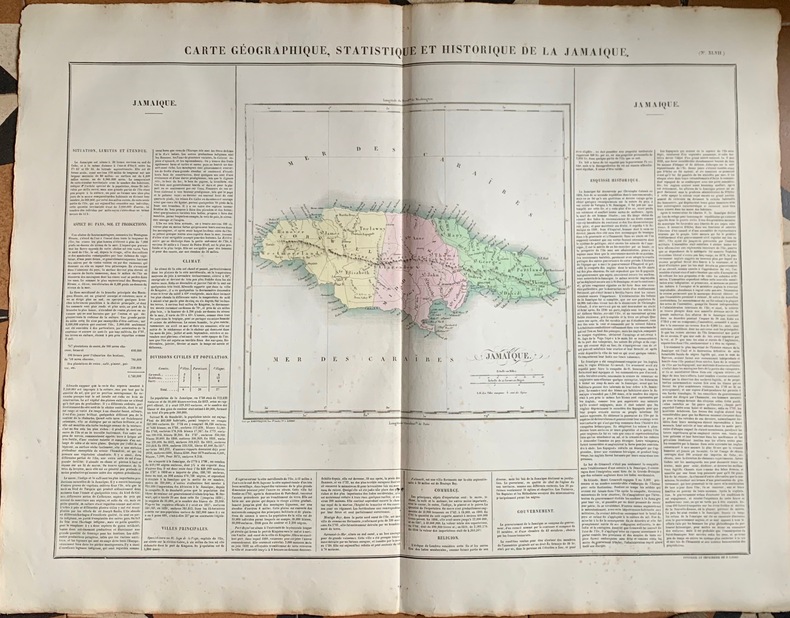
1825115991825 Paris J. Carez, Verdière, Bossange 1825; in-folio en feuilles de 1 feuillet (Table) et 61 sur 63 cartes ou tableaux à double page en couleurs + feuillets " bis" de texte en noir. Ensemble placé dans un carton ancien usagé au dos renforcé. Petites déchirures sans manque en marge de plusieurs planches non rognées, rousseurs en marge de nombreuses planches, quelques traces de mouillure angulaire à plusieurs planches, trace de pli au centre de chaque planche double. les gravures et coloris sont frais. Ensemble de cartes consacré aux deux Amériques du Nord et du Sud et aux Caraïbes et Antilles.
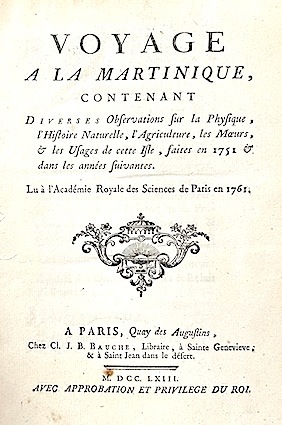
176315381Bauche Paris 1763 1 vol. 4 parties en un vol. in-4 de 4 ff.n.ch. VIII 135 pp. 46 pp. de 136 à 192 pp. 40 ff.n.ch., plein veau fauve marbré de l’époque, dos à nerfs orné, tranches rouges.
181112036Paris, Arthus-Bertrand, 1811. In-8 de (6)-494 pp., demi-veau olive, dos lisse orné, pièce de titre en maroquin rouge (Ateliers Laurenchet).
18144Histoire Naturelle et Morale des Iles Antilles de l'Amérique, enrichie d'un grand nombre de belles Figures en taille douce, des Places et des Raretez les plus considérables, qui y sont décrites. Avec un vocabulaire Caraïbe. Seconde édition Reveuë et augmentée de plusieurs Descriptions, et de quelques éclaircisements, qu'on désirait en la précédente. A Amsterdam, Etienne Roger, en 1716. Frontispice de l'édition de Rotterdam. 3 planches dépliantes. 45 pl.I-T. 583 pages + table des chapitres. Notes manuscrites sur les pages de garde. In-4 en reliure de l'époque avec dos orné. Etat moyen.
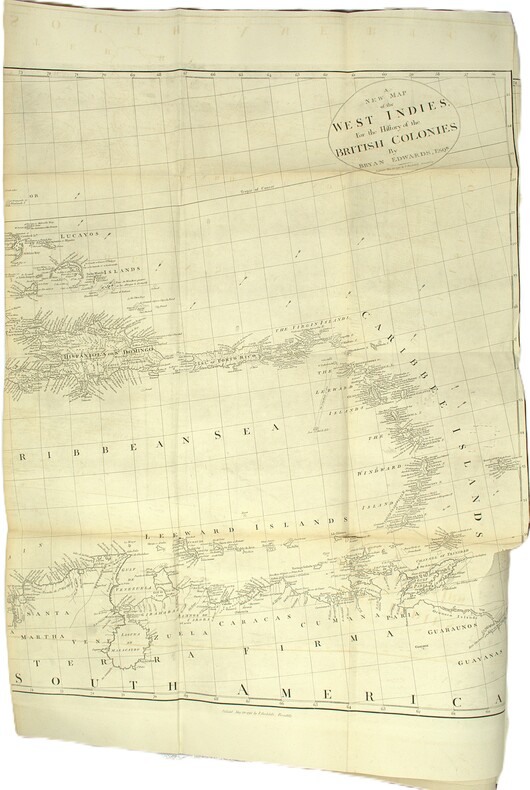
1794PHO-1886John Stockdale, Londres, 1794-1801, 3 volumes in-4 (275 X 225 mm), reliés plein veau marbré époque (restauration ancienne), pièce de titre rouge et de tomaison vert. Tome I, liv-494 pp., Tome II 520 pp, Tome III (1801) xix 443 pp., illustré de 3 frontispices, 11 cartes dont une en double feuille et dépliante (720 X 620) (cartes des Indes occidentales), 2 dépliantes Saint Domingo (250 X 225) et Jamaïque et 8 planches h.t., ex-libris en page de garde, déchirures aux pliures et brunissures en marge de la grande carte, frottements, griffures, pièces de titre et tomaison avec petits manques, quelques brunissures sur les titres et quelques feuillets.
1793012721Boston: Isaiah Thomas and Ebenezer T. Andrews Printers 1793. Leather. Good. Full Calf leather. 696 552 pp. Eight fold out plates/maps in volume one three in volume two all present as called for. 1793 edition of this early geographical survey of the United States as well as the world containing maps relating to the United States at the time North America and the world. This work served to heavily influence the teaching of geography and education in the US. GOOD condition. Moderate to heavy scuffing to the leather covers and extremities with a few deep scrapes and scratches present. Minor soiling and staining. Interiors solid with moderate toning scattered foxing staining and soiling. Dampstaining present to the endpapers. Ownership signatures present. A few pages creased including dog ear creases. The Virginia map is very tattered torn and misfolded with a few other American maps also bearing tears ranging from small to long along the folds. Some creasing to the maps. Sabin 50926. Isaiah Thomas and Ebenezer T. Andrews, Printers unknown
1676P2-5A-3Paris : Gervais Clouzier, 1676. 4 parties en deux volumes, 8° (160 x 100 mm) , plein veau époque, dos à nerfs ornés avec titre et tomaison , différence de reliure, 13ffnch.-246pp-2ffnch et 4ffnch.240pp. , 4ffnch.-297pp.-2ffnch. Et 4ffnch.-153pp.-2ffnch. , coins et coupes usés , reliure solide , mouillure sur quelques feuillets (t3-4).
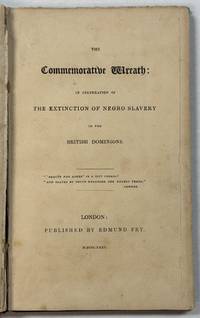
183541420London: Published by Edmund Fry 1835. 2 viii 112 pp. Original cloth rebacked. Title stamped in gilt on upper cover. Frontis engraving with tissue guard of black children in school taught by elegantly dressed white teachers; and with several signs: "The Day of Our Freedom August 1st 1834" engraved by J. Crosland; "That Which I See Not Teach Thou Me"; "Shew Me Thy Ways O Lord Teach Me Thy Paths." Occasional foxing Good plus. <br /> <br /> A scarce work issued to celebrate the abolition of slavery in British colonies with the Slavery Abolition Act passed in 1833 and going into effect on 1 August 1834. "On the memorable day when British Colonial Slavery ceased the 'Peckham Negro's Friend and Instruction Society' held a special meeting with a view to 'signalizing the day of Negro Emancipation by some act of Christian benevolence" and accordingly came to the unanimous resolution of undertaking 'the charge of an Adult School to be established in the island of Jamaica. The necessary steps were taken to effect this design; and it is the hope of aiding the the extension of its practical usefulness which has prompted a few individuals who have long felt deeply interested in the Negro's cause to collect into a small volume such poems as may be within their reach written for the most part in special commemoration of the abolition of Slavery and to apply the profit if any to the furtherance of the object before described."<br /> The authors of most of these poems have signed with their initials only. This is the first edition.<br /> LCP 2587. Published by Edmund Fry unknown
1782CA0094lii315 pages. Octavo 8" x 5 3/4" bound in full leather with gilt lettering to spine. Translated with notes by Pedro Varela y Ulloa. Palau 196692. First Spanish edition.<br /><br />A text that engaged the well-studied debates about the natural history of the Americas and Spain's colonial history. In 1780 in Venice Juan Nuix published Riflessioni imparziali supra l'umanita degli spagnuoli nell' Indie contro i pretersi filosofi e politici. Nuix a Catalan living in Italy since the expulsion of the Jesuits wrote the book to defend Spanish colonialism and historiography against the attacks of Robertson and Raynal. It sailed by the censors in the Council of the Indies and two separate translations appeared in succession one in 1782 edited by a member of the Royal Council Pedro Varela y Ulloa and another in 1783 by Joseph Nuix Juan's brother. The Spanish edition sponsored by the crown opened with an essay by Varela y Ulloa in which he first offered a searing Critique of traditional forms of colonialism not unlike that put forth by Raynal. After describing military campaigns in foreign lands from Alexander the Great to Genghis Kahn as butcheries Varela y Ulloa went on to claim that the Spanish colonialism was unique. The crimes attributed to Spain in the Indies had been committed by private individuals who did not represent the nation as a whole and who had acted as they did while surrounded by hungry cannibals. Moreover compared with the atrocities committed by other European colonial powers the actions of the Spaniards looked like misdemeanors. Varela y Ulloa's effort to portray Spanish colonialism as unique benign captured the essence of Nuix's thesis well. Nuix's defense of the record of Spanish colonialism opened with passages that sought to bolster his credibility by stressing that he was a Catalan and that Catalans had not really participated in the Spanish colonization of the Indies so that he could not be accused of being partisan. He then articulated a five-pronged defense of Castilian colonial behavior in America seeking to demonstrate the unreliability of the sources used by Robertson and Raynal and of their interpretations. Nuix First set out to prove that charges of Spanish cruelty to Amerindians were exaggerations originally put into circulation by writers such as Las Casas whose reports on the destruction of the Indies were at the root of most foreign criticisms of Spain. According to Nuix Las Casas was of Flemish origin which explained why he had sought to undermine Spain. Las Casas also often contradicted himself Nuix argued no impartial jury could trust such "an inept" witness. Foreign historians who had echoed Las Casas's allegations were not credible either not Robertson whose moderation had prompted him to dismiss Las Casas. Robertson had selected and reinterpreted the testimony of Spanish witnesses when recounting various colonial massacres. Instead of quoting them moreover Robertson had manipulated the testimony of witnesses to depict the Amerindians as passive victims of Spanish cruelty. History was not a matter of interpretation however but of faithfully presenting the testimony of witnesses and in that respect Robertson lacked credibility. In order to prove that Spaniards in America had not behaved like greedy barbarians Nuix argued that the alleged depopulation caused by the Conquest was the product of factors outside human control. The infantile susceptibility of the natives to disease for example was why epidemics had wiped them out. The barrenness of the Americas and the idleness of the originally small number of natives had moved the conquerors to create economies based on mining and large estates. Such economies along with the foreign monopoly on colonial trade not Spanish cruelty and greed Nuix contended were responsible for having slowed both markets and population growth.<br /><br />Condition:<br /><br />Provenance: Book plate of Alberto Parreño formerly president of the Cuban Chamber of Commerce in New York to front paste down. Spine head chipped rubbing to edges and corners very crisp internally else about a very good copy. Joachin Ibarra hardcover
1782CA0094lii315 pages. Octavo 8" x 5 3/4" bound in full leather with gilt lettering to spine. Translated with notes by Pedro Varela y Ulloa. Palau 196692. First Spanish edition.<br /><br />A text that engaged the well-studied debates about the natural history of the Americas and Spain's colonial history. In 1780 in Venice Juan Nuix published Riflessioni imparziali supra l'umanita degli spagnuoli nell' Indie contro i pretersi filosofi e politici. Nuix a Catalan living in Italy since the expulsion of the Jesuits wrote the book to defend Spanish colonialism and historiography against the attacks of Robertson and Raynal. It sailed by the censors in the Council of the Indies and two separate translations appeared in succession one in 1782 edited by a member of the Royal Council Pedro Varela y Ulloa and another in 1783 by Joseph Nuix Juan's brother. The Spanish edition sponsored by the crown opened with an essay by Varela y Ulloa in which he first offered a searing Critique of traditional forms of colonialism not unlike that put forth by Raynal. After describing military campaigns in foreign lands from Alexander the Great to Genghis Kahn as butcheries Varela y Ulloa went on to claim that the Spanish colonialism was unique. The crimes attributed to Spain in the Indies had been committed by private individuals who did not represent the nation as a whole and who had acted as they did while surrounded by hungry cannibals. Moreover compared with the atrocities committed by other European colonial powers the actions of the Spaniards looked like misdemeanors. Varela y Ulloa's effort to portray Spanish colonialism as unique benign captured the essence of Nuix's thesis well. Nuix's defense of the record of Spanish colonialism opened with passages that sought to bolster his credibility by stressing that he was a Catalan and that Catalans had not really participated in the Spanish colonization of the Indies so that he could not be accused of being partisan. He then articulated a five-pronged defense of Castilian colonial behavior in America seeking to demonstrate the unreliability of the sources used by Robertson and Raynal and of their interpretations. Nuix First set out to prove that charges of Spanish cruelty to Amerindians were exaggerations originally put into circulation by writers such as Las Casas whose reports on the destruction of the Indies were at the root of most foreign criticisms of Spain. According to Nuix Las Casas was of Flemish origin which explained why he had sought to undermine Spain. Las Casas also often contradicted himself Nuix argued no impartial jury could trust such "an inept" witness. Foreign historians who had echoed Las Casas's allegations were not credible either not Robertson whose moderation had prompted him to dismiss Las Casas. Robertson had selected and reinterpreted the testimony of Spanish witnesses when recounting various colonial massacres. Instead of quoting them moreover Robertson had manipulated the testimony of witnesses to depict the Amerindians as passive victims of Spanish cruelty. History was not a matter of interpretation however but of faithfully presenting the testimony of witnesses and in that respect Robertson lacked credibility. In order to prove that Spaniards in America had not behaved like greedy barbarians Nuix argued that the alleged depopulation caused by the Conquest was the product of factors outside human control. The infantile susceptibility of the natives to disease for example was why epidemics had wiped them out. The barrenness of the Americas and the idleness of the originally small number of natives had moved the conquerors to create economies based on mining and large estates. Such economies along with the foreign monopoly on colonial trade not Spanish cruelty and greed Nuix contended were responsible for having slowed both markets and population growth.<br /><br />Condition:<br /><br />Provenance: Book plate of Alberto Parreño formerly president of the Cuban Chamber of Commerce in New York to front paste down. Spine head chipped rubbing to edges and corners very crisp internally else about a very good copy. Joachin Ibarra hardcover books
1707WRCAM17560London 1707. 8pp. Modern half morocco and marbled boards. Tanned. Very good. The author sets out the five most important advantages which he associates with trading with the Spanish West Indies and then proceeds to respond to the potential objections of others. He concludes by listing the conditions set out by the Spanish which he considers very reasonable as "This Trade is a Jewel." EUROPEAN AMERICANA 707/95. hardcover books
182335353London 1823. Four works in one volume 8vo. Collations as below. Contemporary half calf and marbled paper covered boards flat spine tooled in gilt and blind<br/> <br/>Sammelband of pamphlets relating to the West Indian sugar trade.<br/> <br/>Comprising the following: 1 Larpent Sir George. On Protection to West-India Sugar . Second Edition Corrected and Enlarged. London: Printed for J.M. Richardson 1823. 159 1pp. Sabin 39068. 2 Macaulay Zachariah East and West India Sugar or a Refutation of the Claims of the West India Colonists to a Protecting Duty on East India Sugar. London: Printed for Lupton Relfe 1823. 2 viii 128pp. Sabin 42951. 3 Macaulay Zachariah A Letter to William W. Whitmore Pointing out some of the Erroneous Statements contained in a Pamphlet by Joseph Marryat entitled "A Reply to the Arguments contained in Various Publications Recommending an Equalisation of the Duties on East and West India Sugars." London: for Lupton Relfe 1823. 2 38pp. Sabin 42953. 4 Marryat Joseph. A Reply to the Arguments recommending an Equalization of the Duties on East & West Indian Sugar . second edition. London: for J.M. Richardson 1823. 111 1pp. Sabin 44708. A nice group of pamphlets focusing on the equalisation debate; i.e. an abolition argument that sugar growers in the East Indies were at a disadvantage to their counterparts in the West Indies due to the latter's use of slavery. unknown books
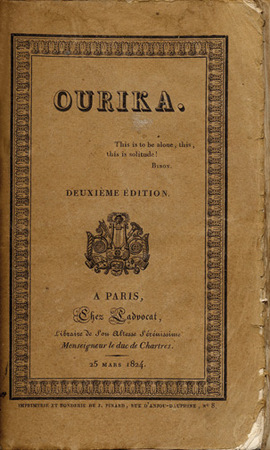
18249443Paris, Ladvocat, 25 mars 1824 (Imprimerie de J. Pinard) ; in-12 ; demi-chagrin bleu-marine, dos à nerfs orné de roulettes décoratives de style romantique, fleurons à froid, filet doré sur les plats, plats de couverture marron illustrés conservés, non rogné (reliure fin XIXe-début XXe) ; 172 pp. y compris le faux-titre et le titre ; au verso du faux-titre on lit "Publié au profit d'un établissement de charité".
168797Paris, Desenne, Petit, Le Normant, Veuve Dufresne, an XI-1803 2 vol. in-8, [4]-326-XL et VIII-358-[2] pp., (erreur de pagination sans manque, pas de 47-48 au tome 1) basane fauve, dos lisse, chainette dorée au dos, tranches bleues (reliure de l'époque). Manque le faux-titre au tome 1, manque angulaire à la page 311-312 avec perte de texte. Bon exemplaire.
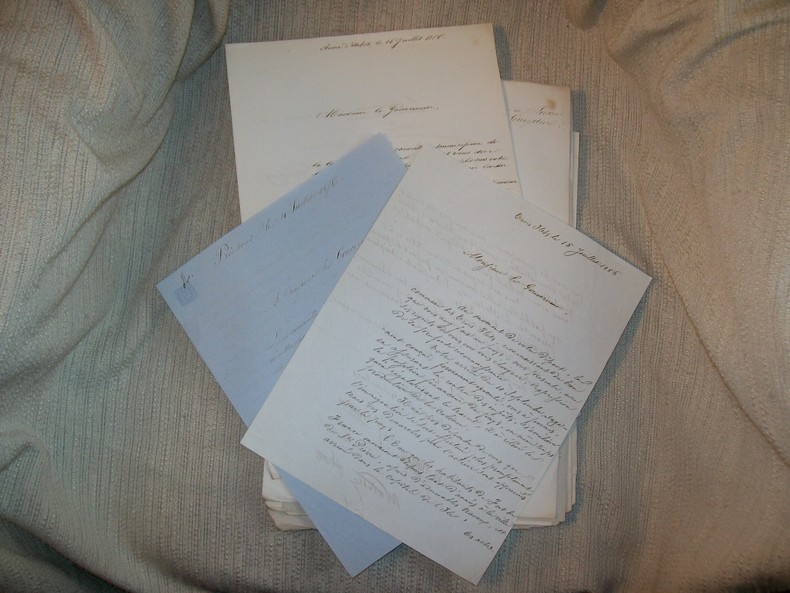
1853GITg926Ensemble de 91 lettres manuscrites originales de divers formats et longueurs, rédigées par différentes personnes, en diverses communes de la Martinique, adressées à Louis-Henri de Gueydon alors qu'il était Gouverneur de cette île. A l'exception de quelques lettres de particuliers, les auteurs sont l'Evêque de Fort-de-France et Saint-Pierre Etienne Le Herpeur et les membres de Conseils Municipaux. Elles sont datées et écrites en grande majorité de Fort-de-France, Saint-Pierre, Bellevue, Le Marin, Macouba, Saint-Esprit, La Trinité, Port d'Espagne, Le Lamentin, L prêcheur, Les Trois Ilets, Les Anses d'Arlets, Le François. Une partie de ces lettres fut adressée au Comte de Gueydon au moment de la naissance de son fils Henri (1854-1907) à Fort-de-France; l'autre partie fut composée lorsque le Comte de Gueydon quitta son poste. Toutes reflètent à quel point il était apprécié et un grand nombre rappelle tout ce qu'il mit en oeuvre pour la prospérité de la Martinique: juste répartition et encaissement des impôts, développement de l'agriculture grâce à l'immigration indienne, défense et développement de l'industrie sucrière, travaux d'intérêt général pour les vagabonds et certains condamnés, aménagement de routes et ponts, d'un bassin de carénage, développement de l'instruction et campagnes de vaccination (avec le concours de Mgr Etienne). Son oeuvre la plus remarquable étant la construction d'un canal permettant à la rivière de Case Navire (aujourd'hui Schoelcher) d'alimenter Fort-de-France en eau potable.
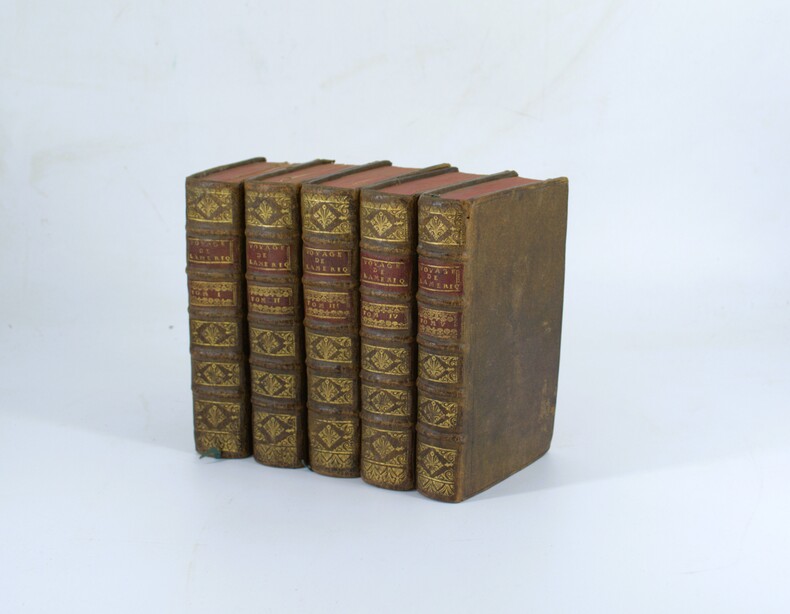
1722PHO-2275Guillaume Cavelier, Paris, 1722, 5 volumes (6) in-12 (17x10cm), T1 ; xxxvi-5ff.-522pp., 21 planches, T2 ; 3ff.-598pp., 20 planches, T3 ; iv-549pp., 31 planches, T4 ; vi-558pp., 14 planches, T5 ; vi-524pp., 6 planches, 90 planches et cartes. Veau époque, dos à nerfs orné avec pièces de titre et tomaison en maroquin rouge, filets aux coupes. Frottements, 3 planches avec manques au tome 1, déchirure sans manque carte de la Martinique Édition Originale.
17781001488vo period calf rebacked with modern calf and new endpapers 3 202pp. Wear to covers; ink name to top of title page and some foxing and darkening within. Otherwise very good. The contents provide coverage of the important proceedings before the Declaration of Independence on July 4th 1776.This commentary reflects the efforts of the Second Continental Congress which was headed by John Hancock. A good portion of the contents focus on correspondence between Washington who had taken command of the Continental Army in May 1775 and Congress election of delegates form each of the Colonies and funding the war with Great Britain. Some remarks actually give insight into the pay that soldiers received privates got $5 per month. Also some information on printing of paper money and what denominations would be used. While the title page indicated this was a reprinted work Sabin only lists the London edition. Reprinted For J. Almon
17781001488vo period calf rebacked with modern calf and new endpapers 3 202pp. Wear to covers; ink name to top of title page and some foxing and darkening within. Otherwise very good. The contents provide coverage of the important proceedings before the Declaration of Independence on July 4th 1776.This commentary reflects the efforts of the Second Continental Congress which was headed by John Hancock. A good portion of the contents focus on correspondence between Washington who had taken command of the Continental Army in May 1775 and Congress election of delegates form each of the Colonies and funding the war with Great Britain. Some remarks actually give insight into the pay that soldiers received privates got $5 per month. Also some information on printing of paper money and what denominations would be used. While the title page indicated this was a reprinted work Sabin only lists the London edition. Reprinted For J. Almon books
183334458v.p. including Antwerp London Havana Pensacola New York 1833. Folio. 12 3/4 x 8 inches. 21 leaves plus two additional manuscript leaves laid in. Contemporary half calf and marbled boards manuscript label on front board. Bookseller's label on front pastedown.<br/> <br/> Account book of Atlantic trading voyages.<br/> <br/> An interesting manuscript ship's log containing financial accounts for the brigs Nimrod and Jasper for an eight year period from 1826 to 1833 while they were under the command of a Captain John Hill. The two ships made numerous voyages between the United States Europe and the Caribbean. The present log book contains line accounts of expenditures for journeys from London and Marseilles to New York and Norfolk in 1827; from Antwerp to London in 1828; from Philadelphia to the West Indies in 1829; from Madeira to the Turks Islands in 1831; from the West Indies to Pensacola to Havana in 1832; from the Indies to New York in 1833; and other similar voyages. The log also contains two copies of an 1832 letter written in Havana by Hill to merchants there inquiring about the price of molasses and a list of port charges at several major way points. A fascinating artifact of trans-Atlantic trade in the 1820s and 1830s. unknown
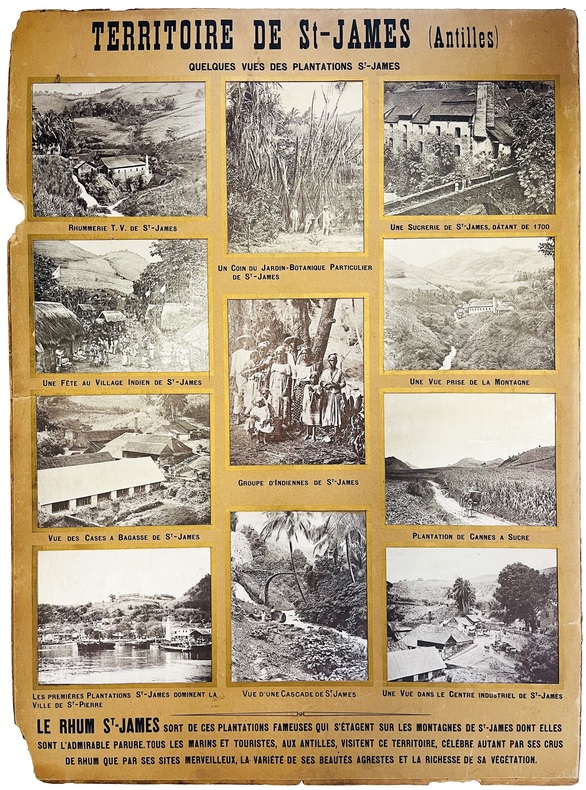
1890LBW-8885S.l., [vers 1890]. Planche cartonnée (87 x 62,5 cm).
1792LBW-3758Auray, 1792. 1 p. in-4 oblong (22,4 x 29,3 cm), en-tête imprimé "Régiment du Port-au-Prince" corrigé à l'encre "Cap", vignette et encadrement gravés, sceau de la municipalité d'Auray et apostille des officiers municipaux, traces de plis.
114659Lyon, Jean de Tournes, Imprimeur du Roy, 1581, 1 volume in-8 de 240x155x45 mm environ, 1f.blanc, 4ff.( titre avec large encadrement gravé à l'ancienne, Epistre, Anagrammes, Extrait du Privilège), 546 pages, 11 ff. (table), 1f.blanc, pleine basane granitée brune, dos à nerfs portant titres dorés, orné de caissons à riches motifs dorés, tranches mouchetées de brun. Texte enrichi de belles lettrines à décor Renaissance (dont la lettrine dite "aux suqelettes"), et 34 in-texte gravées sur bois de pièces de monnaie, médailles, pierres tombales (dont celle signée par Pierre Vase), anciennes courses de chars et une scène de préparation rituelle d'un corps. Des notes anciennes à l'encre sur les pages de garde, sur la page de titre et dans les marges par endroits, mouillures claires en fin volume, des rousseurs et pages brunies, un mors interne fendu mais structure solide. Edition originale, dédiée à Charles Emmanuel de Savoie, datée De Lagnieu ce premier jour de juin l'an 1581.
In-4°; cc.14 (di cui la seconda è bianca), 365 carte num. Capilettera incisa su legno. Marca tipografica al frontespizio (In cornice fig.: una stella cometa con sette stelle tra le punte. Intorno alla coda nastro con il motto: Inter omnes.) . Manca ultima carta con timbro tipografico. Note manoscritte di possesso, datate 1740 e 1926. piccoli segni di tarli nell’ultime carte e macchie di umidità. Legatura in pergamena.
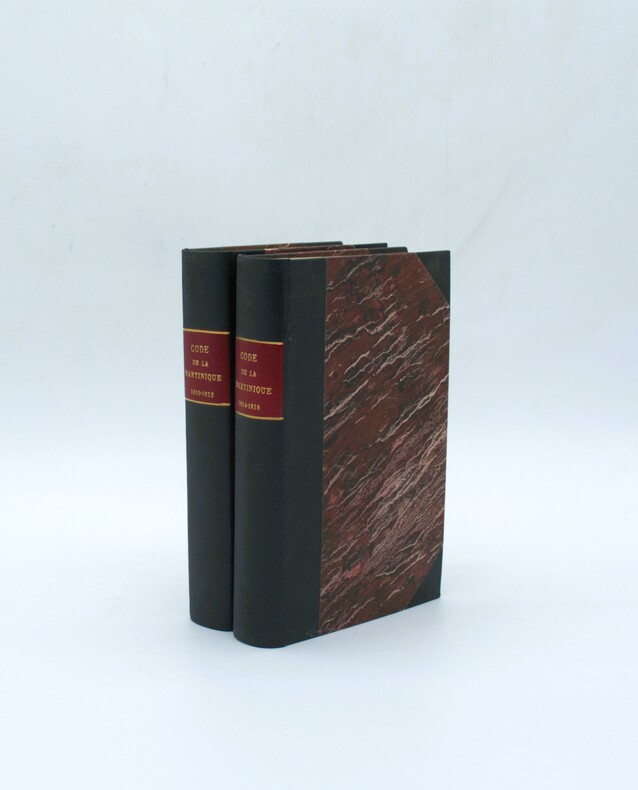
1865PHO-2341Fort-de-France, Imprimerie du gouvernement, 1865-1872. 2 volumes in-8 (22x13,5cm), lxvi-722pp., lxviii-656pp., demi percale et coins moderne, pièce de titre rouge.
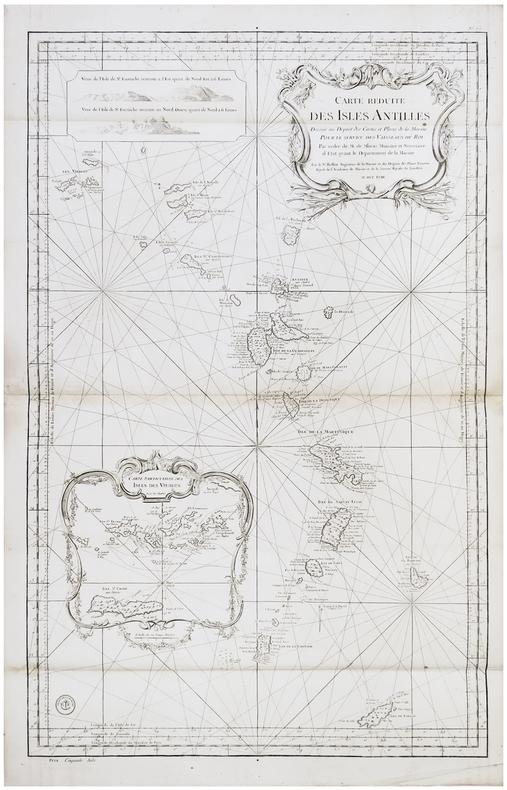
1758LBW-62851758. 890 x 565 mm.