[MAURITIUS IMPRINT]Biblio.com

92 résultats
1796284291796. Small quarto. 4pp. Single folded sheet. Contemporary manuscript notations. Light soiling and wear. Early and unrecorded imprint from the colonial press at the French colony of Mauritius also known as the Ile de France. The text contains the deliberations and acts of the colonial assembly of the island at a time when it was operating virtually independent from France. The acts all concern measures to be taken for the defense of the island at a time when British invasion was feared. The Dutch were the first Europeans to become interested in the island taking possession in 1598. After exploiting the island's dense forests for a century and introducing the cultivation of sugar cane and cotton the Dutch abandoned the colony in 1710. The French soon claimed it as "Ile de France" and the island remained under the control of the French East India Company until 1767. During the long war between France and England at the beginning of the 19th century Mauritius proved to be an important strategic naval base and as a result the British took charge of the island in 1810 and the Treaty of Paris confirmed official British possession in 1814. It remained an important sugar producing colony and in the 20th century agricultural production was expanded to include tea rice and other produce. Printing began on Mauritius in 1768. During the French period until 1810 only about 400 imprints were produced mostly in the form of official documents and newspapers though there are also almanacs and a few other items. All are quite rare. No copies located in OCLC and not recorded by Toussaint in his bibliography of Mauritius imprints. unknown
1794284251794. Small quarto. 9 x 6 3/4 inches. 28pp. Stitched as issued. Contemporary notation on first page some contemporary underlining in text. Minor soiling. A remarkable early imprint from the colonial press at the French colony of Mauritius also known as the Ile de France in the south Indian Ocean. The text contains a report of the French Revolutionary Committee of Public Safety regarding prisoners arrested on the island of Réunion being held as enemies of the Revolution. The document was printed in the capital Port Louis which was called Port de la Montagne from 1792 to 1795. The Dutch were the first Europeans to become interested in Mauritius taking possession in 1598. After exploiting the island's dense forests for a century and introducing the cultivation of sugar cane and cotton in 1710 the Dutch abandoned the colony. The French soon claimed it as "Ile de France" and the island remained under the control of the French East India Company until 1767. During the long war between France and England at the beginning of the 19th century Mauritius proved to be an important strategic naval base and as a result the British took charge of the island in 1810 and the Treaty of Paris confirmed official British possession in 1814. It remained an important sugar producing colony and in the 20th century agricultural production was expanded to include tea rice and other produce. Printing began on Mauritius in 1768. During the French period until 1810 only about 400 imprints were produced mostly in the form of official documents and newspapers though there are also almanacs and a few other items. All are quite rare. No copies located in OCLC; Toussaint locates a copy at the Archives Nationales in Paris.<br/> <br/> Toussaint A247. unknown
1791284301791. Folio. 10 3/4 x 8 1/4 inches. 24pp. Stitched as issued. Top corner of first leaf torn away affecting several lines of text. Lightly dampstained and worn throughout. Still very good. Early and unrecorded imprint from the colonial press at the French colony of Mauritius also known as the Ile de France. Issued at a critical moment at the beginning of the French Revolution the lengthy text concerns the government and judiciary of the island together with a proclamation by the King dated August 24 1790. The text nominally recognizes the authority of the King while taking measures to establish major autonomy of local government. The Dutch were the first Europeans to become interested in the island taking possession in 1598. After exploiting the island's dense forests for a century and introducing the cultivation of sugar cane and cotton in 1710 the Dutch abandoned the colony. The French soon claimed it as "Ile de France" and the island remained under the control of the French East India Company until 1767. During the long war between France and England at the beginning of the 19th century Mauritius proved to be an important strategic naval base and as a result the British took charge of the island in 1810 and the Treaty of Paris confirmed official British possession in 1814. It remained an important sugar producing colony and in the 20th century agricultural production was expanded to include tea rice and other produce. Printing began on Mauritius in 1768. During the French period until 1810 only about 400 imprints were produced mostly in the form of official documents and newspapers though there are also almanacs and a few other items. All are quite rare. No copies located in OCLC and not recorded by Toussaint in his bibliography of Mauritius imprints. unknown
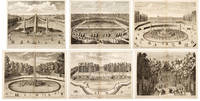
171553314c.1715. The Fountains at Versailles A set of six magnificent engravings of the Fountains at Versailles: 'Fontaine de Latone.' Artist: Engraved by Scotin G. A spectacular view of the Latona Fountain at Versailles as it was in the early eighteenth century surrounded by citizenry strolling courting and playing. The fountain was built in 1671 and still is still in existence. 'Fontaine de l'Encelade dans un des Bosquets des Jardin de Versailles.' Artist: Girard. A spectacular view of the 'Fontaine de l'Encelade' at Versailles. The centre fountain has a plume 78 feet high shooting from the mouth of a bronze giant and is surrounded by smaller fountains made from rocks from Mount Ossa and Olympia. The fountain is surrounded by citizenry strolling courting and playing. Two lines of text in French below the engraving describe the fountain. 'L'Isle Royale.' Engraved by Fonbonne. Magnificent engraving of L'Isle Royalea large pond at Versailles with seven 45 foot fountains. Courtiers stroll and a procession of hand drawn coaches snake along the walkway surrounding the pond. Elegant statues and manicured trees line the walkway. Four lines of text in French below the engraving describe the seven fountains. 'Fontaine d'Apollon.' Engraved by de Rochefort P. A spectacular view of the fountain of Apollo at Versailles as it was in the early eighteenth century surrounded by citizenry strolling courting and playing. The main fountain has the figure of Apollo being guided by four horses surrounded by water bearers. Text below the engraving gives a description and brief history of the fountain. It is still in existence today. 'Bassins de Neptune' Engraved by Daigremont A spectacular view of the Bassin de Neptune at Versailles in the early eighteenth century. Text below the engraving gives a description and brief history of the fountain: 'This grand piece of water is decorated with 22 beautiful vases designed by Le Brun.' translation. A fountain erupts from each vase. Six fifty foot fountains and many smaller fountains adorn this extraordinary water feature whilst wealthy courtiers amble around it. 'L'Arc de Triomphe.' Engraved by Baquoy Maurice. A detailed view of the opulent 'L'Arc de Triomphe' a woodland garden of fountains at Versailles in the early eighteenth century. Two lines of text below the engraving give a description and brief history. Numerous courtiers stroll amidst the profusion of fountains and cascades in a forest glade. Copper engraving. Fine condition good margins. Uncoloured. Size: 55 x 43 cm. 21½ x 17 inches. unknown
179028433Au Port Louis de l'Isle de France: L'Imprimerie Royale 1790. Folio. 13 x 8 1/4 inches. X2 A6. 4 1-9 3. 16 pp. Letterpress printed. Front wrapper printed black. Folded sheets three leaves loose. Title with woodcut Preface by Jollivet and Balu Instructions given by the Colony of the Isle of France to M. M. Collin and Coderc Articles I-XXI List of 31 signatories. Text in French. On laid paper watermarked with a crown cross and lion symbol. Woodcut printer's ornaments tail-piece. Early Mauritius imprint printed a year into the French Revolution from when it was the French colony of Isle de France; this letterpress document instructs the colony's deputies in the Assemblée Nationale in Paris on 21 articles.<br/> <br/> Early and unrecorded imprint from the colonial press at the French colony of Mauritius then known as the Isle de France. Isle de France was a French colony in the Indian Ocean from 1715 to 1810 comprising the African island now known as Mauritius and its dependent territories. It was governed by the French East India Company and formed part of the French colonial empire. Under the French the island witnessed major changes including the importation of enslaved people and the undertaking of vast infrastructural works that transformed the capital Port Louis into a major center of shipping warehousing and commerce. The present document records the steps made to establish what was largely an autonomous self-government of the colony a year into the French Revolution that was raging in Paris. Printing started in Mauritius in 1768. During the French colonial period until 1810 only about four hundred imprints were produced mostly official documents and newspapers though there are also almanacs and a few other sundry items. All are rare. No copies located in OCLC and it is not recorded by Toussaint in his bibliography of Mauritius imprints. The Dutch were the first Europeans to become interested in the island taking possession in 1598. After exploiting the island's dense forests for a century and introducing the cultivation of sugar cane and cotton in 1710 the Dutch abandoned the colony. The French soon claimed it as "Isle de France" and the island remained under the control of the French East India Company until 1767. During the long war between France and England at the beginning of the nineteenth century Mauritius proved to be an important strategic naval base and as a result the British took charge of the island in 1810. The Treaty of Paris confirmed official British possession in 1814. It remained an important sugar producing colony and in the twentieth century its agricultural production was expanded to include tea rice and other crops. L'Imprimerie Royale unknown