138 résultats
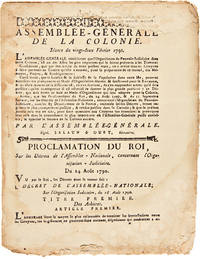
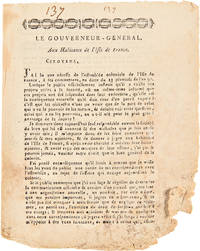
1791284301791. Folio. 24pp. Stitched as issued. Top corner of first leaf torn away affecting several lines of text. Lightly dampstained and worn throughout. Still very good. Early and unrecorded imprint from the colonial press at the French colony of Mauritius also known as the Ile de France. Issued at a critical moment at the beginning of the French Revolution the lengthy text concerns the government and judiciary of the island together with a proclamation by the King dated August 24 1790. The text nominally recognizes the authority of the King while taking measures to establish major autonomy of local government. The Dutch were the first Europeans to become interested in the island taking possession in 1598. After exploiting the island's dense forests for a century and introducing the cultivation of sugar cane and cotton in 1710 the Dutch abandoned the colony. The French soon claimed it as "Ile de France" and the island remained under the control of the French East India Company until 1767. During the long war between France and England at the beginning of the 19th century Mauritius proved to be an important strategic naval base and as a result the British took charge of the island in 1810 and the Treaty of Paris confirmed official British possession in 1814. It remained an important sugar producing colony and in the 20th century agricultural production was expanded to include tea rice and other produce. Printing began on Mauritius in 1768. During the French period until 1810 only about 400 imprints were produced mostly in the form of official documents and newspapers though there are also almanacs and a few other items. All are quite rare. No copies located in OCLC and not recorded by Toussaint in his bibliography of Mauritius imprints. unknown books
1791WRCAM48597Isle de France: Chez F.N. Bolle 1791. 24pp. Folio. Stitched as issued. Top corner of first leaf torn away affecting several lines of text. Lightly dampstained and worn throughout. Still nearly very good. Early and unrecorded imprint from the colonial press at the French colony of Mauritius also known as the Ile de France. Issued at a critical moment at the beginning of the French Revolution the lengthy text concerns the government and judiciary of the island together with a proclamation by the King dated Aug. 24 1790. The text nominally recognizes the authority of the King while taking measures to establish major autonomy of local government. <br> <br> The Dutch were the first Europeans to become interested in the island taking possession in 1598. After exploiting the island's dense forests for a century and introducing the cultivation of sugar cane and cotton in 1710 the Dutch abandoned the colony. The French soon claimed it as "Ile de France" and the island remained under the control of the French East India Company until 1767. During the long war between France and England at the beginning of the 19th century Mauritius proved to be an important strategic naval base. The British took charge of the island in 1810 and the Treaty of Paris confirmed official British possession in 1814. It remained an important sugar producing colony and in the 20th century agricultural production was expanded to include tea rice and other produce. <br> <br> Printing began on Mauritius in 1768. During the French period until 1810 only about 400 imprints were produced mostly in the form of official documents and newspapers although there are also almanacs and a few other items. All are quite rare. No copies located in OCLC and not recorded by Toussaint in his bibliography of Mauritius imprints. Chez F.N. Bolle unknown books
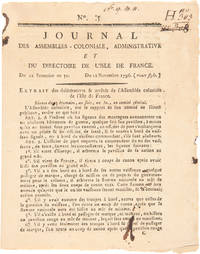
1790WRCAM48602Isle de France: Imprimerie Royale 1790. 29pp. Folio. Printed self-wrappers. Folded sheets several leaves loose. Moderate wear and soiling heavier to wrapper. Wrapper with some minor loss not affecting text. Good. Early and unrecorded imprint from the colonial press at the French colony of Mauritius also known as the Ile de France. An extract from the journals of the "Délibérations & Arretés de L'Assemblée- Générale de la Colonie de l'Isle de France" dated Sept. 25 1790 this document records the steps made to establish what was largely self-government at the outset of the French Revolution. <br> <br> The Dutch were the first Europeans to become interested in the island taking possession in 1598. After exploiting the island's dense forests for a century and introducing the cultivation of sugar cane and cotton in 1710 the Dutch abandoned the colony. The French soon claimed it as "Ile de France" and the island remained under the control of the French East India Company until 1767. During the long war between France and England at the beginning of the 19th century Mauritius proved to be an important strategic naval base. The British took charge of the island in 1810 and the Treaty of Paris confirmed official British possession in 1814. It remained an important sugar producing colony and in the 20th century agricultural production was expanded to include tea rice and other produce. <br> <br> Printing began on Mauritius in 1768. During the French period until 1810 only about 400 imprints were produced mostly in the form of official documents and newspapers although there are also almanacs and a few other items. All are quite rare. No copies located in OCLC and not recorded by Toussaint in his bibliography of Mauritius imprints. Imprimerie Royale unknown books
1790284331790. Folio. 2 9pp. Printed self-wrappers. Folded sheets several leaves loose. Moderate wear and soiling heavier to wrapper. Wrapper with some minor loss not affecting text. Early and unrecorded imprint from the colonial press at the French colony of Mauritius also known as the Ile de France. An extract from the journals of the "Délibérations & Arretés de L'Assemblée-Générale de la Colonie de l'Isle de France" dated Sept. 25 1790 this document records the steps made to establish what was largely self-government at the outset of the French Revolution. The Dutch were the first Europeans to become interested in the island taking possession in 1598. After exploiting the island's dense forests for a century and introducing the cultivation of sugar cane and cotton in 1710 the Dutch abandoned the colony. The French soon claimed it as "Ile de France" and the island remained under the control of the French East India Company until 1767. During the long war between France and England at the beginning of the 19th century Mauritius proved to be an important strategic naval base and as a result the British took charge of the island in 1810 and the Treaty of Paris confirmed official British possession in 1814. It remained an important sugar producing colony and in the 20th century agricultural production was expanded to include tea rice and other produce. Printing began on Mauritius in 1768. During the French period until 1810 only about 400 imprints were produced mostly in the form of official documents and newspapers though there are also almanacs and a few other items. All are quite rare. No copies located in OCLC and not recorded by Toussaint in his bibliography of Mauritius imprints. unknown books
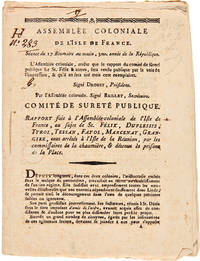
1794284251794. Small quarto. 28pp. Stitched as issued. Contemporary notation on first page some contemporary underlining in text. Minor soiling. Very good. A remarkable early imprint from the colonial press at the French colony of Mauritius also known as the Ile de France in the south Indian Ocean. The text contains a report of the French Revolutionary Committee of Public Safety regarding prisoners arrested on the island of Réunion being held as enemies of the Revolution. The document was printed in the capital Port Louis which was called Port de la Montagne from 1792 to 1795. The Dutch were the first Europeans to become interested in the island taking possession in 1598. After exploiting the island's dense forests for a century and introducing the cultivation of sugar cane and cotton in 1710 the Dutch abandoned the colony. The French soon claimed it as "Ile de France" and the island remained under the control of the French East India Company until 1767. During the long war between France and England at the beginning of the 19th century Mauritius proved to be an important strategic naval base and as a result the British took charge of the island in 1810 and the Treaty of Paris confirmed official British possession in 1814. It remained an important sugar producing colony and in the 20th century agricultural production was expanded to include tea rice and other produce. Printing began on Mauritius in 1768. During the French period until 1810 only about 400 imprints were produced mostly in the form of official documents and newspapers though there are also almanacs and a few other items. All are quite rare. No copies located in OCLC; Toussaint locates a copy at the Archives Nationales in Paris.<br/> <br/>Toussaint A247. unknown books
1794WRCAM48588Port de la Montagne i.e. Port Louis: Chez F.N. Bolle 1794. 28pp. Small quarto. Stitched as issued. Contemporary notation on first page some contemporary underlining in text. Minor soiling. Very good. A remarkable early imprint from the colonial press at the French colony of Mauritius also known as the Ile de France in the south Indian Ocean. The text contains a report of the French Revolutionary Committee of Public Safety regarding prisoners arrested on the island of Réunion being held as enemies of the Revolution. The document was printed in the capital Port Louis which was called Port de la Montagne from 1792 to 1795. <br> <br> The Dutch were the first Europeans to become interested in the island taking possession in 1598. After exploiting the island's dense forests for a century and introducing the cultivation of sugar cane and cotton in 1710 the Dutch abandoned the colony. The French soon claimed it as "Ile de France" and the island remained under the control of the French East India Company until 1767. During the long war between France and England at the beginning of the 19th century Mauritius proved to be an important strategic naval base. The British took charge of the island in 1810 and the Treaty of Paris confirmed official British possession in 1814. It remained an important sugar producing colony and in the 20th century agricultural production was expanded to include tea rice and other produce. <br> <br> Printing began on Mauritius in 1768. During the French period until 1810 only about 400 imprints were produced mostly in the form of official documents and newspapers though there are also almanacs and a few other items. All are quite rare. No copies located in OCLC; Toussaint locates a copy at the Archives Nationales in Paris. TOUSSAINT A247. Chez F.N. Bolle unknown books
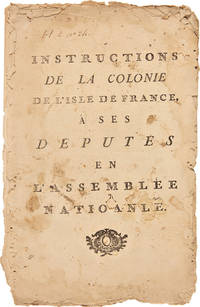
179028433Au Port Louis de l'Isle de France: L'Imprimerie Royale 1790. Folio. 13 x 8 1/4 inches. X2 A6. 4 1-9 3. 16 pp. Letterpress printed. Front wrapper printed black. Folded sheets three leaves loose. Title with woodcut Preface by Jollivet and Balu Instructions given by the Colony of the Isle of France to M. M. Collin and Coderc Articles I-XXI List of 31 signatories. Text in French. On laid paper watermarked with a crown cross and lion symbol. Woodcut printer's ornaments tail-piece. Early Mauritius imprint printed a year into the French Revolution from when it was the French colony of Isle de France; this letterpress document instructs the colony's deputies in the Assemblée Nationale in Paris on 21 articles.<br/> <br/> Early and unrecorded imprint from the colonial press at the French colony of Mauritius then known as the Isle de France. Isle de France was a French colony in the Indian Ocean from 1715 to 1810 comprising the African island now known as Mauritius and its dependent territories. It was governed by the French East India Company and formed part of the French colonial empire. Under the French the island witnessed major changes including the importation of enslaved people and the undertaking of vast infrastructural works that transformed the capital Port Louis into a major center of shipping warehousing and commerce. The present document records the steps made to establish what was largely an autonomous self-government of the colony a year into the French Revolution that was raging in Paris. Printing started in Mauritius in 1768. During the French colonial period until 1810 only about four hundred imprints were produced mostly official documents and newspapers though there are also almanacs and a few other sundry items. All are rare. No copies located in OCLC and it is not recorded by Toussaint in his bibliography of Mauritius imprints. The Dutch were the first Europeans to become interested in the island taking possession in 1598. After exploiting the island's dense forests for a century and introducing the cultivation of sugar cane and cotton in 1710 the Dutch abandoned the colony. The French soon claimed it as "Isle de France" and the island remained under the control of the French East India Company until 1767. During the long war between France and England at the beginning of the nineteenth century Mauritius proved to be an important strategic naval base and as a result the British took charge of the island in 1810. The Treaty of Paris confirmed official British possession in 1814. It remained an important sugar producing colony and in the twentieth century its agricultural production was expanded to include tea rice and other crops. L'Imprimerie Royale unknown
17903401A L'Isle de France, de l'Imprimerie Royale. M. DCC. LXXXX vol.in-8 (17,7 x 12 cm), titre, VIII pp., 140 pp. 12 pp., reliure modeste du dix-neuvième siècle, demi-basane neutre, titre calligrapié sur une étiquette au dos. Détails du contenu : Remarques historiques, VIII pp., Calendrier de janvier à décembre 1790, 48 pp.- Calculs et renseignements astronomiques, tableau dépliant du calcul de longitude suivant M. Willaumez, 18 pp. - Idée de la rade de Port-Louis, Enumération récente des habitans (sic) de la Terre. Statisfiques mondiales. Observations météorologiques au Port-Louis du 1er décembre1788 au 30 novembre 1789. Pronostics Météorologiques, 12 pp. - Idée de l'Isle de France (Historique). Renseignements administratifs. Gouvernement, Armée, Huissiers, Conseil Supérieur créé par Edit du Roi en 1771. Juridiction Royale, Avocats, Notaires, Imprimerie Royale, Clergé de l'Isle de France, Milice Coloniale, etc.,(38 pp). - Idée de l'Isle de Bourbon (Historique). Gouvernement, Armée, Conseil Supérieur par Edit du Roi. Juridiction, Notaires, Bureau des Postes, Soeurs de charité, Milice Coloniale, Paroisse de Saint-Paul, Sainte Suzanne et Saint André, Saint Benoit, Paroisse de Riviere d'abord. - Hygiène, Médecine, liste nominative de Centenaires, Anecdotes. Mesures et Poids divers, etc. (du pied du Roi ou de Paris et des différentes mesures), (23pp.). Arrivées et Départs des vaisseaux du Port-Louis, Isle de France. Depuis le 1er Décembre 1788 jusqu'au 1er Décembre 1789 (exclusivement (10 pp.). (ouvrage complet, en état d'usage, une double page désagrafée). "C'est à peu près entre 1760 et 1770 que l'invention de Gutenberg fit son apparition dans les colonies françaises du Nouveau Monde et de l'Orient dès le XVIème siècle ; il est vrai, des Portugais avaient introduit des presses dans plusieurs des pays lointains. Ce n'étaient là, toutefois, que des presses missionnaires dirigées par des religieux, jésuites principalement et qui ne servirent qu'à la propagation de la foi parmi les infidèles. La production des Presses de l'Ile de France peut se diviser ainsi : les almanachs, les journaux ou gazettes, les publications officielles, etc. Les almanaches qui comptent parmi les premiers "incunables" de l'Isle de France sont d'un intérêt tout particulier. Les annonces, Affiches et Avis divers pour les Colonies des Isles de France et de Bourbon, de Lambert, vécurent jusqu'en 1790. (Références bibliographiques : Auguste Toussaint, Revue Outre-Mers, 1948. Les débuts de l'imprimerie aux Iles Mascareignes).
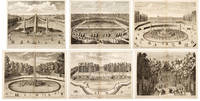
171553314c.1715. The Fountains at Versailles A set of six magnificent engravings of the Fountains at Versailles: 'Fontaine de Latone.' Artist: Engraved by Scotin G. A spectacular view of the Latona Fountain at Versailles as it was in the early eighteenth century surrounded by citizenry strolling courting and playing. The fountain was built in 1671 and still is still in existence. 'Fontaine de l'Encelade dans un des Bosquets des Jardin de Versailles.' Artist: Girard. A spectacular view of the 'Fontaine de l'Encelade' at Versailles. The centre fountain has a plume 78 feet high shooting from the mouth of a bronze giant and is surrounded by smaller fountains made from rocks from Mount Ossa and Olympia. The fountain is surrounded by citizenry strolling courting and playing. Two lines of text in French below the engraving describe the fountain. 'L'Isle Royale.' Engraved by Fonbonne. Magnificent engraving of L'Isle Royalea large pond at Versailles with seven 45 foot fountains. Courtiers stroll and a procession of hand drawn coaches snake along the walkway surrounding the pond. Elegant statues and manicured trees line the walkway. Four lines of text in French below the engraving describe the seven fountains. 'Fontaine d'Apollon.' Engraved by de Rochefort P. A spectacular view of the fountain of Apollo at Versailles as it was in the early eighteenth century surrounded by citizenry strolling courting and playing. The main fountain has the figure of Apollo being guided by four horses surrounded by water bearers. Text below the engraving gives a description and brief history of the fountain. It is still in existence today. 'Bassins de Neptune' Engraved by Daigremont A spectacular view of the Bassin de Neptune at Versailles in the early eighteenth century. Text below the engraving gives a description and brief history of the fountain: 'This grand piece of water is decorated with 22 beautiful vases designed by Le Brun.' translation. A fountain erupts from each vase. Six fifty foot fountains and many smaller fountains adorn this extraordinary water feature whilst wealthy courtiers amble around it. 'L'Arc de Triomphe.' Engraved by Baquoy Maurice. A detailed view of the opulent 'L'Arc de Triomphe' a woodland garden of fountains at Versailles in the early eighteenth century. Two lines of text below the engraving give a description and brief history. Numerous courtiers stroll amidst the profusion of fountains and cascades in a forest glade. Copper engraving. Fine condition good margins. Uncoloured. Size: 55 x 43 cm. 21½ x 17 inches. unknown
1791284301791. Folio. 10 3/4 x 8 1/4 inches. 24pp. Stitched as issued. Top corner of first leaf torn away affecting several lines of text. Lightly dampstained and worn throughout. Still very good. Early and unrecorded imprint from the colonial press at the French colony of Mauritius also known as the Ile de France. Issued at a critical moment at the beginning of the French Revolution the lengthy text concerns the government and judiciary of the island together with a proclamation by the King dated August 24 1790. The text nominally recognizes the authority of the King while taking measures to establish major autonomy of local government. The Dutch were the first Europeans to become interested in the island taking possession in 1598. After exploiting the island's dense forests for a century and introducing the cultivation of sugar cane and cotton in 1710 the Dutch abandoned the colony. The French soon claimed it as "Ile de France" and the island remained under the control of the French East India Company until 1767. During the long war between France and England at the beginning of the 19th century Mauritius proved to be an important strategic naval base and as a result the British took charge of the island in 1810 and the Treaty of Paris confirmed official British possession in 1814. It remained an important sugar producing colony and in the 20th century agricultural production was expanded to include tea rice and other produce. Printing began on Mauritius in 1768. During the French period until 1810 only about 400 imprints were produced mostly in the form of official documents and newspapers though there are also almanacs and a few other items. All are quite rare. No copies located in OCLC and not recorded by Toussaint in his bibliography of Mauritius imprints. unknown
1794284251794. Small quarto. 9 x 6 3/4 inches. 28pp. Stitched as issued. Contemporary notation on first page some contemporary underlining in text. Minor soiling. A remarkable early imprint from the colonial press at the French colony of Mauritius also known as the Ile de France in the south Indian Ocean. The text contains a report of the French Revolutionary Committee of Public Safety regarding prisoners arrested on the island of Réunion being held as enemies of the Revolution. The document was printed in the capital Port Louis which was called Port de la Montagne from 1792 to 1795. The Dutch were the first Europeans to become interested in Mauritius taking possession in 1598. After exploiting the island's dense forests for a century and introducing the cultivation of sugar cane and cotton in 1710 the Dutch abandoned the colony. The French soon claimed it as "Ile de France" and the island remained under the control of the French East India Company until 1767. During the long war between France and England at the beginning of the 19th century Mauritius proved to be an important strategic naval base and as a result the British took charge of the island in 1810 and the Treaty of Paris confirmed official British possession in 1814. It remained an important sugar producing colony and in the 20th century agricultural production was expanded to include tea rice and other produce. Printing began on Mauritius in 1768. During the French period until 1810 only about 400 imprints were produced mostly in the form of official documents and newspapers though there are also almanacs and a few other items. All are quite rare. No copies located in OCLC; Toussaint locates a copy at the Archives Nationales in Paris.<br/> <br/> Toussaint A247. unknown
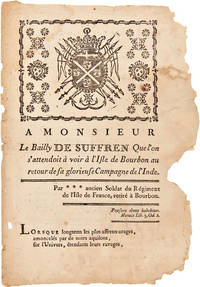
1784WRCAM48601Isle de France: Imprimerie Royale 1784. 4pp. on a single folded sheet. Quarto. Moderately worn with loss at fore- edge and gutter margins not affecting text. Lightly soiled and dampstained. Good. An early and unrecorded imprint from the colonial press at the French colony of Mauritius also known as the Ile de France. The text comprises a poem in eleven stanzas by an anonymous soldier from the Regiment of the Isle de France who retired to the island of Bourbon. As most early imprints from Mauritius are official documents this piece a work of local literature is particularly interesting and desirable. <br> <br> The Dutch were the first Europeans to become interested in the island taking possession in 1598. After exploiting the island's dense forests for a century and introducing the cultivation of sugar cane and cotton in 1710 the Dutch abandoned the colony. The French soon claimed it as "Ile de France" and the island remained under the control of the French East India Company until 1767. During the long war between France and England at the beginning of the 19th century Mauritius proved to be an important strategic naval base; as a result the British took charge of the island in 1810 and the Treaty of Paris confirmed official British possession in 1814. It remained an important sugar producing colony and in the 20th century agricultural production was expanded to include tea rice and other produce. <br> <br> Printing began on Mauritius in 1768. During the French period until 1810 only about 400 imprints were produced mostly in the form of official documents and newspapers though there are also almanacs and a few other items. All are quite rare. No copies located in OCLC and not recorded by Toussaint in his bibliography of Mauritius imprints. Imprimerie Royale unknown books
1784284321784. Quarto. 4pp. on a single folded sheet. Moderately worn with loss at fore edge and gutter margins not affecting text. Lightly soiled and dampstained. Early and unrecorded imprint from the colonial press at the French colony of Mauritius also known as the Ile de France. The text comprises a poem in eleven stanzas by an anonymous soldier from the Regiment of the Isle de France retired to the island of Bourbon. As most early imprints from Mauritius are official documents this piece as a work of local literature is particularly interesting and desirable. The Dutch were the first Europeans to become interested in the island taking possession in 1598. After exploiting the island's dense forests for a century and introducing the cultivation of sugar cane and cotton the Dutch abandoned the colony in 1710. The French soon claimed it as "Ile de France" and the island remained under the control of the French East India Company until 1767. During the long war between France and England at the beginning of the 19th century Mauritius proved to be an important strategic naval base and as a result the British took charge of the island in 1810 and the Treaty of Paris confirmed official British possession in 1814. It remained an important sugar producing colony and in the 20th century agricultural production was expanded to include tea rice and other produce. Printing began on Mauritius in 1768. During the French period until 1810 only about 400 imprints were produced mostly in the form of official documents and newspapers though there are also almanacs and a few other items. All are quite rare. No copies located in OCLC and not recorded by Toussaint in his bibliography of Mauritius imprints. unknown books
1796284291796. Small quarto. 4pp. Single folded sheet. Contemporary manuscript notations. Light soiling and wear. Early and unrecorded imprint from the colonial press at the French colony of Mauritius also known as the Ile de France. The text contains the deliberations and acts of the colonial assembly of the island at a time when it was operating virtually independent from France. The acts all concern measures to be taken for the defense of the island at a time when British invasion was feared. The Dutch were the first Europeans to become interested in the island taking possession in 1598. After exploiting the island's dense forests for a century and introducing the cultivation of sugar cane and cotton the Dutch abandoned the colony in 1710. The French soon claimed it as "Ile de France" and the island remained under the control of the French East India Company until 1767. During the long war between France and England at the beginning of the 19th century Mauritius proved to be an important strategic naval base and as a result the British took charge of the island in 1810 and the Treaty of Paris confirmed official British possession in 1814. It remained an important sugar producing colony and in the 20th century agricultural production was expanded to include tea rice and other produce. Printing began on Mauritius in 1768. During the French period until 1810 only about 400 imprints were produced mostly in the form of official documents and newspapers though there are also almanacs and a few other items. All are quite rare. No copies located in OCLC and not recorded by Toussaint in his bibliography of Mauritius imprints. unknown
1796WRCAM48596Port Nord-Ouest: Chez F.N. Bolle 1796. 4pp. Small quarto. Single folded sheet. Contemporary manuscript notations. Light soiling and wear. Very good. Early and unrecorded imprint from the colonial press at the French colony of Mauritius also known as the Ile de France. The text contains the deliberations and acts of the colonial assembly of the island at a time when it was operating virtually independent from France. The acts all concern measures to be taken for the defense of the island at a time when British invasion was feared. <br> <br> The Dutch were the first Europeans to become interested in the island taking possession in 1598. After exploiting the island's dense forests for a century and introducing the cultivation of sugar cane and cotton in 1710 the Dutch abandoned the colony. The French soon claimed it as "Ile de France" and the island remained under the control of the French East India Company until 1767. During the long war between France and England at the beginning of the 19th century Mauritius proved to be an important strategic naval base and as a result the British took charge of the island in 1810 and the Treaty of Paris confirmed official British possession in 1814. It remained an important sugar producing colony and in the 20th century agricultural production was expanded to include tea rice and other produce. <br> <br> Printing began on Mauritius in 1768. During the French period until 1810 only about 400 imprints were produced mostly in the form of official documents and newspapers though there are also almanacs and a few other items. All are quite rare. No copies located in OCLC and not recorded by Toussaint in his bibliography of Mauritius imprints. Chez F.N. Bolle unknown books
1796284291796. Small quarto. 4pp. Single folded sheet. Contemporary manuscript notations. Light soiling and wear. Early and unrecorded imprint from the colonial press at the French colony of Mauritius also known as the Ile de France. The text contains the deliberations and acts of the colonial assembly of the island at a time when it was operating virtually independent from France. The acts all concern measures to be taken for the defense of the island at a time when British invasion was feared. The Dutch were the first Europeans to become interested in the island taking possession in 1598. After exploiting the island's dense forests for a century and introducing the cultivation of sugar cane and cotton the Dutch abandoned the colony in 1710. The French soon claimed it as "Ile de France" and the island remained under the control of the French East India Company until 1767. During the long war between France and England at the beginning of the 19th century Mauritius proved to be an important strategic naval base and as a result the British took charge of the island in 1810 and the Treaty of Paris confirmed official British possession in 1814. It remained an important sugar producing colony and in the 20th century agricultural production was expanded to include tea rice and other produce. Printing began on Mauritius in 1768. During the French period until 1810 only about 400 imprints were produced mostly in the form of official documents and newspapers though there are also almanacs and a few other items. All are quite rare. No copies located in OCLC and not recorded by Toussaint in his bibliography of Mauritius imprints. unknown books
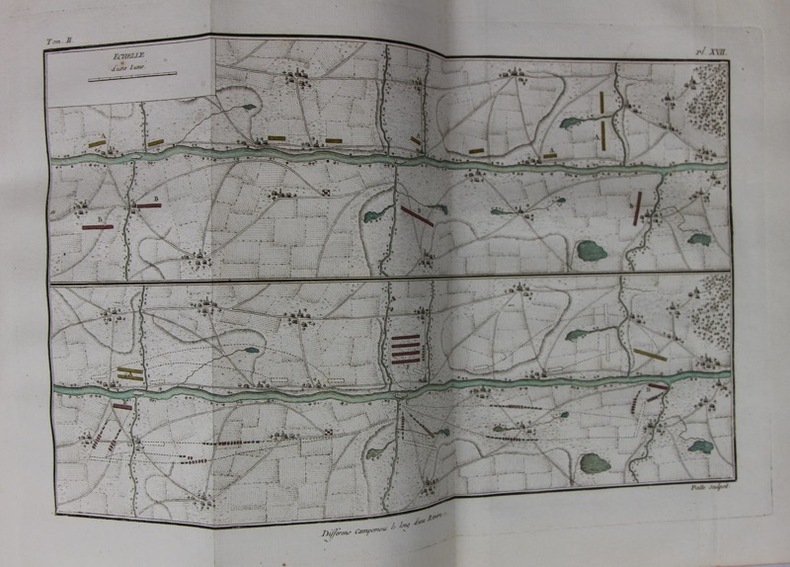
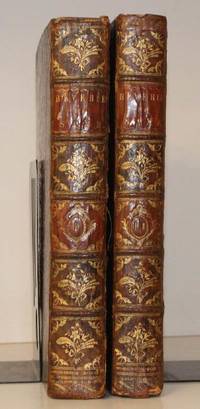
1757104163Amsterdam et Leipzig, Arkstée & Merkus 1757 2 volumes in-4 reliés en plein veau fauve de l'époque, aux plats ornés d'un triple filet d'encadrement doré, dos à nerfs ornés de motifs floraux, pièces de titre et de tomaison, double filet doré sur les coupes, tranches rouge - coiffes arasées, début de fente en queue du premier plat du T I, mors épidermurés, frottements aux plats, coins percés - T. 1 : [5 ff.], CXXXIV pp., 159 pp.; T. 2 : [2 ff.], 259 pp. Ouvrage illustré de 84 planches hors-texte 61 dépliantes, dessinées par Pierre Patte d'après l'auteur et gravées sur cuivre par Moitte, Tardieu et Patte lui-même, finement mises en couleurs sauf 4, représentant des costumes militaires et des plans de bataille.
1788284311788. Folio. Broadsheet 12 3/4 x 8 inches. Moderate wear and soiling small hole in center of sheet affecting a few letters of text. Early and unrecorded imprint from the colonial press at the French colony of Mauritius also known as the Ile de France. The text contains the articles for establishing a Bureau de Charité for the island. The Dutch were the first Europeans to become interested in the island taking possession in 1598. After exploiting the island's dense forests for a century and introducing the cultivation of sugar cane and cotton the Dutch abandoned the colony in 1710. The French soon claimed it as "Ile de France" and the island remained under the control of the French East India Company until 1767. During the long war between France and England at the beginning of the 19th century Mauritius proved to be an important strategic naval base and as a result the British took charge of the island in 1810 and the Treaty of Paris confirmed official British possession in 1814. It remained an important sugar producing colony and in the 20th century agricultural production was expanded to include tea rice and other produce. Printing began on Mauritius in 1768. During the French period until 1810 only about 400 imprints were produced mostly in the form of official documents and newspapers though there are also almanacs and a few other items. All are quite rare. No copies located in OCLC and not recorded by Toussaint in his bibliography of Mauritius imprints. unknown books
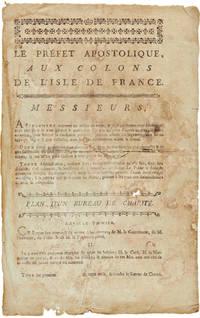
1788WRCAM48600Isle de France: Imprimerie Royale 1788. Broadsheet 12 3/4 x 8 inches. Moderate wear and soiling; small hole in center of sheet affecting a few letters of text. Good. Early and unrecorded imprint from the colonial press at the French colony of Mauritius also known as the Ile de France. The text contains the articles for establishing a Bureau de Charité for the island. <br> <br> The Dutch were the first Europeans to become interested in the island taking possession in 1598. After exploiting the island's dense forests for a century and introducing the cultivation of sugar cane and cotton in 1710 the Dutch abandoned the colony. The French soon claimed it as "Ile de France" and the island remained under the control of the French East India Company until 1767. During the long war between France and England at the beginning of the 19th century Mauritius proved to be an important strategic naval base. The British took charge of the island in 1810 and the Treaty of Paris confirmed official British possession in 1814. It remained an important sugar producing colony and in the 20th century agricultural production was expanded to include tea rice and other produce. <br> <br> Printing began on Mauritius in 1768. During the French period until 1810 only about 400 imprints were produced mostly in the form of official documents and newspapers though there are also almanacs and a few other items. All are quite rare. No copies are located in OCLC and not recorded by Toussaint in his bibliography of Mauritius imprints. Imprimerie Royale unknown books
175751567Arkstee et Merkus Amsterdam and Liepzig 1757. 2 vols. roy. 8vo. First Edition Large Paper text in French on laid paper with 84 fine engraved plates 52 large and folding ALL BUT TWO FINELY COLOURED BY HAND and numerous fine engraved head- and tail-pieces title and first Avertissement leaf of first volume creased; contemporary full tree calf sides framed in gilt backs with raised bands second and fourth compartments with red leather labels framed lettered and numbered in gilt all other compartments richly framed and tooled in gilt with floral sprays red sprinkled edges boards mildly age-marked upper joint of first volume cracked but sound all other joints mildly rubbed but bindings wholly sound A REMARKABLY BRIGHT FRESH CLEAN CRISP COPY WITH BROAD MARGINS IN WHOLLY UNRESTORED PERIOD BINDING. With the eighteenth century personal bookplate of Steuart of the Isle of Man overlaid by the nineteenth-century armorial bookplate of Sir John Ogilvy of Inverquharity on front paste-downs. From the broad margins this may well be a Large Paper or similar superior issue. The later bookplate is that of Sir John Ogilvy 9th Baronet 1803-1890 sometime MP for Dundee and Convener of Forfarshire. De Saxe 1696-1750 was a distinguished soldier of the first half of the eighteenth century serving first the Holy Roman Empire and then the Imperial Army before French service as Marshal General of France. He is remembered for his victories during the Austrian Succession most notably at Fontenoy in 1745 and for this most influential military treatise published shortly after his death. A SPLENDID COPY WITH NOTABLE PROVENANCE. Jähns II 1502; Brunet V 174. Arkstee et Merkus, Amsterdam and Liepzig, hardcover
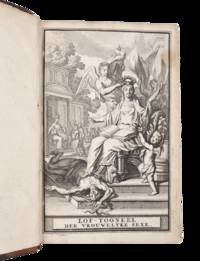
17042202<p>48 378 12 pp. With an engraved frontispiece.</p><p>Contemporary mottled calf with ribbed and gold-tooled spine sprinkled edges.</p><p>Rare first and only edition of a peculiar and polemical work which uses a female abecedarium to attack Catholic invective against women. Arranged alphabetically—from <em>Avidum animal</em> to <em>Zelus Zelotipus</em>—the author ironically surveys women's wit eloquence moral qualities and physical appearance combining satire polemic and learned rhetoric. The book also offers insight into early-eighteenth-century Protestant debates on marriage gender and Catholic religious culture.<br />The author was an Amsterdam merchant and former Catholic priest who converted to Calvinism and became known for his vehemently anti-Catholic writings often directed against monastic life and clerical celibacy. <em>Zeege-pralende lof-tooneel der vrouwelyke sexe</em> must be read within this broader religious and ideological agenda: Johannes Mauritius presents Catholic denunciations of women as a deliberate strategy employed by "the Papists" to justify the prohibition of marriage and to lure men into the cloister. He was the father of the prodigy poet jurist and later Suriname governor Joan Jacob Mauricius 1692–1768 whose early intellectual development was shaped by his father's militant anti-Catholicism and literary ambitions.</p><p><strong>Condition: </strong>corners slightly bumped front joint splitting. Small faint stain on the first few pages see pictures. Otherwise in very good condition.</p><p><strong>Reference: </strong>Muller 482; De Vries 190; Scheepers I 452.</p> Johannes Strander
1796284281796. Small quarto. 8pp. Loose sheets. Contemporary manuscript notations. Moderately soiled and worn. Final page loose torn in center of text with minor loss. Early imprint from the colonial press at the French colony of Mauritius also known as the Ile de France. The text deals with the Governor's reserve powers; it is signed in type by Governor Magallon. The Dutch were the first Europeans to become interested in the island taking possession in 1598. After exploiting the island's dense forests for a century and introducing the cultivation of sugar cane and cotton the Dutch abandoned the colony in 1710. The French soon claimed it as "Ile de France" and the island remained under the control of the French East India Company until 1767. During the long war between France and England at the beginning of the 19th century Mauritius proved to be an important strategic naval base and as a result the British took charge of the island in 1810 and the Treaty of Paris confirmed official British possession in 1814. It remained an important sugar producing colony and in the 20th century agricultural production was expanded to include tea rice and other produce. Printing began on Mauritius in 1768. During the French period until 1810 only about 400 imprints were produced mostly in the form of official documents and newspapers though there are also almanacs and a few other items. All are quite rare. No copies located in OCLC; Toussaint locates a copy at the Mauritius Archives.<br/> <br/> Toussaint A298. Toussaint Early Printing in Mauritius Réunion Madagascar and the Seychelles p. 17. unknown
1796284281796. Small quarto. 8pp. Loose sheets. Contemporary manuscript notations. Moderately soiled and worn. Final page loose torn in center of text with minor loss. Early imprint from the colonial press at the French colony of Mauritius also known as the Ile de France. The text deals with the Governor's reserve powers; it is signed in type by Governor Magallon. The Dutch were the first Europeans to become interested in the island taking possession in 1598. After exploiting the island's dense forests for a century and introducing the cultivation of sugar cane and cotton the Dutch abandoned the colony in 1710. The French soon claimed it as "Ile de France" and the island remained under the control of the French East India Company until 1767. During the long war between France and England at the beginning of the 19th century Mauritius proved to be an important strategic naval base and as a result the British took charge of the island in 1810 and the Treaty of Paris confirmed official British possession in 1814. It remained an important sugar producing colony and in the 20th century agricultural production was expanded to include tea rice and other produce. Printing began on Mauritius in 1768. During the French period until 1810 only about 400 imprints were produced mostly in the form of official documents and newspapers though there are also almanacs and a few other items. All are quite rare. No copies located in OCLC; Toussaint locates a copy at the Mauritius Archives.<br/> <br/>Toussaint A298. unknown books
1796WRCAM48594Port Nord-Ouest: Chez F.N. Bolle 1796. 8pp. Small quarto. Loose sheets. Contemporary manuscript notations. Moderately soiled and worn. Final page loose torn in center of text with minor loss. About good. Early imprint from the colonial press at the French colony of Mauritius also known as the Ile de France. The text deals with the Governor's reserve powers; it is signed in type by Governor Magallon. <br> <br> The Dutch were the first Europeans to become interested in the island taking possession in 1598. After exploiting the island's dense forests for a century and introducing the cultivation of sugar cane and cotton in 1710 the Dutch abandoned the colony. The French soon claimed it as "Ile de France" and the island remained under the control of the French East India Company until 1767. During the long war between France and England at the beginning of the 19th century Mauritius proved to be an important strategic naval base and as a result the British took charge of the island in 1810 and the Treaty of Paris confirmed official British possession in 1814. It remained an important sugar producing colony and in the 20th century agricultural production was expanded to include tea rice and other produce. <br> <br> Printing began on Mauritius in 1768. During the French period until 1810 only about 400 imprints were produced mostly in the form of official documents and newspapers though there are also almanacs and a few other items. All are quite rare. No copies located in OCLC; Toussaint locates a copy at the Mauritius Archives. TOUSSAINT A298. Chez F.N. Bolle unknown books
17567435<b><i>Les Reveries ou Memoires Sur L'Art de la Guerre de Maurice Comte de Saxe Duc de Courlande et de Semigalle Marechal-General des Armées de S.M.T.C. &c. &c. &c. Dediés a Messieurs les Officiers Generaux.</i></b><i> Par Mr. de Bonneville Capitaine Ingenieur de Campagne de Sa Maheste le Roi de Prusse.</i><br /><i><br /></i>Illustrated with 40 full-page and folding plates and 42 engraved vignettes. Folio. Bound in full mid-18th century English paneled calf expertly rebacked with raised bands and morocco spine label. A La Haye Chez Pierre Gosse Junior . . . 1756. First Edition.<p>Maurice Comte de Saxe was the greatest French military general of the 18th century. Having been born as the illegitimate son of Augustus II King of Poland he eventually rose to become Marshall of France. His greatest exploits came during the War of the Austrian Succession where he seized Prague by surprise in a daring invasion captured the fortress of Eger Cheb and gained his famous victory at Fontenoy. The latter made possible the 1745 Jacobite rising and was credited by Napoleon with preserving the <i>Ancien Regime</i> in France for a further 30 years.</p><p>Saxe's <i>Reveries</i> is one of the great classics of 18th century military strategy and theory. "He puts forward his ideal military model his 'legion' and taking issue with the views and practices of his age he advances many original ideas. However rather than discussing his military doctrines the aim of this book is to elucidate the intellectual premises that dominated his mind: he saw a need to subject military affairs to reasoned criticism and intellectual treatment and the ensuing military doctrines were perceived as forming a definitive system." Gat <i>Origins of Military Thought</i>.</p>With the bookplate of the United Service Institution presented by Major General Samuel Lambert. Samuel Lambert served with distinction in the campaign under Sir John Moore in 1808-09 and in the expedition to Walcheren in the later year. He was engaged in the defense of Cadiz in 1810 - 1811 and served throughout the peninsular campaigns of 1812 1813 and 1814. He died in 1848 while serving as Commander of Her Majesty's Forces in Jamaica. Minor wear to binding at edges and corners; o/w a fine wide-margined copy.