EUSTATHIUS, Thessalonicensis.MareMagnum

18 033 résultats
4 volumi in-folio (346x237), pp. (4), 620; 621-1376 (manca l'ultimo bianco); (2), 1379-1970; ff. n. n. 6, 204; stupenda legatura di inizio XX secolo di J. Clarke in marocchino blu, titolo in oro ai dorsi e armi con monogramma di Theodore Williams sui piatti, larga dentelle interna. Impresa tipogr. del Blado ai tre titoli (il volume secondo non ha titolo separato); 3 stemmi silogr. ai ff. preliminari del vol. IV. Unica edizione impressa con lo splendido corsivo greco intagliato da Joannes Honorius per volere del Cardinale Marcello Cervini. Se ne stamparono 1275 esemplari su carta e 2 su pergamena (cfr. L. Dorez, Le Cardinal Cervini et l' imprimerie à Rome). Il volume I contiene il commento dell'Iliade, i vol. II e III, rispettivamente, il testo dell'Iliade e dell'Odissea, mentre il vol. IV, termina il commento ed ha copiosi e dettagliati indici, compilati da Matteo Devarius, impressi su tre colonne in corpo più piccolo. Prima edizione del Commento ai poemi omerici, di Eustazio di Tessalonica, dotto bizantino vissuto nel XII secolo. All'epoca fu il più vasto e stimato, tra i commentari conosciuti, resta ancor oggi assai prezioso per l' immensa ricchezza del materiale che vi è raccolto e per la grande quantità di citazioni di opere andate perdute; i testi sono assai corretti. Splendido, monumentale capolavoro della tipografia greca, che richiese al Blado nove anni di lavoro in collaborazione con altri tipografi, in particolare con Bernardo Giunta. Superbo esemplare a pieni margini, freschissimo. ''Trésor d'érudition grècque...'' (Renouard). . Cfr. A. Tinto, 'The history of a sixteenth-century Greek type, The Library, 5th series, 1970, pp.285-93). Mortimer, Harvard Italian 176. Ediz. romane del Blado 107 e 1202. Stimatissima dal Dibdin, Greek and Latin Classics, II, p. 48-49: ''among the most splendid monuments in the world of greek erudition and greek printing. Heyne has emphatically distinguished these Commentaries of Eustathius as among the most admirable eztant of the text of the poet.. They are the fountain-head from which almost inexhaustible supplies may be drawn for the illustration of the great poet. Of the above editions, that of Rome is not only the first, but the most splendidly executed performance..''. Renouard, Bibl. d' un amateur, II, p. 138: ''Trésor d'érudition grècque, espèce de sanctuaire dans lequel n'ont accés que ceux qui déjà n' ont fait des progrés dans l' étude des anciens classiques.''.
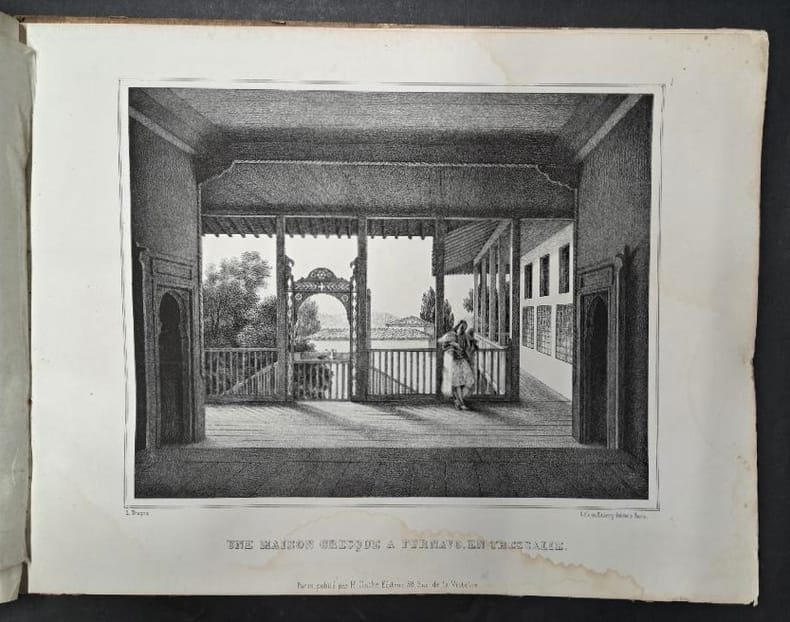
1825124561Paris, publié par H. Gache, éditeur, 56 Rue de la Victoire 1825 In-folio à l’italienne 27 x 34 cm. Cartonnage de l’époque, dos toile beige muet, album illustré de 13 lithographies sous serpentes, exécutées par Thierry Frères d'après les dessins de Louis Dupré, tirées sur Chine appliqué, chaque planche dans un cadre et avec légende ; la première, une vue de l'Acropole d'Athènes, avec le titre en marge supérieure est contrecollée sur le premier plat de couverture. Très rare tiré à part de l’ouvrage “Voyage à Athènes”. Cartonnage terni avec mouillures, certaines planches avec mouillures marginales, serpentes froissées.
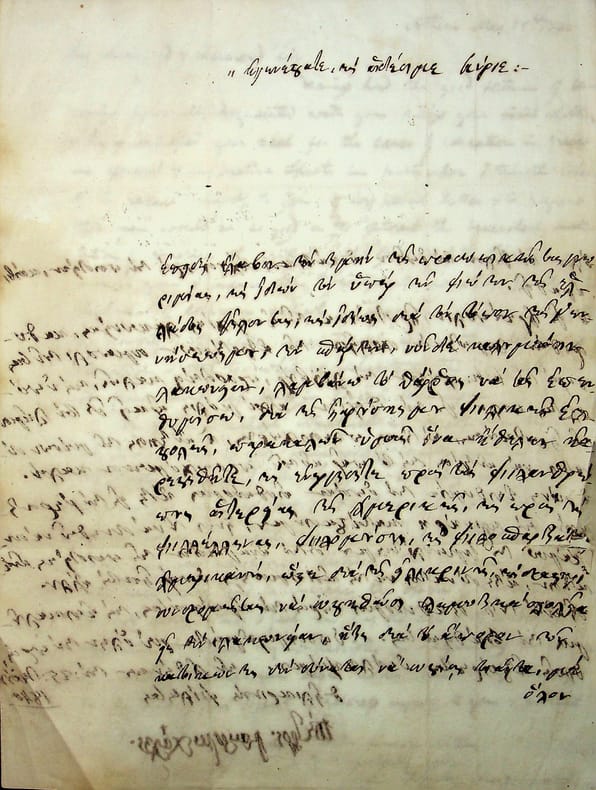
021095[Philhellénisme, Grèce] Pétros dit Petrobey Mavromichális (1765-1848), homme d'état grec, héros de la guerre d'indépendance grecque, ?????? ?????????? ????????????. L.A.S., Athènes, 25 mai 1840, 3p in-4. Extraordinaire lettre en grec (2p) entièrement autographe et signée, suivie de la traduction d'époque en anglais (1p), adressée à Charles Lowell (1782-1861), religieux unitarien américain. Dans cette lettre mentionnant notamment son grand âge, il salue le travail des deux missionnaires américains dans sa région, la Laconie : George William Leyburn (1809-1875) - qui mourra en Grèce - et Samuel Rutherford Houston (1806-1887). Ils avaient en effet fondé une école à Areopolis. Rappelons que Mavromichalis fut le dernier Bey de la Magne (sous l'Empire Ottoman) mais aussi celui qui proclama le soulèvement de la Magne le 17 mars 1821. Il est, en 1840, un des plus hauts et un des plus anciens dignitaires grecs. Charles Lowell, qui est le père du poète romantique James Russell Lowell, était déjà un abolitionniste comme le sera son fils. Il est aussi un religieux influent, notamment dans les milieux philhellènes américains. Petite déchirure près du pli d'origine (petit manque minime). Extraordinaire témoignage de l'influence américaine et protestante en Grèce après son indépendance, le combat de Mavromichalis pour l'indépendance étant devenu un combat pour l'éducation. [517]
Xilografia, 1482. Magnifica prova, impressa su carta vergata coeva, in splendida coloritura coeva, minimi restauri alla piega centrale perfettamente eseguiti, per il resto in ottimo stato di conservazione. Rarissima carta a proiezione trapezoidale, tratta dall’edizione del 1486 della Geographia di Ulm. Donnus Nicolaus Germanus era un cartografo di origine tedesca attivo a Firenze nella seconda metà del XV secolo. Sconosciute sono le sue origini, ma il nome Donnus, diminutivo di Dominus, lascia intendere che si tratti di un monaco benedettino probabilmente originario di Reichenbach. Pioniere della cartografia, si dedicò allo studio della traduzione latina della Geographia di Tolomeo curata da Jacopo Angelo. Nel 1466 il Germanus (Nicolaus Laurentii), che lavorava a Firenze come cosmografo presentò in visione a Borso d’Este, duca di Ferrara, il manoscritto di una Geographia, come visto a base dell’edizione di Bologna del 1477. Nel 1468 Nicolaus produsse la sua terza edizione della Geographia, questa volta spostando la Groenlandia a nord della Scandinavia e l’Islanda a Nord Ovest, alla stessa latitudine. A partire dalle mappe di questa terza versione di Nicolaus, furono realizzate le edizioni a stampa della Geographia di Ulm del 1482 e 1486. Si tratta della prime edizioni stampate al di fuori dell’Italia. Il lavoro contiene 32 carte, delle quali cinque non di derivazione tolemaica, tutte realizzate, a differenza delle versioni italiane, in silografia. Le incisioni su legno sono di Johannes Schnitzer di Arnheim. L’opera è considerata come la più elaborata ed importante edizione della Geographia, proprio perché per la prima volta erano aggiunte alcune carte geografiche di fattura moderna, che servivano da paragone con quelle tolemaiche. La successiva ristampa del 1486, fu edita dal Reger, che acquisì le matrici nel 1484 da Holle. Le matrici in legno furono ristampate senza variazioni sostanziali; unico cambiamento è il testo al verso delle carte (dove è tralasciata la decorazione) ed il titolo di ognuna, aggiunto nella parte superiore della mappa. L’edizione del Reger per la prima volta introduce il Registrum alphabeticum e il De locis et mirabili bus mundi, che diverranno molto popolari tanto da essere inseriti nelle successive edizioni del Tolomeo di Roma del 1490 e 1507/8. Magnifico esemplare di questa importante carta. Dimensioni 550/520x365. Woodcut, 1482. Magnificent proof, printed on contemporary laid paper, in beautiful contemporary colouring, minimal restoration at center fold perfectly executed, otherwise in excellent condition. Very rare map on trapezoid projections, from the edition of 1486 of the Geographia of Ulm. Donnus Nicolaus Germanus was a cartographer of German origin active in Florence in the second half of the fifteenth century. Its origins are unknown, but the name Donnus, short for Dominus, suggests that it is probably a Benedictine native of Reichenbach. A pioneer in cartography, he devoted himself to the study of the Latin translation of Ptolemy's Geographia curated by Jacopo Angelo. In 1466 Germanus (Nicolaus Laurentii), who worked in Florence as cosmographer, appeared in a vision to Duke of Ferrara Borso d'Este, the manuscript of a Geographia. In 1468 Nicolaus produced his third edition of the Geographia, this time moving to the north of Scandinavia, Greenland and Iceland in the North West, at the same latitude. Starting from the maps of this third version of Nicolaus, were made the printed editions of the Geographia of Ulm in 1482 and 1486. This is the first editions printed outside Italy. The work contains 32 maps, of which five are not derived from the Ptolemaic, all made, unlike the Italian versions, in woodcut. The woodcuts are by Johannes Schnitzer of Arnheim. The work is considered as the most elaborate and important edition of the Geographia, because for the first time were added some maps of recent construction, which served as a comparison with the Ptolemaic. The next reprint of 1486, was published by Reger, who acquired the matrices in 1484 by Holle. The plates were reprinted without material changes; the only change is the text on the reverse of the map (where the decoration is omitted) and the title of each, added to the top of the map. The edition of Reger for the first time introduces the Registrum alphabeticum and De locis et mirabili bus mundi, which will become popular enough to be included in subsequent editions of Ptolemy to Rome in 1490 and 1507/8.A magnific example. G. Tolias, Mapping Greece, 1233; Zacharakis, A Catalogue of Printed Mpas of Greece, 2768.
Signed and inscribed by author upon half-title page. xvi, 196 pp plus six black and white photographic plates illustrating ancient coins, and one plate showing coin monograms. Index. Author's inscription indicates this copy was submitted to the British Museum in 1968 for review. "The chief merit of this book is that it reviews all that has been done on the subject by previous scholars, both Indian and foreign, and embodies the fresh data with fresh interpretations. It is a welcome addition to the existing literature on the subject of ancient Indian history in general, and on that of the early Indian numismatics in particular." - Foreword. Small contemporary price stamp upon copyright page, otherwise book clean and unmarked with light wear. Binding sound. Bit of writing on front flap of dust jacket which shows average wear and is now preserved in archival-grade Brodart. A quality copy of this important reference. Book
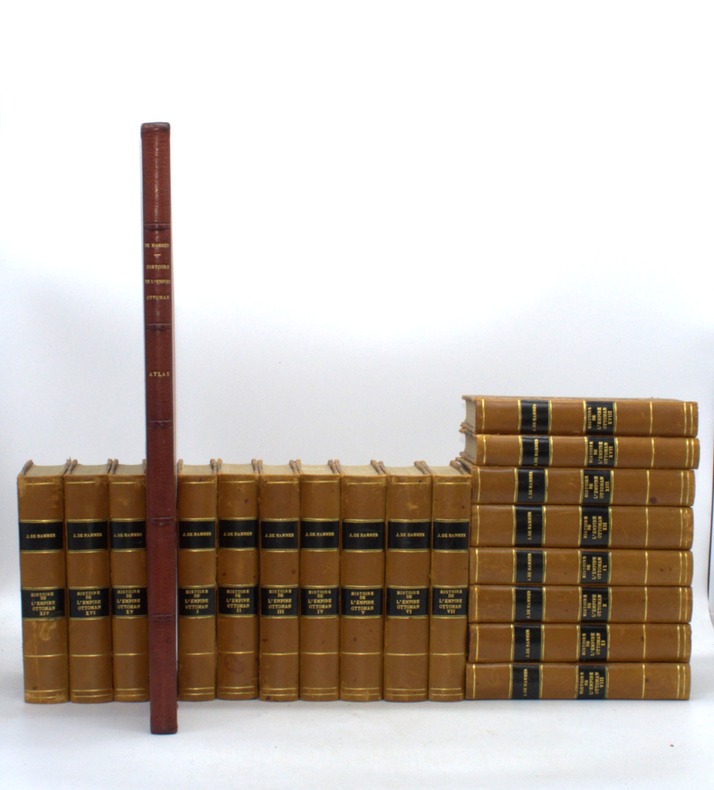
1835PHO-1982Paris, Bellizard, Barthes, Dufour et Lowell ; Londres, Bossange, Barthes et Lowell ; Saint-Petersbourg, Fd. Bellizard et Cie, 1835-1844. 18 volumes de texte in-8 et un atlas in-folio. TEXTE : 18 volumes in-8, relié demi basane et coins moderne, dos lisse orné avec pièces d’auteur, titre et tomaison noires, frottements et épidermures, défauts d’usage, rousseurs dans le texte, tampon et étiquette du relieur. ATLAS : Paris. Bellizard, Dufour etc. 1844. Imprimé chez Thierry Frères. Demi basane et coins à long grain grenat, dos à nerfs avec titre et auteur, In-folio (520x345mm), IV-82pp.-40 planches, il est composé du Commentaire sur l’Atlas de l’Empire Ottoman, d'une liste des cartes, d'une carte générale de l'Empire Ottoman (690x550mm), de 22 cartes particulières (dont une sur 2 feuilles) (815x850), de 13 plans de batailles ou de siège, et de 4 plans de villes dont un grand plan dépliant de Constantinople (690x670mm), le plan de Vienne est en 2 états, par G. Heck et Plée et gravé par U. Muschani, roussurs éparses, 2 cartes uniformément brunies avec réparations, mouillure claire en marge, tache sur les 16 premiers feuillets en tête et en fin d’ouvrage en pied. Provenance : collection de S.A.R. le Prince Osman Ibrahim d'Égypte (1951-2025), fils de S.A.R. le Prince Amr Ibrahim d'Égypte et de S.A.I. la Princesse Nejla Hibetullah Sultan (Necla Osmanoğlu) de Turquie, petite-fille du dernier calife Abdulmejid II et du sultan Mehmed VI, avec sa marque au tampon.
In-folio p. (mm. 380x280), legatura edit. in mz. marocchino rosso, piatti in Linson avorio con al centro la testa di Edipo (eseguita da Manzù) impressa a secco e in rilievo, pp. 100 a fogli sciolti. Il volume è contenuto in una scatola in Linson rosso con etichetta in carta Ingres avorio e titolo in nero, applicata sul quadrante anteriore. Tragedia greca nella traduzione di Manara Valgimigli, con 7 acqueforti originali di Giacomo Manzù. Cfr. Cat. Mardersteig,154. Importante edizione di 114 esemplari numerati. Il ns., 57, fa parte della tiratura di 105 su carta a tino di Pescia, con firma autografa di Manzù. In ottimo stato.
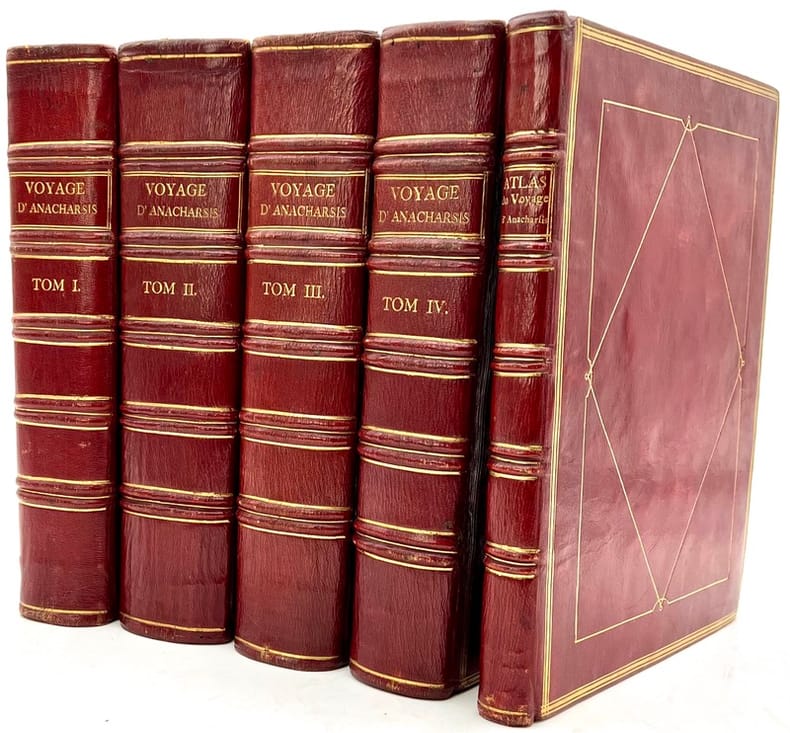
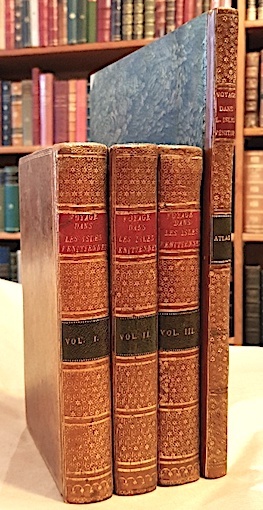
178843221A Paris, chez de Bure l'ainé, 1788. 4 vol. in-4 de VII-(10)-553-(3) pp. ; (8)-646-(2) pp. ; (6)-599-(2) pp. ; (6)-393-(1)-184-(1) pp. ; 1 atlas in-4 de XLII-31 planches gravées, maroquin rouge au grain long, dos à 5 nerfs doubles ornés de filets dorés, plats ornés d'un cadre losange-rectangle avec triple filet doré en encadrement, doublures et gardes de tabis bleu céleste, tranchefiles triples de soie noire et blanche, tranches dorées (reliure de l'époque).
17990046331799 Paris, Didot jeune, an septième [1799]. Sept volumes in-8 (140 X 220 mm) et un atlas in-folio (272 X 440 mm) maroquin bleu-vert à grain long, encadrement de large dentelle dorée et roulette à froid sur les plats, dos cinq nerfs plats ornés et sertis de filets dorés, fleurons à froid et dorés dans les compartiments, guirlandes en queue et tête, coupes et coiffes ornées, bordure intérieure à froid dans un encadrement de filets dorés, tranches dorées (Simier, relieur du roi). Tome I : VIII pages, portrait frontispice, CLII pages, 367 pages - Tome II : (1) f. blanc et (2) ff. de titre et table des chapitres, 517 pages - Tome III : (1) f. blanc et (2) ff. de titre et table des chapitres, 496 pages - Tome IV : VIII pages, 507 pages, (1) f. blanc - Tome V : VIII pages, 495 pages, (1) f. blanc - Tome VI : VIII pages, 454 pages, (1) f. blanc - Tome VII : VIII pages, 552 pages, (1) f. blanc - ATLAS : portrait, 56 pages, IV pages, (1) f. d'explication des médailles, 1 planche de médaille au format grand in-octavo (206 X 280 mm), 36 planches. Ex-libris non identifié : cachet héraldique encré sur les faux-titre des volumes de texte et de l'atlas. Décolorations et quelques frottements et défauts d'usage aux reliures, coiffes de l'atlas habilement restaurées et ses gardes renouvelées, les tomes II et III ont été reliés sans les faux-titre, le tome I sans le premier feuillet blanc.
123193Greece c. 1854-57. . Oblong 8vo 15.2 x 24 cm; 20 pen and wash grey and bistre drawings heightened with white c. 115 x 150 mm with descriptive ms captions in Greek leaves slightly toned occasional spotting to margins but generally clean and fresh; contemporary brown half sheep over black pebble-grained boards cover title 'Antiquites Grecques' in gilt gilt dulled a little worn and rubbed with some loss to spine joints cracked but holding still a lovely example.<br /> A very unusual sketchbook most likely compiled by a French draughstman as an architectural study of the Greek monuments they saw on their travels. The ruins are shown in their monumentality and decay in splendid isolation typical for the period before the sites were excavated.<br /><br />Judging from the condition of the monuments we can date the drawings to between 1854 and 1857. The sketchbook itself was likely purchased in Greece with the drawings applied directly to the pages i.e. not bound later and then on the artist's return to France the binding was stamped with the title 'ANTIQUITÉS GRECQUES'.<br /><br />Sketchbooks of Greek sites are much rarer than comparable ones of Italy partly to do with the Grand Tour or tourist trails stretching as a matter of course to Italy but much rarer to Greece owing to the dangers and challenges of Mediterranean travel and an apprehension amongst travellers in the decades following the Ottoman occupation.<br /> Greece, c. 1854-57. hardcover
180014644Tavernier Paris An VIII (1800) 4 vol. 3 vol. in-8 de 2 ff.n.ch. XVI 407 pp., 2 ff.n.ch. 358 pp., 2 ff.n.ch. 383 pp. et un atlas in-4 de 30 feuillets (planches et cartes), plein veau raciné de l'époque, dos lisse richement orné, triple filet doré en encadrement sur les plats, pièces de titre et de tomaison, tranches dorées, demi reliure à l'imitation pour l'atlas.
264-Eo.J. Aquarell über Bleistift, auf Velin, rechts unten bezeichnet und datiert ?Nauplia im Juni 1834.?. 17,7:29 cm.
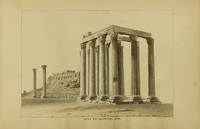
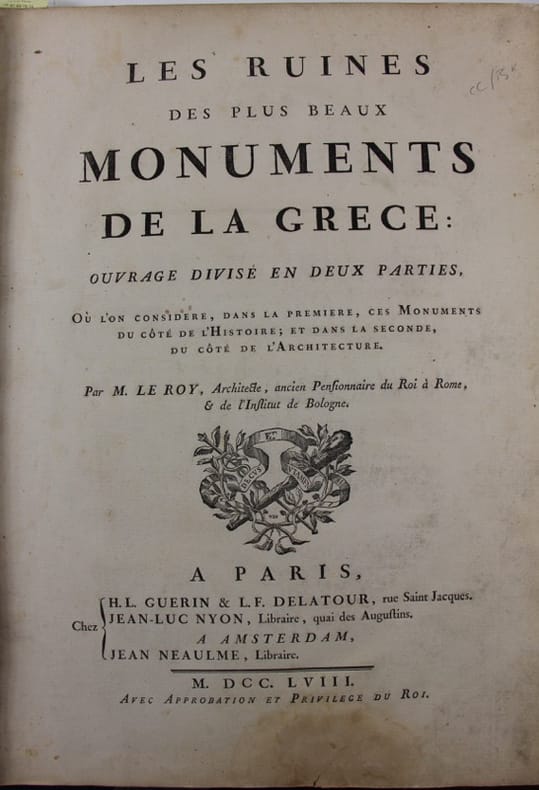
1758129297Paris, Guérin & Delatour, Nyon ; Amsterdam,, Neaulme 1758 2 parties en un volume grand in-folio, demi-basane fauve avec coins de velin vert, dos orne de roulettes dorees, tranches mouchetees Reliure de l'époque, XIV- 56- 2- VI- 28 pp. 60 planches hors texte gravees sur cuivre. Forte mouillure dans le bas du volume touchant le texte et les planches, decoupes marginales aux bas des deux derniers feuillets. Reliure usagée avec des manques. Premier plat fragile. Second plat délié. En l’état.
Acquaforte e bulino, dimensioni mm 295x207, impressa su carta vergata coeva con filigrna "scudo con tre piccoli gigli" (sconosciuta a Woodward), con ampli margini, in perfetto stato di conservazione.Magnifico esemplare di questa rara carta, incisa da Paolo Forlani e ralativa al periodo veneziano dell'editore Claudio Duchetti (Claude Duchet).Al centro dell’isola, con caratteri grandi, è inciso il titolo: RHODUS.Nel cartiglio rettangolare in alto a destra si legge: Rhodus jnsula Carpatij maris, olim Ophiusa, deinde Staclia,postea Telchin dicta fuit Ambitus èius Milliar i20 p[er]hibet[us] bis asarracenis An 655. Deinde quoq[ue] i308. Postremo a Solimano Turcar[um] jmp. i523 capta expulsis qui suas hic sed[e]s tenuera[n]t militibus Hierosolimitanis. Claudio Ducheto formis Anno 1570. Orientazione con una rosa a trentadue venti, il nord è in alto. Carta priva di scala grafica e graduazioneai margini.Carta dell’isola relativa al periodo veneziano del Duchetti durante il quale lavorò in stretta collaborazionecon Paolo Forlani, al quale Woodward attribuisce la lastra. La mappa è orientata con il nord in alto emostra nel mare le linee radiali dei venti tipiche delle carte nautiche. Nel cartiglio l’autore inserisce unabreve storia dell’isola. La lastra viene poi portata a Roma, come dimostra la sua presenza nel catalogo dellavedova di Giacomo Gherardi, erede del patrimonio calcografico del Duchetti (ottobre 1598, n. 272) dov’èdescritta come “l’Isola di Rodi”. La matrice fu successivamente acquistata da Giovanni Orlandi nel 1602e quindi dal fiammingo van Schoel. Sebbene possibili, non sono note ristampe della lastra.BibliografiaBorroni Salvadori (1980): n. 110; Christie’s (2012): n. 41; Destombes (1970): n. 51; Ganado (1994): VI,n. 46; National Maritime Museum (1971): n. 53; Shirley (2004): II, n. 55; Sotheby’s (2000): n. 322; Sotheby’s (2005): n. 96; Tavernari (2014): n. 70. b) Pagani (2012): p. 81; Tooley (1939): n. 465; Zacharakis (1992): n. 955; Zacharakis (2009): n. 1425; Woodward (1990): n. 91; Woodward (1992): n. 54. Etching with engraving, printed on contemporary laid paper with "Shield with three small fleur-de-lys" watermark (not in Woodward), with original margins, very good condition.A fine example of the Forlani's map of Rodhos, printed by Claudio Duchetti (Claude Duchet), in Venice.Map of the island relating to the Venetian period of Claudio Duchetti during which he worked in close collaboration with Paolo Forlani, to whom Woodward attributes the plate. The map is oriented with the north at the top and shows in the sea the radial lines of the winds typical of nautical charts. In the cartouche the author inserts one short history of the island.The plate is then brought to Rome, as evidenced by its presence in the catalog of the widow of Giacomo Gherardi, heir to the Duchetti calcographic heritage (October 1598, n ° 272) where is described as "L'’Isola di Rodi". The plate was subsequently acquired by Giovanni Orlandi in 1602 and then from the Flemish publisher Hendrick van Schoel. Although possible, plate reprints are not known.Literature:Borroni Salvadori (1980): n. 110; Christie’s (2012): n. 41; Destombes (1970): n. 51; Ganado (1994): VI,n. 46; National Maritime Museum (1971): n. 53; Shirley (2004): II, n. 55; Sotheby’s (2000): n. 322; Sotheby’s (2005): n. 96; Tavernari (2014): n. 70; Pagani (2012): p. 81; Tooley (1939): n. 465; Zacharakis (1992): n. 955; Zacharakis (2009): n. 1425; Woodward (1990): n. 91; Woodward (1992): n. 54. Bifolco-Ronca, Cartografia e Topografia Italiana del XVI secolo, Catalogo ragionato delle opera a stampa (2018), p. 1562, tav. 768.
1890biblio1372<p>This is truly one of the world's rare and valuable books: A first edition near fine copy of Mrs. Edmonds sketch of the 18th century Greek hero. Includes a laid-in series 3 of N.Y. Times 1897 stories of the Greek-Turkish War at that time.</p><p>Photos on request.</p> Longmans, Green, And Co. hardcover
169215848Claude Barbin, Jean Boudot, Georges & Louis Josse Paris 1692 1 vol. In-4 de X 406 pp. 12 ff.n.ch. (table), plein veau brun de l'époque, dos à nerfs orné, roulette dorée sur les coupes.
054900Paris Chez Saillant et Nyon. Chez Panckoucke 1774 in 4 (25,5x19) 1 volume reliure demi basane fauve de l'époque, dos à nerfs orné de caissons dorés, pièce de titre de cuir beige, 52 planches ou cartes gravées dépliantes. Et successivement exécutés par le Commodore Byron, le Capitaine Carteret, le Capitaine Wallis, et le Capitaine Cook, dans les vaisseaux le Dauphin, le Swallow et l'Endeavour. Rédigée d'après les journaux tenus par les différents commandants & les papiers de M. Banks, Par J. Hawkesworth. Sir Joseph Banks, Londres 1743-1820, aristocrate et naturaliste britannique, participa au premier voyage de James Cook autour du monde (1768-1771). Atlas seul (collationné complet). Bel exemplaire ( Photographies sur demande / We can send pictures of this book on simple request )
2 parti in 1 volume in-16 (mm 105x71), ff. 24 n.n., 223, (1); 222, deliziosa legatura coeva in p. pelle riccamente decorata ai piccoli ferri con al centro dei piatti armi non identificate (due bande orizzontali in oro sormontate da aquila) entro clipeo con cimiero, agli angoli quattro aquile; completano la decorazione piccoli fioriellini, ombrelli con pendagli e al dorso un raffinato motivo ad intreccio; entro astuccio moderno. Soli volumi II (''De recta partium'') e III (''Syllabarum'') di importante grammatica greca ad uso degli Studenti del Collegio Romano, apparsa per la prima volta a Ingolstadt, ove l'a. era docente, nel 1593 e guò eduta dakki Zabettu bek 1596. Il volume primo di questa edizione apparve nel 1608. Gretser (1562-1625) fu controversista gesuita professore di filosofia e teologia; di vastissima erudizione, difese con larga documentazione storica la teologia del Bellarmino. Esemplare in importante legatura ascrivibile alla bottega dei Soresini: identico ferro per fiori, aquila e ombrello con pendagli, frequente nelle legature romane della fine del XVI e della prima metà del XVII secolo. Assieme a sfingi, erme e cariatidi, fa parte della ''gamma egizia'' della bottega dei Soresini, attiva dal 1585 al 1630 circa. Buon esemplare (piccolo strappo al margine inferiore del terzo ff. lievi gore d'umido). Sommervogel III, 1748-1755.
edizione originale, stampata da Giunta nel mese di gennaio; la seconda dello stesso anno è infatti di agosto per Froben. In-8° cc. (16), 205, 1cb legatura in piena pergamena con dorso parzialmente usurato. Studioso di greco e professore di filosofia Leonicus (1456-1531) fu scrittore molto prolifico; nei tre libri di questa raccolta gli argomenti spaziano dalla storia antica, alla mitologia, alla religione, allo sport, agli usi e costumi dei popoli antichi. Graesse IV, 166 Renouard XXVIII, 104 Camerini I, 339.
18541274641854. GROTE George. A History of Greece; from the Earliest Period to the Close of the Generation Contemporary with Alexander the Great. London: John Murray 1851-57. Twelve volumes. Octavo early three-quarter green morocco gilt raised bands top edges gilt uncut. $3500.Early mixed edition of Grotes celebrated history of Greece illustrated with a large folding map of Greece and 25 engraved maps and plans 16 folding handsomely bound by Morrell.A banker member of Parliament staunch social reformer and one of the founders of the University of London Grote was among the first to attempt to write a comprehensive work on Greece's political and intellectual heritage. His History extends from the mythical beginnings of Greek culture and legend to the reign of Alexander the Great. ""The work of a master The political lessons and ethical judgments so characteristic of the History render it the most instructive of histories"" DNB. Grote ""incontestably won for himself the title not merely of a historian but of the historian of Greece"" Allibone I:747. Grote's History ""is notable for its accurate geographical details for the spirit and vigor of its passages descriptive of martial exploits and above all for its obvious purpose of showing the elevating and inspiring influence of freedom upon human activity Each chapter is in a way a monograph in itself and the work as a whole is one of the greatest masterpieces of historical research that have ever been put forth"" Peck 753. Some folding maps heightened in color by hand. First published in 12 volumes in 1846-56. A mixed edition with volumes from the second third editions and fourth editions. Maps and text generally fine spines uniformly toned. A very handsome set. hardcover
69069Roma,, Excudebat Mascardus / Vitale Mascardi., 1642 Bound in half contemprary vellum, blue marbled paper over boards, 1 volume, folio (480 x 380 mm). Pages (4), 3, (1), 7-221, (1)pp. 15ff. (lacking final blank) + 1 engraved frontispiece (engraved by Camillo Congio) and 14 folding plates, **(lacking plates 10 & 11)**, 12 full-pages engraved plates, 4 engraved potraits and numerous vignettes and initials in the text.
756-Eo.J. Feder und Pinsel in Grau und etwas Grün, grau laviert und mit reicher Deckweißhöhung, auf cremefarbenem festem Zeichenpapier, links unten signiert, bezeichnet und datiert ?C. Wuttke. Corfu 1889.?. 33,2:47,2 cm. Für eine Neuauflage des Buches von Ferd. Gregorovius über Korfu schuf Wuttke 1889 Vorzeichnungen für Illustrationen. Vermutlich ist dieses Blatt in diesem Zusammenhang entstanden.
1926GF253361926 Paris - Editions du Siècle - 1926 - 1 volume in8 broché de 125 pages - 1 des 50 exmplaires sur japon de l'édition originale -
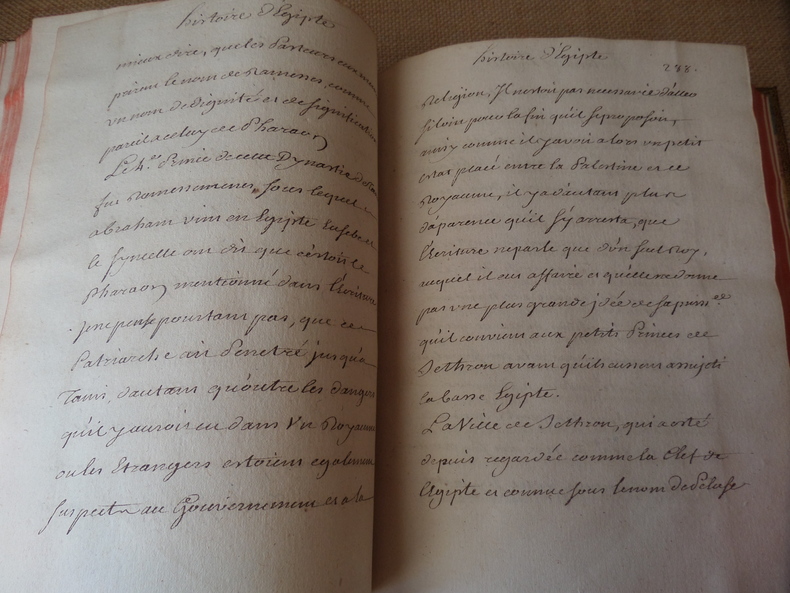
7819manuscrit sans date (début XVIIIe), reliure plein veau d'époque, dos à 5 nerfs, titres et fleurons dorés, roulette dorées sur chasses et champs, tranches rouges, 19,5x24 cm, pagination par feuilles, TOME I, partie 2 (251 à 474) : Histoire d'Egypte, 216 pages( 251 à 358) ; Histoire des Patriarches, 228 pages (359 à 472), table de l'histoire des Patriarches jusqu'à l'exode, 4 pages (473-474). TOME II, partie 1 (1 à 291) : Histoire de l'ancienne Grèce, 70 pages (2 à 36) ; Histoire d'Argos, 76 pages (37 à74) ; Histoire d'Athènes, 274 pages, (75 à 211) ; Histoire de Thèbes, 154 pages (215 à 291). TOME II, partie 2 (293 à 557) : Histoire de Lacedemone, d'Arcadie et de Troye en particulier : Histoire de Lacedemone, 48 pages (293 à 316), Histoire d'Arcadie, 10 pages (317 à 321), Histoire de Troye, 70 pages (323 à 357) ; Histoire de l'ancienne Italie, 154 pages (360 à 436) ; Histoire ancienne de la Sicile, 62 pages (437 à 467) ; Histoire ancienne de l'Affrique, des Isles de la mer méditeranée et des parties de l'Europe qui confinent à l'océan : Histoire ancienne de l'Affrique, 28 pages (469 à 482), Histoire ancienne de l'Espagne, 60 pages (483 à 512), Histoire ancienne de la Sardaigne, 8 pages (513 à 517), Histoire ancienne de la Corse, 3 pages (518 à 519), Histoire ancienne des Isles Baleaires, Majorique, Minorique et Irique, 2 pages (520), Histoire ancienne de l'Isle de Malthe, 3 pages (521 à 522) , Histoire ancienne de l'Europe, 12 pages (523 à 533) ; Histoire ancienne de la gaule, 30 pages (534 à548) ; Histoire ancienne de l'Angleterre, 16 pages (549 à 557).
First printing. 617 pages. Extensive footnotes. Index. Tables and charts. "The first comprehensive account of prevailing rates of interest from earliest recorded history to the present... Reports interest rates in thirty-nine countries and covers a span of forty centuries... Discovers repetitive patterns and trends which seem to bear a direct relationship to the rise and fall of nations and civilizations... Today's financial community possesses here the first inclusive survey of the price of its principal resource, money, and the historical background for projecting future interest rates." - from dust jacket. Small date stamp atop front free endpaper, otherwise clean and unmarked with light wear. Binding sound. Dust jacket now preserved in glossy new archival-grade Brodart. A quality copy of this momentous reference. Fundaburk 3263. Book