18 204 résultats
2 volumi in folio (324 x 224 mm) pp. X, 304 (2), VII 261 (3); ricche legature d'epoca in marocchino rosso a grana lunga, i piatti adorni di varie bordure concentriche, tra cui una a fiori ed una a tralci d'uva; al centro iscrizione "Principe Felice Baciocchi" Granduca consorte di Toscana, cognato di Napoleone in quanto marito della sorella Elisa e Principe di Lucca e Massa. Notevoli i dorsi, con due scomparti riservati alle scritte e 4 con raffinate decorazioni neocliassiche differenti; dentelle e tagli dorati. "Prima edizione intera riveduta e corretta dal traduttore ornata di tavole in rame": un ritratto inciso di Sofocle all'antiporta e 4 tavole in rame f.t. Esemplare ottimamente conservato. Il traduttore Angelelli, bolognese, si dedicò alle traduzioni dal greco dei maggiori autori tra cui Plutarco, S. Basilio, Demostene, Senofonte, Sofocle, Sinesio di Cirene. Era lodato dai contemporanei per fedeltà all'originale ed eleganza di stile, specialmente per il teatro sofocleo. Due grandi volumi in rilegatura d'eccezione di importante provenienza. Al contropiatto anteriore ex-libris del Vicomte de Cossete e di Finaly Landau (Horace de Landau, n°5222-5223). Il Barone de Landau (Brody 1824-Firenze 1903) fu rappresentante dei banchieri Rotschild a Costantinopoli. A Torino ebbe molti rapporti con Cavour e a Firenze acquistò la villa ''Alla Pietra'', che arricchì di numerose collezioni e di una cospicua biblioteca di manoscritti ed incunabuli, aumentata in seguito dagli eredi Finaly. Questa collezione fu dispersa da Hoepli in varie sedute d'asta nel 1949, ma un catalogo parziale era stato redatto in due volumi da A.Roediger tra gli anni 1885-90.. .
1824027252London: Richard Priestley 1824. 2nd Edition 1st Printing. Hardcover. Very Good. Maps and Plates. Xv 409; Iii 341; Iii 392 Pp With Half Titles In Volumes 2 And 3. A Complete Set In Original Brown Cloth Spines Over Gray Boards With Original Paper Spine Labels 4.7 Cm Tall Volume Numbers In Arabic Numerals Also Known With Taller Spine Labels With Roman Numerals Priority Unknown. Taylor's Corrected Second Edition Adding His Notes Which Were Omitted From The First Printing. Worn With Some Fraying At Corners Volume 1 With Cracked Front Joint Along Which Is A 2 1/2" X 1/4" Loss Of Spine Cloth Not Affecting The Labels. Bookplates Of Francis Davies Of Pershore With Rampant Lion And Motto "Lucem Spero" No Other Names Or Marks. Per Wikipedia General Sir Francis John Davies Kcb Kcmg Kcvo 1864 - 1948 Was A Senior British Army Officer Who Commanded The 8Th Division During The First World War. Davies Was Born In London The Son Of Lieutenant General Henry Fanshawe Davies And His Wife Ellen Christine Alexandra Hankey. His Grandfather Was General Francis John Davies Brother And Heir Of Thomas Henry Hastings Davies Mp For Worcester And His Great-Grandfather Was Admiral Of The Fleet Sir Thomas Byam Martin. The Family Seat Was Elmley Castle Pershore Worcestershire. His Younger Brother Was Major General Henry Rodolph Davies. He Was Educated At Eton College. In October 1899 He Served As A Daag Responsible For Intelligence At Army Headquarters In South Africa And As Acting Commissioner Of Police For Johannesburg In 1900. In 1902 He Was Temporarily Employed In The Intelligence Department Until He Became Deputy Assistant Quartermaster General Daqmg At The War Office On 7 September 1902. Two Years Later He Was Appointed Assistant Director Of Military Operations In 1904 He Was Made General Officer Commanding Goc Of The 1St Guards Brigade. He Then Took Over As Brigadier General General Staff Bggs Of Aldershot Command. He Was Promoted To Major General In May 1913 And In October Of That Year Became Director Of Staff Duties At The War Office. In October 1914 Davies Was Appointed As Goc Of The 8Th Division. The Division Along With Its Goc Was Soon Sent To The Western Front. Towards The End Of July Davies Was Posted Away From The Fighting In France And Belgium To Take Over The Command Of Viii Corps Then Heavily Engaged In The Gallipoli Campaign. Davies Promoted To The Temporary Rank Of Lieutenant-General30 Took Over As Its Goc On 8 August . He Brought With Valuable Combat Experience And It Is Said " Over The Five Months Of His Tenure His Ideas And Energy Were The Catalyst For A Myriad Of Tactical And Systematic Improvements Which Greatly Improved The Fighting Efficiency Of His Force Allowing His Troops To Achieve Tactical Superiority Over The Enemy Facing Them". In The Aftermath Of The Evacuation Of British And Allied Forces From Gallipoli In January 1916 Davies Was Moved On To Being Goc Of Ix Corps. Davies Was In Command Only Until June When He Returned To The United Kingdom To Serve As Military Secretary At The War Office. He Held This Post Until After The End Of The War.His Rank Of Lieutenant General Became Substantive In January 1917. Later That Year Davies Was Appointed General Officer Commanding-In-Chief Goc-In-C Of Scottish Command In June 1919. After Being Promoted To The Rank Of Full General In July 1921And After Serving As Lieutenant Of The Tower Of London Which He Had Been Appointed To In June 192335 He Retired From The Army In April 1926. He Had Been Appointed An Aide-De-Camp General To King George V In April 1922. <br/> <br/> Richard Priestley hardcover
244335Amsterdam, Henry & Théodore Boom, 1670-1671 2 parties en un fort vol. in-12, [6] ff. n. ch. (titre-frontispice gravé, titre, dédicace à Cornelijs Tromp, avis au lecteur), 60 pp., [453] pp. mal chiffrées 153, titre, 320 pp., veau blond, dos à nerfs orné, triple filet doré en encadrement sur les plats, tranches dorées, filet doré sur les coupes, dentelle intérieure (Bauzonnet).
Rara pianta di grande formato di La Valletta, incisa da Isaac Briot su disegno di Daniel Rabel e basata sulla mappa di Villamena (1600-1602).Comprende piante dettagliate delle fortificazioni, stemmi, una spiegazione della scala della mappa, abbellimenti decorativi e una legenda che identifica i luoghi importanti. Inserite la mappa di Malta e Gozo nel cartiglio in basso.Nell'angolo in alto a destra della mappa è raffigurato lo stemma dell'Ordine di San Giovanni di Gerusalemme con tre gigli sormontati da una corona e con la croce a otto punte dietro. Nella parte inferiore c'è un secondo stemma del vescovo di Nicosia, che mostra un leone con tre stelle sopra e tre lune a mezzaluna sopra.La mappa è - a volte - inclusa nel Jean BAUDOIN & François-Antoine de NABERAT "HISTOIRE DES CHEVALIERS DE L'ORDRE DE S.". IEAN DE HIERVSALEM, CONTENENTE LEVRO ADMIRABILE..., stampata a Parigi nel 1643.Incisione in rame, leggera evidenza di vecchie pieghe di carta perfettamente restaurate; bell'esemplare, con piccoli margini. Rara. Rare large format plan of Valletta, engraved by Isaac Briot after Daniel Rabel and based on the Villamena's map (1600-1602).Includes detailed plans of the fortifications, coats of arms, an explanation of the scale of the map, decorative embellishments and a key identifying important places. Inset map of Malta and Goza near bottom.The top right corner of the map displays the "Order of St. John of Jerusalem" coat of arms with three fleur-de-lys surmounted by a crown and with the eight pointed cross behind. In the lower part is a second coat of arms of the bishop of Nicosia, showing a lion with three stars above and three crescent moons above that.A rare and attractive map of Malta, showing the city of Valleta, Borgo, Sanglea di Sto. Michele, and the church of St. Salvator -known as the Three Cities. The map includes a detailed plan of the fortifications, descriptions of the scale and a key to the points of interest in Valletta.A baroque cartouche encloses an inset of the islands of Malta and Gozo at lover left. The arms of the Order of St. John are given, and the map is decorated with many sailing ships.The map is - sometimes - included in the Jean BAUDOIN & François-Antoine de NABERAT "HISTOIRE DES CHEVALIERS DE L’ORDRE DE S. IEAN DE HIERVSALEM, CONTENANT LEVR ADMIRABLE.., printed in Paris in 1643.The imprints of Rabel and Briot are given beneath the cartouche. Slight evidence of old folds with expert restoration; nevertheless a good example of this scarce map. Nice example with margins, perfect condition. Rare. Mason, Maps Of Malta In The Order Of St John, 27.
Rara e importante mappa di Cipro, apparsa per la prima volta nell'Histoire des Chevaliers de l'Ordre de St. Iean de Hierusalemme di Badouin . . . . pubblicata a Parigi nel 1629.Si tratta della prima edizione francese di Pierre de Boissat (1603-1662) e Jean Baudoin, della grande storia dell'Ordine di Malta in tre parti di Giacomo Bosio (1544-1627). Originariamente apparve in italiano, a Roma nel 1621. Nato a Chiavari da una nobile famiglia Piemontese, Bosio era un fratello di servizio dell'Ordine di Malta. Nel 1587 venne nominato rappresentante dell'Ordine a Roma, dove compose la sua opera sulla storia dell'isola di Malta, sotto forma di manoscritto.Questa notevole mappa, incisa da Raignauld (o Raigniauld), fornisce un'accurata rappresentazione topografica e visiva di Cipro durante il periodo in cui l'Ordine di San Giovanni era attivamente coinvolto nella difesa e nella conservazione della regione e nell'assistenza ai pellegrini in Terra Santa. Tra le caratteristiche più notevoli, il Capo Karpasia (Sant'Andrea) è notevolmente abbreviato. Una mappa molto interessante che esagera sostanzialmente le dimensioni di Nicosia, Famagosta e Limassol, per illustrare la pianta di queste città e le loro fortificazioni.A partire dal 1100 d.C. circa, durante la prima crociata, l'Ordine di San Giovanni di Malta ha lavorato attivamente nel Mediterraneo orientale e in Terra Santa per proteggere e preservare il passaggio sicuro dei pellegrini verso la regione e salvaguardare la regione dagli invasori e dagli occupanti non cristiani. L'isola di Cipro divenne una delle più importanti roccaforti dell'Ordine. Rare and important early map of Cyprus, which first appeared in Badouin's Histoire des Chevaliers de l'Ordre de St. Iean de Hierusalem . . . . published in Paris in 1629.This is the first French edition by Pierre de Boissat (1603-1662) and Jean Baudoin, the great history of the Order of Malta in three parts by Giacomo Bosio (1544-1627). It originally appeared in Italian, in Rome in 1621. Born in Chiavari to a noble Piedmontese family, Bosio was a brother of service of the Order of Malta. In 1587 he was appointed representative of the Order in Rome, where he composed his work on the history of the island of Malta, in the form of a manuscript.This remarkable early map, engraved by Raignauld (or Raigniauld), provides a remarkably topographical and visual depiction of Cyprus during the period when the the Order of St. John was actively involved in the defense and preservation of the region and the assistance of pilgrims to the Holy Land. Among the more notable features, the Karpasia Cape (St. Andreas) is considerable shorten. A very interesting map which substantially exaggerates the size of Nicosia, Famagusta and Limassol, in order to illustrate plans of these towns and their fortifcations.Beginning in about 1100 AD, during the first Crusade, the Order of St. John of Malta worked actively in the Eastern Mediterranean and the Holy Land to protect and preserve the safe passage of pilgrims to the region and safeguard the region from non-Christian invaders and occupiers. The island of Cyprus became one of the most important strongholds of the Order.Copperplate, in fine condition. Stylianou, A. & J.: The History of the Cartography of Cyprus, No. 110; Zacharakis, C. G.: A Catalogue of printed Maps of Greece, 3rd edition, #2878/1878.
15593332DB(Am Schluss:) Tiguri, apud Christophorum Frosch., anno 1559. Mense Augusto. Folio. (12) Bl., 632 S., (15) Bl. (letztes leeres Bl. fehlt). Mit zahlreichen figürlichen Holzschnitt-Initialen, Holzschnitt-Druckermarke. Blindgeprägter Schweinslederband der Zeit mit 2 Metallschliessen, Papierrückenschild, maschinengeschrieben. + Wichtig: Für unsere Kunden in der EU erfolgt der Versand alle 14 Tage verzollt ab Deutschland / Postbank-Konto in Deutschland vorhanden +, Titelblatt
1374176Paris: Librairie Centrale d'Architecture, 1881 5 tomes in folio en ff. sous portefeuille d’édition dos toile à cordons (1 cordon coupé), 251 planches avec tables explicatives. Rousseurs sur les feuillets de texte, les planches sont sans rousseurs, bon état.
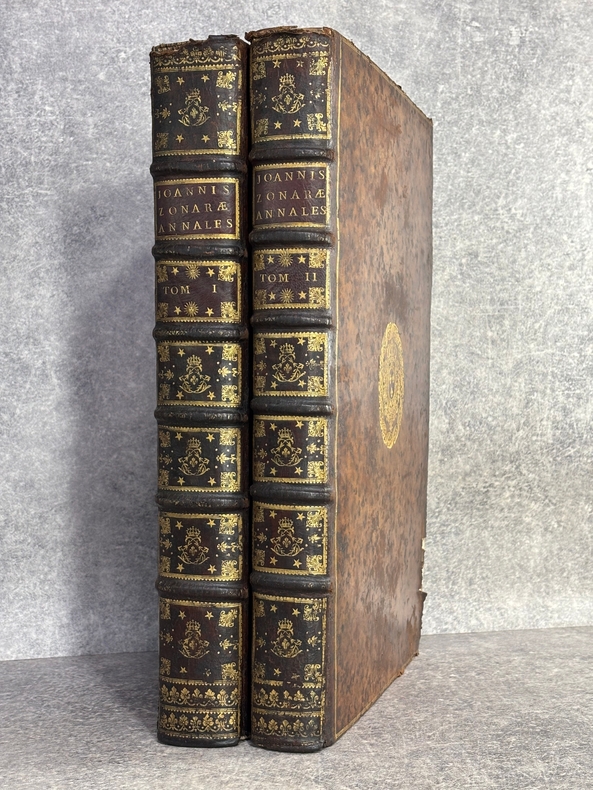
16863846PARISIIS. E TYPOGRAPHIA REGIA. 1686-1687. 2 GRANDS VOLUMES IN-FOLIO (31 X 44,5 X 12,5 CENTIMETRES ENVIRON) DE (32) + 648 ET (4) + 362 + 163 + (68) PAGES, RELIURE D'EPOQUE PLEIN VEAU MARBRE, DOS A SIX NERFS ORNE DE CAISSONS A FLEURONS DORES AUX EMBLEMES ROYAUX, TITRE DORE SUR ETIQUETTE MAROQUIN ROUGE, TRIPLE FILET DORE ENCADRANT LES PLATS AVEC ARMES ROYALES DOREES DE LOUIS XIV AU CENTRE, DENTELLE DOREE SUR COUPES, TRANCHES MOUCHETEES ROUGES. TEXTE GREC ET LATIN EN REGARD SUR DEUX COLONNES. DEBUT DU TITRE EN CARACTERES GRECS. COLOPHON: PARISIIS, E TYPOGRAPHIA REGIA, CURANTE SEBASTIANO MABRE-CRAMOISY, EJUSDEM TYPOGRAPHIAE DIRECTORE, 1686-1687. ILLUSTRE D’UNE GRANDE VIGNETTE DE TITRE AUX ARMES DE LOUIS XIV, REPETEE DANS CHACUN DES VOLUMES, DE BANDEAUX ET LETTRES ORNEES. DE LA COLLECTION BYZANTINE PUBLIEE SOUS LA DIRECTION DU PERE LABBE A QUI CETTE CHARGE AVAIT ETE CONFIEE PAR COLBERT. OUVRAGE RARE. QUELQUES DEFAUTS DE RELIURE, DONT MANQUES DE CUIR, SINON BON ETAT INTERIEUR.
363 pages. Signed and inscribed by author atop half-title page. Text in French. First edition of what was printed in English in 1935 with the title Black Hand Over Europe. "... An appalling expose of the situation of the national minorities in the Balkans and in Central Europe (which) tried heroically to call to the attention of the French people the dangers to which France and all Europe were exposing themselves should France continue to finance and support the criminal and ambitious political parties of the Little Entente, and especially of Yugoslavia... The book is prohibited in the Little Entente, Greece and Turkey, and in Yugoslavia; any government official or employee apprehended reading the book is given five years of hard labour." - from Translator's note to the English Edition. "Two months after the publication of my book the Supreme Court of Belgrade sentenced me by default to twenty years of hard labour and the White Hand (the Panserb terrorist and military organization) sentenced me to death." - from Author's Preface to the English Edition. Prior owner's name and date pencilled atop title page. Average wear. Binding intact. A sound copy of this important work. Book
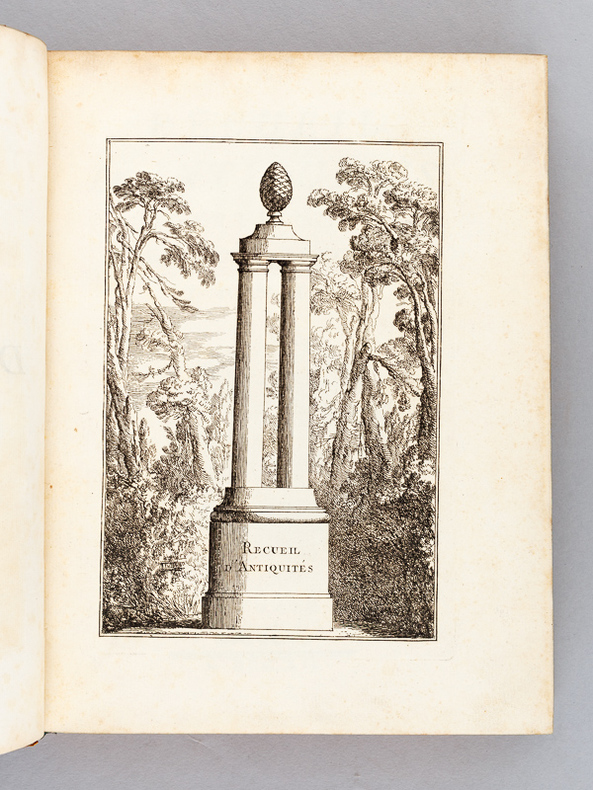
5 vol. in-4 reliure de l'époque plein veau blond, dos à 5 nerfs dorés orné, triple file doré d'encadrement en plats, double filet doré en coupes, chasses ornées, toutes tranches dorées, Chez Desaint & Saillant, [ Chez Duchesne ; Chez N. M. Tilliard ], Paris, 1752-1762, I : Chez Desaint & Saillant, 1752 : 4 ff., XXI-348 pp. et 1 f. n. ch. avec frontispice et 107 planches hors texte ; II : Chez Duchesne, 1756 : 1 f., VIII-429 pp. et 2 ff. n. ch avec frontispice et 128 planches (planches 58 bis et ter) ; III : Chez Desaint & Saillant, 1759 : XXXVI pp. (y compris le frontispice), 448 pp. avec frontispice et 121 planches hors texte ; IV : Chez N. M. Tilliard : 1761 : XX pp. (y compris le frontispice), 418 pp. et 1 f. n. ch. avec frontispice et 125 planches hors texte ; V : Chez N. M. Tilliard, 1762 : XXVI pp. (y compris le frontispice), 1 f. n. ch., 348 pp. avec frontispice et 120 planches hors texte Très jolie série réunissant en belle reliure uniforme plein veau d'époque les 5 premiers volumes (sur 7), parus chez 3 éditeurs (comme c'est le plus souvent le cas). Ce superbe ouvrage est orné de très nombreuses planches hors texte délicatement gravées, et de magnifiques vignettes et culs-de-lampe. Bon état (mouill. en garde du tome 4 avec petite faiblesse aux 4 premiers feuillets et visible au premier plat, qq. petites usures en coiffes, très bon état par ailleurs, d'une très belle fraîcheur intérieure). A partir du tome III, le titre complet devient : "Recueil d'Antiquités Egyptiennes, Etrusques, Grecques, Romaines et Gauloises". Cohen, I, 212 Français
15593332DB(Am Schluss:) Tiguri, apud Christophorum Frosch., anno 1559. Mense Augusto. Folio. (12) Bl., 632 S., (15) Bl. (letztes leeres Bl. fehlt). Mit zahlreichen figürlichen Holzschnitt-Initialen, Holzschnitt-Druckermarke. Blindgeprägter Schweinslederband der Zeit mit 2 Metallschliessen, Papierrückenschild, maschinengeschrieben.
Very Good Turkish, Ottoman (1500-1928) Original full leather bdg. with its miklep (traditional flap), embossed shamsa (mystical sun) on boards. Roy. 8vo. (24 x 17 cm). In Ottoman script. [8], 263 p. Sarlavla page decorated with traditional ornaments. First edition of this extremely rare and the first translation of the Anabasis of Alexander in the Ottoman / Turkish literature. One of 1010 copies. The Anabasis of Alexander was composed by Arrian of Nicomedia in the second century AD, most probably during the reign of Hadrian. The Anabasis (which survives complete in seven books) is a history of the campaigns of Alexander the Great, specifically his conquest of the Persian Empire between 336 and 323 BC. Both the unusual title "Anabasis" (literally "a journey up-country from the sea") and the work's seven-book structure reflect Arrian's emulation (in structure, style, and content) of the Greek historian Xenophon, whose own Anabasis in seven books concerned the earlier campaign "up-country" of Cyrus the Younger in 401 BC. The Anabasis is by far the fullest surviving account of Alexander's conquest of the Persian Empire. It primarily revolves around the military history, reflecting the content of Arrian's model, Xenophon's Anabasis; the work begins with Alexander's accession to the Macedonian throne in 336 BC and has nothing to say about Alexander's early life (in contrast, say, to Plutarch's Life of Alexander). Nor does Arrian aim to provide a complete history of the Greek-speaking world during Alexander's reign. Arrian's chief sources for his writing of the Anabasis were the lost contemporary histories of the campaign by Ptolemy and Aristobulus and, for his later books, Nearchus. One of Arrian's main aims in writing this work on history seems to have been to correct the standard "Vulgate" narrative of Alexander's reign that was dominant in his own day, primarily associated with the lost writings of the historian Cleitarchus. The Anabasis gives a broadly chronological account of the reign of Alexander the Great of Macedonia (336-323 BC), with a particular focus on military matters. George Rhasis (Yorgaki Razi) translated Anabasis Alexandrou = "History of Alexander the son of Philip" the work of Xenophon under the title "Târîh-i Iskender bin Filipos". This is the first translation of an ancient Greek historian into Turkish. Georgios Rhasis, who was one of the first writers of the French-Turkish dictionary in the early period, was an Ottoman intellectual who worked as an instructor and translator in Ottoman and French languages. He also taught at the Eastern Languages School in Paris and continued her studies in Corfu and Paris. In 1821 he came to be in Istanbul as a famous orientalist. Rhasis left the city and the homeland he lived in to settle in Tsarist Russia due to concerns during the Greek Revolution in 1821. The Bulaq or El-Amiriya Press is the first official and governmental printing press to be established in Egypt, and functions according to industrial printing basis, causing not just a qualitative but also a quantitative and knowledgeable leap in science throughout the Arab region. It's established in 1820 by Muhammad Ali Pasha of Egypt and Sudan (1769-1849) and it was part of Muhammad Ali's inclusive development plans for the modernization of Egypt. Library of Congress, Karl Süssheim Collection, no. 129. (OCLC: 966315151). Only 6 copies in OCLC: 27236333.; Alex II 25.; BM e15.; Cairo FKT 166.; IstUKT 802.; Bianchi CD 155.; Bulaq IF 8:21.; Bulaq FK 7:8.; Ridwan 162.; Özege 19837 (No author and no translator in Özege record).
ff. [60], 320 numbered leaves. Woodcut Aldine anchor and dolphin printer's device on the title page and last leaf. Latin Italic type. Some age stain, especially on first and last leaves. In several places the name of Erasmus is obliterated in ink by a censor. An early ownership on the title has been washed out, and a small marginal chip has resulted. Small 8vo. 160 mm. Edges decorated red. Early nineteenth century full vellum binding. Lacks front fly leaf. This second and improved Aldine edition is essentially a reprint of the edition of 1516, edited by Giovanni Battista Cipelli, called Egnazio (1478-1553), with the addition of annotations by Erasmus, which were first published in the Froben edition of 1518. Both Aldine editions contain the relevant texts of Aurelius Victor and Eutropius with the continuation by Paulus Diaconus. The full work was once the common manual of almost everyone who wished to study Roman history, and because of this long and hard use, it is extremely difficult to obtain a clean and perfect example - Renouard. This second edition is considered the more valuable, as containing an 'Index Memorabilium' and the notes of Erasmus and the Venetian philologist Joannes Baptista Egnatius (ca. 1473-1553). Gaius Suetonius Tranquillus, commonly known as Suetonius (ca. 69/75-after 130). Suetonius was a close friend to Senator and letter-writer Pliny the Younger. Pliny describes him as 'quiet and studious, a man dedicated to writing'. Through Pliny, Suetonius came into favor with Trajan and Hadrian. Under Trajan he served as secretary of studies (precise functions are uncertain) and director of Imperial archives. Under Hadrian, he became the Emperor's secretary. In 122, Hadrian dismissed him for disrespectful behavior towards Empress Vibia Sabina. Suetonius may have later regained imperial favor under Hadrian and returned to his position. It was probably in Hadrian's time that he wrote his most important surviving work - this set of biographies on the Lives of the Twelve Caesars. Entitled 'De Vita Caesarum' it deals with successive Roman rulers, from Julius Caesar to Domitian. It also includes other texts on Roman history, notably Eutropius. This collection of ancient Roman historians is dedicated to the great book collector - Jean Grolier, and is followed by a letter from Erasmus commending the edition as well as Egnatius' scholarship. Renouard 91:7; Schweiger 974-975; Adams S-2035; UCLA A4S93; Graesse VI, 521; Ahmanson-Murphy 201 (incomplete); Bibliotheca Erasmiana Bruxellensis 499 (incomplete); Dibdin II, p. 439; STC Italian p. 651. Very good. Scarce. **PRICE JUST REDUCED! ALDINE BOX SAFE
1813gt327Rome, imprimé par De Romanis Relié 1813 "RARE. In-plano (40,5 x 58 cm), reliure cartonnée, ouvrages bien complet, pagination comme suit : Introduction (XIII pp.), explications de peintures de vases grecs (84 pp.)table générale des matières (VIII pp.) planches A, B et C, puis les LX planches. Dans ce recueil, ce qui frappe l'amateur c'est la qualité des gravures, ainsi que celle des dessins réalisés par les artistes grecs !!! Jean-Auguste-Dominique Ingres remarquera la beauté des vases grecs publiés par Tischbein, de Millin et de James Millingen (1774-1845). Pascale Picard-Cajan a découvert les calques d'Ingres et ""a pu établir qu'Ingres avait décalqué presque toutes les planches de vases de Tischbein, de Millin et de James Millingen (1774-1845), lui permettant ainsi d'étudier les principes de composition générale et les attitudes de chaque figure et de réutiliser certains motifs pour ses propres œuvres."" In 'Perspective - Actualité en histoire de l'art', Hildegard Wiegel. Les vases sont classés dans ce magnifique ouvrage par période (suivant les larges divisions de Winckelmann) et reproduits avec un soin et une fidélité sans précédent ; ils ""sont les premiers [tirages] sur lesquels des portions manquantes et restaurées sont indiquées"" (Dietrich von Bothmer). Les plaques non signées sont créditées dans le texte au dessinateur Michele Steurnal (Steurnel), peintre de porcelaine au Real Fabbrica à Naples, et au prolifique graveur reproducteur Francesco Giangiacomo. ""La plupart des dessins ont été faits par M. Michel Steurnal, à Naples, et les gravures par M. Giangiacomo à Rome"" (p.xii). Les vases viennent de collections prestigieuses dont celle de l'auteur. Un ouvrage rare et recherché pour la qualité de ses reproductions et son importance historique ; reliure abîmée (mors fendus aux coiffes, papier reliure décoloré et déchiré sur les bords des plats, cartonnage émoussé aux coins), par ailleurs intérieur frais, bien conservé malgré quelques rousseurs éparses. Livraison a domicile (La Poste) ou en Mondial Relay sur simple demande."
184490951En Athenais: Ek tou Vasilikou typographeiou 1844. Hardcover. Very Good. 7 1 2 738p. Contemporary 1/4 leather with tiny leather corners. 22 cm. Cover moderately scuffed and rubbed. Small surface chip along top of front cover. Light staining on upper portion of last sixty leaves. All edges gilt. Greek text. The printed record of the Greek National Assembly of 1843 convened after the Third of September revolution of 1843 which produced the first Greek constitution. The minutes begin on Sept. 3 1843 and end on March 18 1844. The constitution formally established a constitutional monarchy. King Otto remained on the throne until he was deposed in 1862. One feature of the 1844 constitution progressive at the time was that it called for universal male suffrage. OCLC locates 3 copies in the United States Harvard Univ. of Cincinnati and Cal. State at Sacramento. <br/><br/> Ek tou Vasilikou typographeiou hardcover books
245-Eo.J. Aquarell, mit schwarzer Tuschlinie umrandet, auf Velin. 10,8:17,6 cm.
197263236XI Convegno Di Studi Sulla Magna Grecia; Et Al. As New. 1972. Paperback. FREE UPGRADE to Courier/Priority Shipping Upon Request IN STOCK AND IMMEDIATELY AVAILABLE FOR SHIPMENT - AS NEW THE TEXT BLOCK IS PRISTINE CLEAN UNMARKED AND IN EXCELLENT CONDITION - - Text in German. 114 pp. With 35 ills. 30 x 21 cm. -- with a bonus offer-- . XI Convegno Di Studi Sulla Magna Grecia; Et Al paperback
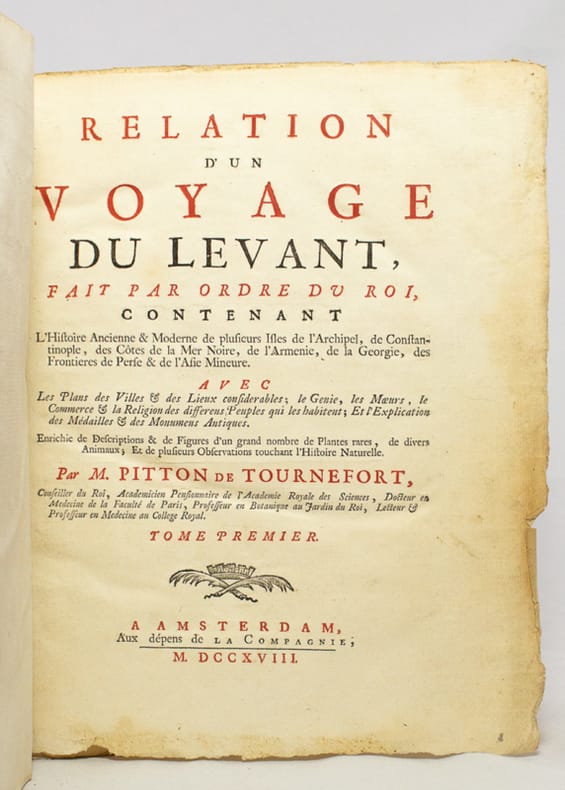
171817654Amsterdam, Aux dépens de la Compagnie, 1718. Deux tomes en un volume in-4° de [28]-188; [2]-208-[16] pages, demi-basane blonde, dos lisse orné de filet doré, pièce de titre en papier cartonné, non rogné.
162019101anvers Elzevir 1620 -in-folio plein-VELIN un fort volume, reliure janséniste plein-vélin ivoire parcheminé à rabats in-folio (jansenist's binding full vellum in-folio)(34 x 23 cm), RELIURE D'EPOQUE, titre manuscrit sur le dos à l'encre brune (handwritten title on the spine), plats muets (cover without text), dos avec un léger manque de velin en tête (moins d'1/2 cm2), toutes tranches lisses (all smooth edges), Ex-libris : "DOCTORIS TINEL ROTOMAGENSIS" (Dr TINEL célèbre collectionneur de ROUEN) imprimé en noir dans un encadrement d'un filet noir sur une étiquette de papier crème, Texte en latin et grec, orné d'une gravure titre gravée sur bois en noir par M. Lasne + 64 planches hors-texte en noir de gravures de Monnaies recto-verso (10 par page) gravées sur bois en noir (engraving wood) par Hubert GOLTZ + Lettrines et culs-de-lampe gravées sur bois en noir, 4 pages + 30 feuillets de planches imprimés des deux côtés + 4 feuillets de planches imprimés d'un seul côté (soit 64 planches) + 326 pages + 14 pages d'Index, 1618 Antverpiae Jacobum Bieum Editeur sur la page de titre mais c'est noté en fin de dernière page : Lugduni Batavorum Typis Isaaci Elzeviri academia typography 1620,
In-folio, 7, (1), 432pp, (80), legatura in pergamena coeva, nervature, titolo manoscritto al dorso, al frontespizio cornice architettonica da Vasari con figure allegoriche e stemmi dei Medici, al centro veduta di Roma. Bella copia a pieni margini, ex libris dell’arcivescovo di Tessalonica Francesco Vitelli. In-folio, 7, (1), 432pp, (80), contemporary vellum binding, bands, handwritten title on the spine, on the title page an architectural frame by Vasari with allegorical figures and Medici coats of arms, in the center a view of Rome. Beautiful copy with full margins, ex libris of the Archbishop of Thessalonica Francesco Vitelli.
ORD-14610Nouvelle édition soigneusement corrigée & augmentée de quelques notes. Neuchâtel. Société Typographique. 1772. 1773. 6 volumes in-12 (102 x 168mm) pleine basane racinée, dos à 5 nerfs ornés de caissons, pièces de titre maroquin rouge, de tomaisons maroquin brun, gardes marbrées, tranches rouges, 556, 444, 502, 468, 431 et 448 pages. Etiquette de P. Gauvry libraire à Bordeaux. Coiffes lgt arasées, petits défauts d'usage aux reliures sinon beaux exemplaires. Manque le tome VII comme souvent. Rare.
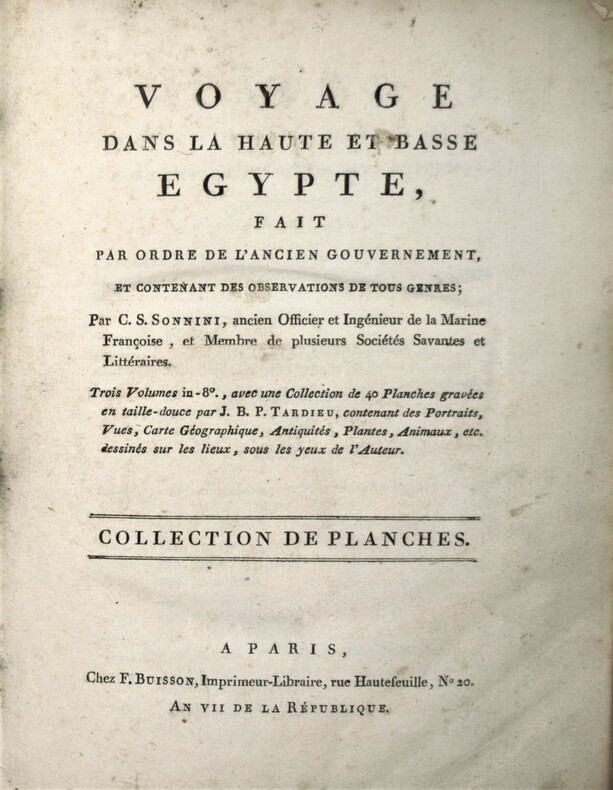
1799PHO-1997À Paris, Chez F. Buisson, Imprimeur-Libraire, an VII- IX (1799-1801). 7 volumes en 6 tomes TEXTE Voyage dans la haute… Égypte ; 3 volumes in-8°, 2ff.-VII-425pp.1f (catalogue), 2ff.-417pp.(2 tableaux dépliants), 2ff.-424pp., demi basane et coins, dos lisse avec pièce de titre et tomaison havane, tranches mouchetées bleues, petits frottements, accroc à une coiffe, petit travail de ver en coin sur qlqs feuillets (T2). Voyage en Grèce et en Turquie ; plein veau raciné époque, dos lisse avec titre et tomaison, tranches jaunes. 2ff-460pp-460pp-2ff., un cahier de la table mal relié. ATLAS Voyage dans la Haute et Basse Égypte et Voyage en Grèce et en Turquie Paris, F. Buisson, An VII de la République (1799). In-4, (2)-2 pp., 39 planches sous serpente et une carte ,déchirures à la carte sans manque (Égypte ), trace de brunissure (carte), mouillure sans atteinte aux planches. Avec Voyage en Grèce et en Turquie, Fait Par Ordre De Louis XVI et avec l’Autorisation de la Cour Ottomane ; par C.S. Sonnini, de plusieurs Sociétés Littéraires et Savantes de l’Europe, et des Sociétés d’Agriculture de Paris et des Observateurs de l’Homme. Paris, Buisson, 1801, in-4, une page de titre-1 f. non chiffré [Liste des planches] -1 très grande carte au contours colorées [980 x 1030 mm] et 6 planches h.-t. [I- VII], réparations à la carte (Grèce) , mouillures, planche du Firman déchirée sans manque et mal pliée, relié demi cuir vert époque , dos lisse avec tomaison et titres , légère fente au dos, frottements, coiffe usée.
1933ZB1310769Societa Magna Grecia Roma 1933. Price HAS BEEN REDUCED by 10% until Monday June 29 SALE item 216 pp. paperback covers foxed spine worn else text clean and binding tight. - If you are reading this this item is actually physically in our stock and ready for shipment once ordered. We are not bookjackers. Buyer is responsible for any additional duties taxes or fees required by recipient's country. Photos available upon request. Societa Magna Grecia, Roma paperback
1752571785 vol. in-4 reliure de l'époque plein veau blond, dos à 5 nerfs dorés orné, triple file doré d'encadrement en plats, double filet doré en coupes, chasses ornées, toutes tranches dorées, Chez Desaint & Saillant, [ Chez Duchesne ; Chez N. M. Tilliard ], Paris, 1752-1762, I : Chez Desaint & Saillant, 1752 : 4 ff., XXI-348 pp. et 1 f. n. ch. avec frontispice et 107 planches hors texte ; II : Chez Duchesne, 1756 : 1 f., VIII-429 pp. et 2 ff. n. ch avec frontispice et 128 planches (planches 58 bis et ter) ; III : Chez Desaint & Saillant, 1759 : XXXVI pp. (y compris le frontispice), 448 pp. avec frontispice et 121 planches hors texte ; IV : Chez N. M. Tilliard : 1761 : XX pp. (y compris le frontispice), 418 pp. et 1 f. n. ch. avec frontispice et 125 planches hors texte ; V : Chez N. M. Tilliard, 1762 : XXVI pp. (y compris le frontispice), 1 f. n. ch., 348 pp. avec frontispice et 120 planches hors texte
1819elala1286<p>London: Printed For J.Harding. 1819. 1819. 8vo. pp. xv 172. with half-title. contemporary half calf some light wear. First Edition. Grece’s informative guide provides details regarding agriculture the cost of clearing land and other useful facts and strongly advises emigrants to choose Canada over the United States. The author himself emigrated to Canada in 1805 settling as a farmer near Montreal and becoming involved in the unsuccessful attempt to cultivate hemp in Lower Canada a costly endeavour that was being encouraged by the imperial and colonial governments. He was a member of both the Montreal and Quebec Agricultural Societies. Selections from his ‘Essays on Husbandry Addressed To The Canadian Farmer’ Montreal: 1817 are included in the appendix pp. 89-121. Casey I 1059. Dionne II 978. Gagnon I 1549. Howes G-352. Kingsford pp. 61-62. Kress C.312. Lande 397. Morgan p. 161. Sabin 28480. TPL 1169. DCB VII pp. 357-58. 1st Edition.</p> London: Printed For J.Harding., 1819.