1 779 résultats
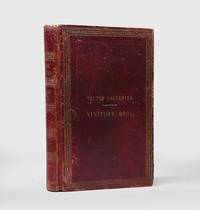
1904166196London: The Bruton Galleries Bond Street 1904-36. The blockbuster Discovery exhibition of 1904 The original visitor's book for one of the stellar red-carpet events of the season: the Bruton Galleries exhibition of artefacts and artwork from Scott's Discovery expedition a landmark in polar exploration. It includes the signatures of numerous crew members including Ernest H. Shackleton Edward A. Wilson Charles Royds Reginald Skelton and Ernest E. Joyce alongside Clements Markham and Llewellyn Longstaff a financial angel of the expedition. The exhibition which opened in November 1904 was curated by Clements Markham who had organized the expedition and launched Scott's polar career. It was remarkably extensive the catalogue listing 484 items including 150 photographs by Reginald Skelton 200 watercolours and drawings by Edward A. Wilson equipment from the expedition a model of the Discovery rations and the South Polar Times. The photographs and artwork constituted a visual record of Antarctic conditions and documented gruelling conditions bringing home "the scale magic and danger of Antarctica with a compelling immediacy" Merwe & Michell p. 66. The show proved extraordinarily popular with "Bruton Street and New Bond Street lined with motorcars and carriages" Huxley p. 141. "Persons of rank and fashion were marshalled into a long queue by a policeman. Society folk were not used to queues in those days and they protested that they had tickets; so had everyone the constable replied and kept them in line" Huxley p. 141. It fuelled the public's growing excitement about polar exploration: "an exhibit of Wilson's Antarctic art attracted over ten thousand viewers to London's prestigious Bruton Gallery. Advertisements in the gallery catalogue touted paints and binoculars used by the artist in the Antarctic" Larson p 159. The Discovery crew received an exuberant homecoming hailed for their "British grit" and Edward VII awarded each man the Antarctic medal. "Indeed for many Scott and his men became the national heroes that the Boer War had failed to supply. The explorers became celebrities. Crowds packed their public appearances" Larson p. 158. The leading actress Ellen Terry attended the event. She had been present when the expedition docked in Portsmouth later writing a postcard to Scott thanking him for letting her see the Discovery. The members of the Discovery expedition who have signed include Ernest H. Shackleton third lieutenant Edward A. Wilson assistant surgeon and artist Charles Royds first lieutenant Reginald Skelton chief engineer and photographer Ernest E. Joyce petty officer Arthur Henry Blissett steward Jacob Cross petty officer Hartley T. Ferrar geologist and Reginald C. Ford chief steward and stores officer. Curiously Scott is not among them. This might be a consequence of his resolve "to keep as quiet as possible" after the expedition Huxley p. 158. Three Shackleton family members attended: Ernest H. Shackleton's sisters Gladys and Helen besides Eileen Shackleton of Bushey. Other noted polar explorers feature among the visitors such as Robert Rudmose-Brown of the Scottish National Antarctic Expedition Scotia 1902-4 alongside its honorary secretary James G. Ferrier. Another notable voyager is Charles Ede the assistant surgeon on HMS Assistance on the British Franklin Search Expedition 1850-1 and a "Mrs. Reynolds" the great-niece of Franklin. The visitor's book serves as a record of an early 20th-century red carpet event and contains approximately 1000 signatures including the writer Walter Jerrold alongside the artists Felix Moscheles and Marietta Pallis. Robert Baden-Powell the founder of the Boy Scout movement also attended. Princess Beatrice and Maria Amelia Queen of Portugal likewise attended. Successive pages record visitors from Lancashire Yorkshire and Scotland. Moreover there are numerous admirals and military men together with a collector of Egyptian art. Two further sections in the book relate to miscellaneous exhibitions held in later years. Folio 283 x 245 mm. Contemporary dark red skiver by Jas. Truscott & Sons of London flat spine gilt-lettered direct spine and covers decorated in gilt front cover lettered "Bruton Galleries/Visitor's Book" marbled endpapers all edges gilt; 115 lined pages signed bearing approximately 2000 names and addresses all recto of which 57 lined pages with approximately 1000 signatures pertaining to the Discovery expedition. Extremities with slight wear from handling some stripping of leather minor toning general finger soiling. A very good copy. Elspeth Huxley Scott 1990; Max Jones The Last Great Quest 2004; Edward J. Larson An Empire of Ice 2011; Pieter van der Merwe and Jeremy Michell eds South: The Race to the Pole 2018. hardcover
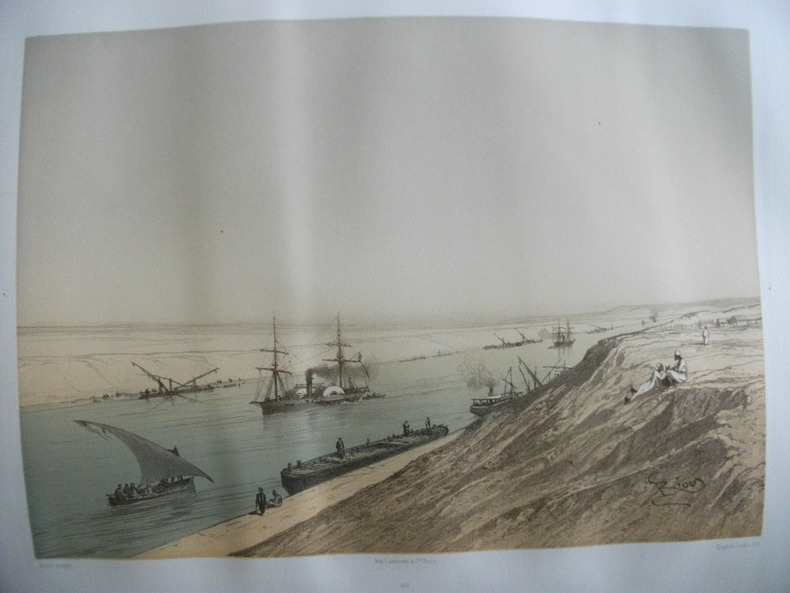
4803Grand in-folio (578 x 415 mm),reliure d’éditeur pleine toile rouge,titre doré et caissons à froid,au dos.Titre et armes dorés sur le premier plat, plaque dorée au deuxième plat ave nom de l'éditeur.Faux-titre,titre,une carte lithographiée,100 pages,25 aquarelles d’après nature par RIOU,sur papier fort,lithographiées par CICERI,sous serpentes imprimées,non rogné,pratiquement sans rousseurs,superbes lithographies à très grandes marges, coloris frais,rare en cartonnage. ÉDITION ORIGINALE,limitée à 500 exemplaires.Paris:Dupont & E.Lachaud,sans date [vers 1870].Coiffes et une charnière restaurées,une pâle mouillure angle supérieur droit à la planche 25 (photo) et de la page 97 jusqu’à la page 100 Ouvrage monumental,admirablement illustré d'après les aquarelles réalisées par Edouard RIOU d’après nature pendant les fêtes organisées lors de l'inauguration du canal de Suez en octobre 1869.Fontane fut le secrétaire de Ferdinand de Lesseps et l'accompagna également pendant les travaux de l'isthme de Panama. RIOU,élève de Gustave Doré, illustra entre autres les ouvrages de Jules Verne et fournit des planches pour Le Tour du Monde. Brunet VII, 510;Blackmer 611 L'auteur (1838-1914) est à la fois historien orientaliste, journaliste et secrétaire de Ferdinand de Lesseps.En 1854, il devient cadre de la Compagnie du Canal de Suez.Eugène Cicéri a réalisé quelques paysages en Afrique du Nord qui lui valent d'être aussi classé parmi les orientalistes. Seuls 500 exemplaires ont été publiés. parmi ceux ci 200 ont été réservés pour Ismaïl Pacha Vice Roi d'Efype. Il s'est senti insulté par la préface de Fontane qui a accordé tout le crédit de ce projet à de de Lesseps, et il a fait retiré de ses 200 exemplaires, à la fois, le portrait de de Lesseps en frontispice et la préface de Fontane.
191722798London 1917. Very good condition. The salver was presented as a wedding gift to Royal Navy officer CHARLES ROYDS 1876-1931 the Discovery's first lieutenant after whom Cape Royds in Antarctica is named. The salver has specially crafted feet fashioned after penguin's feet.<br /> <br /> The Discovery expedition was the first led by Captain Robert Scott and was arranged by the Joint Antarctic Committee composed of members from the Royal Society and the Royal Geographical Society. Known as the British National Antarctic Expedition the goal of the expedition was the scientific exploration of South Victoria Land and the ice barrier as well as the interior of the Antarctic continent. Its achievements included the discovery of the polar plateau and Scott's ascent the first ever in a hot air balloon over Antarctica. It was also the first to do extensive land exploration on the continent and went the furthest south by a sledge reaching 82 16' S. One of the unexpected contributions was the introduction to the Antarctic of so many future explorers as it included Ernest Shackleton Frank Wild & Edgar & Edward Evans. Scott returned to Antarctica a second time aboard the Terra Nova. That expedition which commenced in 1910 developed into a race against the Norwegian explorer Roald Amundsen to become the first to reach the South Pole. Amundsen attained the goal on January 4 1912 beating Scott by two weeks. Scott's expedition ended tragically when he and four companions perished on their return march from the South Pole after failing to reach a supply depot.<br /> <br /> Royd's had a very distinguished list of Antarcticans attending his wedding. But there are a number of ghostly presences that might have been there. Both Scott and Edward Wilson died in 1911 in their attempt to be the first to the South Pole. Ernest Shackleton was on duty in Northern Russia as was Frank Wild. These two were to return to the Antarctic in the Shackleton's Endurance expedition which is one of the greatest stories of survival ever told. Dr. Koettlitz died in 1916. <br /> <br /> The silver salver was made by Goldsmiths & Silversmith's Co. Regent St. London in 1917. It has a scalloped rope edge and four ball and claw feet is inscribed with the seal of the Discovery Voyage depicting icebergs and a penguin encircled within a heraldic belt. Below the seal is the engraved inscription "To Captain C.W. Royds R.N. on his marriage October 5th 1918 from his old messmates in the ‘Discovery' 1901-1904." <br /> <br /> Surrounding the inscription are the engraved signatures of:<br /> <br /> Scottish Royal Navy captain ALBERT B. ARMITAGE 1864-1943; "Albert B. Armitage" was the Discovery's second-in-command. "Armitage had been second in command of the Jackson-Harmsworth expedition to Spitsbergen. In recognition of this he received the Murchison award from the Royal Geographical Society. Armitage was the oldest man in the expedition and his years of Arctic service gave him more such experience than anyone else on the Discovery except Koettlitz. The contrasts between Armitage and Scott were noteworthy. Armitage had a good deal of experience with ships under sail; Scott did not. Armitage had three years of polar work; Scott had none" Scott of the Antarctic Huxley. Cape Armitage the southernmost point on Ross Island is named in his honor.<br /> <br /> LOUIS BERNACCHI 1876-1942; "L. C. Bernacchi" was a Tasmanian physicist and astronomer of Italian extraction. His first polar journey was with Carsten Borchgrevink's Southern Cross expedition 1898-1901 along with Hodgson above. For his work on the Discovery voyage Bernacchi was decorated by the Royal Geographical Society and awarded the Légion d'honneur. Scott was the best man at his wedding. Bernacchi explored regions of Africa and South America wrote several books on the Antarctic was a member of the Royal Geographic Society and served in the British and United States military during World War I. His attempts to raise funds for a 1925 Antarctic expedition failed. Antarctica's Bernacchi Head and Bay honor his name.<br /> <br /> MICHAEL BARNE 1877-1961; "Michael Barne". Barne's responsibilities as a member of Scott's Discovery expedition was to keep records of the voyage. A recipient of the Polar Medal Barne "had been a shipmate of Scott on the Majestic. and was appointed second officer by the committee in June 1900. His duties including assisting Armitage with magnetic studies and taking charge of deep-sea temperature research" Pilgrims on the Ice: Robert Falcon Scott's first Antarctic Expedition Baughman. An Antarctic cape glacier and inlet are named after him.<br /> <br /> GEORGE FRANCIS ARTHUR MULOCK 1882-1963; "George F.A. Mulock". Mulock had joined the relief vessel Morning that resupplied Scott's ships in the Antarctic. In 1902 he came aboard the Discovery to replace Ernest Shackleton who had fallen ill. Mulock served as a surveyor and cartographer during the mission publishing his results as Survey Work of the National Antarctic 1901-04 for which he was awarded the Polar Medal. He had a distinguished career in both World War I and II during which time he was held captive by the Japanese. The Mulock Inlet and Glacier are named in his honor.<br /> <br /> Marine biologist THOMAS VERE HODGSON 1864-1926; "T.V. Hodgson" did pioneering work aboard the Discovery and was the first person to describe the Antarctic's deep sea floor. Prior to joining the Discovery he had been a member of Carsten Borchgrevink's Southern Cross expedition 1898-1901. Cape Hodgson in the Ross Archipelago is named after him.<br /> <br /> Royal Navy officer REGINALD W. SKELTON 1872-1956; "Reginald W. Skelton" was the Discovery's chief engineer and official photographer. Despite the long-standing friendship between Scott and Skelton he was passed over as second-in-command on Scott's fatal 1910 Terra Nova expedition. An Antarctic inlet and three glaciers are named in his honor.<br /> <br /> CYRIL LONGHURST "Cyril Longhurst" was the secretary of the Discovery expedition and served as best man at Shackleton's wedding. Mount Cyril in Antarctica is named after him.<br /> <br /> HARTLEY TRAVERS FERRAR 1879-1932; "H.T. Ferrar" was born in Ireland raised in South Africa and educated as a geologist in England. A relatively young and inexperienced member of the voyage Ferrar met the woman he would marry while the Discovery was docked in New Zealand. His expedition duties included making geological surveys classifying what became known as the Ferrar or Beacon sandstone layer and discovering the first Antarctic fossils. He later conducted geological research in Egypt Palestine and New Zealand. The Ferrar Glacier is named for him.<br /> <br /> Following the Discovery expedition Royds continued his career in the Royal Navy. While commanding the battleship HMS Emperor of India he was given our lovely sterling silver platter to honor his marriage to Mary Louisa Blane a widow and retired actress. After the war Royds was an instructor at the Admiralty retiring from the navy as a rear-admiral. Thereafter he enjoyed a second career as deputy commissioner of the Metropolitan Police for which he received a knighthood.<br /> <br /> A unique object. Professionally polished and in fine condition save a few very faint scuffs. unknown
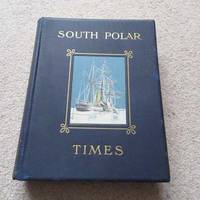
191439Smith Elder London 1914. First Edition. Hardcover Original Cloth. Very Good Condition/No Dust Jacket. 1st Limited Edition: This is copy 43 of a limited edition of 250. Original covers no dust jacket all page edges gilt. Copiously illustrated drawings in the text and full-page plates from sketches and paintings by E. Wilson and others. Gutta-percha binding very delicate with leaves just loosening. Gutta Percha was used as the binding glue in many early books it is not a difficult job to remove and reback using modern glues Ex Library with various library stamps on some pages. The South Polar Times was a magazine written and printed by the members of Antarctic Expeditions during the various voyages they undertook. The South Polar Times form what is perhaps the most personal of the printed documents to have come out of that most remarkable of periods of Antarctic adventures revealing so many often contradictory aspects of these men's various personalities. 'During the Antarctic winter of 1902 and 1903 the officers of the National Antarctic Expedition on board the Discovery among other diversions wherewith to lighten the long and dreary darkness brought out at monthly intervals a periodical to which they gave the name of "The South Polar Times" the contents of which range over a wide field grave and gay scientific and humorous prose and poetry. It contains a diary of the events of each month a record of the proceedings of the local Debating Society a monthly acrostic humorous notes besides articles of a more solid nature as well as stories sketches of various kinds and poems of a standard considerably above average.' One of the corner stones of an Antarctic collection. Volume 1 & 2 were Scott's 1st "Discovery Expedition" Special Limited Edition first issue in this format. Quantity Available: 1. Shipped Weight: Under 5 kilogram. Category: Arctic & Antarctic; Exploration. Pictures of this item not already displayed here available upon request. Inventory No: 39. . This book is extra heavy and may involve extra shipping charges to some countries. Smith Elder hardcover
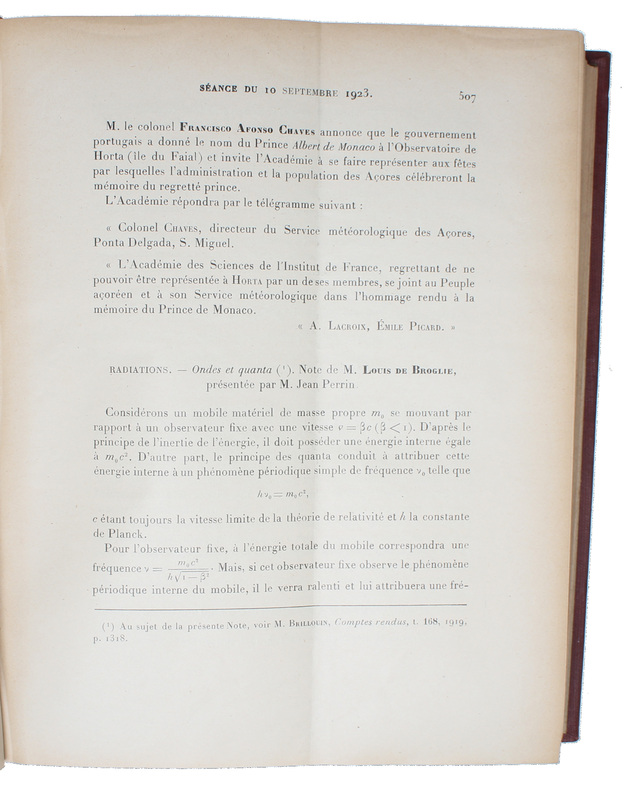
192346949Paris, Gauthier-Villars et Cie, 1923. 4to. Bound in 2 contemp. full cloth. Spines gilt and with gilt lettering. In: ""Comptes Rendus Hebdomadaires des Séances de L'Academie des Sciences"", Tome 177. With htitle a. titlepage. 1513 pp. (Entire volume offered). De Broglie's papers: pp. 507-510, pp. 548-551 a. pp. 630-32. Clean and fine. A stamp to verso of titlepage.
192349718Paris, Gauthier-Villars et Cie, 1923. 4to. Bound in one contemp. full buckram. Spines gilt and with gilt lettering. In: ""Comptes Rendus Hebdomadaires des Séances de L'Academie des Sciences"", Tome 177. Bound with orig. printed front-wrapper to No. 1, half-title and title-page to vol. 177. 1513 pp. (Entire volume offered). De Broglie's papers: pp. 507-510, pp. 548-551 a. pp. 630-32. Clean and fine. A punched stamp on foot of title-page.
192349718Paris Gauthier-Villars et Cie 1923. 4to. Bound in one contemp. full buckram. Spines gilt and with gilt lettering. In: "Comptes Rendus Hebdomadaires des Séances de L'Academie des Sciences" Tome 177. Bound with orig. printed front-wrapper to No. 1 half-title and title-page to vol. 177. 1513 pp. Entire volume offered. De Broglie's papers: pp. 507-510 pp. 548-551 a. pp. 630-32. Clean and fine. A punched stamp on foot of title-page. <br/><br/><em>First edition of these papers which ESTABLISHED A NEW ERA IN PHYSICS by introducing the epochal new principle that particle-wave duality should apply not only to radiation but also to matter and thus CREATING QUANTUM MECHANICS. These 3 papers were extended to form his doctoral thesis of 1924 "Recherches sur la Théorie des Quanta."De Broglie relates "After long reflection in solitude and meditation I suddenly had the idea during the year 1923 that the discovery made by Einstein in 1905 should be generalized by extending it to all material particles and notably to electrons" Preface to his PhD thesis 1924."He made the leap in his September 10 1923 paper: E=hv should hold not only for photons but also for electrons to which he assigns a 'fictitious associated wave'. In his September 24 paper he indicated the direction in which one 'should seek experimental confirmations of our ideas': a stream of electrons traversing an aperture whose dimensions are small compared with the wavelenght of the electron waves 'should show diffraction phenomena' ."Pais "Subtle is the Lord" pp. 425-436.In the third paper October 8 he discusses "The interplay between the propagation of the particle and of the waves could be expressed in more formal terms as an identity between the fundamental variational principles of Pierre de Fermat rays and Pierre Louis Maupertuis particles as de Broglie discussed it further in his last communication . Therein he also considered some thermodynamic consequences of his generalized wave-particle duality. He showed in particular how one could using Lord Rayleigh’s 1900 formula for the number of stationary modes for phase waves obtain Planck’s division of the mechanical phase space into quantum cells.Louis de Broglie achieved a worldwide reputation for his discovery of the wave theory of matter for which he received the Nobel Prize for physics in 1929. His work was extended into a full-fledged wave mechanics by Erwin Schrödinger and thus contributed to the creation of quantum mechanics. After an early attempt to propose a deterministic interpretation of his theory de Broglie joined the Copenhagen school’s mainstream noncausal interpretation of the quantum theory."DSB."This idea i.e. de Broglie's that matter might behave as waves was tested and confirmed by Davisson and Germer in 1927. Thus the duality of both light and matter had been established and physicists had to come to terms with fundamental particles which defied simple theories and demanded two sets of 'complementary' descriptions each applicable under certain circumstances but incompatible with one another." Printing and the Mind of Man 417. </em> hardcover
192346949Paris Gauthier-Villars et Cie 1923. 4to. Bound in 2 contemp. full cloth. Spines gilt and with gilt lettering. In: "Comptes Rendus Hebdomadaires des Séances de L'Academie des Sciences" Tome 177. With htitle a. titlepage. 1513 pp. Entire volume offered. De Broglie's papers: pp. 507-510 pp. 548-551 a. pp. 630-32. Clean and fine. A stamp to verso of titlepage. <br/><br/><em>First edition of these papers which ESTABLISHED A NEW ERA IN PHYSICS by introducing the epochal new principle that particle-wave duality should apply not only to radiation but also to matter and thus CREATING QUANTUM MECHANICS. These 3 papers were extended to form his doctoral thesis of 1924 "Recherches sur la Théorie des Quanta."De Broglie relates "After long reflection in solitude and meditation I suddenly had the idea during the year 1923 that the discovery made by Einstein in 1905 should be generalized by extending it to all material particles and notably to electrons" Preface to his PhD thesis 1924."He made the leap in his September 10 1923 paper: E=hv should hold not only for photons but also for electrons to which he assigns a 'fictitious associated wave'. In his September 24 paper he indicated the direction in which one 'should seek experimental confirmations of our ideas': a stream of electrons traversing an aperture whose dimensions are small compared with the wavelenght of the electron waves 'should show diffraction phenomena' ."Pais "Subtle is the Lord" pp. 425-436.In the third paper October 8 he discusses "The interplay between the propagation of the particle and of the waves could be expressed in more formal terms as an identity between the fundamental variational principles of Pierre de Fermat rays and Pierre Louis Maupertuis particles as de Broglie discussed it further in his last communication . Therein he also considered some thermodynamic consequences of his generalized wave-particle duality. He showed in particular how one could using Lord Rayleigh’s 1900 formula for the number of stationary modes for phase waves obtain Planck’s division of the mechanical phase space into quantum cells.Louis de Broglie achieved a worldwide reputation for his discovery of the wave theory of matter for which he received the Nobel Prize for physics in 1929. His work was extended into a full-fledged wave mechanics by Erwin Schrödinger and thus contributed to the creation of quantum mechanics. After an early attempt to propose a deterministic interpretation of his theory de Broglie joined the Copenhagen school’s mainstream noncausal interpretation of the quantum theory."DSB."This idea i.e. de Broglie's that matter might behave as waves was tested and confirmed by Davisson and Germer in 1927. Thus the duality of both light and matter had been established and physicists had to come to terms with fundamental particles which defied simple theories and demanded two sets of 'complementary' descriptions each applicable under certain circumstances but incompatible with one another." Printing and the Mind of Man 417. </em> hardcover
169141859Leipzig, Grosse & Gleditsch, 1691. 4to. Contemp. full vellum. Faint handwritten title on spine. a small stamp on titlepage. In: ""Acta Eruditorum Anno MDCLXXXXI"". (8),590,(6) pp. and 13 (of 15) folded engraved plates. The 2 first plates lacks, but they do not belong to the papers listed.Leibniz' papers: pp.277-281 a. 1 plate, pp. 435-439. Johann Bernoulli: pp. 274-276 a. 1 plate. Huygens: pp. 281-282. - Jacob Bernoulli: pp. 282-290 a. 1 plate.
169141859Leipzig Grosse & Gleditsch 1691. 4to. Contemp. full vellum. Faint handwritten title on spine. a small stamp on titlepage. In: "Acta Eruditorum Anno MDCLXXXXI". 85906 pp. and 13 of 15 folded engraved plates. The 2 first plates lacks but they do not belong to the papers listed.Leibniz' papers: pp.277-281 a. 1 plate pp. 435-439. Johann Bernoulli: pp. 274-276 a. 1 plate. Huygens: pp. 281-282. - Jacob Bernoulli: pp. 282-290 a. 1 plate. <br/><br/><em>All papers first apperance. All 5 of extreme importence in the development of the Calculus. Leibniz' 2 papers on the catenary curve paper 1-2 offered here was written at the instigation of Jacques Bernoulli. Following the example of Blaise Pascal who had initiated in 1658 a contest for the construction of the cycloid Leibniz also provoked the geometers of his time by challenging them to submit at the fixed date of mid-1691 their geometric method for the construction of the catenary curve. Leibniz later provided the answer followed by Johann Bernoulli and Huygens.'These two papers are a historical account of the origin of the study of this transcendental curve and at the same time the first physical-geometric construction showing the species-relationship between the catenary and the logarithmic curves as two companion curves; one arithmetic the other geometric. All of the differentials of the catenary curve are arithmetic means of corresponding differentials of the logarithmic curve; and all of the differentials of the logarithmic curve are geometric means of the catenary.'"The Catenary is the form of a hanging fully flexible rope or chain the name comes from "catena" which means 'chain' suspended on two points. The interest in this curve originated with Galileo who thought that is was a parabola. Young Christiaan Huygens proved in 1646 that this cannot be the case. What the actual form was remained an open question till 1691 when Leibniz Johann Bernoulli and the then much older Huygens sent solutions to the problem to the "Acta" Jakob Bernoulli 1690 Johann Bernoulli 1691 Huygens 1691 and Leibniz 1691 - these 4 1691-papers offered here - in which the previous year Jakob Bernoulli had challenged mathematicians to solve it. As published the solutions did not reveal the methods but through later publications of manuscripts these methods have been known. Huygens applied with great paper 4 virtuosity the by then classical methods of 17th century infinitesimal mathematics and he needed all his ingenuity to reach a satisfactory solution. Leibniz the papers 1-2 and Bernoulli paper 3 applying the new Calculus found the solutions in a much direct way. In fact the catenary was a test-case between the old and the new style in the study of curves and only because the champion of the old style was a giant like Huygens the test-case can formally be considered as ending in a draw." Grattan-Guiness in "From the Calculus to Set Theory 1630-1910.".The paper by JACOB BERNOULLI no. 5 offered here is a milestone papers as it marks the invention of the "SYSTEM OF POLAR COORDINATES" with points located by reference to a fixed point and a line through that point. Although newton had earlier also devised such a coordinate system in 1671 his work was not known so that the credit for the discovery generally goes to Bernoulli. Parkinson Breakthroughs 1691.Further papers contained in this volume of Acta Eruditorum:DENYS PAPIN: Mecanicorum de Viribus Motricibus sententia asserta a D. Papino adversius C.G.G. L. Leibniz objectiones. pp. 6-13. The plate lacks. - and Dion. Papini Observationes quaedam circa materias ad Hydraulicam spectantes. Pp. 208-213 a. 1 plate. This importent paper is part of the LEIBNIZ-PAPIN-CONTROVERSY.JACOB BERNOULLI: Specimen Calculi Differentialis in dimensione Parabolæ helicoidis ubi de flexuris curvarum in genere carundem evolutionibus. Pp. 13-22. The plate lacks. - and J.B. Demonstratio Centri Oscillationis ex Natura Vectis reperta occassione eorum quæ super hac materia in Historia Literaria Roterodamensi recensentur articulo.Pp.317-321.LEIBNIZ: O.V.E. Additio ad Schediasma de Medii Resistentia publicatum in Actis mensis Febr. 1889. Pp. 177-178. and O.V.E. Quadratura Arithmetica Communis Sectionum Conicarum quæ centrum babent.Pp. 178-182 a. 1 plate.TSCHIRNHAUS: Singularia Effecta Vitri Caustici bipedalis quod omnia magno sumtu hactenus constructa specula ustoria virtute superat per D.T. Pp. 517-520 </em> hardcover
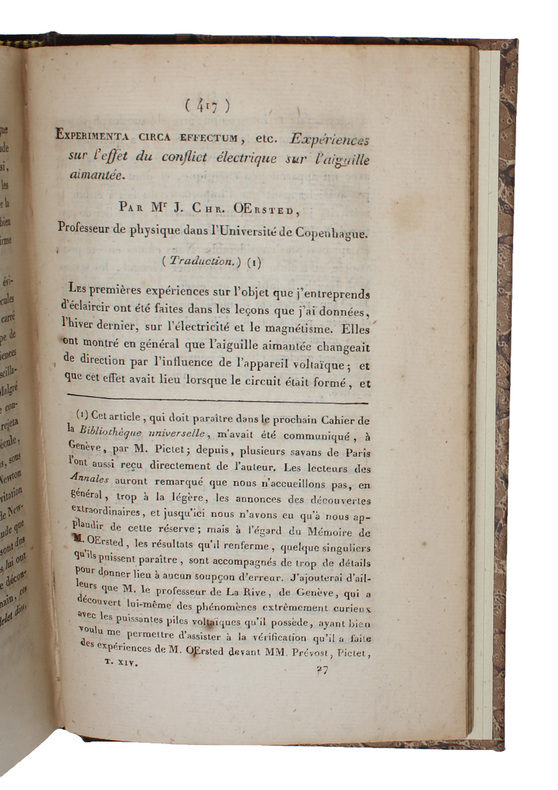
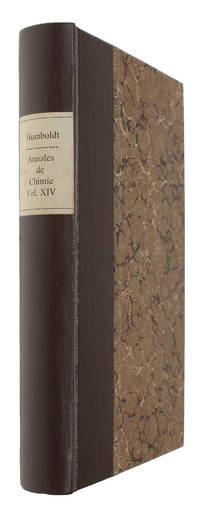
182035260Paris, Crochard, 1820. Recent hcloth. Some repairs to inner margin of titlepage to ""Annales"". In ""Annales de Chimie et de Physique, Par MM. Gay-Lussac et Arago"" Tome XIV pp. 417-25. The whole volume present: 448 pp. and 3 folded engraved plates.
182035260Paris Crochard 1820. Recent hcloth. Some repairs to inner margin of titlepage to "Annales". In "Annales de Chimie et de Physique Par MM. Gay-Lussac et Arago" Tome XIV pp. 417-25. The whole volume present: 448 pp. and 3 folded engraved plates. <br/><br/><em>First French translation and the first translation of Oersted's epoch-making announcement in his Latin pamphlet "Extperimenta circa effectum conflictus electrici in acun magneticam. Hafniæ 1820" privately printed in a very small number and only distributed to colleques in Europe. This discovery and confirmation of the connection between 2 forces electricity and magnetism must be considered one of the happiest events in the history of science both with regard to scientific and practical results. - "From the moment that Ørsted's discovery became known it created an enormous sensation. The results communicated were so astounding that they were received with a certain distrust but they were stated with such accuracy that it could hardly be permitted to entertain any doubts. In the course of a short time the treatise was translated into all the chief languages." Kirstine Meyer. - Dibner:61 - PMM: 282 - Horblitt: 3 b. - Sparrow: 152. </em> hardcover
Very Good Turkish, Ottoman (1500-1928) Original wrappers. Foolscap 8vo. (18 x 13 cm). In Ottoman script (Old Turkish with Arabic letters). 112 p. On the first page, written 'copies without seals are fake', and this copy is with a seal. Slightly faded and chipped on extremities. Foxing on first pages. Uncut marginal extremities Otherwise a good copy. Exceedingly rare first edition of the first Ottoman voyage to Cape of Good Hope and first-hand travel account of the Ottoman qadi Abubakr Effendi (1814-1880) of South Africa and Mozambique, who was sent in 1862 by Sultan Abdulaziz at the British Queen Victoria's request in order to teach and assist the Muslim community of the Cape Malays. The presence of the Muslim population in South Africa dates back to the 16th century, South Africa and the Cape of Hope have become a colony of Western countries such as Portugal, the Netherlands, and the United Kingdom. The Ottoman Empire was interested in the Far East, Javanese, and South African regions in the 16th century and then tried to establish a relationship. The direct relationship between the Ottoman Empire and South Africa in the 19th century, upon the request of the Muslim people and England, was formed through Abubakr Effendi. The Muslims in conflict with various religious issues have found the remedy by consulting a scholar from the Ottoman Empire through England. After all, Abubakr Effendi reached Cape Town in 1862 and tried to resolve the conflicts among the Muslim people. (Abubakr Effendi: An Ottoman Scholar in South Africa in the Nineteenth Century: Yilmaz, Yusuf). "Abubakr Efendi was sent to Cape Town by Ottoman Sultan Abdulaziz. When chaos reigned in the Islamic society because of the imams who declared themselves as leaders in the region, Muslim leaders in Cape of Good Hope conveyed their letters to the Queen of England in 1862 declaring that they needed a religious leader. Since they had not been educated for years, they had forgotten their Java language and could not read their own books. They sent a letter to the Queen of England, informing them that help could be sought from the Ottoman court, the center of Muslim countries in the period. The issue was refused in the Parliament and the Ottoman Ambassador Musurus Pasha was offered it to the Ottoman Sultan. Abubakr Effendi's mission was to prevent Muslims in Cape of Good Hope to clash with each other and teaching them authentic Islamic knowledge free of superstition. Although Abubakr Efendi had some Arabic translators in his service, he still learned English and African languages in a short time and wrote books in order to benefit the Muslims there. On the fifteenth day he set foot on the continent, he opened a madrasah called the "Ottoman School" and enrolled three hundred students in twenty days. He traveled to Mauritius and Mozambique. He wrote his famous book 'Bayan al-Din' (a sort of catechism) in Afrikaan in Arabic letters. Then he married Rukiye Hanim, but they divorced after a while since they had to communicate by using an English and Arabic dictionary. Then he married James Cook's nephew Tahota Saban Cook. In his memoir, Ömer Lütfi wrote down all the travels of Abubakr Efendi for two years. Abubakr Efendi stayed in South Africa for 22 years and died there." (140 yillik miras: Güney Afrika'da Osmanlilar: Uçar, Ahmet). Abubakr Efendi first traveled to London and then to South Africa by a ship with his assistant Omar Lutfi. He established the first Ottoman School in Cape Town and then wrote his work Bayan Al-Din in Afrikaans with Arabic letters and distributed it to the Muslim population of South Africa. Four printed copies in OCLC: 427674106 (Three copies); 635151131 (One copy). Özege 22397. First Edition. Extremely rare.
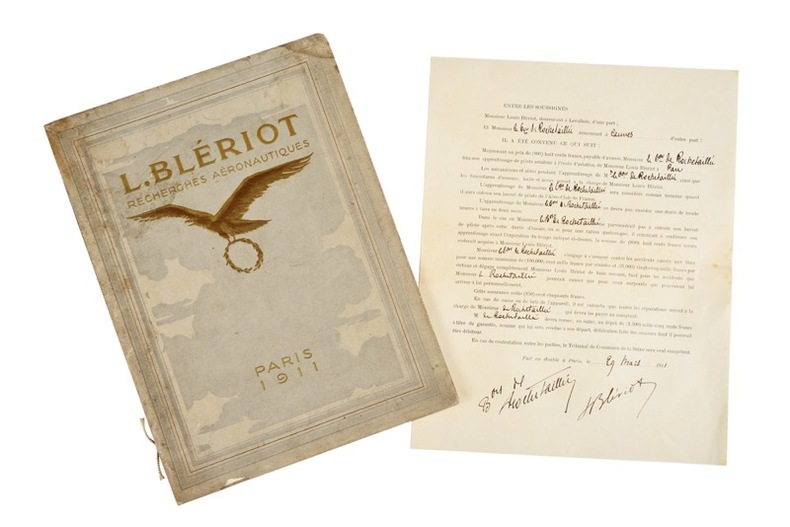
21757formulaire imprimé et complété et signé des deux parties (1 feuillet blanc recto, 274 x 212 mm), en vue d’obtenir le brevet de pilote de l’Aéro-Club de France. L’apprentissage coutait 800 francs soit en terme de pouvoir d’achat 251 455 € d’aujourd’hui !
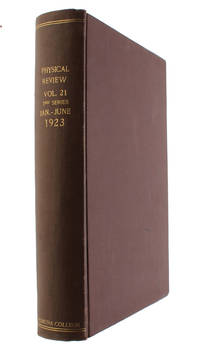
192347061Lancaster, The Physical Review, 1923. Royal8vo. Contemp. full buckram. In:""The Physical Review"", Series II, vol. 21. (4),736 pp., Plates and textillustr. (Entire volume offered). A perforated stamp in upper margin on a few leaves. Compton's paper: pp. (483-) 501.
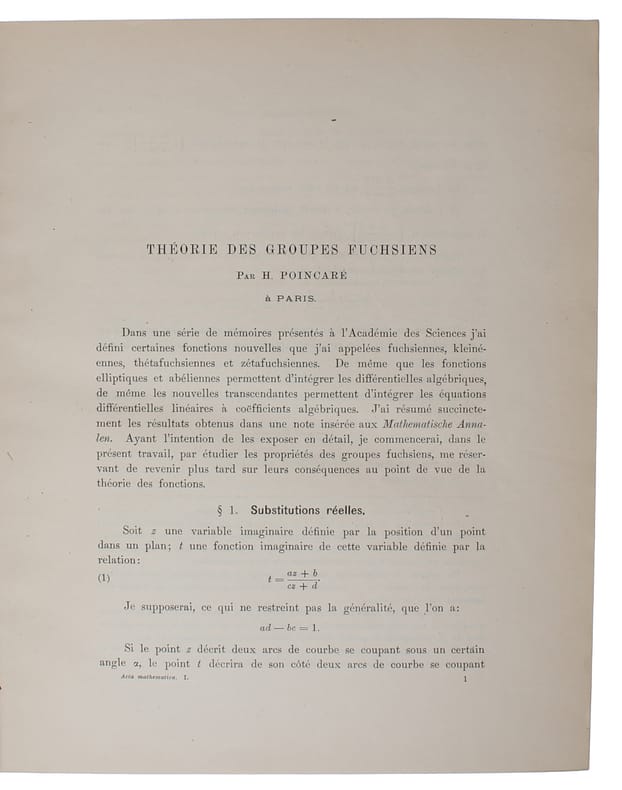
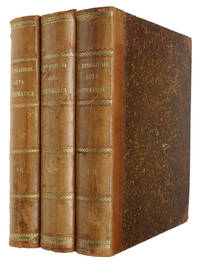
188460243Berlin, Stockholm, Paris, F. & G. Beijer, 1882-84. Large4to (272 x 230 mm). Three volumes uniformly bound in contemporary half calf with gilt lettering to spine. In ""Acta Mathematica"", volume 1-5. Light wear to extremities, boards and spines with scratches. Stamp to verso of front board in all volumes. First three leaves in first volume detached, otherwise internally fine and clean. Vol. I, pp. 1-62" Pp. 193-294 Vol. II, pp. 97-113 Vol. III. pp. 49-92 Vol. IV pp. 201-312" Vol. V pp. 209-278.
192347061Lancaster The Physical Review 1923. Royal8vo. Contemp. full buckram. In:"The Physical Review" Series II vol. 21. 4736 pp. Plates and textillustr. Entire volume offered. A perforated stamp in upper margin on a few leaves. Compton's paper: pp. 483- 501. <br/><br/><em>First printing of this milestone paper in quantum physics in which Compton verifies Planck's quantum postulate and found that some of the X-rays had in scattering lenghtened their wavelenght. This phenomena was called the "Compton Effect" in his honour. For this discovery Compton received the Nobel prize in physics in 1927."Compton was able to account for this lenghtening of wavelenght by presuming that a photon of light struch an electron which recoiled subtracting some energy from the photon and therefore increasing its wavelenght. This made it seem that a photon acted as a particle: thus after more than a century the particulate natuer of light as evolved by Newton was revived. What itamounted to was that Compton brought to fruition the view that electromagnetic radiation had both a wave aspect and a particle aspect and that the aspect which was most evident depended on how the radiation was tested. De Broglie was at the same time showing that this held true also for ordinary particles such as electrons." AsimovParkinson "Breakthroughs" 1923 P. - Sigmund Brandt "The Harvest of as Century" Episode 31. </em> hardcover
188460243Berlin Stockholm Paris F. & G. Beijer 1882-84. Large4to 272 x 230 mm. Three volumes uniformly bound in contemporary half calf with gilt lettering to spine. In "Acta Mathematica" volume 1-5. Light wear to extremities boards and spines with scratches. Stamp to verso of front board in all volumes. First three leaves in first volume detached otherwise internally fine and clean. Vol. I pp. 1-62; Pp. 193-294; Vol. II pp. 97-113; Vol. III. pp. 49-92; Vol. IV pp. 201-312; Vol. V pp. 209-278. <br/><br/><em>First publication of these groundbreaking papers which together constitute the discovery of Automorphic Functions. "Before he was thirty years of age Poincaré became world famous with his epoch-making discovery of the "automorphic functions" of one complex variable or as he called them the "fuchsian" and "kleinean" functions." DSB.These manuscripts written between 28 June and 20 December 1880 show in detail how Poincaré exploited a series of insights to arrive at his first major contribution to mathematics: the discovery of the automorphic functions. In particular the manuscripts corroborate Poincaré's introspective account of this discovery 1908 in which the real key to his discovery is given to be the recognition that the transformations he had used to define Fuchsian functions are identical with those of non-Euclidean geometry. See Walter Poincaré Jules Henri French mathematician and scientist.The idea was to come in an indirect way from the work of his doctoral thesis on differential equations. His results applied only to restricted classes of functions and Poincaré wanted to generalize these results but as a route towards this he looked for a class functions where solutions did not exist. This led him to functions he named Fuchsian functions after Lazarus Fuchs but were later named automorphic functions. First editions and first publications of these epochmaking papers representing the discovery of "automorphic functions" or as Poincaré himself called them the "Fuchsian" and "Kleinian" functions."By 1884 Poincaré published five major papers on automorphic functions in the first five volumes of the new Acta Mathematica. When the first of these was published in the first volume of the new Acta Mathematica Kronecker warned the editor Mittag-Leffler that this immature and obscure article would kill the journal. Guided by the theory of elliptic functions Poincarë invented a new class of automorphic functions. This class was obtained by considering the inverse function of the ratio of two linear independent solutions of an equation. Thus this entire class of linear diffrential equations is solved by the use of these new transcendental functions of Poincaré." Morris Kline.Poincaré explains how he discovered the Automorphic Functions: "For fifteen days I strove to prove that there could not be any functions like those I have since called Fuchsian functions I was then very ignorant; every day I seated myself at my work table stayed an hour or two tried a great number of combinations and reached no results. One evening contrary to my custom I drank black coffee and could not sleep. Ideas rose in crowds; I felt them collide until pairs interlocked so to speak making a stable combination. By the next morning I had established the existence of a Class of Fuchsian functions those which come from hypergeometric series; i had only to write out the results which took but a few hours.the transformations that I had used to define the Fuchsian functions were identical with those of Non-Euclidean geometry." </em> hardcover
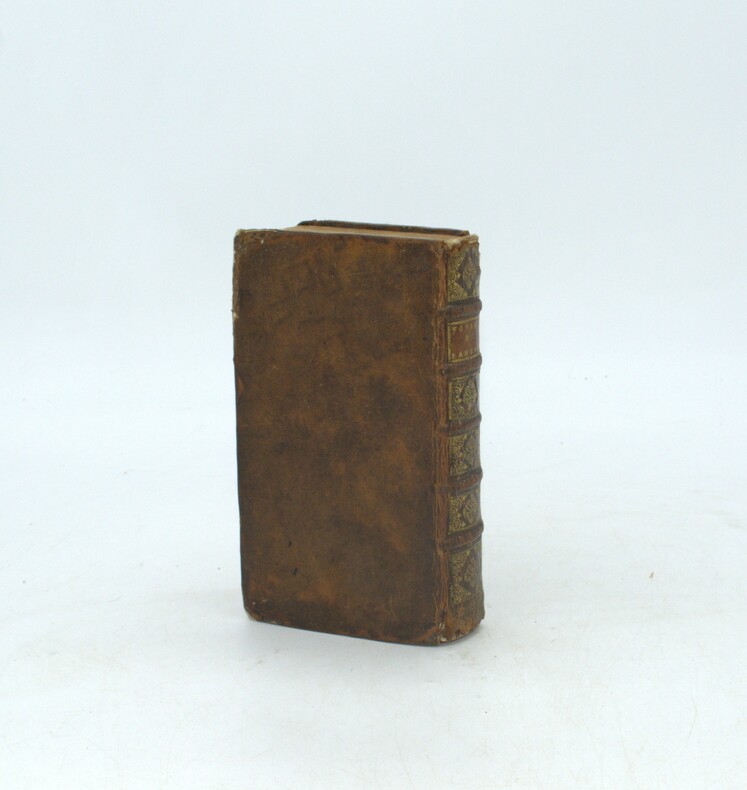
1703PHO-2014À La Haye, Chez les Frères L'Honoré, 1703. 2 tomes en un volume in-12, veau, dos à nerfs orné avec pièce de titre (reliure de l'époque) défauts d’usage. Rare édition de l'une des relations de voyage les plus importante pour l'histoire du Canada. - + 279 pp. & -- 220 + 8ff., Un frontispice et 24 planches ou cartes, certaines repliées, dont la « Carte Général de Canada ». Ex-libris manuscrit sur le titre. Première édition, troisième tirage.
69 pages. Complete with 8 protected map plates. Signed and inscribed by E.O.S. Scholefield, Archivist of British Columbia atop front cover. Pages 3-4 constitute a letter of submittal by Mr. Scholefield to the Honourable Henry Esson Young, Provincial Secretary. This work "represents the first bulletin of the British Columbia Provincial Archives Department." - page 3. "Vindicates the contention of Captain Vancouver that his ships were the first to complete the navigation of the inner channels which separate Vancouver Island from the British Columbia mainland." - M. Menzies. Errata neatly affixed to verso of Map List. Map plate V loose but present. Rough cut edges. Contents clean, unmarked and lightly toned. Short openings to bottom edges of beige card covers. Strathern 399. Book
182046026(Paris, Crochard, 1820). No wrappers. In ""Annales"". In ""Annales de Chimie et de Physique, Par MM. Gay-Lussac et Arago"" Tome XIV, Cahier 4, Titlepage to vol. 14 + pp. 337-442. (Entire issue offered). Ørsted's paper: pp. 417-25. A few scattered brownspots.
182046026Paris Crochard 1820. No wrappers. In "Annales". In "Annales de Chimie et de Physique Par MM. Gay-Lussac et Arago" Tome XIV Cahier 4 Titlepage to vol. 14 pp. 337-442. Entire issue offered. Ørsted's paper: pp. 417-25. A few scattered brownspots. <br/><br/><em>First French translation and the first translation of Oersted's epoch-making announcement in his Latin pamphlet "Extperimenta circa effectum conflictus electrici in acun magneticam. Hafniæ 1820" privately printed in a very small number and only distributed to colleques in Europe. This discovery and confirmation of the connection between 2 forces electricity and magnetism must be considered one of the happiest events in the history of science both with regard to scientific and practical results. - "From the moment that Ørsted's discovery became known it created an enormous sensation. The results communicated were so astounding that they were received with a certain distrust but they were stated with such accuracy that it could hardly be permitted to entertain any doubts. In the course of a short time the treatise was translated into all the chief languages." Kirstine Meyer. - Dibner:61 - PMM: 282 - Horblitt: 3 b. - Sparrow: 152. </em> unknown
56401-19Fine. Fern Cave: The history of the discovery exploration and mapping of the Fern Cave System unknown
Very Good Turkish, Ottoman (1500-1928) Original wrappers. Foolscap 8vo. (17 x 12 cm). In Ottoman script (Old Turkish with Arabic letters). 152 p. Roumi: 1324 = Gregorian: 1906. Taken from a volume including multiple books. Spine is restored. A very good copy. First and only edition of this early and extensively rare book including a first-hand account of the topography and descriptions of Hejaz, Mecca, and other parts of Arabian Peninsula such as Taif and Yemen by Sadiq Sherif, who was the first person to take photographs of Mecca, Medina, and the Hajj in 1880 and 1881 as well. Sadiq Sherif was the grandson of Serif Abdulmuttalib, the Emîr of Mecca. This book written by Sherif was dedicated to 'the Progress and Union Society' [i.e. Ittihad ve Terakki Cemiyeti]. The book describes the way of administration and territorial division of Hejaz after giving some information of its geography, borders, tribes and natives, mountains, rivers, crops and products, and animals of this Ottoman 'vilâyat' [i.e. province]. Sherif gives detailed information on how and when the Ottoman Empire ruled Hejaz, the location of Mecca city, its borders, physical and social geography, crops in Mecca and around, its flora, fauna, demographic structure, 'nahiyes', Kâba's construction, and its history, sacred places around, Masjid-i Haram and other masjids, cemeteries, mountains, gifts by Ottoman caliphs to Kaba, 'Taif' area, people who were 'Emîr' of Mecca from the period of Mohammad, Wahhabism and its birth, etc. At the last, Sherif gives place to his personal letter (layihâ) including 49 articles. The letter was about the reforms that Hejaz needs and it was sent to the Ottoman 'sadâret' [i.e. prime ministry]. (Source: History of geographical literature during the Ottoman Empire, Edited by Ihsanoglu). Muhammad Sadiq Sherif Bey was the first person to take photographs of Mecca, Medina, and the Hajj in 1880 and 1881. Sadiq Bey trained as a military engineer after completing his studies in Cairo and at the École Polytechnique in Paris. It is not known when, or from whom, Sadiq Bey learned to take photographs but it was most probably through one of the resident photographers in Egypt. In 1861, prompted by the need to carry out more extensive military land surveys of the area between Wajh and Medina, Sadiq Bey made his first journey to Arabia. He took a camera along with his surveying equipment and took his very first photographs of Medina. In a series of articles published in the Egyptian Military Gazette in 1877, he refers to his early photography at Medina describing the use of a 'photographia'. Sadly, however, none of the photographs from this first journey has survived. In 1880 he was appointed as the treasurer of the Mahmal, the ornate cloth to cover the Ka'ba brought each year on a special litter to Mecca. He accompanied the Mahmal to Medina and Mecca from September 1880 until January 1881. Again equipped with his camera, he succeeded in producing the series of photographs that are now considered some of the earliest known photographs of the region, those of the Ka'ba, taken under great secrecy. Sadiq Bey published various accounts of his travels in Arabia in military journals, through the Emiry Grand Press in Cairo, but the 1880/81 series of photographs appear to have been issued separately for wider distribution through the Société Khédiviale de Géographie. The society's secretary, Dr. Frederic Bonola, advertised sets of photographs for sale. In January and April 1880 Sadiq Bey gave a talk and report to the society on his earlier 1861 expedition, and on 20 May 1881 he presented a report on his recent journey to Mecca; detailed accounts were published in the society's bulletins, numbers 9/10 and 12. (Source: Christie's). Özege 11888.; Karatay, TM II: 695.; MKAHTBK, II: 991.; OCLC 248374684 / 4082352.
184849336Paris, Victor Masson, 1848 a. 1851. 8vo. 2 contemp. hcalf, raised bands, gilt spine. Light wear along edges. Small stamps on verso of titlepages and on verso of 1 plate. In ""Annales de Chimie et de Physique"", 3me Series - Tome XXIV and XXXI. (6),512 pp. and 2 plates + 512 pp. a. 4 plates.(2 entire volumes offered). Pasteur's papers: pp. 442-459 a. pp. 459-460, 1 double-page folded engraved plate + pp. 67-102 a. 1 plate. Some scattered brownspots to first part of the first volume, not affecting P's papers.