1 815 résultats
184849336Paris Victor Masson 1848 a. 1851. 8vo. 2 contemp. hcalf raised bands gilt spine. Light wear along edges. Small stamps on verso of titlepages and on verso of 1 plate. In "Annales de Chimie et de Physique" 3me Series - Tome XXIV and XXXI. 6512 pp. and 2 plates 512 pp. a. 4 plates.2 entire volumes offered. Pasteur's papers: pp. 442-459 a. pp. 459-460 1 double-page folded engraved plate pp. 67-102 a. 1 plate. Some scattered brownspots to first part of the first volume not affecting P's papers. <br/><br/><em>First full exposition of Pasteur's momentous and revolutionary discovery of "molecular assymetry" and founding the science of Polarimetry.The discovery was first announced by Pasteur in may 1848 by the printing of the preliminary report of only 4 short pages in order to establish priority. The announcement - 4 pages - was published in Comptes rendus hebdomadaires de l’Académie des Sciences Paris Seance of May 15 1848 26 21 535-538 Published on May 1848."In 1848.Pasteur studied the crystals of tartrates one of the substances that exhibited the now-clockwise now-counterclockwise effect under the microscope and found that the crystals were mirror images of the others. The two crystals resembled each other as a right-hand glove resembles a left-hand glove.This was a revolutionary discovery and it took some courage to announce it. A few years before the well-known chemist Mitscherlich had studies the same tartrate crystals and declared them all to be identical. Pasteur was only a twenty-sic-year-old unknown. neverthelless he announced his findings and went before Biot to repeat the separation ofthe crystals before the eyes of the aged authority in the field. Biot was convinced and Pasteur received the Rumford medal of the Royal Society for his work.Pasteur had thus founded the science of polarimetry in which the measurements of the manner in which the plane of polarized light was twisted could be used to help to determine the structure of organic substance to follow various chemical reactions and so on."Asimov. Leicester & Klickstein "A Source Book of Chemistry" p. 374-379. </em> hardcover
In-4°: pp. 25. Testatine e capilettera xilografati. Legatura in cartonato.
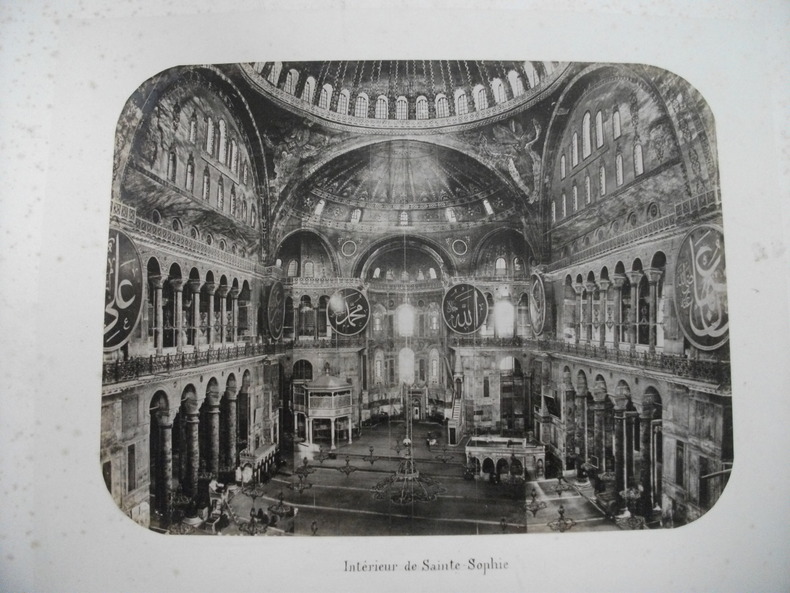
5466Album de vues de Constantinople et vues de Cordoue, Séville,Grenade 25 photographies tirage albuminés,19 x26 pour la plupart pour Costantiople et 23 x 32 pour Espagne,contrecollées sur carton très fort.l’ensemble monté sur onglets toilés,dans un Album pleine toile rouge,titre doré sur le premier plat,7 filets,et écoinçons dorés en encadrement.Format 47x34cm.Vers 1880 1) pont de Constantinople du quartier Pera enjambe la corne d’or en reliant Pera à Istambul.2) Sainte Sophie 3) intérieur de Sainte Sophie 4)la tribune impériale à Sainte Sophie 5)Eaux douces d’Asie 6)femmes Turcques en costumes d’apparat avec leurs admirateurs 7) Eaux douces d’Europe 8)Yildis–Kiosk 9)Palais de Beylerbey 10) Yéni-Mahallé 11)Tour de Léandre 12)Palais de Tchergham 13 Mosquée de St Isaac 14)les Isles 15) Palais sur le Bosphore 16) Environs de St Isaac 17)jardins à Cordoue 18 Palais à Cordoue 19)Cordoue la mezquita 20)Séville 21) Séville 22) Cordoue, 23) Cordoue, 24)et 25).(une décoloration angle supérieur droit au deuxième plat- rousseurs éparses sur les cartons forts) Photographes attitrés des sultans Abdulaziz et Abdülhamid II, les frères Abdullah, d’origine arménienne, se sont rendus célèbres dans tout l’Empire ottoman et jusqu’en Europe où leur participation aux Expositions universelles de 1867 et 1878 a été très remarquée. Situé à Péra, leur studio était le passage obligé des touristes à la recherche de vues sur Constantinople. Mais c’est avec le portrait en studio que les frères Abdullah ont acquis leur renommée. Ils ont notamment réalisé un portrait d’Abdulaziz qui leur a décerné en 1863 le titre de photographes officiels du sultan. Sous leur objectif, se sont alors succédés les membres de la famille impériale et les dignitaires ottomans, les monarques et les princes européens en visite ainsi que des figures éminentes des différentes communautés de Constantinople
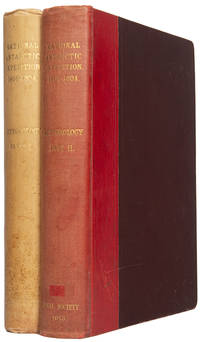
115669London Royal Society 1908-1913. . First edition; 2 vols 4to; vol. I: frontispiece 14 plate leaves large folding coloured map 1 very large chart dissected into 4 parts with title sheet; vol. II: 261 leaves of weather maps printed on one side only vol. I in red buckram backed boards vol. II in bright carmine red cloth backed boards spines faded lightly soiled a very good set; xiv 544; 26 pp.<br /> From the library of Professor Otto Nordenskjöld 1869-1928 the distinguished Swedish Antarctic explorer and scientist. Nordenskjöld was on the Swedish scientific expedition to the Antarctic 1901-1903 and would have had a particular interest in the results of the Discovery expedition.<br /><br />Meteorology is an important work providing a compendium of over a thousand synoptic charts concerning the Antarctic drawn not only from Scott's expedition but also from the Scottish Swedish and German expeditions. This was the first attempt to give an idea of the general principles underlying atmospheric circulation in the southern hemisphere.<br /> Rosove 288-9.A1 288-210.A1 binding b; Taurus 50; Spence 840. London, Royal Society, 1908-1913. hardcover
182843318Leipzig, Johann Ambrosius Barth, 1828. Without wrappers as issued in ""Annalen der Physik und Chemie. Hrsg.von Poggendorff"", Bd. 14, Zweites Stück. (=Jahrgang 1828, zehntes Stück). Pp. 191-306 a. 3 engraved plates. (the entire issue offered (Heft 2) together with the titlepage to 14. Band). Brown's paper: pp. 294-313. Clean and fine. Small stamp on verso of titlepage.
173546590(Paris, L'Imprimerie Royale, 1735). 4to. Without wrappers. Extracted from ""Mémoires de l'Academie des Sciences. Année 1733"". Pp. 23-39, pp. 73-84, pp. 233-254 a. 1 engraved plate, pp. 457-476. With titlepage to the volume (1733/1735). Margins of titlepage with a few brownspots.
182843318Leipzig Johann Ambrosius Barth 1828. Without wrappers as issued in "Annalen der Physik und Chemie. Hrsg.von Poggendorff" Bd. 14 Zweites Stück. =Jahrgang 1828 zehntes Stück. Pp. 191-306 a. 3 engraved plates. the entire issue offered Heft 2 together with the titlepage to 14. Band. Brown's paper: pp. 294-313. Clean and fine. Small stamp on verso of titlepage. <br/><br/><em>First appearance in German of this monumental paper in atomic theory and kinematics as it was the first evidence for atomism that was an observation rather than a deduction from abstract principles."In 1827 as he was viewing a suspension of pollen in Water under the microscope he noted that the individual grains were moving about irregularly. This he thought was the result of the life hidden within the pollen grains. However when he studied dye particles indubitably nin-livin suspended in water he found the same erratic motion. This has been called "Brownian motion" ever since and Brown could merely report on the observation. He had no explanation for it. Nor had anyone else until the development of the kinetic theory of gases by men such as Maxwell a generation later. It seemed plain. after Maxwell and especially after the work of Einstein and Perrin a half century after Maxwell that the Brownian Motion was actually a visible effect of the fact that water was composed of particles. It was the first evidence for atomism that was an observation rather than a deduction." Asimov.The issue contains other importent papers by C. Naumann G. Magnus Th. Saussure "Kohlensäuregas in der Atmosphäre" andothers.PMM: 290 the English paper from 1828 - Sparrow Milestones of Science No 31. - Magie "A Source Book in Physics p. 251-255. - Dibner Heralds of Science No 156. </em> unknown
173546590Paris L'Imprimerie Royale 1735. 4to. Without wrappers. Extracted from "Mémoires de l'Academie des Sciences. Année 1733". Pp. 23-39 pp. 73-84 pp. 233-254 a. 1 engraved plate pp. 457-476. With titlepage to the volume 1733/1735. Margins of titlepage with a few brownspots. <br/><br/><em>First appearance of these milestone papers in the histroy of electricity in which Dufay explains his discovery of two kinds of electricity and the relation between them attraction and repulsion shocks and sparking and the full recognition of electrostatic repulsion. He formulates the two-fluid theory of electricity. He further showed that "not all bodies can become electrified themselves" by friction and went on to show "that they can all acquire a considerable electrical virtue when the tube of rubbed glass wood metals or liquids are brought near them" provided only that they are insulated by beiing stood on "a support of glass or of sealing-wax".Dufay "TRANSFORMED A COLLECTION OF MISCELLANEOUS WEEDS INTO THE FIRST GARDEN OF EUROPE" Heilbron"Dufay's substantive discoveries - ACR the two electricities shocks and sparking - are but one aspect and perhaps not the most significant of his achievement. His insistence on the impiortence of the subject on the universal character of electricity on the necessity of organizing digesting and regulariizing known facts before grasping new ones all helped to introduce order and professionel standards into the study of electricity at precisely the moment when the accumulation of data began to require them. He foundthe subject a record of often capricious disconnected phenomena the domain of the polymaths textbook writers and prfesional lecturers and left a body of knowledge that invited and rewarded prolonged scrutinity from serious physicists." Heilbron "Electricity in the 17 & 18 Centuries" p. 260.Parkinson "Breakthroughs" 1734 P - Ronalds Library p. 145. - Not in Wheeler Gift Cat. </em> unknown
11997dessinés d’après nature par Jules COIGNET, avec des notes d’Amédée ACHARD. Grand in folio 615x430mm. Pleine percaline noire de l’éditeur, titre au dos et sur le premier plat , avec armes, dorés. Filets à froid en encadrement. . Titre illustré, 56 pages de notes par Amédée ACHARD, 27 superbes lithographies hors –texte de SABATIER, plus la page de titre d’après les dessins de Jules COIGNET. 1) Bade chemin de Fremersberg. 2) Bade vu sous les murs du château. 3) route du vieux château.4) intérieur du vieux château.5) Rocher du vieux château.6) Vue générale du vieux château. 7) Eglise d’Elersteinburg. 8 )Allée de Lichtenhal. 9) Cascade de Géroldsau. 10) Tour d’Yburg. 11) Scierie de la route d’Eberstein. 12) Eberstein. 13) la gorge du loup. 14) Vieille route de Gernbach. 15) la murg à Gernsbach. 16) Maison de ville à Gernsbach. 17) Route de Forbach. 18) Forbach. 19) Fontaine à Forbach. 20) chute du Schwarzembarch. 21) chute des bois dans le Schwarzembarch. 22) une des sept cascades. 23) une des cascades d’Allerheiligen. 24) Ruines d’Allerheilingen. 25) Le Mummelsee. 26) Le Val d’Enfer ; 27) Entrée du Val d’Enfer. Charnières intérieurs toile noire. Complet des superbes lithographies de SABATIER d’après Jules COIGNET. A signaler de petits raccommodages à la reliure coiffes et coins, une déchirure réparée, à une page de note, en fin de volume. Bel ensemble Hachette éditeur 1858.
19842548821984. unbound. Outstanding official NASA photograph signed by all six members of Flight STS-41-D Discovery's first mission. This vibrant color 8 x 10-inch photo features all six crew members in flight gear: Charles Walker the first non-government person to fly in space Judy Resnik who died two years later at the age of 36 in the Challenger explosion Richard "Mike" Mullane a former Air Force Colonel Steve Hawley Hank Hartsfield and Michael L. Coats the pilot of this mission. No place no date circa 1984. Set in a cream-colored matte and brown wooden frame measuring 12 x 14 inches. Near fine condition.<br/><br/> unknown books
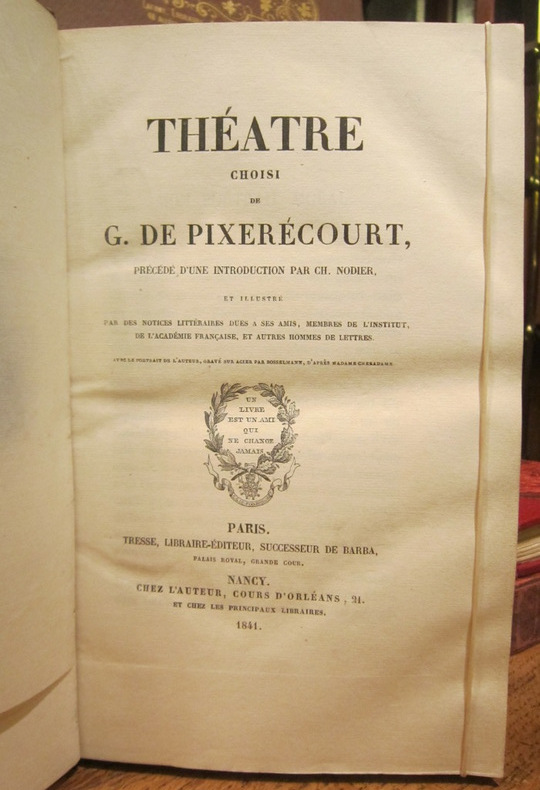
1841002830Paris et Nancy, Tresse, et Chez Lauteur, 1841
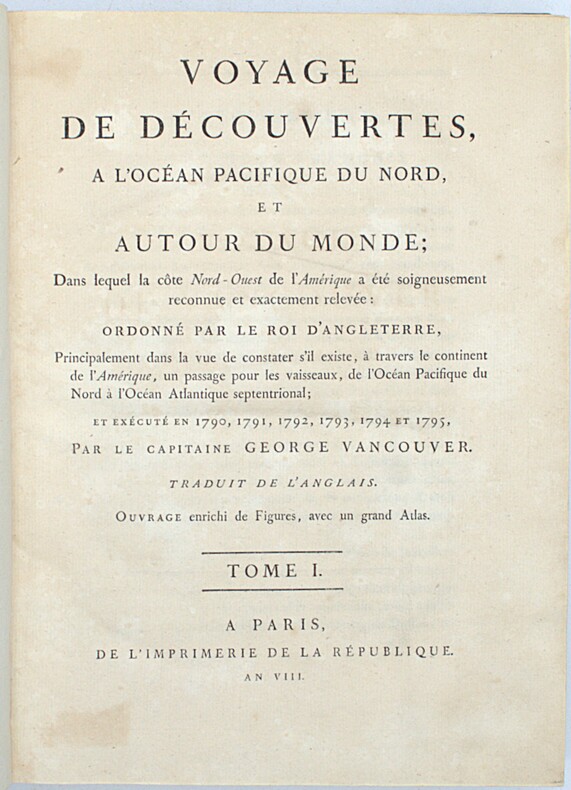
1800PHO-2418Paris, Imprimerie de la République, an VIII (1800). 3 vol. in-4 (28,5 × 21 cm), XII-491pp., 2ff.-516pp., 3ff.-562pp., demi-veau fauve à petits coins de vélin, dos lisses teintés vert et ornés de bateaux (reliure de l’époque). Charnières fendillées, accrocs à deux coiffes. Infimes rousseurs, petites déchirures sans gravité. Tome I, quelques cahiers brunis, 1 feuillet fragile.
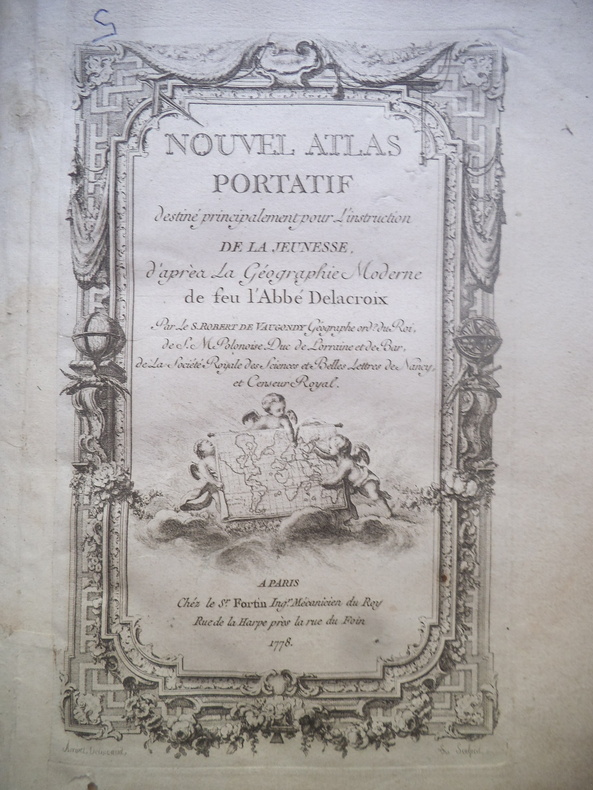
14501Nouvel atlas portatif destiné principalement pour l’instruction de la jeunesse d’après la géographie moderne de feu l’abbé DELACROIX par le S. Robert de VAUGONDY géographe du Roi de S.M Polonoise Duc de Lorraine et de Bar de la société royale des sciences et belles lettes de Nancy et censeur royal . A Paris chez le Sr FORTIN 1778. In 4 demi-chagrin fauve à nerfs, pièce de titre chagrin rouge, fers, roulette, filets, caissons dorés. Cartes 290x420mm. Faux titre, Titre gravé avec frise décorative en encadrement. IX, et suite de 52 cartes, sur double page pages, montées sur onglets. Contours couleurs d’origine., gavées par DUSSY. Complet. Coiffe inférieure manquante, mouillure pâle en marge supérieure visible au recto, jusqu’à la carte 20. Pages de faux titre avec quelques légères salissures sans gravité,. Cartes avec coloris frais Cartes numérotées au pochoir, au verso.
80428Paris, Typographie de Firmin-Didot et Cie. 1903, 300x245mm, 360pages, broché. Couverture supérieure détachée, dos fendu. A faire relier. Intérieure en très bon état, aucun défaut. Sous emboitage. Cet exemplaire attend les soins d’un bon reliure afin d’en être dignement et justement habillé selon son importance historique et son impacte phénomal dans les découvertes scientifiques.
183244146Leipzig, Johann Ambrosius Barth, 1832. Contemp. hcalf., raised bands, gilt spine. Light wear along edges. In ""Annalen der Physik und Chemie. Hrsg. von J.C. Poggendorff"", Band 25. (Entire volume offered). VIII,648 pp. and 6 folded engraved plates. Small stamps on verso of titlepage and plates. Faraday's papers: pp. 91-142 a. pp. 142-186. with 3 folded engraved plates. Clean and fine.
183244145Paris, Crochard, 1832. Contemp. hcalf., gilt spine, light wear along edges. In: ""Annales de Chimie et de Physique, Par MM. Gay-Lussac et Arago."", tome 50, Series 2. (Entire volume offered). 448 pp. 2 folded engraved plates. Faraday's papers: pp. 5-67 a. pp. 113-162.
175042895(Petropoli (St. Petersbourg), 1750). 4to. Uncut, without wrappers. Extracted from ""Novi Commentarii Academiae Scientiarum Imperialis Petropolitanae"", Tom. I. ad Annum 1747 et 1748. Pp. 245-266 a. 1 engraved plate (ad. p. 251). Clean and fine.
183244146Leipzig Johann Ambrosius Barth 1832. Contemp. hcalf. raised bands gilt spine. Light wear along edges. In "Annalen der Physik und Chemie. Hrsg. von J.C. Poggendorff" Band 25. Entire volume offered. VIII648 pp. and 6 folded engraved plates. Small stamps on verso of titlepage and plates. Faraday's papers: pp. 91-142 a. pp. 142-186. with 3 folded engraved plates. Clean and fine. <br/><br/><em>First German editions of the 2 first memoirs of Faradays groundbreaking researches on electricity constituting the first 2 papers of his "Experimental Researches in Electricity" and containing his fundamental discovery of electromagnetic induction THE FOUNDATION OF NEARLY ALL THE ELECTRICITY IN USE TODAY. In 1820 Oersted had generated magnetism from electricity Faraday here finds the opposite effect generating electricity by magnetism. He also described the first electrical generator second paper. THESE PAPERS ARE SOME OF THE GREAT CLASSICS OF CHEMISTRY AND PHYSICS."Faraday demonstrated this theory involving the lines of force.by inserting a magnet into a coil of wire attached to a galvanometer. While the magnet was being inserted or removd current flowed through the wire. If the magnet was held stationary and the coil moved over it one way or the other there was current in the wire. In either case the magnetic lines of force about the magnet were cut by the wire.If the magnet and coil were both held motionless whether the magnet was within the coil or not there was no current.Faraday hd thus discovered electricalinduction.It was to lead to great things but this was not apparent."Asimov."Although his discovery of the electric motor and the dynamo was almost entirely identical to his theoretical discoveries it laid the foundation of the modern electrical industry - electric light and power teælephony wireless telegraphy televison etc. - by providing for the production of continous mechanical motion from an electrical source and vice versa." PMM 308.Horblit 29 - Milestones 62. - Dibner 64. - PMM 308.The volume contains further notable papers. Elie de Beaumont "Zweiter geologischer Brief.an A.v. Humboldt über die relative Alter der Gebirgszüge" pp. 1-58 a. 2 plates one handcoloured papers by Döbereiner E. Lenz Moser Mitscherlich de Saussure J. Dumas F.E. Neumann Gay-Lussac Johannes Müller "Beobachtungen zur Analyse der Lymphe des Bluts und des Chylus" pp. 513-590. </em> hardcover
183244145Paris Crochard 1832. Contemp. hcalf. gilt spine light wear along edges. In: "Annales de Chimie et de Physique Par MM. Gay-Lussac et Arago." tome 50 Series 2. Entire volume offered. 448 pp. 2 folded engraved plates. Faraday's papers: pp. 5-67 a. pp. 113-162. <br/><br/><em>First French editions of the 2 first memoirs of Faradays groundbreaking researches on electricity constituting the first 2 papers of his "Experimental Researches in Electricity" and containing his fundamental discovery of electromagnetic induction THE FOUNDATION OF NEARLY ALL THE ELECTRICITY IN USE TODAY. In 1820 Oersted had generated magnetism from electricity Faraday here finds the opposite effect generating electricity by magnetism. He also described the first electrical generator second paper. THESE PAPERS ARE SOME OF THE GREAT CLASSICS OF CHEMISTRY AND PHYSICS."Faraday demonstrated this theory involving the lines of force.by inserting a magnet into a coil of wire attached to a galvanometer. While the magnet was being inserted or removd current flowed through the wire. If the magnet was held stationary and the coil moved over it one way or the other there was current in the wire. In either case the magnetic lines of force about the magnet were cut by the wire.If the magnet and coil were both held motionless whether the magnet was within the coil or not there was no current.Faraday hd thus discovered electricalinduction.It was to lead to great things but this was not apparent."Asimov."Although his discovery of the electric motor and the dynamo was almost entirely identical to his theoretical discoveries it laid the foundation of the modern electrical industry - electric light and power teælephony wireless telegraphy televison etc. - by providing for the production of continous mechanical motion from an electrical source and vice versa." PMM 308.Horblit 29 - Milestones 62. - Dibner 64. - PMM 308. </em> unknown
175042895Petropoli St. Petersbourg 1750. 4to. Uncut without wrappers. Extracted from "Novi Commentarii Academiae Scientiarum Imperialis Petropolitanae" Tom. I. ad Annum 1747 et 1748. Pp. 245-266 a. 1 engraved plate ad. p. 251. Clean and fine. <br/><br/><em>First appearance of a groundbreaking paper in chemistry in which Lomonosov describes his discovery of the transition of a metal into passive state and this is the first scientific description of this phenomena. He observed and described fast termination of the dissolution of iron in concentrated nitric acid and attributed this to a change in the solvent properties."Lomonosov employed corpuscular mechanics in chemical explanations more extensively than Boyle had done. Treating chemical compounds as particles in adhesion he held that "adhesion is eliminated and renewed by means of motion.since no change in a body can take place withouy motion". He attempted to apply these theories to chemical phenomena - although he was limited to speculation- in papers on the action of chemical solvents in general."DSB VIII p. 469."Lomonosov was founder of Russian science and he would be universally recognized as a great pioneer of science had he been born a West European. He was famous also for his literary works including poems and dramas. In 1755 he wrote a Russian Grammar that reformed the language and in the same year he helped found the University of Moscow. In 1760 he published the first history of Russia."Isaac Asimov. </em> unknown
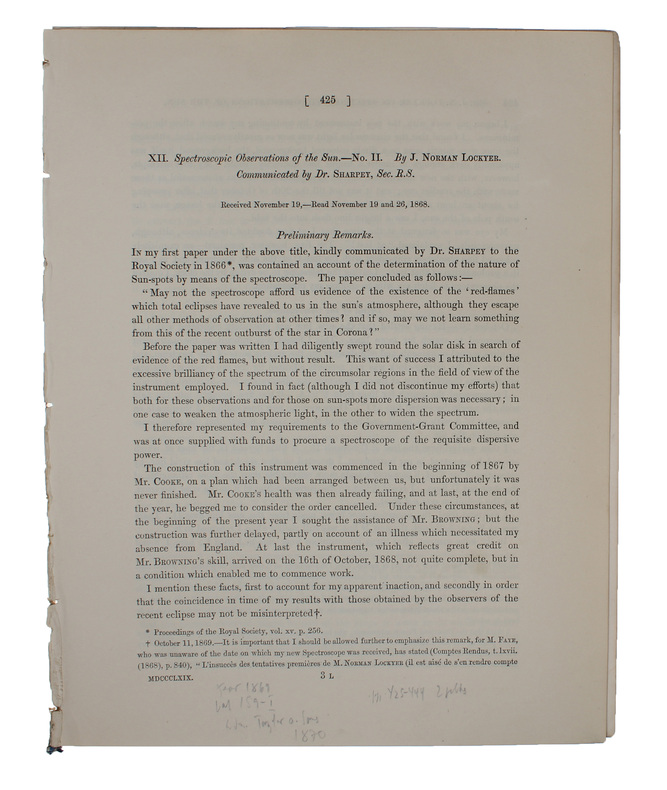
187042423(London, Taylor and Sons, 1870). 4to. No wrappers as extracted from ""Philosophical Transactions"" 1869, Vol. 159 - Part I. Pp. 425-444 and 2 lithographed plates (1 with the spectrum of helium, 1 with his spectroscope (not requiring eclipses to function)). Clean and fine.
187042423London Taylor and Sons 1870. 4to. No wrappers as extracted from "Philosophical Transactions" 1869 Vol. 159 - Part I. Pp. 425-444 and 2 lithographed plates 1 with the spectrum of helium 1 with his spectroscope not requiring eclipses to function. Clean and fine. <br/><br/><em>First appearance of this milestone paper in chemistry physics and astronomy announcing the discovery of helium in the sun and naming it 'helium' for Helios the Greek God of the Sun. In the same paper he demonstrates his invention of the spectroscope by which the prominences of the sun could be observed and studied without an eclipse by leading the light from the very edge of the sun through a prism. - Helium was not discovered on the earth before 1895 by William Ramsay and it was Crookes who established its identity with the helium Lockyer observed in the spectrum of the sun."This the last discovery was announced on the same day by the French astronomer Janssen who was in India observing a total eclipse. As a result the French government some ten years later struck a medallion showing the heads of both scientists.By that time the two men had made a much more dramatic discovery at the same time this time in cooperation. Janssen studying the spectrum ofthe sun during the eclipse had noted a fine line he did not recognize. he send a report on this to Lockyer an acknowledges expert on solar spectra. Lockyer compared the reported position of the line with lines of known elements concluding that it must belong to a yeat unknown element possibly not even existing on the earth. He named the element from the Greek word for the sun."Asimov. </em> unknown
19671458751967. Archive of eight vintage borderless photographs three typescript essays and a carbon typescript of the first essay and first page of the second by photographer Jerry Bauer circa 1967 with the photographs corresponding to the topics of the essays. <br/><br/>Bauer was an American photographer best known for his photographic portraits of writers with his portraits of Samuel Beckett being held in particularly high regard. Much of his work resides in the collection of the National Portrait Gallery in London.<br/><br/>The first essay "The American Underground: Mind Expansion A Messiah 'Love'" is an examination of Timothy Leary and the "League for Spiritual Discovery" LSD a communal organization carrying out studies in the religious use of psychedelic drugs as well as the effects of LSD. Two photographs are of the New York Millbrook estate mentioned in the essay one of the centers for the group one photograph of the estate itself and the other of two participants on the porch. Another photograph shows three young people lounging on a bed a young man with beads in his hand matching the description in the essay of a subject's focus on "a set of beads" and a description of the living quarters being ". . . simple: mattresses on the floor." <br/><br/>The second essay "American Underground : Mind Expansion The Poets 'Love' 2" is broken into three sections. The first is about the musical group The Fugs who Bauer describes as "the Beatles of the American underground." Two of the photographs in and around Washington Square Park feature members of The Fugs one of a gleaming Ed Sanders and Geoff Outlaw with two unidentified young women. In a second photograph the same group is on the grass along with Ken Weaver and a third unidentified young woman.<br/><br/>The second section of the essay is about "the two stars" of the underground film movement Andy Warhol stars Baby Jane Holzer and Edie Sedgewick with a corresponding photograph taken in Warhol's Factory showing Ingrid Superstar sitting on a mattress Baby Jane Holzer on the floor with her back to the camera along with several unidentified subjects. Holzer is identified from a published photograph by Bauer titled "Baby Jane Holzer" taken at the same time as the one in the archive.<br/><br/>The final section of the essay is a about American youth and drug culture in Greenwich Village as well as the neighborhood itself. Here the related photographs are of several young people seated on the grass one playing the guitar in Washington Square Park and one of several people standing around a Greenwich Village intersection.<br/><br/>The third essay "Andy Warhol: Film Director of America's Underground" is a study of Warhol's early experimental films. Beginning with a brief summation of Warhol's early career Bauer goes on to postulate about Warhol's films discussing the director's various regulars including Elekro Baby Jane Holzer Sally Kirkland Nico here spelled "Nicot" and others.<br/><br/>Photographs: Six photographs 10.75 x 8.25 inches two photographs 10.75 x 8 inches. Near Fine overall.<br/><br/>Ribbon typescript essays: 8.25 x 10.75 inches. Typescript on onionskin stock six leaves bound with a silver corner clip. Near Fine.<br/><br/>Carbon typescript essays: 8.25 x 10.75 inches. Carbon typescript on onionskin stock three leaves bound with a silver corner clip. Near Fine. unknown books
Very Good English, Middle (1100-1500) Original imitation vellum. An OCLC register says "decorated with small shells and seaweed pasted on". Chipped on extremities and spine, slight pouring on paper; several tapes used at the link of the pages to binding. Otherwise a good copy. Small 4to. (27 x 18 cm). In Middle English (15th century). The first leaf attached to front cover. At end, 6 blank leaves. [46] p. with [7] blank pages, many illustrations, 1 letter with its broken seal. Separately, a facsimile of a letter from Isabella (Dona Isabel por Gracia de Dios Reina de Castilla y Leon etc. etc. A Don Cristobal Colon de Genova) to Columbus, dated 'Granada a? trece de Abril de MCCCCXCII,' with a broken seal attached. Script on vellum as well. Two registers in OCLC (1029665801 and 60764823 -This one is New York Edition-). 'Düsseldorf Edition' says "A spurious work purporting to be the logbook of Christopher Columbus, which, according to legend, he threw into the sea during a storm, and which was found on the coast of Pembrokeshire 400 years later. Written in antiquated English, with paper and binding made to imitate in color and appearance a volume damaged by exposure to seawater. "S.A.S.X. MY XPO FERENS" from cover, variously interpreted, eg. Supples servus altissimi Salvatoris Xristi Mariae Josephi Xpoferens. Forgery attributed to Karl Maria Seyppel. Printed by lithographic process on imitation parchment paper. Text and illustrations printed to appear handwritten, with many decorated initials. Accompanied by: reproduction of a letter purported to be by the finder of the logbook dated "September forth 1890"; "Don~a Isabel por gracia de Dios Reina do Castilla y Leon, etc., etc. a? Don Cristo?bal Colon de Ge?nova," supposed letter on imitation parchment, authorizing his voyage, dated "Granada, a? trece de abril de mccccxcij," with an attached seal, laid in.". This is a fine hoax on Colombus' first travel into America. It includes a map containing Cuba, San Salvador, and unknown areas with a hand drawing of Columbus as well as other illustrations and decorative borders, etc. This Edition may be printed in memory of the 400th year of '1492'. "Columbus's log of the first voyage has not survived, although we do have an abstract of it, written in the 1530s by Bartolome de las Casas. However, that actually used the "Barcelona Copy" of Columbus's original log. The chart above shows the sources that exist today in green, and sources that have disappeared in red. The chart also shows where secondary souses got their original information. When he returned to Spain in 1493, Columbus gave his original log to the Sovereigns at the royal court in Barcelona. Queen Isabela ordered the log to be copied, resulting in the so-called Barcelona Copy. The original has not been seen since, however, the Barcelona Copy was returned to Columbus just before his second voyage later that year, and remained in his possession until his death in 1506. It then passed into the hands of son Fernando, who used it when he wrote a biography of Columbus in 1538. The Barcelona Copy too was lost sometime after 1554. Sometime around 1530, the Barcelona Copy was abstracted by Las Casas into the Diario. This abstract as part of his research that led to his massive work, the Historia de las Indias. So The Diario remains our best historical record of the first voyage of Columbus. On the westward passage, Columbus kept two sets of distance figures in the log. According to Las Casas, this was done to allay the fears of the crew that they had sailed too far from Spain. The abstract is mostly written in the third person, but there are a number of large direct quotes from the log written in Columbus's own first-person.". (Source: Christopher-Columbus Europe website).
Very Good Turkish, Ottoman (1500-1928) Lithographed Edition. First and Only Edition of this first Turkish book exclusively related to America. This very rare work (both in scarce institutional holdings and market rarity) is the first book in Turkish to describe the discovery and conquest of America. Thus, it is an important and early source on America in the Islamic world. "The first treatise [in Turkish] dedicated exclusively to America" (Strauss). It is printed in a format that is specific to the early printing period of the Ottoman Empire and is written in a tâliq script and has the appearance of a manuscript. It has neither a preface nor a proper title. The heading (serlevha) on the first page which is placed in a decorative floral design reads: "First chapter: On the Islands Discovered by the Venetian and Genoese seafarers, and, secondly, on the discovery of America by Christopher Columbus". It also contains the mandatory praise of the ruler, i.e., Sultan Abdülmecid, and indicates that it was "translated and transferred from some selected writings (ba'z-i evrâk-i müntahabe)". The dramatic events of the discovery and of the different conquests by the Spaniards are vividly described in plain and simple language. Though it is not free from clichés adopted from Western sources, the darker aspects of the European expansion are not omitted. Particular interest is devoted to the fauna and flora of the American continent. The modern territorial divisions of the American continent, and briefly, its political history, are dealt with in a special chapter at the end of the book. This chapter comprises information about both North and South America from the Polar Regions (Arazi-i kutbiyye) and "Russian America" (Amerika-i Rusiyye) to the Banda Oriental (Banda) or the Cisplatine Republic (Çisplatin) and the Province of Patagonia (Patakonya Eyaleti). It takes into account the latest developments. The last event referred to is General Soulouque's takeover in Haiti. "[.] ?in Santa Domingo (Sen Domeng), i.e., the island of Haiti, a general from the Negro people appeared in the Frankish year of 1847 and beat the Spaniards and the French. Assuming the title of 'king', he is known today as Faustin I." (p. 54). In fact, General Soulouque (Emperor of Hayti, (1782-1867)) had assumed the title of 'Emperor' in 1849. His reign lasted until 1859. (Source: Nineteenth-Century Ottoman Americana by Johann Strauss). Original wrappers. Occasionally slight stains on some pages and chipped on front cover, otherwise a very good copy. Roy. 8vo. (23 x 16 cm). In Ottoman script (Turkish with Arabic letters). 56 p. Litho. Only two copies in OCLC: (University of California, Los Angeles & Library of Congress, Karl Süssheim Collection, no. 1717.): 948879228.; TBTK 4412 / 5557.; Özege 1591 / 22639.