232 résultats
183247933Paris, Crochard, 1832. Contemp. hcalf. Spine gilt. Light wear along edges. Stamps to verso of titlepage. In: ""Annales de Chimie et de Physique"", 2e Series, vol. 51. (Entire volume offered). 448 pp. a. 1 folded engraved plate. Faraday's letter: pp. 404-434. Internally clean and fine.
183248329(Paris, Crochard, 1832). No wrappers. In: ""Annales de Chimie et de Physique"", 2e Series, vol. 51, Cahier 4. Pp. 337-444 (Entire issue offered). Faraday's letter: pp. 404-434 a. 1 engraved plate. Some brownspots.
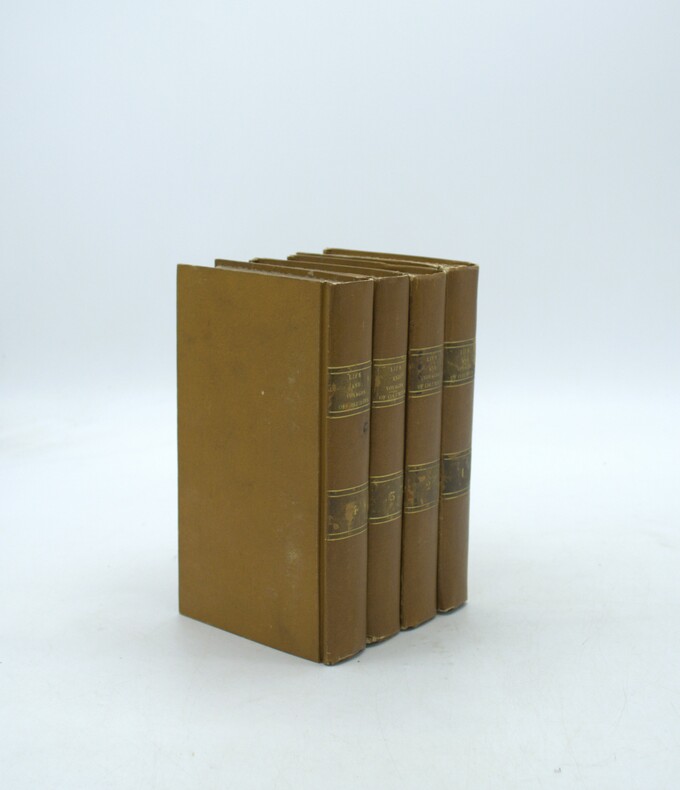
1828PHO-2111Paris, Baudry, 1828. 4 volumes in-8 (18,5 x 10,5 cm), reliés plein cartonnage d’époque, dos lisse avec pièces de titre et tomaison, quelques frottements aux pièces, coins légèrement usés, très peu de rousseurs. Illustré d’une carte dépliante en frontispice du premier volume.
186153357Paris Mallet-Bachelier 1861. 4to. No wrappers. In: "Comptes Rendus Hebdomadaires des Séances de L'Academie des Sciences" Tome 52 No 8. Pp. 321- 368. Entire issues offered. Pasteur's paper: pp. 344-347. Minor marginal brownspots. <br/><br/><em>First printing of a milestone paper in microbiology being the paper in which Pasteur disclosed his discovery of organisms that lived without oxygen. Two years later he named them anaerobic or zymics contrasting to aerobic which only lived in the presence of free oxygen."In 1861 he turned his attention to the butyric fermentation and made another importent discovery viz. that this fermentation proceeds in the absence of oxygen. In the fermented material he found cylindrical rods which he showed were the cause of the fermentation. Following the nomenclature and ideas of the time he regarded them as animal in character and named them Vibrio." Bullock "The History of Bacteriology" p. 61. </em> unknown
186153357(Paris, Mallet-Bachelier), 1861. 4to. No wrappers. In: ""Comptes Rendus Hebdomadaires des Séances de L'Academie des Sciences"", Tome 52, No 8. Pp. (321-) 368. (Entire issues offered). Pasteur's paper: pp. 344-347. Minor marginal brownspots.
1860WOC-1226Nouvelle édition, revue et corrigée par l'auteur, avec une carte repliée des Environs D'Annecy. Annecy, Imprimerie de Louis Thésio, 1860. In-12 (17x11,5cm) broché de couverture d'origine. 288pp. + Carte. + Annonces.
180143492Halle Rengerschen Buchhandlung 1801. Without wrappers as published in "Annalen der Physik. Herausgegeben von Ludwig Wilhelm Gilbert" Bd. 7 Viertes Stück. The entire issue offered =Heft 4. Pp. 387-528. Ritter's announcement p. 525. With titlepage to volume 7. Clean and fine. Titlepage a bit shavedin inner margin. <br/><br/><em>First printing of Ritter's announcement of his discovery of ultraviolet light in a halfpage letter addressed to Gilbert's Annalen. With that discovery it became clear that visible light represents no more than a fraction of a continous spectrum.A year earlier in 1800 William Herschel discovered infrared light. This was the first time that a form of light beyond visible light had been detected. After hearing about Herschel's discovery of an invisible form of light beyond the red portion of the spectrum Ritter decided to conduct experiments to determine if invisible light existed beyond the violet end of the spectrum as well. He had heard that blue light caused a greater reaction in silver chloride than red light did. Ritter decided to measure the rate at which silver chloride reacted to the different colors of light. He directed sunlight through a glass prism to create a spectrum. He then placed silver chloride in each color of the spectrum and found that it showed little change in the red part of the spectrum but darkened toward the violet end of the spectrum. Johann Ritter then decided to place silver chloride in the area just beyond the violet end of the spectrum in a region where no sunlight was visible. To his amazement this region showed the most intense reaction of all. This showed for the first time that an invisible form of light existed beyond the violet end of the visible spectrum. This new type of light which Ritter called Chemical Rays later became known as ultraviolet light or ultraviolet radiation the word ultra means beyond. - Parkinson Breakthroughs: 1801 P. </em> unknown
180143492Halle, Rengerschen Buchhandlung, 1801. Without wrappers as published in ""Annalen der Physik. Herausgegeben von Ludwig Wilhelm Gilbert"", Bd. 7, Viertes Stück. The entire issue offered (=Heft 4). Pp. 387-528. Ritter's announcement p. 525. With titlepage to volume 7. Clean and fine. Titlepage a bit shavedin inner margin.
181714479Bourg, Bottier ; in-8, broché ; CLVII (157) pp., (1 bl.) ; 125, (1) pp. : Nyon : Manuel pratique ou précis de la méthode d'enseignement naturel pour les nouvelles écoles élémentaires ; Jean Nicollet de Fribourg en Suisse : Avis aux agriculteurs sur la découverte importante d'une poudre [...] préserver les grains... ; Thomas Riboud : Notes historiques et statistiques sur les travaux et la situation de la Société d'Émulation et d'Agriculture de l'Ain... (Le Duc, 115), couverture beige décorée.
189542221London Harrison and Sons 1895. 4to. No wrappers as extracted from "Philosophical Transactions" Vol. 186 - I Series A. Pp. 187-241 a. 8 textillustrations apparatus. Fine and clean. <br/><br/><em>First printing of this importent paper in the history of chemistry Lord Rayleigh's most famous discovery announcing the discovery of this new gas the first finding of one of the rare gases inert gases having unusual properties and forming a distinct group in the periodic table and all with zero valency."The original paper in the "Philosophical Transactions" will undoubtly rank as a classic the investigation having been a particularly brilliant ine." Ernst von Meyer in History of Chemistry. For this discovery Lord Rayleigh and W. Ramsay received the Nobel Prize 1904.After having made several measuring of the densities of gases "Rayleigh came across a curious puzzle. With oxygen he always obtained the same density regardless of how the oxygen might be produced whether from one particular compound from a second compound or from the air. The situation was different with nitrogen. The nitrogen he obtained from air constantly showed a slightly higher density than the nitrogen he obtained from any of various compounds. Rayleigh could think of several ways in which the nitrogen obtained from air might be contaminated but none of the possibilities checked out experimentally. He was so frustrated that he went so far as to write to the journal "Nature" asking for suggestions. Ramsay a brilliant Scottish chemist asked permission to tackle the problem and received it. The upshot was that a new gas somewhat denser that nitrogen was discovered to exist in the atmosphere. It was named argon and it was the first of a series of rare gases of unusual properties whose existence had never been suspected."Asimow.Dibner Heralds of Science No. 50 - Neville Historical Chemical Library vol. II p.358. </em> unknown
189549207London Harrison and Sons 1895. 4to. Orig. full cloth. Gilt lettering to spine. Blindtooled covers. First corner a bit bumped. In "Philosophical Transactions" Vol. 186 - I Series A. XIV26024 pp. Entire volume offered. The paper: p. 187-241 a. 8 textillustrations apparatus. The title-page with faint brownspots. Otherwise internally clean and fine. <br/><br/><em>First printing of this importent paper in the history of chemistry Lord Rayleigh's most famous discovery announcing the discovery of this new gas the first finding of one of the rare gases inert gases having unusual properties and forming a distinct group in the periodic table and all with zero valency."The original paper in the "Philosophical Transactions" will undoubtly rank as a classic the investigation having been a particularly brilliant ine." Ernst von Meyer in History of Chemistry. For this discovery Lord Rayleigh and W. Ramsay received the Nobel Prize 1904. The volume also contains WILLIAM CROOKES "On the Spectra of Argon" OSBORNE REYNOLD "On the Dynamical Theory of Incompressible Viscous Fluids and the determination of the Criterion" KARL PEARSON "Contributions to the Mathematical Theory of Evolution. - II. Skew Variations in Homogenous Materials" etc.After having made several measuring of the densities of gases "Rayleigh came across a curious puzzle. With oxygen he always obtained the same density regardless of how the oxygen might be produced whether from one particular compound from a second compound or from the air. The situation was different with nitrogen. The nitrogen he obtained from air constantly showed a slightly higher density than the nitrogen he obtained from any of various compounds. Rayleigh could think of several ways in which the nitrogen obtained from air might be contaminated but none of the possibilities checked out experimentally. He was so frustrated that he went so far as to write to the journal "Nature" asking for suggestions. Ramsay a brilliant Scottish chemist asked permission to tackle the problem and received it. The upshot was that a new gas somewhat denser that nitrogen was discovered to exist in the atmosphere. It was named argon and it was the first of a series of rare gases of unusual properties whose existence had never been suspected."Asimow.Dibner Heralds of Science No. 50 - Neville Historical Chemical Library vol. II p.358. </em> hardcover
189542221(London, Harrison and Sons, 1895). 4to. No wrappers as extracted from ""Philosophical Transactions"", Vol. 186 - I, Series A. Pp. 187-241 a. 8 textillustrations (apparatus). Fine and clean.
189549207London, Harrison and Sons, 1895. 4to. Orig. full cloth. Gilt lettering to spine. Blindtooled covers. First corner a bit bumped. In ""Philosophical Transactions"", Vol. 186 - I, Series A. XIV,(2),602,(4) pp. (Entire volume offered). The paper: p. 187-241 a. 8 textillustrations (apparatus). The title-page with faint brownspots. Otherwise internally clean and fine.
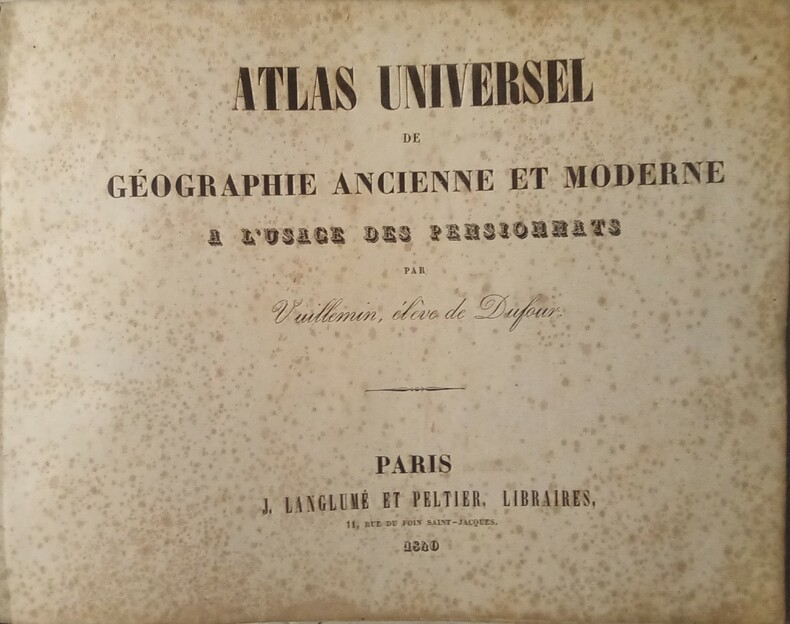
1840WOC-1374Paris, J. Langlumé et Peltier, Libraires, 1840. In-4 (25x32cm) oblong relié demi basane marron un peu passé, plats de papier marbré. Quelques rousseurs.
187547271Paris Gauthier-Villars 1875. 4to. No wrappers. In: "Comptes Rendus Hebdomadaires des Séances de L'Academie des Sciences" Tome 81 No 12 and No 23. Pp. 485- 508 a. 1065- 1148. 2 entire issues offered. Boisbaudran's papers: pp. 493-495 a. pp. 1100-1105. <br/><br/><em>First printing of the paper in which Boisbaudran announced his discovery of Gallium together with the first printing of the paper in which he by a series of experiments proved that Gallium the metal that he had discovered amd named in honour of France is a true element. A larger paper on the discovery was published in 1877 in "Annales de Chimie et Physique". In 1879 Bausbaudran was awarded the Davy Medal for his discovery of Gallium. "In 1875 Boisbaudran spectroscopically discovered a new element gallium which he found in zinc blende from a mine in Hautes-Pyrénées. Continuing his work in Wurtz’s laboratory in Paris he was a able to obtain the free metal by electrolysis of a solution of the hydroxide in potassium hydroxide. Gallium Boisbaudran realized was the "eka-aluminum" predicted by Mendeleev and was the first of Mendeleev’s predicted elements to be isolated. Boisbaudran’s finding thus provided valuable evidence for the validity of Mendeleev’s periodic classification of the elements."DSB."Lecoq de Boisbaudran announced his discovery by spectroscopic analysis of the new element gallium. Mendeleev had first predicted its existence and had named it eka-aluminium. The discovery was made in the author's private laboratory in a specimen of zinc blende from the Pierrefitte mine in the Angelès Valley in the Hautes Pyrénées. He describes how on the evening of 27 August 1875 he detected the existence of this new element which he named "gallium" in honor of France Gallia. A month later he "performed in Wurtz's laboratory in Paris.a series of experiments to prove that gallium.is a true element"Weeks. he discusses how he eventually isloated small amounts of pure metallic gallium and determined its physical and chemical properties. The paper the paper offered first describes gallium compounds e.g. ammonium gallium alum chloride oxide and sulphate."Roy G. Neville II p. 29. </em> unknown
187547271(Paris, Gauthier-Villars), 1875. 4to. No wrappers. In: ""Comptes Rendus Hebdomadaires des Séances de L'Academie des Sciences"", Tome 81, No 12 and No 23. Pp. (485-) 508 a. (1065-) 1148. (2 entire issues offered). Boisbaudran's papers: pp. 493-495 a. pp. 1100-1105.
187748136Paris Gauthier-Villars 1877. 4to. No wrappers. In: "Comptes Rendus Hebdomadaires des Séances de L'Academie des Sciences" Tome 85 No 3. Pp. 101- 168. Entire issue offered. Pasteur & Joubert's paper: pp. 101- 115. <br/><br/><em>First appearance of one of the founding papers in the realm of antibiotics being the discovery of "Vibrion septique" Cl. septicum the first pathogenic anaerobe to be found. "Pasteur and Joubert were probably the first to realize the practical implications of antibiosis. They noted the antagonism between Bacillus anthracis and other bacteria cultures in the paper offered"Garrison & Morton: No. 1932.1 and 2490. </em> unknown
187748136(Paris, Gauthier-Villars), 1877. 4to. No wrappers. In: ""Comptes Rendus Hebdomadaires des Séances de L'Academie des Sciences"", Tome 85, No 3. Pp. (101-) 168. (Entire issue offered). Pasteur & Joubert's paper: pp. (101-) 115.
1895ne81Paillart C. Broché 1895 In-8 (23x14.5 cm), dos broché, couverture illustrée, 240 pages, illustrations en noir ; couverture roussie, petit manque au dos, rares rousseurs dans le texte, assez bon état. Livraison a domicile (La Poste) ou en Mondial Relay sur simple demande.
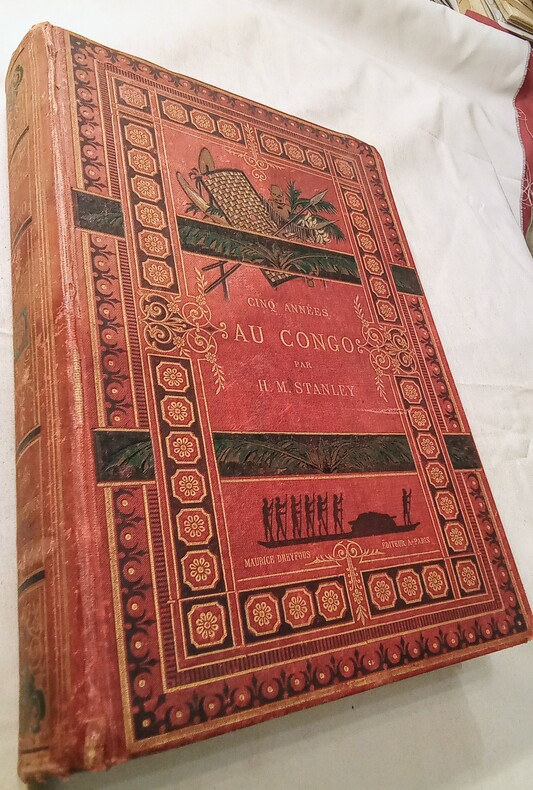
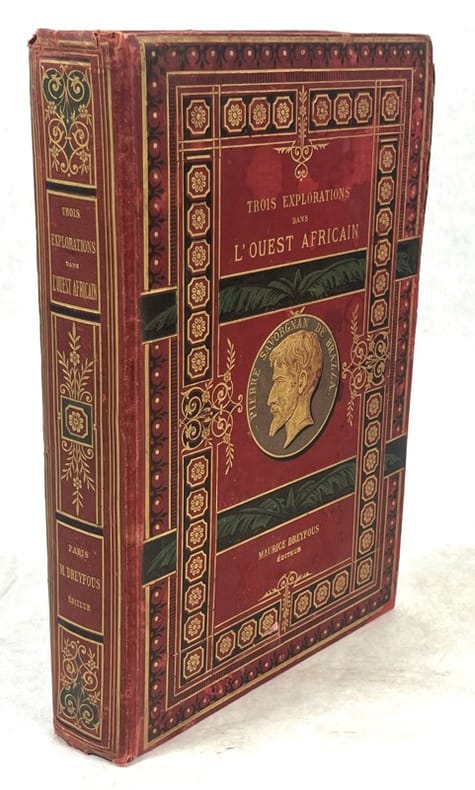
1890WOC-1655Voyages – Explorations – Fondation de L'État Libre du Congo. Traduit de l'anglais par Gérard HARRY. Ouvrage illustré de 100 gravures sur bois et de 4 cartes en couleur, dont une Carte murale dressée par H. M. STANLEY (qui manque ici). 2 ème édition. Paris, Maurice Dreyfous, éditeur, sans date (vers 1890). Petit in-4 (26x4x17cm) de percaline bordeaux éditeur orné et passé, charnières et coiffes faibles, tranches dorées et manque la page de garde du plat supérieur. XV,533pp.
1887140774Paris, Maurice Dreyfous 1887 In-4 26 x 17 cm. Cartonnage éditeur percaline rouge, dos et plats ornés, tranches dorées, illustré de 2 eaux-fortes et de 80 dessins dans et hors-texte, exécutés d’apès nature ou d’après les documents authentiques, 463 pp., notes, table des matières, table des gravures.
1892MARI0787Milano, Treves 1892. 4°, 1 mehrfarb., reich dekorierter Schmucktitel, 1 Vor- ,1 Haupttit., 1 Widmungsbl., 1 Vorw., 446 S.; 1 Vors-, 1 Haupttit., 392 S.; beide Bände mit zahlr. Abb., Bd. 1 mit Front., braune OLnbde. m. dekorativer Goldpräg. (Emblem m. kl. Schiffsdarst. sowie dem Nord- u. Südamerika), Papiermoiree-Vorsätze, berieb., Ecken u. Kanten bestoß., beide Rücken rissig u. tlw. vom Buchblock geplatzt, etw. abgegriff., innen vereinzelt stockfleck. In Italienisch. [2 Warenabbildungen]
185847111Paris Mallet-Bachelier 1858. 4to. No wrappers. In: "Comptes Rendus Hebdomadaires des Séances de L'Academie des Sciences" Tome 47 No 6 a. No 10. Pp. 245- 279 a. pp. 393- 431 entire issues offered. Bernard's papers: pp. 245- 253 a. pp. 393 -400. <br/><br/><em>First appearance of these landmark papers in which Barnard explains his discovery of how the nerves controls the blood vessels. This is the "discovery of the vascoconstrictor and vasodilator nerves and description of their function of regulating the blood supply to the different parts of the body."Garrison & Morton No. 774."In 1858 the papers offered Bernard demonstrated the existence of vasodilator nerves by finding an increased blood flow through the submaxillary gland when the corda tympani is stimulated. He also observed that the venous blood became bright red. Since that time an enormous amount of research has been carried out on the vasomotor system."R.J.S. Mcdowall.Garrison & Morton No. 774. </em> unknown
185847111Paris, Mallet-Bachelier, 1858. 4to. No wrappers. In: ""Comptes Rendus Hebdomadaires des Séances de L'Academie des Sciences"", Tome 47, No 6 a. No 10. Pp. (245-) 279 a. pp. (393-) 431 (entire issues offered). Bernard's papers: pp. (245-) 253 a. pp. (393) -400.