1 815 résultats
17811099761781 Un volume In-16 (9,5 x 16cm environ), reliure pleine peau, filets, et fleurons dorés au dos, tranche marbrées en couleurs, reprenant le motif des gardes - Cinq ouvrages reliés en un volume intitulé "Recueil II" à l'aide d'une pièce de titre au dos, répartis comme suit : (1) A Amsterdam; et se trouve à Paris, Chez Méquignon l'aîné, Librairie, rue des Cordeliers - M. DCC. LXXIX. 1779 - 46 pages - (2) A Berlin, et se trouve, à Paris, Chez l'Auteur , Barrière de Reuilly; Fauxbourg Saint-Antoine. Et Chez Belin, Librairie, rue Saint-Jacques - M DCC LXXIX. 1779 - 35 pages - (3) A Paris, Chez l'Auteur, rue Croix des Petits-Champs, Maison de M. Bourdet, Chirurgien-Dentiste du Roi. et Chez Blaizot, Librire du Roi, rue Satory, à Versailles - Avec Approbation et Permission - M. DCC. LXXXI. 1781- 139 pages - Cul-de-lampe - (4) A Amsterdam; et se trouve à Paris, Chez Bastien, Libraire, rue du Petit-Lion, Fauxbourg Saint-Germain - M. DCC. LXXIV. 1774 - 56 pages - (5) A Paris, Chez Saugrain, Libraire, Quai des Augustins, près de la rue Pavée - M. DCC. LXXXI. 1781 - 116 pages
183247933Paris, Crochard, 1832. Contemp. hcalf. Spine gilt. Light wear along edges. Stamps to verso of titlepage. In: ""Annales de Chimie et de Physique"", 2e Series, vol. 51. (Entire volume offered). 448 pp. a. 1 folded engraved plate. Faraday's letter: pp. 404-434. Internally clean and fine.
183248329(Paris, Crochard, 1832). No wrappers. In: ""Annales de Chimie et de Physique"", 2e Series, vol. 51, Cahier 4. Pp. 337-444 (Entire issue offered). Faraday's letter: pp. 404-434 a. 1 engraved plate. Some brownspots.
66 p., nbr. ill. n/b. et coul. Inv. 29173
169141859Leipzig Grosse & Gleditsch 1691. 4to. Contemp. full vellum. Faint handwritten title on spine. a small stamp on titlepage. In: "Acta Eruditorum Anno MDCLXXXXI". 85906 pp. and 13 of 15 folded engraved plates. The 2 first plates lacks but they do not belong to the papers listed.Leibniz' papers: pp.277-281 a. 1 plate pp. 435-439. Johann Bernoulli: pp. 274-276 a. 1 plate. Huygens: pp. 281-282. - Jacob Bernoulli: pp. 282-290 a. 1 plate. <br/><br/><em>All papers first apperance. All 5 of extreme importence in the development of the Calculus. Leibniz' 2 papers on the catenary curve paper 1-2 offered here was written at the instigation of Jacques Bernoulli. Following the example of Blaise Pascal who had initiated in 1658 a contest for the construction of the cycloid Leibniz also provoked the geometers of his time by challenging them to submit at the fixed date of mid-1691 their geometric method for the construction of the catenary curve. Leibniz later provided the answer followed by Johann Bernoulli and Huygens.'These two papers are a historical account of the origin of the study of this transcendental curve and at the same time the first physical-geometric construction showing the species-relationship between the catenary and the logarithmic curves as two companion curves; one arithmetic the other geometric. All of the differentials of the catenary curve are arithmetic means of corresponding differentials of the logarithmic curve; and all of the differentials of the logarithmic curve are geometric means of the catenary.'"The Catenary is the form of a hanging fully flexible rope or chain the name comes from "catena" which means 'chain' suspended on two points. The interest in this curve originated with Galileo who thought that is was a parabola. Young Christiaan Huygens proved in 1646 that this cannot be the case. What the actual form was remained an open question till 1691 when Leibniz Johann Bernoulli and the then much older Huygens sent solutions to the problem to the "Acta" Jakob Bernoulli 1690 Johann Bernoulli 1691 Huygens 1691 and Leibniz 1691 - these 4 1691-papers offered here - in which the previous year Jakob Bernoulli had challenged mathematicians to solve it. As published the solutions did not reveal the methods but through later publications of manuscripts these methods have been known. Huygens applied with great paper 4 virtuosity the by then classical methods of 17th century infinitesimal mathematics and he needed all his ingenuity to reach a satisfactory solution. Leibniz the papers 1-2 and Bernoulli paper 3 applying the new Calculus found the solutions in a much direct way. In fact the catenary was a test-case between the old and the new style in the study of curves and only because the champion of the old style was a giant like Huygens the test-case can formally be considered as ending in a draw." Grattan-Guiness in "From the Calculus to Set Theory 1630-1910.".The paper by JACOB BERNOULLI no. 5 offered here is a milestone papers as it marks the invention of the "SYSTEM OF POLAR COORDINATES" with points located by reference to a fixed point and a line through that point. Although newton had earlier also devised such a coordinate system in 1671 his work was not known so that the credit for the discovery generally goes to Bernoulli. Parkinson Breakthroughs 1691.Further papers contained in this volume of Acta Eruditorum:DENYS PAPIN: Mecanicorum de Viribus Motricibus sententia asserta a D. Papino adversius C.G.G. L. Leibniz objectiones. pp. 6-13. The plate lacks. - and Dion. Papini Observationes quaedam circa materias ad Hydraulicam spectantes. Pp. 208-213 a. 1 plate. This importent paper is part of the LEIBNIZ-PAPIN-CONTROVERSY.JACOB BERNOULLI: Specimen Calculi Differentialis in dimensione Parabolæ helicoidis ubi de flexuris curvarum in genere carundem evolutionibus. Pp. 13-22. The plate lacks. - and J.B. Demonstratio Centri Oscillationis ex Natura Vectis reperta occassione eorum quæ super hac materia in Historia Literaria Roterodamensi recensentur articulo.Pp.317-321.LEIBNIZ: O.V.E. Additio ad Schediasma de Medii Resistentia publicatum in Actis mensis Febr. 1889. Pp. 177-178. and O.V.E. Quadratura Arithmetica Communis Sectionum Conicarum quæ centrum babent.Pp. 178-182 a. 1 plate.TSCHIRNHAUS: Singularia Effecta Vitri Caustici bipedalis quod omnia magno sumtu hactenus constructa specula ustoria virtute superat per D.T. Pp. 517-520 </em> hardcover
169141859Leipzig, Grosse & Gleditsch, 1691. 4to. Contemp. full vellum. Faint handwritten title on spine. a small stamp on titlepage. In: ""Acta Eruditorum Anno MDCLXXXXI"". (8),590,(6) pp. and 13 (of 15) folded engraved plates. The 2 first plates lacks, but they do not belong to the papers listed.Leibniz' papers: pp.277-281 a. 1 plate, pp. 435-439. Johann Bernoulli: pp. 274-276 a. 1 plate. Huygens: pp. 281-282. - Jacob Bernoulli: pp. 282-290 a. 1 plate.
1523177781523 broché - 15x23.5 - 379pp - éditions FAYARD - 19991
37938Solar. 1990. In-8 cartonnée avec jaquette. Nombreuses photographies en couleurs. 238 p. BE.
9800Perrin In-8, broché, couverture souple ill, Bel exemplaire, 273 pages, index et bibliographie in fine.
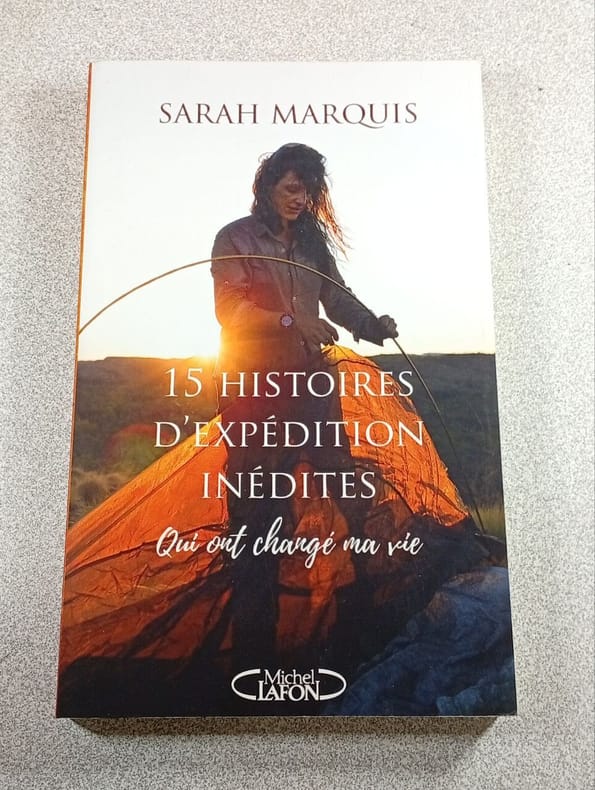
2022500300762MICHEL LAFON 2022 224 pages 13 9x22 3x1 7cm. 2022. Broché. 224 pages.
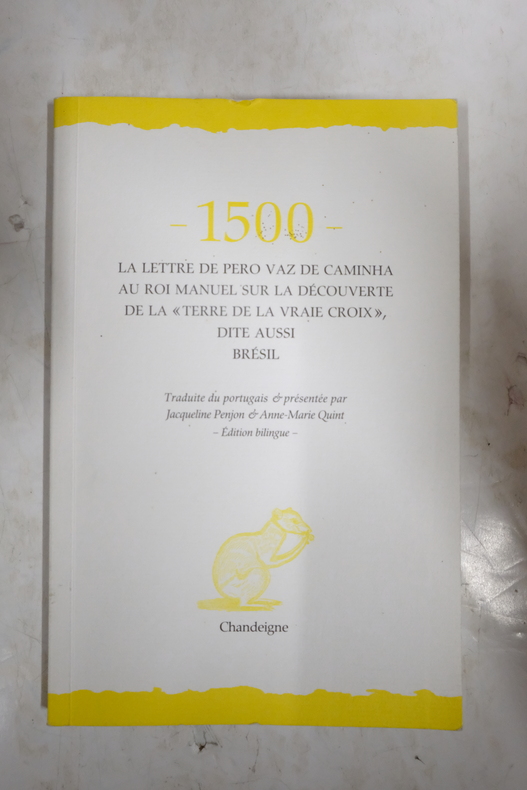
2011VOY4433MBroché, 96 pages, paru en 2011 chez Chandeigne, livre en très bon état général. Nous avons d'autres exemplaires des éditions Chandeigne, retrouvez les dans notre catalogue grâce au mot-clé "Chandeigne".
Frost, OrcuttIn Pristine Condition. unknown
Chartrand, R. Durham, K.In Pristine Condition. unknown
Yates, AnnaIn Pristine Condition. unknown
Adamson, Glenn, Meyers, ZIn Pristine Condition. unknown
Very Good English, Middle (1100-1500) Original imitation vellum. An OCLC register says "decorated with small shells and seaweed pasted on". Chipped on extremities and spine, slight pouring on paper; several tapes used at the link of the pages to binding. Otherwise a good copy. Small 4to. (27 x 18 cm). In Middle English (15th century). The first leaf attached to front cover. At end, 6 blank leaves. [46] p. with [7] blank pages, many illustrations, 1 letter with its broken seal. Separately, a facsimile of a letter from Isabella (Dona Isabel por Gracia de Dios Reina de Castilla y Leon etc. etc. A Don Cristobal Colon de Genova) to Columbus, dated 'Granada a? trece de Abril de MCCCCXCII,' with a broken seal attached. Script on vellum as well. Two registers in OCLC (1029665801 and 60764823 -This one is New York Edition-). 'Düsseldorf Edition' says "A spurious work purporting to be the logbook of Christopher Columbus, which, according to legend, he threw into the sea during a storm, and which was found on the coast of Pembrokeshire 400 years later. Written in antiquated English, with paper and binding made to imitate in color and appearance a volume damaged by exposure to seawater. "S.A.S.X. MY XPO FERENS" from cover, variously interpreted, eg. Supples servus altissimi Salvatoris Xristi Mariae Josephi Xpoferens. Forgery attributed to Karl Maria Seyppel. Printed by lithographic process on imitation parchment paper. Text and illustrations printed to appear handwritten, with many decorated initials. Accompanied by: reproduction of a letter purported to be by the finder of the logbook dated "September forth 1890"; "Don~a Isabel por gracia de Dios Reina do Castilla y Leon, etc., etc. a? Don Cristo?bal Colon de Ge?nova," supposed letter on imitation parchment, authorizing his voyage, dated "Granada, a? trece de abril de mccccxcij," with an attached seal, laid in.". This is a fine hoax on Colombus' first travel into America. It includes a map containing Cuba, San Salvador, and unknown areas with a hand drawing of Columbus as well as other illustrations and decorative borders, etc. This Edition may be printed in memory of the 400th year of '1492'. "Columbus's log of the first voyage has not survived, although we do have an abstract of it, written in the 1530s by Bartolome de las Casas. However, that actually used the "Barcelona Copy" of Columbus's original log. The chart above shows the sources that exist today in green, and sources that have disappeared in red. The chart also shows where secondary souses got their original information. When he returned to Spain in 1493, Columbus gave his original log to the Sovereigns at the royal court in Barcelona. Queen Isabela ordered the log to be copied, resulting in the so-called Barcelona Copy. The original has not been seen since, however, the Barcelona Copy was returned to Columbus just before his second voyage later that year, and remained in his possession until his death in 1506. It then passed into the hands of son Fernando, who used it when he wrote a biography of Columbus in 1538. The Barcelona Copy too was lost sometime after 1554. Sometime around 1530, the Barcelona Copy was abstracted by Las Casas into the Diario. This abstract as part of his research that led to his massive work, the Historia de las Indias. So The Diario remains our best historical record of the first voyage of Columbus. On the westward passage, Columbus kept two sets of distance figures in the log. According to Las Casas, this was done to allay the fears of the crew that they had sailed too far from Spain. The abstract is mostly written in the third person, but there are a number of large direct quotes from the log written in Columbus's own first-person.". (Source: Christopher-Columbus Europe website).
Very Good Turkish, Ottoman (1500-1928) Original wrappers. No bdg. Wear spine, dispersed pages. Roy. 8vo. (24 x 17 cm). In Ottoman script (Old Turkish with Arabic letters). 197, 6 p., 5 panoramic folded huge b/w plates (Including the photographic plts.; 1-) Turkish Convention May, 13, 1923, Detroit, Mich by Photo Craft Byallen -23x39 cm-; 2-) [Among the Young Turks in Detroit, -23x106 cm-; 3-) In the White House with the President, -23x106 cm-; 4-) Islamic Society in the US, -32x40 cm-; 5-) Among the Young Turkish people in Chicago, -23x26 cm-). First and only edition of this exceedingly rare travel account of America by Dr. Mehmed Fuad [Umay], (1885-1963), who was a Turkish doctor and the founder of Himâye-i Etfâl [i.e. Society for the Protection of Orphans], a society that was established in 1921 to provide orphanages to children of the deceased soldiers in the Turkish War of Independence; began visiting many of the Turkish colonies in the US, giving lectures and raising a considerable amount of money for the establishment of these orphanages in Turkey. On 21 March 1923, Fuad Bey was granted permission from the Grand National Assembly of Turkey to go to the US in order to raise funds among the Ottoman immigrants for immediate war relief. Thus, for the first time, humanitarian action became an organized effort by fostering diaspora mobilization. Fuad Bey arrived in Ellis Island on 6 April 1923 on a ship named SS Aquitania and headed to the Ottoman Welfare Association at 35 Rivington Street. In the first meeting held by the Ottoman Welfare Association for the benefit of Turkish Orphan Society, Fuad Bey notes that a total of USD 17,500 was raised in just six hours. To those who donated over USD 1,000, a personally autographed picture of Mustafa Kemal was given by Fuad Bey. He visited the Turkish colonies in Wisconsin, Illinois, Michigan, New York, New Jersey, Massachusetts and Rhode Island. He lectured about the Turkish War of Independence (1919-1922) and the success of the struggle, and many Turkish and Kurdish workers residing in these cities donated their life savings to support the construction of orphanages and the reconstruction of the entire country. Fuad's visit to Peabody, Massachusetts aroused exceptional excitement among the Turkish and Kurdish immigrants. It was the first chance for the Muslim Anatolian immigrants to manifest their national pride and attachment to the homeland. At the same time, their socioeconomic achievement was evidenced with the arrival of Fuad Bey in Peabody in an auto decorated with a large American flag and followed by a dozen autos filled with Turks, the machines decorated with American and Turkish flags.". A day before his arrival, the Turks refrained from work and "went around with badges in honor of his coming. Mehmed Fuad noted that there were around 600 Turks when he visited Peabody in 1923. Despite their small number, they had established Kizilay [i.e. Turkish Red Crescent] society. After being shown some of the tanneries in Peabody and Salem, Fuad gave an address to the Turks and Kurds at the Peabody Institute. The scene was described as: "All the Turks in town were present. They made a spectacle of the doctor's visit, many of them taking a day off. They wore badges in his honor and displayed in front of the Institute the American and Turkish flags. Great enthusiasm was shown. Baskets of roses were carried down the aisles and the flowers were bought at any price, bunches of money being put in the baskets. It was said that USD 8,000 was raised among the Turks of this city for Dr. Fuad Bey to take back with him.". Fuad Bey visited Peabody for a second time on 14 August 1925, as he came for the National Conference of Social Workers held in Denver, Colorado in June, 1925. When he arrived in Massachusetts, he was met by a delegation of Turkish people from [.]". (Source: Ottoman Immigrants and the Formation of Turkish Red Crescent Societies in the United States). No printed copy in OCLC.; Özege 727.; TBTK 11126.
Very Good Arabic Original manuscript without binding. 12mo. (16 x 11 cm). In Arabic. [40] p., drawings, and tables. Marginal texts additionally. A linear wormhole on the bottom from beginning to the end, the thread in the spine is broken hence two separate parts. Otherwise a good copy. Rare manuscript compiled from works related to astronomical instruments written by probably Sibtu'l-Mardînî, copied anonymously in the early 19th century on the paper with 'ahar' with four marginal drawings and tables. The copier of this manuscript is not described. An 'Ebced' notes on the last blank page. The manuscript starts with a calendar in the Islamic system which is prepared with red and black inks and annotated info around the table. The first part includes how to use an almucantar, directions on the sphere, location of the stars in the sky. On the last two pages, the author describes the preparation of an almucantar. The second part is titled "Hadhâ risâle-i cenûb tarafi" [i.e. Tractate on the South direction], and the third and last part titled " Hadhâ risâle-i cenûb taraf, Hadha mukharrar latashich al-shaat fî taraf al-cayb min al-rub'u' mu'âl-ihtizâr", includes some 'sinus mathematics' with two impressive tables on the opposite page. Sibt al-Maridini, the full name Muhammad ibn Muhammad ibn Ahmad ibn Muhammad ibn al-Ghazal (1423-1493), was an Egyptian-born astronomer and mathematician. His father came from Damascus. The word "Sibt al-Maridini" means "the son of Al-Mardini's daughter". His maternal grandfather, Abdullah al-Mardini, was a reputed astronomer of the eighth century AH. He was a disciple of the astronomer Ibn al-Majdi (d. 850/1506). Sibt al-Mardini taught mathematics and astronomy in the Great Mosque of al-Azhar, Cairo. He was also a timekeeper (muwaqqit) of the mosque. He wrote no fewer than fifty treatises in astronomy (sine quadrants, sundials, astronomical tables, and prayer times) and wrote at least twenty-three mathematics textbooks. Al-Sakhawy counted two hundred books that were written by Sibt al-Mardini, on Islamic law, astronomy, and mathematics. Libraries that specialize in ancient manuscripts, all over the world, have transcripts of his works. Sibt al-Mardini's declared that "the opinion of the muezzins (those who call people to prayer) is less correct than that of the legal scholars and it is the latter that should be used as the basis for the determination of prayer time". (Wikipedia). Sib? al-Maridini was a prolific author of astronomical texts, which were still being used and studied into the 19th century. Little is known with certainty about his life. It is thought that he grew up in Damascus, where his maternal grandfather, Abd Allâh ibn Khalîl ibn Yûsuf Jamâl al-Dîn al-Mâridînî (died: 1406), was the muwaqqit (timekeeper) in charge of regulating the daily rituals of the Islamic community) of the Umayyad Mosque. Later he traveled to Cairo, where tradition places him as a student of Ibn al-Majdî. Sib? al-Mâridînî wrote extensively on mathematics and mathematical astronomy. Like his grandfather, he was especially interested in astronomical instruments. The bio-bibliographical sources list some 25 treatises, many of which exist today in multiple copies. According to the historian al-Jabarti (died: 1822), Sib? al-Mâridînî's works on mîqât (ritual timekeeping) and astronomical instruments were still being studied in the curriculum of Cairo's al-Azhar, one of the preeminent educational institutions in the Islamic world, at about the beginning of the 19th century. (Biographical encyclopedia of astronomers, 2007).
Very Good Turkish, Ottoman (1500-1928) A fine half leather bdg. with marbled boards. Two volumes in one. Cr. 8vo. (20 x 14 cm). The text in Ottoman script (Old Turkish with Arabic letters) with bilingual titles in Ottoman Turkish and French on frontispieces and title pages. 2 volumes set: (248 p.; 270, [1] p., the first volume has Columbus' engraved portrait frontispiece, the second has Amerigo Vespucci's portrait). Hegira: 1310 = Gregorian: 1893. First and only edition of this very rare book, which is the first Turkish original work on the history of the discovery of America printed for the Quadricentennial of the Discovery. With this book, Christopher Columbus and Amerigo Vespucci quickly became popular among Ottoman readers (soon after Iranian readers with a translation of the first volume only), and immediately among other Middle Eastern readers, and thus the first comprehensive and original text describing Colombus and the discovery of America appeared in the Middle East and Islamic world. It's been published in Istanbul under the title "The history of the discovery and conquest of America". The first volume is on Christopher Columbus, and the second volume is on Amerigo Vespucci, their lives and travels. Andreas Kopassis Efendy (1856-1912) was one of the few Ottoman Greeks proficient in the Ottoman literary language. Cretan Kopassis is an intriguing figure who made a remarkable career serving the Ottoman state. At the time of the publication, he was a member of the State Council (Sura-yi Devlet). He displayed quite an extraordinary interest in scholarly research and he seems to have been one of the first to have studied Ottoman "tahrir defterleri" [i.e. Ottoman tax registers]. This could be called a translation in a sense. Kopassis makes no reference to preceding translations, nor does he refer to Robertson's history of America. His main source was a more recent equally "classic" work on Christopher Columbus, Washington Irving's "History of the life and voyages of Christopher Columbus" (first published in 1828). Another source referred to by Kopassis is J. H. Campe's "Entdeckung von Amerika" (first published in 1781). His educational background is evident particularly in the introductory chapter where ample references are made to Pliny, Ptolemy, and Plato's Timaios which contain allusions to Atlantis. In his takri (Introduction) to this work, Kemalpasazade Said Bey (1848-1921) praised the author for his elegant prose. Sultan Abdülhamid awarded the order of merit (liyâkât) in gold to the author. In the same year (1315=1895), an aide-de-camp at the Iranian Ministry of War, Muhibb-i 'Âli Khan, translated the first volume into Persian. At the turn of the century, Christopher Columbus had become a very popular figure for Ottoman readers of all ages...". (Source: STRAUS, JOHANN: Nineteenth-century Ottoman Americana.; "Frontiers of the Ottoman Imagination: Studies in Honour of Rhoads Murphey."). Only one copy in OCLC 777274675 (Leiden University Library). Not in American libraries.; Özege 19857.
Good Turkish, Ottoman (1500-1928) Original wrappers. Roy. 8vo. (23 x 16 cm). In Ottoman script (Old Turkish with Arabic letters. 120 p., several tables of zones and routes. Slight foxing on cover, fading on pages, chippings on extremities of cover and some pages, repaired spine. Otherwise a good copy. First and only Turkish edition of this rare description of the Black Sea, including the historical geography of the western shores of the region, written in a travelogue style, by Bulgarian admiral Ivanov when he was the head of the Naval School in Varna (1928-1931) where he lectured on meteorology, oceanography and naval aviation for officers and conducted the seamanship course for the civil navy. Ivanov was a Bulgarian officer and admiral and a freemason, who was a member of the "Black Sea Friends" Lodge. He is a descendant of Kolyo Ficheto. In 1910, he graduated from the Military School in Sofia, and in 1914, he also completed a naval cadet course in St. Petersburg. From 1912 to 1913 he served in the Port Company of the Navy. During the period March 30, 1913 - September 1, 1913, he was the chief of the ship "Druzki". In the same year, he also served on the ship "Nadezhda". From 1914 he was adjutant of the Mobile Defense and flag officer of the destroyer detachment. He participated in World War I. Özege 10186.; Six copies can be traced in OCLC: 977483558.; 949487717.; 67339656.; 1030754762.
Very Good Turkish, Ottoman (1500-1928) Lithographed Edition. First and Only Edition of this first Turkish book exclusively related to America. This very rare work (both in scarce institutional holdings and market rarity) is the first book in Turkish to describe the discovery and conquest of America. Thus, it is an important and early source on America in the Islamic world. "The first treatise [in Turkish] dedicated exclusively to America" (Strauss). It is printed in a format that is specific to the early printing period of the Ottoman Empire and is written in a tâliq script and has the appearance of a manuscript. It has neither a preface nor a proper title. The heading (serlevha) on the first page which is placed in a decorative floral design reads: "First chapter: On the Islands Discovered by the Venetian and Genoese seafarers, and, secondly, on the discovery of America by Christopher Columbus". It also contains the mandatory praise of the ruler, i.e., Sultan Abdülmecid, and indicates that it was "translated and transferred from some selected writings (ba'z-i evrâk-i müntahabe)". The dramatic events of the discovery and of the different conquests by the Spaniards are vividly described in plain and simple language. Though it is not free from clichés adopted from Western sources, the darker aspects of the European expansion are not omitted. Particular interest is devoted to the fauna and flora of the American continent. The modern territorial divisions of the American continent, and briefly, its political history, are dealt with in a special chapter at the end of the book. This chapter comprises information about both North and South America from the Polar Regions (Arazi-i kutbiyye) and "Russian America" (Amerika-i Rusiyye) to the Banda Oriental (Banda) or the Cisplatine Republic (Çisplatin) and the Province of Patagonia (Patakonya Eyaleti). It takes into account the latest developments. The last event referred to is General Soulouque's takeover in Haiti. "[.] ?in Santa Domingo (Sen Domeng), i.e., the island of Haiti, a general from the Negro people appeared in the Frankish year of 1847 and beat the Spaniards and the French. Assuming the title of 'king', he is known today as Faustin I." (p. 54). In fact, General Soulouque (Emperor of Hayti, (1782-1867)) had assumed the title of 'Emperor' in 1849. His reign lasted until 1859. (Source: Nineteenth-Century Ottoman Americana by Johann Strauss). Original wrappers. Occasionally slight stains on some pages and chipped on front cover, otherwise a very good copy. Roy. 8vo. (23 x 16 cm). In Ottoman script (Turkish with Arabic letters). 56 p. Litho. Only two copies in OCLC: (University of California, Los Angeles & Library of Congress, Karl Süssheim Collection, no. 1717.): 948879228.; TBTK 4412 / 5557.; Özege 1591 / 22639.
Very Good Turkish, Ottoman (1500-1928) Original wrappers. Foolscap 8vo. (18 x 13 cm). In Ottoman script (Old Turkish with Arabic letters). 112 p. On the first page, written 'copies without seals are fake', and this copy is with a seal. Slightly faded and chipped on extremities. Foxing on first pages. Uncut marginal extremities Otherwise a good copy. Exceedingly rare first edition of the first Ottoman voyage to Cape of Good Hope and first-hand travel account of the Ottoman qadi Abubakr Effendi (1814-1880) of South Africa and Mozambique, who was sent in 1862 by Sultan Abdulaziz at the British Queen Victoria's request in order to teach and assist the Muslim community of the Cape Malays. The presence of the Muslim population in South Africa dates back to the 16th century, South Africa and the Cape of Hope have become a colony of Western countries such as Portugal, the Netherlands, and the United Kingdom. The Ottoman Empire was interested in the Far East, Javanese, and South African regions in the 16th century and then tried to establish a relationship. The direct relationship between the Ottoman Empire and South Africa in the 19th century, upon the request of the Muslim people and England, was formed through Abubakr Effendi. The Muslims in conflict with various religious issues have found the remedy by consulting a scholar from the Ottoman Empire through England. After all, Abubakr Effendi reached Cape Town in 1862 and tried to resolve the conflicts among the Muslim people. (Abubakr Effendi: An Ottoman Scholar in South Africa in the Nineteenth Century: Yilmaz, Yusuf). "Abubakr Efendi was sent to Cape Town by Ottoman Sultan Abdulaziz. When chaos reigned in the Islamic society because of the imams who declared themselves as leaders in the region, Muslim leaders in Cape of Good Hope conveyed their letters to the Queen of England in 1862 declaring that they needed a religious leader. Since they had not been educated for years, they had forgotten their Java language and could not read their own books. They sent a letter to the Queen of England, informing them that help could be sought from the Ottoman court, the center of Muslim countries in the period. The issue was refused in the Parliament and the Ottoman Ambassador Musurus Pasha was offered it to the Ottoman Sultan. Abubakr Effendi's mission was to prevent Muslims in Cape of Good Hope to clash with each other and teaching them authentic Islamic knowledge free of superstition. Although Abubakr Efendi had some Arabic translators in his service, he still learned English and African languages in a short time and wrote books in order to benefit the Muslims there. On the fifteenth day he set foot on the continent, he opened a madrasah called the "Ottoman School" and enrolled three hundred students in twenty days. He traveled to Mauritius and Mozambique. He wrote his famous book 'Bayan al-Din' (a sort of catechism) in Afrikaan in Arabic letters. Then he married Rukiye Hanim, but they divorced after a while since they had to communicate by using an English and Arabic dictionary. Then he married James Cook's nephew Tahota Saban Cook. In his memoir, Ömer Lütfi wrote down all the travels of Abubakr Efendi for two years. Abubakr Efendi stayed in South Africa for 22 years and died there." (140 yillik miras: Güney Afrika'da Osmanlilar: Uçar, Ahmet). Abubakr Efendi first traveled to London and then to South Africa by a ship with his assistant Omar Lutfi. He established the first Ottoman School in Cape Town and then wrote his work Bayan Al-Din in Afrikaans with Arabic letters and distributed it to the Muslim population of South Africa. Four printed copies in OCLC: 427674106 (Three copies); 635151131 (One copy). Özege 22397. First Edition. Extremely rare.
Very Good Turkish, Ottoman (1500-1928) Original wrappers. Foolscap 8vo. (17 x 12 cm). In Ottoman script (Old Turkish with Arabic letters). 152 p. Roumi: 1324 = Gregorian: 1906. Taken from a volume including multiple books. Spine is restored. A very good copy. First and only edition of this early and extensively rare book including a first-hand account of the topography and descriptions of Hejaz, Mecca, and other parts of Arabian Peninsula such as Taif and Yemen by Sadiq Sherif, who was the first person to take photographs of Mecca, Medina, and the Hajj in 1880 and 1881 as well. Sadiq Sherif was the grandson of Serif Abdulmuttalib, the Emîr of Mecca. This book written by Sherif was dedicated to 'the Progress and Union Society' [i.e. Ittihad ve Terakki Cemiyeti]. The book describes the way of administration and territorial division of Hejaz after giving some information of its geography, borders, tribes and natives, mountains, rivers, crops and products, and animals of this Ottoman 'vilâyat' [i.e. province]. Sherif gives detailed information on how and when the Ottoman Empire ruled Hejaz, the location of Mecca city, its borders, physical and social geography, crops in Mecca and around, its flora, fauna, demographic structure, 'nahiyes', Kâba's construction, and its history, sacred places around, Masjid-i Haram and other masjids, cemeteries, mountains, gifts by Ottoman caliphs to Kaba, 'Taif' area, people who were 'Emîr' of Mecca from the period of Mohammad, Wahhabism and its birth, etc. At the last, Sherif gives place to his personal letter (layihâ) including 49 articles. The letter was about the reforms that Hejaz needs and it was sent to the Ottoman 'sadâret' [i.e. prime ministry]. (Source: History of geographical literature during the Ottoman Empire, Edited by Ihsanoglu). Muhammad Sadiq Sherif Bey was the first person to take photographs of Mecca, Medina, and the Hajj in 1880 and 1881. Sadiq Bey trained as a military engineer after completing his studies in Cairo and at the École Polytechnique in Paris. It is not known when, or from whom, Sadiq Bey learned to take photographs but it was most probably through one of the resident photographers in Egypt. In 1861, prompted by the need to carry out more extensive military land surveys of the area between Wajh and Medina, Sadiq Bey made his first journey to Arabia. He took a camera along with his surveying equipment and took his very first photographs of Medina. In a series of articles published in the Egyptian Military Gazette in 1877, he refers to his early photography at Medina describing the use of a 'photographia'. Sadly, however, none of the photographs from this first journey has survived. In 1880 he was appointed as the treasurer of the Mahmal, the ornate cloth to cover the Ka'ba brought each year on a special litter to Mecca. He accompanied the Mahmal to Medina and Mecca from September 1880 until January 1881. Again equipped with his camera, he succeeded in producing the series of photographs that are now considered some of the earliest known photographs of the region, those of the Ka'ba, taken under great secrecy. Sadiq Bey published various accounts of his travels in Arabia in military journals, through the Emiry Grand Press in Cairo, but the 1880/81 series of photographs appear to have been issued separately for wider distribution through the Société Khédiviale de Géographie. The society's secretary, Dr. Frederic Bonola, advertised sets of photographs for sale. In January and April 1880 Sadiq Bey gave a talk and report to the society on his earlier 1861 expedition, and on 20 May 1881 he presented a report on his recent journey to Mecca; detailed accounts were published in the society's bulletins, numbers 9/10 and 12. (Source: Christie's). Özege 11888.; Karatay, TM II: 695.; MKAHTBK, II: 991.; OCLC 248374684 / 4082352.
1793373234J. Dodsley London 1793. 5th Edition. Hardcover. Very Good Condition. 21 pages. This 1765 article published in The Annual Register provides a detailed account of John Harrison's groundbreaking work in solving the longitude problem at sea through the use of artificial time-keepers. Harrison an English clockmaker developed the marine chronometer a device that allowed sailors to accurately determine their longitude while at sea. His invention was crucial for safe navigation reducing the risk of ships becoming lost or wrecked due to miscalculations. The article outlines the proceedings and debates surrounding Harrison's work including his struggles with the Longitude Board which was reluctant to grant him the full 20000 prize promised under the 1714 Longitude Act. Despite proving the accuracy of his time-keepers Harrison faced political opposition and bureaucratic delays before finally receiving recognition for his achievements. Published at around the same time that Harrison's book of a similar title was published this contemporary 21 page account quotes Harrison extensively and represents the opinions and ideas regarding navigation from the perspective of the time. The whole volume extends to around 600 pages. Bound in modern but not recent brown buckram with a contrasting black leather lettering piece gilt title. Library label to the endpapers stamp on first blank and label to reverse of the title page. The first blank has a hand note stating "Given by Lt.Col. A.R. Hurst". Hurst has served with the Royal Field Artillery in the First World War. The whole volume is very clean with bright pages very firmly bound and in attractive condition. Size: 13.5 x 21 cms. Category: Antiquarian & Rare; Featured Items; Printed before 1800; Special Features. This item may require more postage than the rates shown for delivery outside the UK. If extra postage is required we will contact you before processing your order and you will be given the details and option to decline the extra cost. J. Dodsley hardcover
79632Paris, Hachette, 1990. 12 x 22, 128 pp., quelques illustrations, cartes et plans en couleurs, broché, bon état.