289 résultats
169141859Leipzig Grosse & Gleditsch 1691. 4to. Contemp. full vellum. Faint handwritten title on spine. a small stamp on titlepage. In: "Acta Eruditorum Anno MDCLXXXXI". 85906 pp. and 13 of 15 folded engraved plates. The 2 first plates lacks but they do not belong to the papers listed.Leibniz' papers: pp.277-281 a. 1 plate pp. 435-439. Johann Bernoulli: pp. 274-276 a. 1 plate. Huygens: pp. 281-282. - Jacob Bernoulli: pp. 282-290 a. 1 plate. <br/><br/><em>All papers first apperance. All 5 of extreme importence in the development of the Calculus. Leibniz' 2 papers on the catenary curve paper 1-2 offered here was written at the instigation of Jacques Bernoulli. Following the example of Blaise Pascal who had initiated in 1658 a contest for the construction of the cycloid Leibniz also provoked the geometers of his time by challenging them to submit at the fixed date of mid-1691 their geometric method for the construction of the catenary curve. Leibniz later provided the answer followed by Johann Bernoulli and Huygens.'These two papers are a historical account of the origin of the study of this transcendental curve and at the same time the first physical-geometric construction showing the species-relationship between the catenary and the logarithmic curves as two companion curves; one arithmetic the other geometric. All of the differentials of the catenary curve are arithmetic means of corresponding differentials of the logarithmic curve; and all of the differentials of the logarithmic curve are geometric means of the catenary.'"The Catenary is the form of a hanging fully flexible rope or chain the name comes from "catena" which means 'chain' suspended on two points. The interest in this curve originated with Galileo who thought that is was a parabola. Young Christiaan Huygens proved in 1646 that this cannot be the case. What the actual form was remained an open question till 1691 when Leibniz Johann Bernoulli and the then much older Huygens sent solutions to the problem to the "Acta" Jakob Bernoulli 1690 Johann Bernoulli 1691 Huygens 1691 and Leibniz 1691 - these 4 1691-papers offered here - in which the previous year Jakob Bernoulli had challenged mathematicians to solve it. As published the solutions did not reveal the methods but through later publications of manuscripts these methods have been known. Huygens applied with great paper 4 virtuosity the by then classical methods of 17th century infinitesimal mathematics and he needed all his ingenuity to reach a satisfactory solution. Leibniz the papers 1-2 and Bernoulli paper 3 applying the new Calculus found the solutions in a much direct way. In fact the catenary was a test-case between the old and the new style in the study of curves and only because the champion of the old style was a giant like Huygens the test-case can formally be considered as ending in a draw." Grattan-Guiness in "From the Calculus to Set Theory 1630-1910.".The paper by JACOB BERNOULLI no. 5 offered here is a milestone papers as it marks the invention of the "SYSTEM OF POLAR COORDINATES" with points located by reference to a fixed point and a line through that point. Although newton had earlier also devised such a coordinate system in 1671 his work was not known so that the credit for the discovery generally goes to Bernoulli. Parkinson Breakthroughs 1691.Further papers contained in this volume of Acta Eruditorum:DENYS PAPIN: Mecanicorum de Viribus Motricibus sententia asserta a D. Papino adversius C.G.G. L. Leibniz objectiones. pp. 6-13. The plate lacks. - and Dion. Papini Observationes quaedam circa materias ad Hydraulicam spectantes. Pp. 208-213 a. 1 plate. This importent paper is part of the LEIBNIZ-PAPIN-CONTROVERSY.JACOB BERNOULLI: Specimen Calculi Differentialis in dimensione Parabolæ helicoidis ubi de flexuris curvarum in genere carundem evolutionibus. Pp. 13-22. The plate lacks. - and J.B. Demonstratio Centri Oscillationis ex Natura Vectis reperta occassione eorum quæ super hac materia in Historia Literaria Roterodamensi recensentur articulo.Pp.317-321.LEIBNIZ: O.V.E. Additio ad Schediasma de Medii Resistentia publicatum in Actis mensis Febr. 1889. Pp. 177-178. and O.V.E. Quadratura Arithmetica Communis Sectionum Conicarum quæ centrum babent.Pp. 178-182 a. 1 plate.TSCHIRNHAUS: Singularia Effecta Vitri Caustici bipedalis quod omnia magno sumtu hactenus constructa specula ustoria virtute superat per D.T. Pp. 517-520 </em> hardcover
Frost, OrcuttIn Pristine Condition. unknown
Chartrand, R. Durham, K.In Pristine Condition. unknown
Yates, AnnaIn Pristine Condition. unknown
Adamson, Glenn, Meyers, ZIn Pristine Condition. unknown
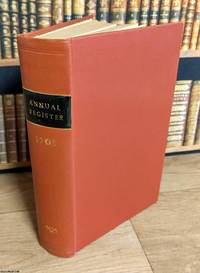
1793373234J. Dodsley London 1793. 5th Edition. Hardcover. Very Good Condition. 21 pages. This 1765 article published in The Annual Register provides a detailed account of John Harrison's groundbreaking work in solving the longitude problem at sea through the use of artificial time-keepers. Harrison an English clockmaker developed the marine chronometer a device that allowed sailors to accurately determine their longitude while at sea. His invention was crucial for safe navigation reducing the risk of ships becoming lost or wrecked due to miscalculations. The article outlines the proceedings and debates surrounding Harrison's work including his struggles with the Longitude Board which was reluctant to grant him the full 20000 prize promised under the 1714 Longitude Act. Despite proving the accuracy of his time-keepers Harrison faced political opposition and bureaucratic delays before finally receiving recognition for his achievements. Published at around the same time that Harrison's book of a similar title was published this contemporary 21 page account quotes Harrison extensively and represents the opinions and ideas regarding navigation from the perspective of the time. The whole volume extends to around 600 pages. Bound in modern but not recent brown buckram with a contrasting black leather lettering piece gilt title. Library label to the endpapers stamp on first blank and label to reverse of the title page. The first blank has a hand note stating "Given by Lt.Col. A.R. Hurst". Hurst has served with the Royal Field Artillery in the First World War. The whole volume is very clean with bright pages very firmly bound and in attractive condition. Size: 13.5 x 21 cms. Category: Antiquarian & Rare; Featured Items; Printed before 1800; Special Features. This item may require more postage than the rates shown for delivery outside the UK. If extra postage is required we will contact you before processing your order and you will be given the details and option to decline the extra cost. J. Dodsley hardcover
0243176295.Gpaperback. Good. Access codes and supplements are not guaranteed with used items. May be an ex-library book. paperback
1333716311.Gpaperback. Good. Access codes and supplements are not guaranteed with used items. May be an ex-library book. paperback
1330060776.Gpaperback. Good. Access codes and supplements are not guaranteed with used items. May be an ex-library book. paperback
192347061Lancaster The Physical Review 1923. Royal8vo. Contemp. full buckram. In:"The Physical Review" Series II vol. 21. 4736 pp. Plates and textillustr. Entire volume offered. A perforated stamp in upper margin on a few leaves. Compton's paper: pp. 483- 501. <br/><br/><em>First printing of this milestone paper in quantum physics in which Compton verifies Planck's quantum postulate and found that some of the X-rays had in scattering lenghtened their wavelenght. This phenomena was called the "Compton Effect" in his honour. For this discovery Compton received the Nobel prize in physics in 1927."Compton was able to account for this lenghtening of wavelenght by presuming that a photon of light struch an electron which recoiled subtracting some energy from the photon and therefore increasing its wavelenght. This made it seem that a photon acted as a particle: thus after more than a century the particulate natuer of light as evolved by Newton was revived. What itamounted to was that Compton brought to fruition the view that electromagnetic radiation had both a wave aspect and a particle aspect and that the aspect which was most evident depended on how the radiation was tested. De Broglie was at the same time showing that this held true also for ordinary particles such as electrons." AsimovParkinson "Breakthroughs" 1923 P. - Sigmund Brandt "The Harvest of as Century" Episode 31. </em> hardcover
191722798London 1917. Very good condition. The salver was presented as a wedding gift to Royal Navy officer CHARLES ROYDS 1876-1931 the Discovery's first lieutenant after whom Cape Royds in Antarctica is named. The salver has specially crafted feet fashioned after penguin's feet.<br /> <br /> The Discovery expedition was the first led by Captain Robert Scott and was arranged by the Joint Antarctic Committee composed of members from the Royal Society and the Royal Geographical Society. Known as the British National Antarctic Expedition the goal of the expedition was the scientific exploration of South Victoria Land and the ice barrier as well as the interior of the Antarctic continent. Its achievements included the discovery of the polar plateau and Scott's ascent the first ever in a hot air balloon over Antarctica. It was also the first to do extensive land exploration on the continent and went the furthest south by a sledge reaching 82 16' S. One of the unexpected contributions was the introduction to the Antarctic of so many future explorers as it included Ernest Shackleton Frank Wild & Edgar & Edward Evans. Scott returned to Antarctica a second time aboard the Terra Nova. That expedition which commenced in 1910 developed into a race against the Norwegian explorer Roald Amundsen to become the first to reach the South Pole. Amundsen attained the goal on January 4 1912 beating Scott by two weeks. Scott's expedition ended tragically when he and four companions perished on their return march from the South Pole after failing to reach a supply depot.<br /> <br /> Royd's had a very distinguished list of Antarcticans attending his wedding. But there are a number of ghostly presences that might have been there. Both Scott and Edward Wilson died in 1911 in their attempt to be the first to the South Pole. Ernest Shackleton was on duty in Northern Russia as was Frank Wild. These two were to return to the Antarctic in the Shackleton's Endurance expedition which is one of the greatest stories of survival ever told. Dr. Koettlitz died in 1916. <br /> <br /> The silver salver was made by Goldsmiths & Silversmith's Co. Regent St. London in 1917. It has a scalloped rope edge and four ball and claw feet is inscribed with the seal of the Discovery Voyage depicting icebergs and a penguin encircled within a heraldic belt. Below the seal is the engraved inscription "To Captain C.W. Royds R.N. on his marriage October 5th 1918 from his old messmates in the ‘Discovery' 1901-1904." <br /> <br /> Surrounding the inscription are the engraved signatures of:<br /> <br /> Scottish Royal Navy captain ALBERT B. ARMITAGE 1864-1943; "Albert B. Armitage" was the Discovery's second-in-command. "Armitage had been second in command of the Jackson-Harmsworth expedition to Spitsbergen. In recognition of this he received the Murchison award from the Royal Geographical Society. Armitage was the oldest man in the expedition and his years of Arctic service gave him more such experience than anyone else on the Discovery except Koettlitz. The contrasts between Armitage and Scott were noteworthy. Armitage had a good deal of experience with ships under sail; Scott did not. Armitage had three years of polar work; Scott had none" Scott of the Antarctic Huxley. Cape Armitage the southernmost point on Ross Island is named in his honor.<br /> <br /> LOUIS BERNACCHI 1876-1942; "L. C. Bernacchi" was a Tasmanian physicist and astronomer of Italian extraction. His first polar journey was with Carsten Borchgrevink's Southern Cross expedition 1898-1901 along with Hodgson above. For his work on the Discovery voyage Bernacchi was decorated by the Royal Geographical Society and awarded the Légion d'honneur. Scott was the best man at his wedding. Bernacchi explored regions of Africa and South America wrote several books on the Antarctic was a member of the Royal Geographic Society and served in the British and United States military during World War I. His attempts to raise funds for a 1925 Antarctic expedition failed. Antarctica's Bernacchi Head and Bay honor his name.<br /> <br /> MICHAEL BARNE 1877-1961; "Michael Barne". Barne's responsibilities as a member of Scott's Discovery expedition was to keep records of the voyage. A recipient of the Polar Medal Barne "had been a shipmate of Scott on the Majestic. and was appointed second officer by the committee in June 1900. His duties including assisting Armitage with magnetic studies and taking charge of deep-sea temperature research" Pilgrims on the Ice: Robert Falcon Scott's first Antarctic Expedition Baughman. An Antarctic cape glacier and inlet are named after him.<br /> <br /> GEORGE FRANCIS ARTHUR MULOCK 1882-1963; "George F.A. Mulock". Mulock had joined the relief vessel Morning that resupplied Scott's ships in the Antarctic. In 1902 he came aboard the Discovery to replace Ernest Shackleton who had fallen ill. Mulock served as a surveyor and cartographer during the mission publishing his results as Survey Work of the National Antarctic 1901-04 for which he was awarded the Polar Medal. He had a distinguished career in both World War I and II during which time he was held captive by the Japanese. The Mulock Inlet and Glacier are named in his honor.<br /> <br /> Marine biologist THOMAS VERE HODGSON 1864-1926; "T.V. Hodgson" did pioneering work aboard the Discovery and was the first person to describe the Antarctic's deep sea floor. Prior to joining the Discovery he had been a member of Carsten Borchgrevink's Southern Cross expedition 1898-1901. Cape Hodgson in the Ross Archipelago is named after him.<br /> <br /> Royal Navy officer REGINALD W. SKELTON 1872-1956; "Reginald W. Skelton" was the Discovery's chief engineer and official photographer. Despite the long-standing friendship between Scott and Skelton he was passed over as second-in-command on Scott's fatal 1910 Terra Nova expedition. An Antarctic inlet and three glaciers are named in his honor.<br /> <br /> CYRIL LONGHURST "Cyril Longhurst" was the secretary of the Discovery expedition and served as best man at Shackleton's wedding. Mount Cyril in Antarctica is named after him.<br /> <br /> HARTLEY TRAVERS FERRAR 1879-1932; "H.T. Ferrar" was born in Ireland raised in South Africa and educated as a geologist in England. A relatively young and inexperienced member of the voyage Ferrar met the woman he would marry while the Discovery was docked in New Zealand. His expedition duties included making geological surveys classifying what became known as the Ferrar or Beacon sandstone layer and discovering the first Antarctic fossils. He later conducted geological research in Egypt Palestine and New Zealand. The Ferrar Glacier is named for him.<br /> <br /> Following the Discovery expedition Royds continued his career in the Royal Navy. While commanding the battleship HMS Emperor of India he was given our lovely sterling silver platter to honor his marriage to Mary Louisa Blane a widow and retired actress. After the war Royds was an instructor at the Admiralty retiring from the navy as a rear-admiral. Thereafter he enjoyed a second career as deputy commissioner of the Metropolitan Police for which he received a knighthood.<br /> <br /> A unique object. Professionally polished and in fine condition save a few very faint scuffs. unknown
DADAX1250308461Feiwel & Friends 2018-09-11. hardcover. New. 8.85x0.67x11.19. Buy with confidence. Excellent Customer Service & Return policy. Feiwel & Friends hardcover
2003Adhya-9783540047605Springer 2003. Paperback. New. Springer paperback
2003Adhya-9783540047605Springer 2003. Paperback. New. Springer paperback
2016x-0309438845Natl Academy Pr 2016. Paperback. New. 1st edition. 87 pages. 9.00x6.00x0.50 inches. Natl Academy Pr paperback
A9780309438841Paperback / softback. New. The field of endeavors known as aEUROoeregulatory scienceaEURO has grown out of the need to link and integrate knowledge within and among basic science research clinical research clinical medicine and other specific scientific disciplines whose focus aggregation and ultimate implementation could inform biomedical product development and regulatory decision making. Substantial efforts have been devoted to defining regulatory science and communicating its value and role across the scientific and regulatory ecosystems. Investments are also being made in technology infrastructure regulatory systems and workforce development to support and advance this burgeoning discipline. In October 2015 the National Academies of Sciences Engineering and Medicine held a public workshop to facilitate dialogue among stakeholders about the current state and scope of regulatory science opportunities to address barriers to the disciplineaEURO TMs success and avenues for fostering collaboration across sectors. Participants explored key needs for strengthening the discipline of regulatory science including considering what are the core components of regulatory science infrastructure to foster innovation in medical product development. This report summarizes the presentations and discussions from the workshop. paperback
1572937815.Gpaperback. Good. Access codes and supplements are not guaranteed with used items. May be an ex-library book. paperback
194250233-5: Faber & Faber. Very Good in Very Good- dust jacket. 1942. Reveiw Copy. Hardcover. Faber & Faber hardcover
ria9781108032674_inpPaperback. New. New Book; Fast Shipping from UK; Not signed; Not First Edition; Founded in 1788 the African Association lay behind many of the most famous expeditions to Africa at the turn of the eighteenth century. This volume published in 1802 includes revealing reports and letters from both Mungo Park and Fri paperback
B9781108032674Paperback / softback. New. Founded in 1788 the African Association lay behind many of the most famous expeditions to Africa at the turn of the eighteenth century. This volume published in 1802 includes revealing reports and letters from both Mungo Park and Friedrich Hornemann as well as fascinating background detail to their expeditions. paperback
1108032672.Gpaperback. Good. Access codes and supplements are not guaranteed with used items. May be an ex-library book. paperback
0841617805New. spiral_bound. New. Satisfaction Guaranteed or your money back. unknown
0841617805.Gspiral_bound. Good. Access codes and supplements are not guaranteed with used items. May be an ex-library book. unknown
177746614London W. Bowyer and J. Nichols 1777. 4to. Extracted from "Philosophical Transactions" Year 1777. Vol. 67 - Part I. Pp. 260-265. Clean and fine broadmargined. <br/><br/><em>First apperarance of this paper constituting the first reliable account of colour blindness.Usually Goethe or John Dalton - Huddart's case was cited in Dalton's paper of 1794 - is supposed to have discovered colourblindness. However the English oculist Joseph Huddart was the discoverer of this phenomenon. The first physiological explanation of it does come from Goethe.Garrison & Morton: 5832. </em> unknown
2007Q-0787986623Jossey-Bass 2007-04-20. Hardcover. New. In shrink wrap. Looks like an interesting title! Jossey-Bass hardcover