1 815 résultats
97524aafLondon / Leipsic, T. Fisher Unwin, 1912, lg. in-8vo, frontispiece + 4 ff. + 247 p., illustrated with 58 b/w plates + 6 in colours + 2 maps (1 folding), small legacy stamp ‘Guggisberg’, original publisher’s brown pictorial clothbound. Fine copy.
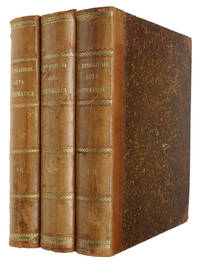
188460243Berlin, Stockholm, Paris, F. & G. Beijer, 1882-84. Large4to (272 x 230 mm). Three volumes uniformly bound in contemporary half calf with gilt lettering to spine. In ""Acta Mathematica"", volume 1-5. Light wear to extremities, boards and spines with scratches. Stamp to verso of front board in all volumes. First three leaves in first volume detached, otherwise internally fine and clean. Vol. I, pp. 1-62" Pp. 193-294 Vol. II, pp. 97-113 Vol. III. pp. 49-92 Vol. IV pp. 201-312" Vol. V pp. 209-278.
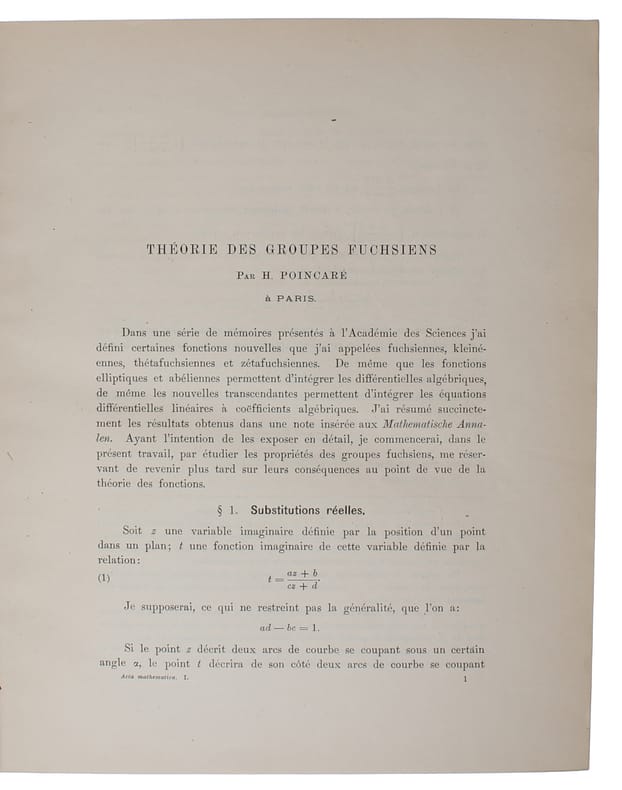
188460243Berlin Stockholm Paris F. & G. Beijer 1882-84. Large4to 272 x 230 mm. Three volumes uniformly bound in contemporary half calf with gilt lettering to spine. In "Acta Mathematica" volume 1-5. Light wear to extremities boards and spines with scratches. Stamp to verso of front board in all volumes. First three leaves in first volume detached otherwise internally fine and clean. Vol. I pp. 1-62; Pp. 193-294; Vol. II pp. 97-113; Vol. III. pp. 49-92; Vol. IV pp. 201-312; Vol. V pp. 209-278. <br/><br/><em>First publication of these groundbreaking papers which together constitute the discovery of Automorphic Functions. "Before he was thirty years of age Poincaré became world famous with his epoch-making discovery of the "automorphic functions" of one complex variable or as he called them the "fuchsian" and "kleinean" functions." DSB.These manuscripts written between 28 June and 20 December 1880 show in detail how Poincaré exploited a series of insights to arrive at his first major contribution to mathematics: the discovery of the automorphic functions. In particular the manuscripts corroborate Poincaré's introspective account of this discovery 1908 in which the real key to his discovery is given to be the recognition that the transformations he had used to define Fuchsian functions are identical with those of non-Euclidean geometry. See Walter Poincaré Jules Henri French mathematician and scientist.The idea was to come in an indirect way from the work of his doctoral thesis on differential equations. His results applied only to restricted classes of functions and Poincaré wanted to generalize these results but as a route towards this he looked for a class functions where solutions did not exist. This led him to functions he named Fuchsian functions after Lazarus Fuchs but were later named automorphic functions. First editions and first publications of these epochmaking papers representing the discovery of "automorphic functions" or as Poincaré himself called them the "Fuchsian" and "Kleinian" functions."By 1884 Poincaré published five major papers on automorphic functions in the first five volumes of the new Acta Mathematica. When the first of these was published in the first volume of the new Acta Mathematica Kronecker warned the editor Mittag-Leffler that this immature and obscure article would kill the journal. Guided by the theory of elliptic functions Poincarë invented a new class of automorphic functions. This class was obtained by considering the inverse function of the ratio of two linear independent solutions of an equation. Thus this entire class of linear diffrential equations is solved by the use of these new transcendental functions of Poincaré." Morris Kline.Poincaré explains how he discovered the Automorphic Functions: "For fifteen days I strove to prove that there could not be any functions like those I have since called Fuchsian functions I was then very ignorant; every day I seated myself at my work table stayed an hour or two tried a great number of combinations and reached no results. One evening contrary to my custom I drank black coffee and could not sleep. Ideas rose in crowds; I felt them collide until pairs interlocked so to speak making a stable combination. By the next morning I had established the existence of a Class of Fuchsian functions those which come from hypergeometric series; i had only to write out the results which took but a few hours.the transformations that I had used to define the Fuchsian functions were identical with those of Non-Euclidean geometry." </em> hardcover
Features: A Son of the Navahos - I, by James Willard Schultz; Left or Right?, by Margaret Warde; Capturing Daniel Webster's Statue, by C.A. Stephens; The Berkshire Boy, by MacGregor Jenkins; Bartholomew Crab's Discovery, By William Leavitt Stoddard; Walter Camp - The Father of American Football - With nice photo of the Yale Graduate's Team, by Hartford Powell, Jr.; Through the Dragon's Teeth - II, by Lewis R. Freeman; Game Extinction - Its Causes and Remedies, by Edwin A. Osborne; The Art of Making Antique Boxes; Prudy Pickles' Penny Shop, by Dahris Butterworth Martin; Grape Nuts ad on back cover. Somewhat above-average wear. Book
714 pages. Contents include: How Mrs. S.E. Waller's Pictures Have Been Painted; The Money Kings of the New World, by W.T. Stead; Dr. Niels Finsen and his remarkable discovery of healing rays - with wonderful photos; The Making of a Flume - with great photos; The Tame Fish of Logan; The New Khartoum - with many photos; The Floor of the Pacific, by The Hon. W.E. Meehan, Fish Commissioner of the State of Pennsylvania - with photos; The Money Kings of the Modern World II - The Rothschilds, by W.T. Stead - with several photos and illustrations; The Momentous Motor - great vintage technology article with photos; "Skin O' My Tooth" - Edited and Compiled by Baroness Orczy; Bird Babies; Strong Mac; The Making of a Mandolin - with photos; The Money Kings of the Modern World - Part III - Mr. J. P. (Pierpont) Morgan; Municipal Ambulance Work - with fantastic photos of horse-drawn ambulances; Baron Shibusawa of Japan - with great photos; The Game of Sticke - its evolution and progress; The Fiscal Policy of The Empire, by John Holt Schooling; Coalport Porcelain - the story of an ancient and famous industry; The Most Wonderful Map in the World - France, in Jasper, Set with Jems; Hints on Sea-Swimming - Mr. Montagu A. Holbein give advice, and suits the action to the world for photographic illustration; The Nelson Room at Trafalgar House; The Money Kings of the Modern World - Some European Potentates - M. Witte, Baron Hirsch, Alfred Nobel, Alfred Beit, Herr Krupp, M. Jean de Bloch; The Fiscal Policy of the Empire - Part II; A Painter of the Sea-Coast - Mr. Elmer Keene and his Art; Sir James Brooke - Rajah of Sarawak; Pictures in Postage Stamps - using old postage stamps to create art; Capturing A Sperm Whale - with awesome photos; plus many fictional stories. Backstrip all but detached. Front free endpaper and first several pages loose but present. Several other pages loose. Hinges open. Above-average wear. Reading copy only, but remains a very informative and enjoyable reference. Book
203pp. 26 cm. Hardcover Very good condition good
385p. + Plus photographs. Chapter heading drawings. Inked ownership of Emilie Latimer. 8vo. Original full cloth binding. Original dust jacket, slight tear without loss. AFRICA/3 + AFRICA/2 Lacks DJ
Unfolds into a magnificent mural over 3 metres in length. Over 1,300 entries. Over 350 illustrations across ten colourful panels, including cutaway diagrams and maps. Documents developments in thirteen major subject areas and in world history, compared against a timeline in a unique integrated design. Includes glossary and keys to colour-coded bands. Clean and unmarked with light wear. A nice copy of this wonderful teaching tool. Book
Roy. 8vo., First Edition thus, on Japanese vellum, with a folding map as frontispiece, title-vignette in blue and black, and 12 maps; original blue buckram, ivory buckram back lettered in gilt, uncut, brown silk marker, covers lightly dust-soiled else a very good, bright, clean copy. EDITION LIMITED TO 1050 NUMBERED COPIES (THIS COPY OUT-OF-SERIES). Sold from an institution with its stamp on front free endpaper, half-title and title. The seventh publication of the Argonaut Press, printed by Walter Lewis at the University Press, Cambridge. The title-vignette is by William Monk.
192pp. 25cm Paperback Very good condition
8vo., with plates and endpaper maps; original blue pictorial cloth, covers lightly age-soiled else a very good, clean copy. Scott's own account of the National Antarctic Expedition of 1901-1904 was first published in 1905. This is a nice copy of the reissue of the first one-volume edition of 1929. Scarce, especially in this condition. Spence, 1072 (recording the first one-volume edition).
1587380161.Gpaperback. Good. Access codes and supplements are not guaranteed with used items. May be an ex-library book. paperback
0260105244.Gpaperback. Good. Access codes and supplements are not guaranteed with used items. May be an ex-library book. paperback
337pp. 22 cm. Hardcover Very good condition good Signed by the author for Bonnie
191441545London, 1914. No wrappers, but stiched. All three papers contained in: ""Philosophical Magazine"", Sixth Series, Vol. 27. No. 159. March 1914. The whole issue issue offered (=no. 159): pp. 397-540 and 2 plates.Rutherford's paper.pp. 488-498. - Darwin's paper: pp. 499-506. - Bohr's paper: pp. 506-523. All clean and fine.
191441545London 1914. No wrappers but stiched. All three papers contained in: "Philosophical Magazine" Sixth Series Vol. 27. No. 159. March 1914. The whole issue issue offered =no. 159: pp. 397-540 and 2 plates.Rutherford's paper.pp. 488-498. - Darwin's paper: pp. 499-506. - Bohr's paper: pp. 506-523. All clean and fine. <br/><br/><em>First edition and first printing of all three papers. Rutherford in this paper for the first time identifies the hydrogen nucleus and called it the 'positive electron'. He later called it 'the proton' . In his definitive paper of 1911 he estimated the radius of the nucleus a hundred thousand times smaller than that of an atom. Darwin in his paper offered here gave a more precise measure.In the first lines of the paper Rutherford outlines the content "The present paper and and the accompanying paper by Mr. C. Darwin the second paper offered here deal with certain points in connection with the "nucleus" theory of the atom which were purposely omitted in my first communication on that subject Phil. Mag. May 1911. A brief account is given of the later investigations which have been made to test the theory and of the deductions which can be drawn from them. At the same time a brief statement is given of recent observations on the passage of alpha particles through hydrogen which throw importent light on the dimensions of the nucleus." - Rutherford had studies alpha-particles intensely in the years before 1914 and proved quite conclusively that the individual particle was a helium atom with its electrons removed. The alpha particles were like the positive rays that had been discovered by Goldstein 1886 and now in 1914 the paper offered Rutherford suggested that the simplest positive rays must be those obtained from the hydrogen and that these must be the fundamentall positively-charged particle. He names it a 'positive electron'.Darwin in the paper offered "concluded from the known data:"No force proportional to some power of the distance other than the inverse square can give the dependence the Rutherford scattering cross section on the initial velocity" and he then calculated the distance of closest alpha-particle-nucleus approach.The paper by Niels Bohr relates to "The Stark effect". In 1913 appeared "an importent new discovery: when atomic hydrogen is exposed to a static electrical field its spectral lines split the amount of splitting being proportional to thefield strenght the linear Stark effect. After Rutherford read this news in "Nature" he at once wrote to Bohr:'I think it is rather up to you at the present time to write something on.electric effects.'" A. Pais. Bohrs paper on The Stark effect appeared in 1914 the paper offered here. - Rosenfeld. Niels Bohr' publications No. 10. </em> unknown
1965332Beamsville Ontario: Discovery Women's Institute Printed by Rannie Publications 1965. First edition. Stapled Wraps. Unpaginated. pp. 64. 4to. Illustrated card covers. Profusely illustrated with maps black and white photographs portraits and illustrations. Lightest rubbing to the extremities contents clean and unmarked with tight sound binding; very good. Rare. A comprehensive local history of Discovery N.W.T. formerly a mining town with details on the Indigenous peoples of the region religious affiliations of the community and the institutions serving them schools libraries newspapers fraternal organizations etc. <br/><br/> [Discovery Women's Institute], Printed by Rannie Publications paperback
98329aafLondon, Seeley, Service & Co., 1925, in-8vo, 318 p., illustrated + 1 folding map, light foxing, small legacy stamp ‘Guggisberg’, original publisher’s blue pictorial clothbound. Very good to fine copy.
192 pages. Explores the latest research of Cleve Backster, who by attaching a lie-detector to the leaf of a plant discovered that it had feelings and the ability to read our thoughts. Now this ability - primary perception - has been traced even to disconnected cells of our own bodies. The implications and possibilities of that discovery, and the difficult struggle it has had in finding acceptance in the tradition-bound scientific community makes exciting, challenging, mind-expanding reading. Unmarked. Crease to one page. Small bookseller's label inside front cover. Very light wear. Glossy illustrated covers. Nice copy. Book
Features: Must we woo Red China? - by Arnold J. Toynbee; A time of trouble (Affairs of the State); Should Women give Men the Vote?; America's new big rich - despite high taxes, a small number of little-known men have made huge postwar fortunes - John D. MacArthur, Dr. Edwin Land, Howard Ahmanson, John Mecom, W. Clement Stone, Henry Crown - with photos; The Great wild-bee safari - bee-tree hunting; Last of the Divorce Rances - Donner Trail Ranch; Adak - "A woman behind Every Tree" - a return to the Aleutian/Alaskan Island manned by 80,000 Americans during World War II; Discovery that helps prevent miscarriages - 'Skin Patch'; The big (James) Bond bonanza - great photos of the 'Thunderball' shoot and more. Colour Chevrolet Truck 'Workpower' centerfold. Average wear. Unmarked. A sound copy. Book
xl, 451, 4 [ads] pages. Two large colour fold-out maps of North American drainage basins by J.G. Bartholomew; Black and white photographic plates and diagrams. "In the following pages an attempt has been made to set forth in order the chief facts relating to the discovery and exploration of the northeastern part of the continent of North America." - Preface. Professionally rebacked using original cloth. Unmarked with average wear. Small tape repair to first fold-out map. Second fold-out map loose but present with minor loss to one corner. A sound copy. MORLEY [Ontario] p.7, MORLEY [Atlantic] p.3. Book
0260052701.Gpaperback. Good. Access codes and supplements are not guaranteed with used items. May be an ex-library book. paperback
284pp. illus., maps, ports. 24 cm. Hardcover Very good condition good The expolration of the great rivers of North American for three centuries
8vo., First Edition, with a frontispiece, 50 plates on 32 and endpaper maps; white cloth, gilt back, a near fine copy in unclipped dustwrapper. Detailed and well-illustrated account of the freeing of Discovery by the Terra Nova (McKay) and Morning (Colbeck) from the Antarctic ice in 1904.
Book in mint condition. Dust jacket not price clipped or marked or torn with tiny crease to spine foot and minor traces of storage. 530pp. A comprehensive anthology of the writings of explorers through the ages.