1 815 résultats
188247024Paris Gauthier-Villars 1882. 4to. No wrappers. In: "Comptes Rendus Hebdomadaires des Séances de L'Academie des Sciences" Tome 95 No 22 a. Tome 104 No 21 entire issues offered. Pp. 1017-1076 and pp. 1387-1462. Raoult's papers: pp. 1030-33 tome 95 and pp. 1430-1433 tome 104. <br/><br/><em>First appearance of Raoult's two importent papers in which described a method for finding the molecular weight of an organic compound by the determination of the lowering of the freezing point of water that resulted from dissolving that compound in water and the law governing the relation between solutes and vapor pressure."Then in 1882 F.-M. Raoult published his results on the effects of nondissociating organic solutes from which he deduced a general law controlling the lowering of freezing points the first paper offered. Four years later he extended this work to show the effect of solutes on vapor pressure the second paper offered. Having established the effect of nondissociating compounds he was in position to show that salts produced an eeffect which though anomalous could nevertheless be explained by the supposition that a dissolved molecule broke up into other molecules. This work was of great value in supplying a new method for determining molecular weights since the depression of freezing point and vapor pressure as well a the related rise in boiling point later discovered are proportional to the moleculat concentrations ofthe solutions; it was of equal value in supporting the ideas of van't Hoff on osmotic pressure. With the announcement of the dissociation theory of Arrhenius the anomalies were explained and the full significance of the generalizations of Raoult was recognized. Raoult published the formulations of his laws in the "Comptes Rendus" for 1882 and 1887 the papers offered" Leicester a. Klickstein "A Source Book in Chemistry" pp. 471 ff. </em> unknown
pp. xvi, 598, (4)[Publisher's catalogue] + Plus two portrait frontis. Illustrated with numerous full page woodcuts. Age stained. 8vo. Original full black embossed cloth binding, gold lettered. Worn and stained. AFRICA/2 = 2nd c. spine torn, lacks first fly leaf.
pp. xvi, 615, (2)[Publisher's catalogue] + Plus two portrait frontis. Illustrated with numerous full page woodcuts. Very slight age stained. 8vo. Original full black embossed cloth binding, gold lettered. Nice copy. AFRICA/2
59760aafLondon, George Philip & Son, 1891, in-8vo, 372 p., 22 ill., 6 maps, + 1 folded map, small legacy-stamp Dr. Guggisberg, orig. cloth, trace of use, spine and corners a bit trifled, 2nd. fly-leaf missing, very good copy.
9551In 4 cartonné, dos toilé rouge, premier plat illustré en couleurs. Faux-titre, titre illustré en couleurs, 64 pages, texte encadré d’un large filet bleu. 95 illustrations dans le texte, hors-texte, pleine page, pus la couverture de JORDIC. Paris librairie Garnier frères 1926 Un petit manque angle inférieur droit du premier plat sinon très bon état
97392aafLondon, Hutchinson & Co., 1906, gr. in-8vo, XXVIII + 520 p. / XVI + 521-1183 p., richly illustrated with 28 coloured ills, a.o., small legacy-stamp ‘Dr. Guggisberg’, original pictorial clothbound. Pictorial (Botanical) endpapers.Traces of use, joints starting. Good copy.
Full Title: "LIBELLUS, QUO DEMONSTRATUR: CICUTAM Non solum usu interno tutissime exhiberi, sed et esse simul remedium valde utile in multis morbis, qui hucusque curatu impossibiles dicebantur. Editio Altera. [BOUND WITH] Libellus Secundus. [BOUND WITH] Supplementum Necessarium. Three volumes in one." pp. (16), 110; 292; 67 + Wonderful folding engraved plate of the Giant Hemlock. Foxed. 8vo. Contemporary French full mottled leather binding, slightly worn at extremities. Manuscript of the first owner, a physician, (J. F.?) Coste. An important work on the medical properties and other aspects of hemlock, aconite, hyoscyamus, colchicum, etc. Before this publication, these plants were considered highly poisonous and had been rarely used in medicine owing to the difficulty of accurately estimating their doses and the danger this presented to the patient. Anton Storck, a 19-year-old Viennese doctor, in 1760 repeatedly sipped tea laced with hemlock, said to be the suicide drug of Socrates and believed in Storck's time to be beneficial against pain. The experiment so terrified Storck that he lost the ability to speak temporarily, but he suffered no lasting ill effects, and went on to publish this study. There is a direct line from Storck to the Americans Frederick Prescott and Scott Smith, who in the 1940s had themselves so paralyzed temporarily by curare that not even an eyelid could blink, thus demonstrating that the deadly poison could immobilize patients and revolutionize surgery. Throughout medical history researchers have served deliberately as guinea pigs because animal experiments can work only up to a point. Blake, p. 434; Waring 379. Quite scarce and important. **PRICE JUST REDUCED! W153
11912Librairie des Provinces de France. 1937. Grand in-8° br. Illustrations de Charles Dehayes. Plans dAndré Guérin. 176 pp. E.O. 1/950 du tirage numéroté. E.O.
1999Q-0912299762Stoneydale Pr Pub Co 1999-03-01. Hardcover. New. In shrink wrap. Looks like an interesting title! Stoneydale Pr Pub Co hardcover
1999Q-0912299851Stoneydale Pr Pub Co 1999. Hardcover. New. In shrink wrap. Looks like an interesting title! Stoneydale Pr Pub Co hardcover
8289Librairie Plon 1956
183248329Paris Crochard 1832. No wrappers. In: "Annales de Chimie et de Physique" 2e Series vol. 51 Cahier 4. Pp. 337-444 Entire issue offered. Faraday's letter: pp. 404-434 a. 1 engraved plate. Some brownspots. <br/><br/><em>First printing of Faraday's famous letter to Gay-Lussac in which he claim to be the discoverer of electro-magnetic induction analysed the results of the Italian philosophers pointing out their errors and defending himself from what he regarded as imputations on his character. The style of this letter is unexceptionable for Faraday could not write otherwise than as a gentleman; but the letter shows that had he willed it he could have hit hard. The letter was later translated into English and published in "Philosophical Magazine" in 1840 under the title "On Magneto-electric Induction"."In 1831 seemingly out of nowhere came the discovery of electromagnetic induction and the beginning of the experimental researches in electricity which were to lead Faraday to the discovery of the laws of electrochemistry specific inductive capacity the Faraday effect and the foundations of classical field theory." DSB. </em> unknown
183247933Paris Crochard 1832. Contemp. hcalf. Spine gilt. Light wear along edges. Stamps to verso of titlepage. In: "Annales de Chimie et de Physique" 2e Series vol. 51. Entire volume offered. 448 pp. a. 1 folded engraved plate. Faraday's letter: pp. 404-434. Internally clean and fine. <br/><br/><em>First printing of Faraday's famous letter to Gay-Lussac in which he claim to be the discoverer of electro-magnetic induction analysed the results of the Italian philosophers pointing out their errors and defending himself from what he regarded as imputations on his character. The style of this letter is unexceptionable for Faraday could not write otherwise than as a gentleman; but the letter shows that had he willed it he could have hit hard. The letter was later translated into English and published in "Philosophical Magazine" in 1840 under the title "On Magneto-electric Induction"."In 1831 seemingly out of nowhere came the discovery of electromagnetic induction and the beginning of the experimental researches in electricity which were to lead Faraday to the discovery of the laws of electrochemistry specific inductive capacity the Faraday effect and the foundations of classical field theory." DSB. The volume contains further importent papers by AMPÈRE "Note sur une Experience de Hippolyte Pixii relative au Courant produit par la Rotation d'un aimant à l'aide dün appareil imagine par M. Hippolyte Pixii" WÖHLER et LIEBIG "recherches sur le Radical de l'Acide benzoique" and "Lettre de M. Berzelius sur le Benzoyle et l'Acide benzoique" papers by Strohmeyer Gay-Lussac Dutrochet Boussingault BERZELIUS "Sur le Bleu de Prusse et le Cyanoferrure de plomb" etc. etc. </em> unknown
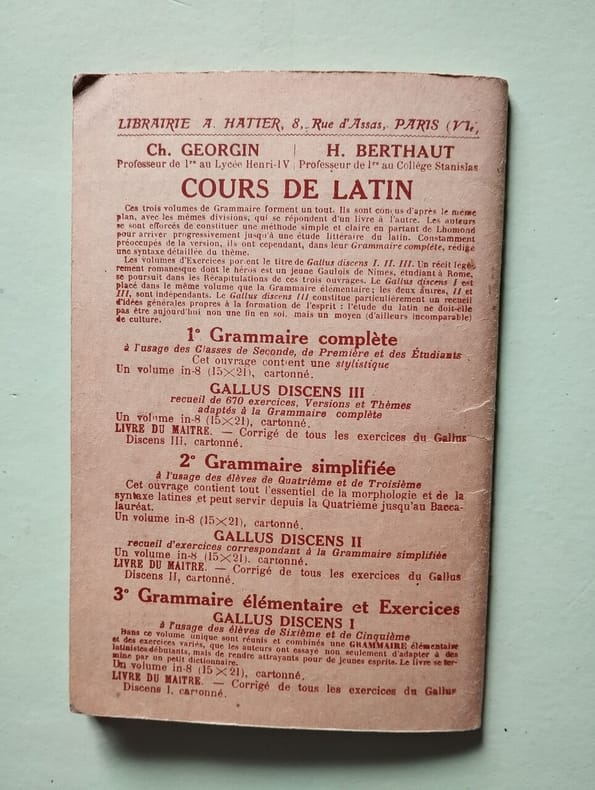
1938500338685Librairie Hatier 1938 1938.
1390332136.Gpaperback. Good. Access codes and supplements are not guaranteed with used items. May be an ex-library book. paperback
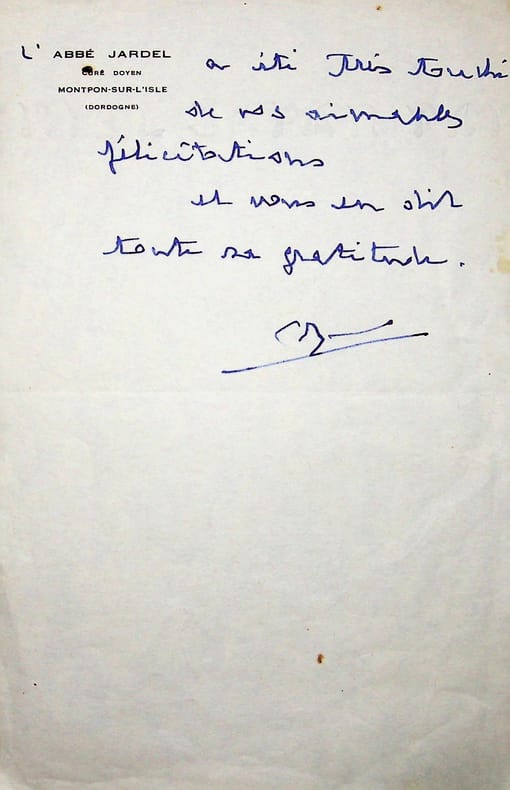
018061Abbé Edmond Jardel (XXe), curé-doyen de Montpon-sur-L'isle (Dordogne), lié a lé découverte de la grotte du Sorcier (Saint-Cirq). L.A.S., sd, 1/2p in-8. Remerciements pour des félicitations. [416]
194031721Chez l'Auteur 1940 Petit In-8 Poème en feuilles non paginées - Dessin de J.Thomas d'après la statuette Aurignacienne découverte à Lespugue (Haute-Garonne) par M. René de Saint-Périer et exposée au Musée de l'Homme à Paris ; rousseurs éparses - Exemplaire sur japon
193723850Paris Gallimard 1937 In-12 251 pp, photos hors texte. Service de presse non coupé
9915in 12 broché,couverture illustrée.Faux-titre,titre,342 pages,16 illustrations hors texte de Lucien METIVET.Paris Paul OLLENDORFF 1896. Edition originale.Un des 25 exemplaires sur papier de luxe (chine)n°8 au crayon de couleur rouge. Couverture doublée. Petites rousseurs.
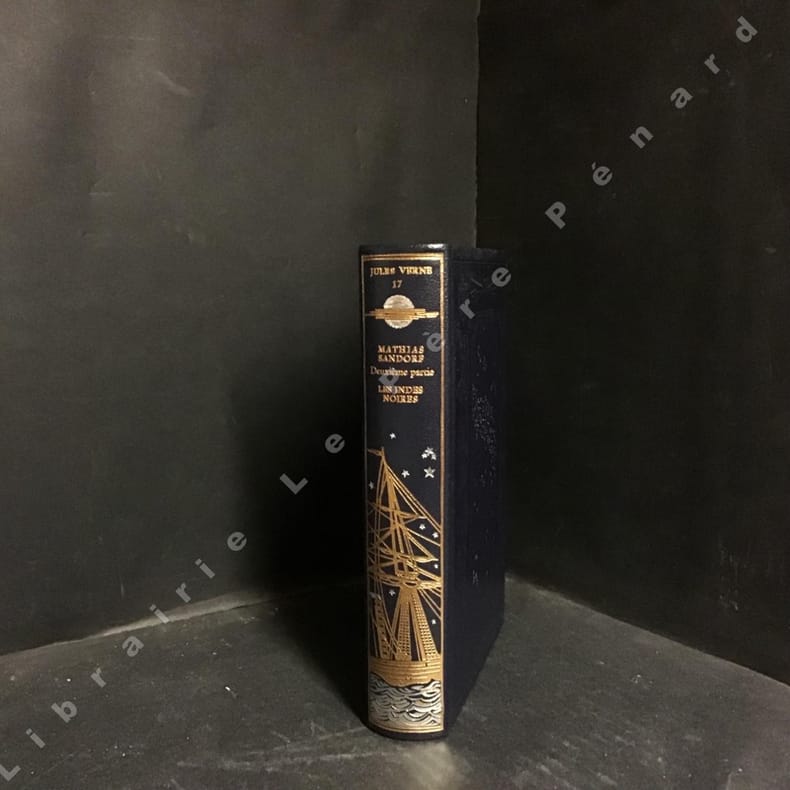
19781256271978 Chez Jean de Bonnot - 1978 - In-8 (14.5x21 cm environ), reliure pleine peau bleue de l'éditeur, dos lisse avec titres et décor dorés, avec riches décor à froid sur les plats, tranche de tête dorée, signet bleu - 336 pages - Illustrations de l'époque de l'auteur en N&B
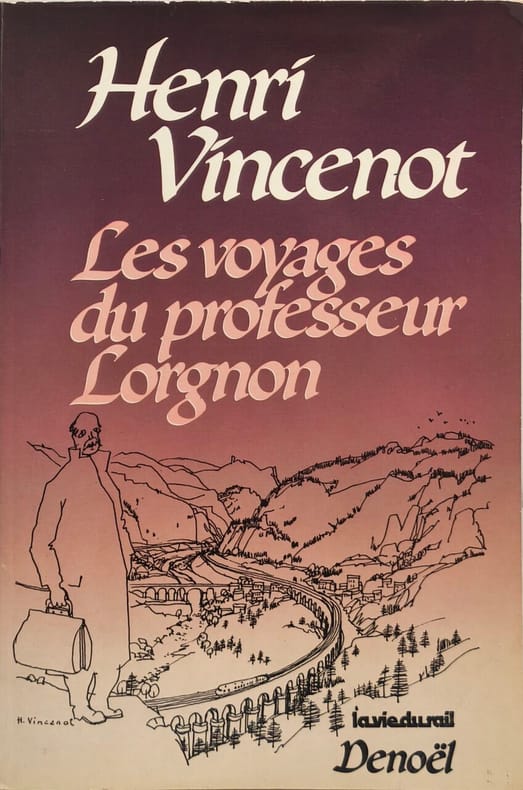
19835870Denoël / La vie du rail 1983 336 pages 14x23x3cm. 1983. Broché. 336 pages. Cette série de récits suit les pérégrinations du Professeur Lorgnon alter ego de l'auteur qui parcourt la France sur les lignes ferroviaires secondaires. Mêlant chronique touristique observations poétiques et érudition l'œuvre invite à découvrir les trésors cachés des campagnes françaises leur gastronomie leur histoire et leurs paysages à travers une quête personnelle teintée de philosophie
48834Puf.1948.In-8 br.533 p. Etat correct mais très mauvaise qualité du papier.
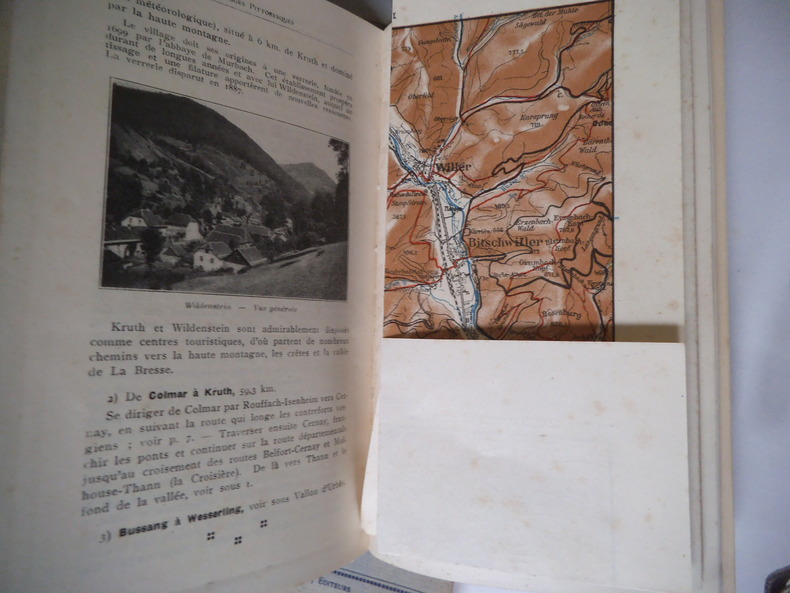
12323Guide illustré, sous le patronage de la fédération des syndicats des Vosges. Tomes en 3 volumes in 12 broché. Braun & Cie éditeur. Premier volume : Strasbourg-Wissembourg-Niederbronn-Saverne-Sarreguemines-Raon l’Etape- Senones- Vallée de la Bruche- Donaon- Ste Odile- Barr-Hohwald. Faux-titre, titre, XXIV, une carte en couleurs Vosges du nord. 1 paln en couleurs : Strasbourg. 329 pages, nombreuses illustrations photos en sépia et cartes en couleurs dépliantes. Couverture poussiéreuse et petite rousseurs. Tome 2 :: Colmar, Sélestat, ville-Ste-Marie aux mines, Ribeauvillé, le vignoble- la valle de Kaysersberge, la vallée de munster, Schlucht- Hohneck, Gérardmer, St Dié. Faux-titre, grande carte automobile des Vosges centrales, en couleurs. Titre, XIV – 287 pages, petite tache triangulaire en tête du premier plat. Tome3 : Mulhouse-le vignoble-la vallée de Guebwiller-le massif du grand ballon et la crête- la vallée de Wesserling- la vallée de Massevaux- les vallées de la Moselle & de la Moselotte- le massif du ballon d’Alsace. Grande carte automobile, dépliante, des Vosges méridionales Faux-titre, titre, XVI- 247 pages.
72454sd Editions J. Dupuis, collection "Les Beaux Romans Populaires pour la Famille", Série B, N° 75 - Sans date - 1 brochure in-4, broché couverture illustrée - 42 pages, imprimées sur 2 colonnes - Illustrations dans le texte
201901569Paris, Gallimard découverte, 1990 ; in-12, 128 pp., br. Broché bon état-n°77 achitecture.