GOUGER, RobertBiblio.com
3 315 résultats
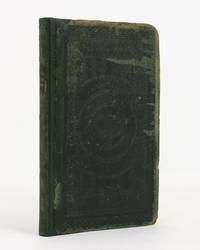
1838140755London: Harvey and Darton 1838. First Edition. Hardcover. Very Good. London Harvey and Darton 1838 first edition. Duodecimo viii 136 pages. Original full dark green leather extensively decorated in blind on both sides recently rebacked in dark green calf retaining an early cloth backstrip and small leather title-label with slight loss; new marbled endpapers; leather worn at the extremities with the corners of the boards rounded off; all edges gilt; minor signs of age and use including some early pencilling most of it lightly erased; overall a very good copy. A presentation copy in a presentation binding inscribed on the flyleaf to 'The Revd. H.M. Villiers with the author's best regards'. <p>Robert Gouger 1802-1846 'Earnest persistent and practical . with a pleasant manner and a persuasive tongue but he was inclined to exaggerate his own republican views and the virtues of South Australia. With his youthful looks and boyish ardour he was often thought to be brash and reckless yet he was South Australia's most devoted promoter' 'Australian Dictionary of Biography'. 'The South Australian Act was passed in August 1834 and a month later Gouger presented his library of colonial books to the South Australian Literary and Scientific Association. After much delay and more hard work by Gouger the South Australian Colonization Commission was gazetted in May 1835. Its first appointment was Gouger as colonial secretary a recognition of faithful service that was affirmed even by the Colonial Office'. <p>He arrived on the 'Africaine' in November 1836. His young wife and new-born son both died five months later. He 'bought eight town acres 3.2 ha at Adelaide's first land sale and began to build a house but was soon entangled in the party factions that bedevilled the new settlement. He quarrelled with Osmond Gilles; after a public brawl they were both arrested and Gouger was suspended. By way of Hobart Town he left in November 1837 for England where he was reinstated by the Colonization Commission raised funds for a Congregational chapel in Adelaide and published "South Australia in 1837; in a series of letters with a postscript as to 1838". In October 1838 he married his cousin Sarah Whittem of Kenilworth. <p>Gouger returned to Adelaide in June 1839 and resumed office but his health began to fail. Soon after Governor Sir George Grey arrived he was appointed colonial treasurer. He bore the brunt of Grey's economic reorganization until August 1844 when he had to apply for leave because of mental affliction. He had also suffered in the depression but his claims for a pension and repayment of salary lost during his suspension were refused by the Colonial Office. Although Gouger had £1700 worth of securities the sale of his effects yielded barely enough for him to return to London with his family. He died at Kensington on 4 August 1846 survived by his widow two sons and a daughter'. Ferguson 2497. <p>Provenance: Henry Montagu Villiers 1813-1861 bishop of Durham fifth son of George Villiers 1759-1827 and younger brother of George William Frederick Villiers fourth earl of Clarendon . In 1836 he was ordained to the curacy of Deane Lancashire and on 25 Jan. 1837 was removed to the vicarage of Kenilworth Warwickshire. The lord chancellor Lord Lyndhurst gave him the wealthy rectory of St. George's Bloomsbury London in 1841 and it was as rector of St. George's that he made his reputation displaying great ability and untiring zeal in the management of his large parish. He was an extreme low churchman and especially appealed as a preacher to the poor. The dissenters in his vestry eagerly supported him and with men of every sect and stamp who belonged to the evangelical order he avowed the fullest sympathy. He introduced an admirable system of management into his parochial schools. From 26 March 1847 to 1856 he was a canon of St. Paul's Cathedral. In June 1860 he was translated to the see of Durham. Great things were expected from his energy and tact in Durham where the spiritual provisions were very deficient; but he died at the Castle Bishop Auckland on 9 Aug. 1861' 'Dictionary of National Biography'. <p>The book later entered the collection of Sir Archibald Grenfell Price 1892-1977 geographer historian and educationist; his armorial bookplate has been remounted on the renewed pastedown. Harvey and Darton hardcover
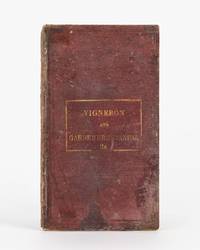
1871144375Adelaide: The Author and 'Sold by All Booksellers' 1871. 2nd Edition. Hardcover. Adelaide The Author and 'Sold by All Booksellers' 1871 second edition revised and enlarged/ 1843. Duodecimo 180 × 106 mm viii last blank 134 23 advertising section including the rear pastedown pages. Flush-cut plum-coloured cloth with the short title on the front cover in gilt within a gilt frame with a double-line border in blind around the margins; lettering a little indistinct; cloth discoloured and stained and a little worn at the extremities; front joint cracked with the hinge later reinforced with a narrow strip of paper; small light waterstains to the margins of the front endpaper; minor signs of age and use including an annotation in red ballpoint at the foot of the title page 'First published 1843'; notwithstanding this is a very presentable copy of a book designed to be used in the field. See Crittenden 12 for mention of this revised edition of only 'the fourth in the line of Australian gardening books'. McEwin notes in his preface to this edition the addition of a chapter on the 'Formation of the Flower Garden and Shrubbery with Monthly Calendar of operations' calendars are now also included 'for the Vineyard Fruit Garden and Kitchen Garden. There has also been added to the catalogues of fruits and vegetables a list of the most esteemed varieties of each . An Appendix has also been added on Fruit-drying'. [The Author] (and 'Sold by All Booksellers') hardcover
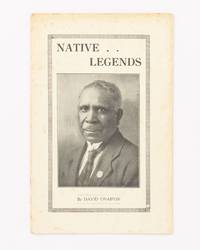
1929138109Adelaide: Hunkin Ellis & King Printers and Publishers Pirie Street 1929. First Edition. Paperback. Very Good. Adelaide Hunkin Ellis & King Printers and Publishers Pirie Street first published 1929; suggested third issue with minor differences as detailed below. Octavo 16 pages with 2 illustrations from photographs on pages 6 and 12; the colophon at the foot of the last page states 'Hunkin Ellis and King Ltd. Printers Pirie Street Adelaide'. Pale green wrappers with a portrait of the author on the front cover plus text on the inside rear cover 'An Aboriginal Pleads for His Race' by David Unaipon; wrappers foxed and lightly used with the spine expertly stabilised on the inside; unrelated text written in ink on the blank outside rear cover and in the blank bottom quarter of the last page quoting Sir Stanton Hicks on soil health; overall a very good copy. This is claimed - incorrectly - to be the first book by an Aboriginal Australian see Michael Richards: 'People Print and Paper. A Catalogue of a Travelling Exhibition celebrating the Books of Australia 1788-1988' National Library of Australia 1988 - item 48 with 1929 as the date of publication. Both the Australian National Bibliography and Greenway are unclear confused and confusing on this point but a review copy with this date in Sir Will Sowden's hand has been sighted and that should settle it. Variant issues of both the first and later editions of this seminal work exist: obvious changes to this edition include the page count commencing with the first page and not the second; the removal of the lizard illustration from the fourth page and the addition of the text on the inside rear cover. Subtle changes indicate that the book was partially reset: these include the variant colophon on the last page the Pirie Street address no longer includes the number 113; a variant font for the captions; and variant spacings between the headings and text. <p>It is worth enumerating the other variants we have identified and our suggested order of issue. There are two different cover illustrations: the portrait of the author as with this copy and a portrait of a young Indigenous woman Clara and each appears on at least two variant colour wrappers. In the first issue the outside rear cover carries a small advertisement within a thin border: 'The Narrinyeri Their Customs and Traditions By David Unaipon Is in Course of Preparation'. This advertisement appears to have been removed from all subsequent issues most likely because the proposed publication did not appear under the advertised title and not even under Unaipon's name if it is the book we think it is. In early 1927 after an unfortunate breakdown in communications between David Unaipon and Angus and Robertson the publishers sold the copyright of Unaipon's manuscript 'Legendary Tales of the Australian Aborigines' to Dr William Ramsay Smith. In 1930 in a slightly edited form not least with Smith now claiming full authorship the manuscript was published in London as 'Myths and Legends of the Australian Aboriginals'. The full account of this unhappy story was published in 'Legendary Tales of the Australian Aborigines' edited by Stephen Muecke and Adam Shoemaker Miegunyah Press 2001. <p>What we believe to be the second issue contains two rather than three illustrations to the text the lizard illustration from the fourth page is removed; the printer's street number 113 and the name of the city are lacking from the colophon; and there is no advertisement on the rear cover. The third issue as in the present copy is similar to the second but can be distinguished by corrected pagination the page count commences with the first page and not the second; another variant colophon with 'and' instead of an ampersand and Adelaide reintroduced; captions set in different type; and the addition of text to the inside rear cover 'An Aboriginal Pleads for His Race'. Hunkin, Ellis & King, Printers and Publishers, Pirie Street paperback
19203La Trobe's letter from Clapham House Lewes Worcester; 26 December 1870. Harington's from Whitbourne Court Worcester; 29 May 1872. La Trobe took up the lease of Whitbourne Court in 1858; Clapham House was his final residence and place of death. The recipient of this letter was the future twelfth baronet. His father the eleventh baronet had married the daughter of the local vicar Robert Biscoe in 1860 and would purchase Whitbourne Court in 1877. La Trobe had made Whitbourne Court his home on return from Australia no dounbt leading to the acquaintance of these parties.ONE: Letter from La Trobe to Richard Harington 1861-1931 the future twelfth baronet written on account of his blindness by a secretary possibly his daughter Nelly who often performed this role. 3pp. 12mo. Bifolium with mourning border. In fair condition on lightly-aged paper. A touching letter beginning: 'My dear Dicky for tho' I am told you are now a schoolboy & mean to be a “man†you will remain my Dicky to the end of the world. I wish to send you a little remembrance but find that my bookseller cannot supply all I had selected as some books are out of print.' He says a little more on this present before continuing: 'Give my love & the good wishes of every member of my family to your father & mother & little brothers & assurances of our constant remembrance. I am too old to make or to wish to make new friends and I cling to the remembrance of the past. I wish I could tell your mother how constantly my thoughts & sympathies are with the dear family to which she belongs but I really hardly have heart to write to any one of them lately.' The letter signs off but not with La Trobe's signature 'Ever dear Dicky your affte old friend C. J. La Trobe'. TWO: Letter to the same recipient from his father Sir Richard Harington 1835-1911 eleventh baronet. 4pp. 12mo. Bifolium with mourning border. In fair condition on lightly-aged paper. The letter contains the following brief reference to La Trobe: 'Mr. La Trobe is staying at Broadwas: he dined with us on Monday night & asked after you.' Other topics include: the son's gift of 'a very nice artificial minnow' Bobby's whooping cough a present for Charly and presents of stamps from uncles Vincent and Henry. From the Harington family papers. La Trobe's letter from Clapham House, Lewes, Worcester; 26 December 1870. Harington's from Whitbourne Court, Worcester; 29 May 1 unknown
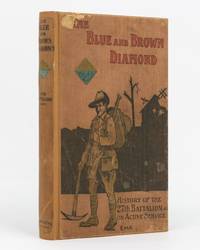
1921129501Adelaide: Lonnen & Cope 1921. First Edition. Hardcover. Very Good. Adelaide Lonnen & Cope 1921. Octavo 228 pages with 12 illustrations and 16 maps plus 13 pages of plates and the printed front endpaper. Expertly rebound retaining the colour-pictorial cloth now cut into three panels and mounted on the new matching plain cloth with replacement endpapers closely matched in colour with the front one a photocopy of the original printed version; slight blemishes to the retained original cloth; acidic text paper tanned as ever; top corner tip of most leaves rounded off; a tear across one leaf expertly sealed; small and inoffensive stains and tears to some leading margins; minor signs of age and use; overall a very good copy of a book notoriously difficult to find in halfway decent condition because of the poor quality of the materials used in its production. Provenance: 2280 Corporal Victor Clarence Sidney McGrath a member of the battalion with his ownership details written in ballpoint pen on the title page. <p>Dornbusch 310; Fielding and O'Neill page 227; Trigellis-Smith 226. Lonnen & Cope hardcover
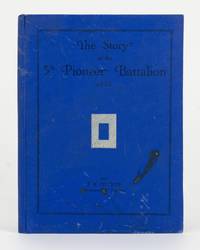
1937144807Adelaide: The Collotype Co. Commercial Printers for the Adelaide 5th Pioneer Reunion Club 1937. First Edition. Hardcover. Very Good. Adelaide The Collotype Co. Commercial Printers for the Adelaide 5th Pioneer Reunion Club 1937. Quarto 116 pages with 19 full-page plates plus 2 folding maps. Blue cloth lettered in black on the front cover along with the battalion's colour patch a rectangle white around purple - here blue; cloth a little stained and marked; a very good copy internally fine. The book includes a five-page Honor Roll and a preface by Lieutenant-Colonel Herbert Gordon Carter DSO 1885-1963 the Battalion's Commanding Officer from August 1916 to the end of the war. The editor was 'late Sergeant "D" Company'. He states in the introductory paragraph to his foreword that he is 'keenly sensible of the fact that probably a book three times larger could have been written had it been possible to get in touch with the men of the Battalion who were in a position to know well the activities of their various Companies. <p>The story such as it is is correct as to salient facts and this is entirely owing to the fact that Colonel Carter soon after his return to Australia wrote a complete Diary of the Battalion's movements and operations from the early days in Egypt to the Armistice'. Herbert Gordon Carter was a very interesting man: consult the 'Australian Dictionary of Biography'. <p>Dornbusch 338; Fielding and O'Neill page 235; Trigellis-Smith 303. The Collotype Co., Commercial Printers [for the Adelaide 5th Pioneer Reunion Club] hardcover
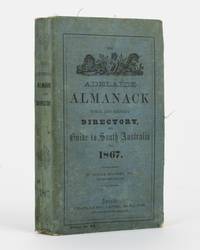
1866144419Adelaide: C. Platts E.S. Wigg J. Howell and W.C. Rigby 1866. First Edition. Hardcover. Very Good. Adelaide C. Platts E.S. Wigg J. Howell and W.C. Rigby 1866. Duodecimo ii viii including the index to the Almanack 128 iv index to the Directory 122 vi index to the South Australian Almanac sic and Directory Advertiser 70 70a-71a 71-98 98a-99a 99-144 pages plus advertising on the pastedowns. Some of the advertisements contain woodcut illustrations; the two 'a' leaves and an adjacent one in each case are printed on orange paper. Flush-cut blue cloth with the full title page details repeated on the front cover and advertising on the rear one; cloth a little mottled and marked with minimal fraying at the edges; trifling signs of age and use; a very good copy. The very large oval blindstamp of 'Howell Bookseller Rundle Street Adelaide' appears at the head of the first leaf of the first index. C. Platts, E.S. Wigg, J. Howell, and W.C. Rigby hardcover
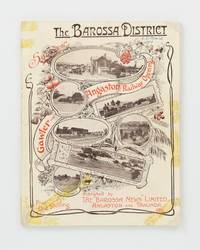
1911144775Angaston: 'Barossa News' Limited printed by Hussey and Gillingham Adelaide 1911. First Edition. Paperback. Very Good. Angaston 'Barossa News' Limited printed by Hussey and Gillingham Adelaide 1911. Quarto 120 pages extensively illustrated including many pictorial advertisements. Three-colour pictorial title-wrappers with additional advertising on the other three surfaces; expert conservation to the wrappers small chips infilled and discoloured tape removed albeit leaving behind some stains; later ownership name on the front cover; minimal signs of age and use elsewhere; overall in very good condition. A very rare item of local history with content that is far more substantial than its title suggests: for example there are thirteen pages of well-illustrated text devoted to the fruit and vine industries. 'Barossa News' Limited (printed by Hussey and Gillingham, Adelaide) paperback
1881136694Adelaide: E. Spiller Government Printer 1881. First Edition. Hardcover. Very Good. Adelaide E. Spiller Government Printer 1881. Quarto 8 pages last blank and 52 separately-paginated Acts in all approximately 500 pages. Contemporary full morocco; spine tooled in gilt; front cover extensively stamped in gilt with the design repeated in blind on the rear cover; all edges gilt and lightly marked; slight wear to the extremities now expertly conserved; marbled endpapers and adjacent leaves a little creased and marked; paper a little tanned; trifling signs of age and use; in excellent condition. The elaborate binding was likely executed by Emanuel Spiller the South Australian Government Printer at the time. Spiller's name appears as exhibitor and jury-member of competitions and exhibitions of binding and printing throughout the 1880s. The 'Sydney Mail and New South Wales Advertiser' for 27 March 1880 carries a lengthy article by John Plummer on colonial bookbindings displayed at the Sydney International Exhibition noting that '. in the South Australian Court Mr. E. Spiller the Government printer of Adelaide occupies the foremost rank'. <p>Although offered primarily as a fine example of colonial binding the Acts contained in this volume numbers 196 to 238 as well as nine Private Acts are not without interest. There are numerous railways and tramways acts as well as acts on subjects as diverse as Chinese immigration the Adelaide Synagogue mining inebriates and the substantial 'No. 237. Marine Board and Navigation Act' 143 pages. E. Spiller, Government Printer hardcover
110463The photographs are a little uniformly faded with some unobtrusive tiny dark spots and minimal silvering-out; they are attractively presented in the original wooden frame with a gilt fillet behind the glass. The frame is lightly scuffed in places; it has a new hanging wire and backing tape but retains the original framer's label on the verso 'From K. Cameron Picture Framer and Mount Cutter Leigh St. Adelaide'. Two of these images heavily cropped to show only the horse were reproduced in 'The Observer' Adelaide 24 June 1905. The photographer is not identified. The Suffolk is a breed of draught horse nicknamed Punch because of its stocky appearance and power Hendricks: 'International Encyclopedia of Horse Breeds' 2007. unknown
100633A gelatin silver photograph 218 × 294 mm laid down as issued on the original printed mount of the photographer 'E. Ziegler 40 Elizabeth St Norwood' Ernest Charles Victor Ziegler active 1879-1925. The photograph and mount are in superb condition behind glass in the original frame. 'The Advertiser' 11 December 1931 sets the scene for these Inter-Collegiate matches: 'Today the annual cricket match between St Peter's and Prince Alfred Colleges will begin at the Adelaide Oval. Last year the game was played at Prince Alfred College the first time in the history of the matches first played in 1878 that the Adelaide Oval was not available. The match is one of the most important cricket events outside first-class matches in South Australia although in recent years it has failed to sic the importance and drawing power of inter-collegiate matches played before the war. Many famous cricketers have graduated from the college teams'. <p>The 1910 SPSC team - victorious to the tune of 232 runs - was no exception; sitting next to each other are C.E. Pellew and Vice-Captain A.G. Moyes. 'Nip' Pellew played for South Australia 1913-14 to 1928-29 the AIF Touring XI 1919 to 1919-20 and Australia ten Tests in 1920-21. Johnny Moyes a 'promising young cricketer . had represented 1912-15 South Australia making a century on debut been chosen 1914 for Australia in a tour cancelled due to World War I against South Africa and played for Victoria in 1920. In Sydney he achieved one of the highest individual scores in grade cricket when he made 218 runs in 83 minutes for the Gordon District Cricket Club in 1922. he served as a New South Wales selector 1926-27 and wanted Sir Donald Bradman to play for the State' 'Australian Dictionary of Biography'. For many years he worked as a journalist including fifteen years as sporting editor of 'The Sun' and he published thirteen books on cricket. In 1949 he began 'broadcasting sporting sessions for the Australian Broadcasting Commission. In 1950-51 he covered his first Test series against England. In 1955 he received a full-time contract. As a cricket broadcaster he became a household name in Australia and New Zealand in the 1950s and early 1960s' ADB. unknown
105467Very Good. Image size approximately 325 × 263 mm on the original ruled mount visible surface 430 × 365 mm framed and glazed. The photograph is beginning to lift slightly at two corners; mount slightly soiled at one corner; frame a little scuffed and marked; overall in excellent condition. On the reverse is the paper label of 'S. Solomon Photographer 51 Rundle Street Adelaide'. The address the original of which was illustrated and illuminated by W.G.P. Joyner gives an indication of the scale and importance of Dunn's enterprises: '. by your perseverance energy and strict integrity you have overcome all obstacles and today you have the satisfaction of leaving to your successors the largest milling and wheat business in the Southern Hemisphere'. <p>An article in the 'South Australian Chronicle' for 8 June 1889 describes the circumstances of the presentation of the address and also describes the original in detail. 'The address is the work of Mr. Joyner and is one of his most artistic productions . The words and the signatures which number 105 being those of most of the leading employés are situated in the centre while all around are well executed paintings of a number of the mills belonging to the firm taken from photographs. In the left-hand corner there is a painting of the site of the original mill at Hay Valley . On the top are Mr. Dunn's residence at Mount Barker 'The Laurels' and the Dunn Memorial Church which that gentleman presented to the residents of Mount Barker while the right hand corner is occupied by a view of the firm's stores and offices in Freeman-street Adelaide now Gawler Place. On the left side of the address there are views of the mills at Wilmington the old mill at Port Adelaide and at Mount Barker and two representations of the new Roller Eclipse mill at Port Adelaide. On the other side the Nairne mill takes precedence while underneath it is the gem of the collection the works at Port Pirie including some of the shipping of the port with the railway in front. The Port Augusta and Bridgewater mills are represented and an excellent portrait of Mr. Dunn is also included in the set.' <p>A number of the source photographs are to be found in a Dunn family photograph album now held by the State Library of South Australia PRG 1485/3. Dunn's entry in the 'Australian Dictionary of Biography' records that 'he retired in 1889 and died at Mount Barker on 13 October 1894. The firm's eleven mills five with the most modern machinery then represented an investment of £150000. They annually had an export trade of some 20000 tons of flour to Britain Western Australia New South Wales and South Africa some 400 employees and a payment to farmers of £500000'. unknown
1861100535London: George Philip 1861. First Edition. Hardcover. Fine. London George Philip late 1861. A full-colour map printed surface 610 × 510 mm cut into 20 panels mounted on linen as issued folded and mounted in the publisher's gilt-decorated cloth case external dimensions 190 × 118 mm. Slight wear to the corners of the case with minimal restoration to the spine; light erasures to the pastedown and paper-lined verso of the exposed panel of the folded map; the map is lightly marked in one spot but is essentially in fine condition. There are two interesting rubber-stamps on one cloth panel that of 'W.C. Rigby Newsagent Adelaide' and 'Archiv. Provinciae Austriae S. J.'; the erasures mentioned above appear to have removed a couple of examples of the Jesuit Archive stamp. Philips' Authentic Maps of the Australian Colonies Number 6 according to the information printed on the front pastedown. Tooley 974 basic details of the map only not noting the Travelling Maps series. Pertinent details printed on the map that provide evidence of the date of publication include 'Burke & Wills 1860-61' and the locations where King and the bodies of Gray Burke and Wills were found King was found in September 1861. The latest reference to Stuart is 'Stuart's Route 1860' presumably his fifth expedition from November 1860 to September 1861. The entire region of South Australia west of about 133 degrees east longitude and north of the coastline is described as 'Unexplored Country added to South Australia in 1861'; the Act to annex this land was passed in Great Britain in August 1861. Historians of Australian bookselling will know that William Charles Rigby commenced trading as a bookseller and newsagent in Adelaide in late 1859. George Philip hardcover
1874115996Adelaide: James Heath Lewis Printer first conference and Wesleyan Book Depot all other conferences 1874. First Edition. Hardcover. Very Good. Adelaide James Heath Lewis Printer first conference and Wesleyan Book Depot all other conferences 1874 to 1886. Octavo 13 issues ranging from 32 to 90 pages the first and the last conferences but generally 50-60 pages each. Contemporary binder's cloth all edges speckled; title in gilt on the spine with the year of publication neatly inked on the leading edge of each issue; small and much later ownership details on the first title page; in excellent condition. Trove indicates that the only institutional holdings of any copies are the first three issues in the State Library of South Australia. James Heath Lewis, Printer (first conference), and Wesleyan Book Depot (all other conferences) hardcover
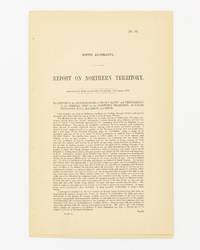
187358350Adelaide: Government Printer 1873. Fine. Adelaide Government Printer 1873. Foolscap folio 10 pages. Drop-title; four small holes in the left-hand margins where stab-sewn when bound now neatly disbound; essentially a fine copy. South Australian Parliamentary Paper Number 55 of 1873. Reynolds was away for approximately fifteen weeks and his report is full of matters pertinent to his portfolio - land its uses and people to use it. 'Any person visiting these islands who considers the number of their inhabitants the peculiar adaptability of the people for tropical and semi-tropical lands their habits their general industry the rapid increase of population in these islands - which threatens ere long to burst through its present geographical limits . then takes up the map of Australia and especially that portion our Northern Territory - can draw no other inference but that Nature and Providence combine to show that the Northern Territory of Australia is destined to become by its striking geographical position the point where the superabundant population of those islands may find a foothold and a home where millions of acres wait for the occupancy of a race just adapted to their special wants'. <p>He spent from 17 May to 11 June in the Northern Territory and got stuck into things - and people - and recommended that the entire control of the Territory be 'under one experienced responsible head'. However something struck a chord with him; shortly after he returned to Adelaide he resigned from his position and 'Attracted by business opportunities in the Territory he went back and opened a store. This was not successful and in February 1875 he and his wife embarked on SS "Gothenburg" for the return journey to Adelaide - and went down with the ship off the Queensland coast' 'Northern Territory Dictionary of Biography' Volume 1. Government Printer unknown
101124The photograph is mounted behind an oval blood-red matt gilded on the bevelled edge visible image size 365 × 260 mm; these are surmounted by a second matt with an attractively scalloped inner edge. It is behind glass in an impressive vintage wooden frame - almost certainly of huon pine 80 mm wide - with a very ornate gilt fillet above the glass. The external dimensions are 680 × 555 mm; the visible surface of the glass is 490 × 360 mm. Opalotypes also called opaltypes and 'milk glass positives' are photographs printed on sheets of opaque translucent white glass. The process was patented in 1857 and although it survived until the 1920s this portrait from the later nineteenth century would have to be considered a very fine example of its type. It is also a credit to both the artistry of the photographer and the craftsmanship of the picture-framer neither of whom are identified. The item was purchased in Adelaide so it is highly likely the subject photographer and framer were local. unknown
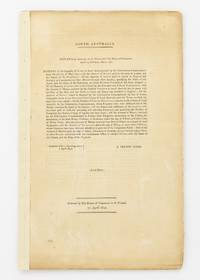
1841110034London: Richard Clay Printer 1841. First Edition. Hardcover. Very Good. London Richard Clay Printer 1841. Octavo 5 6-27 1 blank pages the title page contains just the words 'South Australia' with the imprint details on the verso. Later half morocco and marbled papered boards with a contrasting leather title-label on the spine top edge gilt marbled endpapers; covers lightly rubbed with the marbled paper a little unevenly discoloured; title page a little dusty with some light pencilling author date binder's instructions and a tiny sealed tear to the leading edge; bottom corner of the last leaf a little creased with trifling loss to the corner-tip; a very good copy. Correspondence and evidence before a Select Committee of the House of Commons on the affairs of South Australia relating to 'the dismissal by Her Majesty upon the recommendation of Lord John Russell of the original South Australian Commissioners on the 23rd of December 1839 who had been giving their gratuitous services to the public from the 5th of May 1835 up to that time and the appointment of three friends of his own in their places with salaries of £1000 per annum each' from the preamble. Ferguson 3272. Richard Clay, Printer hardcover
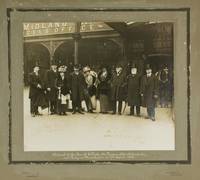
1913114191Manchester: Mack & Co. Photographers 1913. Very Good. Manchester Mack & Co. Photographers 1913. A gelatin silver photograph image size 240 × 283 mm on the original mount external dimensions 375 × 455 mm; the caption is in white ink in a calligraphic hand below the image; the details of the photographic studio are printed below an embossed printed border. The mount is a little rubbed and worn at the extremities with a small sealed crack to one margin; there is minor surface damage to the mount well clear of the image and caption where an old window mat has been removed; the photograph has a few tiny surface blemishes near the bottom edge but overall in excellent condition. At the time Archibald Henry Peake 1859-1920 was the Premier of South Australia a position he held on three occasions 1909-1910 1912-1915 and 1917-1920. He died in office on 6 April 1920. In 1912 'the Liberals won an eight-seat majority . Peake again became premier treasurer and minister of education. His government concentrated on constructing rural railway lines often against expert advice. Most proved uneconomic impoverishing the railways for years. In 1912 the government created the Industrial Arbitration Court; in return for the introduction by it of a minimum wage workers lost the right to strike or to engage in any activity which might prolong a strike. Six o'clock closing of hotels was carried at a plebiscite simultaneously with the 1915 election and remained for over fifty years. Peake's government liberalized the franchise for the Legislative Council. In London in 1913 Peake had an audience with King George V and recorded his experiences in "Notes from a Diary" 1914. The ministry's major achievement was its arrangement in 1914 with the Federal New South Wales and Victorian governments for the locking of the Murray River: the River Murray Commission carried out the co-ordinating agreement' 'Australian Dictionary of Biography'. The nature of this item and the fact that we purchased it with other photographs identified as such suggest strongly that it was originally in the possession of Peake himself. Mack & Co. [Photographers] unknown
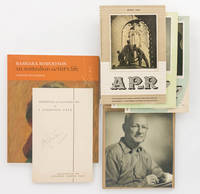
194886817Adelaide: Adelaide Camera Club 1948. Very Good. Adelaide Adelaide Camera Club 1948. Tall octavo 4 pages a bifolium printed on card listing all 159 photographs in the exhibition; the front cover is signed in pencil by the photographer. Small light crease to the bottom corners; trifling surface loss to the rear page; in excellent condition. The exhibition of work by the Adelaide photographer Eric Robertson 1889-1955 ran from 17-27 February 1948. Offered together with an album approximately 190 × 235 mm containing related photographs: a large portrait of Robinson 14 interesting snapshots of scenes at the exhibition six examples of Robinson's work and a review cutting. <p>Also present are three copies of 'The Australasian Photo-Review' April 1947 April 1948 and October 1948; all three contain articles and reproductions of photographs by Robertson. In particular the October 1948 issue contains 13 reproductions from this exhibition and a three-page article about the images by Robertson. A copy of the biography of Eric Robertson's daughter 'Barbara Robertson. An Australian Artist's Life' by Lorraine McLoughlin 2009 is also included; it contains relevant family history. 6 items. Adelaide Camera Club unknown
98784An attractive calligraphic testimonial visible image size 390 × 260 mm in blue ink on a two-tone blue background within a decorative gilt border was signed by nine senior members of the congregation and presented to the outgoing Honorary Secretary. It is surmounted by a large ornamental scroll a mass of wattle blossom and a large vignette illustration of a paddle steamer towing a heavily-laden barge on the River Murray. The copious amounts of dirty smoke belching forth are starkly realistic - an unexpected bonus on an otherwise routine production. The work is signed 'Niehuus & Lucy Adelaide'; we are unsure when they commenced work together but the partnership was dissolved four months after this commission was completed. Minimal foxing and light surface blemishes do not detract from this charming period piece recently mounted and matted ready for framing. unknown
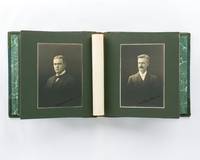
1919108343Adelaide 1919. First Edition. Hardcover. Very Good. Adelaide circa 1919. A custom-made photograph album 190 × 200 mm containing 6 card leaves with an original gelatin silver photograph mounted on both sides of each leaf with interleaved tissue-guards. Each photograph is approximately 135 × 95 mm. Half leather and cloth lettered in full in gilt on the front cover with 'The Eucalypts' in gilt on the spine; leather discoloured and moderately rubbed with slight wear in a few areas; some tiny paint spots near the head of the front cover; tissue-guards a little foxed and offset; marginal silvering-out to five prints; overall in very good condition. All but the first portrait is signed and only the last one contains an additional inscription the date '10.1.19'. The State Library of South Australia has another example of this album enabling us to confirm the identities where the handwriting was unclear. Ministers of religion lawyers doctors and architects predominate. The subjects are Reverend A.H. Gifford possibly A.E. Gifford; Benjamin Benny 1869-1935 senator and solicitor; George McEwin 1873-1945 lawyer and philanthropist; Edward Erskine Cleland 1869-1943 barrister and judge; Alfred McBain Bonython 1865-1954 architect; Sir James Wallace Sandford 1879-1958 merchant and politician; Reverend Wilfred Harris Unitarian minister returned to England in 1918; Dr Herbert Frank Shorney 1878-1933 opthalmologist; Sir Thomas John Mellis Napier 1882-1976 later a SA Supreme Court judge; Harold Reid; Edward Warner Benham 1872-1948 lawyer and academic; and Francis Hedley Counsell 1864-1933 architect. <p>The subtitle is a misquote from 'Among the Sandhills' by Adela Florence Nicolson née Cory 1865-1904 an English poet who wrote under the pseudonym Laurence Hope 'The scented orange bushes check the breeze Granting in tribute many waxen stars And aromatic Eucalyptus trees Defy the sun with grey-green scimitars'. We have saved the best until the end: we purchased this item decades ago and have postponed cataloguing it innumerable times not knowing who 'The Eucalypts' were. We have finally solved the puzzle by the simple expedient of spending untold hours on it. We eventually discovered the lengthy biographical sketch of Alfred Bonython compiled by Giles Walkley for the University of SA's database on architects accessible online. Among many other interesting details he records that 'At the age of 42 Bonython became the father of a fourth daughter . Determinedly reviving his literary activities he joined both at their outset in 1910 Lady Symon's Poetry Society and the "liberal Christian" discussion group The Eucalypts Club . SRG 252'. hardcover
1840131291London: 'Ordered by the House of Commons to be Printed' 1840. Very Good. London 'Ordered by the House of Commons to be Printed' 10 April 1840. Foolscap folio 32 pages last one a docket with numerous tables and lists. Sewn as issued the thread recently renewed and now holding a place a piece of archival paper protecting the spine; all edges uncut; first and last pages unevenly tanned and lightly foxed; leading edge of the first leaf lightly chipped; light tidemark to the top and bottom margins of four consecutive leaves; a very good copy. Great Britain and Ireland Parliamentary Paper Number 223 of 1840. The full title runs to 23 lines enumerating ten separate returns. 'Contains valuable information with respect to many South Australian subjects' Ferguson but the perennial value of this paper is the headline one which runs to eleven pages. Its complete title is 'A Return of the Quantity of Land in South Australia sold by the Colonization Commissioners since the 5th day of May 1835:- Of the Amount of Money paid for the same in London and the Names of the Purchasers:- Of the Amount of Money paid to Agents in England and Scotland as Commission on Sales effected through their Agency specifying the Name of the Agent and the Name of the Purchaser on whose Purchase Commission has been charged'. Ferguson 3002. 'Ordered, by the House of Commons, to be Printed' unknown
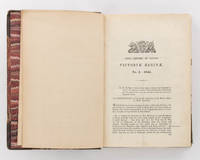
184413685Adelaide: various Government Printers or Printers acting under Authority 1844. Hardcover. Very Good. Adelaide various Government Printers or Printers acting under Authority 1844 to 1848 or possibly early 1849. Quarto each Act or Ordinance separately paginated totalling several hundred pages. Contemporary half leather and marbled papered boards a little rubbed and worn at the extremities; some later pencilled annotations; internally in excellent condition. The balance of the volume contains another 65 separate Acts or Ordinances: 1845 17 items; 1846 17 items; 1847 19 items plus the title page and index leaf; and 1848 12 items plus the title page and index leaf. Not least Ordinance Number 8 of 1844 with an Amendment Number 5 of 1846: 'To allow the Aboriginal Inhabitants of South Australia and the parts adjacent to give Information and Evidence without the Sanction of an Oath'. <p>Other ordinances of interest include 'To Establish a Savings Bank in South Australia to Provide for the Management thereof and for the Security of Deposits therein' Number 15 of 1847 and its Amendment Number 13 of 1848; 'For the Naturalization of certain Persons Natives of Germany' only Messrs Meyer Klose Teichelmann and Schuermann in 1845; in 1847 the list contained 309 names with addresses and occupations; 'Authorising the making of Railways' Number 7 of 1847 in 68 pages; plus miscellaneous business as usual Scab in Sheep; Laws of Customs; Salary of the Governor; Qualifications of Medical Practitioners . <p>Provenance: the Adelaide lawyer Romilly Garveth Harry 1907-1981 with his ex libris name-plate on the front pastedown; 'Shierlaw & Jessop Solicitors Adelaide' is written in ink on the front flyleaf. various Government Printers (or Printers acting under Authority) hardcover
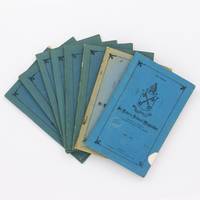
1914131663Adelaide: W.K. Thomas & Co. Printers 1914. First Edition. Paperback. Very Good. Adelaide W.K. Thomas & Co. Printers 1914 to 1919. Octavo eight issues ranging between 48 and 80 pages plus plates in some of them. Several of the plates reproduce photographs relating to Australians in the war including a folding panorama of North Beach Anzac and several snapshots taken in the field. Title-wrappers slightly worn and marked and two issues have minimal expert conservation; minor signs of age and use but overall in very good condition. Spanning the First World War this run offers powerful insights into the effects of the war on the school community. Among the usual sporting fixtures and school news are first-hand accounts of important actions sent back to Australia by 'old boys' on active service and numerous short obituaries. Recurring sections include a nominal roll of former pupils in uniform details of their awards and medals and an ever-growing roll of the wounded missing and killed. Particularly noteworthy are accounts of: 1 The Gallipoli landings from several soldiers; 2 The Battle of Cocos; 3 Light Horse actions in the Palestine; 4 Naval actions in the Persian Gulf; and 5 Trench warfare on the Western Front. The names of decorated old scholars appear regularly including Arthur Blackburn VC. <p>The ties of the Old School seem to have been strong even on the battlefield. In the obituary for Lieutenant Eric W. Talbot 10th Battalion it is noted that 'On April 24th 1915 the night before the landing he sat with Col. Price Weir who made use of his draughtsmanship to prepare the landing plans. In the attack at dawn he first had command of scouts and being allowed to choose his men he selected a team entirely of old "Saints"' Number 90 page 61. <p>The issues present in this run are Number 86 May 1914 Number 90 August 1915 Number 92 August 1916 Number 94 May 1917 Number 95 August 1917 Number 98 August 1918 Number 101 September 1919 and Number 102 December 1919. Offered with them is the 'Programme of the Annual Sports held on the School Oval on Saturday April 29th 1916' small octavo 19 pages; a little marked. 9 items. W.K. Thomas & Co., Printers paperback
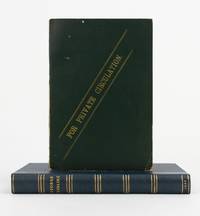
1889139653London: G.E. Waters 1889. Paperback. Very Good. London G.E. Waters 1889 first thus. Duodecimo 43 pages plus a frontispiece with tissue-guard. Original flush-cut dark blue card covers lettered in gilt 'For Private Circulation' diagonally across the front cover; all edges gilt; covers rubbed with minimal wear at the extremities and slightly creased at the front bottom corner; biographical details of Tinline in ballpoint pen on the front free endpaper; scattered light foxing; an excellent copy of a very rare ephemeral production now housed in a fine quarter morocco clamshell case lettered and decorated in gilt on the spine 'George Tinline'. The text is an extract from the 'South Australian Register' of Thursday 7 April 1853 and records the testimonial dinner two days earlier for George Tinline 'in recognition of his work in the financial crisis of 1850-52 . In October 1851 thousands of South Australian men left their jobs to try their luck in the Victorian goldfields severely bankrupting the state of its labour and coinage. In order to avoid financial disaster Acting Manager of the South Australian Banking Company George Tinline 1815-1895 proposed the establishment of the South Australian Assay Office which was to pay more per ounce for gold than any other colony in Australia outbidding Melbourne for Victorian gold. This plan was executed in conjunction with the Bullion Act of 1852 which enabled banks to exchange gold bullion for hand notes at a fixed value. This meant that gold ingots were worth 72 shillings per ounce in South Australia compared to 58-60 shillings in Melbourne. This difference was worth the gold diggers while and soon gold flowed from diggers and dealers to the Adelaide market the devalued currency ensuring a roaring export trade with Victoria and the success the Bank of South Australia. In honour of his crucial work and imaginative efforts in maintaining credit and preventing the financial collapse in the colony of South Australia Tinline was presented with the silver salver. At a private dinner attended by 200 notables Chairman George Elder expressed that the colony was indebted to Mr. Tinline proclaiming him a faithful steward of South Australia. In addition to the inscribed salver he was given 2000 guineas the text in fact records a cheque for £2500; and was awarded £1000 by the London directors. The salver itself was made by Hunt & Roskell silversmiths and jewellers to the Queen for a significant sum £210 for a full service including the salver . The salver is divided into three illustrated segments which narrate the story of George Tinline and the financial crisis of 1851-53. The first shows the farm labourers heading for the Victorian gold fields taking with them some useful tools. The second shows George Tinline presenting the Governor with the Bullion Act who then signs it. Finally the third shows the welcome given to the gold escort arrival and the weighing of the gold at the diggings' History Trust of South Australia catalogue record for the Tinline Salver now in their collection. The frontispiece is an image of the salver. <p>Ferguson 17183a. G.E. Waters paperback