3 315 résultats
140947Sydney Ure Smith Publication 1963-1973. c70pp. ea. 4to. 10 volumes encased in button sealed board envelopes. Each containing numbers 1-4 corresponding with each year ranging from 1963-1964 to 1972-1973. Button missing from Vol. 9. Colour and b&w illustrations throughout some general wear. Otherwise a very good copy. 10 Vols. in publishers cases very scarce. Sydney, Ure Smith Publication 1963-1973. unknown
217882Sydney 1925. 4to. c. 100pp. Tipped-in colour and b/w plates. Original stiff wrappers with dustwrapper. A very good copy. Detailed description available on application. Includes Hardy Wilson and Margaret Preston. Sydney, 1925. unknown
217865Sydney 1922. 4to. c. 100pp. Tipped-in colour and b/w plates. Original stiff wrappers with dustwrapper. A very good copy. Detailed description available on application. The first of the new series and quite scarce Sydney, 1922. unknown
28873Third Series No 66. John Fairfax & Sons. Sydney. February 1937. 4to 81pp. Cover intact and protected; text in ex cond. Sir Arthur Streeton's recent work articles adverts tipped in plates. Third Series, No 66. John Fairfax & Sons. Sydney. February, 1937. unknown
35666Third Series No 7. John Fairfax & Sons. Sydney. March 1924. 4to non-paginated. Cover very worn text interior in vg cond. 4 tipped in col plates articles by Lionel Lindsay. Third Series, No 7. John Fairfax & Sons. Sydney. March 1924. unknown
38583Third Series No 53. Art in Australia Ltd. Sydney. December 1933. 4to 60pp. Cover in vg cond and protected by clear mylar; text interior in vg cond. Includes "The Works of Louis McCubbin James Fleet." and many interesting contemporary adverts. Third Series, No 53. Art in Australia Ltd. Sydney. December 1933. unknown
37577Third Series No 6. Art in Australia. Sydney. December 1923. 4to. Cover intact and in vg cond. some foxing in text which is in vg cond overall. Commentary by Norman Lindsay reply to Orpen; tipped in frontis and 8 other tipped in plates contemporary adverts. Third Series, No 6. Art in Australia. Sydney. December, 1923. unknown
35667Third Series No 68. John Fairfax & Sons. Sydney. August 1937. 4to 128pp. Cover in vg cond. text interior in vg cond. Also includes "Drawings in Australia by Lionel Lindsay" many interesting contemporary adverts. Third Series, No 68. John Fairfax & Sons. Sydney. August 1937. unknown
41989Tenth Number. Art in Australia Ltd. Sydney. 1921. 4to non-paginated. Stiff paper wraps some splits in yap edges; interior in vg cond. Articles on Macquarie's contributions and other articles adverts 7 tipped in coloured plates and other plates. Tenth Number. Art in Australia Ltd. Sydney. 1921. paperback
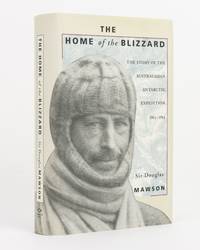
1996141170Kent Town: Wakefield Press in association with the Mawson Antarctic Collection Appeal 1996. Hardcover. Very Good/Very Good. Kent Town Wakefield Press in association with the Mawson Antarctic Collection Appeal 1996 first thus/ 1930 abridged edition/ 1915. Octavo xxxii 438 2 'Mawson Antarctic Collection Appeal' pages with illustrations and maps plus numerous plates reproducing 'over ninety original photographs'. Papered boards; spine slightly canted; top corners a trifle bumped; an excellent copy with the excellent dustwrapper lightly sunned on the spine. Number 129 of only 500 copies in boards. This copy is signed in ink by Mawson's two daughters Patricia Thomas and Jessica McEwin with both signatures dated 1996. Wakefield Press in association with the Mawson Antarctic Collection Appeal hardcover
180219812London: M. Jones 1802. Very good condition. An eagle wings outspread attacking a dog in a beautiful period hand colored copper engraving by V. Woodthorpe from Barrington's 'The History of New South Wales'. The book was very influential in building up the British public's impressions of the New Colony. Slightly marked right edge of print. Closed tear into margin restored from back. Page measures approximately 5 x 8 1/4". OCLC: 220785202. M. Jones unknown
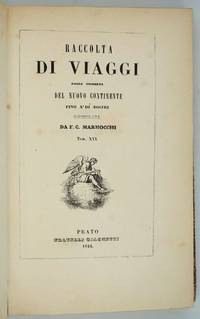
184429219Prato: Tipografia Giachetti 1844. First Italian. Hardcover book. Very good overall. 'The entire volume is devoted to Mitchell's explorations in Australia. One volume of a set of voyages published in Italian by Francesco Marmocchi. Large 8vo 282pp ii frontispiece & 12 plates with illustrations in the text. Attractive publishers vellum spine and marbled boards. Gilt spine labels slt chipped board edges rubbed internally clean plates slt toned. Volume 16 of Australia ID 26206468. Tipografia Giachetti hardcover
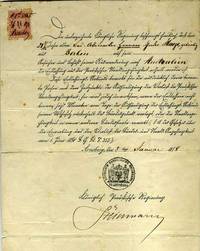
187818730Germany 1878. Very good condition. Printed document with hand inscribed information on the emigrant dated 3rd January 1878 allowing a Prussian citizen to emigrate to Australia. With a red German tax stamp at the upper left and circular Arnsberg government stamp. A few splits at old folds "denationalization" noted in ink on verso otherwise very good condition. 8 1/4 x 13" unknown
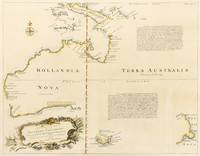
1744133907London: Printed for T. Woodward and others 1744. Very Good. London Printed for T. Woodward and others 1744. A hand-coloured engraved map visible image size 372 × 483 mm recently mounted and matted just outside the printed border using archival materials visible image size 372 × 483 mm external mat size 545 × 643 mm ready for framing or long-term storage in its custom-made Mylar sleeve. A long sealed clean tear to the blank area in the bottom right-hand corner mainly along the crease of the original fold; light central vertical crease; a few small insignificant light marks; in very good condition. The first dedicated English map of Australia originally issued as part of the second edition of John Harris's 'Navigantium atque Itinerantium Bibliotheca or a Complete Collection of Voyages and Travels' London 1744-1748; 'Vol. 1 page 325' is printed in the top right-hand corner. Clancy 'So They Came South' pages 136-37; Clancy 'Mapping of Terra Australis' page 91; Tooley 241: 'A reissue of Thevenot's map of 1663 but with title as above within cartouche bottom right. Bowen inserts the Tropic of Capricorn and two long legends. The first one is very exactly copied from the original . The second legend is a long laudatory account of the presumed riches of Terra Australis'. Printed for T. Woodward (and others) unknown
95220The Radfords were born in Devon emigrated to South Australia in October 1838 and lived in the Barossa Valley from the mid-1840s until their death. From the perceived ages of the subjects these images would appear to date from the 1850s. Other later images of the Radfords are held in the State Library of South Australia. They substantiate the identification and confirm that these daguerreotypes by an anonymous photographer are of rural South Australian origin as the Radfords did not leave the colony after they arrived here in 1838. Both images are in excellent condition with the original brass mats one a little tarnished preservers and glass but uncased as found. Any daguerreotype of Australian origin is rare rural South Australian ones excessively so in our experience. 2 items. unknown
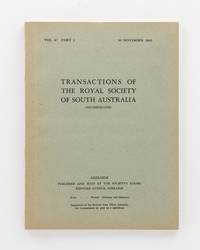
194319591Adelaide: RSSA 1943. First Edition. Paperback. Fine. Adelaide RSSA 1943. Quarto 68 pages with a full-page map after Tindale in a total of ii 175-330 pages with numerous illustrations plus plates. Original printed wrappers; a fine copy. An exhaustive survey based in part on material collected on expeditions 'to Pandi on the lower Diamantina adjacent to the Queensland border in 1934 and the northern Flinders Ranges in 1937' combined with 'much published information . widely scattered in literature. The present paper is an attempt to bring it together under a zoological classification'. It is effectively an annotated thematic bibliography of the area the north-eastern corner of South Australia and environs. This issue also contains COOPER H.M.: An Exceptional Australian Axe-head 2 pages with 3 illustrations plus a full-page plate. Other contributors include Sir Douglas Mawson H.H. Finlayson Constance Eardley and Bernard Cotton. A 25-page companion article by T.H. JOHNSTON and J.B. CLELAND on the flora of basically the same area was published in Part 1 of this volume. Fine copies are available for $55 each. SPECIAL: the two parts are offered together for $165. RSSA paperback
185519819London 1855. Very good overall. Engraved trade advertising letterpress advertising the services of Thomas Beck Wholesale Stationer Engraver Printer Lithographer Die Sinker and Manufacturer of Copying Machines 81 Cheapside Two Doors West of Old Jewry London. A London newspaper advertisement for Thomas Beck Co. appeared in December 1846. With an engraved vignette of dock workers at an English/Australian dock sealing crates marked "Gold" "Tallow" and "Wool" with tall masted ships & a steamship visible in the distance; elaborate engraved borders. Printed on laid paper blank at verso. 4 1/4 x 4 3/4". Slightly marked. unknown
1968213501Canberra.: Australian War Memorial. Reprint. 1968. Black and white maps photographic plates and illustrations xiii 533pp appendix index 24 x 16.5cm. Dustjacket lightly worn now protected overall a very good copy. . Australian War Memorial. unknown
183814492Albany NY 1838. Single issue of a New York newspaper with a long article entitled 'The Canada War' the Canadian Rebellion of 1837-1838 on the outcome of the Battle of Wind Mill Point which was fought by the Hunter Patriots to liberate the colony of Upper Canada from British rule. <br /> <br /> Many of the Patriots led by "a Pole Von Shulz" were captured and sentenced to be transported to Van Diemen's Land apparently 60 in all were convicted and transported to a penal colony. The names of the captured mentioned are William Johnson Johnston Gen. Birge and Capt. Sprague. Thos. J. Sutherland's capture is mentioned at the first page of the article. <br /> <br /> The article begins at page 2 declaring the "utter failure of the revolutionary expedition against Prescott" and measures 17.5 column inches. It continues on to page 3 in 2 columns for another 29 column inches. <br /> <br /> Also with an article on the Mormon War with action in Missouri described ". the instructions to Gen. Clark are to extirpate the whole fraternity of Mormons and drive them beyond the states". Slt. toned and ruffled at right edges; folded horizontally at center and vertically with slt. rubbing at folds; sml damp stain at lower left corner o/w very good. unknown
1880166761880. Four albumen photographs of Sydney all with the Charles Bayliss blind stamp. <br /> Charles Bayliss 1850 - 1897 one of Australia's preeminent landscape photographers who worked for years with Merlin and Holtermann before setting up his own shop in Sydney in 1879. He established his studio at 348 George Street; then moved to 335a George Street advertising himself as a photographer of city and country views often with people and making views to be sold individually while also contributing images for albums. He also made remarkable 360 degree panoramas of the city of Sydney around this time.<br /> These four images are mounted on a page from an album with handwritten captions in black ink. The first photograph "Sydney Harbor NSW" is a view looking over rooftops toward the harbor and tall masted ships moored and docked; and "Sydney Observatory" looking up toward the building from a lower vantage point; both with handwritten labels laid down and with the C. Bayliss stamp at the lower left. On the verso are "Botanical Gardens Sydney" which shows an entrance gate with an open doorway and view into the garden at the right and "Nepean River NSW" with a view across the river to cliffs on the far side are blind stamped at the lower right "C. Bayliss Photo Copyright". Album page 9 x 11 1/2"; each photograph 7 x 4 1/2". Album page chipped at corners; photographs very good condition. unknown
55088The seventeen signatures are Lawry Captain Ian Chappell Connolly Cowper Freeman Gleeson Hawke Inverarity Jarman Joslin Mallett McKenzie Renneberg Redpath Sheahan Taber and Walters. Very slightly creased; a fine copy. unknown
185021187Switzerland 1850. Very good condition. Striking lithograph of the view at Port Jackson of the Sydney Heads taken from the foot of the lighthouse. From a German edition of Dumont D'Urville's 'Voyage Autour du Monde'. A view of the cliffs with ships out to sea and three gentlemen viewers in the lower left foreground one possibly sketching. Paper size 10 1/4 x 6 1/2". Very bright and clean image. unknown
1915134649Sydney: Trustees of the National Art Gallery of NSW 1915. Very Good. Sydney Trustees of the National Art Gallery of NSW 1915. Quarto a portfolio containing 7 plates tipped in on thin gilt-captioned card mounts external dimensions 220 × 285 mm housed in the original glassine sleeve. A portfolio of gilt-lettered dark green paper over thin card a little bowed; extremities a little rubbed with minor wear to the head of the spine; front pastedown unevenly discoloured; overall in excellent condition the contents are fine. The first plate is a photographic view of the Gallery building; the others reproduce paintings by Arthur Burgess George Lambert William Lister Lister Fred Mahony A. de Neuville France and Sir Luke Fildes Britain. The only war-related images are one of the Australian Fleet in 1913 and 'The Defence of Rorke's Drift' from the Zulu War in 1879! Several relics of the day are pinned to the flaps on the rear cover of the portfolio: a large inscribed gum leaf surmounted by the Australian Coat of Arms printed on a small card disc with an attached blue ribbon; a stickpin with a small enamel Australian flag; a flower made out of felt; and a white ribbon tied in a bow with a small piece of red white and blue ribbon around the centre. <p>For the record the Sir John Monash Centre at the Australian National Memorial in France has this to say about Australia Day: 'In 1915 Australia Day was part of a fundraising plan for Australian troops serving in the war to help improve the general living conditions of the soldiers and to enable the Red Cross and other organisations such as the South Australians Soldiers' Fund to provide more comfort and care for injured and ill Australian soldiers. <p>It was the mother of four Australian soldiers Mrs Ellen Wharton-Kirke who suggested the organisation of a national patriotic fundraising day to celebrate Australia's military achievements in the conflict and help improve the lives of Australians serving on the front line. The idea was taken up by the government and the date of the first "Australia Day" was set for 30 July 1915. <p>Three months after the landing of Australian troops in Gallipoli Australian communities took part in Australia Day. During this day marches fairs auctions and performances are organised all over Australia to raise funds for the troops. <p>Commemorative items such as ribbons handkerchiefs badges or matchboxes were made and sold in the streets of Australia. The messages written on these objects appealed to Australian patriotic sentiment and the development of a strong national identity. The day was also an opportunity for those who could not serve to support the troops. <p>In 1915 Australia Day was a success and continued in the subsequent years to support the troops fighting on the frontline. It was not until 1935 that Australia Day became Australia's national holiday and was celebrated on 26 January'. Trustees of the National Art Gallery of NSW unknown
25015'Royal Mint Melbourne Australia / 21 May 1875'. Barton who was born in London joined the Royal Mint’s Melbourne branch as one of two assayers on its opening in 1869; in 1887 he was promoted to Superintendent and in 1895 to Deputy Master holding that position until his reitrement in 1904. See his entry in the Encyclopaedia of Australian Science and Innovation. In case Barton has misspelled the name the recipient may be William Dawson Grubb 1817-1879 or his son Frederick William Grubb 1844-1923 who have a joint-entry in the Australian Dictionary of National Biography. 3pp 12mo. Bifolium. Signed ‘Robert Barton’. In very good condition lightly aged and folded twice for postage. Begins: ‘Dear Grubbe / I met the writer of the enclosed letter not present after you left & he told me that between us we could not have advised you to go to a worse place for the sport you want than Echuca I feel therefore that I have been instrumental although far from my intention in leading you a wild duck chase.’ He has been informed by ‘Singleton’ that ‘there are very few Kangaroo if any near Echuca & the duck are impossible to get near’. He suggests that Grubbe takes the steamer to Albury and proceeds as Singleton directs ‘& you are in a country abounding with Kangaroo & splendid duck shooting’. Barton is enclosing a note from his friend ‘to his brother who is managing the “Walla Walla†station’ and whom Grubbe will find ‘a very decent fellow. He is a batchelor sic I believe living in a large house. Ask at Albury if you are anywhere near Tumbarumba Caves because if so they are one of the finest sights of the Colonies.’ Barton wishes he had known this information before Grubbe left ‘as then you might have gone to Albury via the new line but if you elect to go from Echuca you will at all events see the river Murray’. 'Royal Mint [Melbourne, Australia] / 21 May 1875'. unknown
192760008Sydney NSW; Hobart Tasmania & New York: Beatties Studio; Photographers Photo Service ca. 1927-1934. Two vols. Thick oblong folio. 13.5 x 10.25 x 2 in. 200; 170 pp unpaginated. on thick black paper stock. With 197 silver gelatin photographs all tipped-in nearly all w/ typescript mimeograph captions mounted below or alongside sized from 5 x 7 in. up to 8 x 10 in. most sized 8 x 10 in. all printed on glossy photo stock some on thicker heavier weight most w/ pencil annotations typescript or imprints on verso a few w/ photographer’s imprint w/in negative at lower fore-edge others w/ embossed armorial photo studio stamp of kangaroo on shield. Uniformly bound in contemporary black pebbled flexible shagreen nested steel backed post-binders black brass screw-posts at gutter margin chipping edgewear to covers some scuffing spine leather covering perished occasional closed tears & chipping to some leaves light faint previous mounting offsetting occasional soiling or slight dampstaining to a few leaves still a VG- set of albums with nearly all of the photographs in excellent condition and with strong bright contrast. These substantial land promotion albums appear to have been designed to tout the advantages for potential homesteaders investors and visitors to Australia from the end of the Roaring 20’s into the Great Depression. Nearly 200 photos depicting bustling cities & shipping ports mines manufacturing burgeoning housing sports flora & fauna and some of the indigenous Australian Aborigine peoples extol the possibilities in Oceania’s economic engine. Following World War I Australia had seen massive changes in population and increasing economic and social changes following the devastation of World War I and the worldwide influenza pandemic with over 215000 killed and wounded between both catastrophes. With the onset of the Great Depression economic activity slowed and unemployment soared to nearly 20%. These albums include several photos of the newly constructed Canberra Provisional Parliament House completed in 1927 with bare land and little infrastructure nearby except for the Hotel Canberra. Designed originally to hold politicians and visitors when the parliament was in session the Hotel was built by contractor John Howie and designed by John Smith Murdoch. Several photos of Sydney Australia the streets a flapper driving her sporty 1927 Chevrolet Capitol AA Roadster and the famed beaches of Sydney. Several photos depict the Australian Lifesaving Clubs which began in 1907 as surf life saving with the Bondi Surf Bathers’ Life Saving Club but which denied full membership to women until 1980. One particular photo depicts a young comely Australian woman surfer leaning against her wooden longboard only about 15 years after Isabel Letham’s famed ride with Duke Kahanamoku in 1915. Many of the Sydney images reveal a capitol city in transition including horse-drawn cars alongside 1920’s automobiles and electric trolleys and trams. Also featured are photographs of the New Castle Steel works the Lithgow Steel Works whose blast furnace site closed in 1928 and the Mt. Boppy gold mining process mill depicting the cyanid vats to extract the ore. Still others show the Burrinjack Dam construction which had begun before World War I but not finished until 1928; horse-drawn silver ore mining wagons in the Barrgorang Valley from the Yerranderle Mines along roads to Camden NSW; orchards long the McDonald River and raising rabbits for the New South Wales Wool & Fur Co. Ltd. at Castle HIll near Parramatta. Also featured are many aerial and street photos of Queensland Brisbane Docks Victoria Bridge Queen Street with streetcars horse breaking in outback stations grape & cotton harvesting children attending “Bush Schools†and more. Still more reveal the bustling wharves at the Freemantle sheep sheering railway yards boaters on Henley-on-Yarra Flinders Street Station wheat harvest and farming and even the one of the famed wheat windjammers “The Carnandale.†Several of the photos depict the indigenous Australian Aborigines with one of the captions noting that 60000 “Full-Blood and 19000 half-caste Aborigines with 40000 still nomadic and others working sheep and cattle stations.†Another photo is included of two young Maori girls as well.The second album also contains views of a traveling salesman or traveling “Bust Hawker†featuring a horse-drawn wagon with sides hinged up and shoppers as well as aerial photos of gardens banana plantations date farms logging Kerri Trees in Western Australia and an entire section devoted to photos of Australian fauna. These depict Wombats Kangaroos pink & white Cockatoos Cassowary birds Wallabys Barn Owls Koala Bears Black Swans Opossums a Platypus Lyre-birds Kokaburra birds Australian penguins and others. Identified photographs by John Beattie Jr. from Beatties Studio Hobart Tasmania include Mt. Rugby from Balmoral Beach Big Ben Gum Tree on the estate of W.L. Clennett Saw Mill Proprietor Port Esperance whose height was nearly 250 feet as well as Dobson’s Basin Geeveston depicting a remarkable group of fen tree bowers. Originally founded in the 1840’s by the Anson Brothers John Beattie d. 1930 son of a Scottish-Australian emigre photographer worked for them in the 1880’s and then purchased the business renaming it Beatties Studio. He operated the studio for decades was the photographer who first developed all of Amundsen’s original photos of his South Pole Expedition in a single day and was an active proponent of the indigenous Aborigine population often defying popular opinion and authority over their historical mistreatment. Sadly a 1933 fire destroyed the studio and most of the negatives but it was reconstituted and many negatives and images rediscovered afterwards. See: Elizabeth Heffernan Exciting New World: Australia in the 1920s Royal Australian Historical Society 2022; Georgie Burgess Photography Pioneer John Beattie Shared Tasmania’s Wild Places with the World ABC Radio Hobart March 9 2019. Beatties Studio; Photographers Photo Service, hardcover