5 989 résultats
R260136579STEVE PARISH. NON DATE. In-4. Broché. Bon état, Couv. convenable, Dos satisfaisant, Intérieur frais. 48 pages. Premier plat illustré en couleurs. Nombreuses photos en couleurs dans et hors texte. Texte en anglais.. . . . Classification Dewey : 994-Australie
Book shows sunning to covers and spine and light shelf wear. Binding is solid and square, covers have sharp corners, exterior shows no other blemishes, text/interior is clean and free of marking of any kind. Previous owner's flower mark on half title page, along with small stain. 499 pages in 79 chapters; no indication of any other "book." An "alchemical novel."
1898YG075371898 55 p., 12 pls, disbound (no covers). Published in: Transactions of the Wagner Free Institute of Science of Philadelphia.
95963The archive comprises nearly 440 pieces each approximately 320 × 510 mm or larger many from the later 1970s when Mitchell was at the height of his powers. A unique commentary on the personalities and events of the times: when Hawke Fraser and Dunstan were in power Nixon went to China the war in Vietnam ended and the first wave of 'boat people' began to arrive here many Indigenous Australians were in a parlous state cricket and cricketers still caused grief . Approximately 440 items. unknown
1880R320030712HACHETTE ET CIE. 1880. In-8. Cartonné. Etat d'usage, Coins frottés, Dos très frotté, Rousseurs. 224 pages illustrées de nombreuses gavures en noir in et hors texte - Frontispice (Carte) - coins et tranches frottés - Dos fané - Mors et coiffes abimés - Caronnage monochrome.. . . . Classification Dewey : 994-Australie
Broch?. 16 pages. 23x31 cm. Couverture factice.
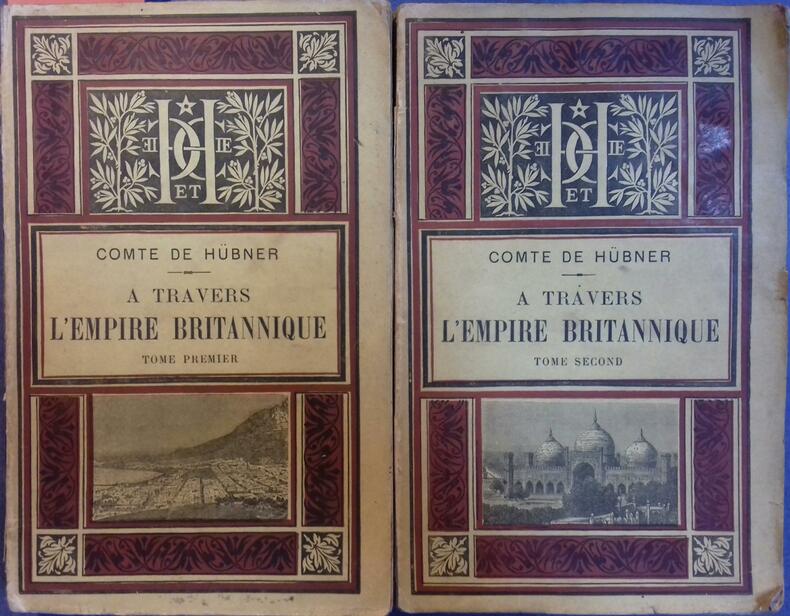
2390Paris, Hachette et Cie, 1889, deuxième édition, reliure demi-basane vert foncé, dos à 5 nerfs, titre et fleurons dorés, 12x18 cm , 498+485 pages, rousseurs, ouvrage contenant 49 gravures sur bois . (dos bruni au tome 1)
188928983Couverture souple. 2 volumes brochés. 501 + 485 pages. Rousseurs. Couverture légèrement défraîchie. Manques au dos.
189023999Paris Librairie Victor Palmé 1890 -in-8 demi-chagrin un volume, reliure demi-chagrin rouge in-octavo (binding half shagreen in-octavo), cartonnage éditeur à plaques spéciales Editeur bicolores (rouge, noir et or) pour le dos et les plats (editor hard-back percale with special covers editor for the spine and the cover), dos long (spine without raised bands) décoré "or" (gilt decoration), plats décorés noir, rouge et "or" (gilt decoration), percaline rouge aux plats, toutes tranches dorées (all edge smooth es gilt ), marque-page en tissu (bookmark in tissue), orné de trés nombreuses illustrations in et hors-texte en noir + une grande carte dépliante hors-texte en noir in-fine, XVI + 365 pages, 1890 Paris Librairie Victor Palmé Editeur,
Hardcover and dustjacket, both a very nice clean copy. A Picture of the Painting Bailed Up by Tom Roberts, depicting an incident in the days of bushrangers, Illustrates the front cover. Pages 310. Size 8vo. The book contains pen drawings by Cedric EMANUEL. [P-15] Pictorial illustrated inside front and back covers with Australian Pictorial Symbols.
131324Fine. One page quarto folded once across the middle; in fine condition. The letter accompanied an inscribed and signed copy of Thiele's book 'The Little Desert' Rigby 1975. It is dated 3 April 1997 and was sent from King Scrub via Dayboro in Queensland where the Thieles lived after leaving Adelaide. <p>He is responding to a letter from his old Adelaide friend Alan Brissenden 1932-2020 academic noted scholar of Shakespeare writer and critic who had recently visited the Little Desert in Victoria's Wimmera district and in the first paragraph he writes about his love for the area. He encloses a photocopy of a recent newspaper article still present on the practice of modern plagiarism which leads him to a critical discussion of the actions of Helen Demidenko / Darville referencing her recent fortnightly columns in the 'Courier Mail' 'Her first piece was unbelievably awful. A few days later it was revealed that - yet again - she had pinched much of it verbatim from an American "professor" on the Internet'. Apparently plagiarism 'is actually taught as a technique at some universities . Incredible! We obviously live in "the new morality"'. <p>He finishes on a positive note still busy with publishers 'although I think it is about time I hung up my keyboard and retired to a hammock under the palm trees. Now I'll let you get on with your own work so that you can finish a book on Shakespeare with a bit of post-modern intertextualisation'. unknown
105467Very Good. Image size approximately 325 × 263 mm on the original ruled mount visible surface 430 × 365 mm framed and glazed. The photograph is beginning to lift slightly at two corners; mount slightly soiled at one corner; frame a little scuffed and marked; overall in excellent condition. On the reverse is the paper label of 'S. Solomon Photographer 51 Rundle Street Adelaide'. The address the original of which was illustrated and illuminated by W.G.P. Joyner gives an indication of the scale and importance of Dunn's enterprises: '. by your perseverance energy and strict integrity you have overcome all obstacles and today you have the satisfaction of leaving to your successors the largest milling and wheat business in the Southern Hemisphere'. <p>An article in the 'South Australian Chronicle' for 8 June 1889 describes the circumstances of the presentation of the address and also describes the original in detail. 'The address is the work of Mr. Joyner and is one of his most artistic productions . The words and the signatures which number 105 being those of most of the leading employés are situated in the centre while all around are well executed paintings of a number of the mills belonging to the firm taken from photographs. In the left-hand corner there is a painting of the site of the original mill at Hay Valley . On the top are Mr. Dunn's residence at Mount Barker 'The Laurels' and the Dunn Memorial Church which that gentleman presented to the residents of Mount Barker while the right hand corner is occupied by a view of the firm's stores and offices in Freeman-street Adelaide now Gawler Place. On the left side of the address there are views of the mills at Wilmington the old mill at Port Adelaide and at Mount Barker and two representations of the new Roller Eclipse mill at Port Adelaide. On the other side the Nairne mill takes precedence while underneath it is the gem of the collection the works at Port Pirie including some of the shipping of the port with the railway in front. The Port Augusta and Bridgewater mills are represented and an excellent portrait of Mr. Dunn is also included in the set.' <p>A number of the source photographs are to be found in a Dunn family photograph album now held by the State Library of South Australia PRG 1485/3. Dunn's entry in the 'Australian Dictionary of Biography' records that 'he retired in 1889 and died at Mount Barker on 13 October 1894. The firm's eleven mills five with the most modern machinery then represented an investment of £150000. They annually had an export trade of some 20000 tons of flour to Britain Western Australia New South Wales and South Africa some 400 employees and a payment to farmers of £500000'. unknown
1920136174Angaston: C.C. Yates Photographer 1920. Very Good. Angaston C.C. Yates Photographer circa 1920s. An original gelatin silver photograph 156 × 114 mm on the original mount 246 × 202 mm with the blindstamp of the photographer in the bottom right-hand corner. Tiny surface chip to the emulsion on the bottom edge; in excellent condition. The details identifying the scene were written in pencil on the mount of another example of this photograph we have handled. Light Pass as it is known today is in the Barossa Valley 3 kms from Nuriootpa. The tiny hamlet is home to two Lutheran churches the Immanuel and the Strait Gate. The Immanuel Lutheran Church explains 'What makes us unique' on its website: 'We enjoy special services such as Harvest Festival Vineyard Service Easter Services Seed and Soil Service and many others throughout the year'. C.C. Yates [Photographer] unknown
1920136175Angaston: C.C. Yates Photographer 1920. Very Good. Angaston C.C. Yates Photographer circa 1920s. An original gelatin silver photograph 159 × 113 mm on the original mount 246 × 202 mm with the blindstamp of the photographer in the bottom right-hand corner. Mount a little foxed; tiny surface chip to the emulsion on the right-hand edge; in excellent condition. The details identifying the scene are written in pencil on the verso of the mount. Light Pass as it is known today is in the Barossa Valley 3 kms from Nuriootpa. The tiny hamlet is home to two Lutheran churches the Immanuel and the Strait Gate. The Immanuel Lutheran Church explains 'What makes us unique' on its website: 'We enjoy special services such as Harvest Festival Vineyard Service Easter Services Seed and Soil Service and many others throughout the year'. C.C. Yates [Photographer] unknown
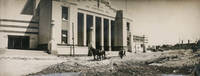
1936125803Adelaide: D. Darian Smith Commercial & Aerial Photography 1936. Very Good. Adelaide D. Darian Smith Commercial & Aerial Photography 1936. A panoramic gelatin silver photograph 128 × 322 mm unmounted as issued with the ink-stamp of the photographer on the verso. The print has a slight longitudinal curl and a few light creases near the right-hand edge; overall in excellent condition. The photograph was taken as the landscaping in the front of the building was being undertaken; the horse-drawn roller seems an anachronism against the backdrop of the impressive Art Deco facade. The State Library of South Australia has in its collection a raking shot of the building taken from the north-east showing the completed landscaping SLSA B 7265. 'Centennial Hall built to celebrate the centenary of the founding of the Colony later State of South Australia and to house the 1936 Centennial Empire Exhibition was opened on 20 March 1936. It was considered to be a significant historical landmark and was one of the few remaining examples of 1930s Art Deco architecture in Adelaide. However the building developed "concrete cancer" and was closed at the end of the 2005 Royal Show because it was unsafe. Demolition of Centennial Hall commenced on Wednesday 18 July 2007' Wikipedia. A huge poster advertising the Centennial Exhibition is visible in this image. D. Darian Smith, Commercial & Aerial Photography unknown
110709Image size 229 × 286 mm on the original mount 252 × 304 mm with the caption in ink below the image behind a mat with interior quarter-round corners maximum visible image size 223 × 282 mm framed and glazed with a gilt fillet behind the glass. The caption is not visible when the mat is in position; the bottom left-hand corner of the mount and photograph has been broken away and repaired with a 75 mm diagonal crack across that corner visible but unobtrusive; there is a tiny amount of surface loss to the shirt of the player in the centre of the front row; overall a very appealing period piece in an early but not contemporary mat and frame. Furreedpore Faridpur formerly in East Bengal India now Bangladesh has important Australian connections exemplified by this photograph. Silas Mead 1834-1909 a Baptist minister emigrated to South Australia in July 1861; 'he preached at chapels in Adelaide and North Adelaide. Regular services began at White's Rooms and within a month a Baptist Church was constituted with twenty-six members. Inspired by Mead's enthusiastic leadership the congregation decided to build a large church in Flinders Street; it was opened on 19 May 1863. When its cost of £7000 was cleared by 1864 he established at Furreedpore India the first constituted Australian Baptist Foreign Mission and later helped to found similar societies in other Australian colonies'. His son Dr Cecil Silas Mead 1866-1940 followed closely in his footsteps; after graduating from the University of Adelaide in 1891 'he served as a medical missionary in eastern Bengal for twenty-nine years returned to Adelaide to teach anatomy in 1923-39 and died in June 1940' 'Australian Dictionary of Biography'. Dr Mead is second from the right in the top seated row; we have no reason to doubt that this photograph was once in his possession and for all intents and purposes it is unique. A copy of 'Doctor Sahib: The Story of Dr Cecil Silas Mead' by Elva Schroeder 2013 is offered together with the photograph. 2 items. unknown
100633A gelatin silver photograph 218 × 294 mm laid down as issued on the original printed mount of the photographer 'E. Ziegler 40 Elizabeth St Norwood' Ernest Charles Victor Ziegler active 1879-1925. The photograph and mount are in superb condition behind glass in the original frame. 'The Advertiser' 11 December 1931 sets the scene for these Inter-Collegiate matches: 'Today the annual cricket match between St Peter's and Prince Alfred Colleges will begin at the Adelaide Oval. Last year the game was played at Prince Alfred College the first time in the history of the matches first played in 1878 that the Adelaide Oval was not available. The match is one of the most important cricket events outside first-class matches in South Australia although in recent years it has failed to sic the importance and drawing power of inter-collegiate matches played before the war. Many famous cricketers have graduated from the college teams'. <p>The 1910 SPSC team - victorious to the tune of 232 runs - was no exception; sitting next to each other are C.E. Pellew and Vice-Captain A.G. Moyes. 'Nip' Pellew played for South Australia 1913-14 to 1928-29 the AIF Touring XI 1919 to 1919-20 and Australia ten Tests in 1920-21. Johnny Moyes a 'promising young cricketer . had represented 1912-15 South Australia making a century on debut been chosen 1914 for Australia in a tour cancelled due to World War I against South Africa and played for Victoria in 1920. In Sydney he achieved one of the highest individual scores in grade cricket when he made 218 runs in 83 minutes for the Gordon District Cricket Club in 1922. he served as a New South Wales selector 1926-27 and wanted Sir Donald Bradman to play for the State' 'Australian Dictionary of Biography'. For many years he worked as a journalist including fifteen years as sporting editor of 'The Sun' and he published thirteen books on cricket. In 1949 he began 'broadcasting sporting sessions for the Australian Broadcasting Commission. In 1950-51 he covered his first Test series against England. In 1955 he received a full-time contract. As a cricket broadcaster he became a household name in Australia and New Zealand in the 1950s and early 1960s' ADB. unknown
189929277London: Reinhold Thiele and Co. 66 Chancery Lane 1899. London Reinhold Thiele and Co. 66 Chancery Lane possibly 1899. A vintage albumen paper photograph 250 × 195 mm laid down on the printed mount of the photographer. The photograph has slight surface silverfish damage not affecting the figure; original mount slightly foxed; recently matted ready for framing visible image size 335 × 280 mm. This full-length portrait features Howell with a cricket ball grasped firmly in his right hand standing alongside a wicket in the practice nets at Lord's in 1899. Displayed in a window cut into the rear of the modern mount is his bold ink surname signature. Howell toured England in 1899 1902 and 1905: he took all 10 for 28 against Surrey in his first match in England in 1899. A rare and impressive item. Reinhold Thiele and Co., 66 Chancery Lane unknown
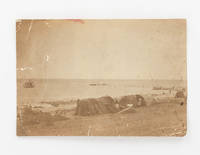
125137South Australia: Unknown Photographer. South Australia Unknown Photographer late nineteenth century. An albumen paper photograph 104 × 158 mm a little creased and marked with expert conservation to the bottom left-hand corner; trifling light surface marks; overall in decent condition. Not least of the fascinating details in this rare image is the paddle-wheeler visible offshore on the left-hand side. Unknown Photographer unknown
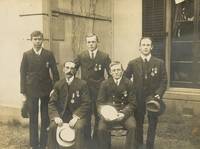
1913134415Adelaide: Unknown Photographer 1913. Adelaide Unknown Photographer 1913. A gelatin silver photograph image size 152 × 206 mm on the original cardboard mount external dimensions 188 × 240 mm. Slight silvering-out and minor surface blemishes visible in a raking light; small chip near the top right-hand corner; mount slightly bowed unevenly trimmed around the edges slightly bumped at the corners with minor surface blemishes; overall a very presentable item. It is highly likely the name of the photographer was on the portion of the bottom margin that has been cut away. The SS 'South Africa' laden with 4486 cases of explosives caught fire while moored at the North Arm Port Adelaide on the afternoon of 21 August 1910. With much of the crew abandoning ship it was left largely to the firefighters police and boatmen of Port Adelaide to extinguish the fire before the dynamite in the hold exploded. The men in this photograph are almost certainly the crew of South Australia Marine Board Motor Boats 'President' and 'Controller' who assisted with firefighting efforts. All five wear the Sea Gallantry Medal and three also wear the special medal presented by the citizens of Port Adelaide. While official gallantry medals had previously been awarded to the fire crews and police the boat crews were not acknowledged until 1913. <p>The presentation of the medals at Government House Adelaide where this photograph was likely taken is described in the Adelaide 'Register' for 16 May 1913 albeit misidentifying the medal being presented. 'His Excellency the Governor Sir Day Bosanquet . said: "It is with great pleasure that I today present the King's police medals to the volunteers of Port Adelaide who in August 1910 went out to the burning vessel 'South Africa' and undeterred by the fact that she was laden with dynamite and gelignite and remained at their post until the fire was extinguished and all danger of the explosion which might have occurred at any moment was over. Such deeds thrill us with admiration and pride. The names of G.W. Justice coxswain. G.W. Krueger driver and Charles McArtney deckhand of the launch 'President' and Thomas S. Hughes coxswain and R. Justice driver of the launch 'Controller' will be ever remembered and go down to posterity as those of heroes who put aside all fear of personal danger and thought only of the performance of their duty." Sir Day pinned the medals on the coats of the recipients who were wearing the bronze medals and gold watches presented to them by the people of Port Adelaide in recognition of their heroic conduct. "I think your's sic was a piece of magnificent bravery" he added "and I am sorry your names were not sent in earlier. I congratulate each of you on having received the medal though late in the day and wish you success in your future careers"'. We have found no other example of this image. Unknown Photographer unknown
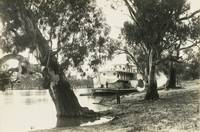
1910137365Near Kingston: Unidentified Photographer 1910. Very Good. Near Kingston Unidentified Photographer circa 1910s. A gelatin silver photograph 207 × 307 mm with one short tear to the top edge expertly sealed; in excellent condition. '2343 Near Kingston River Murray' is written in red pencil on the verso. The State Library of South Australia has a poor-quality reproduction of this image in its Kingston-on-Murray Collection B 31442 dated 'Approximately 1870'. This is clearly incorrect as PS 'Marion' wasn't built until 1897. [Unidentified Photographer unknown
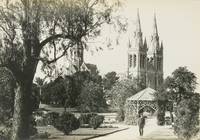
1917137366Adelaide: Unidentified Photographer 1917. Very Good. Adelaide Unidentified Photographer circa 1917. A gelatin silver photograph 220 × 310 mm with two tears to the top edge expertly sealed; in excellent condition. '2790 Pennington Park' is written in red pencil on the verso; ''& Cathedral' has been added later in lead pencil. The State Library of South Australia has a damaged smaller-format example of this photograph in its Searcy Collection 'St. Peter's Cathedral North Adelaide PRG 280/1/18/356' 15 × 20 cm approximately 1917. [Unidentified Photographer unknown
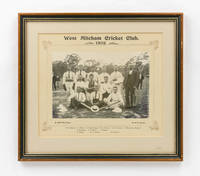
1902122144Adelaide: N. Netter Photo. 45 & 47 Arcade 1902. Fine. Adelaide N. Netter Photo. 45 & 47 Arcade 1902. A gelatin silver photograph 143 × 209 mm on the original captioned mount now matted visible image size 223 × 267 mm and behind glass in a period-style wooden frame external dimensions 319 × 354 mm. The frame is a little scuffed; the photograph and mount are in fine condition. A wonderful image of a parochial cricket team in the field: it should even appeal to the collector of photographs who has no interest at all in cricket. N. Netter, Photo., 45 & 47 Arcade unknown
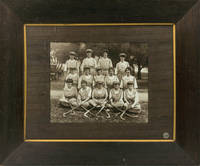
1924123086Gawler: Marchant's Studio 1924. Fine. Gawler Marchant's Studio circa 1924. An original gelatin silver photograph behind glass in the original blackwood frame with gilt fillet and wood-veneer mat visible image size approximately 238 × 288 mm external dimensions approximately 480 × 580 mm. The photograph is in fine condition; the frame is in excellent condition albeit slightly scuffed and marked. A small Marchant's Studio paper label is mounted on the mat; a considerably larger label mounted on the verso states it has been 'Established Sixty Years'. Davis and Stanbury 'The Mechanical Eye in Australia' suggest this occurred in 1864. 'The game of hockey was brought to Australia by British Naval officers stationed around the country in the late 1800s. By 1900 according to Hockey Australia the game was being played in private girls' schools. Being a non-contact team sport it was considered ideal for women. The first women's hockey association was formed in New South Wales in 1908. Two years later women's clubs from Tasmania Victoria and South Australia were competing alongside clubs from New South Wales at an interstate tournament at Rushcutter's Bay and from this tournament came the establishment of the Australian Women's Hockey Association in July 1910 - fifteen years before the Australian Hockey Association AHA was formed in 1925. State hockey associations for men had been formed in South Australia 1903; Victoria and New South Wales 1906; Western Australia 1908; and Queensland 1920s. This division in the administration of men's and women's hockey continued in subsequent years. The Australian Women's Hockey Association affiliated with the All England Women's Hockey Association and joined the International Federation of Women's Hockey IFWH in 1927' Australian Women's Archives Project online. Accordingly this item is tolerably early as well as being a fine piece of portraiture. Marchant's Studio unknown
1870112789Adelaide: The Adelaide Photographic Company 1870. Adelaide The Adelaide Photographic Company circa 1870. An albumen paper photograph 94 × 61 mm mounted as issued on the printed card 104 × 63 mm of The Adelaide Photographic Company. A few tiny surface scrapes to the bottom millimetre or so of the photograph and slight surface loss to the plain section of the mount adjacent to it but overall the condition is excellent. There is an example of the same image in the State Library of NSW a gift from a family member John Howard Johnson dated January 1870. The 'Australian Dictionary of Biography' has this to say about Angas: 'although his prominence in the foundation of South Australia has been somewhat exaggerated . he deserves full credit for the capital and settlers that he introduced into the new colony'. He emigrated with his family in 1851 and spent the rest of his life in the colony. The Adelaide Photographic Company unknown