11 043 résultats
in-8, pp. 162, (2), leg. mod. m tela con angoli e cop. orig. ai piatti. Storia dell'importante oreficeria della metà del XV secolo. Con al fine appendice con documenti relativi a M. Lucagnolo e il catalogo degli orefici che operarono prima del 1800. Lozzi I p. 360 n. 2225. [233]
In 8°; (8), 224 pp. Bella legatura degli inizi del XX° secolo in tutto cartoncino rigido a motivi verdi, rossi e amaranto. Titolo in oro su fascetta in pelle rossa al dorso. Ottimo esemplare ancora in barbe. Terza edizione ma la più completa fra quelle uscite che presenta, in più rispetto alle edizioni precedenti, per la prima volta la descrizione dell'epidemia che colpì i buoi di Matelica in provincia di Macerata. L'opera contiene anche la celebre opera sull'epidemia dei cavalli di Roma descritta dal grande medico romano Giovanni Maria Lancisi. Antonio Maria Borromeo, figlio del Conte Bonifacio e chierico teatino, fu un celebre arcade, letterato e scienziato padovano. L'opera qui presentata ebbe un enorme successo e fu scritta dall'autore dopo aver visto e seguito in prima persona una virulenta epidemia che colpì i buoi nel villaggio di Sarmeola, in provincia di Padova, nell'estate del 1712. "L'opera, lodata anche da G. M. Lancisi per le interessanti argomentazioni esposte, dimostra un non superficiale interesse del B. per le scienze naturali e la zoologia, confermato anche dalla lettera indirizzata ad A. Vallisnieri e da questo inserita nelle Osservazioni ed esperienze intorno all'origine e costumi di varii insetti, Padova 1713.". L'opera contiene anche varie ricette per rimedi farmaceutici per la cura delle epidemie. Importante studio di veterinaria in bellissima copia con ampi margini. Opera rara, tre soli esemplari censiti in ICCU.
in-8, pp. XII, 269, (2), leg. mod. carta dec. Con 9 tavv. in rame raff. vedute della città e 2 tavv. ripiegate con la pianta di Ascoli e 33 rimandi. Bell'operetta di interesse storico e artistico scritta dall'architetto e ornatista fermano (Fermo 1806 - Magliano di Tenna 1878). Fossati Bellani 3560 cita solo 8 tavv. Borroni 4041. Manca a Lozzi. [MM4-284]
in-4 picc., pp. 260, rileg. primo Novecento in cart. dec. con tass. in pelle e tit. oro al d. Con figg. in rame n.t. raff. monete antiche. Opera di una certa rarità dello scrittore storico marchigiano (Staffolo 1721-1788) pubblicata anonima, dove l'A. entra nel merito della rivalità per la supremazia culturale tra Camerino e Macerata. Lozzi 2440. Parenti, Falsi luoghi, p.67. Qualche brun. ma bell'esempl. a larghi margini. [045]
Carta geografica tratta dal L’Italia a cura di Fabio Magini, edito a Bologna nel 1620, tre anni dopo la prematura morte del padre. Composto da un breve testo descrittivo di sole 24 carte, l’opera è corredata di 61 carte geografiche della penisola, e costituisce il primo esempio di atlante italiano. L’opera è per intero di mano del Magini, che iniziò la realizzazione delle carte nel 1594 circa, dando alla luce per prima nel 1595 la carta del territorio di Bologna. Tutte le carte vennero alle stampe quindi prima del 1620, nelle loro stesure provvisorie, successivamente corrette ed aggiornate per l’edizione definitiva. Per la realizzazione delle lastre il Magini si servì di due dei più famosi intagliatori dell’epoca: il belga Arnoldo Arnoldi e l’inglese Benjamin Wright. La carta del territorio di Urbino è basata sulle precedenti mappe di Giacomo Gastaldi, Luchini, Ferrando Bertelli e Mercator e sulle pitture di Egnazio Danti al Vaticano. Esemplare di secondo stato, con la carta ultimata nella parte cartografica; del primo stato è noto un solo esemplare, alla Biblioteca Vaticana. Orografia, idrografia e toponomastica notevolmente implementate. In basso a destra compare una grande rosa dei venti, con orientazione nord-nord-est in alto. Nel cartiglio in basso a destra scompare la dedica a Federico Bonaventuri, sostituita da quella Al’ Ser.mo Si.r Fran.co Mar.a Feltrio della Rovere Duca d’Urbino & c. segue la Fabio di Gio[vanni] Ant.o Mag.ni Bibliografia Almagià (1922): pp. 59-62, n. 16; Almagià (1960): p. 23, tav. XLV; Mangani-Mariano (1998): pp. 154-157, n. 12. Map taken from L'Italia edited by Fabio Magini, published in Bologna in 1620, three years after the untimely death of his father. Composed of a short descriptive text of only 24 pages, the work is accompanied by 61 maps of the peninsula, and is the first example of an Italian atlas. The work is entirely by the hand of Giovanni Antonio Magini, who began the realization of the maps in 1594 or so; the first dated map (1595) the map of the territory of Bologna. All the maps were printed before 1620, in their provisional drafts, later corrected and updated for the final edition. For the realization of the plates Magini used two of the most famous engravers of the time: the Belgian Arnoldo Arnoldi and the English Benjamin Wright. Copperplate, in good condition. La carta del territorio di Urbino è basata sulle precedenti mappe di Giacomo Gastaldi, Luchini, Ferrando Bertelli e Mercator e sulle pitture di Egnazio Danti al Vaticano. Esemplare di secondo stato, con la carta ultimata nella parte cartografica; del primo stato è noto un solo esemplare, alla Biblioteca Vaticana. Orografia, idrografia e toponomastica notevolmente implementate. In basso a destra compare una grande rosa dei venti, con orientazione nord-nord-est in alto. Nel cartiglio in basso a destra scompare la dedica a Federico Bonaventuri, sostituita da quella Al’ Ser.mo Si.r Fran.co Mar.a Feltrio della Rovere Duca d’Urbino & c. segue la Fabio di Gio[vanni] Ant.o Mag.ni Literature Almagià (1922): pp. 59-62, n. 16; Almagià (1960): p. 23, tav. XLV; Mangani-Mariano (1998): pp. 154-157, n. 12.
Inc. rame f. 60,5 x 42. In: Mortier P. - Nouveau Théà tre d'Italie... a La Haye
in-4, pp. VI, 94, bella leg. m. perg. coeva con carta dec. ai piatti. Dettagliate notizie sul dazio del frumento nelle varie provincie della Marca: Ancona, Pesaro e Urbino. Lozzi 3526: "Raro". [217]
DADAX0304346268UNKNO 0000-00-00. hardcover. New. 8.25x1.25x10.25. Buy with confidence. Excellent Customer Service & Return policy. UNKNO hardcover
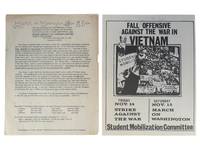
1969222141969. Student Mobilization Committee to End the War in Vietnam Fall Offensive Against the War in Vietnam handbill archive 1969 documents grassroots antiwar mobilization in the weeks surrounding the November 15 March on Washington and supports research into student organizing Vietnam War dissent protest communications and the relationship between antiwar activism and civil rights language. The material documents the system of mass antiwar protest coordination through locally distributed leaflets public calls for disciplined nonviolence strike-and-march scheduling and visual appeals to interracial and cross-movement solidarity revealing how organizers sought to convert dispersed campus opposition into a visible national demonstration. The Student Mobilization Committee was a national coalition active from 1966 to 1973 and the November 1969 Washington action drew more than 500000 demonstrators after the October Moratorium and alongside New Mobilization Committee activity making these handbills useful evidence of how antiwar organizations framed participation legality and public legitimacy during one of the largest Vietnam War protests in the United States.<br /> <br /> Two original handbills issued in connection with the November 14 and 15 1969 antiwar actions in Washington D.C. comprising one mimeographed leaflet distributed by the CWRU Student Mobilization Committee and one offset-printed graphic leaflet headed "FALL OFFENSIVE AGAINST THE WAR IN VIETNAM" each approximately 8½ x 11 inches. The mimeographed leaflet opens with a quoted November 9 1969 New York Times editorial warning that "The Administration has been following a course calculated to increase the danger that the protest march will turn into a violent confrontation" and answers with the committee's insistence that "Nov. 14-15 will be the most massive legal peaceful and non-violent demonstrations ever held in the U.S." Its text explains the functional logic of the protest effort arguing that "Only a massive peaceful demonstration of the American people can require the government to end the conflict and bring the troops home now" while also identifying government rhetoric as a threat to the movement's legitimacy: "The source of rumors about violence. is the government itself." The second leaflet uses bold graphic design and a black-and-white protest photograph showing demonstrators one raising a peace sign with placards reading "End the War Now!" and "Bring the Troops Home Now!" and a background banner declaring "End Racial Oppression!" Beneath the image the leaflet gives the coordinated schedule: "FRIDAY NOV. 14 / STRIKE AGAINST THE WAR" and "SATURDAY NOV. 15 / MARCH ON WASHINGTON" linking workplace and campus strike tactics to the mass Washington demonstration.<br /> <br /> Student Mobilization Committee to End the War in Vietnam. Nov. 14-15 peaceful and non-violent demonstrations leaflet. Cleveland: CWRU Student Mobilization Committee 1969. Mimeographed organizing handbill using press quotation rebuttal and direct appeal to defend the planned Washington demonstrations against anticipated claims of violence. The leaflet shows the mechanisms of antiwar communication in practice: organizers framed participation as peaceful legal and morally necessary urging readers that "Marching on Washington November 15 in the peaceful and non-violent demonstration is the best way to build that movement to end the war immediately. JOIN US!" 2 Student Mobilization Committee to End the War in Vietnam. Fall Offensive Against the War in Vietnam. Washington D.C.: Student Mobilization Committee to End the War in Vietnam 1969. Offset-printed handbill combining protest imagery antiwar slogans and a two-day action calendar for the November 14 strike and November 15 March on Washington. The inclusion of the banner "End Racial Oppression!" places the antiwar action within a broader field of late-1960s radical politics where opposition to U.S. military policy intersected visually and rhetorically with civil rights and racial justice claims. Light toning minor edge wear and small creases very good. Compact evidence of the messaging infrastructure behind the November 1969 antiwar mobilization preserving both the defensive language of nonviolence and the public visual vocabulary used to recruit participants for national protest. unknown
166 pages. Features: Over 100 pages of sensational furniture manufacturer ads, most of which are wonderfully illustrated in black and white; A Sales Class That Sells; Profitable Use of Lamps; Building on Individuality; Millions for New Homes; Productive Outdoor Advertising; W.O. Broyles; Beating the Gyp (mail order sharks who exploit the consumer); and much more. Printed upon glossy stock. Above-average external wear and soiling. Front cover loose but present. This rare vintage trade publication offers a superlative snapshot of mid-1920s American furniture design and the retail furniture business. Book
1999SONG1860942008Imperial College Press 1999-12-14. hardcover. Used: Good. 6.36x1.14x8.84. Buy with confidence. Excellent Customer Service & Return policy. Imperial College Press hardcover
1995SONG084938253XCRC Press 30/11/1995. 1. hardcover. Used: Good. 6.50x1.00x9.75. Buy with confidence. Excellent Customer Service & Return policy. CRC Press hardcover
Very Good Turkish, Ottoman (1500-1928) Original paper autograph letter handwritten signed by Mahmud Sevket, Izzeddin Çalislar. (33x21 cm). In Ottoman script. 2 p. Repaired back side. Request of a surgical operation by 'Said bin Mehmed' (Siroz Redif Taburu Efrâdindan) and Mahmud Sevket Pasha and Izzeddin's confirmations. Signed by Mahmud Shevket Pasha as "commander of Turkish countercoup of 1909 (Hareket Army)" and by Izzeddin [Çalislar] as "Erkân-i Harb Kolagasi (Batallion commander)". The Ottoman countercoup of 1909 (13 April 1909) was an attempt to dismantle the Second Constitutional Era of the Ottoman Empire and replace it with an autocracy under Sultan/Caliph Abdul Hamid II. Unfortunately for the advocates of representative parliamentary government, mutinous demonstrations by disenfranchised regimental officers broke out which led to the collapse of the Ottoman government. Characterized as a counterrevolution, chaos reigned briefly and several people were killed in the confusion. It was instigated by some parts of the Ottoman Army in a large part by a certain Cypriot Islamic extremist. Dervish Vahdeti reigned supreme in Istanbul for 11 days. The Countercoup was put down in the 31 March Incident, on 24 April 1909 by the Army of Action (Hareket Ordusu) which was the 11th Salonika Reserve Infantry Division of to the Third Army (Ottoman Empire) commanded by Mahmud Shevket Pasha. Extremely rare.
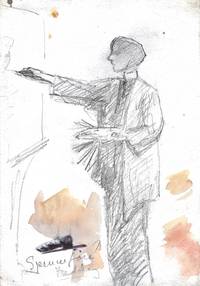
4084Without date or place. English Camden Town Group Painter 1878-1914. Dimensions seven inches by ten inches. Grubby but in good condition. From the Mark Bonham Carter collection. Captioned 'Spencer Gore Freddy' with an arrow pointing to impressionistic representation of figure nine inches high of the artist in a suit with high-collared shirt holding a palette in his left hand and with his right hand outstretched and painting onto a canvas. Around the figure dabs of watercolour and a representation of a foot. Crude drawing of seascape on reverse. Together with scrap of paper reading 'MR. THEO RAMOS rang a propos Spenser-Gore. sic Freddie Gore's no. is 352 . 4940 Also - Bernard Dunstan 10% is on. or off'. See Image. Without date or place. unknown
10257137-nnew. unknown
In Vrbino per li Mazzantini stampatori camerali, 1650 (In Urbino appresso Marc’Antonio Mazzantini, 1651). (cm. 20,5 x 15,5). Cartonato moderno. Pp. (8), 773, (12). Due pagine d’indice restaurate, ma splendido esemplare, freschissimo. Domenico di Guzmán, (Caleruega, 1170 – Bologna, 6 agosto 1221), è stato un presbitero spagnolo, fondatore dell’Ordine dei frati predicatori, proclamato santo nel 1234. Edizione originale ed unica.
17353792<p>1735. Hardback. Very Good. Original 1735 Entschuldigungen ""Excuses"" in Old German language and font. Early Protestant writings. Authors: Christian Gottfried Marche Johann Jakob Rambach</p><p> Condition: Good Has been re-covered in maybe the 1950's or 1960's with a woodgrain vinyl sheeting 560 pages 4"" X 6.5"" Tall.<br /><br />What follows is the beginning of the book proper after the Forward/Dedication. -- To the dear reader Light and Grace are wished to you from the first source of salvation by yours Johann Jacob Hambach.<br />Dear reader The sin of excuses is one of the first fruits of the Fall. For just as soon as a human was unfaithful to his Creator and He called him the person back to Himself stood him before His judgment and asked: Did you not eat from the tree about which I commanded you you should not eat from it Then Adam answered: That woman you presented me with gave me to eat from that tree and I ate. And when god thereafter also called the woman to account and asked her: Why did you do this so this one also answered: the snake betrayed me so I ate. 1 Book Mos. III 11 12 13. Thus they began to excuse themselves by or according to on the basis of or after each other. etc.<br /><br />Some interesting things from a gifted reader friend R. Harris about this book the 1735 Entschuldigungen. I like that the author writes this as a kind of letter from himself to his reader I like that it flat-out calls excuses sin. Not ""the making of excuses"" but excuses. In this writer's mind there is no excuse that is valid for anything. Not the lack of quotation marks. Instead when there is a colon :it's an indication that what follow is a quote. Note that Genesis is called 1 Book Mos. or first book of Moses which is what it is still normally called in German. Shorthand in German is ""erste Mose"" written 1. Mose for 1st Moses and Exodus is 2. Mose zweite Mose 2nd Moses. I just think it's interesting the way the scripture reference is notated which is so different from modern German and even more different from the English/American way of doing it. We'd say Genesis 3:11-13. Much easier! The other thing I thought was interesting was that the entire beginning chapter or what looks like a chapter is essentially a long flowery dedication to the Holy Roman Emperor. I do like this beginning Kind of makes the point all at once. Peace and no stinkin' excuses!</p> hardcover
in-4, pp. XXXVII, leg. m. perg. con carta dec. ai piatti. Con 10 tavv. in rame raff. medaglie e vetri. Lozzi 3509. [026]
182653952Paris, L'Imprimerie Royale, 1826. Later hcloth. Spine with gilt lettering. Stamp on title-page. VII,359 pp. Clean and fine.
182653952Paris L'Imprimerie Royale 1826. Later hcloth. Spine with gilt lettering. Stamp on title-page. VII359 pp. Clean and fine. <br/><br/><em>First French edition of Blunt's "The American Coast Pilot". - Sabin 6028. </em> hardcover
2001SONG0415930863Routledge 2001-10-26. 1. hardcover. Used: Good. 6.04x0.64x9.50. Buy with confidence. Excellent Customer Service & Return policy. Routledge hardcover
194143270, , 1941. Album In-4 de 35 photographies (13 x 18 cm) contrecollées sur papier fort bleu, couverture grise.
1913NATW0423_2KWien, k.k. Hof- u. Staatsdruckerei 1902 - 1913. Folio, OLn., schwache Gebrauchsspuren, Bibl.-Stemp. auf Vors. Vorhanden sind Hefte mit den Niederschlagsmengen folgender Gebiete: Donaugebiet, Marchgebiet, Murgebiet mit den Gebieten d. Raab in Stmk., Draugebiet mit dem Gebiet d. Waag in Mähren, Rheingebiet.
14 fotografie originali in b/n vintage, stampa alla gelatina ai sali d'argento, montate sui fogli i cartoncino di un album cm 24,5 x 34. Titolo 'Marche. Ancona' manoscritto con bella grafia al piatto anteriore dell'album, al contropiatto post. didascalie manoscritte per ciascuna delle 14 foto. La prima misura cm 12,5 x 17,5 ritrae Porta Pia, un uomo cammina lungo la strada; la seconda misura cm 15,5 x 21,5 ritrae un panorama della citta' vista dal Duomo; la terza e la quarta misurano cm 17,2 x 12,5: la terza mostra ancora un panorama della citta' dal Duomo, la quarta un panorama ripreso dal Faro; la quinta e la sesta misurano cm 20,5 x 14,4, la quinta ritrae un panorama della citta' dal porto. In primo piano si vede una barca in legno con tre pescatori; la sesta e' ancora una vista dal porto sulla citta' con una barca di lato in mare; la settima e l'ottava misurano cm 15,5 x 21,5 ritraggono entrambe il Duomo S. Ciriaco sul Colle Guasco (ritratto laterale del fronte della chiesa con le scalinate); la nona misura cm 21,3 x 15,3 ritrae un altro scorcio sul Duomo, visto lateralmente (si vede nella sua interezza la torre campanaria); la decima misura cm 14,7 x 10,7 ritrae altro scorcio sul Duomo; l'undicesima misura cm 14 x 9,7 ritrae vista del Duomo dal piazzale del Faro; la dodicesima e la tredicesima misurano cm 12,7 x 17,7, la dodicesima ritrae la statua di Clemente XII in piazza del Plebiscito; la tredicesima la chiesa di San Domenico in piazza del Plebiscito; l'ultima, la quattordicesima misura cm 10 x 14,5 ritrae la ex chiesa di S. Francesco delle Scalr, alcuni passanti in primo piano.
Rarissima edizione illustrata del 1658 di questa Raccolta di poesie di Carlo Ulisse da Macerata. "Carlo Ulisse maceratese, Gentiluomo di varia dottrina, e versato in diverse lingue, come apparisce da un suo libro intitolato "Linguarum balbuties, e ristampato in Bologna l'anno 1671. Fu anche rimatore e alcune sue poesie volgari si leggono nella citata Opera". Cfr. Crescimbeni, Dell'istoria della volgar poesie p. 193. Frontespizio entro cornice figurata. All'interno poesie dedicate a diverse persone nobili, per ognuno dei quali viene riportato lo stemma. I personaggi citati: Rapacciolo, Barcellino da Fossombrone, Pasquino da Senigallia, Mazza da Pisa, Barteloczio da Montecchio, Carlo Filippo Leonardo da Amandola, Marino di Agugliano, Cino de Serra da Macerata, Coraduzio da Camerano, Butinello da Civitanova, Cardinale di Lugo, Scalamonti da Ancona, Prosperi da Velletri ecc... Con frontespizio proprio: Ode a Furio Camillo Sinibaldi di Osimo, Alfonso Butinelli da Civitanova. In buone condizioni e completo. Copertina cartonata coeva in buone condizioni generali con lievi usure ai margini e dorso. Legatura in buone condizioni. All'interno le pagine si presentano in buone condizioni con fioriture. In 24. Dim. 13,5x7,5 cm. Pp. 140+(1).