48 602 résultats
176824720Paris De Bure pere 1768. Small 8vo. Cont. full mottled calf. Back gilt and worn. Leather at lower compartment lacks. Spine ends gone. First leaves dampstained decreasing toward end. Engraved frontisp. 4626 pp. hardcover
184129698Rouen, E. Frère et le Brument, Éditeurs, 1841/42. 2 Bände in einem Buch. 3 u.5. Auflage. Sprache : Französisch. XII, 175, 174 Seiten. Frontispiz. Mit 11 Stahlstiche u. 2 gest. Faltkarten. Kl. 8°, Broschiert.
418 p. Foxed. 12 mo. Attractive leather backed marbled boards binding. Gautier was a famed French poet, novelist, and critic. He was a leading exponent of "art for art's sake" - the belief that formal, aesthetic beauty is the sole purpose of a work of art. This work about his trip to Russia was first published 1866-1867. It was of enormous influence on French attitudes towards Russia in the Nineteenth century. Scarce. **PRICE JUST REDUCED! FR3
In 16, pp. 83 + (1). Br. rifatta. Racconto del viaggio in Francia di questo prelato (1809 - 1892). Dal 1850 al 1914, sono pubblicate una trentina di importanti testimonianze italiane su Parigi. I viaggiatori italiani in Francia (Giovanni Rajberti, Giambattista Casoni, i romanzieri e i poeti Edmondo De Amicis, Giovanni Faldella, Fernando Fontana, Carlo Del Balzo, Ferdinando Martini, Antonio Fogazzaro, Matilde Serao...) si recano perlopiu' nella capitale, trascurando la province, manifestando un disinteresse dal quale si salva parzialmente la Costa Azzurra. Nonostante i titoli di 'La Francia' o 'I Francesi', le memorie degli Italiani sono incentrate su Parigi. Tizzani, prima di parlare della capitale, si sofferma tuttavia su Marsiglia, e successivamente con brevi cenni sul Belgio, i confini del Reno e la Svizzera.
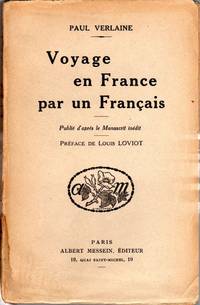
190719174Paris: Albert Messein Editeur 1907. Brossura wrappers. Molto buono Very Good. Publié d'aprés le Manuscrit inédit. Préface de Louis Loviot. 16mo. pp. 140. Molto buono Very Good. Bruniture leggere al dorso Some light browning at spine. Prima edizione First Edition. Albert Messein Editeur, unknown
A Paris, E. Maillet, libraire, 1865. In-12 ; 123 pp comprenant un avant-propos et une préface. Demi-chagrin bordeau à coins, dos à 5 nerfs, tête dorée. (reliure époque). Edition revue sur l'édition originale de 1754 publiée chez Duchesne. Tirage à 454 exemplaires, un des 450 sur papier de Hollande, bien complet du plan du voyage de St Cloud. Bon exemplaire, quelques rares rousseurs éparses, un plat décoloré. Neel Louis Baltazar est né vers 1695 à Rouen (Seine-Maritime). Homme de lettres. Destiné à la magistrature, Néel préfère verser dans la poésie. Son nom est resté grâce au succès de son principal ouvrage, Voyage de Saint-Cloud à Paris par mer, dans lequel il se moque d'un Parisien allant pour la première fois à Saint-Cloud (Hauts-de-Seine). Néel disparaît en 1754 à Rouen. Outre ce Voyage de Paris à Saint-Cloud par mer, et retour à Paris par terre (La Haye 1748), Néel a aussi écrit : une Épître au prince de Conti sur ses conquêtes en Italie (1743), une Épître au roi sur sa première campagne en 1744, La prise de Bruxelles (1746) et La prise de Maastricht (1748), qui sont deux poèmes, Histoire du comte de Saxe (Mittau 1752) et Histoire de Louis, duc d'Orléans (1753).
Par Néel, avec une préface et des notes par E. Legrand, aquarelles de Jeanniot gravées par Gillot, tiré à petit nombre, 1 vol. in-8 reliure de l'époque demi-maroquin à coins bleu, dos à 5 nerfs dorés orné, tête dorée, filet doré en mors et coins, couv. cons., reliure signé de V. Champs, date en queue, A. Lahure, Paris, 1884, XXXI-116 pp. Jolie reliure signée de Champs. Etat très satisfaisant (petit frott. à un mors, lég. rouss. sur tranches). Vicaire, II, 758 Français
First edition, small 4to, xxviii, 344pp., orig. upper printed wrapper bound-in, cont. morocco, marbled boards, lightly rubbed, uncut.
Traduzione: E. De Sermizelles . Prefazione: Paulin Paris . Edizione: Prima edizione . Pagine: XXXII+344 . Illustrazioni: Incisione a tutta pagina di Salmon . Formato: 8° . Rilegatura: Cartonato novecentesco con piatti marmorizzati e dorso in pelle marrone con cinque nervature e titoli in oro. . Stato: Buono . Caratteristiche: Sono conservate le copertine originali. Interno freschissimo. .
63991Imprimerie Nationale P. 1904 In-4 34 cm 112pp. illustr. 10 gravures hors-texte couverture muette Nb-0385 unknown
51410ABParis Les Éditions De La Nouvelle France o.J. 4° 112 Abb. OK. Kl. Einr. d. ober. u. unt. Kapit., Rü.-Gel. stellenw. geplatzt u. berieb., leicht bestoss., innen gebräunt, aber sauber erhalten. 1 Notiz/Bemerkg. u. Stemp. a 1. Bl.
Paris, Editions de la Nouvelle France, 1944. In-4 cartonnage éditeur sous jaquette illustrée, 112 pages. Photos de Athaud, Bovis, Durand, Grono, Jahan, René Jacques, Roubier. Très bon état.
180329701Paris: Didot 1803. Fine. Didot Paris 1803 40 x 54 cm une feuille Original unshaved full-page etching from the Imperial edition of the Description de l'Égypte or Recueil des observations et recherches faites en Égypte pendant l'expédition française publié par les ordres de Sa Majesté l'Empereur Napoléon le Grand A Collection of the observations and research carried out in Egypt during the French expedition published on the orders of his Majesty the Emperor Napoleon the Great'.Produced between February 1802 and 1830 on the orders of Naopleon Bonaparte and published between 1809 and 1828 1000 copies were printed and distributed to institutions on vergé paper with an 'Égypte ancienne et moderne' watermark visible when held up to the light. Light marginal spotting not touching image otherwise in very fresh fine condition. An engraving from the Description de l'Egypte one of the masterpieces of French printing and the birth of a new field: Egyptology. A gigantic survey of Egypt at the time of Bonaparte's conquests in 1798 and 1799 the work is divided into 13 volumes of engravings making up 892 plates of which 72 colored as well as presenting the splendors of the Egypt of the Pharaohs in 9 volumes. The other volumes discuss natural history and present a fascinating portrait of Coptic and Islamic Egypt as it was seen by Bonaparte's Eastern Armies. The Egyptian campaign' militarily a disaster demonstrates through the engravings of the Description d'Egypte the scientific success it nonetheless became thanks to the 167 expert members of the Commission of the Sciences and Arts of the Institut d'Egypte Egyptian Institute who followed Napoleon's army. The Institut gathered together in Egypt the mathematician Monge the chemist Berthollet the naturalist Geoffroy Saint-Hilaire as well as numerous artists engineers architects and doctors. They were tasked with re-discovering modern and ancient Egypt and displaying its natural treasures as well as the know-how of its inhabitants.This edition the so-called Imperial edition of the plates for the Description de l'Egypte was printed in four large formats two of which were specially created for it and christened Moyen-Egypte and Grand-Egypte. A special press was built to print it the process extending over 20 years from 1809 to 1829. The Imperial edition proved so popular that a second edition this time in black and white and without the Egypte ancienne et moderne watermark known as the Royal Edition was published during the Restoration by the printing house of C.-L.-F. Panckoucke Paris.The engravings of the Description d'Egypte owe a great deal to Baron Dominique-Vivant Denon illustrator diplomat collector and later Director of the Musée Napoléon the Louvre. His exploration of the South of Egypt gave Bonaparte the idea of sending the experts of the Institut there thus creating a faithful and complete portrait of the area. This was the research gathered together from 1802 in the mammoth Description de L'Egypte.Denon embarked on this story of archeological exploration at the age of 51 reaching first Alexandria and then Cairo before exploring Upper Egypt. Along with the members of the Institut d'Egypte the Natural History Museum's painter H.J. Redouté brother of Pierre-Joseph Redouté author of Roses the mineralogist Dolomiue and the draughtsman Joly Denon then explored the Nile Delta and Lower Egypt. When however he joined the 21st Light Infantry Regiment as it marched across Upper Egypt in pursuit of the retreating Mameluks in November 1798 he found himself the only civilian. In the very midst of the battle itself he reeled off sketches of the works of art that peppered his path right up to the threshold of the Sudan. He said that he had crossed a country that is apart from its name entirely unknown to Europeans and therefore everything was worth describing Voyages dans la Basse et la Haute Egypte pendant les campagnes de Bonaparte en 1798 e Didot unknown
2012933769.Gpaperback. Good. Access codes and supplements are not guaranteed with used items. May be an ex-library book. paperback
17634Avignon, Roumanille, 1890, 1 broché, dos renforcé. in-8, faux-titre, titre, 94 pages ;
176824720Paris, De Bure pere, 1768. Small 8vo. Cont. full mottled calf. Back gilt and worn. Leather at lower compartment lacks. Spine ends gone. First leaves dampstained, decreasing toward end. Engraved frontisp. 462,(6) pp.
GF29171Album à l'italienne de 21 photographies originales de format divers montées sur onglets (de 6,5 x 11cm à 12,5 x 17 cm), les pages sont retenues par un cordon de soie gris - Couverture de papier gris avec titre manuscrit à l'encre - Endommagé sur le mot "Mars" -
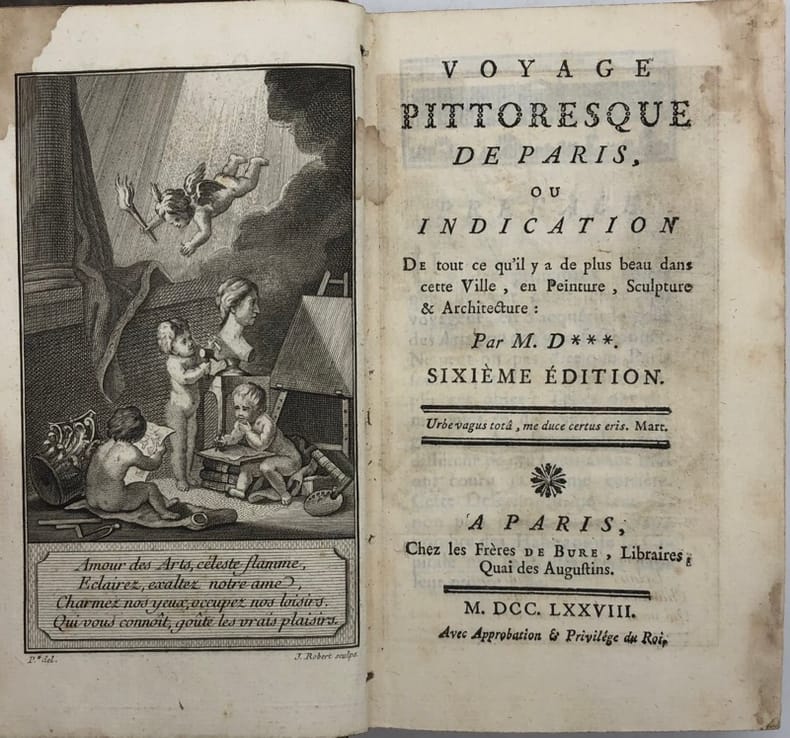
7553P., Frères de Bure, 1778. In 12 veau marbré de l’époque, dos à nerfs orné, tranches rouges (coins émoussés, coiffe supérieure arrachée), petites armes aux centres des plats XII-feuillet de table-492 pp.-2 ff. non ch. (approbation et privilège) + 8 planches hors texte.
8091P., Frères de Bure, 1778. In 12 veau marbré de l’époque, dos à nerfs orné, tranches rouges (coins émoussés, coiffe supérieure arrachée), petites armes aux centres des plats XII-feuillet de table-492 pp.-2 ff. non ch. (approbation et privilège) + 8 planches hors texte.
231004Paris, de Bure, 1778 in-12, XII-(2)-492-(4) pp., 8 planches dont une en frontispice, veau fauve, dos à nerfs orné, tranches marbrées (rel. de l'époque). Trace d'humidité dans la marge extérieure fragilisant un peu le papier, manque aux coiffes, coins usés, tache d'humidité sur les plats.
231009À Paris, Chez de Bure, 1779 in-12, XXXII-469-[3] pp., frontispice gravé, veau fauve marbré, dos à nerfs orné aux petits fers dorés, tranches rouges (reliure de l'époque). Coiffes et coins usés.
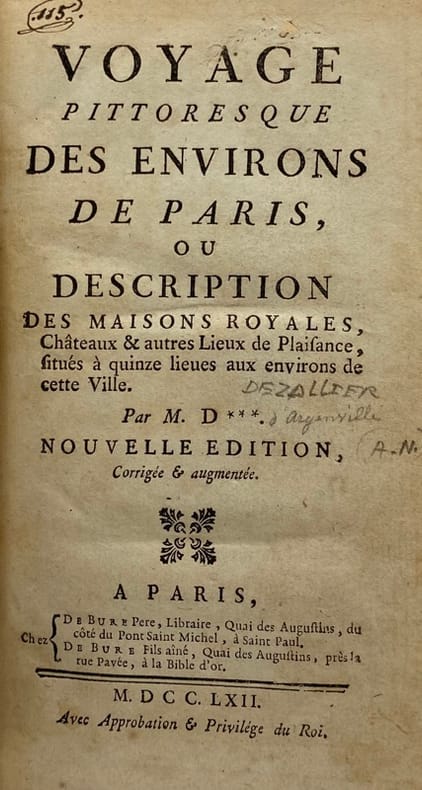
233418À Paris, Chez de Bure, 1762 in-12, 407 pp., frontispice gravé, veau fauve marbré, dos à nerfs orné, tranches rouges (reliure de l'époque). Mors en partie fendus, coiffes et coins usés.
236906À Paris, Chez de Bure, 1768 in-12, 24-462-[6] pp., frontispice gravé, veau fauve, dos à nerfs orné, tranches rouges (reliure de l'époque). Mors fendus, coiffes et coins usés.
236907À Paris, Chez de Bure, 1770 in-12, X-(2) pp., 483-(5) pp., 8 planches gravé dont le frontispice mis en couleurs, veau brun marbré, dos lisse orné, tranches rouges (reliure de l'époque). Début de fente aux mors, coiffes et coins usés.