FridolinAntiquariat.de

37 résultats
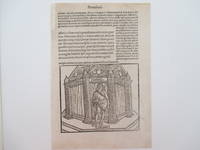
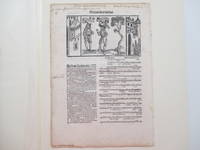
149114838Gedruckt in Nürnberg bei Koberger, 1491. 31,8 x 22 cm (Blattgröße), 24,6 x 15,6 (Druckspiegel)
149114839Gedruckt in Nürnberg bei Koberger, 1491. 31,8 x 22 cm (Blattgröße), 24,6 x 15,6 (Druckspiegel)
149114837Gedruckt in Nürnberg bei Koberger, 1491. 31,8 x 22 cm (Blattgröße), 24,6 x 15,6 (Druckspiegel)
149114835Gedruckt in Nürnberg bei Koberger, 1491. 31,8 x 22 cm (Blattgröße), 24,6 x 15,6 (Druckspiegel)
149114834Gedruckt in Nürnberg bei Koberger, 1491. 31,8 x 22 cm (Blattgröße), 24,6 x 15,6 (Druckspiegel)
149114833Gedruckt in Nürnberg bei Koberger, 1491. 31,8 x 22 cm (Blattgröße), 24,6 x 15,6 (Druckspiegel)
149114832Gedruckt in Nürnberg bei Koberger, 1491. 31,8 x 22 cm (Blattgröße), 24,6 x 15,6 (Druckspiegel)
149114831Gedruckt in Nürnberg bei Koberger, 1491. 31,8 x 22 cm (Blattgröße), 24,6 x 15,6 (Druckspiegel)
149114828Gedruckt in Nürnberg bei Koberger, 1491. 31,8 x 22 cm (Blattgröße), 24,6 x 15,6 (Druckspiegel)
149114827Gedruckt in Nürnberg bei Koberger, 1491. 31,8 x 22 cm (Blattgröße), 24,6 x 15,6 (Druckspiegel)
149114830Gedruckt in Nürnberg bei Koberger, 1491. 31,8 x 22 cm (Blattgröße), 24,6 x 15,6 (Druckspiegel)
149114829Gedruckt in Nürnberg bei Koberger, 1491. 31,8 x 22 cm (Blattgröße), 24,6 x 15,6 (Druckspiegel)
149114836Gedruckt in Nürnberg bei Koberger, 1491. 31,8 x 22 cm (Blattgröße), 24,6 x 15,6 (Druckspiegel)
149317352AB1493. Lyon 1493. 225 : 155 cm. One leaf with one woodcut. Leaf 223 shows the Terenz editor Calliopius in front of a polygonal building. The woodcut was also attributed to the master of the Lübeck bible.' - Hain/Copinger 15424; Goff T-91; GW M45397. unknown
149617350AB1496. Straßburg Grüninger I.XI. 1496 305 : 21 cm. One leaf with one woodcut. Leaf LXX 'Secundus actus' from the "Heautontimorumenos". The woodcut shows the two protagonists of the play. - With some old annotations. - Hain/Copinger 15431; Goff T-94; GW M45481. unknown
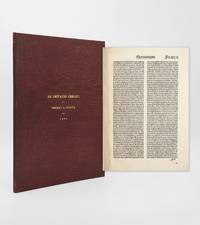
1494376720Nuremberg: Caspar Hochfeder 1494. Leaf XCII. Text in two columns 53 lines in black letter with rubricated N on verso running head Liber Sermonum. Small folio. Leaf with minor staining mounted in brown cloth folder with printed descriptive slip from 1927 Foliophiles portfolio of German Incunabula mounted opposite leaf. Leaf XCII. Text in two columns 53 lines in black letter with rubricated N on verso running head Liber Sermonum. Small folio. Attractive leaf from the Nuremberg 1494 edition of the Works of Thomas à Kempis printed by Caspar Hochfeder ISTC it00352000. Cf. Disbound and Dispersed 2005 Checklist 29. Provenance: General Theological Seminary bookplates perforated stamps Caspar Hochfeder unknown
149764069New York & Strassburg: Ben Abramson Johann Gruninger 1946; 1497. 4to. 48 pp. Double-page title illustrated w/ woodcut engraving w/ 7 additional woodcut engravings. Quarter-orange cloth over illustrated boards cover art facsimile reproductions of illustrated leaves from the 1497 Buch der Cirurgia minor edgewear slight scuffing minor bumping to couple corners still VG copy; One leaf. 4to. 2 pp unpaginated. preserved in fold over flaps on front pastedown left margin repaired faint tidemark on upper third at corner still G clear artifact numbered on verso of title w/ gilt booklabel for the Aldredge Bookstore Dallas TX on rear pastedown. First editions thus No. 52 of 112 copies printed of this limited edition containing an original leaf from the 1497 edition: “the first important printed treatise in German. It combines a compilation of the ancient and medieval authorities with Brunschwig’s own extensive experience. . . and is notable for its woodcuts some of the earliest specimens of medical illustration.†The leaf included here is a survivor from Chapter Three addressing how to find veins and treat open wounds. Sigerist’s work was first published as an essay introduction with the R.Lier & Co. 1923 facsimile of Brunschwig’s Book of Cirurgia. See: Garrison & Morton 5559. Ben Abramson, [Johann Gruninger], hardcover
1472256254Strassburg: Johann Mentelin 1472. Single leaf printed recto and verso. Text in two columns 62 lines initials supplied in red 5 on recto one on verso. 1 vols. Folio. Fine. Mounted in card folder. Single leaf printed recto and verso. Text in two columns 62 lines initials supplied in red 5 on recto one on verso. 1 vols. Folio. Hain 10366; BMC I 56; ISTC No. in00133000 Johann Mentelin unknown
1472256254Strassburg: Johann Mentelin 1472. Single leaf printed recto and verso. Text in two columns 62 lines initials supplied in red 5 on recto one on verso. 1 vols. Folio. Fine. Mounted in card folder. Single leaf printed recto and verso. Text in two columns 62 lines initials supplied in red 5 on recto one on verso. 1 vols. Folio. From the Press of Johann Mentelin 1472. Hain 10366; BMC I 56; ISTC No. in00133000 Johann Mentelin unknown books
147159416Rome: Adam Rot 1471. after 2 Oct. 1471. 8vo 12 leaves printed in black with red heading some marginal chipping in two columns good. Probably HC 14820; Pr 3433; BMC IV 42; BSB-Ink 447; GW M42586. Rules and constitution of the Apostolic Chancery. Notes on Benedict XII 1334-1342; Boniface VIII 1294-1303; Paul II 1464-1471; Calixtus III 1455-1458; Boniface VIII 1294-1303; Alexander IV 1254-1261; Gregory X 1271-1276; Clement VI 1342-1352. Adam Rot unknown books
149664508Basel, [Michael Furter], 13. März 1496. 4°. 22 nn. Bll. (2 Sp., 47 Z., Min. f. Init.), Mod. Ppbd. unter Verwendung eines alten Antiphonarblattes.
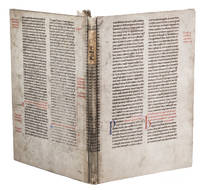
14869BDEHOBV62VDWürzburg: Georg Reyser 1486. Later bound in two leaves from a 13th-century vellum theological manuscript rubricated and decorated with alternating red and blue initials with penwork. Folio. Printed in red and black in rotunda type 32 lines; printed area: 18 x 12 cm; type: 112a. With illustrations cut from 19th- or 20th-century reproductions of early woodcuts ca. 21 x 14 cm pasted on the front Annunciation and back pastedown Christophorus with the year "cccc xx tercio". Interesting example of the study of early printing in 19th-century England. The 12 leaves come from the library of the 19th-century collector Dr C. Inglis whose father boasted an impressive collection of early printed books. Inglis believed that the leaves came from an unknown work titled De vita et honestate clericorum ex consilio Moguntinum printed in 1453 by Gerhardus Episcopus. Tipped in is a letter to Inglis by the well-known bibliographer William Blades discussing this matter. Although the text opens with "De Vita et honestate clericorum ex consilio Maguntinensis Gerhardi Archiepiscipi" it was in fact part of Statuta synodalia herbipolensia printed at Würzburg by Georg Reyser in ca. 1486. The first 6 leaves are 2-d7 and the final 6 leaves are quire g.With owner's inscription of Sir Edward Coates bookplate with initials "CC" Clifford Coates the bookplate of Dr. C. Inglis and some annotations on front pastedown; an autograph letter signed by Wiliam Blades to C. Inglis tipped to flyleaf. 12 well-preserved leaves.l Cf. BMC II 572; Goff S-741; Hain 15036; Hubay Inc. Universitätsbibl. Würzburg 1953; ISTC is00741000. Georg Reyser, hardcover
149165634(Köln, Heinrich Quentell, 1491). 4°. 10 nn. Bll. (Got. Typ., 38-39 Zeilen, rubriziert u. mit ausgefüllten Initialspatien), Ldr. d. 20. Jhds. m. goldgepr. Rückenschild.
1493D4438Venice: Johannes Rubeus 1493. Hardcover. Very Good. Venice: Johannes Rubeus 1 January 1493. Folio 315 x 225mm. 174 leaves. Collation: a 7; b-x 8; tabula 7. 61 lines Roman type capital spaces unrubricated. Contemporary notation and hand-drawn manicules indicating the text throughout many are whimsically flourished or holding objects. Final blank on watermarked paper of flying swan in pearled medallion. Content are in three parts the first is a revised and augmented version with excerpts taken from classical authors and Italian humanists and formulas for letter-writing. The second part consists of an anthology of prose writers including Cicero Lactantius Macrobuius Plutarchus etc. The third part contains selections from Petrarch dramatic poets Terence Seneca Plautus and a variety of humanist speeches by Renaissance copyists letter-writers and philosophers including Johannes Lamola Poggius Florentinus Galeatius Sforza and the author himself. Contents: Leaf 2a title: Oratorum omnium Poetarum: Hystoricorum: ac Philosophorum elegantes dicta: per Clarissimum iurum Albertum de Eiib in unum collecta faeliciter incipiunt. Leaves 120a-123b contain: Liber augustalis imperatorum Francisci Petrarchae Benvenuto Rambaldis continuation of Petrarchs Epitome vitarum virorum illustrium; Leaves 125a-129b: Francisci Petrarchae de aduersa fortuna Remedia; Leaves 129b- 132b: Francisci Petrarchae: de prospera fortuna remedia. Leaf 168b Colophon: Summa Oratorum omnium: Poetarum: Historicorum: ac Philosophorum Autoritates in unum collectae per clarissimum uirum Albertum de Eyb Vtriusque iuris doctorae eximium: quae Margarita poetica dicitur: faeliciter finae adepta est. M.CCCCLXXXXIII. Kalae. Ianuarii. Leaves 169a-175b: Tabula. totius . oprois. 18th-century three-quarter sheep over marbled pasteboards spine gilt with title silk book mark; wanting first and final original blank a few wormholes at the beginning and end some just affecting text; faint dampstaining in the upper margins few creased corners corner torn of m2 and marginal tear m8 very slightly spotted and soiled in places. From the Collection of Baron de Eyb his heraldic lithographed ex-libris dated 1899 to front pastedown an evident descendant of the author. Eyb is the name of an old Franconian noble family which is named after Eyb in Ansbach. It is likely this volume was owned by a contemporary with familial ties to the author and stayed within the family until the early 20th century. Eighth Edition of this important work of German Humanism. Albrecht von Eyb one of the earliest German Humanists was born in 1420 near Ansbach. Eyb went to Italy and devoted himself to humanistic study at the Universities of Pavia and Bologna. He returned to Germany in 1451 having been appointed Canon at Eichstätt and Bamberg. From 1452 to 1459 he was again a student at Bologna gaining the degree of doctor in 1459. That same year Eyb wrote Margarita poetica in honor of his mother Margarete von Wolmershausen. It was first published in Nuremberg by Johann Senschschmidt in 1472 and reprinted at least 13 times by 1503. It remained a popular manual of classical rhetoric by its three distinct focuses: letter-writing model orations and florilegia compilation of excerpts. The work is known for its vivid expression found within selected passages from classical and contemporary authors from Cicero to Petrarch. The Catholic Encyclopedia calls it a textbook of humanistic rhetoric consisting of a collection of passages in prose and verse from Latin authors to which are added specimens of humanistic eloquence. Of only about 40 in existence OCLC locates 13 copies of this edition in US collections. BMC V 417; Goff E177; GW 9536; HC 6824; Madsen 1547; Schmitt I 4233; Sheppard 4121; Proctor 5132 <br/><br/> Johannes Rubeus hardcover
1493D4438Venice: Johannes Rubeus 1493. Hardcover. Very Good. Venice: Johannes Rubeus 1 January 1493. Folio 315 x 225mm. 174 leaves. Collation: a 7; b-x 8; tabula 7. 61 lines Roman type capital spaces unrubricated. Contemporary notation and hand-drawn manicules indicating the text throughout many are whimsically flourished or holding objects. Final blank on watermarked paper of flying swan in pearled medallion. Content are in three parts the first is a revised and augmented version with excerpts taken from classical authors and Italian humanists and formulas for letter-writing. The second part consists of an anthology of prose writers including Cicero Lactantius Macrobuius Plutarchus etc. The third part contains selections from Petrarch dramatic poets Terence Seneca Plautus and a variety of humanist speeches by Renaissance copyists letter-writers and philosophers including Johannes Lamola Poggius Florentinus Galeatius Sforza and the author himself. Contents: Leaf 2a title: Oratorum omnium Poetarum: Hystoricorum: ac Philosophorum elegantes dicta: per Clarissimum iurum Albertum de Eiib in unum collecta faeliciter incipiunt. Leaves 120a-123b contain: Liber augustalis imperatorum Francisci Petrarchae Benvenuto Rambaldis continuation of Petrarchs Epitome vitarum virorum illustrium; Leaves 125a-129b: Francisci Petrarchae de aduersa fortuna Remedia; Leaves 129b- 132b: Francisci Petrarchae: de prospera fortuna remedia. Leaf 168b Colophon: Summa Oratorum omnium: Poetarum: Historicorum: ac Philosophorum Autoritates in unum collectae per clarissimum uirum Albertum de Eyb Vtriusque iuris doctorae eximium: quae Margarita poetica dicitur: faeliciter finae adepta est. M.CCCCLXXXXIII. Kalae. Ianuarii. Leaves 169a-175b: Tabula. totius . oprois. 18th-century three-quarter sheep over marbled pasteboards spine gilt with title silk book mark; wanting first and final original blank a few wormholes at the beginning and end some just affecting text; faint dampstaining in the upper margins few creased corners corner torn of m2 and marginal tear m8 very slightly spotted and soiled in places. From the Collection of Baron de Eyb his heraldic lithographed ex-libris dated 1899 to front pastedown an evident descendant of the author. Eyb is the name of an old Franconian noble family which is named after Eyb in Ansbach. It is likely this volume was owned by a contemporary with familial ties to the author and stayed within the family until the early 20th century. Eighth Edition of this important work of German Humanism. Albrecht von Eyb one of the earliest German Humanists was born in 1420 near Ansbach. Eyb went to Italy and devoted himself to humanistic study at the Universities of Pavia and Bologna. He returned to Germany in 1451 having been appointed Canon at Eichstätt and Bamberg. From 1452 to 1459 he was again a student at Bologna gaining the degree of doctor in 1459. That same year Eyb wrote Margarita poetica in honor of his mother Margarete von Wolmershausen. It was first published in Nuremberg by Johann Senschschmidt in 1472 and reprinted at least 13 times by 1503. It remained a popular manual of classical rhetoric by its three distinct focuses: letter-writing model orations and florilegia compilation of excerpts. The work is known for its vivid expression found within selected passages from classical and contemporary authors from Cicero to Petrarch. The Catholic Encyclopedia calls it a textbook of humanistic rhetoric consisting of a collection of passages in prose and verse from Latin authors to which are added specimens of humanistic eloquence. Of only about 40 in existence OCLC locates 13 copies of this edition in US collections. BMC V 417; Goff E177; GW 9536; HC 6824; Madsen 1547; Schmitt I 4233; Sheppard 4121; Proctor 5132 <br/><br/> Johannes Rubeus hardcover books