Britannicus, GregoriusAntiquariat.de

37 résultats
149564829(Brescia, Angelus und Jacobus Britannicus, 26. März 1495. 8°. 94 nn. Bll. (1-2 Spalten, 40 Zeilen, Got. Typ.), Pgmt. d. 16. Jhds. m. durchzogenen Bünden.
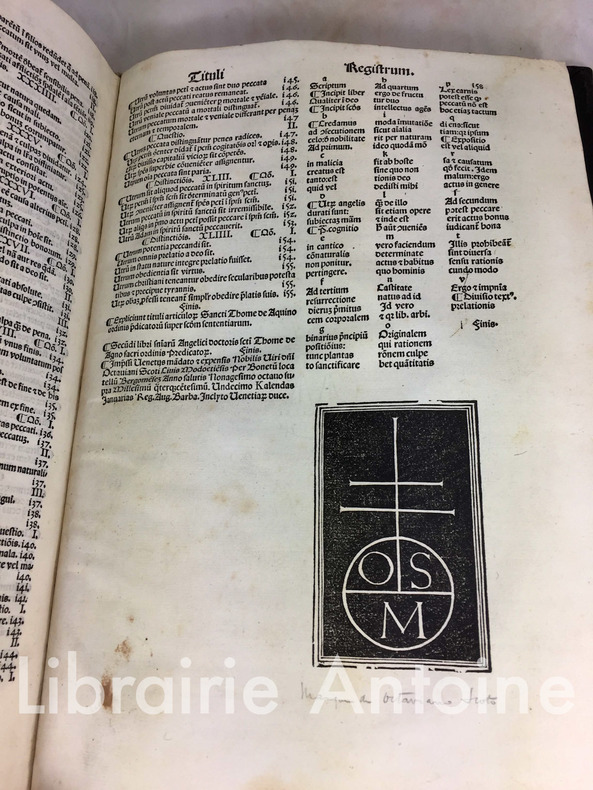
149365208Venedig, Bonetus Locatellus für Octavianus Scotus, 4. Juni 1493. Fol. Mit großer Metallschnitt-Druckermarke am Schluss u. einigen meist schwarzgrundigen Holzschn.-Initialen. 313 num., 5 nn. Bll. (2 Kol., 66 Z., Got. Typ.), HPgmt. d. 19. Jhds. m. marmor. Deckeln u. Schnitt.
149865400Brescia, Jacobus Britannicus, 24. Oktober 1498. Fol. Mit einigen Holzschn.-Initialen. 32 nn. Bll. (Rom. Typ., 45 Zeilen), Ppbd. d. 20. Jhds. m. Rückentitel.
1492D16270Venice: Hieronymus de Paganinis 1492. Hardcover. Very Good. 7 September 1492 from colophon: “Impressa vero in felici Venetorum ciuitate sumptibus et arte Hieronymi de Paganinis Brixiensis. Anno gratie millesimo quadrigentesimo nonagesimosecundo. Septimus Idus septembris.”. 8vo 170 x 120mm. 510 leaves of 552 lacking the Interpretation of Hebrew Names 41 leaves at the end and final blank. Signatures: A10 a-z8 aa-zz8 A-P8 Q12. Title printed with “Biblia” in gothic letter in upper margin above rectangular woodcut of St. Peter holding keys within double ruled border captioned “Tu es petrus” later hand coloring to halo and garb of Peter. Title verso with the “Tabula alphabetica historiarum Bibliae” compiled by Gabriele Bruno. Text printed double column index in triple column 50 lines to a full column printed in gothic type with red rubrics and headings rubricated versal initials alternating red and blue ink printed marginal citations throughout. Modern vellum yapped edges endpapers renewed; register and first few leaves of prologue little frayed to the margins some light dampstaining near end only light intermittent stains edges lightly browned annotations trimmed close in few margins and few minor marginal repairs otherwise a sound and solid incunable edition of the Biblia Latina retaining the inaugural woodcut. Scattered period Latin annotations and manicules in margins occasionally repeating a word in Scripture like “Patientia” or names of the biblical persons from text “Helias” “Jezebel” or “Joab” and names of kings and their sons are also curiously given much attention writing in more lengthy memory devices for their relationships “Roboam filius Salamonis rex in Juda” – all seemingly the work of one scholar and another cancelled early inscription on A9 perhaps the name “Carolii”. Overall studied and plenty in inscriptions some annotations in Jerome’s prologue and later books are written in red <br />ink. This is the second octavo edition of the Latin Bible printed in Venice in 1492 containing the corrections by the Franciscan scholar Pierangelo da Montolmo named in the robust colophon as “Petrus Angelus de Monte Ulmi”; supposedly a folio edition was issued this <br />same year by the same printer Girolamo de’ Paganini or “Hieronymus de Paganinis” though not found in standard references. The earliest octavo edition of the Latin Bible also known as the “poor man’s Bible” was printed in Basel by Froben in 1491. This Venetian octavo <br />edition is the first Latin Bible to include the “Tabula alphabetica historiarum Bibliae” an alphabetical table of contents compiled by the Franciscan Gabriele Bruno or Brunus in 1489. It is also the earliest printed Bible to display a woodcut on the title – printers of <br />Bibles had previously avoided title pages to best imitate manuscript sources. This 1492 edition was reprinted in 1497 and corresponded closely to the Brescian edition of 1496; the more common 1497 reprint reused the St. Peter woodcut but omitted “Biblia” on the title page. The woodcut’s caption “Tu es Petrus” You are Peter is the formula spoken at papal coronations and the words have long been associated with arguments for papal authority. Interestingly Pope Alexander VI was ordained into the papal office the month prior to this printing on 11 August 1492. Corrected editions of the Bible abounded during the Renaissance a period of intense and progressive scholarship and increasing publishing opportunities; this edition is distinctly associated with Franciscan study and use and made revolutionary efforts to organize the Bible with Bruno’s new contents list. The new “pocket-sized” Bible was an easier and more affordable format to disseminate Scripture. Travelling clergy would have especially benefitted from its portability. This copy interesting for its somewhat heavy Latin marginalia dating closely to the period of the printing; the eager reader names biblical persons of interest and contemplates their genealogical relationships throughout. ISTC 594000. <br/><br/> Hieronymus de Paganinis hardcover books
14983237Venise Bonetus Locatellus pour Octavianus Scotus 1498 In-folio, 157 sur 158 feuillets chiffrés (manque le f. 76), reliure en maroquin noir sur ais de bois, plats décorés à froid d'un double encadrement de fers répétés et soulignés d'une double paire de filets, au centre alignement de deux fers répétés, traces de fermoirs, dos à nerfs, gardes en vélin de réemploi d'un manuscrit liturgique (missel ou évangéliaire) du XIIème siècle.
149565314Basel, Johann Froben, ?M.cccc.xcv. sexto Kalendas Novembres? (d. i. 27. Oktober 1495). 8°. Mit einem fast ganzs. Textholzschnitt. 508 nn. Bll. (Bl. A1 weiß; Got. Typ., 2 u. 3 Kol., 54 Zeilen, rubriziert u. mit Initialen in Rot u. Blau), Ldr. d. 16. Jhds. a. 4 Bünden m. 8 Eckbeschlägen, 2 Mittelstücken u. 2 kl. Metallsternchen, marmor. Schnitt.
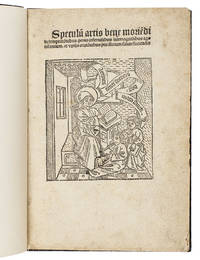
1495ABC_47543Cologne: Heinrich Quentell 1495. Recent marbled paper over boards by the Geneva bookbinder Jean-Luc Honegger b. 1953 who set up his atelier ca. 1978 signed with his honegger stamp in blue ink at the foot of the back paste-down sewn on 3 recessed supports the marbled paper in an antique spot pattern see Wolfe 162-163 with black spots on unusually fine-grained grey Stormont spots and with veins in red turquoise orange dark blue and white black morocco spine label with the title in gold roman capitals reading up the spine. Small Chancery 4to 20.5 x 14.5 cm. With a large woodcut 10.0 x 8.8 cm on the title page: depicting a teacher Pope Gregory the Great ca. 600 CE declared a saint in 1295 with a dove on his shoulder his attribute seated behind a lectern with an open book instructing two of his pupils seated before him each with a book in his hands with above them a scroll inscribed Accipies tanti doctoris dogmata sancti. Set in a single column with 36 lines to the page in a rotunda gothic type Quentell type 7 here 79G though in the Typenrepertorium 80G with a larger textura gothic for the first line of the title Quentell type 10 155G though the only capital in that line is the 8 mm lombardic initial S Quentell initials e described as 6/7 mm but noting that they are used with type 10. With spaces left for manuscript initials 1 6-line and many 3-line a few - mostly on b1v and b2r - with manuscript guide letters in black ink. Most pages with a few words underscored in black ink. Quentells second quarto edition of the well-known manual on the art of dying in the original Latin matching his ca. 1493 quarto edition almost line for line and using the same woodcut quite different from any used with this text before that date. Quentells quarto editions contain the original long version of the text known as Speculum artis bene moriendi often attributed to Matthaeus de Cracovia or Albertus Magnus editions in Italian are often attributed to Dominicus de Capranica Cardinal of Fermo. The Ars moriendi was one of the earliest incunabula printed and consists of two related Latin texts written around 1415 and 1450 offering guidance on how to have a good death according to Christian beliefs of the late Middle Ages. The texts were written in response to the Black Death and social upheavals of the 15th century with the earliest versions likely composed in southern Germany. The highly popular Ars moriendi was translated into many West European languages and was the first in a tradition of guides to death and dying. The first edition in the original Latin appeared ca. 1474 but was preceded by a German edition in 1473 and perhaps by an edition in Italian described as ca. 1471/75. Quentell published the Latin text together with other works in a folio edition described as ca. 1484/89 but he published four quarto editions of the Ars moriendi alone described as ca. 1493 the present ca. 1495 ca. 1498 and another probably after 1500. He published no Ars moriendi editions in vernacular languages. His first three quarto editions have the same collation but the present edition matches the ca. 1493 edition almost line for line and uses the same woodcut while the ca. 1498 edition differs considerably and uses a different woodcut.Heinrich Quentell one of the greatest early Cologne printer-publishers issued many theological and philosophical texts for university use but also liturgical texts working both alone and with Johann Helman who may have also jointly employed contract printers and dispatched servants to sell books. Quentell was one of the first printers to consistently provide his books with title-pages with approximately 91% of his over 380 publications including one.Quentell used the present Magister cum discipulis-woodcut in several other editions including the Heymericus de Campo Promptuarium argumentorum 1492 GW 12406 and Jacobus van Gruitrode Speculum aureum animae peccatricis 1493 GW M10728. Wynkyn de Worde used a copy in his Parabolarum Alani cum commento 1508 STC 254.3 and other printers copied it as well.All Quentells Ars moriendi editions are undated and the present one used his types 7 and 10 and initials e which all apeared in his books in the period 1488 to 1500. The present edition is probably dated ca. 1495 in the literature because it appears to fall between the two quarto editions thought to date from ca. 1493 and ca. 1498.The bookbinder Jean-Luc Honegger still active today is best known for his bindings for the Bibliothèque Nationale de France in Paris and the Bodmer Foundation near Geneva. With the bookplate of the Bibliotheca Philosophia Hermetica Joost Ritman in Amsterdam and probably bound for them. Slightly browned water stains at the foot of a few leaves not approaching the text some smudges in the margins and on the blank final page. The binding slightly worn at the extremities and with a few unobtrusive scratches on the back board. Otherwise in very good condition and only slightly trimmed about 5 mm at the head and probably no more at the fore-edge and foot giving generous margins about 2 3 and 4 cm at the head fore-edge and foot respectively and some leaves with tranchefiles at the foot.l Bibliothèque Nationale Catalogue des incunables A598; BMC I p. 294; Bod-Inc A449; Bohonos Szandorowska Incunabula quae in bibliothecis Poloniae asservantur 562; BSB-Ink A766; Buffévent VIII 45; Goff A1098; Günther Wiegendrucke der Leipziger Sammlungen 781; GW 02610; HC 14911; ISTC ia01098000; Madsen Kongelige Biblioteks inkunabler 352; Ohly-Sack 274; ÖNB-Ink A483; Pell 1339; Polain 972; Proctor 1425; Sack Freiburg 306; Sallander Uppsala 2046; Schramm VIII 484; Schreiber Manuel de lamateur de la gravure sur bois et sur métal au XVe siècle 3671; Thienen Incunabula in Dutch libraries 425; UBL-Ink A354; USTC 739947; Voulliéme Die Buhdrucker Kölns 305; Voulliéme Inkunabeln der Königlichen Bibliothek 1011; Voulliéme Trier 697. Heinrich Quentell, hardcover
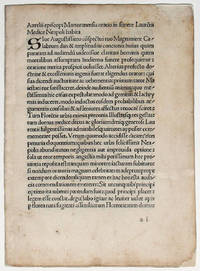
14922680<p>4to. 20.5 x 15 cm 4to. 20.5 x 15 cm 8 ff. rather dog-eared at edges and with some light soiling. Disbound in a cloth-covered box.<br /></p><p>Rare first edition of this funeral oration for Lorenzo de Medici read in Santa Maria Nuova on 16 April 1492 evidently the only contemporary printed oration of the many delivered and printed in his honor to survive.</p><p>"Lorenzo de' Medici… born January 1 1449 Florence Italy—died April 9 1492 Careggi near Florence Florentine statesman ruler and patron of arts and letters was the most brilliant of the Medici. He ruled Florence with his younger brother Giuliano 1453–78 from 1469 to 1478 and after the latter's assassination was sole ruler from 1478 to 1492." Brittanica.com</p><p>The present publication is the sole oration devoted to Lorenzo in the Short-Title List of Funeral Orations from the Italian Renaissance Ca. 1374-1534 compiled by John McManamon and the only printed example featured in the 1992 exhibition at the Bibliotheca Nazionale Centrale <i>Lorenzo dopo Lorenzo La Fortuna Storica di Lorenzo il Magnifico. </i>Notwithstanding the poor survival rate of ephemeral publications and the controversial character of the <i>laudandus</i> the statistic remains remarkable. The motive for the present oration was overwhelmingly political and meant to insure continuation of the traditionally strong alliance between Naples and Florence at a difficult time of dynastic transition. According to Miglio <i>DBI </i>X.369-70 the work was published before it was read.</p><p>A Naples edition was published the same year from the press of Cristannus Preller IGI VI.1722-A. The work was re-published in the 19th century by Vito Capialbi <i>in Memorie di R. Zeno e A. Bienato</i> Naples 1838 49-86. Milanese born Aurelio Bienato was Reader in Rhetoric at the University of Naples 1470-80 and later elected Bishop of Martirano modern Catanzaro in which sinecure he remained until his death. Miglio also lists an unpublished commentary on Quintilian <i>Iter Italicum</i> I.415-16 II.570 and a collection of Latin verses <i>Elegantiarum epithomata</i> an epitome of Lorenzo Valla's <i>Elegantiae linguae latinae</i> which went through a number of incunable editions 1479/80; 1488; 1491. </p><p>US copies ISTC: Huntington Newberry and Yale. </p><p>Provenance: Ritman copy.</p>Goff B-667; BMC vi.784; GW IV.1346; Paolo Pira ed. Lorenzo dopo Lorenzo. La Fortuna Storica di Lorenzo il Magnifico Florence Biblioteca Nazionale 1992 I.24; John M. McManamon Funeral Oratory and the Cultural Ideals of Italian Humanism 1989 p. 256 & 41-43. Phillipus de Mantegatiss
149565636[Paris, Pierre Le Dru für] Jacques Moerart, o. J. (um 1495). 8°. Titel m. einer fast blattgr. Holzschn.-Druckermarke. 95 (statt 96, fehlt das letzte weiße) Bll. (Got. Type, 32 Zeilen, rubriziert), Brauner Maroquin-Bd. d. frühen 20. Jhds., der Vorderdeckel m. grünen Intarsien u. reicher floraler Vergoldung, Rücken-, Deckel- u. Innenkantenverg., goldgepr. Rückentitel u. Goldschnitt.
1497WB19676Strasbourg: Johann Reinhard Grüninger 26 April 1497. Hardcover. Very Good. Chancery Folio; 304 x 207mm; 490 leaves of 492 lacking blank Z6 and the final leaf of the table; a bifolium from gathering B is bound in A. It features red and blue Lombard capitals with a woodcut depicting Saint Jerome on the title page. The first bifolium has undergone extensive repair work at the gutter and outside edges with the first leaf being soiled chipped and laid down on new paper. Throughout the volume there are smaller repairs and tears with one larger tear that has been repaired affecting the text on page ss2. <br /> <br />Dampstaining and some soiling are present particularly at the ends and there is worming affecting some of the text. The final leaf has been heavily repaired resulting in loss of text at the outer edge. The book is bound in modern black blindstamped morocco with clasps in a style reminiscent of the period with gilt edges showing some signs of wear. The provenance of the book includes extensive marginalia with an inscription indicating it belonged to Georgius Wenceslaus Pastor of Olbersdorf dated 1635 who acquired it from Samuel Ursinus. <br /> <br />A Bible printed by the prolific Strasbourg printer Johann Reinhard Grüninger replete with annotations credibly by Georgius Wenceslaus the Lutheran pastor who served in Olbersdorf a town in the historical region of Silesia which is now part of modern-day Poland. It features a woodcut on the title page portraying Saint Jerome depicted both in contemplative study and in prayer at the foot of the cross. <br /> <br />HC 3122; BMC I 111; BSB-Ink B-476; GW 4277; Bod-inc B-308; Goff B-600; ISTC ib00600000. Uncommon in commence. <br/><br/> [Johann (Reinhard) Grüninger,] hardcover
1493700DBNürnberg, Anton Koberger, 23. Dezember 1493. Folio (44,5 x 32 cm). (10), 286, (1) Bl. Mit 1980 teils wiederholten Holzschnitten von Michael Wohlgemuth, Wilhelm Pleydenwurff u. a. (einige Holzschnitte koloriert). Späterer Halblederband auf Holzdeckeln mit 2 Metallschliessen (neu aufgebunden mit erneuerten Vorsätzen).
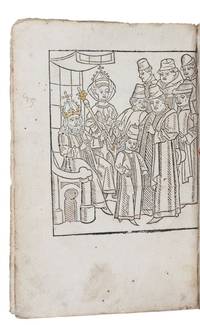
14805273Gouda: Gheraert Leeu 1480. Contemporary limp sheepskin parchment without a spine so that the sewing is completely visible. Kept in a modern brown half morocco clamshell box. 4to 20.5 x 14 cm. With 4 full-page woodcuts plus 14 repeats. The first shows King Pontianus on his throne the Queen standing next to the throne and the seven wise men standing before them with one telling a story. The last shows the same group but with the king's son Diocletianus telling his story The other two show in one case a wise man and in the other the queen telling a story to the king and are used for various stories. That with a wise man has scroll with an opening where type is set to indicate which wise man is speaking. The first illustrated edition in any language of one of the oldest and most popular texts of early European literature. It is also the first illustrated book printed by Gheraert Leeu just before his better-known Dialogus creaturarum. No copy of any edition before 1483 in any language is recorded in a Dutch library. Known in English as The seven sages of Rome it is a series of educational short stories within a "frame story" in the tradition of the Indian Panchatantra the Arabian Nights etc. and some of the stories are variations on stories told there. These stories were first published in Latin at Cologne in 1472. Leeu probably published the first edition in the Low Countries in Dutch with only a single woodcut dated 25 July 1479. That edition is known only from two incomplete copies. His present Latin edition must date between that and 3 June 1480 so it is not clear whether it preceded the unillustrated Deventer edition of 1479 or later. Our copy is preserved in its original limp parchment and only very slightly trimmed giving wide margins 1.5 4 and 5 cm. With 8 early owners' inscriptions one dated 1579 and others clearly older four small and mostly marginal worm holes running through the first leaves and the usual traces of age and handling. The parchment is stained and slightly wrinkled. Nearly untrimmed and in good condition.l Campbell 947; Goff S-448; Goudriaan Een Drukker zoekt publiek. Gheraert Leeu te Gouda 1477-1484 list of publications no. 46; Hain 3000; ILC 1952; ISTC is00448000 7 copies; Klebs Incunabula 906.4; Kok Woodcuts in Incunabula printed in the Low Countries 69. 1-4; Polain 1970; Van Thienen & Goldfinch 1952 same 7 copies; Vijfhonderste Verjaring Boekdrukkunst Nederlanden 127 with. ill.; not in BMC STC Dutch; Incunabula in Dutch Libraries; Gheraert Leeuw exhibition at Gouda 1992; cf. Lexicon des Mittelalters VII pp. 1836-1839. Gheraert Leeu, unknown