426 résultats
Very Good Turkish, Ottoman (1500-1928) Full leather new bdg. Original illustrated cover saved inside. Roy. 8vo. (24 x 17 cm). In Ottoman script (Old Turkish with Arabic letters). [12], 166, [2] p., b/w and color plates of Ottoman warships and scenes from naval wars, seven maps of the earliest examples of Ottoman cartography. Very rare second edition of this book on the history of Ottoman naval wars against Venetians began with the Crete campaign (War of Candia) in 1645 and lasted for years until 1656. The book was published first in 1729 in Müteferrika Printing House which was the first printing house in the Islamic world as the third printed book. This is the second edition including five maps of almost the same size (two paged) titled world map, The Mediterranean, The Archipelago (Aegean), The Adriatic Sea, and the compass-like in its first edition as well as two maps and twenty-six plates (some of them are color) and small illustrations of Ottoman ships as head of some carriage returns. Additional maps depict the city of Venice (from Kitab-i Bahriye [i.e. Book of Navigation) and the travels of Ottoman Admiral Sidi Ali Reis through the Sea of Oman. The Cretan War or the Fifth Ottoman-Venetian War, was a conflict between the Republic of Venice and her allies (chief among them the Knights of Malta, the Papal States, and France) against the Ottoman Empire and the Barbary States because it was largely fought over the island of Crete, Venice's largest and richest overseas possession. This account of Ottoman maritime warfare in Turkish, written in Safer 1067/November 1656. This date places the book in a moment of utmost danger for the Ottoman capital following the defeat of the Ottoman navy at the hands of the Venetians at the Dardanelles (4 Ramadan 1066/26 June 1656) and the subsequent loss of the islands of Lemnos and Tenedos. It is also written shortly after the appointment of Köprülü Mehmed Pasha as grand vizier (25 Dhulqada 1066/14 September 1656). Thus it is suggested to read it as a program of reform of the navy intended for a person whom Hadji Khalfa might have seen as the "man of the sword" who might revert the fate of the Empire. Of the four ulemâ [i.e. scholars] who wrote endorsements for the book, two are closely related to the Köprülü family. The first part is a history of Ottoman maritime campaigns from the beginning to 1067/1656, while the second is a systematic description of naval affairs, from administration and offices to shipbuilding, culminating in a list of 40 suggestions for the organization and strategy of the Ottoman navy, including the use of recent scientific and technological innovations. Thus the juxtaposition with history provides an argument for reform. Suggestions are largely centered around the traditional qanun-i qadim; there is no reference to high-board ships. The final pages include an important discussion of historical causality, explaining how divine omnipotence creates the consequence of historical causes, in reward for the righteous rule, or punishment of injustice. (Source: Ottomanhistorians). Özege 21273.
4to, [iv],10pp., 5 photographic plates, orig. printed wrappers bound-in, cloth-backed marbled boards. Illustrations of some examples of type used in incunabula attributed to the Press at Marienthal. Tipped-in at the back: HENNEN (Dr.) Unbekannte und Unzul?nglich Gew?rdigte Marienthaler... Otto Harrassowitz, Leipzig. 1887. 12pp., orig. upper wrapper.
Very Good Greek, Modern (post 1453) Original b/w city map of Byzantine Constantinople printed in 1936, Noemvrios (November). Oblong: 32x46 cm. In Greek (Modern). Folded. Scale: 1:2000. [GREEK MAP of BYZANTINE CONSTANTINOPLE] Byzantion Konstantinoupolis: To petrion kai ta peristh autou. Khartis topographikos - arkhaiologikos ikpointheis kai katartistheis upo Misn. It show Haliç (The Golden Horn) section and shores of Constantinople.
8vo (225 x 140 mm), xxiii, [1], [3]-343, [1]pp.,, 8 lithographed plates (5 folding), later calf brown morocco, uncut, t.e.g. a nice copy. Scarce sale catalogue of the large celebrated collection of incunabula (mainly from German presses) and manuscripts gathered together by Professor Kloss, a physician from Frankfurt, built on the collections of Johannes von Dalberg, Bishop of Worms, Adelmann von Adelmannsted and the Church Library at Essligen. 4,682 lots. Provenance: From the reference library of E. P. Goldschmidt with initials stamped in gilt at base of spine. De Ricci, p.117.
18153015Vers 1815 1815 Inventaire manuscrit vers 1815 d’une bibliothèque privée sans doute de la région de Limoge.Feuillets de différents formats assemblés en désordre, 18ff« Voici donc en abrégé et par ordre des matières le tableau sommaire en différents genres des ouvrages (…) tels qu’ils sont classés et placés par doubles rangées de chacune des tablettes de ladite grande armoire. »« De main gauche, dixième tablette deuxième rangée de livre mélange de vieilles brochures et imprimés, première rangée sur le fond et l’arrières, vieux ouvrages en parchemin.Deuxième tablette : inventions, secrets et jeux récréatifs, sept volumes en parchemin.« Magasin des modes françaises et anglaises. Plan généalogique de fortifications de guerre (plus loin) collection informe et dévastée (aujourd’hui sans ordre), mais considérable et précieuse en ce qu’elle est composée d’un très grand nombre d’estampes et gravures anciennes et de différents genres de la main d’hommes alors célèbres dans l’école. Les unes et les autres enfermées comme enfouies pèle et mêle sous des cartons multipliés et de différentes grandeurs et formats. "
179328478Québec De l'Imprimerie de Jean Neilson 1793
1791109402Couverture souple. Un volume broché in-octavo, VIII pages + 475 pages. Couverture muette d'époque avec étiquette manuscrite, Petit manque au dos. Légèrement défraîchi. Marges poussiéreuses.
611Document signé F.-X. Larue, notaire public. Neuville, 4 juin 1812. In-f (26.3cm) 3 p. en partie inprimées. Endos manuscrit. Très bel état, sauf pour quelques points de rousseurs. [ Expédition pour le seigneur. Concession de 7 arpents de terre par Messire Charles Joseph Brassard Deschenaux, prêtre vicaire général de Québec et seigneur de Neuville, tant en son nom que comme tuteur de deux enfants mineurs de Guillaume de Lorimier et de feue Magdelaine Deschenaux, à Pierre Mailloux, résident du village de Cap-Santé, pour la somme de 12 livres 6 sous tournois de rente seigneuriale et 6 sols de cens annuels. DBC VI, p. 92-93: Brassard Deschenaux, Charles-Joseph (1752-1832) prêtre, vicaire général, seigneur, fils aîné de Joseph Brassard Deschenaux, secrétaire de l'intendant François Bigot. Il possédait une bibliothèque qui comprenait 2,200 volumes, dont des Diderot, Buffon, Rousseau et Voltaire, « à sa mort disparaissait l'un des derniers prêtres issus des grandes familles de la fin du Régime français. Frère du notaire, avocat, fonctionnaire et juge Pierre-Louis Brassard Deschenaux ». Bon document de l'époque seigneuriale considéré comme « incunable canadien » pour sa partie imprimée pré 1820, probablement imprimé à Québec chez John Neilson. Reflète la modernité d'un fin lettré qui avait à administrer les seigneuries de Neuville, de St-Michel, de Livaudière et partie de Bélair et de Beaumont, qu'il hérita à la mort de son père avec ses frères et soeurs en 1793.]
524674me année - N° 32 - Janvier 1890 - Paraît le 20 de chaque mois - in-8 broché
186022830Paris, L. Curmer (Lyon, Louis Perrin), 1860-1861 ; 4 volumes petit in-8°, demi-maroquin cerise poli, à coins, dos à 5 nerfs, titre doré, plats de papier peigné à la cuve, tête dorée, gardes intérieures de papier vieil or semé de lions héraldiques inscrits dans un cercle.
1566WRCAM54413Mexico: Antonio de Espinosa 1566. 440416 leaves with several woodcut illustrations and woodcut initials throughout. Small thick quarto. Contemporary vellum with yapp edges remnants of vellum ties at fore-edge. Light wear and soiling to vellum endpapers renewed. Small marca de fuego on top edge. Moderate wear to initial leaves moderate worming in lower corner and occasionally along lower margin all expertly repaired slightly affecting only a few printed marginalia and catchwords. Light tanning and occasional foxing. A very good copy overall. A very rare complete and substantial example of early Mexican printing. This work was produced and published by Antonio de Espinosa the second printer in the New World after Juan Pablos and is one of the most considerable efforts of his career in Mexico. Espinosa was brought to Mexico by Juan Pablos as an assistant and type cutter in 1550 and he eventually broke Pablos' monopoly and began printing for himself in 1559. The present work printed in 1566 is one of only a handful produced in Mexico during that decade and is one of the initial books of the Mexican incunable period. <br> <br> The text itself is the first edition of a religious work by Bartholomé de Ledesma explicating church sacraments in great detail later reprinted in Salamanca in 1585. The work is split into six parts. The first discusses the sacraments generally and the ensuing five treat individual sacraments in depth. Ledesma was a key figure in the early Mexican church as a close advisor of the second Archbishop in the New World Alonso de Montúfar and the chair of theology at the nascent University of Mexico founded in 1551. He was also one of the foremost proponents of book censorship and prohibition in New Spain and vigorously investigated private libraries and booksellers for forbidden materials and was responsible for the destruction of many volumes. He later became the Bishop of Oaxaca a position in which he served until his death in 1604. <br> <br> Overall the work is a fine example of the sophistication which Espinosa brought to early Mexican printing. The titlepage contains a fine coat of arms that of Archbishop Montúfar and the section on marriage sacraments includes several finely executed woodcut diagrams of consanguinity. The text is printed elegantly in a Roman type which Espinosa had introduced to New World printing with printed marginal notes in italic and woodcut initials throughout. Below the colophon is an excellent example of Espinosa's printer's device the first used on any book produced in the Americas. In his 1940 census of Mexican imprints Wagner located twelve copies of this work and over seventy-five years later OCLC adds only three more. It appears just four times in auction records of which one copy was incomplete. <br> <br> A rare desirable Americanum printed by the second printer in the New World and one of the earliest Mexican incunabula still obtainable. ICAZBALCETA 47. MEDINA MEXICO 50. PALAU 134124. SABIN 39677. WAGNER NUEVA BIBLIOGRAFIA MEXICANA 47. Antonio de Espinosa hardcover books
883381861-1888, demi-basane, divers documents reliés ensemble, reliure en mauvais état, un feuillet détaché (sans manque), un page manuscrite en fin de volume, quelques rousseurs sur les pages.
192797291927 Paris et Bruxelles : G. Van Oest, 1927-1930. 2 volumes grand in-4,brochés,130 planches hors-texte dont 104 en couleurs, couvertures conservées. Bel exemplaire. Edition tirée à 650 exemplaires numérotés sur papier à la cuve des papeteries d'Arches. Superbement imprimée par l'Imprimerie nationale, elle est illustrée de nombreuses planches en héliochromie réalisées par D. Jacomet
First Edition, 4to, viii,[2]259 + [1, errata]pp., bookplate of Charles W.G. Howard including the words "Gift of The Rt. Hon. Sir David Dundas of Octertyre, 1877", full calf, burn mark on upper cover, spine rubbed. "Johann Friedrich Lichtenberger was a professor in the Academy of Strasburg. His works maintain the claims of Gutenberg at the first printer, and are characterised by much patient research." - Bigmore & Wyman I, p.438.
4 Vols., 4to, over 2740pp., orig. cloth. Reproduces the catalogue cards of the ca. 16,000 items in this very important collection. Some of the many subjects include: incunabula, curiosities of bookmaking (such as chained books), modern fine printing, history of paper, type specimen books, printing manuals, graphic design, trade catalogues, binding, and much more.
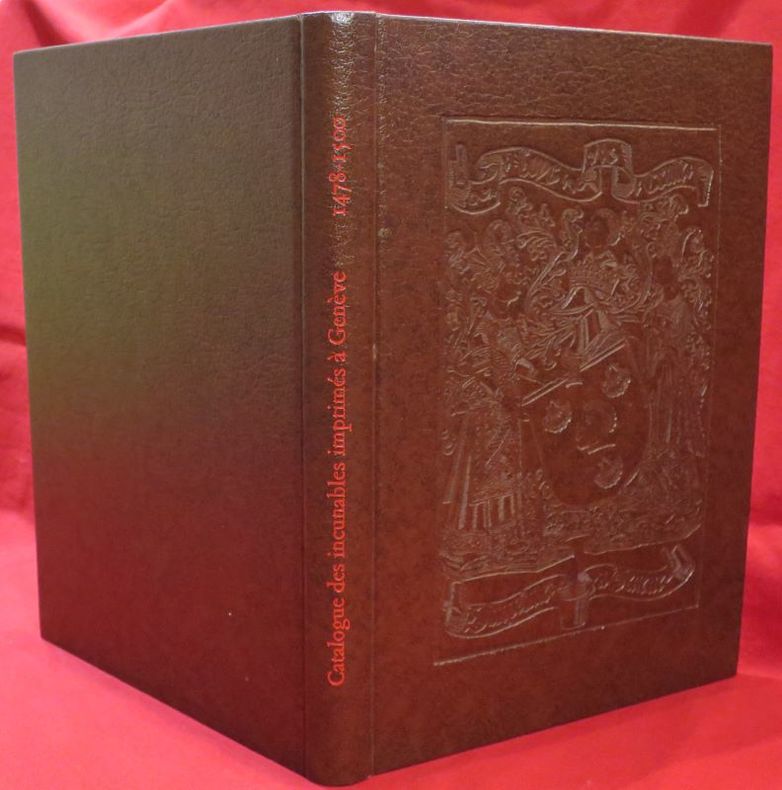
105174Bibliothèque Publique et Universitaire de Genève, 1978,1 volume in-4 de 272x192x20 mm environ, 206 pages, reliure de l'éditeur, décor à la plaque sur le premier plat, nombreuses illustrations n & b et couleur, bon état.
101.745Paris, Firmin-Didot, 1886. 15 x 25, 270 pages, 221 figures, 1 chromolithographie, reliure d'édition plein cuir, dos richement orné de fers dorés, plats : encadrements gravés à froid, 3 tranches dorées, très bon état (pas trop de rousseurs dans l'ensemble).
4to (270 x 180mm), [6]pp., with introduction followed by 41 ff. in exact facsimile, one of 250 copies, orig. vellum-backed boards, vellum label on upper cover, uncut.
192012291920 broché in-octavo, dos gris - manque de papier en haut et en bas, couverture illustrée, illustrations : 40 planches noires hors-texte, 372 pages, 1920 London Maggs Bros Dealers in Fine and Rare Books Prints and Autographs,
1515AMO-4519Venundantur Parhisiis in edibus Johannis Petit sub lilio aureo. [Impressus Joannis Barbier.] Impensis Johannis Petit bibliopole Parisiensis. Anno Domini millesimo quingentesimo decimoquinto. Pridie Kalendas Decembris [30 novembre 1515] 108-[92] f. (sign. a-z8, [-]8, [-]8) ; in-8° (collationné complet) Suit l'édition de 1511 imprimée par J. Barbier pour J. Petit (Renouard, ICP, II, 155). Matériel typographique de Jean Barbier. Texte sur 2 col. caractères gothiques, titre en rouge et noir, marque au titre. Références : Renouard, ICP, II, 1169. Renouard, Imprimeurs, III, p. 173, n° 238. Relié à la suite : Quadragesimale opus declamatum Parisiorum urbe ecclesia sancti Johannis in Gravia : per venerabilem patrem Sacre Scripture interpretem divini verbi preconem eximium : fratrem Oliverium Maillardi ordinis fratrum Minorum. Parisius sub eodem recollectum : ac novissime magno labore correctum impressionique traditum. Anno. M. CCCCC. XV. (Et per quendam... impensis vero honestiviri Johannis Petit bibliopole Parisiensis impressorum. Anno M. CCCCC. XVI. Dievero. XXV. mensis. Maii.) [1516] 174-[4] f. ; in-8° (collationné complet). Même pagination que l'édition de 1506 ou 1508 (Jean Barbier pour Jehan Petit également). Texte imprimé sur deux colonnes, caractères gothiques. Relié à la suite : Passio Domini nostri Jesu Christi a reverendo.p.Oliverii Maillard Parisius declamata. (Paris,) : J. Petit, (1519) | Paris : [Michel Lesclancher, imprimeur] : Jean Petit (libraire), Sans date [circa 1519] Sign. A-B (16 feuillets) ; in-8° (collationné complet) Daté d'après la marque de Jean Petit au titre (Renouard, Marques, n° 883). - Caractères gothiques à 2 colonnes. Référence : Renouard, ICP, II, 2136. Haebler, IV (marque de J. Petit) Renouard, 883 (marque de J. Petit) ; BP16_103799 (Bibliographie des éditions parisiennes du 16e siècle); Localisation d'exemplaires dans les fonds publics : Lausanne, BCU London, BL Oxford, BL. Ensemble 3 ouvrages reliés en 1 fort volume petit in-8 (162 mm x 100 mm | Hauteur des marges : 157 mm). Exemplaire avec de bonnes marges. Reliure plein veau brun glacé, dos lisse, filets dorés, titre doré "MAILLARD // SERMONS", doublures et gardes de papier marbré, tranches dorées. Roulette à froid en encadrement des plats. Reliure exécutée dans les premières années du XIXe siècle (sans doute pas après 1825). Reliure fraîche malgré quelques marques et frottements sans gravité, intérieur d'une grande fraîcheur totalement dépourvu de rousseurs, papier bien blanc. Première page de titre légèrement salie. Cachet sur le premier titre (bibliothèque Jean-François [-René-Marie-Pierre] de Kergariou (1779-1849)). Quelques faibles mouillures sans conséquence et peu visibles.
An outstanding catalogue. 1 leaf; XIV, 498 pp plus 3 full-page plates. 614 incunables described in great detail. 4to. Original wraps. Uncut and unopened. FINE AND BRIGHT, with no defects.
180627526Quebec Imprimé à la Nouvelle Imprimerie 1806
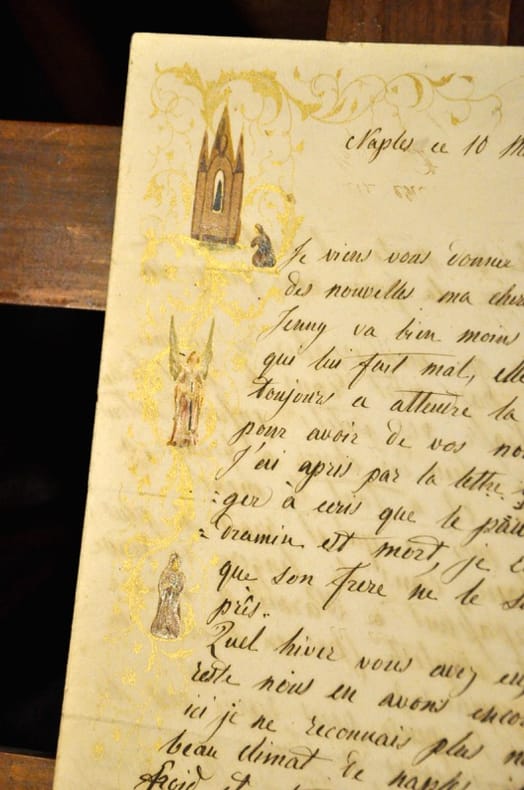
3018Naples, 10 mai 1850. Très belle lettre écrite sur un petit bi-folium, agrémenté en marge d’une grande composition à l’or et de trois aquarelles dans le style troubadour : Un personnage en prière devant une église, un ange et une sainte femme (pochoir et aquarelle). Une charmante lettre adressée à sa « chère Grum », le climat de Naples n’est pas clément, « Le Roi a ete bon pour eux il a permis a Adinolphe de porter l’uniforme de Husard de la garde vous pensez sa joie », suivent quelques nouvelles domestiques. Très beau document dans l’esprit néo gothique cher à la Duchesse.
First Edition, folio, viii, 72pp.,, ex-library, 6 folding plates, 8 tables on 6 folding leaves, orig. cloth-backed boards, uncut.