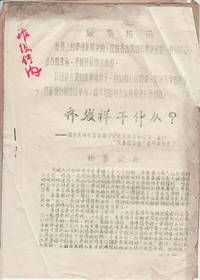
武鸣县直革联. [WUMING XIAN ZHI GE LIAN].Biblio.com
26 619 résultats
1967159598Guangxi Province.: No publisher. 1967. Chinese Cultural Revolution propaganda pamphlet includes three articles exposing the former Secretary of CPC County Committee 齐发祥 Qi Faxiang his allies 李国祥 Li Guoxiang and 县委揭斗会 the Revelation and Denunciation Meeting of County Committee. 6 pp stapled in one place note in red ink upper cover worming with loss on page 3 and page 4 and a little loss at edges a working copy. Text in Chinese. Qi Faxiang and his allies were accused of being three-anti elements. It was claimed that Qi was the person who was responsible for the death of thousands in a political campaign. He was also accused of sabotaging the local People's Commune. The articles reveal that the 县委揭斗会 Revelation and Denunciation Meeting of County Committee are really those who are covering up for the capitalist roaders. . No publisher. unknown
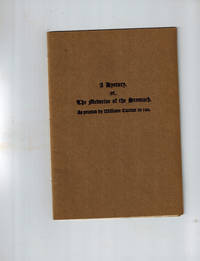
1963005223Oxford England: Bodleian Library 1963. "100 copies handset by Roy Herman Sowers and printed on the old Daniel press in the Bodleian Library Oxford August 1963". Fine in stitched brown wrappers 6 pgs. A small reprint of one of the first medical books published in English. SCARCE. . Limited Edition. Stitched Wrappers. Fine in Wraps as Issued/No Jacket As Issued. 12mo - over 6¾" - 7¾" tall. Bodleian Library Paperback books
19670001018Paris FRANCE: Author Published. Good. 1967. On offer is 'Dossier Solange' by Zwy Milshtein includes two original signed pen and ink drawings. This is a very extraordinary rare set of handmade engravings being the second signed original proofs set "exemplaire no.2" dated 1967 which was never offered for commercial sale together with two original pen and ink drawings both signed and dated 1967 by the artist. The Dossier is comprised of: an outer sleeve/box with hand drawn title treatment and graphic; inner hard cover title shell handwritten and drawn which is a duplicate of the outer hard cover; two original pen and ink drawings not prints signed by Milshtein they are on one page one on either side; on hand made textured art paper 144mm x 172mm twenty-two 22 French-folded pages on handmade hand cut art paper of the four sides of a French-fold there is an engraving front and one page with text and roman numeral thus two blank. Overall size: 282mm x 170mm. Eighteen 18 pages have de-bossed and the odd embossed engravings including the inside cover and text numbered I-XVIII the number V appears twice although it has a different etching on each page. Number XII is omitted. Protective tissue throughout. The text and the eighteen engravings which accompany them together with the cover were all executed by Milshtein. The engravings were hand pressed by the artist and the original pages engraved after printing. The condition is very good with the exception of the spine on the inner hard cover being detached and taped. One or two etchings have very feint foxing spots negligible. BIO NOTES: Zwy Milshtein is well known in France as a painter and as a master at the art of engraving. Milshtein was born in 1934 in Kichinev the area now known as Moldovia. During the World War II his family emigrated to Russia and then later returned to Romania. In 1948 Milshtein arrived in Israel but later moved to Paris in 1955. Since that time he has received great acclaim for his etchings and engravings. Numerous exhibitions in Paris and abroad attest to his artistic skills. In the year 1970 Milshtein had an exhibition at ARC the Museum of Modern Art Paris France. In 1978 a retrospective exhibition of his engravings was held at the Bibliotheque Nationale in Paris. In 1997 his work was featured in the Hans Christian Andersen House project which selected top European artists to create an homage to celebrate the bi-centennial birthday of the famous Danish author. G.; French; 16mo - over 5¾" - 6¾" tall; ART ARTISTS FRANCE MOLDAVIA PRISONER AUTOGRAPH JEWISH HEBREW YIDDISH JUDAICA AUTHOR WRITER HOLOGRAPH SIGNED POETRY POET Hand Drwan Personal Memoir Handwritten hand written autograph autographs signed letters document documents manuscript manuscripts writers writer author holograph Travel personal Americanaantiquité contrat vélin document manuscrit papier Antike Brief Pergament Dokument Manuskript Papier oggetto d'antiquariato atto velina documento manoscritto carta antigüedad hecho vitela documento manuscrito Papel . Author Published hardcover
193652300864Haarlem Netherlands: Uitgave Firma Ruijgrok & Co. 1936. Book. Fair. Paperback. First Edition. 4to - over 9¾" - 12" tall. 125 pages. Circa 1936. Written in Dutch. "Met groot genoegen nam ik kennis van dit werk van mijn oud-leerling L.W. Zweerman en voldoe daarom gaarne aan zijn verzoik het met een kort woord in te leiden." - from Foreword by H. Ellens. Profusely illustrated in both colour and black and white. Well used and soiled copy. Damage at each end of spine. Binding intact. Unmarked. Uitgave Firma Ruijgrok & Co. Paperback
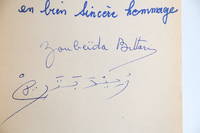
196478009Paris: Gallimard 1964. Fine. Gallimard Paris 1964 14.50 x 20.50 cm broché First edition of which there were no deluxe copies. Preface by Miriam Cendrars. Rare two-color autograph inscription dated and signed by Zoubeïda Bittari to madame Levêque. Gallimard unknown
1948002032New York: Limited Editions Club 1948. Hardcover. Near Fine/good . Lamotte Bernard. xxvi 2 409 1 p. 35 leaves of collotype plates some in color; 29 cm. Burgundy moire silk; oval blue silk spine label with gilt-tooled title. Grey slipcase with burgundy floral pattern. Many pages unopened. This is number 631 of a limited edition of 1500 copies designed by George Salter and printed at the Garamond Press in Baltimore. The illustrations were drawn by Bernard Lamotte and reproduced in collotype by Georges Duval in Paris; signed by the artist Bernard Lamotte. Book is in Near Fine Condition: spine very slightly faded; clean and bright. Slipcase is in Good Condition: top section and edges are browned; top and bottom sections just starting to separate at opening; otherwise solid. Limited Editions Club hardcover
19090008050LOS ANGELES CALIFORNIA. Good. 1909. On offer is an outstanding travel journal written by a young girl in California in the early years of the 20th century. This well-written journal measures 9.25 inches by 7.5 inches and contains 60 pages. It is 60% complete. The cover and pages are in good condition and the handwriting is legible and quite easy to read. Also included is a black and white photograph a map/itinerary and a number of newspaper clippings - all in very good condition. The author is Zola Grace Strawser a 14 year old school girl. Born in 1895 she grew up in Los Angeles where her father Bert was a successful businessman. She had 3 sisters - Nellie Merle and Bertie. Casual research has not discovered any additional biographical information. In July of 1909 she left on a long train trip from Los Angeles to the Worlds Fair in Seattle. Along the way she makes stops in Las Vegas and Salt Lake City amongst other places. She is a keen observer and her descriptions are detailed and well-written. "The train slowly pulled out of the Salt Lake City Station and our long hoped for journey began. Nellie Merle Bertie Papa and Daisy Clark were there to say "goodbye." Daisy Clark gave us our first box of candy and also a beautiful bunch of carnations. The ride to Pomona was not so interesting as we made so many trips to San Bernardino before. Our next stop was Ontario. From Ontario you have a very beautiful view of the mountains which is very interesting. We next passed through Riverside and Coulton and arrived in San Bernardino 12:12. Between Los Angeles and San Bernardino can be seen orange trees and mountains while from San Bernardino is a vast stretch of desert. We then went to lunch and from the window you could see right down between the mountains on which were some snow. I saw an automobile filled with men and for a long time had great fun waving back and forth. They at last got ahead of us. We had to go so slow up a high incline . the rest of the landscape was desert desert desert. ." July 8. In Salt Lake City she visited a number of sites: ". we saw all the important buildings the temple tabernacle the Lion House Bee Hive grave of Brigham Young and the "Eagle Gate" July 9. She goes out to visit Saltair - an amusement park and resort built at the south end of Great Salt Lake. At one time Saltair was the largest and most popular family resort west of New York. Today it is abandoned a victim of shrinking water and the ravages of a changing climate. Each day's entry is accompanied by a small pen and ink drawing representing some remark in the entry. She writes an excellent description of a wedding accompanied by a drawing of wedding bells and music notes and the inscription "No Wedding Bells For Me.: "THE WEDDING: Talk about your presents you ought to have seen Bessie's. Cut glass china silverware well it was enough to make anyone wish it was them getting married. She also received four chairs three tables bedding and linen. The few people assembled to see her married arrived about half past seven. Bessie who was naturally nervous broke right down and cried but as soon as the ceremony was over she was as happy as a lark and was receiving many congratulations. Well while we are waiting for the guests to arrive I will describe the appearance of the house. The rooms were all decorated in carnations roses ferns palms and small trees. On the electric lights were twined smilax and over the globes were different color flower shades. The long porch was made beautiful with small green palms and at the father end a Hawaiian orchestra played the whole evening. The yard which was very large was strung with lanterns of all manner and shapes. There was a wall of canvas all around so as to keep intruders out. The guests have now arrived and the air was sweet with lavender and violet perfume. Ladies with low neck chiffon dresses; with white satin evening coats; ladies with the tight fitting empire ladies in simple white ladies in red pink blue and every imaginable color. In the evening lunch was served and while the bride and groom were eating they threw handfuls of rice at them. Of course their dinner was spoilt and they had to get more dinner. About an hour after the bride and groom were missed and the whole party set out to look for them. The bride was found and the girls who were quite rough drew her across the bed and a hat pin stuck in her and hurt her. Mrs. Brook fought them and Bessie got free again and escaped in the crowd and hid in the cellar. She was so scared and sick that she could hardly stand. She then slipped in the back bedroom and changed her wedding dress for her brother's clothes. There she slipped in the automobile barn until the crowd had gone around the front and slipped over the fence and went in the house next door and mingled with the crowd who did not know her dressed as a boy. Cora the girl next door put on a long black coat and put something over her head. Her brother was waiting in a buggy outside. With one jump Cora was in the buggy and was driving away as fast as possible. The whole party thought it was Bessie and Vic and started after the buggy. Cora's brother had heart trouble and when they were about a block away he fainted and Cora had to drive home with her brother in her arms. When she reached home she fainted and they had an awful time. Of course the crowd found it was not the bride and groom. The bride and groom left for the canyon 20 min. to one. While all the excitement was going on the groom was next door asleep." July 14. After a number of adventures she continues her trip to Seattle and the World's Fair: "In the morning Irene mother and I went to the fairgrounds. I can't very describe how they look only by showing you postcards. They have an imitation geyser which goes up and down all the time. "The Cascades" are simply beautiful. You can stand at the top and look right over the falls and the geyser and see Mt. Rainier. The buildings are all white and the flowers are beautiful. In the evening we went to a show and saw the smallest woman in the world "Princess Checita" July 31. We again went to the fair and visited many buildings. Our feet were just covered with blisters from all the walking up the hills. Mama isn't feeling well. She is lonesome for papa. Aug 1 "As this was to be our last day at the fair we visited all the buildings we had not seen before. In the government building were articles from the "Dead Letter Office." Skulls snakes a pig's tail money jewelry a bustle the hair of a woman who had been scalped guns swords and all manners of weapons beads small funny statues locks of hair old books and dirty table covers pencils and everything imaginable. We had a nice time at the fair and had our pictures taken several times."Aug 6. Before they return to Los Angeles they travel up to Portland on August 8th and on the 9th take a boat trip up the Columbia River all the way to The Dalles. There are two brochures included from this trip and two pages of wonderful descriptions. On Aug 11th they board their train for their return trip. She arrived back in San Francisco on Aug 12th and met her father the next day: ". In the evening we took dinner at the Cafe Bismark a German-influenced restaurant in San Francisco in the 1900s. It was called "the largest and finest café in the city." and then went to the Orpheum a long-vanished vaudeville theatre. After the theatre we met papa on his way to Chicago. Aug 13. Her trip ends when she reaches home on Aug 17th. Following her account of the trip are 4 pages with some notes made in 1910 and 1911. "Nellie and I gave a masquerade party" Dec 3 1910 "Merle Bertie and Mother and I start for Catalina to spend the month."Aug 3 1911. A historian looking at the early history of California would find this journal simply rich in local detail. The descriptions are excellent and her keen eye misses nothing. There are interesting observations about the towns she visits and the people she encounters. It is clear that she comes from a well-to-do family and this would be an interesting contrast to the majority of people living in California at this time.; Manuscript; 4to - over 9¾" - 12" tall; KEYWORDS: HISTORY OF EARLY 20TH CENTURY 1900S PROGRESSIVE ERA UNITED STATES CALIFORNIA LOS ANGELES ZOLA GRACE STRAWSER; BERT STRAWSER; ACME LAUNDRY; SAN BERNARDINO; SEATTLE WORLD FAIR 1909 BISMARK CAFE; ORPHEUM THEATRE DEAD LETTER OFFICE DLO TRAVEL JOURNALS TRAVEL BY RAIL EXPOSITIONS FAIRS TRAIN JOURNEYS TRAIN TRIPS WEDDING CEREMONIES BLACK AND WHITE PHOTOS MAPS DRAWINGS SOCIAL HISTORY AMERICANA HANDWRITTEN MANUSCRIPT DOCUMENT LETTER AUTOGRAPH WRITER HAND WRITTEN DOCUMENTS SIGNED LETTERS MANUSCRIPTS DIARY DIARIES JOURNALS PERSONAL HISTORY SOCIAL HISTORY HISTORICAL HOLOGRAPH WRITERS AUTOGRAPHS PERSONAL MEMOIR MEMORIAL ANTIQUITÉ CONTRAT VÉLIN DOCUMENT MANUSCRIT PAPIER ANTIKE BRIEF PERGAMENT DOKUMENT MANUSKRIPT PAPIER OGGETTO D'ANTIQUARIATO ATTO VELINA DOCUMENTO MANOSCRITTO CARTA ANTIGÜEDAD HECHO VITELA DOCUMENTO MANUSCRITO PAPEL . hardcover
199517461Bennington VT: The Bennington Museum 1995. 1st. Hardcover. New/New. 12.3x8.8x0.6in. in shrinkwrap. <br>Published to accompany an exhibition at the Bennington Museum Bennington Vermont May 6 - July 30 1995 and the Shelburne Museum Shelburne Vermont August 13 - October 23 1995. With 214 illustrations. <br>172pp 2.42lb 12.3x8.8x0.6in The Bennington Museum hardcover
19370001294FAKENHAM NORWICH NORFOLK ENGLAND UK. Good. 1937. On offer are two 2 original manuscript diaries that are very interesting on many levels handwritten by Miss Zita Phillips a young English school girl fourteen or fifteen we guess who boards even though her family lives close by in what appears to be a religious all girls school in Fakenham near Norwich in Norfolk England. A casual reading tells one that she is of a wealthy family her father teaches occasionally at high school level the family travels in higher up local social circles and religion is important in many ways to the family. These diaries do a super service in providing a peek into the private world of a school girl away from home confiding to the diary the day to day happenings and yearnings of her mind and heart. She uses two 100 pp 8 x 6 inch hardcover notebooks adding dates. Of the two books; one is dated 1937 beginning in January running through to November 25th which is blank. The second book begins January 1st runs sporadically through August. This book while undated we deduce is from 1938 given the January 1st entry is a Sunday. At first the diaries appear to be written by a girl of limited abilities for schoolwork and short of some enthusiasm for Lacrosse not much else. She does prove to be a more intellectual author as we read more. Upon arriving home for what would be a 'Spring Break' the girl finds her father and mother in some re awakening of religious fervor. Zita rails at the announcement of compulsory morning prayers at home - 'of all the Puritanical ideas!' - she writes. Then a passage: 'Daddy questioned me about my religion and to think it over and to tell him. I won't be questioned about my religion.' This is a passionate young girl and when love does hit here it is a train. His name is Noel and for a number of pages she moons about him. And then there is Hal. Once she has met him and realized she can't stop thinking about him she begins a campaign to be with him. Our writer is not a dimwit as she references the world events such as Hitler's rise and Mussolini's battles. Zita also does a great job and local historians and collectors will have many clues which should identify the school and other missing details. She names among many many others: Betty Kellett Nita Brooks Dr. Fawkes Anne Purdy Betty Bristowe Felicity Moss Elizabeth Withers Helen Appleton Anne Daugbert 'my Dane' Sylvia Eckersley Elwyn Jones Felicity Moss-Blundell Patience Cunningham Bishop Bertram Pollock. She also mentions : at School Parliament she is proposed as gardening monitor reading 'In the Steps of St. Paul by HV Thorton playing a new game called Monopoly church in Sheringham and others 2 pages of secret writings in Greek printing notes on the coronation of George VI and much much more. Lacrosse is the sport of choice and there are a number of team lists she has noted names and positions. There has been some damp damage long ago but the books have aged well and save for a loose page and the odd damp-stains these books are overall G.; Manuscript; 8vo - over 7¾" - 9¾" tall; FAKENHAM NORWICH NORFOLK PHILLIPS WOMEN'S STUDIES GENDER STUDIES HANDWRITTEN MANUSCRIPT DOCUMENT LETTER AUTOGRAPH DIARY JOURNAL LOG KEEPSAKE WRITER HAND WRITTEN DOCUMENTS SIGNED LETTERS MANUSCRIPTS HISTORICAL HOLOGRAPH WRITERS DIARIES JOURNALS LOGS AUTOGRAPHS PERSONAL MEMOIR MEMORIAL PERSONAL HISTORY Archive Lot ENGLAND GREAT BRITAIN antiquité contrat vélin document manuscrit papier Antike Brief Pergament Dokument Manuskript Papier oggetto d'antiquariato atto velina documento manoscritto carta antigüedad hecho vitela documento manuscrito papel. . hardcover
197073444Rio de Janeiro: Editora Expressao e Cultura 1970. Fine. Editora Expressao e Cultura Rio de Janeiro 1970 23.50 x 28 cm reliure de l'éditeur Second edition. Publisher's binding in full boards smooth spine covers decorated with multicolored squares. Handsome copy despite a slight and insignificant tear at foot of spine. Note by publisher Fernando de Castro Ferro and text by Carlos Drummond de Andrade. Editora Expressao e Cultura hardcover
196715424München: C. H. Beck'sche Verlagsbuchhandlung 1967. 2nd. Hardcover. Fine/Near Fine. 9.4x6.6x1.8in. reprinted 1979; dust jacket slightly yellowed on spine. Dust jacket in clear protector. <br>The standard work on German and Netherlandish astronomical instruments from the 11th through the 18th centuries. With 13 illustrations in the text and 169 illustrations on 80 black and white plates. Text in German. <br>689pp 2.90lb 9.4x6.6x1.8in C. H. Beck'sche Verlagsbuchhandlung hardcover
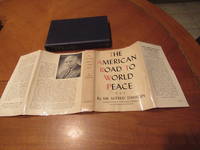
1953054317New York Ny: E. P. Dutton 1953. 1st Edition 1st Printing. Hardcover. Fine/Very Good. 187 Pp. Blue Cloth Gilt. First Edition Stated. A Fine Example. Dust Jacket Priced $4.00 Light Usage Minute Losses At Corners Three Waterspots On Front Panell. Per Wikipedia Sir Alfred Eckhard Zimmern 1879 -1957 Was An English Classical Scholar Historian And Political Scientist Writing On International Relations. He Was Appointed Lecturer In Ancient History New College Oxford 1903 And Fellow And Tutor New College 1904-1909. He Authored The Greek Commonwealth In 1911 Where He Characterized The Rise Of Athens As A Positive For Its Neighbors And The Athenian Empire As An Empire Of Freedom. Later He Was A Staff Inspector At The Board Of Education 1912-1915. He Was A Member Of The Round Table Group 1913-1923 And A Member Of The Political Intelligence Department Of The Foreign Office 1918-1919. A British Policymaker During World War I And A Prominent Liberal Thinker Zimmern Played An Important Role In Drafting The Blueprint For What Would Become The League Of Nations. Zimmern Was A Proponent Of A British Commonwealth Arguing That It Could Evolve And Adapt To Shifting Circumstances And Changing Perspectives Among Its Members. Zimmern Founded The League Of Nations Society In 1917. In 1918 He Was Appointed As Head Of A Section In The British Foreign Office To Think Through The Establishment Of An International Organization For Peace. Zimmern Drafted The Blueprint Of What Would Become The League Of Nations: A Regular Conference System With A Permanent Secretariat And Open To Universal Membership Zimmern Was Skeptical Of Wilsonian Guarantees For National Self-Determination Warning Against Fixing State Boundaries Too Rigidly And Warning Against Making The League Responsible For Protecting Minority Rights. He Argued For Placing The Supervision Of Africa Under An International Commission Zimmern Opposed The Creation Of A Democratic Powerful World State Arguing That It Was Too Mechanistic Impractical And Prone To Tyranny. Zimmern Also Opposed A Loose And Informal Concert System. He Became The Inaugural Woodrow Wilson Chair Of International Politics And The First Professor Of International Politics Also Known As International Relations In The World At Aberystwyth University 1919-1921. He Was Co-Founder Of The Royal Institute Of International Affairs 1919. His Book The Third British Empire Was Among The First To Apply The Expression "British Commonwealth" To The British Empire. He Was A Prominent Liberal Internationalist. He Was Also Credited With Coining The Phrase "Welfare State." After Leaving Aberystwyth He Taught At Cornell University In 1922 And 1923. Zimmern Was Deputy Director Of The League's Institute For Intellectual Co-Operation In Paris In The Mid-1920S. With His Wife Lucie Zimmern He Founded And Ran The Geneva School Of International Studies From 1923 To 1939. Zimmern Joined The British Labour Party In 1924 And Was Labour Candidate For Carnarvon Boroughs Against David Lloyd George In The General Election Of 1924. A Close Friend Of Ramsay Macdonald Zimmern Followed Him In 1931 When Macdonald Formed The National Government. He Became An Active Member Of The National Labour Organization And Frequently Wrote Articles For Its Journal The News-Letter. He Was The Inaugural Montague Burton Professor Of International Relations Oxford University 1930-1944. Zimmern Is An Influential Proponent Of Liberal Internationalism. He Was Nominated In 1947 For The Nobel Peace Prize In Connection With His Unesco Work. Note: He Had No Knowledge Or Experience Of The Actual Mechanics Of Government Especially The Still-Insurmountable Difficulty Of Writing Fully Enforceable Domestic Law In A Country Of Common Law Or International Law For Countries With 200 Systems Of Codified And Common Law And Enforcing It Nor Was He A Philosopher Of What Purposes A Good Government's Authority Should Serve. The Title Is Similar To "An American Road To Peace: A Constitution For The World" By Mario A. Pei 1945. <br/> <br/> E. P. Dutton hardcover
1933015919Los Angeles 1933. Original Artwork . Single Sheet. Near Fine. 13" x 16. Single Sheet Printed As A Woodcut For The Background Then Hand Decorated Probably Tempera With Four Colored Angels. Text At Top "Gloria In Excelsis Deo" Text At Bottom "Greetings Frank J Zimmerer 1933". Image Size 10" X 13".In His Later Years He Had His Studio On Olvera Street In Los Angeles. This Print Sent To Shrader Of The Otis Art Institute. <br/> <br/> unknown
199216168Bloomington Indiana USA: Indiana University Press 1992. VG/VG. First edition first printing in d/w. PRESENTATION COPY INSCRIBED AND SIGNED BY THE AUTHOR on front endpaper. Inscription reads 'For -----/With Thanks and/Affection/Caroline Zilboorg/Paris June 1 1993'. Illustrated with photographs. Richard Aldington 1892-1962 was an English writer and poet particularly known for his World War One poetry. Hilda 'HD' Doolittle 1886-1961 was an American poet and novelist. They were married from 1913 to 1938. This collection of the early letters includes all 93 letters that Aldington sent to H D from the war front and immediately after his demobilization in 1919. The correspondence discusses H D's relationship with her lover Cecil Gray and her lesbian relationship with Bryher. With Biographical Appendix Periodical Appendix and Index. Previous owner signature on front endpaper; d/w has slight sunning around spine; else a very good plus copy in a very good plus d/w of a SCARCE first edition first printing SIGNED BY THE AUTHOR. D/w now protected in a detachable non-adheive clear sheaf. Presentation Copy Inscribed And Signed. First Edition First Printing. Hardback. Very Good Plus/Very Good Plus. Indiana University Press Hardcover
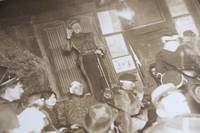
194787360Paris: Albin Michel 1947. Fine. Montmartre and Montparnasse parties moments before WW1 Albin Michel Paris 1947 13.50 x 19 cm relié ""It's war!"" we shouted that night over and over again. The terrible word brought us bad luck. It was 1913: the following year we were packing our kits again. This time for real. And not all the guests came back."" p. 335 First edition one of only 6 copies printed on Hollande this being copy no. 1 of the deluxe issue. Bound in navy blue morocco backed boards with corners spine very lightly sunned with raised bands gilt date at foot marbled paper-covered boards and endpapers edges untrimmed top edge gilt covers and spine preserved. Binding signed Lavaux. A fine copy with wide margins attractively bound. Bookplate pasted to a flyleaf. The author's own copy profusely extra-illustrated of this magnificent Montmartre chronicle. Tipped in is an original ink portrait of Roland Dorgelès by Gus Bofa humorously captioned: ""Monsieur Roland Dorgelès dans son uniforme de rédacteur à la petite semaine"" Alongside two original photographs one depicting the famous Montmartre figure Francisque Poulbot in his Guignol theatre Agence Rol 1910 and the other a very rare photograph of the legendary Fête des Dernières Cartouches organised by Poulbot on 23 May 1913. We have located only one other known image of this event. The photograph shows the merry band of participants at Poulbots place on rue de lOrient dressed as soldiers from the Franco-Prussian War of 1870. The celebration which created quite a stir is recounted by Dorgelès in this book: One day or rather one night the uproar reached its height: when Poulbot gave his famous Dernières Cartouches party. The idea came to him after a dispute with his landlord on rue de lOrient who had refused to renew his lease. Poulbot had only recently moved in and had built a studio in the garden at his own expense. Does he think Im going to give it to him as a gift he fumed. He can rot! Ill barricade myself inside and wait for eviction. Right away we all swore to join him in defying the police just like at Fort Chabrol. But our tall friend was already improving the plan: Even better! Well dress up as soldiers from 1870 and defend ourselves like the Last Cartridges! The Maison des Dernières Cartouches was an inn in Bazeilles where French soldiers had made a heroic last stand during the fall of Sedan. Their sacrifice inspired a famous history painting by Alphonse de Neuville. By firing from the windows! By blowing everything up! The operation was immediately planned. Orders were issued stamped with the imperial eagle and the recruits assembled their own equipment not from a costume hire that wouldve been too easy. Old relics were unearthed ragmen looted the flea market raided for red trousers: in less than two weeks the battalion was fully outfitted. Everything was period-accurate down to the Chassepot rifles of Gravelotte. Even the weapons were authentic. Not a single gaiter button was missing. As the evening began rifle butts rattled the doors. The police No reinforcements. The Montparnasse reservists arrived soaked to the bone having marched across Paris in fours bayonets fixed greeted along the way by bewildered officers. We drank we sang we roared. Then we set off on patrol brimming with spirit and the honest folk returning from the cinema were startled to see soldiers appearing on corners and aiming at them: Halt! Who goes there Some caught on others stammered in fright: Whats happening What You didnt know War has been declared. There are some things though one shouldnt joke about. When our martial energy waned we all poured into the Lapin Agile and started singing Le Père la Victoire in chorus. It wasnt period-accurate but never mind. At dawn as the sky began to pale we gathered on rue Lepic officers drew their sabres the bugle sounded the charge and we launched an assault o Albin Michel hardcover
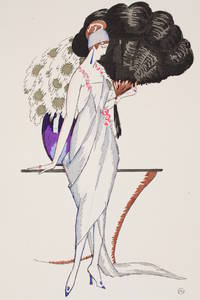
192057600Paris: Lucien Vogel éditeur 1920. Fine. Lucien Vogel éditeur Paris Mai 1920 18 x 24 cm une feuille Original color print heightened in gold and palladium printed on laid paper unsigned. Original engraving created for the illustration of La Gazette du bon ton one of the most beautiful and influential fashion magazines of the 20th century celebrating the talent of French creators and artists at the height of the Art Deco movement. Famous fashion magazine founded in 1912 by Lucien Vogel La Gazette du bon ton was published until 1925 with an interruption during the War from 1915 to 1920 due to the mobilization of its editor-in-chief. It consists of 69 issues printed in only 2000 copies and is illustrated notably with 573 color plates and 148 sketches representing models by great couturiers. From their publication these luxurious publications ""addressed bibliophiles and society aesthetes"" Françoise Tétart-Vittu ""La Gazette du bon ton"" in Dictionnaire de la mode 2016. Printed on fine laid paper they used a typeface specially created for the magazine by Georges Peignot the Cochin typeface later adopted in 1946 by Christian Dior. The prints were created using the metal stencil technique heightened in colors and some highlighted in gold or palladium. The adventure began in 1912 when Lucien Vogel a man of society and fashion - he had already participated in the magazine Femina - decided to found with his wife Cosette de Brunhoff sister of Jean the father of Babar La Gazette du bon ton whose subtitle was then ""Art modes et frivolités"". Georges Charensol reports the words of the editor-in-chief: ""En 1910 observe-t-il il n'existait aucun journal de mode véritablement artistique et représentatif de l'esprit de son époque. Je songeais donc à faire un magazine de luxe avec des artistes véritablement modernes . J'étais certain du succès car pour la mode aucun pays ne peut rivaliser avec la France."" ""In 1910 he observed there was no fashion journal that was truly artistic and representative of the spirit of its time. I therefore thought of making a luxury magazine with truly modern artists . I was certain of success because for fashion no country can rival France."" ""Un grand éditeur d'art. Lucien Vogel"" in Les Nouvelles littéraires n°133 May 1925. The magazine's success was immediate not only in France but also in the United States and South America. Originally Vogel therefore brought together a group of seven artists: André-Édouard Marty and Pierre Brissaud followed by Georges Lepape and Dammicourt; and finally his friends from the École des beaux-arts who were George Barbier Bernard Boutet de Monvel or Charles Martin. Other talents quickly joined the team: Guy Arnoux Léon Bakst Benito Boutet de Monvel Umberto Brunelleschi Chas Laborde Jean-Gabriel Domergue Raoul Dufy Édouard Halouze Alexandre Iacovleff Jean Émile Laboureur Charles Loupot Charles Martin Maggie Salcedo. These artists mostly unknown when Lucien Vogel called upon them would later become emblematic and sought-after artistic figures. These same illustrators created the drawings for La Gazette's advertisements. The plates highlighted and sublimated the dresses of seven creators of the era: Lanvin Doeuillet Paquin Poiret Worth Vionnet and Doucet. The couturiers provided exclusive models for each issue. Nevertheless some of the illustrations featured no real model but only the illustrator's idea of contemporary fashion. La Gazette du bon ton was a decisive stage in the history of fashion. Combining aesthetic excellence and artistic unity it brought together for the first time the great talents from the worlds of arts letters and fashion and imposed through this alchemy a completely new image of woman elegant independent and bold also carried by the new generation of couturiers Coco Chanel Jean Patou Marcel Rochas. Acquired in 1920 by Condé Montrose Nast La Gazette du bon ton would largely inspire the new composition and aesthetic choices of Lucien Vogel éditeur unknown
19690001557PEOPLE'S REPUBLIC OF CHINA. Good. 1969. On offer is a super original late 1960s manuscript relic of Mao Zedong's Cultural Revolution and the cruel manipulation of the people as the politics of the times changed to the socialist agenda of the Great Proletarian Cultural Revolution. This document attests to the forced recanting of many former managers as evidenced by this document being a 38 page manuscript confession handwritten by a director of a local bureau during the revolution. This bureau or cadre manager like many others in China were called upon forcefully much of the time to expose and confess their so called crimes of anti-socialist revolution activity in the bureau they had worked in. This was unfortunately all too common during the Revolution and sometimes the results were fatal. This 19cm x 26cm 38 page document is comprised of papers held by paper clip with some small rusting to the clip and one page has a tape repair to the back. Overall G. HISTORICAL NOTE: As one online source succinctly sums up the times: "People's Republic of China from 1966 through 1976. Set into motion by Mao Zedong then Chairman of the Communist Party of China its stated goal was to enforce socialism in the country by removing capitalist traditional and cultural elements from Chinese society and impose Maoist orthodoxy within the Party. The most important yet naturally unstated reason for the revolution was the return of Mao Zedong to a position of political power after he lost most of his political influence after his failed Great leap forward."; Chinese Language; 4to - over 9¾" - 12" tall; KEYWORDS: HISTORY OF GREAT PROLETARIAN CULTURAL REVOLUTION CULTURAL REVOLUTION CONFESSIONS RECENT ANTI SOCIALIST ACTIVITIES ANTI CAPITALISM MAO ZEDONG MAO TSE TUNG GREAT LEAP FORWARD MAOIST SOCIALISM COMMUNISM COMMUNIST CHINE CHINESE SINO POLITICS JIANG QING GRASSROOTS SOCIALISM PROPAGANDA POST FIVE YEAR PLAN 5 YEAR PLAN GANG OF 4 GANG OF FOUR LIN BIAO BEIJING PENG LUO LU AND YANG ZHONGFA 267 INDOCTRINATION RED CHINA CHAIRMAN MAO MARXISM-LENINISM MAOISM LIN YURONG HANDWRITTEN MANUSCRIPT AMERICANA DOCUMENT LETTER AUTOGRAPH DIARY JOURNAL LOG KEEPSAKE WRITER HAND WRITTEN DOCUMENTS SIGNED LETTERS MANUSCRIPTS HISTORICAL HOLOGRAPH WRITERS DIARIES JOURNALS LOGS AUTOGRAPHS PERSONAL MEMOIR MEMORIAL PERSONAL HISTORY antiquité contrat vélin document manuscrit papier Antike Brief Pergament Dokument Manuskript Papier oggetto d'antiquariato atto velina documento manoscritto carta antigüedad hecho vitela documento manuscrito Liu ShaoQi . unknown
1936049673Shanghai: 1936. 1st Edition 1st Printing. Soft cover. Very Good. 40 Pp. Covers. Color And B/W Illustrations Text. First Printing Of The December 15 1936 Issue. Light Wear No Marks.This 1936-1937 Satirical Journal Targeting The Political Left Right And Center Is Quite Scarce It Had No Political Friends Worldcat Showing Only A Few Institutional Holdings. From Wikipedia: Among The Artists Who Established The Original Shanghai Manhua / Shanghai Sketch In 1928 Several Had Worked Together On The Small Short-Lived Journal Sanri Huabao Three Day Pictorial Including Ye Qianyu And The Brothers Zhang Guangyu And Zhang Zhenyu. The Journal Was Shut Down When Chiang Kai-Shek's Northern Expedition Reached Shanghai In April 1927. Out Of Work Cartoonists Ye Qianyu Huang Wennong And Lu Shaofei Published A Dedicated Publication For Manhua Named Shanghai Manhua Shanghai Sketch. The First Effort Resembled A Propaganda Poster And Was A Failure. Undeterred The Original Three Joined By Eight More Artists Including The Zhang Brothers Ding Song And Wang Dunqing Formed The Shanghai Sketch Society Also Translated As Shanghai Manhua Society In The Autumn Of 1927. It Was China's First Association Dedicated To Manhua And A Major Event In The History Of Chinese Comics.Shanghai Manhua Simplified Chinese: ; Traditional Chinese: ; Pinyin: Shànghai Mànhuà Originally Titled Shanghai Sketch Was A Weekly Pictorial Magazine Published In Shanghai From 21 April 1928 Until 7 June 1930. Considered The First Successful Manhua Magazine In China And One Of The Most Influential. In May 1936 Zhang Guangyu Re-Established Shanghai Manhua While Many Of The Original Members Were Then Working With Modern Sketch. Together They Organized The Highly Successful First National Cartoon Exhibition In September And Formed The National Association Of Chinese Cartoonists In The Spring Of 1937. The Blossoming Movement However Was Brought To A Halt By The Japanese Invasion A Few Months Later. <br/> <br/> ????? paperback
196413553Paris: S. Bornemann 1964. Fine. S. Bornemann Paris s. d. 1964 11.50 x 18 cm broché First edition. Illustrated cover work decorated with figures. La poussette les quatre as la monégasque la main du destin les échelons le grand triomphe. Rare and handsome copy. S. Bornemann unknown
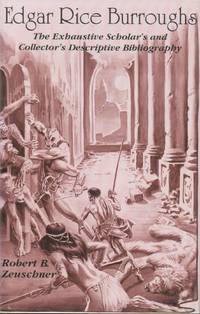
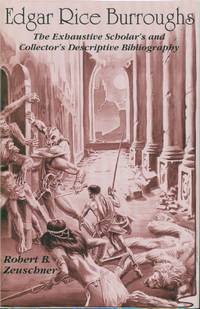
199634451Jefferson NC: McFarland and Co 1996. 1st ed. Hardcover. 1st ptg.8vo full green cloth stamped in gilt 288 pp. #86 of 300 copies with specially designed bookplate signed by Zeuschner and a generous inscription by Zeuschner to the previous owner on the front free endpaper. Foreword by Philip Jose Farmer. Jacket cover art by Thomas Yeates grayscale illlustrations scattered throughout. As new. Inscribed by the author. McFarland and Co hardcover
199632607Jefferson NC: McFarland and Co 1996. 1st ed. Hardcover. 1st ptg. 8vo full green cloth stamped in gilt 288 pp. Foreword by Philip Jose Farmer. Custom bookplate signed by Zeuschner laid in. Cover art by Thomas Yeates grayscale illlustrations scattered throughout. As new. McFarland and Co hardcover
19865467Ludwig Schultheis Hamburg & Franco Sciardelli Milano 1986. 1st edition. V.g. /No Jacket. Paper covers with fold-around flaps. Thematically arranged catalogue of the work of a talented Italian Tuscan artist and bookplate designer whose early work flirts with Futurism but who is now best appreciated for his erotic and often nocturnal scenes. Note: the ISBN is the same as that previously used for another book by the German publisher " Deutsche Künstlerinnen des 20. Jahrhunderts" 1983. Slight soiling to lower edge reading crease but still a very good copy. 198 pp. Ludwig Schultheis, Hamburg & Franco Sciardelli, Milano unknown
1946286323Verlag Josef Kösel München 1946. Hardcover Pappe mit Leinenrücken und -ecken ohne Schutzumschlag 16 Bände 1946/4719481950-19561958-19631965 194919571964 fehlen. Zustand: Keine Beschädigungen vereinzelte Eintragungen. Rücken Ecken Kanten gut. Aus einer Kindergärtnerinnen-Seminarsbibliothek mit Kennungen Stempel Rückenschild. Verlag Josef Kösel, München, hardcover
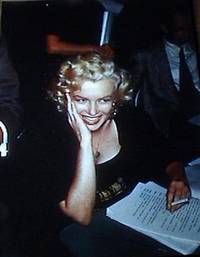
19520001038HOLLYWOOD LOS ANGELES CALIFORNIA CA. Very Good. 1952. On offer is an exceptional archive of original color slides positives featuring the most remarkable female beauty of the 20th century being Marilyn Monroe. Ms. Monroe is candidly captured during a rehearsal and live performance of Edgar Bergen's radio show October 26th 1952. The writer of the show featuring the internationally famed Bergen and his equally famous puppet Charlie McCarthy was Mr. Zeno Klinker. Mr. Klinker the character Effie Klinker is named after the man besides being a talented writer and comedian his sister also a creative talent being the renowned Death Valley artist Orpha Klinker was also a passionate photographer who photographed nearly every visiting actor actress or celebrity on the Bergen show and at this particular broadcast he had direct access to Marilyn Monroe. She is absolutely ravishing and at the height of her beauty and appears to be having a sensational time. A number of group shots include Monroe Bergen and other cast members. Collectors and historians of Monroe's life and career will recognize that as her star was ascending and she gaining some small influence due to her roles in 'The Asphalt Jungle' and 'All About Eve' at this broadcast of one of the most popular radio shows ever she was a mere three months before the 1953 film noir movie 'Niagara' would launch her to stardom. This archive is comprised of 42 different unpublished images that have been stored for more than 50 years. Klinker captured two near identical photos of each image to use in a stereographic type viewer and create a 3-D effect so while there are 42 images they are meant to create 21 'stereoviews'. The color positives have sleeves that would slip into the stereo-viewer. There is no stereo-viewer with the archive. VG.; EDGAR BERGEN CHARLIE MCCARTHY MARILYN MONROE VENTRILIQUIST MEMOIR MEMORIAL PERSONAL HISTORY NORMA JEAN NORMA JEANE BAKER EPHEMERA PHOTOGRAPHY PHOTOGRAPHIC HISTORY OF RADIO Norma Jeane Mortenson . unknown
19673554Aufbau-Verlag Berlin und Weimar 1967. 4to. First Edition; cloth a very good copy in the dustwrapper. Sold from an institution with its cancelled bookplate and neat stamp on title verso. Extensive checklist includes Selbstandig enschienene Schriften Gesammelte Werke Romane Novellen Schauspiele Essays Ubersetzungen aus dem Franzosischen von Heinrich Mann Herausgegebene Arbeiten and Briefsammlungen and Publikationen in Zeitschriften Zeitungen Antologien Almanachen etc. Full indexes of titles and persons. Scarce. Aufbau-Verlag, Berlin und Weimar, hardcover