73 résultats
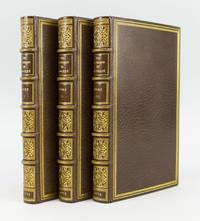
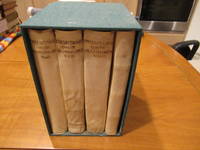
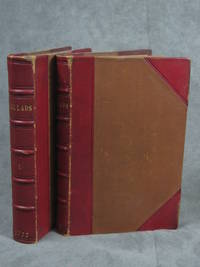
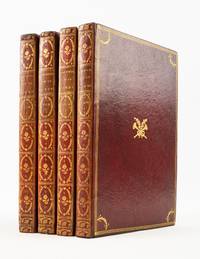
1773ST20891Paris: Chez de Lormel Imprimeur de l'Academie Royale de Musique 1773. FIRST EDITION First Issue with pencilled correction of "affreux Serpent" on p. 54 of Vol. II. 237 x 160 mm. 9 1/4 x 6 1/4". Engraved throughout. Four volumes. <br/> Tasteful contemporary crimson morocco gilt covers with triple fillet border floral garland at corners crossed trumpets with laurel branches at center smooth spines in gilt compartments with floral sprig within an oval catkin wreath two tan morocco labels gilt turn-ins marbled endpapers all edges gilt restorations to head of two spines. ENGRAVED THROUGHOUT: Engraved decorative title page and dedication page in volume I three engraved frontispieces by Le Bouteux and Le Barbier in volumes II-IV one of these a portrait of the dedicatee La Dauphine Marie Antoinette and 100 FULL-PAGE PLATES the 25 in volume I designed and engraved by Moreau le jeune all with tissue guards those in volumes II-IV engraved by Masquelier and Née after designs by Le Barbier Le Bouteux and Saint-Quentin about one-third of the plates with original tissue guards. Without the separately printed portrait of Laborde issued in 1774 and found in some copies. Cohen-de Ricci pp. 534-38; Ray 49 pp. 90-91 p. 76; Lewine pp. 266-68. Spines slightly and evenly sunned a hint of wear at corners but the bindings otherwise beautifully preserved with only the most trivial imperfections; internally with isolated inconsequential foxing or small stains. A VERY FINE CONTEMPORARY SET the lovely bindings scarcely worn the margins extremely ample the contents clean and fresh and THE ENGRAVINGS RICHLY IMPRESSED.<br/> <br/> Dedicated to the crown princess Marie Antoinette this opulent production--offered here in fine contemporary morocco--beautifully displays the music fashion and aristocratic antics of Louis XV's court perfectly encapsulating the French Rococo. According to Cohen-de Ricci "This book—one of the most beautiful of the 18th century—is perhaps along with 'Contes de La Fontaine' the most delightful by virtue of the grace of its subjects and the variety of the costumes depicted therein." It contains some of the most elegant and memorable engravings to be seen in any French work of the period and they transform a book of perhaps more than occasionally vapid songs into a profoundly pleasurable visual experience. The author Benjamin de Laborde or Jean-Benjamin de La Borde 1734-94 was the hunchbacked valet of King Louis XV. In consequence of the monarch's indulgence of his favorite de Laborde's songs were given a presentation described by Ray as being of "the utmost sumptuousness" the entire work having been produced by engraving. The first volume which Cohen-de Ricci Ray and Lemire unanimously proclaim a "masterpiece" is graced by plates that were both designed and cut by Jean-Michel Moreau called Moreau le jeune 1741-1814. Ray says that the work done by Moreau le jeune during the 1760s "showed him to be the equal of the established rococo masters Boucher Eisen and Gravelot" and that in his work during the 1770s "he carried all before him." So Moreau was in his prime then when he executed these charming scenes often of courtship set in pastures pleasure parks and elegant interiors; they represent the culmination of the Rococo style delicate and lush without being cloying. Because of a quarrel between the artist and the author the final three volumes were illustrated by Le Bouteux and by Jean-Jacques-François Le Barbier 1738-1826. Le Barbier was one of the first great French neoclassical illustrators and Ray declares the engravings here his "most sustained and accomplished series of illustrations apart from that for Gessner's 'Oeuvres'" and laments that the present work "has not received the attention it deserves." Le Barbier's compositions are characterized by charm grace and elaborate and convincing detail. This first printing presents the engravings at the height of their richness and power which has been undimmed by the intervening centuries. With any copy of this work the engravings will always take center stage but here the tasteful contemporary red morocco bindings deserve a prolonged bow: they are perfectly elegant and elegantly perfect. Chez de Lormel, Imprimeur de l'Academie Royale de Musique unknown
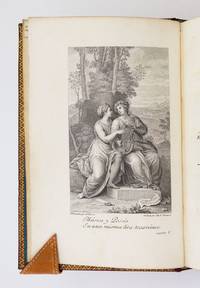
1779ST19371Madrid: Imprenta Real 1779. FIRST EDITION. 235 x 150 mm. 9 1/4 x 6". 10 p.l. 126 XL pp. 1 leaf errata. <br/> EXCELLENT CONTEMPORARY CRIMSON MOROCCO BY DEROME LE JEUNE his ticket with address of Rue St. Jacques on verso of front free endpaper covers framed with thick and thin gilt rules raised bands spine compartments with central floral sprig surrounded by a lozenge of small tools volute cornerpieces gilt titling gilt-rolled turn-ins gilt edges cobalt blue paste-paper endpapers. WITH SIX CHARMING ENGRAVED ALLEGORICAL PLATES after G. Ferre. Front pastedown with morocco bookplate of Mortimer L. Schiff and small book label with a gilt cipher on a red peach. A Large Paper Copy. Palau y Dulcet IV 107; RSIM B VI 429; MGG VI 1403 f.; Gregory-Bartlett I 129. Three minute dents to front board a hint of wear to bands and corners isolated faint foxing blank recto of frontispiece leaf and blank verso of final leaf with faint blue shadown from endpapers but all of these quite trivial and otherwise A BEAUTIFUL COPY--fresh clean and bright internally with very wide margins and strong impressions of the plates and in a lustrous binding showing with few signs of use.<br/> <br/> This is surely one of the handsomest poetical treatises on music ever produced and it is offered here in a binding done by one of the finest craftsmen working in Europe during the period of the book's publication. The work is written in the "silva" form of poetry used by persons of high rank illustrated with fine engravings and put into elegant morocco by the finest hands among the large Derome family of binders. According to Palau our first edition is "beautiful and printed on fine paper." He says further that although the strongly expressed opinions of the youthful author on contemporary composers caused the work to be "unfairly attacked" it was "appreciated by professors of music and collectors of literature in that genre" especially in Italy and America. A child of the Enlightenment Iriate 1750-91 gained entry to intellectual and artistic circles in Madrid through his uncle who was librarian to the king of Spain. He translated works by Horace and Virgil into Spanish by royal request and wrote criticism poetry and dramas. He is best known for his satirical fables on the contemporary literary scene "Fábulas literarias." There were no fewer than 18 members of the Derome family who made their livings as binders in Paris from the middle of the 17th century until the first quarter of the 19th but by far the most distinguished family member was Nicolas-Denis called "le jeune" 1731-88. Known for the gracefulness of his bindings and for being capable of "amazing delicacy" in Hobson's words Derome le jeune was simply the leading binder of the day and his work was much in demand. Because he refused to turn away customers Derome was forced to hire a number of assistants whose work he could not always supervise closely. However Thoinan says that the binder's best work is indicated by the presence of his ticket as here. The volume's provenance adds to its luster: it was in the distinguished library of American bibliophile Mortimer Schiff 1877-1931. In Dickinson's words Schiff a financier and philanthropist Schiff "brought together an unrivaled collection of decorative bindings." His library included works by great printers important illustrated books and works printed on vellum but chiefly fine and historic bindings. The "Reliures" database of the Bibliothèque Nationale de France commends Schiff for assembling "one of the most important inter-war libraries" noting that his collection was "renowned for its collection of French bindings.". Imprenta Real unknown
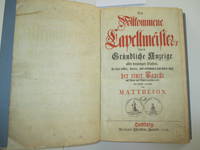
173916570AB1739. Ham burg Herold 1739. 345 : 225 cm. 28 pages 2 leaves 484 pages 8 leaves register with engraved vignette on title-page type-set musical examples within the text woodcut head and tailpieces 1 full-page engraved plate. Contemorary half vellum decorated papers on boards. First print of the first edition "Neues Verzeichnis bisheriger Matthensonischer Werke" which is only missing in the first print. The rare original edition of the most important work of Matteson an encyclopedia of knowledge of the music-practice of its time. An undispensable source for music-academics. He brings together a vast array of facts as well as his most complete statement of several major theoretical concepts. These include the systematizing of the doctrines of rhetoric as they become the basic of compositio.A lengthy discussion of emotion in music leads to.the only attempt found in baroque literature to arrive at a true "Doctrine" of the Affections. New Grove 11 p. 835. - Mattheson's most important and extensive theoretical work "an encyclopedia of the entire musical practice of his time" in the extremely rare original edition. The important matters from music theory and aesthetics which are often dealt with quite briefly in the 3 "Orchestras" in the "Critica musica" in the two "Schools for basso continuo" as well as in the "Core of melodic science" are treated in such detail that this work must almost be called a fundamental one Schmidt. Mattheson's works have become an indispensable source for musicology because without them it is difficult to understand the great music-historical turn that took place in his time. Joseph Haydn owned a copy of it; Goethe knew it as is evident from his letter to Zelter of Jan. 1 1819. - Cannon No. 138; Wolffheim I 819; Hirsch I 378. - With a small inscribtion at the inner front board. Boards coverd with a special marbled paper. hardcover
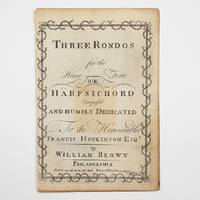
1787373365Philadelphia: Printed and sold by the Author . John. Aitken Sculp 1787. Engraved title letterpress 1p. List of Subscribers 6 engraved sheets. 4to. Loose sheets trimmed close at the gutter margin. Engraved title letterpress 1p. List of Subscribers 6 engraved sheets. 4to. "By one of those strange coincidences which delight the historian and at the same time provide the essayist with convenient points of departure the year 1787 which saw the writing of the Constitution of the United States saw also the solid beginnings of music publishing in this country as a separate and independent enterprise. The scene of these beginnings was Philadelphia the publisher and composer a certain William Brown the engraver John Aitken; the publication itself bore a dedication to no less a person than Francis Hopkinson signer of the Declaration of Independence and our first native composer. Three Rondos for the Piano Forte or Harpsichord. Composed and Humbly Dedicated to the Honourable Francis Hopkinson Esq. by William Brown. Philadelphia. Printed and Sold by the Author. Price Two Dollars. J. Aitken Sculp - so runs the full title of this musical landmark which the composer-publisher himself in inviting subscribers had called 'the first attempt of the kind in America'" Oliver Strunk "Early Music Publishing in the United States" The Papers of the Bibliographical Society of America vol. 31 no. 2 1937 pp. 176-79.<br /> <br /> Dunlap & Claypoole's Daily American Advertiser of 23 January through 10 February 1787 announced that subscriptions were being gathered for William Brown's Three Favorite Rondos Adapted to the Harpsichord. Subscriptions were being gathered both by Mr. Brown and Mr. Reinagle for the work. Among the notables on the subscriber list here are Alexander Reinagle four members of the Penn family and the dedicatee Francis Hopkinson. <br /> <br /> Very scarce with only four examples in OCLC. Evans 20246; Sonneck p. 361 Printed and sold by the Author ... J[ohn]. Aitken Sculp unknown
1776ST12954Paris: Joseph-Gérard Barbou 1776. 215 x 135 mm. 8 1/2 x 5 1/4". Three volumes. <br/> ELEGANT 19TH CENTURY BROWN MOROCCO GILT BY JOLY FILS stamp-signed on front turn-ins covers with French fillet border raised bands spine compartments densely gilt with complex fleurons drawer handle tools and circlets intricately gilt turn-ins marbled endpapers gilt edges. Engraved title pages three engraved vignettes and three engraved plates after Moreau le jeune. Cohen-de Ricci p. 604. Lightly washed and pressed in keeping with bibliophilic fashion at the time of binding one title page with small corner tear otherwise A FINE SET clean and still crisp internally with ample margins and the scarcely-worn bindings quite lustrous.<br/> <br/> This is a finely bound copy of singer and playwright Pierre Laujon's songs "About Society" and "About Folly" with illustrations of "ravishing grace" that Cohen-de Ricci considers among the best efforts of Jean Michel Moreau. Laujon 1727-1811 wrote and performed in musical reviews and ballets where his efforts attracted the attention of the Count of Clermont and the Prince de Condé who hired him to direct their festivals and pageants. The songs here were composed for these "society festivals" gently mocking the frivolous naughty behavior of the elite. The accompanying illustrations showing beautifully dressed courtiers and bon-vivants are the work of Moreau le jeune 1741-1814 deemed by no less than Gordon Ray to be "the greatest name among French illustrators of the 18th century." The graceful bindings here were done by one of the great bookbinding houses of France. After apprenticing in the provinces Antoine Joly 1838-1917 moved to Paris found employment with the celebrated Léon Gruel later formed a partnership with Thibaron in 1874 succeeded him 11 years later and in 1892 turned the business over to his son Robert 1870-1924 who signed his work "Joly fils." According to Duncan & DeBartha "An excellent gilder like his father Robert designed and produced a range of classical covers." The trifecta of light-hearted songs elegant engravings and luxurious bindings endow this set with a great deal of French charm. Joseph-Gérard Barbou] unknown
179350100Vienna / Wien: Musicalische-Typographische Gesellschaft 1793. Hardcover. Very good. 7 x 9 inches. 6 88 pages of text followed by 'Noten-Beispeile zu Kirnberger's Grundsatze des General Basses in Drei Abtheilungen - three sections of music 13 18 & 15 pages in length 2. Text in german. No date circa 1793. Period binding half brown morocco over marbled boards gilt decoration on spine red leather spine label. Condition is Very Good; moderate wear to spine edges and corners boards rubbed it looks like someone has gone over some of the printed title page in black ink text pages have light to moderate toning pencil underlining and marginal lines on about a dozen pages of text music pages are not toned and are unmarked but have light water-stains on upper 1/3 of pages binding is tight. RRGR Musicalische-Typographische Gesellschaft hardcover
177144016Paris: Chez Bluet Libraire 1771. 4to. 20cm trimmed in 4's viii362 but 363pp. & 1p. "Approbation du Censeur Royal complete with half title stylized initial B vignette on the title page initial illustrated vignette in frame border on page one beginning and ending printed chapter device decorations printed music throughout in near contemporary quarter calf backed blue paper over boards gilt ruled bands and panel device decorations and faded title the spine is somewhat worn the upper hinges is cracked the board edges are heavily worn text block is sound on the whole considering the contemporary period a very good. Very Good. Antoine Bemetzrieder en allemand : Anton Bemetzrieder est un compositeur théoricien et professeur de musique français né à Dauendorf le 26 mars 1739 et décédé à Londres en 1817. Il suit d'abord des études à Strasbourg et est diplômé en philosophie en 1760 et en droit en 1762. Il part s'installer à Paris en 1766 et entame l'étude de la musique qu'il enseigne bientôt. En particulier il fut engagé par Denis Diderot en 1769 pour enseigner le clavecin à sa fille. Son premier ouvrage les Leçons de clavecin et Principes d'harmonie rencontra un vif succès. Il y avait pu profiter de l'aide de Diderot qui donna sans doute sa forme de dialogue à ce traité pédagogique. Bemetzrieder publiera d'autres ouvrages pédagogiques jusqu'à son départ pour Londres en 1781. Il y enseigne encore la musique réédite ses œuvres et en écrit de nouvelles sur la musique les mathématiques la philosophie et l'éthique. BEMETZRIEDER Antoni 1743-1817.<br /> Antoine Bemetzrieder in German: Anton Bemetzrieder was a French composer theorist and music teacher born in Dauendorf on March 26 1739 and died in London in 1817. He first studied in Strasbourg graduating with degrees in philosophy in 1760 and in law in 1762. He moved to Paris in 1766 and began studying music which he soon began teaching. In particular he was hired by Denis Diderot in 1769 to teach his daughter the harpsichord. His first work Harpsichord Lessons and Principles of Harmony was a great success. He benefited from the help of Diderot who undoubtedly gave this pedagogical treatise its dialogue-like form. Bemetzrieder published other pedagogical works until his departure for London in 1781. There he continued to teach music republished his works and wrote new ones on music mathematics philosophy and ethics.<br /> <br /> With a contemporary bookplate "Bibliotheque de Mr. Gaston Calmann-Levy Chez Bluet, Libraire unknown
17241750London: John Cluer. G: in good condition. Cover marked and heavily rubbed. Wear to spine with loss at ends. Remains of book-plate to front paste-down. Inner hinge cracking. Previous owners inscriptions to prelims 1725 1747 1840 1858 & 1946. Sporadic marking. Occasional ink and pencil annotations. Aeg. 1724. First Edition Thus. Red hardback tooled leather cover. 170mm x 120mm 7" x 5". xvi 152pp. B/w frontispiece. Carefully Corrected & also Figur'd for y Organ Harpsicord and Spinet. . John Cluer hardcover
1770009869Paris: Chez Lacombe 1770. Book. Very Good -. Hardcover. First Edition. 4to - over 9¾" - 12" tall. xxiv 252 pages illustrations including music plates music table. Very Good Plus bound in contemporary quarter leather over marbled boards boards rubbed at corners and edges gilt at spine dulled scattered light toning prior owner name and inscription front end page. Abbe Pierre-Joseph Roussier 1716 -1790 was known as an ardent proponent of the theories of Jean-Philippe Rameau. SCARCE. Chez Lacombe Hardcover
1734019334Venice Venezia 1734 1737: Giuseppe Bettinelli 1734. First Edition . Full Vellum. Very Good. Frontispiece. Four Volumes 1734 Stated Second Edition Of The First Volume First Editions Of Volumes 2 Through 4. Vol. 1: Half Title Frontispiece Title 12 1 504 And Is The Stated Second Edition Dated 1734; The First Edition Was Issued In 1733. Vol Ii: Title 1 1 480 Dated 1734. Vol. Iii: Title 1 1 520 With "La Betulia Liberata" 1734 Same Publisher At Rear Title 1 72. Vol. Iv:Title 1 2 With Nine Separately Paginated Plays The Last Being Really A Dialogue 11737. Original Vellum. Metastasio Was A Renowned Child Prodigy Whose Plays Became Incorporated Into Much 18Th Century Music. Light Usuage To Vellum. Contents Fine Except A Damage In 1" Corner Of First Three Pages Not Affecting Text And Related Damp Mark No Damp Staining At Lower Foredge Corner Of Pages In Margins And Not Affecting Text. Original Signatures Of Joachim Steetz Dated 1747. Very Scarce Worldcat Locating Only One Copy. New Sturdy Slipcase By Heritage Bindery Pasadena. <br/> <br/> Giuseppe Bettinelli hardcover
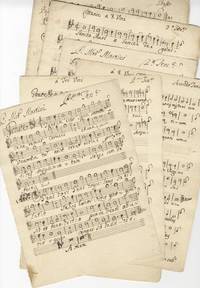
175040348Italy 1750. 5 parts. Quarto and two bifolia. Notated on 10-stave rastrum-ruled paper. Watermark letters within a circle.<br /> <br /> Contains:<br /> <br /> 1 P.rimo Ten.ore: 1 p. Text commencing "Tantum ergo sacramentum" and Genitori Genitoque" "P Mro Martini" to head.<br /> 2 P.rimo Ten.ore music different from above: 1 p. Text commencing "Tantum ergo sacramentum" and Genitori Genitoque."<br /> 3 Basso: 1 p. Text commenting "Tantum ergo sacramentum" and "Genitori Genitoque" with "Tantum &c. a 3 Voci Ripieno" to head.<br /> 4 Secondo Tenore: 2 pp. Text commencing "Pange lingua" "Nobis datus" "Verbum caro" and "Genitori Genitoque." With "à 3. Voci TT. e B." to head of first page.<br /> 5 2o. Ten.ore: 1 p. Text commencing "Tantum ergo" and "Genitori Genitoque." With "P Mro Martini" to head.<br /> 6 2o. Ten.ore: 3 i blank pp. Text commencing "Sancta Maria" "Sedes sapienti" "Regina Martyrum" and "Agnus Dei." With "Littanie a 3. Voci" to head. <br /> 7 Basso: 3 i blank pp. Text commencing "Kyrie" "Virgo potens" "Regina Angelorum" and "Agnus Dei." With "Littanie a 3. Voci" to head.<br /> <br /> A few small stains. unknown
1777002487Germantown Pa: Christoph Saur 1777. Hardcover. Good. Title continued: "Ordentlich in XII. Theile verfasset. Auch mit nöthigen Registern und einer Verzeichniss versehen unter welche Titul die im Anhang befindlichen Lieder gehörig: Auch zur Beförderung des so Kirchen- als Privat-Gottesdienstes mit erbaulichen Morgen- Abend- Buss- Beicht- und Communion-Gebätlein vermehret. Fünfte und ermehrte Auflage." 16 522 16 14 p.: frontispiece portrait of Luther with biographical caption; 17 cm. Signatures: 8 A-2L8 2M4 8vo. Contemporary calf with five spine compartments between raised bands. Woodcut tailpiece; typographical headpieces. Hymns without music as was typical of German hymnals of the period. Printed in two columns. Errors in pagination: p. 198 339 and 382 misnumbered 298 393 and 582. Without the 56-page "Evangelia und Episteln auf alle Sonntage . und der Historie von der Zerstöhrung der Stadt Jerusalem." often found at the end. First Cent. of Ger. Language Printing in the U.S.A. 491. Inscriptions on front endpapers in old German script dated 1814 and 1793. In Good Condition: leather is rubbed; lacking clasps; free endpapers are chipped and torn; lower part of title page stained; pp. 273-336 S-X8 partially missed in sewing; section lacking from last leaf of the index with small loss of text; scattered soiling and foxing. A worn but solid copy of this German-language hymnal printed by Christopher Saur/Sower during the American Revolution. Christoph Saur hardcover
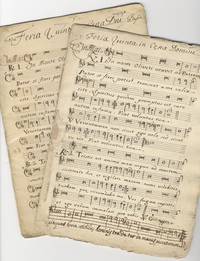
178040349Italy 1780. Folio 226 x 312 mm. Sewn. Notated on 10-stave rastrum-ruled paper with lowermost stave of first page of the Tenore part hand-drawn with music and text added in another hand. Watermark letters within a circle above a star. <br /> <br /> Music for Holy Thursday Good Friday and Holy Saturday of Holy Week in the Christian calendar: <br /> <br /> - "Feria Quinta in Cena Domini." Tenore. 4 pp. Bound with "Feria Sexta in Parasceve" Basso 6 pp. and an additional bass part headed "Sabbato Sancto" 6 pp. <br /> <br /> - "Feria Quinta in Cena Domini." Basso 6 pp. Bound with "Feria Sexta in Parasceve" 6 pp. "Sabbato Sancto" 6 pp. 1f. blank. <br /> <br /> With short semi-chanted homophonic liturgical pieces:<br /> "In Monte Oliveti" "Tristis est anima mea" "Ecce appropinquat" "Ecce vidimus" "Vere languores" "Amicus meus" "Flius quidem hominis" "Unus ex vobis" "Eram quasi agnus innocens" "Seniores populi" "Revelabunt celi iniquitatem" "Omnes amici" "Velum Templi" "Vinca mea" "Tamquam ad latronem" "Tenebre facte sunt" "Barabbas latro dimittitur" "Tradiderunt me" "Jesum tradidit" "Sicut ovis" "Sepultro Domino" "Jerusalem Iuge" "Plange quasi virgo" "Recessit Pastor" "O Vos omnes" "Caligaverunt oculi mei" "Ecce quomodo" "Æstimatus sum" "Agnus Dei" and "Lustris sex qui."<br /> <br /> Occasional moderate soiling and small stains; first leaf of Tenore part partially detached. unknown
177115368<p>Paris: Chez Vente Librairie 1771 Contemporary burgundy morocco gilt flat spine tooled in seven panels gilt decorated borders on both covers gilt turn-ins all edges gilt. Decorative endpapers with gilt star pattern. . Twelvemo. Five full-page engravings. Old ink annotation on a preliminary blank. A fine copy. A review of music theatre dance etc. This book documents entertainment in Paris just before the revolution. These almanacs were issued annually from 1667 to 1778.</p> Chez Vente Librairie,
1784e8266Dublin: Printed by Joseph Hill at the College Printing-House. VG : in very good condition. Rebacked with later calf/gilt spine. Author's inscription on fep. 1784. First Edition. Mottled calf gilt. 210mm x 130mm 8" x 5". 203pp. 2 plates one folding. Inscription reads: 'For the Right Honourable Lord Viscount Castlereagh from his most obliged and sincere servt'. . Printed by Joseph Hill, at the College Printing-House unknown
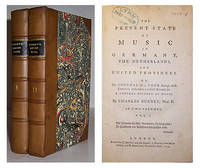
1773000352London: T. Becket and Co. J. Robson G. Robinson 1773. First Edition. . Hardcover. See Description. 8vo. 2 volumes. Volume I. pp. viii 376. Volume II. pp. vi 2 352. p. vi in volume 2 should probably be numbered iv. "Advertisement" and errata leaves are bound after the title page in volume 2. Library stamp on upper portion of the title page in each volume and a number stamped lightly on verso. Bound in modern half-calf with marbled boards. Interior is generally clean; pages are mildly age toned with an occasional touch of light foxing; a couple of faint corner creases present; a small marginal tear on p. 157 of volume 2 is neatly sealed. Some spots of light staining present on outer edge of text block. Charles Burney 1726-1814 was an English musician and composer. In 1773 he was elected a member of the Royal Society. According to Andrew Deakins Musical Bibliography "The tour of which this book is the fruit was commenced in July 1772. Dr. Burney visited Brussels Antwerp Frankfort Munich Vienna Prague Dresden Leipzig Berlin and many other cities forming friendships with the Bach family J.A. Hiller and other masters who furnished him with numberless details about the early and later state of music." Deakin Musical Bibliography p.47; ESTC T104544. <br/> <br/> T. Becket and Co., J. Robson, G. Robinson hardcover
17770073170London: T. Evans 1777. First edition. Hardcover. Very Good/No Jacket. Complete set in 2 volumes. 1777 First Edition. 334 and 308 pp. Hardcovers short 8vos. Handsomely rebound in late 19th century 3/4 red morocco with brown cloth. 5 raised bands and gilt titles on spines. Engraved vignette on either title page. Lacks original blank endpapers but both half-title present. The leather shows light wear to the corners and spine ends. Contents bold and unmarked with only a few pages showing small faint fox marks. Previous owner's bookplate on the front pastedown of both books and small signature on the front blank of both. Complete in 2 volumes. Very rare first edition. T. Evans hardcover
174040863Italy 1740. Oblong folio 222 x 305 mm. Notated in black ink on 10-stave rastrum-ruled paper. Watermark with initials "G.M." within a circle below a trefoil. <br /> <br /> Violino primo: 1f.<br /> Violino secondo: 1f. <br /> Unfigured basso continuo: i title 2 i blank pp. <br /> <br /> Violino primo part slightly soiled at edges; small tears to blank margins. Violino secondo part with small tear and minor stains to blank margins. Basso continuo part slightly soiled and stained with small tears to margins of title; title and second page of music reinforced at inner margins with early narrow strip of paper. This elegant and lighthearted trio sonata in B-flat major is cast in three movements: Allegro Assai C Andante C and Presto 3/8. Each movement is in binary form with repeats. The opening Allegro Assai incorporates leaping octaves occasional swerves into G-minor terrain and climactic rising scales at its conclusion. The Andante makes use gentle syncopations and slides of a third. The opening two movements start with the Romanesca progression a favorite opening gambit of 18th century composers conveying freshness and an amorous mood. The final Presto is a compact and attractive minuet. Most often the violins harmonize with each other and the bass making frequent use of parallel thirds and sixths; in several spots however they double each other. This may indicate that this work was originally conceived for a larger ensemble with string sections as it is not particularly common to encounter such doubling in chamber music. This sonata may have originally been an orchestral overture to a theatrical work. <br /> <br /> Not located in the RISM manuscripts database. unknown
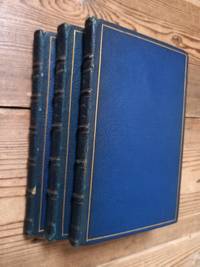
17752248London: W. Hay 1775. Hardcover. Very Good . Scarce. Complete in 3 volumes. 12mo. Full blue leather 5 bands and gilt tiles on spine. All edges bright gilt. Marbled endpapers with gilt decoration on leather at pastedown. Vol. I ii 170pp plus index & one page of publisher’s catalogue has a piece missing from the edge of the last page & small tear no text effected. Vol. II 230pp plus index & one page of publisher’s catalogue. Vol. III 247pp plus index. Authors include Langhorne Russel Macfarlane Cunningham Ogilvie Scoto Britannus Dunbar Bellentyne Pennycuick Lindsay Archibald Scott Fergusson Alexander Robertson Murray Graham Drummond etc. Particularly in the first volume many of the poems and songs are attributed to “a gentleman†or similar. The subjects range from parodies to eulogies folk songs to love songs and all that life entails. Ex reference library with pictorial bookplate on front pastedowns single stamp on front & rear endpapers first and last pages blind stamp on reverse of title pages. A very good set of these rare volumes. W. Hay hardcover
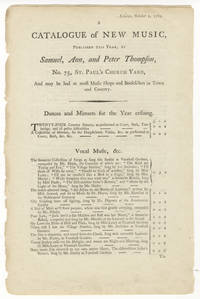
178936363London: Samuel Ann and Peter Thompson No. 75 St. Paul's Church Yard And may be had at most Music Shops and Booksellers in Town and Country 1789. Folio. Disbound. 4 pp. <br /> <br /> Contains announcements of newly-published "Dances and Minuets for the Year ensuing; Vocal Music &c.; Psalmodia Evangelica; New Editions of the following Music; New Editions of Instruction Books and Pocket Companions for the following Instruments" and announcements of publications forthcoming in December.<br /> <br /> Slightly worn and browned; outer edge slightly chipped; leaves loose; binder's holes and chipping to inner margins with minor paper loss. "Peter Thompson was the founder of the important business carried on by the Thompson family for half a century. They were the last survivors of the music trade which once thronged St. Paul's Church Yard and their place of business had very likely been one of the shops held by members of the trade a century or more previously . In 1780 Peter . a grandson of the original founder is added to the firm which now stands as Samuel Ann & Peter and the business prospers still more." Kidson: British Music Publishers Printers and Engravers pp. 125-26. Samuel, Ann, and Peter Thompson, (No. 75) St. Paul's Church Yard, And may be had at most Music Shops and Booksellers in Town and unknown
1795045633London: Clementi Banger Collard Davis & Collard et al. 1795. Early Edition. Hardcover Half Leather. Very Good Condition. Collection of engraved scores bound up in half reverse brown leather modest wear at edges rubbing to boards with loss of marbled paper stain to rear cover. Modest foxing occasional minor staining and creasing a few ownership marks; generally very good internally. The scores are: <br /> <br /> Ignace Pleyel. Three Grand Sonatas for the Piano-Forte or Harpsichord. In which are introduced for the Subjects of The Adagios & Last movements Select Scotish Airs With Accompanyments for a Violin and Violoncello.London: Printed & sold by Preston & Son n.d. 1793; And: Ignace Pleyel. Two Grand Sonatas For the Piano Forte or Harpsichord with an Accompanyment for the Violin ad Libitum.Op. 7.London: Printed & Sold by F. Linley at his Music Warehouse n.d.; And: Joseph Mazzinghi. Three Sonatas for the Piano Forte with or without the Additional Keys and an Accompaniment for a Flute or Violin.Op. 14.NB. In this Sett are introduced several favorite Airs. London: Printed by G. Goulding n.d. 1793; And: Joseph Mazzinghi. Three Sonatas For the Piano Forte with or without the Additional Keys and an Accompanyment For a Flute or Violin. In which are introduced several favorite Airs.Op.a 19. London: Printed for G. Goulding n.d.; And: L. Latour. Three Sonatas for the Piano Forte or Harpsichord with an Accompaniment for a Violin & Violoncello.Op. I. London: Printed & Sold at A. Bland & Weller's Music Warehouse n.d.; And: James Hook. Three Grand Sonatas for the Piano Forte with an Accompaniment for a Violin in which are Introduced for the Subjects of the Adagios & last Movements Favorite Irish Airs.Op. 78. London: Printed & Sold by Preston & Son n.d. 1795; And: Bland's Collection Continued by F. Linley of Sonatas Lessons Overtures Capricios Divertimentos &c. &c. for the Harpsichord or Piano Forte without Accompts. by the most Esteem'd Composers. London: Printed & Sold by F. Linley Successor to Mr. Bland n.d.; And: T. H. Butler. Lewie Gordon A Favorite Air Arranged as a Rondo for the Piano Forte.London: Printed & Sold by Preston & Son n.d.; And: The New German Waltz adapted as a Rondo for the Harp or Piano Forte by Madame Dussek. Edinburgh: Printed for Corri Dussek & Co. n.d. Size: Folio. Quantity Available: 1. Shipped Weight: 2-3 kilos. Category: Music; Inventory No: 045633. Clementi, Banger, Collard, Davis, & Collard et al. hardcover
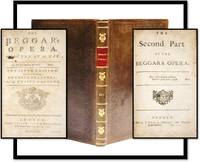
174917048London: John Watts & T. Read 1749. Very Good/No Dust Jacket As Issued. <br /> <br /> Modern full calf leather with a floral blind-stamped borders the spine with compartments with harp designs and a red leather title renewed endpages. Contains illustrated title page and numerous musical scores for each song as well as the overture.<br /> <br /> The bindings are tight and square. Text clean light even toning. Moderate shelf handling wear. 8vo; 8 inches tall; delicate edges to the first few pages some age-related blemishes through-out.<br /> <br /> The Beggar's Opera with the ouverture in score; and the musick prefix'd to each song. 76 pages followed by 8 pages of other books published by John Watts with brief synopsis of each. The first edition had the score on 16 pages at the end here the music is printed in the text in woodcut.<br /> <br /> Second Part of the Beggars Opera. v 1 70. This a pirated edition of Polly Gay's sequel to the Beggar's Opera. Published Anonymous. By John Gay. Also known as Polly and is a ballad opera with text by John Gay and music by Johann Christoph Pepusch. It is a sequel to Gay's The Beggar's Opera. Due to censorship the opera was not performed in Gay's lifetime. It had its world premiere on 19 June 1777 at the Haymarket Theatre in London.<br /> <br /> Provenance: From the private collection of Anton Vishio Sr. a scholar and mentor. He taught Latin and Classical Greek at the Gilmore School in Baltimore for 45 years. <br /> <br /> Ref: ESTC ESTC; T13803; Old English plays noted bibliographically and biographically. London: Pickering & Chatto 1909; page 63 item no. 536. Background Information:<br /> The Beggar's Opera written in 1728 by John Gay with music arranged by Johann Christoph Pepusch is a notable ballad opera in three acts. This play holds great significance in the realm of Augustan drama and stands as the sole enduring example of the once flourishing genre of satirical ballad opera.<br /> <br /> The primary aim of this piece was to satirize the burgeoning popularity of Italian opera in London. As aptly described by The New York Times Gay crafted the work as an anti-opera cleverly exploiting the public's fascination with the Italian opera style prevalent in 18th-century London.<br /> <br /> By lampooning this style The Beggar's Opera captivated audiences with its wit and irreverence. In contrast to the grandeur and lofty themes of traditional opera Gay's work relied on familiar tunes and portrayed characters from everyday life.<br /> <br /> While some of the songs were composed by notable opera composers such as Handel only the most popular melodies were included. This deliberate choice allowed the audience to hum along forging a connection with the music and characters on stage.<br /> <br /> Central to its narrative The Beggar's Opera satirically tackled political corruption poverty and social injustice permeating all levels of society. Through its biting commentary the play shed light on the pervasive nature of corruption exposing its presence in various strata of society.<br /> <br /> Overall The Beggar's Opera not only served as a parody of Italian opera but also offered a critical examination of societal issues. By blending accessible music relatable characters and astute satire this enduring piece continues to captivate audiences and maintain its relevance to this day.<br /> <br /> The Second Part of the Beggars Opera Polly<br /> <br /> Similar to its predecessor Polly also faced censorship during its time. The production was prohibited by the Lord Chamberlain the Duke of Grafton most likely influenced by Walpole. However rather than negatively impacting Gay the censorship served as exceptional advertisement for the play. In 1729 Polly was published through a subscription model leading Gay to earn a substantial sum of money.<br /> <br /> Although Polly did not see the light of day on stage during Gay's lifetime its censorship was more severe compared to the first play. Walpole deemed the satire in Polly to be far more explicit and potent. Consequently the Lord Chamberlain banned the play from even entering the rehearsal stage labeling it as a lewd and defamatory work. It is worth noting that the ban on Polly may have been a result of its association with Gay rather than solely its subject matter. Finally on 19 June 1777 Polly made its stage debut at the Haymarket Theatre in London.<br /> <br /> However the ban's impact was merely nominal as the play was not only printed and sold in April 1729 but also prompted Gay and his publisher to file injunctions against 17 printers and booksellers for pirating the work in June of the same year. John Watts & T. Read unknown
174921646London: John Watts & T. Read 1749. Very Good/No Dust Jacket As Issued. <br /> A 'Forbidden' Augustan Sammelband<br /> A significant eighteenth-century manuscript containing the definitive Augustan satire and its censored sequel. <br /> <br /> The Beggar's Opera 1749 features the music woodcut within the text rather than as a separate appendix. It is bound here with a contemporary 1729 pirated edition of Polly published anonymously the same year as the official subscription release. While the original Beggar's Opera revolutionized London theater as an anti-opera lampooning Italian style and political corruption Polly was so biting in its satire of Robert Walpole that it was banned from the stage for nearly 50 years.<br /> <br /> KEY FEATURES<br /> Music: Numerous woodcut musical scores integrated within the text including the overture.<br /> Sequel: Includes the rare 1729 pirated edition of Polly issued during the height of Gay's legal battles with unauthorized printers.<br /> Binding: Modern full calf with harp-design compartments floral blind-stamped borders and a red leather title label.<br /> Provenance: From the scholarly collection of Anton Vishio Sr.<br /> Catalog: Includes the 8-page publisher's catalog of John Watts at the rear.<br /> <br /> CONDITION: Very Good. The modern binding is tight square and handsomely executed. The text block is clean with light even age-toning and occasional minor blemishes. The first few leaves show delicate edges. 8 inches tall; renewed endpapers. HISTORICAL SIGNIFICANCE -<br /> John Gay's The Beggar's Opera remains the sole enduring example of the satirical ballad opera a genre that weaponized popular tunes to expose social injustice and the absurdity of the Italian opera craze. Its sequel Polly became a cause célèbre of 18th-century censorship; banned by the Lord Chamberlain the text became an instant forbidden bestseller. This volume documents the transition of the work from a theatrical performance to a literary protest captured here in the format favored by 18th-century gentleman scholars.<br /> <br /> SUBJECTS: Ballad Opera Augustan Satire 18th Century Theatre Censorship Pirated Editions Drama Music Score Literary Sammelband.<br /> <br /> BIBLIOGRAPHIC REFERENCE: ESTC T13803; Pickering & Chatto 1909 p. 63. John Watts & T. Read unknown
1739009866Paris: Jean Desaint 1739. Book. Very Good. Hardcover. First Edition. 16mo - over 5¾" - 6¾" tall. 2 xvj 542 3 pages. Printer's address p. 541 transl. from the French "From the Printing Office of Jean-Baptiste Christophe Ballard Sole Printer to the King for Music & Notator of His Majesty's Chapel". Only the title page and the chapter headings are in French the rest is in Latin. Printed notated music. Bound in contemporary quarter calf over marbled boards marbled end papers with woodcut arms to title-page.Very Good tear to leather at head of spine joints rubbed prior owner name in ink front end page scattered minor toning contemporary ink inscription in Latin rear end page. The Desaint edition RARE OCLC locates a single copy in Lyon France. Jean Desaint Hardcover
1779045654Lyon: Jean-Marie Bruyset 1779. Later Edition. Hardcover Half Leather. Good Condition. 19th century half leather hinges cracked binding sound but rubbed. Scattered mostly minor foxing old catalog entry pasted to front blank; generally clean internally. 10 folding plates. A nice copy. First published in 1752. xxxvi 236 4pp. Size: Octavo 8vo. Quantity Available: 1. Shipped Weight: Under 1 kilo. Category: Music; Inventory No: 045654. <br/><br/> Jean-Marie Bruyset hardcover