78 266 résultats
Oblong folio (ca. 316 x 226 mm). Brown ink on paper, 16 staves (Johnson, Tyson & Winter Nr. 2). 3 pp. on 2 leaves (separate, second leaf mounted to a cloth stub with another, blank sheet of contemporary paper). A total of 217 measures (omitting preludes) with deletions and corrections throughout. Stored in custom-made red morocco portfolio with cloth interior flaps and brass applications on both covers (342 x 248 mm). First draft for the lied "Neue Liebe, neues Leben", a setting of a 1775 poem by Johann Wolfgang von Goethe, begun in late 1798. The present sketch, jotted down without interruptions in a very cursory, almost rushed hand already contains the melody and the words with no expression markings, but includes occasional bass sections as well as parts of the piano accompaniment at the end of verses; it shows several important departures from the version printed in 1810. At the head of the page, written in a different ink and pen and comprising the first four staves, are the first eight bars of the finale of Beethoven's String Quartet No. 1 in F major (Op. 18, No. 1, composed between 1798 and 1800, published in 1801), providing the violin voice with the theme chorus of triplets. - The lied in its present version (WoO 127) was published in early 1808, nearly a decade after this first sketch, by Simrock in Bonn as the first part of the "III deutsche Lieder", apparently without the composer's consent. Beethoven subsequently revised his work (the manuscript of that revision, dated "1809", is today kept at the Beethoven Haus in Bonn) and published it the following year with Breitkopf & Härtel in Leipzig as part of his "Sechs Gesänge" (Op. 75, No. 2). "Il s'agit du monologue d'un amant que la rencontre d'un nouvel amour a bouleversé au point de ne plus savoir où il en est : sa tentation est alors de fuir ce qui le rend étranger à lui-même" (E. Brisson). In 1811 Beethoven presented a manuscript copy of that second version, the first leaf of which is also kept in Bonn (while most of the remainder is at the Pierpont Morgan Library in New York), to Bettina Brentano on the occasion of her wedding to Achim von Arnim. Nohl has pointed out that the present first draft with its "dramatic, aria-styled phrasings" retains a somewhat "grandiose and dark quality" as compared to the reduced later version, and "if one were to interpret the urgent stride so vividly apparent in this sketch, dashed off, as it seems, without a single interruption and in a mood of deep emotional excitation, then one feels instinctively that forces of an even greater passion than such as Bettina could have aroused in Beethoven must have been at work here" (cf. p. 695). - Occasional quite insignificant brownstaining; altogether very crisp. Both leaves annotated with Beethoven's name in a near-contemporary hand. At the head of the first page is the "mysterious caption" (cf. Nohl), also by a different, early hand: "Der Schluß von seinem letzten Septuor als Motto für den Text" (apparently referring to Beethoven's Septet, Op. 20, also written in 1799; a tentative explanation is advanced by van der Zanden, p. 168). - Beethoven manuscripts written before 1800 almost never come to market; no other complete autograph manuscript of this version is known. The two leaves formerly were a single bifolium owned by baroness Anna von Gleichenstein, the sister of Beethoven's friend Therese Malfatti (remembered as a possible dedicatee of "Für Elise"), which was soon separated. Even in 1865, when Nohl edited the first leaf, its counterpart was no longer in the possession of the Gleichenstein family. The first sheet later surfaced in the archives of the music publisher Schott in Mainz and was sold at Sotheby's in 2002 (6 December, lot 14: £65,725). The second leaf was offered in 1968 by Hans Schneider of Tutzing in his catalogue 136 (lot 37, DM 17,800; then again in cat. 142, lot 266, with illustration on p. 45) and was acquired in 1969 by a private collector who had it auctioned by Venator & Hanstein in Cologne in 2011 (cat. 118, lot 861: EUR 108,000). Now that both leaves have been reunited, Hans Schneider's words, written half a century ago about only the final 62 measures, are no less true: "Through Beethoven's synthesis of his own music with a text by Goethe we are presented with a musical autograph as desirable as it is beautiful" (cat. 136, p. 37). WoO 127. Beethoven, Werke (Neue Ausgabe), Abt. 12.1, Lieder und Gesänge mit Klavierbegleitung. Kritischer Bericht (Munich, 1990), no. 18, pp. 20f., and cf. no. 41, pp. 47-49. Ludwig Nohl, "Eine Beethoven'sche Skizze", Recensionen und Mittheilungen über Theater und Musik 44 (4 Nov. 1865), pp. 695-697 (an edition of the first leaf only). Max Unger, "Neue Liebe, neues Leben. Die Urschrift und die Geschichte eines Goethe-Beethoven-Liedes", Zeitschrift für Musik 103.9 (Sept. 1936), pp. 1049-1075, here at pp. 1060-1062. Jos van der Zanden, "The Shakespeare Connection: Beethoven's String Quartet Op. 18 No. 1 and the Vienna Haustheater", Eighteenth-Century Music 18.1 (March 2021), pp. 151-170, here at p. 168 note 106.
2 pages in ink and pencil on 16-stave paper (322:234 mm), with two folds. Formerly sewn on the left margin, leaving three punched holes. Accompanied by two autograph letters signed from Friedrich Wilhelm Künzel in Leipzig to Fred M. Steele of Chicago, dated July 16th, 1886, discussing the acquisition and certifying the authenticity of the present leaf. Stored in custom-made green morocco portfolio. A densely-used two-sided autograph sketchleaf containing music to opus 117, "König Stephan" or "Ungarns erster Wohltäter" ("Hungary's first Benefactor"), the front showing, among other motifs, the opening cello/bassoon line for the beginning of the first movement chorus, "Ruhend von seinen Thaten" (Andante maestoso e con moto, C major), and the verso with material from the end of the movement, all over with various freely written passages in ink and pencil, mostly on single staves, some with text underneath, containing many holograph corrections and instances where ink is written over pencil. - The present sketchleaf, apparently hitherto unknown to scholarship, belongs to a book of sketches that Beethoven used while writing his stage music "König Stephan" in 1811. Beethoven created his own book from various paper on hand and used it while at the spa in Teplitz from late 1810 into mid 1811. He finished "König Stephan" between 20 August and mid-September 1811. The sketches are of the first chorus (after the overture). The musical play was commissioned for the opening of the new theatre in Pest along with "The Ruins of Athens". First performed on 9 February 1812, it was published as op. 117. King Stephen I founded Hungary in 1000. Emperor Francis I of Austria commissioned the new theatre, and Beethoven was chosen as the composer to honour the occasion of the opening. The Austrian Emperor was honouring Hungary's loyalty, thus the subject matter on a text by August von Kotzebue. - The Beethoven-Haus in Bonn holds four other sketches from this sketchbook (viewable in their digital online archive, as entries HCB Bsk 2/50, 3/51, 4/52, and Mh 81), all of which share the same three holes punched on the left-side margin of the present sketch. We would like to thank Dr. Carmelo Comberiati, professor of Music History at Manhattanville College, for his assistance in cataloguing this lot. - Provenance: Friedrich Wilhelm Künzel, Leipzig, before 1886; Collection of Fred M. Steele, Chicago, purchased from the above, 1886. Offered in the "Collection of Important Autographs in the estate of Mrs. Ella P. Steele, widow of Mr. Fred M. Steele" (Philadelphia, 1918). Acquired from the purchaser's descendants, last located in Greenwich, CT. For an in-depth discussion of the pages to which this sketch belongs, cf. Douglas Johnson, Alan Tyson and Robert Winter, "The Beethoven Sketchbooks", p. 201-206.
Oblong folio. Engraved piano score with the text. Untrimmed. First printing of the first edition of Beethoven's only opera; of the utmost rarity. Inscribed on the title page, in Beethoven's own hand, to his benefactor Pasqualati (1777-1830), in whose house the composer then lodged: "Seinem werthen Freunde Baron von Pasqualati vom Verfasser" ("To his dear friend Baron Pasqualati, from the author"). - No more than three copies of this first edition bearing Beethoven's autograph inscription are known; the present one is described by Kinsky/Halm as follows: "This copy from the collection of the Society of Friends of the Music in Vienna (cf. no. 893 in the guide-book to the Centenary Exhibition, Vienna 1927) was presented to the conductor Arturo Toscanini by the Austrian Government on 1 November 1934 on the occasion of a performance of Verdi's 'Requiem', directed by him, as a gift of honour (cf. 'Philobiblon' VIII, 6)". - Professionally cleaned with repairs to gutter. Collection stamp of the Society of Friends of the Music in Vienna on title page and verso of final leaf. Beethoven's autograph inscription pencilled across the blank margin of the title page. - The present dedication copy was not publicly shown since the great 1927 exhibition in honour of the centennial of Beethoven's death; it was latterly considered lost (as are the other two dedication copies of "Fidelio" described in the catalogue of Beethoven's works). We acquired it directly from Toscanini's estate in spring 2016. Literature (all referencing this copy): Beethoven und die Wiener Kultur seiner Zeit (= Führer durch die Beethoven-Zentenarausstellung der Stadt), Wien 1927, 893. Philobiblon VIII (1935), 6. Kinsky/Halm, Werkverzeichnis Beethoven, 184.
Oblong folio (353 x 270 mm). Full score for orchestra. Manuscript in black ink on 20-stave paper by "D. T. Éditeur, Paris", mainly on one system per page. 12 pp. on 3 bifolia (only ff. 2-3 still conjoined), lacking one bifolium after f. 5 (portions of f. 1 and f. 5 roughly torn off). Extremely rare musical manuscript: the orchestral score for a dance from "The Maid of Orleans". Composed in 1878-79, with a libretto by the composer, Tchaikovsky's opera in 4 acts premiered on 25 February 1881 at the Mariinsky Theatre in St Petersburg; in the following year it became the first of Tchaikovsky's operas to be performed outside Russia, with a production in Prague opening on 28 July. - The part in this manuscript belongs to Act II, nearing the central moment of the opera when Joan of Arc's victory is announced: at the Château de Chinon, King Charles VII, absorbed in his worries, seeks to distract himself by listening to the minstrels, and three dances follow one another: "Dance of the Gypsies" (Allegro vivace), "Dance of the Pages and Dwarves" (Allegro moderato), and finally the present "Dance of the Buffoons" (Allegro molto). - Though lacking a bifolium (bars 173-233), the manuscript is otherwise complete in orchestration and includes a number of revisions by the composer. An elegant copy, the manuscript nevertheless shows some haste in writing, with corrections to the text, a whole bar crossed through, and other corrections (with a slightly thicker pen nib) probably made on checking through. The text offers a number of minor variants from the received printed score, chiefly relating to dynamics and slurrings. - The manuscript's dating poses a puzzle: Tchaikovsky was working on the libretto from about 21 November to 3 December, though in a letter to Mme. von Meck he indicated he did not intend to begin composition until after he had finished work on the orchestral Suite no. 1, whose last two movements he completed on 27 November (the same day as the present manuscript). In the event he did not begin work on the composition until 4 December, according to a letter to his brother Anatoli of the following day; at the end of the opera's autograph he writes that it was begun in Florence on 23 December. The present manuscript therefore precedes the accepted dates for the beginning of composition: its finished condition, and the fact that the "Dance of the Buffoons" would not represent the most obvious starting point for the opera, may mean that it originally formed part of a separate composition, and the coincidence of dates hints at some association with the Suite no. 1 itself. Tchaikovsky had left home late in 1878 for a trip to Florence and Paris, arriving in Florence on 20 November. - Provenance: The editors of the Thematic and Bibliographical Catalogue of P. I. Tchaikovsky's Works refer to the composer's "rather careless attitude towards his own manuscripts [...] Many of them were handed to various people and were later partly lost". The present manuscript, of a movement which was subsequently incorporated into a larger work, would have been a suitable candidate for presentation. It was most likely acquired from the composer, or shortly afterwards, by a cousin of Anton and Nikolai Rubinstein, Aaron Rubinstein (b. 1850); at some subsequent stage ownership stamps appear to have been roughly removed from the first and fifth leaves. Sold at Christie's London for Aaron Rubinstein's descendants on 3 June 2009 (lot 41: £97,250). - Musical manuscripts by Tchaikovsky are extremely rare on the market: prior to the appearance of this manuscript at Christie's more than a decade ago, only a single leaf had been offered for sale in the preceding 30 years, and no substantial manuscript had appeared since before the war. Since then, a 16-leaf working manuscript comprising score drafts of several movements of the orchestral Suite no. 2 was sold at Sotheby's in 2015, commanding £270,000.
Oblong 4to (287 x 228 mm). 1 page, meticulously notated in 38 bars on five systems of two staves. Annotated in a 19th-century hand "copié par Chopin", loosely matted. Stored in a custom-made red morocco portfolio with cut signatures of Arthur Rubinstein (1931) and Vladimir Horowitz (1978), famed as interpreters of Chopin's music. Two short piano works inspired by Polish folk music. Kobylanska considers that whilst both works are signed by Chopin, they are too unsophisticated to be his own compositions, and are perhaps transcriptions of Polish folk tunes: "Beide Stücke sind zwar mit Ch signiert, in ihrer ganzen Art jedoch zu primitiv, als daß man sie für eigene Kompositionen Chopins halten könnte. Wir ordnen sie in dieses Kapitel ein, da es sich vielleicht um Übertragungen von polnischen Volksweisen handeln mag." If so, it is fascinating not only to see Chopin in the posture of an ethnomusicologist some sixty or more years before the pioneering research of Bartók and Kodály, but also that the resulting works, notated with his characteristic exquisite neatness, should be granted the imprimatur of his discreet, repeated signature. - Provenance: 1) collection of the actor, director and playwright Sacha Guitry (1885-1957); his sale, Drouot, Paris, 21 November 1974 (lot 15); 2) collection of the Canadian chemist and physician Frederick Lewis Maitland Pattison (1923-2010), with his bookplate on the portfolio's inside front cover. Krystyna Kobylanska, Frédéric Chopin: Thematisch-bibliographisches Werkverzeichnis (1979), VII b (Transkriptionen von Volksweisen), nos. 7 and 8. First published in Jean-Jacques Eigeldinger, "Un autographe musical inédit de Chopin", Schweizerische Musikzeitung / Revue musicale suisse, CXV/1 (Jan.-Feb. 1975), pp. 18-23. F. L. M. Pattison, "A Folk Tune Associated with Chopin and Liszt", Journal of the American Liszt Society 20 (1986), pp. 38-41. J. M. Chominski & T. D. Turlo, Katalog dziel Fryderyka Chopina (1990), p. 240 (Sketches, fragments, exercises): "Folk melodies meticulously recorded on a single sheet".
Oblong 12mo (ca. 98 x 52 mm). 1 p., with a similar receipt for another legacy with 4 additional signatures on verso. Evenly browned, a little stained, edges a little chipped. Decoratively framed and glazed with a brass plaque and an engraved portrait (light chipping to gilt frame). Signature by Johann Sebastian Bach, confirming in his own hand the receipt of 2 guilders ("acc[epi] - 2 fl.") from the Lobwasser Bequest. The sum was paid out around every 2nd of July to the cantor, deputy headmaster, and third teacher (tertius) at St. Thomas. Above and below Bach's signature, his colleagues Conrad Benedict Hülse and Abraham Kriegel sign for their 2 guilders. - One of Bach's several supplementary sources of income which together made up a substantial part of his Leipzig salary, this payment would in the mid-18th century have corresponded roughly to an organist's weekly wages. The "Legatum Lobwasserianum", a legacy of 1000 guilders, was bequeathed in 1610 by a Leipzig lawyer's pious widow, Maria Lobwasser; the 50 guilders of annual interest, paid on the Feast of the Visitation, went toward supporting St Thomas's church and school personnel. - This is one of only two known receipts from Bach receiving his Lobwasser funds. The other, from 1750, was originally written on the same sheet of paper underneath the entry for 1748, but the two records were later cut apart and separated. Curiously, the relevant entry for 1749 must have been made in another, now lost document, as a date "1749" and Hülse's stricken-out signature, apparently made here in error, appear at the bottom of the present slip of paper (formerly between the 1748 and 1750 records). The small 8vo leaf, removed from a receipt book, was complete in 1908 when it was offered at C. G. Boerner's sale of "precious autographs from a Viennese private collection" (lot 3). The buyer was probably the noted Swiss collector Karl Geigy-Hagenbach, in whose "album of manuscripts by illustrious personages", published in 1925, it was again illustrated intact. The receipt's location was subsequently unknown until, in May 1986, the present upper half of the sheet appeared at Christie's manuscripts sale (lot 271). It was likely acquired there by the Canadian chemist and physician Frederick Lewis Maitland Pattison (1923-2010) and subsequently sold by the New York dealer Kenneth W. Rendell (his description pasted on the reverse of the frame) to the Musée des Lettres et Manuscrits, Paris; acquired from their sale. - In December 2014, the lower half (bearing the receipt for 1750, signed by Bach's son Johann Christian in the place of the blind and dying composer) appeared at Swann's in New York, described as having previously been in the collection of the Polish harpsichordist Wanda Landowska (1879-1959), and was bought by the Bach-Archiv in Leipzig. C. G. Boerner, auction catalogue XCII (Leipzig, 8 & 9 May 1908), lot 3. K. Geigy-Hagenbach, Album von Handschriften berühmter Persönlichkeiten vom Mittelalter bis zur Neuzeit (Basel 1925), p. 243. H.-J. Schulze, Marginalien zu einigen Bach-Dokumenten, Bach Jahrbuch (1961), pp. 79-99, here at p. 93. Bach-Dokumente, Krit. Gesamtausgabe (ed. W. Neumann & H.-J. Schulze), vol. 1 (1963), p. 207, no. 137.
Oblong small 4to. 1 page. With autograph address on reverse ("An Herrn v. Mayer"). In German. To Friedrich Sebastian Mayer, with instructions for the singer who performed the role of Don Pizarro at the premiere of "Fidelio" (in the original première of 20 November 1805 as well as in that of the reworked version of 29 March 1806): "Hier der Ite Akt - diesen Abend den Zweiten - wo eigentlich nur wenige Veränderungen gemacht worden - sobald beyde Akte geschrieben, bitte ich sogleich, mir sie wieder zu zustellen" ("Here is the 1st Act - the second will follow this evening - which in fact contains only few changes - when both have been copied, please return them to me directly"). - The reception of Beethoven's first "Fidelio" version had been lukewarm; the second had enjoyed greater success. However, it was not until 1814, when Beethoven produced a third version of his only opera, that the work met with resounding cheers. Wilhelmine Schröder-Devrient, one of the greatest tragic sopranos of the 19th century, who had accepted the role of Leonore in 1822, was instrumental for the opera's ever-increasing popularity. When Vienna's State opera, destroyed by Allied bombs during WWII, re-opened in 1955, it was Beethoven's "liberation opera" that was chosen to mark the occasion. - Slightly browned and wrinkled, overall in good condition. Beethoven, Briefwechsel (ed. S. Brandenburg), no. 244.
Small 4to (ca. 160 x 158 mm). 1 p. Stored in custom-made burgundy morocco chemise, interior finished with navy-blue morocco, inner front cover with a steel-engraved portrait of Beethoven under a silk matte. To the Viennese civil servant Franz Rettich (1768-1818), who was to help Beethoven send urgently needed scores to Graz for a charity concert on March 29th, only six days hence: - "Es dürften bis Morgen abend wohl sicher noch die 2 overturen folgen, und so wird Ihnen geholfen, jedoch mit der äußersten Anstrengung. Schreiben Sie nur gefälligst, daß man in Graz sicher alles erwartete erhalte, jedoch muß man sich im Voraus gefaßt machen zur Probe, da die Sachen mit dem Postwagen zwar nicht zu spät, aber doch auch nur eben zur rechten Zeit ankommen werden [...]" ("The two overtures ought quite certainly to follow by tomorrow evening, and so you shall be accommodated, but only thanks to the greatest exertions. Just kindly write that everything expected in Graz will dependably be received, but everyone must prepare for the rehearsal in advance, as the things will arrive by stagecoach, not indeed too late, but still only just in time [...]"). - In summer 1811 Beethoven had met the civil servant and patron of Graz, Joseph von Varena (1769-1843), who had persuaded the composer to support his charity concerts with music. Beethoven was enthusiastic and in late January 1812 promised Varena several pieces, including the overtures of "King Stephen" (op. 117) and "The Ruins of Athens" (op. 113), both of which were already intended for the inauguration of the German theatre in Pest on 9 February and were therefore in Hungary at the time of writing. Franz Rettich, secretary at the Superior Court of Justice in Vienna, was chosen to act as intermediary and messenger. (The father of the actor Karl Rettich, he had himself been a supporting actor at Vienna's court theatre between 1789 and 1797 before entering the civil service.) - In fact, the timing turned out to be extremely tight, as Beethoven's copyist Wenzel Schlemmer, the only man the composer would trust with the job, had fallen ill. In his present note to Rettich, Beethoven promises that the work will be finished in time, but warns that the orchestra in Graz will have very little opportunity to rehearse. Anxious to keep his word, Beethoven even forced Schlemmer to sign a declaration that he would complete the copies by March 26, noon - a pledge he would prove unable to keep. Ultimately, the copies were finished too late to go to Graz with Rettich by regular stagecoach and had to be sent by special courier, whom Rettich paid 21 guilders for the service, arriving at high noon on the day of the concert. The programme began at 6:30 that evening with a (very probably unrehearsed) performance of the "King Stephen" overture, but the overture from "The Ruins of Athens" had to be skipped. Still, the concert played an important role in making Beethoven known in Styria: "Varena, an ally from the very beginning, contributed much to that important first boost which launched a serious and lasting reception of Beethoven's works outside Vienna, enriching the musical life of Graz and amplifying with remarkable swiftness the structure of local concert programmes in the 19th century" (cf. Nemeth, p. 29). - Traces of original vertical and horizontals folds; in excellent condition. On the verso, Rettich has certified the receipt: "This message was written to me and I received it on March 23." Beethoven, Briefwechsel (ed. S. Brandenburg), vol. 2, p. 251, no. 562. F. Bischoff, "Beethoven und die Grazer musikalischen Kreise", Beethovenjahrbuch 1 (1908), pp. 6-27, here at p. 11. Cf. M. Nemeth, Beethoven-Rezeption in Graz im frühen 19. Jahrhundert unter besonderer Berücksichtigung seiner Symphonik und des Grazer Konzertwesens (unpublished M.A. thesis, Graz, 2003).
4to. 2 pp. (90 lines). Original draft for Wagner's famous oration held on December 15, 1844, when Carl Maria von Weber's remains were laid to rest at the Catholic cemetery in Dresden. The mortal remains of Weber, who had died in London in 1826, were transferred back to Germany in 1844 on the initiative of Wagner, and were finally buried there. - With small departures printed in: Richard Wagner, Gesammelte Schriften und Dichtungen, II, 1871, 61 ff., also: Gesammelte Schriften und Dichtungen, 4th ed., vol. 2, 1907, 46 ff. A facsimile of the fair copy of Wagner's speech, which has also survived, is published in Julius Kapp, Richard Wagner. Sein Leben, sein Werk, seine Welt in 260 Bildern, Berlin 1933, 40. - Provenance: Cäcile Geyer, Wagners half-sister (1815 - 1893), their son Ferdinand Avenarius (1856 - 1923), and his stepson Wolfgang Schumann (1887 - 1964), afterwards in private collection. - Mild toning and slightly spotty; small damage to edges.
Two pages (207:300 mm). 14 bars on one six-stave system (bars 51-64 of the published edition) for voice, bass, two horns and strings, the text for the aria "Sono le femmine si maliziose [...] nessun per certo le troverà". A fragment of Haydn's "Dice Benissimo". Haydn composed two insertion arias for Antonio Salieri’s dramma giocoso of 1778, "La scuola de' gelosi": one is lost to us, while the present manuscript is a fragment of the aria created for the bass voice of the manservant Lumaca. One of Haydn's many responsibilities as Kapellmeister of the Esterházy family - by 1780 under Nikolaus I - was as director of the opera company, his patron's newest passion as of the mid-1770s. Esterháza Palace was transformed, at the behest of Prince Nikolaus, into an important fixture on the opera calendar, with its theatre routinely hosting multiple productions each year. Not only would Haydn direct and produce the performances, but he would compose his own works, as well as adapting those of other composers - usually choosing dramma giocoso - to suit the forces at his disposal. This often meant composing insertion arias - such as the present work - to suit the voice of a particular singer: around twenty such arias survive, dating from 1777 to 1789, although only a handful are written for bass or tenor. - Remnants of tape at upper, left-hand and bottom margins of recto. Provenance: Professor Theodor Dielitz (presentation and authentication inscription; Dielitz's substantial autograph collection was auctioned by Hartung in Berlin in January 1858), given to a Dr. Pribil as a duplicate, 1 January 1848. Last in the Metropolitan Opera Guild Collection. Not in Hoboken.
Gum bichromate print (vintage), 223 x 164 mm. Monogrammed and dated by the artist in red ink at lower right. Matted, framed and glazed. Portrait of the 45-year-old Mahler during the heyday of his directorship at the Vienna Court Opera, three years after his wedding to Alma Schindler. One of the extremely rare works by the sugar industrialist and collector Friedrich Spitzer, who since 1895 had devoted himself to a close study of experimental photographic processes, especially gum bichromate printing - a multi-layered method that accommodated the needs of fin-de-siècle artistic photography in that it allowed for a high degree of creative freedom during every step of the process, making every resulting print a unique work of art. - Spitzer, who cultivated an image as a dandy, was a member of Vienna's modernist art scene around the turn of the century. He was accepted into the renowned London photographic society "Linked Ring" as early as 1892 and joined Vienna's "Camera Club" in 1897. For his small but expressive and technically brilliant body of work he is remembered as one of the principal Austrian artistic photographers of his age. - The present portrait of Mahler was shown at Spitzer's only exhibition, at Vienna's Miethke Gallery in 1907. The artist's autograph signature with the date "05" is usually cropped from the published reproductions. - Perfectly preserved; framed under museum glass. Illustrated in: Photographische Rundschau und Photographisches Zentralblatt, Zeitschrift für Freunde der Photographie 20 (1906), plates. Christine Kühn, Kunstfotografie um 1900. Die Sammlung Fritz Matthies-Masuren, 1873-1938, exhibition catalogue Kunstbibliothek Berlin, 25.4.-15.6. 2003, p. 137. Gilbert E. Kaplan, Das Mahler Album (Vienna: Brandstätter, 1995, erroneously described). First exhibited: Galerie Miethke, cat. Skulpturen von Ilse Conrat u. künstlerische Fotografien von Prof. Heinr. Kühn und Dr. F. V. Spitzer (1907), no. 122. Cf. Gerd Pichler, "Joseph Maria Olbrichs nie gebaute Künstlerkolonie in Wien und Josef Hoffmanns Künstlerkolonie auf der Hohen Warte", in: ICOMOS 64 (2017), pp. 83-88.
4to. ½ p. Framed and glazed. In Italian, to George Thomson in Edinburgh, a friend of Robert Burns and publisher of Haydn's song adaptations, inquiring about London performances of his "Creation" and announcing that he intends to write, before his death, another two or at least one dozen works specially for Thomson: "Stimatissimo Signor mio. Nell' ultima vostra lettera di Luglio m'avete fatto troppo Complimenti per la mia Creazione del Mondo. Mi stimo molto felice, che Iddio m'ha donato questo piccolo Talento per dar soddisfazione agli Amatori di Musica, tanto più, che per questa grazia Divina posso far del bene al prossimo mio, ed ai poveri: io vorrei dunque saper, se in Londra fu data la Creazione per i poveri, o per il Concerto professionale, e quanto denaro habbiano fatto; io ho fatto in Vienna con questi due pezzi di Musica, cioè colla Creazione, e con le quattro stagioni per le nostre povere Vedove di Musica, in tempo di tre anni quaranta mila fiorini: Se mi potete col tempo darmi una risposta sopra quel punto, mi fareste un gran piacere. - Vi mando dunque queste tredici Ariette con l'istessa speranza, che vi daranno piacere, io vorrei far ancora prima della mia morte venti cinque, o almeno dodici di queste Ariette, mà solamente per voi caro amico, perche cose più grandi non posso più sorprendere, la mia vecchiezza m'indebolisce sempre più [...]". With Thomson's autogr. note of contents on the reverse: "Dr. Haydn. With 13 more Airs to which he composed Symph.s and Accomp.ts and Enquiring whether the Creation had been perf.d in London for the benefit of the poor - and that he will yet do some more airs for me, and only for me!" - Traces of folds; slight tear at horizontal centerfold (touching text), otherwise immaculate. Provenance: in the collection of Emilie Schaup in 1931; later in a Vienna private collection. First published in German translation by Botstiber, Der Merker 1/19, 777; Italian text first printed by Leo Grünstein in: Das Alt-Wiener Antlitz (Vienna 1931) I, 138 (but recipient erroneously identified as Bridi). Dénes Bartha (ed.), Joseph Haydn. Gesammelte Briefe und Aufzeichnungen (Kassel 1965), p. 452, no. 357; H. C. Robbins Landon (ed.), The collected correspondence and London notebooks of Joseph Haydn (London 1959), p. 234f. Thomson's note was first published (with a departure) in: Eva Badura-Skoda, "Eine private Briefsammlung", in: Festschrift Otto Erich Deutsch (Kassel 1963), p. 280-290, at p. 283, with fig. 2.
Folio (270 x 345 mm). Title and 24½ pp. (paginated 1-25), final blank leaf. Written in brown ink on 32-stave paper, with 2 systems of 15 staves per page (except for the last page, which only has one system). 431 bars. Bound in contemporary red half morocco with gilt red morocco title label to the upper cover. Marbled endpapers (somewhat chipped). Exceptionally rare, unpublished musical manuscript: Bizet's autograph orchestration of the overture to Hippolyte Rodrigues's opera "David Rizzio", about the historical courtier who was the private secretary and rumoured lover of Mary, Queen of Scots. In 1566 he was assassinated by her husband, the jealous Lord Darnley, and a conspiracy of Protestant nobles. - A wealthy stockbroker and lawyer, Rodrigues (1812-98) was also a writer and composer. He retired early to devote himself to literature and music, notably composing melodies and piano pieces, but also more ambitious works such as this opera. Rodrigues was secretary of the "Société scientifique-littéraire israélite"; his sister Léonie was married to Fromental Halévy, Bizet's former teacher. Thus, Hippolyte Rodrigues was Geneviève Halévy's uncle and served as witness to her marriage to Bizet on 3 June 1869; he would lend the young couple his house in Saint-Gratien for their honeymoon. - In 1866 Hippolyte Rodrigues first published the textbook for "David Rizzio"; the piano and vocal score of the opera in four acts (first designated as a lyrical drama "en 3 actes, 4 tableaux", "paroles et musique de Hippolyte Rodrigues", would appear in 1873, privately printed by Eugène Heutte in Saint-Germain. Bizet listed this score in the catalogue of his music library. "Whether Bizet orchestrated any more of the opera than the overture is not known [...] The opera was not performed, except possibly as a play, and the music has not otherwise survived" (MacDonald). - The title-page of the manuscript first states, cryptically: "Ouverture / Jean-Jacques", followed by the correct title in Bizet's hand: "Overture de / David Rizzio / composée par / Hippolyte Rodrigues / orchestrée par / George Bizet". The orchestra includes 2 flutes, 2 oboes, 2 clarinets in A, 2 bassoons, 2 horns in D, 2 horns in C, 2 pistons in A, 3 trombones, timpani, bass drum and cymbals, violins I and II, violas, cellos, basses. The Overture begins with an Allegretto moderato in B minor in 2/4 time (25 bars); then, after a rallentendo and a brief Andante (10 bars, the last two, skipped, are noted on p. 4), comes an Allegretto (16 bars), followed by a reprise of the Andante; an Allegro 2/2 (36 measures); an Andantino in D minor in 2/4 (72 bars), then a brief passage "Un peu animé" (14 bars), leading to an Allegretto in E major (79 bars), then briefly in C (11 bars); the work ends with an Allegro in C minor in 2/2 time (110 bars), then in D, changing after 4 bars into 2/4 time until the end (46 bars). - Binding rubbed and bumped; stitching loosened. Of great rarity. Provenance: Hotel Drouot, Paris, sale at an unknown date. Delorme & Collin du Bocage, 14 Nov. 2008, lot 10. MacDonald, Bizet Catalogue, T56.
22 pages. Oblong 4to (c.17 x 27 cm). 8-stave paper, contemporary brown polished calf, stamped in gilt and blind ("Clara Mangin"), presentation inscription. Album of 12 autograph manuscripts signed by Paganini, Rossini and others, containing mainly complete songs and piano pieces. 1) Paganini, Niccolò. Album-leaf comprising two chromatic scale-passages in contrary motion, each spanning two octaves, twenty-six bars music in all, notated for treble & bass in brown ink on three two-stave systems, signed and inscribed ("All' Egregia Madamigella Clara Mangin ... Boulogne, li 15. Agosto 1834 Nicolò Paganini"). - 2) Rossini, Gioachino. Autograph manuscript of "Mi lagnerò tacendo", signed ("G. Rossini"), comprising a sixteen-bar setting of Metastasio's text, notated in dark brown ink on two three-stave systems per page, [c.1836], 2 pages. Together with: Théodore Labarre (the song "Mathilde", 2 pages) - Georges Mathius ("Andantino" in E minor for piano, 3 pages, 1836) -Jules Godefroy ("Pensée du moment", for piano, 2 pages, 1835) - Henri Bertini ("Téma" for piano, signed and inscribed 14 Mai 1836. HBertini") - Theodore Döhler (Allegro in c minor for piano, signed) - Sigismond Thalberg (musical quotation of an 'Andantino' in G) - George Onslow ('Allegretto con moto' in E-flat, for piano, signed "...23 Janvier 1846 George Onslow", 3 pages) - Eugene Ortolan ('Souvenirs d'auvergne' in F, 3 pages, 2 September 1847), and others in the album of Clara Mangin, 22 pages, oblong 8vo (c.17 x 27cm), the manuscripts all written directly into the album, 8-stave paper, contemporary brown polished calf, stamped in gilt and blind ("Clara Mangin"), presentation inscription, 26 June 1834, Boulogne, Paris, Calais, Clermont and elsewhere, 1836-1847, somewhat worn, with front cover detached. - Autograph music by Paganini is rarely offered for sale. This is a fine album of the 1830s-1840s, containing mainly complete works rather than short quotations. Rossini's song is one of many such settings that the composer made of his favourite Metastasian poem. The volume was given to Clara Stéphanie Mangin of Boulogne in 1834, in recognition of winning a music prize. We learn from the three-page piano work by George Onslow in 1846 that Clara had become Comtesse d'Espinay Theix Royat; the Château de Theix was near Clermont-Ferrand.
CARUSO ENRICO (NAPOLI 1873-IVI 1921), CELEBRE TENORE LIRICO ITALIANO, CONSIDERATO IL PIU' GRANDE DELLA SUA EPOCA, NOTO COLLEZIONISTA D'ARTE, MONETE, FRANCOBOLLI E CARTOLINE. <BR>IMPORTANTE COLLEZIONE DI 51 CARTOLINE POSTALI ILLUSTRATE, QUASI TUTTE VIAGGIATE PER POSTA: (1 RITRATTO; 4 FOTOGRAFICHE DALLA VILLA BELLOSGUARDO DI LASTRA A SIGNA (FI); 3 SUE AUTOGRAFE; 17 SUE OLOGRAFE; 22, A LUI INVIATE, AUTOGRAFE DI ARTISTI E PERSONAGGI SUOI CONTEMPORANEI; 2 INDIRIZZATE ALLA PRIMA MOGLIE ADA GIACCHETTI; 2 AUTOGRAFE DEL CANTANTE LUCIO DALLA CON STROFE DI SUO PUGNO DALLA CANZONE "CARUSO"), MONTATA SU 40 FOGLI DA ESPOSIZIONE, CORREDATI DAI RELATIVI TESTI ESPLICATIVI.
4to. 119 pp. and 99 pp. Includes a "Melic draft", dated 7 April 1944 (2 pp.). 220 pp. altogether. On staved paper; one ms. somewhat browned by age. The present, complete XVth "Zwölftonspiel" comprises: 1) Melischer Entwurf, captioned "J. M. Hauer XV. Zwölftonspiel. Hanns Blaschke 7. April 1944". 2 pp., notes in four colours (coloured pencil in blue, red, green, and orange). 2) Ms. score, captioned "Josef Matthias Hauer. XV. Zwölftonspiel für Orchester mit einer Zwölftonreihe, die vom Bürgermeister Dipl. Ing. Hanns Blaschke gewählt wurde, und die in sechs verschiedenen Tropen steht. Partitur/ Erster Teil im 2/4 Takt mit achttaktigen Perioden d=50, Dauer 10 Minuten". 119 pp., ink and pencil. 3) Ms. score, captioned "Josef Matthias Hauer XV. Zwölftonspiel für Orchester mit einer Zwölftonreihe, die von Bürgermeister Dipl. Ing. Hanns Blaschke gewählt wurde und die in sechs verschiedenen Tropen steht. Erster Teil im 2/4 Takt mit achttaktigen Perioden. Zweiter Teil im 3/4 Takt mit sechstaktigen Perioden. Partitur", 99 pp., ink and pencil. - Well-preserved fair copies. Cf. New Grove VIII, 303-305.
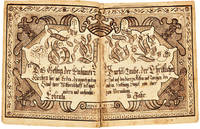
1747WRCAM46388Ephrata 1747. 264pp. plus 7pp. printed register. Small quarto. Contemporary three-quarter calf and marbled boards. Spine heavily worn split in center. Later 19th-century ownership inscription on front fly leaf. Slight wear and foxing to some leaves and some ink burn resulting in splits to some leaves. Very good. In a half morocco and cloth slipcase spine gilt. A unique and spectacular manuscript hymnbook created by the religious community at Ephrata Pennsylvania founded by Johann Conrad Beissel. This manuscript is from the period when the community was at its zenith and is an outstanding example of the Frakturschriften for which the Ephrata Cloister is known. It contains over 250 pages of manuscript music some of it likely original compositions. The printed register at the end contains 375 hymn listings and an additional fifteen pieces of music precede the main body of the work. <br> <br> Johann Conrad Beissel 1692-1768 was born in Germany and orphaned at an early age. A charismatic and engaging personality he tried on several religious movements and eventually emigrated to Pennsylvania in 1720 after being banished from his homeland for radical religious beliefs. Beissel spent part of the 1720s with the Dunkards in Germantown and Lancaster County before his controversial beliefs about celibacy and Sabbath-keeping caused a rift with his fellow congregants. He then established himself as a hermit on the banks of the Cocalico River where he was eventually joined by other like- minded individuals who wished to follow his teachings and so founded the Ephrata Cloister in 1732. "What began as a hermitage for a small group of devoted individuals grew into a thriving community of nearly 80 celibate members supported by an estimated 200 family members from the region at its zenith in the mid-18th century. During that period much of the activity surrounded the charismatic founder and leader Conrad Beissel. His theology a hybrid of pietism and mysticism encouraged celibacy Sabbath worship Anabaptism and the ascetic life yet provided room for families limited industry and creative expression" - Ephrata website. "Both within and without Ephrata Beissel aroused controversy. His opposition to the institution of marriage early divided his congregation as did his refusal to tolerate the community's money-making industries. His adoption of the Jewish sabbath and work on Sunday violated provincial laws and aroused the opposition of civil officials. That women left their husbands and homes to be with Beissel produced their husbands' ever-lasting hostility and even provoked one to attack Beissel physically. Beissel's willingness to permit women to spend nights in his cabin and his initial housing of men and women in the same building led to rumors of sexual promiscuity that prompted a neighbor to try to set fire to the cloister" - ANB. <br> <br> The community became known for its self- composed a cappella music Germanic calligraphy known as Frakturschriften and the complete publishing center which included a paper mill printing office and book bindery. Printing at Ephrata began in 1745 the third geographical location of printing in Pennsylvania. In fact the largest book printed in America before 1800 numbering more than 1500 pages was published at the Ephrata printing shop in 1748. The first printed hymnbook of the cloister was called the "Turtle-Taube Turtle Dove" and contained more than 400 of the community's hymns most of which Beissel had written. It was issued in 1747 the same year as this manuscript. <br> <br> In addition to the press the Cloister also had a scriptorium which produced beautiful manuscript hymnals and other works. Beissel composed many original hymns for the community which then produced manuscript volumes containing both the words and separately the music. He is said to have composed more than 4000 lines of poetry almost all of it religious some of it set to music also of his composition. "For the community's worship he developed distinctive types of choral harmony and antiphonal singing and he frequently required the members to sing in this style on late night walks around Ephrata" - ANB. Manuscript production at Ephrata was used as a form not only of book production but also as a meditation and spiritual act. Beissel established a monastic style of living for the Cloister in 1735 three years after its founding and the earliest output of the scriptorium dates to this time. Most of the fine manuscript work was likely done by the Sisters the Cloister was segregated by gender while the Brothers maintained the printing press. The scriptorium flourished during the 1740s and 1750s declining near the end of that decade. The present manuscript was produced while the scriptorium was at the pinnacle of its output and handiwork. <br> <br> This volume with its elaborate fraktur titlepage was likely a presentation copy rather than a standard everyday hymnbook. The Ephrata community produced virtually the only original hymn texts and tunes during the colonial era. It was meant to be used with the printed words from the 1747 edition of DAS GESANG DER EINSAMEN UND VERLASSENEN TURTEL-TAUBE. A bearded face has been drawn in each of the two upper corners of the fraktur a highly interesting and unusual feature of the work. It is inscribed on the front fly leaf with a later ownership inscription which reads "Abm. Burger's Book / January 29 1830" which is followed by a gift inscription: "A Present of a Music Book from / Abm. Burger / to / Elder Lucius Crandal / Plainfield / Essex County / N.J. / December 17th 1854." These lines were probably written by Abraham Berger 1795- 1856 a member of the Snow Hill Congregation in Quincy Pennsylvania an offshoot of the Ephrata community located about ninety miles to the southwest. When Ephrata was in its decline in the late 18th and early 19th centuries Snow Hill was in its prime and as a result many of the books and manuscripts were transferred from Ephrata to Snow Hill. This would explain how and why Berger may have acquired the volume. <br> <br> The gift recipient Lucius Crandall 1810- 76 was an elder and minister in the Seventh Day Baptist Church first at Plainfield New Jersey and later at congregations in Rhode Island and New York. The Ephrata Cloister congregation following its incorporation in 1814 became known as the Seventh Day Baptists of Ephrata also referred to as the German Seventh Day Baptists. While Ephrata had no official ties or affiliation to the Seventh Day Baptist Church with which Crandall was affiliated the two denominations formed a close relationship. This was true to the extent that in the later 19th century Crandall's denomination included the annual reports of the Ephrata and Snow Hill congregations in their own annual reports. Ministers and members would travel from Crandall's Seventh Day Baptist Church to the Cloisters at Ephrata for feast days and baptisms etc. providing a link between the two men. <br> <br> The Winterthur Library and Museum in Delaware has a significant collection of these hymnals as noted by Kari Main in her excellent 1997 article on the subject she compares eight hymnals. Columbia University has half a dozen manuscript hymnals as well and further collections can be found at the Ephrata Cloister The Free Library of Philadelphia the Library of Congress and the Hershey Museum. Many of these derive from the great Samuel Pennypacker collection dispersed at auction in 1908. Such manuscript works are incredibly rare on the market today and the present copy is an especially fine example of these remarkable manuscripts. Kari M. Main "From the Archives: Illuminated Hymnals of the Ephrata Cloister" in WINTERTHUR PORTFOLIO Vol. 32 No. 1 pp.65-78. ANB online. Website of the Ephrata Cloister http://http://www.ephratacloister.org/history.h tm. hardcover books
Albumen print (vintage), 129 x 100 mm on backing cardboard (152 x 106 mm) with gilt imprint of the Müller & Pilgram studio in Leipzig. Gilt and bevelled edges. Fine head-and-shoulders portrait in quarter profile, within a white vignette, inscribed by Tchaikovsky to the French conductor and violinist Édouard Colonne (1838-1910), thanking him warmly for having made his music successful in France: "A mon cher ami Edouard Colonne de la part d’un artiste fier de ses succès Parisiens qu'il n'a obtenus que grâce au chef éminent du célèbre orchestre du Chatelet". - Colonne's orchestra, the "Association Artistique des Concerts Colonne" situated at the Théâtre du Châtelet since 1875, famously performed the works of contemporary French composers (doing much to rehabilitate Berlioz in his native country), but also devoted itself to the works of foreign masters, notably Richard Wagner and Richard Strauss. The orchestra would also invide great composers such as Mahler, Debussy, or Prokofiev to perform their works. Colonne had met Tchaikovsky as early as 1878 during the Russian composer's visit to Paris and gave the local premiere of his 4th Symphony. In return, from 1890 onwards Tchaikovsky mediated several 'exchange' concert trips for Colonne to Russia. - A few old pencil notes on the reverse; very finely preserved.
An outstanding collection covering the entire relevant ouevre of Johann Strauss Father and Son in original editions, as printed for the works' first perfomances at various balls, festivities and for other occasions in Vienna. Comprises 150 printings of compositions by Johann Strauss I and 50 by Johann Strauss II, including his famous waltz "Wiener Blut".
1 page. Folio. Partly printed contract in English with Christian Rudolph Wessel & Co, importers and publishers of foreign music in London, for the sale of the present and future copyright and rights in Great Britain, of opus 25, "Twelve Etudes or Studies", dedicated to [the name is left blank; it will be the Countess d'Agoult] in two volumes to be published simultaneously in France and Germany on the 14th October 1837, for the sum of 16 livres sterling. Piano maker Camille Pleyel, who had accompanied Chopin to London, also signed as a witness. - Blindstamped in lower margin; slight traces of moisture and small tear to centerfold.
4to. 1 p. on bifolium. To his friend Franz Kruthoffer (1740-1815?), secretary at the Imperial Embassy in Paris and Gluck's de facto private secretary: a fine document of Gluck's shrewd business sense as well as of the high demand among librettists for music by the foremost composer of his age. For Kruthoffer's sake, Gluck promises to accomodate his publisher Peters with regard to royalties, but he makes it clear that in turn he will be asking extra voucher copies and will not let this one-off concession establish a precedent for future negotiations. Also, Gluck complains of the unsolicited opera librettos with which he is swamped by poets, and he forbids Kruthoffer to accept such submissions for him: "Wertester Freyndt / Ihren brief von 17 october habe rechtens Erhalten, in dem letzten Ersehe das begehren des Mr. [Johann Anton de] Peters, welches, weilen Er Ihr gutter freyndt ist, ich vor dieses mahl annehmen wiel, aber Etliche partitionen werde mir vor behalten, wie auch, das auß diesen wenigen, was Er geben wiel, keine consequentz vor zukünfftige opern gemacht wer den soll; der Courrier wiel abgehen, ich kan ihnen nichts mehr schreiben als Unser Compliments tres sinceres de la part de ma femme et de moi a vous, et a Mr. [Franz] de Blumendorff. Ich bitte ihnen auch kein pacquet an mich an zu nehmen Wo man mir wiel poesie schicken umb opern zu machen, dan ich werde grausamb desentwegen bombardirt [...]". - Folded horizontally, without an address: as mentioned in the text, the thrifty Gluck sent this letter - as most of his communications with Kruthoffer - by way of the diplomatic courier service just leaving Vienna for Paris. Kruthoffer has noted his response in the upper margin: "Beant. Paris am 18ten Dezember 1776". - Extremely rare, especially when signed (as Gluck, using the diplomatic mail, usually omitted his signature from his letters to Kruthoffer). Kinsky's 1927 edition of Gluck's correspondence with Kruthoffer noted the loss of a letter of this date; it was not published until 1932. - Provenance: in the "autograph collection of Mrs E[milie] Sch[aup] in Vienna" (cf. Komorn, p. 674) in 1932; in an unidentified "private collection" (cf. Badura-Skoda) in 1963. Includes old collection folder. Not in Kinsky (but cf. note p. 26). Not in Müller v. Asow (ed.), The Collected Correspondence and Papers of Christoph Willibald Gluck (1962). First published: Maria Komorn, Ein ungedruckter Brief Glucks, in: Zeitschrift für Musik 99 (1932), p. 672-675, at p. 674. Facsimile: Eva Badura-Skoda, "Eine private Briefsammlung", in: Festschrift Otto Erich Deutsch (Kassel 1963), p. 280-290, at fig. 5 and p. 282f.
Oblong folio. 5 pp. (4 ff., a full sheet folded twice). Four voices with lyrics. From part II of Joseph Haydn's oratorio: the trio "Zu dir, o Herr, blickt alles auf" ("Poco Adagio"), arranged by the composer's brother for his Arnsdorf male quartet. The caption as well as the postscript (with a statement of provenance) are added by the flautist and violist Georg Johann Schinn (1768-1833), a student and friend of Michael Haydn's: "Von Herrn M. Haydn für 4 Männerstimmen arrangirt zu Armsdorf am 6ten October 1800. Vom Herrn P. Werigand Rettensteiner Pfarrer in Armsdorf die Original Partitur davon erhalten als Hochzeitgeschenk im 2. Dezbr. 1802". - From 1763 onwards, Joseph Haydn's younger brother served for 40 years as leader of the orchestra of Sigismund von Schrattenbach, the Salzburg Archbishop. The Arnsdorfer Benedictine monk Rettensteiner was a close friend who prepared German lyrics, copies, and adaptations for the male choir. For Michael Haydn he also translated numerous pieces of Latin liturgical music into German and collected material on Haydn's life and works. Much of this was used for the earliest biography of Michael Haydn, published by Schinn in 1808 (in collaboration with F. J. Otter). - Traces of an old vertical fold. Untrimmed, the final two leaves remaining uncut.
8vo. 9 ff. Draft letters that for the greater part do not have an identifiable correpondent and that show a lot of cancellations. Amongst other things Liszt speaks about attacs on his person: "Before reading. (to Mme P.) I have not yet read the recollections in question; but from what has come back to me from it, the author enjoys to make me just as ridiculous as detestable. [...] to some scandals I would not know what to oppose but tacit decency that does not entrap me at all and leaves others the burden of their debasement. [...] one or the other [has] previously written to me numerous letters of excitement about the nobility of my character and the straightness of my feelings. Concerning this, I will not deny at all and I will continue to ascribe to them their remarkbale and brilliant talents of Artists, writers and inventors, fully regretting that they so strongly turn them against my poor person (page no. 1). The sesond page can be identified as a draft letter to the Hungarian Nobleman Albert Apponyi (1846-1933), to whom Liszt writes about the Academy of Music in Budapest, his interest in Hungarian art and his desire to be useful for his country: "at the chamber of deputies the said academy would be useful to emphasize art in Hungary; [...] Can one not take into account similar precendents now and set back when one is concerned with going forward? I cannot and I position myself in your view as wisely as favourably. Despite of the difficulties of a situation confused by different obsessions and despite of the smallness of our financial means we definitely have to return to our plan and not become unmanagable. Regarding my 'personal conveniences' that you are so kind as to worry about, let me assure you once more that I do not aspire anything else than this: the peace to work in my room. Orare et laborare. The point of honour that noone but you will understand better attaches me to Hungary, our home country. Could I fill it with all my duty of recognition!" At the end of this side a fragement of a letter written in German can be found: "Honoured friend, Strongly attached to you with my heart and my spirit, I am rarely and insufficiently sad to be able to show you my sincere friendship. Many thanks for your kind letter and its joyful notification." - In another draft Liszt mentions the Villa d'Este, Cosima and Wagner as well as his mother (Marie d'Agoult, alias Daniel Stern): "After your departure from the Villa d'Este I wrote to Cosima and also spoke to her about your last incriminated articles. She answers to me [...] 'the Italien hou [...] seemed superbe to me'! But what did not at all seem superbe to me but on the contrary repellent, shameful and disgusting was the cunning and frivolous behaviour of Cosima's mother against her daughter. I mention it to you confidentially. [...] (page no. 3). - Enclosed one photography of Liszt mounted on cardboard by Nadar, shortly before his death in 1886. - Provenance: Robert Bory, musicologist.
Altogether 315 pages on 186 ff. Mostly 4to and large 8vo. Remarkable series of 89 autograph letters and postcards to his publishers Hugo and Gustav Bock. To judge from the catalogue of Reger's letters made available online by the Max-Reger-Portal, only some 30 items in the present collection would appear to be recorded or published: some of them are to be found, often only in extract form, in Lotte Taube's "Max Regers Meisterjahre (1909-1916)" (1941); others survive institutionally in Meiningen in the form of transcripts. The correspondence reveals in great detail Reger's relationship with the Berlin publishing firm of Bote & Bock, discussing many of Reger's compositions, including op. 76, 82, 100, 106, 112, 113, 115, 117, 118, 120, 123, 125, 126, 128, 129, 130, some letters with musical examples. - Hugo Bock (1848-1932) had run the venerable German publishing house of Bote & Bock from the age of 23 and was largely responsible for building the company's international reputation; Gustav Bock (1882-1953) was Hugo's eldest son. In 1908, the year before the present correspondence begins, the company acquired the firm of Lauterbach & Kuhn in Leipzig, and thus the rights to much of Reger's music. This move angered Reger, who made it his aim to end his relationship with the company as quickly as possible. In the end, up to 1913, Bote & Bock published Reger's works bearing the opus numbers 103b to 129, among them the third clarinet sonata (op. 107), the three Geistliche Gesänge (op. 110), as well as the great Meiningen orchestral works. The last letter in the series dates from August 1915; only nine months later the composer was dead. - Some letters docketed by the recipients, some with punch holes, a few newspaper cuttings. Overall in good condition. Jürgen Schaarwächter, ed., Max Reger: Briefe an den Verlag Ed. Bote & G. Bock [Schriftenreihe des Max-Reger-Instituts, Band XXII] (2011); Max-Reger-Portal (Max-Reger-Institut/Elsa-Reger-Stiftung).
Oblong 8vo. 1 page. Five bars from The Triumphlied (Op. 55), a work for baritone solo, choir and orchestra, with underlined text: "Denn wahrhaftig u. gerecht sind seine Gerichte etc." Brahms wrote the work on the occasion of the German victory in the Franco-Prussian War and dedicated it to emperor Wilhelm I.