283 résultats
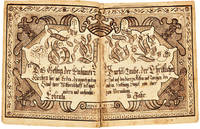
1747WRCAM46388Ephrata 1747. 264pp. plus 7pp. printed register. Small quarto. Contemporary three-quarter calf and marbled boards. Spine heavily worn split in center. Later 19th-century ownership inscription on front fly leaf. Slight wear and foxing to some leaves and some ink burn resulting in splits to some leaves. Very good. In a half morocco and cloth slipcase spine gilt. A unique and spectacular manuscript hymnbook created by the religious community at Ephrata Pennsylvania founded by Johann Conrad Beissel. This manuscript is from the period when the community was at its zenith and is an outstanding example of the Frakturschriften for which the Ephrata Cloister is known. It contains over 250 pages of manuscript music some of it likely original compositions. The printed register at the end contains 375 hymn listings and an additional fifteen pieces of music precede the main body of the work. <br> <br> Johann Conrad Beissel 1692-1768 was born in Germany and orphaned at an early age. A charismatic and engaging personality he tried on several religious movements and eventually emigrated to Pennsylvania in 1720 after being banished from his homeland for radical religious beliefs. Beissel spent part of the 1720s with the Dunkards in Germantown and Lancaster County before his controversial beliefs about celibacy and Sabbath-keeping caused a rift with his fellow congregants. He then established himself as a hermit on the banks of the Cocalico River where he was eventually joined by other like- minded individuals who wished to follow his teachings and so founded the Ephrata Cloister in 1732. "What began as a hermitage for a small group of devoted individuals grew into a thriving community of nearly 80 celibate members supported by an estimated 200 family members from the region at its zenith in the mid-18th century. During that period much of the activity surrounded the charismatic founder and leader Conrad Beissel. His theology a hybrid of pietism and mysticism encouraged celibacy Sabbath worship Anabaptism and the ascetic life yet provided room for families limited industry and creative expression" - Ephrata website. "Both within and without Ephrata Beissel aroused controversy. His opposition to the institution of marriage early divided his congregation as did his refusal to tolerate the community's money-making industries. His adoption of the Jewish sabbath and work on Sunday violated provincial laws and aroused the opposition of civil officials. That women left their husbands and homes to be with Beissel produced their husbands' ever-lasting hostility and even provoked one to attack Beissel physically. Beissel's willingness to permit women to spend nights in his cabin and his initial housing of men and women in the same building led to rumors of sexual promiscuity that prompted a neighbor to try to set fire to the cloister" - ANB. <br> <br> The community became known for its self- composed a cappella music Germanic calligraphy known as Frakturschriften and the complete publishing center which included a paper mill printing office and book bindery. Printing at Ephrata began in 1745 the third geographical location of printing in Pennsylvania. In fact the largest book printed in America before 1800 numbering more than 1500 pages was published at the Ephrata printing shop in 1748. The first printed hymnbook of the cloister was called the "Turtle-Taube Turtle Dove" and contained more than 400 of the community's hymns most of which Beissel had written. It was issued in 1747 the same year as this manuscript. <br> <br> In addition to the press the Cloister also had a scriptorium which produced beautiful manuscript hymnals and other works. Beissel composed many original hymns for the community which then produced manuscript volumes containing both the words and separately the music. He is said to have composed more than 4000 lines of poetry almost all of it religious some of it set to music also of his composition. "For the community's worship he developed distinctive types of choral harmony and antiphonal singing and he frequently required the members to sing in this style on late night walks around Ephrata" - ANB. Manuscript production at Ephrata was used as a form not only of book production but also as a meditation and spiritual act. Beissel established a monastic style of living for the Cloister in 1735 three years after its founding and the earliest output of the scriptorium dates to this time. Most of the fine manuscript work was likely done by the Sisters the Cloister was segregated by gender while the Brothers maintained the printing press. The scriptorium flourished during the 1740s and 1750s declining near the end of that decade. The present manuscript was produced while the scriptorium was at the pinnacle of its output and handiwork. <br> <br> This volume with its elaborate fraktur titlepage was likely a presentation copy rather than a standard everyday hymnbook. The Ephrata community produced virtually the only original hymn texts and tunes during the colonial era. It was meant to be used with the printed words from the 1747 edition of DAS GESANG DER EINSAMEN UND VERLASSENEN TURTEL-TAUBE. A bearded face has been drawn in each of the two upper corners of the fraktur a highly interesting and unusual feature of the work. It is inscribed on the front fly leaf with a later ownership inscription which reads "Abm. Burger's Book / January 29 1830" which is followed by a gift inscription: "A Present of a Music Book from / Abm. Burger / to / Elder Lucius Crandal / Plainfield / Essex County / N.J. / December 17th 1854." These lines were probably written by Abraham Berger 1795- 1856 a member of the Snow Hill Congregation in Quincy Pennsylvania an offshoot of the Ephrata community located about ninety miles to the southwest. When Ephrata was in its decline in the late 18th and early 19th centuries Snow Hill was in its prime and as a result many of the books and manuscripts were transferred from Ephrata to Snow Hill. This would explain how and why Berger may have acquired the volume. <br> <br> The gift recipient Lucius Crandall 1810- 76 was an elder and minister in the Seventh Day Baptist Church first at Plainfield New Jersey and later at congregations in Rhode Island and New York. The Ephrata Cloister congregation following its incorporation in 1814 became known as the Seventh Day Baptists of Ephrata also referred to as the German Seventh Day Baptists. While Ephrata had no official ties or affiliation to the Seventh Day Baptist Church with which Crandall was affiliated the two denominations formed a close relationship. This was true to the extent that in the later 19th century Crandall's denomination included the annual reports of the Ephrata and Snow Hill congregations in their own annual reports. Ministers and members would travel from Crandall's Seventh Day Baptist Church to the Cloisters at Ephrata for feast days and baptisms etc. providing a link between the two men. <br> <br> The Winterthur Library and Museum in Delaware has a significant collection of these hymnals as noted by Kari Main in her excellent 1997 article on the subject she compares eight hymnals. Columbia University has half a dozen manuscript hymnals as well and further collections can be found at the Ephrata Cloister The Free Library of Philadelphia the Library of Congress and the Hershey Museum. Many of these derive from the great Samuel Pennypacker collection dispersed at auction in 1908. Such manuscript works are incredibly rare on the market today and the present copy is an especially fine example of these remarkable manuscripts. Kari M. Main "From the Archives: Illuminated Hymnals of the Ephrata Cloister" in WINTERTHUR PORTFOLIO Vol. 32 No. 1 pp.65-78. ANB online. Website of the Ephrata Cloister http://http://www.ephratacloister.org/history.h tm. hardcover books
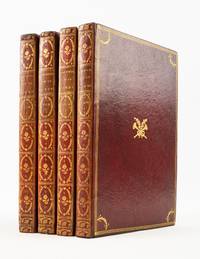
1773ST20891Paris: Chez de Lormel Imprimeur de l'Academie Royale de Musique 1773. FIRST EDITION First Issue with pencilled correction of "affreux Serpent" on p. 54 of Vol. II. 237 x 160 mm. 9 1/4 x 6 1/4". Engraved throughout. Four volumes. <br/> Tasteful contemporary crimson morocco gilt covers with triple fillet border floral garland at corners crossed trumpets with laurel branches at center smooth spines in gilt compartments with floral sprig within an oval catkin wreath two tan morocco labels gilt turn-ins marbled endpapers all edges gilt restorations to head of two spines. ENGRAVED THROUGHOUT: Engraved decorative title page and dedication page in volume I three engraved frontispieces by Le Bouteux and Le Barbier in volumes II-IV one of these a portrait of the dedicatee La Dauphine Marie Antoinette and 100 FULL-PAGE PLATES the 25 in volume I designed and engraved by Moreau le jeune all with tissue guards those in volumes II-IV engraved by Masquelier and Née after designs by Le Barbier Le Bouteux and Saint-Quentin about one-third of the plates with original tissue guards. Without the separately printed portrait of Laborde issued in 1774 and found in some copies. Cohen-de Ricci pp. 534-38; Ray 49 pp. 90-91 p. 76; Lewine pp. 266-68. Spines slightly and evenly sunned a hint of wear at corners but the bindings otherwise beautifully preserved with only the most trivial imperfections; internally with isolated inconsequential foxing or small stains. A VERY FINE CONTEMPORARY SET the lovely bindings scarcely worn the margins extremely ample the contents clean and fresh and THE ENGRAVINGS RICHLY IMPRESSED.<br/> <br/> Dedicated to the crown princess Marie Antoinette this opulent production--offered here in fine contemporary morocco--beautifully displays the music fashion and aristocratic antics of Louis XV's court perfectly encapsulating the French Rococo. According to Cohen-de Ricci "This book—one of the most beautiful of the 18th century—is perhaps along with 'Contes de La Fontaine' the most delightful by virtue of the grace of its subjects and the variety of the costumes depicted therein." It contains some of the most elegant and memorable engravings to be seen in any French work of the period and they transform a book of perhaps more than occasionally vapid songs into a profoundly pleasurable visual experience. The author Benjamin de Laborde or Jean-Benjamin de La Borde 1734-94 was the hunchbacked valet of King Louis XV. In consequence of the monarch's indulgence of his favorite de Laborde's songs were given a presentation described by Ray as being of "the utmost sumptuousness" the entire work having been produced by engraving. The first volume which Cohen-de Ricci Ray and Lemire unanimously proclaim a "masterpiece" is graced by plates that were both designed and cut by Jean-Michel Moreau called Moreau le jeune 1741-1814. Ray says that the work done by Moreau le jeune during the 1760s "showed him to be the equal of the established rococo masters Boucher Eisen and Gravelot" and that in his work during the 1770s "he carried all before him." So Moreau was in his prime then when he executed these charming scenes often of courtship set in pastures pleasure parks and elegant interiors; they represent the culmination of the Rococo style delicate and lush without being cloying. Because of a quarrel between the artist and the author the final three volumes were illustrated by Le Bouteux and by Jean-Jacques-François Le Barbier 1738-1826. Le Barbier was one of the first great French neoclassical illustrators and Ray declares the engravings here his "most sustained and accomplished series of illustrations apart from that for Gessner's 'Oeuvres'" and laments that the present work "has not received the attention it deserves." Le Barbier's compositions are characterized by charm grace and elaborate and convincing detail. This first printing presents the engravings at the height of their richness and power which has been undimmed by the intervening centuries. With any copy of this work the engravings will always take center stage but here the tasteful contemporary red morocco bindings deserve a prolonged bow: they are perfectly elegant and elegantly perfect. Chez de Lormel, Imprimeur de l'Academie Royale de Musique unknown
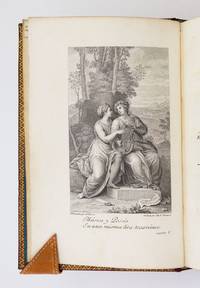
1779ST19371Madrid: Imprenta Real 1779. FIRST EDITION. 235 x 150 mm. 9 1/4 x 6". 10 p.l. 126 XL pp. 1 leaf errata. <br/> EXCELLENT CONTEMPORARY CRIMSON MOROCCO BY DEROME LE JEUNE his ticket with address of Rue St. Jacques on verso of front free endpaper covers framed with thick and thin gilt rules raised bands spine compartments with central floral sprig surrounded by a lozenge of small tools volute cornerpieces gilt titling gilt-rolled turn-ins gilt edges cobalt blue paste-paper endpapers. WITH SIX CHARMING ENGRAVED ALLEGORICAL PLATES after G. Ferre. Front pastedown with morocco bookplate of Mortimer L. Schiff and small book label with a gilt cipher on a red peach. A Large Paper Copy. Palau y Dulcet IV 107; RSIM B VI 429; MGG VI 1403 f.; Gregory-Bartlett I 129. Three minute dents to front board a hint of wear to bands and corners isolated faint foxing blank recto of frontispiece leaf and blank verso of final leaf with faint blue shadown from endpapers but all of these quite trivial and otherwise A BEAUTIFUL COPY--fresh clean and bright internally with very wide margins and strong impressions of the plates and in a lustrous binding showing with few signs of use.<br/> <br/> This is surely one of the handsomest poetical treatises on music ever produced and it is offered here in a binding done by one of the finest craftsmen working in Europe during the period of the book's publication. The work is written in the "silva" form of poetry used by persons of high rank illustrated with fine engravings and put into elegant morocco by the finest hands among the large Derome family of binders. According to Palau our first edition is "beautiful and printed on fine paper." He says further that although the strongly expressed opinions of the youthful author on contemporary composers caused the work to be "unfairly attacked" it was "appreciated by professors of music and collectors of literature in that genre" especially in Italy and America. A child of the Enlightenment Iriate 1750-91 gained entry to intellectual and artistic circles in Madrid through his uncle who was librarian to the king of Spain. He translated works by Horace and Virgil into Spanish by royal request and wrote criticism poetry and dramas. He is best known for his satirical fables on the contemporary literary scene "Fábulas literarias." There were no fewer than 18 members of the Derome family who made their livings as binders in Paris from the middle of the 17th century until the first quarter of the 19th but by far the most distinguished family member was Nicolas-Denis called "le jeune" 1731-88. Known for the gracefulness of his bindings and for being capable of "amazing delicacy" in Hobson's words Derome le jeune was simply the leading binder of the day and his work was much in demand. Because he refused to turn away customers Derome was forced to hire a number of assistants whose work he could not always supervise closely. However Thoinan says that the binder's best work is indicated by the presence of his ticket as here. The volume's provenance adds to its luster: it was in the distinguished library of American bibliophile Mortimer Schiff 1877-1931. In Dickinson's words Schiff a financier and philanthropist Schiff "brought together an unrivaled collection of decorative bindings." His library included works by great printers important illustrated books and works printed on vellum but chiefly fine and historic bindings. The "Reliures" database of the Bibliothèque Nationale de France commends Schiff for assembling "one of the most important inter-war libraries" noting that his collection was "renowned for its collection of French bindings.". Imprenta Real unknown
1767WRCAM45554New York: James Parker 1767. 447991431pp. Antique-style three-quarter calf and marbled boards leather label. Titlepage neatly repaired at bottom not affecting text. Two contemporary signatures on titlepage. Light tanning and scattered foxing. A very good copy. The first book of music printed from type in America. "This is the First Edition in English of the Prayer-Book of the Reformed Dutch Church of New York. It is a translation of the old Holland liturgy. The translation of the book from the Dutch was made by the Rev. John Livingston D.D. The Psalms were rendered into English verse by Francis Hopkinson one of the signers of the Declaration of Independence. There are one hundred fifty Psalms in metre accompanied on every page by the printed music. The type for the music notes was ordered from Daniel Cromelin of Amsterdam in 1764. The Ten Commandments are also versified and supplied with music. These are followed by the Songs of Zacharias the Virgin Mary and Simeon. The same musical treatment is given to the Creed and the Lord's Prayer" - Church. EVANS 10561. ESTC W6234. CHURCH 1067. AMERICAN SACRED MUSIC IMPRINTS 398. James Parker hardcover books
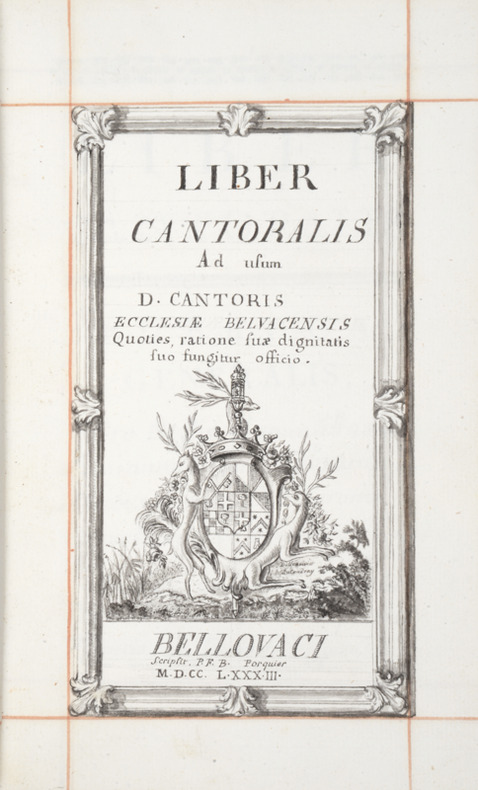
178341437Beauvais, , 1783. Manuscrit in-8 réglé de XL-201 pp., maroquin rouge, dos à nerfs orné à la grotesque, pièce de titre en maroquin vert, triple filet doré d'encadrement sur les plats, gardes de papier dominoté, filet or sur les coupes, roulette intérieure dorée, tranches dorées (reliure de l'époque).
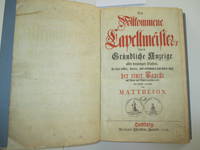
173916570AB1739. Ham burg Herold 1739. 345 : 225 cm. 28 pages 2 leaves 484 pages 8 leaves register with engraved vignette on title-page type-set musical examples within the text woodcut head and tailpieces 1 full-page engraved plate. Contemorary half vellum decorated papers on boards. First print of the first edition "Neues Verzeichnis bisheriger Matthensonischer Werke" which is only missing in the first print. The rare original edition of the most important work of Matteson an encyclopedia of knowledge of the music-practice of its time. An undispensable source for music-academics. He brings together a vast array of facts as well as his most complete statement of several major theoretical concepts. These include the systematizing of the doctrines of rhetoric as they become the basic of compositio.A lengthy discussion of emotion in music leads to.the only attempt found in baroque literature to arrive at a true "Doctrine" of the Affections. New Grove 11 p. 835. - Mattheson's most important and extensive theoretical work "an encyclopedia of the entire musical practice of his time" in the extremely rare original edition. The important matters from music theory and aesthetics which are often dealt with quite briefly in the 3 "Orchestras" in the "Critica musica" in the two "Schools for basso continuo" as well as in the "Core of melodic science" are treated in such detail that this work must almost be called a fundamental one Schmidt. Mattheson's works have become an indispensable source for musicology because without them it is difficult to understand the great music-historical turn that took place in his time. Joseph Haydn owned a copy of it; Goethe knew it as is evident from his letter to Zelter of Jan. 1 1819. - Cannon No. 138; Wolffheim I 819; Hirsch I 378. - With a small inscribtion at the inner front board. Boards coverd with a special marbled paper. hardcover
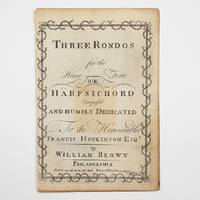
1787373365Philadelphia: Printed and sold by the Author . John. Aitken Sculp 1787. Engraved title letterpress 1p. List of Subscribers 6 engraved sheets. 4to. Loose sheets trimmed close at the gutter margin. Engraved title letterpress 1p. List of Subscribers 6 engraved sheets. 4to. "By one of those strange coincidences which delight the historian and at the same time provide the essayist with convenient points of departure the year 1787 which saw the writing of the Constitution of the United States saw also the solid beginnings of music publishing in this country as a separate and independent enterprise. The scene of these beginnings was Philadelphia the publisher and composer a certain William Brown the engraver John Aitken; the publication itself bore a dedication to no less a person than Francis Hopkinson signer of the Declaration of Independence and our first native composer. Three Rondos for the Piano Forte or Harpsichord. Composed and Humbly Dedicated to the Honourable Francis Hopkinson Esq. by William Brown. Philadelphia. Printed and Sold by the Author. Price Two Dollars. J. Aitken Sculp - so runs the full title of this musical landmark which the composer-publisher himself in inviting subscribers had called 'the first attempt of the kind in America'" Oliver Strunk "Early Music Publishing in the United States" The Papers of the Bibliographical Society of America vol. 31 no. 2 1937 pp. 176-79.<br /> <br /> Dunlap & Claypoole's Daily American Advertiser of 23 January through 10 February 1787 announced that subscriptions were being gathered for William Brown's Three Favorite Rondos Adapted to the Harpsichord. Subscriptions were being gathered both by Mr. Brown and Mr. Reinagle for the work. Among the notables on the subscriber list here are Alexander Reinagle four members of the Penn family and the dedicatee Francis Hopkinson. <br /> <br /> Very scarce with only four examples in OCLC. Evans 20246; Sonneck p. 361 Printed and sold by the Author ... J[ohn]. Aitken Sculp unknown
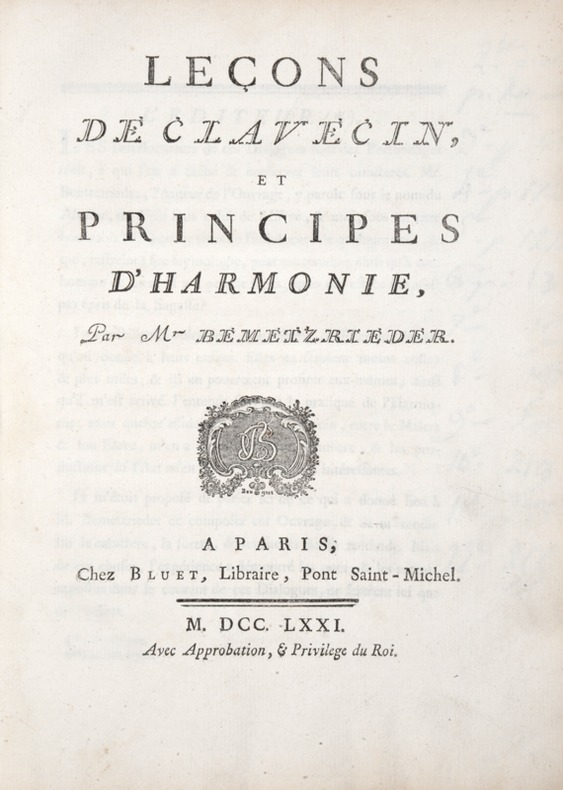
177140271A Paris, chez Bluet, 1771. In-4 de VIII-362-(2) pp., vélin dur, dos orné, pièce de titre en maroquin brun (reliure de l'époque).
176543831S.l.n.d., , (1765 ca). Manuscrit in-12 oblong (134 x 190 mm) de (1)-73-(3) ff. de musique notée à l'encre brune avec la description des figures en regard, table, veau fauve, dos orné à nerfs, trace de pièce de titre, triple filet doré d'encadrement sur les plats, dentelle intérieure, tranches jaspées (reliure de l'époque).
175141030, , 1751-1753. Manuscrit in-4 à 28 lignes par page de (498) pp., table, veau granité, dos orné à nerfs, pièce de titre en maroquin rouge, tranches rouges (reliure de l'époque).
1782rx1271A Paris, Chez Panckoucke, Libraire, Hôtel de Thou, rue des Poitevins., A Liège, chez Plomteux, imprimeur des états Relié 1782 "Treize volumes reliés demi-basane (reliure début XIX) dont 8 volumes de texte, de""Aiguillier"" à ""Zinc"" et les 5 volumes de planches contenant l'intégralité des planches associées au texte des 8 volumes. Nous possédons donc 1094 planches, dont 874 simples et 220 doubles sur les 2018 pour la catégorie Arts et Métiers mécaniques, mais seules ces 1094 planches sont concernées pour les 8 volumes de texte de cette même catégorie à proprement parler ; dos insolés, épidermures sur le cuir, frottements aux mors, coiffes et plats, par ailleurs intérieur frais, ensemble en bon état dans une reliure datant des 20 premières années du XIX° siècle. Livraison a domicile (La Poste) ou en Mondial Relay sur simple demande."
170311074Paris chez l'Autheur, Foucault, 1703 veau brun, dos à n. (dos refait à l'identique avec des fers anciens). in-folio, (2ff.), 254pp. (1 f.),
176416516Paris, La Veuve Duchesne; Gueffier, 1764-1766. 3 ouvrages en un volume in-8 de 120-62-80 pages, plein maroquin citron, dos lisse orné de fleurs de lys et petits fers dorés, dentelle géométrique avec des motifs floraux en encadrement des plats, filet doré aux coupes, roulette dorée aux chasses, gardes de tabis rose, tranches dorées.
172211363Paris de l'imprimerie de J.B.C. Ballard, 1722 in-4, basane, dos à n. (fente sur 4 cm. à 1 mors, réparation au titre). (4ff.), XXIV-432pp., 18pp.,
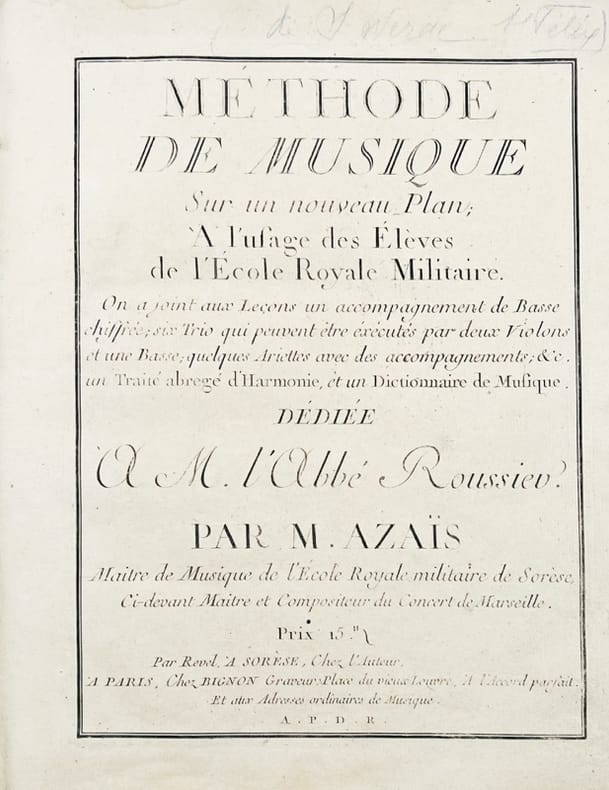
177644574Sorèze, chez l'auteur, Paris, Bignon, sans date, (1776). In-folio de (4)-173 pp. de musique notée, basane marbrée, dos orné à nerfs, tranches rouges (reliure de l'époque).
177015605Paris, Claude-Antoine Jombert, 1770 ; 4 tomes in-8 ; plein veau fauve marbré, dos à nerfs décorés et dorés, pièces de titre et de tomaison fauves, filet doré sur les coupes, tranches marbrées, grand fer doré du Collège Royal du Puy en Velay (Collegium Regium Aniciense) au centre du premier plat du tome Ier (reliure de l'époque) ; (2), XIV, 460, (20) de table, 4 pp. de catalogue, 32 planches hors-texte_; (2), 462, (16) pp., 56 planches h.-t. (55 + 17bis) dont 9 dépliantes ; (2), 482, (12) pp., 31 planches h.-t. (30 + 7bis) ; (10), 446, (4) pp., 17 planches h.t. ; soit en tout 136 planches gravées sur cuivre dont 9 dépliantes ; figures in-texte.
17824690Londres, 1782. 6 vol. in-18, 328-[2] + 300 + 312 +314-[2]+[4]-291 + [4]-XL-282-[2] pages. Plein maroquin rouge, dos lisses ornés de fil. et fleur. dor., triple fil. dor. encadrant les plats, têtes et tranches dorées, joli papier de garde bleu. Menus défauts à 4 coiffes et 3 coins, et quelques feuillets légèrement déboîtés au vol 3.
174211077Paris Vve Mouret, Mme Boivin, le sr. Le Clerc 1742 petit in-fol., basane marbrée, dos lisse, p. de titre mar.(dos frotté en partie) 5 titres, 116pp.,
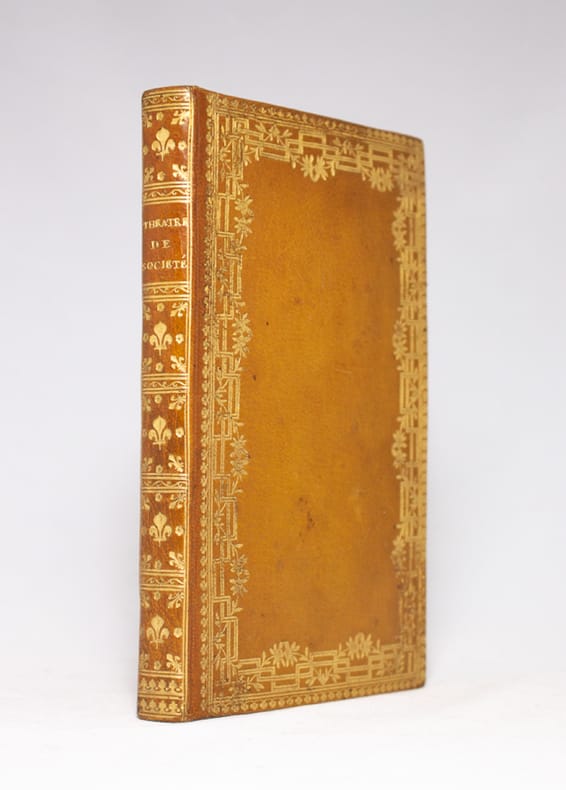
1776ST12954Paris: Joseph-Gérard Barbou 1776. 215 x 135 mm. 8 1/2 x 5 1/4". Three volumes. <br/> ELEGANT 19TH CENTURY BROWN MOROCCO GILT BY JOLY FILS stamp-signed on front turn-ins covers with French fillet border raised bands spine compartments densely gilt with complex fleurons drawer handle tools and circlets intricately gilt turn-ins marbled endpapers gilt edges. Engraved title pages three engraved vignettes and three engraved plates after Moreau le jeune. Cohen-de Ricci p. 604. Lightly washed and pressed in keeping with bibliophilic fashion at the time of binding one title page with small corner tear otherwise A FINE SET clean and still crisp internally with ample margins and the scarcely-worn bindings quite lustrous.<br/> <br/> This is a finely bound copy of singer and playwright Pierre Laujon's songs "About Society" and "About Folly" with illustrations of "ravishing grace" that Cohen-de Ricci considers among the best efforts of Jean Michel Moreau. Laujon 1727-1811 wrote and performed in musical reviews and ballets where his efforts attracted the attention of the Count of Clermont and the Prince de Condé who hired him to direct their festivals and pageants. The songs here were composed for these "society festivals" gently mocking the frivolous naughty behavior of the elite. The accompanying illustrations showing beautifully dressed courtiers and bon-vivants are the work of Moreau le jeune 1741-1814 deemed by no less than Gordon Ray to be "the greatest name among French illustrators of the 18th century." The graceful bindings here were done by one of the great bookbinding houses of France. After apprenticing in the provinces Antoine Joly 1838-1917 moved to Paris found employment with the celebrated Léon Gruel later formed a partnership with Thibaron in 1874 succeeded him 11 years later and in 1892 turned the business over to his son Robert 1870-1924 who signed his work "Joly fils." According to Duncan & DeBartha "An excellent gilder like his father Robert designed and produced a range of classical covers." The trifecta of light-hearted songs elegant engravings and luxurious bindings endow this set with a great deal of French charm. Joseph-Gérard Barbou] unknown
1771002379Paris Veuve Duchesne 1771
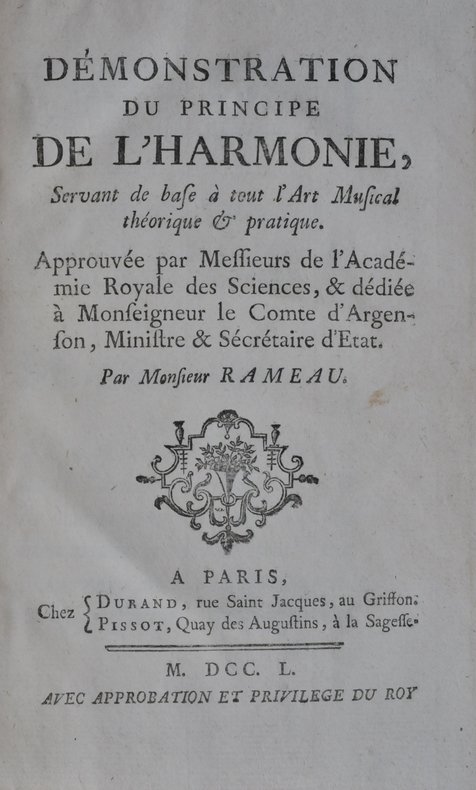
175046405346Paris, Durant, Pissot, 1750 ; in-8, veau fauve marbré, dos orné, tr. rouges. (Reliure de l’époque) XXIII pp., XLVII pp., 112 pp.Suivi de : Nouvelles Réflexions de M. Rameau sur sa démonstration du Principe de l’Harmonie, servant de base à tout l’Art Musical théorique et pratique. Id., ibid., 1752 ; 2 ff., 85 pp. (approbation signée Condillac), 5 planches dépliantes (appartenant au 1er ouvrage).ÉDITION ORIGINALE très rare, dédiée au comte d’Argenson. Ce traité, rédigé avec Diderot, est considéré comme le mieux écrit de tous les écrits théoriques de Rameau. À son sujet, et sur l’apport important de Diderot, voir Girdlestone. Rameau pp. 491-494. L’ouvrage fut adressé en 1749 aux membres de l’Académie des Sciences. Les 47 pages préliminaires donnent le rapport très flatteur des académiciens, signé Dortous de Mairon, Nicole et D’Alembert. Dans ce livre on retrouve, sous une forme très soignée, la matière des traités théoriques publiés précédemment par Rameau.Bel exemplaire avec la très rare suite des Nouvelles réflexions publiée en 1752, voir Girdlestone pp. 531-541.
17372674DBParis, Prault, 1737. 4°. (16), 201, (13) S. Mit 12 Kupfertafeln. + Wichtig: Für unsere Kunden in der EU erfolgt der Versand alle 14 Tage verzollt ab Deutschland / Postbank-Konto in Deutschland vorhanden +, 2674D
171217449Paris Raymond Mazieres 1712 in-12 veau brun moucheté, dos à ners (fente sur 1 cm à un mors). frontispice, (6ff. n.c.), 139pp. (2ff.n.c.), 22 pp. de musique notée non comprises dans la pagination.
17372674DBParis, Prault 1737. 4°. (16), 201, (13) S. Mit 12 Kupfertafeln.