738 résultats
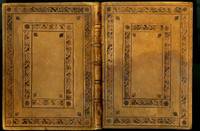
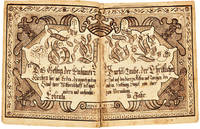
1747WRCAM46388Ephrata 1747. 264pp. plus 7pp. printed register. Small quarto. Contemporary three-quarter calf and marbled boards. Spine heavily worn split in center. Later 19th-century ownership inscription on front fly leaf. Slight wear and foxing to some leaves and some ink burn resulting in splits to some leaves. Very good. In a half morocco and cloth slipcase spine gilt. A unique and spectacular manuscript hymnbook created by the religious community at Ephrata Pennsylvania founded by Johann Conrad Beissel. This manuscript is from the period when the community was at its zenith and is an outstanding example of the Frakturschriften for which the Ephrata Cloister is known. It contains over 250 pages of manuscript music some of it likely original compositions. The printed register at the end contains 375 hymn listings and an additional fifteen pieces of music precede the main body of the work. <br> <br> Johann Conrad Beissel 1692-1768 was born in Germany and orphaned at an early age. A charismatic and engaging personality he tried on several religious movements and eventually emigrated to Pennsylvania in 1720 after being banished from his homeland for radical religious beliefs. Beissel spent part of the 1720s with the Dunkards in Germantown and Lancaster County before his controversial beliefs about celibacy and Sabbath-keeping caused a rift with his fellow congregants. He then established himself as a hermit on the banks of the Cocalico River where he was eventually joined by other like- minded individuals who wished to follow his teachings and so founded the Ephrata Cloister in 1732. "What began as a hermitage for a small group of devoted individuals grew into a thriving community of nearly 80 celibate members supported by an estimated 200 family members from the region at its zenith in the mid-18th century. During that period much of the activity surrounded the charismatic founder and leader Conrad Beissel. His theology a hybrid of pietism and mysticism encouraged celibacy Sabbath worship Anabaptism and the ascetic life yet provided room for families limited industry and creative expression" - Ephrata website. "Both within and without Ephrata Beissel aroused controversy. His opposition to the institution of marriage early divided his congregation as did his refusal to tolerate the community's money-making industries. His adoption of the Jewish sabbath and work on Sunday violated provincial laws and aroused the opposition of civil officials. That women left their husbands and homes to be with Beissel produced their husbands' ever-lasting hostility and even provoked one to attack Beissel physically. Beissel's willingness to permit women to spend nights in his cabin and his initial housing of men and women in the same building led to rumors of sexual promiscuity that prompted a neighbor to try to set fire to the cloister" - ANB. <br> <br> The community became known for its self- composed a cappella music Germanic calligraphy known as Frakturschriften and the complete publishing center which included a paper mill printing office and book bindery. Printing at Ephrata began in 1745 the third geographical location of printing in Pennsylvania. In fact the largest book printed in America before 1800 numbering more than 1500 pages was published at the Ephrata printing shop in 1748. The first printed hymnbook of the cloister was called the "Turtle-Taube Turtle Dove" and contained more than 400 of the community's hymns most of which Beissel had written. It was issued in 1747 the same year as this manuscript. <br> <br> In addition to the press the Cloister also had a scriptorium which produced beautiful manuscript hymnals and other works. Beissel composed many original hymns for the community which then produced manuscript volumes containing both the words and separately the music. He is said to have composed more than 4000 lines of poetry almost all of it religious some of it set to music also of his composition. "For the community's worship he developed distinctive types of choral harmony and antiphonal singing and he frequently required the members to sing in this style on late night walks around Ephrata" - ANB. Manuscript production at Ephrata was used as a form not only of book production but also as a meditation and spiritual act. Beissel established a monastic style of living for the Cloister in 1735 three years after its founding and the earliest output of the scriptorium dates to this time. Most of the fine manuscript work was likely done by the Sisters the Cloister was segregated by gender while the Brothers maintained the printing press. The scriptorium flourished during the 1740s and 1750s declining near the end of that decade. The present manuscript was produced while the scriptorium was at the pinnacle of its output and handiwork. <br> <br> This volume with its elaborate fraktur titlepage was likely a presentation copy rather than a standard everyday hymnbook. The Ephrata community produced virtually the only original hymn texts and tunes during the colonial era. It was meant to be used with the printed words from the 1747 edition of DAS GESANG DER EINSAMEN UND VERLASSENEN TURTEL-TAUBE. A bearded face has been drawn in each of the two upper corners of the fraktur a highly interesting and unusual feature of the work. It is inscribed on the front fly leaf with a later ownership inscription which reads "Abm. Burger's Book / January 29 1830" which is followed by a gift inscription: "A Present of a Music Book from / Abm. Burger / to / Elder Lucius Crandal / Plainfield / Essex County / N.J. / December 17th 1854." These lines were probably written by Abraham Berger 1795- 1856 a member of the Snow Hill Congregation in Quincy Pennsylvania an offshoot of the Ephrata community located about ninety miles to the southwest. When Ephrata was in its decline in the late 18th and early 19th centuries Snow Hill was in its prime and as a result many of the books and manuscripts were transferred from Ephrata to Snow Hill. This would explain how and why Berger may have acquired the volume. <br> <br> The gift recipient Lucius Crandall 1810- 76 was an elder and minister in the Seventh Day Baptist Church first at Plainfield New Jersey and later at congregations in Rhode Island and New York. The Ephrata Cloister congregation following its incorporation in 1814 became known as the Seventh Day Baptists of Ephrata also referred to as the German Seventh Day Baptists. While Ephrata had no official ties or affiliation to the Seventh Day Baptist Church with which Crandall was affiliated the two denominations formed a close relationship. This was true to the extent that in the later 19th century Crandall's denomination included the annual reports of the Ephrata and Snow Hill congregations in their own annual reports. Ministers and members would travel from Crandall's Seventh Day Baptist Church to the Cloisters at Ephrata for feast days and baptisms etc. providing a link between the two men. <br> <br> The Winterthur Library and Museum in Delaware has a significant collection of these hymnals as noted by Kari Main in her excellent 1997 article on the subject she compares eight hymnals. Columbia University has half a dozen manuscript hymnals as well and further collections can be found at the Ephrata Cloister The Free Library of Philadelphia the Library of Congress and the Hershey Museum. Many of these derive from the great Samuel Pennypacker collection dispersed at auction in 1908. Such manuscript works are incredibly rare on the market today and the present copy is an especially fine example of these remarkable manuscripts. Kari M. Main "From the Archives: Illuminated Hymnals of the Ephrata Cloister" in WINTERTHUR PORTFOLIO Vol. 32 No. 1 pp.65-78. ANB online. Website of the Ephrata Cloister http://http://www.ephratacloister.org/history.h tm. hardcover books
1974011575NY: Privately published 1974. Private edition. Hardcover. Near Fine. Bound musical score as performed on the opening night of February 25 1973 at theSchubert Theatre. Bound musical scores are privately published a project usually undertaken by the music preparation supervisor and then presented to producers and creative principals as a momento or official record of the music as presented opening night. This copy is legendary producer and director Hal Prince's who both produced and directed A LITTLE NIGHT MUSIC inscribed to him by Mathilde Pincus and Al Miller whose company was responsible for music supervision: April 12 1974 To Hal Price Another one to add to your collection of 'greats!' Our greatest esteem respect admiration - and love. Sincerely Mathilde and Al." It is also inscribed by composer and lyricist Stephen Sondheim: "Wyth lots of Luv - Steve" which wittily Sondheim has written with Swedish grammatical notations this musical being based on Ingmar Bergman's Smiles of a Summer Night. Typically there are about 12-18 bound musical scores per production. Never commercially sold only for private presentation. This copy especially rare in that along with Sweeny Todd it represents a highpoint in Prince and Sondheims collaboration besides being one of the highpoints in Sondheim's cannon. Squarish folio green cloth gilt titles front and spine. Privately published hardcover books
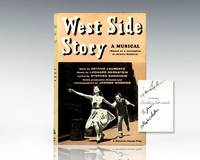
195871012New York: Random House 1958. First edition of this classic musical. Octavo original half cloth. Signed by Arthur Laurents Leonard Bernstein and inscribed by Stephen Sondheim on the half-title page. Fine in a very good dust jacket. Rare and desirable signed by these three contributors. This is the first example we have seen. Rare and desirable. In 1947 Jerome Robbins approached Leonard Bernstein and Arthur Laurents about collaborating on a contemporary musical adaptation of Romeo and Juliet. He proposed that the plot focus on the conflict between an Irish Catholic family and a Jewish family living on the Lower East Side of Manhattan during the Easter-Passover season. The girl has survived the Holocaust and emigrated from Israel; the conflict was to be centered around anti-Semitism of the Catholic "Jets" towards the Jewish "Emeralds" a name that made its way into the script as a reference. Eager to write his first musical Laurents immediately agreed. Bernstein wanted to present the material in operatic form but Robbins and Laurents resisted the suggestion. They described the project as "lyric theater" and Laurents wrote a first draft he called East Side Story. Only after he completed it did the group realize it was little more than a musicalization of themes that had already been covered in plays like Abie's Irish Rose. When he opted to drop out the three men went their separate ways and the piece was shelved for almost five years. In 1955 theatrical producer Martin Gabel was working on a stage adaptation of the James M. Cain novel Serenade about an opera singer who comes to the realization he is homosexual and he invited Laurents to write the book. Laurents accepted and suggested Bernstein and Robbins join the creative team. Robbins felt if the three were going to join forces they should return to East Side Story and Bernstein agreed. Laurents however was committed to Gabel who introduced him to the young composer/lyricist Stephen Sondheim. Sondheim auditioned by playing the score for Saturday Night his musical that was scheduled to open in the fall. Laurents liked the lyrics but was not impressed with the music. Sondheim did not care for Laurents' opinion. Serenade ultimately was shelved. Laurents was soon hired to write the screenplay for a remake of the 1934 Greta Garbo film The Painted Veil for Ava Gardner. While in Hollywood he contacted Bernstein who was in town conducting at the Hollywood Bowl. The two met at The Beverly Hills Hotel and the conversation turned to juvenile delinquent gangs a fairly recent social phenomenon that had received major coverage on the front pages of the morning newspapers due to a Chicano turf war. Bernstein suggested they rework East Side Story and set it in Los Angeles but Laurents felt he was more familiar with Puerto Rican immigrants and Harlem than he was with Mexican Americans and Olvera Street. The two contacted Robbins who was enthusiastic about a musical with a Latin beat. He arrived in Hollywood to choreograph the dance sequences for The King and I and he and Laurents began developing the musical while working on their respective projects keeping in touch with Bernstein who had returned to New York. When the producer of The Painted Veil replaced Gardner with Eleanor Parker and asked Laurents to revise his script with her in mind he backed out of the film freeing him to devote all his time to the stage musical. West Side Story is set in the Upper West Side neighborhood in New York City in the mid 1950s an ethnic blue-collar neighborhood in the early 1960s much of the neighborhood was cleared in an urban renewal project for the Lincoln Center which changed the neighborhood's character. The musical explores the rivalry between the Jets and the Sharks two teenage street gangs of different ethnic backgrounds. The members of the Sharks from Puerto Rico are taunted by the Jets a white gang. The young protagonist Tony a former member of the Jets and best friend of the gang's leader Riff falls in love with Maria the sister of Bernardo the leader of the Sharks. The dark theme sophisticated music extended dance scenes and focus on social problems marked a turning point in American musical theatre. Bernstein's score for the musical includes "Something's Coming" "Maria" "America" "Somewhere" "Tonight" "Jet Song" "I Feel Pretty" "A Boy Like That" "One Hand One Heart" "Gee Officer Krupke" and "Cool". The original 1957 Broadway production directed and choreographed by Jerome Robbins and produced by Robert E. Griffith and Harold Prince marked Sondheim's Broadway debut. It ran for 732 performances before going on tour. The production was nominated for six Tony Awards including Best Musical in 1957 but the award for Best Musical went to Meredith Willson's The Music Man. Robbins won the Tony Award for his choreography and Oliver Smith won for his scenic designs. The show had an even longer-running London production a number of revivals and international productions. A 1961 musical film of the same name directed by Robert Wise and Robbins starred Natalie Wood Richard Beymer Rita Moreno George Chakiris and Russ Tamblyn. The film was nominated for eleven Academy Awards and won ten including George Chakiris for Supporting Actor Rita Moreno for Supporting Actress and Best Picture. Random House hardcover books
1767WRCAM45554New York: James Parker 1767. 447991431pp. Antique-style three-quarter calf and marbled boards leather label. Titlepage neatly repaired at bottom not affecting text. Two contemporary signatures on titlepage. Light tanning and scattered foxing. A very good copy. The first book of music printed from type in America. "This is the First Edition in English of the Prayer-Book of the Reformed Dutch Church of New York. It is a translation of the old Holland liturgy. The translation of the book from the Dutch was made by the Rev. John Livingston D.D. The Psalms were rendered into English verse by Francis Hopkinson one of the signers of the Declaration of Independence. There are one hundred fifty Psalms in metre accompanied on every page by the printed music. The type for the music notes was ordered from Daniel Cromelin of Amsterdam in 1764. The Ten Commandments are also versified and supplied with music. These are followed by the Songs of Zacharias the Virgin Mary and Simeon. The same musical treatment is given to the Creed and the Lord's Prayer" - Church. EVANS 10561. ESTC W6234. CHURCH 1067. AMERICAN SACRED MUSIC IMPRINTS 398. James Parker hardcover books
1925RMILKIN00TWMethuen 1925. Very Good. Milne A. A. The King's Breakfast. Music by H. Fraser-Simson; Decorations by E. H. Shepard. London: Methuen 1925. #18 of 100 signed copies. 17pp. Small folio. Signed by author. Book condition: Very good with lightly bumped corners a few scratches and label discolored by its own adhesive. Signed by Milne Fraser-Simson and Shepard. Rare. Methuen unknown books
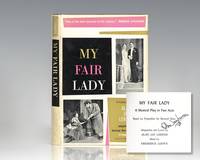
195679755New York: Coward-McCann 1956. First edition of "one of the best musicals of the twentieth century" The New York Times. Octavo original boards illustrated frontispiece of Andrews and Harrison. Signed by Alan Jay Lerner on the title page. Affixed to front free endpaper is a signed photograph of Julie Andrews and "with the compliments of Miss Andrews" affixed to the pastedown. Laid in signed photograph by Stanley Holloway Alfred P. Dolittle. The verso of the front free endpaper has a signed photograph of Rex Harrison affixed to it. On the dedication page is a card signed by Robert Coote Colonel Pickering and a signature of Wilfrid Hyde-White who played Colonel Pickering in the film version. There's also a magazine clipping of Harrison's behatted head also signed by him. Near fine in a near fine dust jacket with light wear. Jacket design by David Lyons. My Fair Lady is a musical based on George Bernard Shaw's Pygmalion with book and lyrics by Alan Jay Lerner and music by Frederick Loewe. The story concerns Eliza Doolittle a Cockney flower girl who takes speech lessons from professor Henry Higgins a phoneticist so that she may pass as a lady. The original Broadway and London shows starred Rex Harrison and Julie Andrews. The musical's 1956 Broadway production was a notable critical and popular success. It set a record for the longest run of any show on Broadway up to that time. It was followed by a hit London production a popular film version and many revivals. My Fair Lady has been called "the perfect musical". Coward-McCann hardcover books
1810WRCAM49175Mainly New York Philadelphia & Boston 1810. 38pp. Folio. Modern backstrip over contemporary marbled boards label and endpapers renewed. Corners worn boards rubbed. Minor foxing and toning some dampstaining. The second page of "The Moment is Sad" is lacking otherwise complete. Good. A wonderful collection of early American sheet music mostly American imprints most printed on two pages. The printers of these early sheets include some of the most notable names of the period such as Hewitt Graupner Blake and Paff. Dichter & Shapiro in the Introduction to their EARLY AMERICAN SHEET MUSIC include these four publishers in a list of names they deem "eminently worth while." The highlights of the songs within the book are as follows: <br> <br> 1 Fortune Michael: "Jefferson & Liberty. A New Song. To the Air of Jefferson's March." Philadelphia. 1801. First edition. The most notable music sheet in this collection. Fortune an Irish immigrant wrote the song to commemorate Jefferson's election and sent Jefferson a copy of the song. The music was published by the first American antiquarian bookseller N.G. Dufief who at the time he published this was trying to sell Jefferson Benjamin Franklin's library for the Library of Congress. For whatever reasons jealousy self-interest Jefferson turned him down and Dufief auctioned it in 1803. Perhaps Dufief hoped to advance his sale by sponsoring this publication. Very rare with only one copy listed in OCLC at Oxford University. WOLFE 4607. SHAW & SHOEMAKER 734. <br> <br> 2 "The Downfall of Paris." Boston. 1806. First state with no page number. One printed page of music with no lyrics. WOLFE 2737. <br> <br> 3 "The Battle of the Nile: A Favorite Patriotic Song." Philadelphia. ca. 1804. First printing by this publisher. A paean to Nelson's victory over Napoleon in Egypt. WOLFE 461. <br> <br> 4 Mozart: "Away with Melancholy." New York. ca. 1795. An early printing of this song an excerpt from THE MAGIC FLUTE. SONNECK & UPTON p.35. <br> <br> 5 Briggs Edward Smith: "A Hindustani Girls Song. Tis thy will and I must leave thee." New York. ca. 1800. "Soon a british fair will charm thee thou alas! Her smiles must woo / but tho' she to rapture warm thee don't forget thy poor HIN-DOO." SONNECK & UPTON p.188. <br> <br> 6 Gaveaux Pierre: "La Pipe de Tabac. A Favorite French Song." New York. ca. 1800. Not in Wolfe. SONNECK & UPTON p.332. <br> <br> 7 Gaveaux Pierre: "The Dish of Tea or Ladies Answer to the Pipe Tabac." New York. 1802. WOLFE 2896. SONNECK & UPTON p.110. hardcover books
196815318New York 1968. Near fine. Eight Kodak color transparency slides. 2" square with image area 1 3/8" x 15/16" approx. Date-stamped "MAR 68" to border of verso. No- tated in ink outside of image area with names numbers. Clean well preserved. Near fine. High-resolution jpgs of all images provided. <br/><br/>A collection of exceptional but presumably unpublished images of Jimi Hendrix performing at New York City's Hunter College on March 2 1968. Seven capture the guitar hero on stage: with his signature Stratocaster kneeling before a giant stack of amplifiers playing with his teeth etc. The eighth is a candid portrait likely snapped backstage. Though we've been unable to determine the photographer the photos are of clear professional caliber and bear a certain re- semblance to the work of legendary rock-and-roll photographer El- liott Landy. An iconic selection of original vintage slides capturing the signature style of a rock legend. unknown books
2003149182N.p.: N.p. 2003. Archive of material from the 2003 musical including three rehearsal scripts dated 7/29/03 3/31/03 and 10/23/03 with various production materials bound in including sheet music production schedules and cast and crew contact information. Two scripts noted as belonging to uncredited cast member Walter O'Neil with his holograph pencil and ink annotations throughout noting blocking and staging directions. <br/><br/>Based on Gregory Maguire's 1995 novel a revisionist imagining of L. Frank Baum's 1900 novel "The Wonderful Wizard of Oz" from the perspective of Elphaba the misunderstood Wicked Witch of the West. A wildly successful musical which made its Broadway debut at the Gershwin Theatre on October 30 2003 named one of the highest-grossing Broadway productions and running for 6836 performances to date. Nominated for ten Tony Awards and winning three including Best Actress in a Musical for Idina Menzel.<br/><br/>Set in the magical land of Oz.<br/><br/>7/29/02 script:<br/><br/>Housed in a blue three-ring binder. Title integral with the first page of the script dated 7/29/02 noted as Workshop script. 148 leaves with last page of text numbered 147. Xerographic duplication rectos only with green undated revision pages throughout. Pages Near Fine.<br/><br/>3/31/03 script:<br/><br/>Housed in a black three-ring binder with an illustrated flyer for the musical tucked into the front wrapper. Title page present dated 3/31/03 noted as Rehearsal Draft. 146 leaves with last page of text numbered II-9-146. Xerographic duplication rectos only with white revision pages throughout dated variously between 4/03/03 and 6/20/03. Pages Near Fine.<br/><br/>10/23/03 script:<br/><br/>Housed in a black three-ring binder. Title page present dated 10/23/03 noted as New York Rehearsal Script. 125 leaves with last page of text numbered II-8-123. Xerographic duplication rectos only. Pages Near Fine. N.p. unknown books
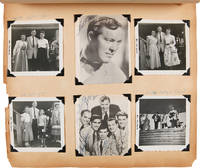
1955WRCAM55629Pennsylvania & New Jersey 1955. 130 black and white photographs from 2 x 3 1/2 inches to 8 x 10 inches almost all with printed captions in the margins dated May or June 1955 most also with manuscript captions written below the image in red or blue pencil. Plus two souvenir programs; one 6-x-9- inch promotional color photograph signed; and twenty 8 x 10-inch promotional black and white photographs most signed. Square folio. Contemporary red leatherette photograph album. Covers soiled front cover detached minor edge wear. One leaf detached minor wear to photographs album pages toned chipped and somewhat brittle. Very good. A fantastic personal photographic record of early rock and roll and country music stars from 1955 compiled by a woman named "Ann" who traveled to document her musical interests. Many of the photographs are non- professional and were likely taken by Ann or a friend or family member. Several of the professional pictures of country music artists - including Eddy Arnold Faron Young Porter Wagoner and the Maddox Brothers and Rose - are signed by the stars themselves. <br> <br> Two locations can be identified from the pictures Uncle Roy's Beautiful Sunset Park in Jennersville Pennsylvania and Circle A Ranch in Deer Park New Jersey but a variety of small clubs auditoriums jamborees and honky tonks are depicted. The album features mounted photographs capturing notable musicians such as Hank Thompson several photos including one of their tour bus Shorty Long Hank Snow Kenny Roberts Clair "Tiny" Mickey Sally Starr Mickie Evans Tim Holt the Tune Dusters the Eckert Family and others. One original photograph shows Ray Meyers an accomplished steel guitar player despite being born without arms signing an autograph with his right foot. The musician photographs are interspersed with some family photographs. <br> <br> Most notable are the dozen photographs featuring Bill Haley & His Comets at the height of their fame. Their most famous song "Rock Around the Clock" which is credited by some for bringing rock and roll music to the mainstream was released the year before and then featured in and popularized by the release of the film THE BLACKBOARD JUNGLE in March 1955. Two of the Bill Haley photographs are signed though the compiler trimmed them a bit and a few of them feature Haley with various local women identified in the captions. <br> <br> Accompanying the album are twenty-one larger promotional photographs many of which are signed. These include Hank Snow color photo signed on verso; Hank Thompson and the Brazos Valley Boys signed by Snow in the image; another of Hank Snow by himself signed in the image; Faron Young signed in the image; Porter Wagoner Junior "Speedy" Haworth and Don Warden signed by all three in the image; Eddy Arnold signed in the image; Lash La Rue signed in the image; Jesse Rogers inscribed to "Ann" on verso; Maddox Bros. and Rose signed in bottom margin; the Eckert Family giant photographic postcard signed by all on verso; Rosie and Retta signed by Retta Maddox on verso; Gordon Terry "Champion Old- Time Fiddler" signed in the image; prolific singer-songwriter Jean Shepard with her signature on the verso; Lloyd Arnold inscribed on verso; Lloyd Arnold with his band the Rockin Drifters inscribed to "Ann" in the bottom margin; cowgirl TV hostess Sally Starr inscribed on the verso "To Ann Lovingly Sally Starr"; Don Reno & Red Smiley and the Tennessee Cut-Ups signed by the whole band on the verso; the Wilburn Brothers signed by both in the image; and a few unsigned photos including one featuring Jimmy Dean. There are also two souvenir programs laid in: a promotional program for Webb Pierce signed by him inside and a SOUVENIR PICTURE ALBUM GRAND OPRY with signatures by Kitty Wells and Lester Wilburn of the Tennessee Mountain Boys inside. <br> <br> A wonderful collection of early rock and roll and country music notables compiled by a fan in 1955 at the point when rock and roll was beginning to emerge in the popular culture. hardcover books
1974152441N.p.: N.p. 1974. Draft Working script for the 1975 Andy Warhol-produced musical copy belonging to Monique van Vooren. Includes 36 additional unbound pages primarily revisions as well as twelve pages staple bound containing the bulk of dialogue for van Vooren's character Venus with name repeatedly circled in holograph pencil. Annotations throughout both copied and in holograph ink and pencil. Frequent annotated changes to sequence as well as dialogue missing sequential pages and unbound revisions reflect the continually changing and famously chaotic production. <br/><br/>From the estate of actress Monique van Vooren. <br/><br/>The musical opened on January 29 1975 at the Little Theatre. It was a star-studded opening night and after party at Sardi's with Warren Beatty Andy Warhol Diane von Furstenberg Diana Vreeland Kurt Vonnegut Rex Harrison Yoko Ono and others in attendance. Unfortunately scathing reviews followed and after only four days and a run of ten performances the production closed on February 1 1974.<br/><br/>In 1970 John Phillips inspired by the 1969 Apollo 11 moon landing conceived of a space-themed musical project a space opera originally entitled "Space" and spent the next five years on the project in its various incarnations. In 1974 Phillips' wife Genevieve Waite persuaded Andy Warhol to produce the project as a Broadway musical with Warhol's collaborator Paul Morrissey slated to direct. The project was renamed "Man on the Moon" with Waite von Vooren and Denny Doherty slated to star. Reportedly two weeks before opening night co-producer Richard Turley fired Morrissey installing a more experienced Broadway director uncredited who changed everything casting stage directions songs and script. <br/><br/>Phillips would later used some of the songs from the musical for the soundtrack of the 1976 Nicolas Roeg film "The Man Who Fell to Earth" starring David Bowie. In 2009 "Andy Warhol Presents Man on the Moon" was released as part of the "John Phillips Presents" series and included unreleased demos and songs recorded at a dress rehearsal at The Factory by Warhol.<br/><br/>Self wrappers integral with first page. 87 leaves with last page of text unnumbered. Xerographic duplication rectos only. Pages Very Good plus to Near Fine bound with ring binder mechanism lacking wrappers.<br/><br/>Twelve pages bound with staple to top left. Near Fine.<br/><br/>36 unbound pages Very Good to Near Fine. N.p. unknown books
1970146874N.p.: N.p. 1970. Archive of 288 vernacular color photographs of country music acts from the 1970s housed in a contemporary photo album with the subject of nearly every photograph identified by holograph ink captions. Occasional additional notations give a date range between 1972-1980 for the photographs with most being dated 1977-1979. <br/><br/>The photographs primarily consist of performers on stage indicating the photographer was near the stage with a strong sense of composition and timing. Photographs of performers casually posing for the camera indicate the photographer likely had backstage access for some of the performances. <br/><br/>Based on additional information in some of the handwritten captions the photographs were primarily taken at concerts or events in the Western New York region - Chautauqua Dunkirk Little Valley and Lakewood - all within an hour of each other as well as the nearby Erie County NY Fair and Expo and Pittsfield PA. Other locations include the New York State Fair and Pittsburgh PA. <br/><br/>Included are images of country music legends Johnny Cash Dolly Parton Loretta Lynn Conway Twitty Hank Snow June Carter Cash The Carter Family Minnie Pearl Tanya Tucker Tammy Wynette and Wanda Jackson. Also included are photographs of singers who while lesser known today were among the biggest stars of the era including Bobby Goldsboro Crystal Gayle Donna Fargo Freddy Fender Jeannie C. Riley Buddy Alan Charlie Walker Peggy Sue Bill Anderson Kenny Price LeRoy Van Dyke Lynn Anderson Jay Lee Webb Jean Shepard and Kitty Wells. Finally the album contains images of smaller and possibly even regional acts some of which appear unknown to us presenting a broad survey of a transitional era in country music as rock soul and pop began to fuse with the more traditional country sound that had begun declining in popularity toward the end of the previous decade. <br/><br/>For more details please inquire. <br/><br/>Photographs variously sized primarily 3.5 x 5 inches but up to 7.5 x 9.75 inches. Generally Near Fine. <br/><br/>Housed in an about Very Good generic photo album with starting and loss to the spine fraying and rubbing. Several internal pages loose or with dried glue leading to occasional slipping of the photographs. N.p. unknown books
12466Used; Like New/Used; Like New. An ornamental music folder boards covered in gold velvet the front board decorated with four brass corner ornaments each inlaid with multi-color cloisonné surrounding an elaborate and large central decoration in brass and detailed cloisonné with a raised image of a lyre at the center. 14.25 x 11.25x .5 inches. From the collection of King Farouk of Egypt sold originally at the 1988 Oakland Galleries auction of the J.W. Menhall Estate including items from the King Farouk Collection and sold here with a copy of the sale catalogue in which the folder is illustrated. <br><br><br />Farouk I of Egypt was the tenth ruler from the Muhammad Ali Dynasty and the penultimate King of Egypt and the Sudan succeeding his father Fuad I of Egypt in 1936. He ruled during a turbulent time in Egyptian and Middle East history that was marked by the creation of the Arab League the first Arab-Israeli conflict and heated nationalist opposition to the British. Instead of being the shrewd political leader that Egypt needed Farouk was a materialistic womanizer and corpulent spendthrift whose outrageous lifestyle eventually led to his downfall. Enamoured of the glamorous royal lifestyle although he already had thousands of acres of land dozens of palaces and hundreds of cars the youthful king often travelled to Europe for grand shopping sprees earning the ire of many of his subjects. It is said that he ate 600 oysters a week and in 1951 he bought the pear-shaped 94-carat Star of the East Diamond and a fancy-coloured oval-cut diamond from jeweler Harry Winston. Overthrown in the Egyptian Revolution of 1952 he was forced to abdicate in favor of his infant son Ahmed Fuad who succeeded him as Fuad II of Egypt. He died in exile in Italy. hardcover books
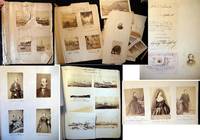
186621446European Origin: Not Published 1866. Album of materials gathered by John Henry Cornell 1828-1894 American musical author organist and composer ".a solidly trained composer of church-music part-songs and songs.an erudite and methodical student of theory and an able author and translator." Grove; educated in New York England and Germany in 1866 he traveled once again to Europe visiting historic sites and his musical peers collecting photographs autographic materials and ephemera along the way that are preserved here; Approximately 100 pages with items usually tipped-on to one side only; including photographs of composers usually standard carte-de-visite size of fellow musicians & others including: 3 Photos on the same page of musicians Carl Reinecke 1824 - 1910 Danish composer; Ferdinand David 1810-1873 German virtuoso violinist and composer; Alexander Dreyschock 1818-1869 Czech pianist and composer; trombone virtuoso Moritz Nabich 2 one with his instrument and others of Madame and Fraulein Nabich; King John of Saxony; Fraulein Suvanny Soubrette at the Leipzig Theatre; German actress Hedwig Raabe 1844-1905 with a clipped signature - and on the same page a photo of Franz Buchner Orchestral Director with a small inscribed card; German painter Peter von Cornelius 1784-1867; a cdv-size photo of A.J. Boekelman musical director from Utrecht with inscribed card; photo of Hungarian composer pianist conductor and arranger Károly Carl Thern 1817- 1886 with clipped signature; U.S. Consul Dickinson of Indiana see below in printed ephemera for a bit more on this man; photo of Father Skelly O.S.B. Kilkenny Ireland - and almost 20 additional portrait photographs of presumed musical peers and their families some of these with signed inscriptions that have so far eluded identification; Also including and laid-into the album loosely or on pages trimmed from the album: Moritz Hauptmann 1792-1868 a small photo and two small clipped notes signed a few inches square one tipped-on below the image another note on a tipped-on card 2" x 3" loose; below the image of Hauptmann is a photo of Isaac Ignaz Moscheles 1794-1870; on another sheet Franz Wilhelm Abt 1819-1885 autograph 7-line note signed with cdv-size photo with a clipped greeting on card tipped in below the image - another unidentified musician's image above also with a signed photo & card and on the back of the sheet with the letter another two images one with signed card; Johannes Gijsbertus Bastiaans 1812-1875 and a photo of his wife both inscribed; on a loose sheet the obituary of Cornell noting his musical career marriage education and travels and that he at one time had taken Roman Catholic religious orders in Baltimore and had died within the Episcopal Church with selections of his compositions played at the funeral service held at Trinity Chapel in New York City - here are a signed card of William Reed Huntington of Grace Church 1838-1900 and an autograph of Morgan Dix 1827-1908 both men prominent leaders of the Episcopal Church of the U.S. in the 19th century - Dix was one of the officiants at Cornell's funeral - on the back of this loose sheet is a cabinet card photograph of an image of W.A. Mozart; Printed ephemera including: A 3" x 5" card printed black on pink with humorous musical-themed imagery announcing "Klapperkasten Moscheles-Abend Leipzig d. 12 May 1866 im Schutzenhaus" with a small circular albumen photo image of the composer at the side a younger cdv-size image of Moscheles and above another printed note accomplished in hand to John Cornell regarding Klapperkasten; a card printed black on blue stock "Soiree musicale von Nabich Posaunen-Virtuos" 2 1/2" x 3 1/2" - old fold line good cond. loose and a "Groot Concert te geven door den heer Moritz Nabich.B. Van der Eijken.J. Hrimaly." with the program below in which 2 pieces are by Cornell - approx. 8" x 4" Joh. Enschede en Zonen Haarlem imprint below - on the back of this loose sheet are two photographs of architecture one identified as the "House of W. Vorschuur" and three cdv-size photos: one of Dutch painter Wouterus Verschuur 1812 -1874 and his son W. Verschuur Jr. also a painter - both signed directly below their portraits on the photos and one of the performers on the concert program Czech violinist Jan Hrimaly 1844-1915; a broadside announcement for a "Musikalische Soiree" Im Saale des Hotel de Prusse with the program printed by Julius Krampe with 2 Cornell pieces played 8 1/2" x 5" one edge with some creasing wrinkling still very good; a Soiree Musicale with Moritz Nabich and Mejufvrouw Boekelman and list of works printed by Van Munster & Zoon 8" x 5" and with 2 Cornell works played too with a couple closed edge-tears and creases good; another loose piece of ephemera 4 1/2" x 3 1/4" a menu-card dinner-choice text handwritten and the rest printed by Friedrich Daehne and noted below by Cornell as "Bill of fare of our 4th of July Dinner." - on back is noted ".with U.S. Consul T. Y. Dickinson Jas. Wilson of Newport R. I. and others Leipzig"; an announcement of a concert 10" x 7 1/2" "Jena. Montag den 19. Februar 1866 im Rosensaale Concert des Academ. Gesangvereins." with the program of music tipped-on is most of a map published by C.H. Wogan "The Strangers Guide to Dublin" approx. 6" x 8" one side trimmed close with loss to two of the corner vignettes; also a folding 12" x 15" map of Berlin by Baldwin & Cradock trimmed close to the neat line all around; a curious advert for a moisturizing rejuvenating apparatus not illustrated clipped from a periodical for "Regenerators" of Leo Bohlius a hairdresser in Germany; with some additional newspaper clippings of the time and a few later also tipped-in or loose; with approximately 150 additional architectural scenery & art photos from the time averaging 3" x 3" size with a few larger images; the photos are of locales in Kilkenny Quenstown Ireland; various places in Wales & England; Altenburg Leipzig Dresden Hanover Germany; Brussels Belgium and other places; including a small photo of the Kristallnacht-destroyed synagogue of Leipzig; and another noted as the "Old Opera-House in Dresden as I saw it. Burnt down."; among these are about 10 ethnic European costume photos in cdv size also; the album approx. 13" x 11" size; the sheets only no covers; still loosely bound; many pages edge-chipped and the paper quality good; the first page with old discoloration and the "Ireland" scenery photos on that page chipped torn and worn; as noted above there are many loose and cut-out pieces - the evidence is within the album of where some of these may originally have been located - all this seems to be done by a very unskilled hand perhaps a childish effort; some leaves obviously and crudely excised at some time; by and large the photographs & ephemeral items in good condition; good also to have included here the final materials recording his obituary & death; a very interesting compendium of visual and textual information especially regarding the Romantic composers of Europe and their association with their American counterpart; we note that one of the loose albume pages contains a group of material regarding the wife of Martin Luther; including a photographic reproduction of an engraving depicting the ruins of the Kloster Nimbschen by Selbstverlag V. Peters Leipz. approx. 3" x 4" in black and white identified below as "Ruins of Nimbshcen Convent of which Katharine Bora was a member."; with an unknown gentleman's carte-de-visite-sized photo-portrait circa 1860s; with an albumen photograph also carte size approx. 2 1/4" x 3" of a portrait identified below of Katharina von Bora Luther 1499-1552 wife of Martin Luther the German leader of the Protestant Reformation; and tipped-on is a 1" x 1 3/4" thin beige leather fragment having evidence of tiny stitching and some threading around 3 edges of a "Piece of Katharine Bora's slipper" identified in the same handwriting as the above items; ".According to Dr. Stefan Rhein Director of Luther monuments in the state of Sachsen-Anhalt.Katharine von Bora was Luther's companion and equal partner the picture of a self-assured self-confident liberated woman at the side of her husband. But this most important woman of the Reformation period of the 16th century is relatively unknown for she lived in the shadow of her powerful husband." Erwin Weber Lutheran Journal 1999; for the future of the Protestant Christian faith Luther's marriage established the validity of marriage within the clergy as well as focusing attention on the importance of inspirational strong women in early Protestantism; the items with some ageing darkening; the old backer paper with some tears cutouts from paper probably from a larger sheet; list of items on the page written in a later hand in top left corner; the items in very good condition and an interesting fragment of the life of this important Lutheran woman. Manuscript. No Covers. Good. Not Published Paperback books
196815319New York 1968. Near fine. Eight Kodak color transparency slides. 2" square with image areas 1 3/8" x 15/16" approx. Date stamped "MAR 68" to border of verso. Notated in ink outside of image area with names numbers. Clean well preserved. Near fine. High-resolution jpgs of all images provided. <br/><br/>A collection of presumably unpublished images of Jim Morrison at New York's Fillmore East March 22 1968. Three of Morrison on stage two pictured with five intimate close-ups likely captured backstage. A particularly poignant shot has him leaning into the microphone with a light projection behind. This two-night four-show Fillmore engagement produced what are often considered some of the best shows of the band's career. Though we've been unable to determine the pho- tographer they are of clear professional caliber and bear a certain resemblance to the work of legendary rock-and-roll photographer Elliott Landy. A striking group of original vintage slides. unknown books
1900D10896America England et al 1900-1970s. Sheet Music. Very Good. A massive collection of more than 700 pieces of sheet music each title in an archival sleeve -- just a small handful of duplicates. Condition varies from Good some chipping and dust-soiling to Fine though generally Very Good. Spanning decades the bulk are published in New York Chicago Detroit and London but also include Rome Hollywood San Francisco and beyond. Composers include Harold Adamson Mack Gordon Vincent Youmans Irving Berlin Lew Brown Alfred Bryan Sammy Cahn B. G. De Sylva Ray Henderson Al Dubin Arthur Freed Nacio Herb Brown George and Ira Gershwin Oscar Hammerstein Richard Rodgers Otto Harbach Paul Francis Webster Gus Kahn Edgar Leslie Sam Lewis Joe Young Jay Livingston Ray Evans Frank Loesser Cole Porter Leo Robin and others. Arranged for intermediate pianists but including a few pieces for beginners and most with chord progressions for ukulele and/or guitar styles include fox trots waltzes ballads war-time songs holiday songs and songs from Broadway Disney and film. Please inquire for a full list. <br/><br/> unknown books
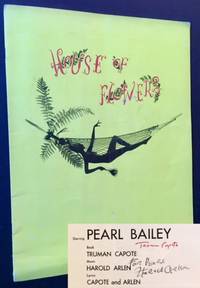
195515414New York: Passantino 1955. Original wraps. Near Fine. A wonderful piece of theatre history the original 1955 program for Truman Capote's "House of Flowers". THIS COPY IS NOT ONLY SIGNED BY TRUMAN CAPOTE on the title page next to his printed name BUT IS ALSO INSCRIBED BY HAROLD ARLEN WHO WROTE THE MUSIC FOR THE PLAY TO PEARL BAILEY THE PLAY'S LEAD. This inscription appears next to Arlen's printed name on the title page as well. The program itself is clean and Near Fine in its stapled yelow wrappers with very faint creasing along the panels. Tall thin quarto crisp black-and-white photos thruout of the principals involved in the production and performance of the play. <br/><br/> Passantino paperback books
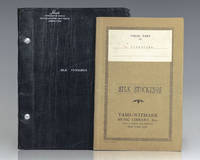
110658New York: Tams-Witmark Music Library. Rare original Silk Stockings shooting script with music and lyrics by Cole Porter. Quarto original black Hart Stenographic Bureau leatherette wrappers bound and bradded. In near fine condition. Annotations throughout. Accompanied by the vocal part of Ninotchka which is in fine condition. Loosely based on the Melchior Lengyel story 'Ninotchka' Silk Stockings premiered on Broadway in 1955 and was the final musical that Cole Porter wrote for the stage. The production opened Broadway on February 24 1955 at the Imperial Theatre and closed on April 14 1956 after 478 performances. Tams-Witmark Music Library hardcover books
1815544Harrisburg: Gedruckt bey Johan Wyeth Buchhändler in Harrisburg bey Conrad Doll Lancaster und bey Jacob Doll Yorktaum 1815. Oblong 8vo. 145 x 285 mm. 5 ¾ x 11 inches. Contemporary leather spine over marbled paper boards; spine cracked and boards loose but only partially intact partial loss of marbled paper on both boards; paper stock aged brown. Ownership mark of David Stauffer with inscriptions dated 1840 and 1850. With faults a complete copy. Harrisburg: Gedruckt bey Johan Wyeth 1815. WITH: . Oblong 8vo. 145 x 265 mm. 5 ¾ 10 ½ inches; 120 pp. Contemporary leather spine blue paper covered boards; binding a bit scuffed and soiled paper stock toned brown with age otherwise a very good copy. Together two parts published in two volumes five years apart; rare survival. Doll's two volumes of church music are the earliest German language music books to use type to print the notes. The type font was called four-shape note system. It copied the type created and first used by Little and Smith in The Easy Instructor published in 1801 and was used by John Wyeth without acknowledgement. In addition to introducing this type to the Pennsylvania German tune-book tradition Wyeth was responsible for the development of Southern folk hymnody. E. C. Wolf records that the 1810 edition was reprinted in 1814 and again in 1821; in 1815 a second volume was issued with a similar title but different content." Shaw and Shoemaker American Bibliography 19986 34588 Arndt German Language Printing 1736 2081. E. C. Wolf Lutheran Hymnody and Music Published in America p. 178. Gedruckt bey Johan Wyeth Buchhändler in Harrisburg, bey Conrad Doll, Lancaster, und bey Jacob Doll, Yorktaum unknown books
1979011573NY: Privately published 1979. Private edition. Hardcover. Very Good . Bound musical score as performed on the opening night of March 1 1979 at the Uris Theater. Bound musical scores are privately published a project usually undertaken by the music preparation supervisor and then presented to producers and creative principals as a momento or official record of the music as presented opening night. This copy is inscribed by Mathilde Pincus and Al Miler whose company was responsible for music supervision on Sweeney Todd to Ruth Mitchell who was director Hal Prince's assistant on the musical and his long-time associate producer on most of his Broadway shows: "To Ruth we thank you as part of the production staff for this great great work and we love you as a great friend - and sincere. Sincerely - with much love - Mathilde and Al". Typically there are about 12-18 bound musical scores per production. Never commercially sold only for private presentation. Squarish folio green cloth gilt titles front and spine some speckles of white bookhelf paint front cover. Privately published hardcover books
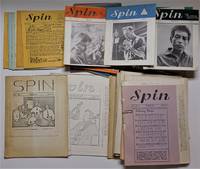
1961008126Wallasey Cheshire England: Spin Publications 1961. RARE. 61 magazines the complete run of one of Britain's early and iconic folk music revival magazines. All are Near Fine to Fine. 10 issues each in the first 3 volumes 6 each in Vols. 4-6 5 issues in Vol 7 Nos. 5 and 6 in a combined issue and 4 issues in Vols. 8 and 9. The first seven numbers of Vol. 1 printed as a duplicated 12 page stapled magazine in 300 copies. By the time of Vol. 1 No.7 the magazine had become so popular that it went into photo offset and 1000 copies were printed. Published out of Chelsea under the auspices of the the Liverpool Spinners and the Spinners Club the magazine's main focus was on British traditional folk music. Editor Beryl Davis was the wife of the Spinners singer Tony Davis. By 1965 it had grown to 500 readers with many in America. Covers in Vol. 2 included Martha & Huddie Ledbetter Woody Guthrie and Pete Seeger while Vol. 3 No. 7's cover featured a then 24 year old Bob Dylan. Individual issues are SCARCE in todays market so to complete a full set would be a long term project. Worldcat notes 4 institutional holdings none of which have complete sets. Thus likely this is a once-in-a-lifetime opportunity. . First Edition. Stapled Folder. Near Fine/No Jacket As Issued. Various. Spin Publications Paperback books
1816046831Madrid: La Viuda de Aznar 1816. Second Edition. Hardcover Full Leather. Good Condition. Early tooled leather spine with raised bands marbled endpapers; water stains to endpapers and to bottom margin more or less throughout title stained scattered minor maginal stains small hole to corner of final leaf final music leaf with mild stains. viii 30 2pp with 17 leaves of printed music a few folding. <br/><br/>A scarce work on the guitar first published in 1799 - the first edition is rare this the second only slightly less so. About a dozen copies of the second edition in OCLC rare in commerce. Size: Octavo 8vo. Quantity Available: 1. Shipped Weight: Under 1 kilo. Category: Music; Inventory No: 046831. La Viuda de Aznar hardcover books
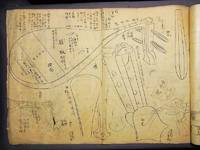
13110Used; Like New/Used; Like New. An interesting collection of detailed original Japanese drawings showing the construction and decoration of Imperial Court instruments. 39 x 27 cm 15 x 10.5 in. 12 pp. Bound with a single string.  Pen and ink on very delicate rice paper. Slight chipping/small tears to outer edge central vertical crease overall fine.  Undated ca. 1900. <br style=""> unknown books
1949139871Los Angeles: Twentieth Century-Fox 1949. Revised Final script for the 1950 film. Bound presentation belonging to producer Sol C. Siegel with his name in gilt on the front board. With 53 studio still photographs tipped in throughout four pages of retakes and added scenes tipped in at the rear as well as a number of holograph annotations primarily denoting the titles of various musical numbers. <br/><br/>Based on the short story "Stork Don't Bring Babies" by S.K. Lauren Grable and Dailey play a showbiz couple who discover in successive order that they cannot have children that they can adopt children and that they aren't really fit to raise children. But things get better with the help of several musical numbers scored by Harold Arlen. <br/><br/>Bound in green faux leather boards with gilt titles and rule and marbled endpapers. Title page present dated Dec. 1 1949 noted as Revised Final with credits for screenwriters Trotti and Binyon. 191 leaves with last page of text numbered 130. Mimeograph duplication with blue revision pages throughout dated variously between 12/21/19 and 1/5/50. Pages Very Good plus photographs Near Fine with some bruising or chipping to the verso of the preceding page on either the top or bottom edge. Boards Near Fine with a bump to the upper rear corner. <br/><br/>Hirschhorn The Hollywood Musical. Twentieth Century-Fox unknown books
1955149900Beverly Hills CA: Metro-Goldwyn-Mayer MGM 1955. Five vintage candid reference photographs from the 1955 film showing variously actors Marlon Brando Frank Sinatra composer Frank Loesser and director Joseph L. Mankiewicz on the set. <br/><br/>The first photo double weight shows Marlon Brando as Skye Masterson surreally <br/>socking one of his gangster companions in the nose. <br/><br/>The second photo shows Brando rehearsing "Luck Be a Lady" with sheet music in hand and with the song's composer Frank Loesser at the piano.<br/><br/>The third photo shows Sinatra and Brando in a candid moment.<br/><br/>The fourth photo single weight shows director Joseph L. Mankiewicz and dancer Carey Leverette relaxing contemplatively Mankiewicz sitting and smoking his pipe Leverette inside a large industrial exhaust pipe.<br/><br/>FIFTH PHOTO 149973 TBD KRJ<br/><br/>Based on the 1950 Broadway musical which was in turn based on Damon Runyon's short stories "The Idyll of Miss Sarah Brown" and "Blood Pressure." A serial gambler wins a bet that he can get a Christian missionary to travel with him to Havana where the pair begin to fall for each other. Nominated for four Academy Awards.<br/><br/>Set in New York and Havana.<br/><br/>All photos: 8 x 10 inches. Very Good to Near Fine overall variously with a few pinholes and very shallow creasing. Metro-Goldwyn-Mayer [MGM] unknown books