HAYDN, Joseph 1732-1809Biblio.com
1 598 résultats
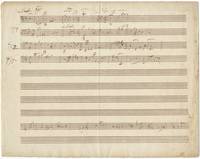
39430Large oblong quarto 241 x 309 mm. Notated in dark brown ink on the verso of the second leaf of a bifolium i.e. page 4 on 10-stave rastrum-ruled paper of British manufacture. Watermark dated 1794.<br /> <br /> Late spring or early summer 1795 see H.C. Robbins Landon: Haydn Chronicle and Works Volume III p. 495.<br /> <br /> With pencilled note in another hand to first page: "Haydn autograph notes of the 12 English Symphonies. Haydn misquotes the 2nd." <br /> <br /> Very slightly worn browned and soiled; minor foxing and very short splits to central fold; vertical crease to center of bifolium; lower edge with several miniscule tears.<br /> <br /> In addition to noting the musical incipits which comprise 25 measures spread out over 4 staves Haydn identifies the key time signature and year in which each symphony was first performed in noting the performance date of Symphony 97 however Haydn makes an error and cites 1791 instead of 1792. <br /> <br /> The sketch for the piano trio Hob. XV:25 is notated 5 staves below the symphonic incipits and consists of 9 measures of melodic material for the famous third movement. <br /> <br /> Provenance<br /> Leo Liepmannssohn auction catalogue Berlin 1907 lot 91. The Westley Manning Collection Sotheby's London 12 October 1954 lot 207. The London Symphonies were commissioned by the London impresario and violinist Johann Peter Salomon 1745-1815 and composed over the period 1791-95. Salomon was responsible for bringing Haydn to London where he became immensely popular largely through performances of his music at Salomon's concerts.<br /> <br /> "Haydn's London symphonies nos. 93-104 crown his career as a symphonic composer. Not only do they outdo the Paris symphonies stylistically but he produced them in person for rapturous audiences; this interaction stimulated him to ever bolder and more original conceptions. . The last six London symphonies are even more brilliant than the first six. . Haydn's determination to conquer new territory with each work is palpable." James Webster in Grove Music Online<br /> <br /> "The finale of Hob. XV:25 is the famous rondo "in the Gypsies Style." It seems that a composer's most popular works if not spurious are at least unusual manifestations of his style and this rondo fits this characterization. . Even though this finale was best known during the eighteenth century as a separate piece in many different settings its impact is best appreciated within the context of this keyboard trio cycle for the Andante and Poco Adagio the first and second movements hardly prepare one for its burst of energy." A. Peter Brown: Joseph Haydn's Keyboard Music Sources and Styles p. 377.<br /> <br /> ". the G major Trio 39 turned out to be Haydn's most popular piano piece because of the 'Gypsy Rondo' Finale. . It became an enormous favourite first in England and immediately afterwards on the Continent." Robbins Landon III pp. 431-432. <br /> <br /> A unique and interesting manuscript being a virtual catalogue of all the London Symphonies and including music from the famous Gypsy Rondo some of Haydn's best music from his important London period. unknown
180895829London: Lavenu Cianchettini & Sperati 1808-1810. First editions of the first printings of the full orchestral scores of the complete symphonies of Beethoven Mozart and Hadyn. Quarto two volumes bound in three quarters morocco over marbled boards wit gilt titles and tooling to the spine including A Complete Collection of Haydn Mozart and Beethoven's Symphonies Cianchettini and Sperati and A Complete Collection of <span class="match">Mozart</span> and Beethoven's <span class="match">Symphonies. </span>A Compleat Collection of Haydn Mozart and Beethoven's Symphonies contains the first appearance of the full scores of <span class="match">Mozart</span>'s Overture to the Marriage of Figaro <span class="match">Mozart</span>'s Symphony no. 40 and no. 41. Fuld The Book of World-Famous Music 564-567. A Complete Collection of <span class="match">Mozart</span> and Beethoven's <span class="match">Symphonies Lavenu contains the first appearance of the </span>full scores of <span class="match">Mozart</span>'s Symphony no. 39 no 13 and no. 38. In very good condition with light toning to the text. An exceptional collection of the utmost rarity. 1786 saw the successful premiere of Mozart's The Marriage of Figaro in Vienna. Its reception in Prague later in the year was even warmer and this led to a second collaboration with Da Ponte: the opera Don Giovanni which premiered in October 1787 to acclaim in Prague but less success in Vienna in 1788. The two are among Mozart's most important works and are mainstays of the operatic repertoire today. In 1787 the young Ludwig van Beethoven spent several weeks in Vienna hoping to study with Mozart. No reliable records survive to indicate whether the two composers ever met. Beethoven would go on to become a crucial figure in the transition between the Classical and Romantic eras in classical music he remains one of the most recognized and influential of all composers with his best-known compositions including 9 symphonies; 5 piano concertos; 1 violin concerto; 32 piano sonatas; 16 string quartets; a mass the Missa solemnis; and an opera Fidelio. Lavenu, Cianchettini & Sperati hardcover books
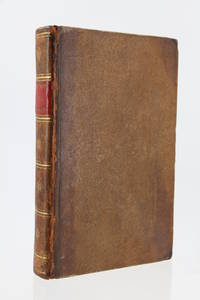
180895829London: Lavenu Cianchettini & Sperati 1808-1810. First editions of the first printings of the full orchestral scores of the complete symphonies of Beethoven Mozart and Hadyn. Quarto two volumes bound in three quarters morocco over marbled boards wit gilt titles and tooling to the spine including A Complete Collection of Haydn Mozart and Beethoven's Symphonies Cianchettini and Sperati and A Complete Collection of Mozart and Beethoven's Symphonies. A Compleat Collection of Haydn Mozart and Beethoven's Symphonies contains the first appearance of the full scores of Mozart's Overture to the Marriage of Figaro Mozart's Symphony no. 40 and no. 41. Fuld The Book of World-Famous Music 564-567. A Complete Collection of Mozart and Beethoven's Symphonies Lavenu contains the first appearance of the full scores of Mozart's Symphony no. 39 no 13 and no. 38. In very good condition with light toning to the text. An exceptional collection of the utmost rarity. 1786 saw the successful premiere of Mozart's The Marriage of Figaro in Vienna. Its reception in Prague later in the year was even warmer and this led to a second collaboration with Da Ponte: the opera Don Giovanni which premiered in October 1787 to acclaim in Prague but less success in Vienna in 1788. The two are among Mozart's most important works and are mainstays of the operatic repertoire today. In 1787 the young Ludwig van Beethoven spent several weeks in Vienna hoping to study with Mozart. No reliable records survive to indicate whether the two composers ever met. Beethoven would go on to become a crucial figure in the transition between the Classical and Romantic eras in classical music he remains one of the most recognized and influential of all composers with his best-known compositions including 9 symphonies; 5 piano concertos; 1 violin concerto; 32 piano sonatas; 16 string quartets; a mass the Missa solemnis; and an opera Fidelio. Lavenu, Cianchettini & Sperati hardcover
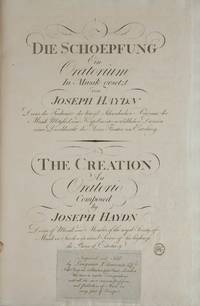
180040127Vienna: The Composer 1800. Folio. Contemporary quarter dark tan mottled calf with ivory vellum-edged marbled boards titling gilt to spine. 1f. recto title verso blank 4ff. subscribers list 303 i blank pp. Text in German and English. Title and music engraved list of subscribers typeset.<br /> <br /> With Haydn's small circular monogrammatic handstamp "JH" to foot of title. <br /> <br /> Binding worn rubbed and bumped; minor loss to head and tail of spine. Occasional small stains and moderate browning; some signatures partially split at lower portion. In very good internal condition overall. First Edition. HWV Vol. II p. 36. Hirsch IV 799. Leipzig catalogue p. 19. Vecsey 303. Eitner V p. 66. BUC p. 456. RISM H2521. <br /> <br /> The Creation to a libretto by Gottfried von Swieten was first performed at the Palais Schwarzenberg in Vienna on 29 and 30 April 1798; its first public performance took place on 19 March of the following year at the Burghteater in Vienna. <br /> <br /> "There is hardly any doubt in the mind of the average music-lover that Haydn's Oratorio The Creation is tutto sommato his greatest single accomplishment and certainly ranks as one of the greatest products of any eighteenth-century mind. It occupies a central position in choral literature and its composition and first performances were the dominant features of Haydn's life in the late 1790s." Robbins Landon: Haydn Chronicle and Works Vol. IV: Haydn The Years of 'The Creation' 1796-1800 p. 12.<br /> <br /> Copies of the first edition of this monumental work containing the subscribers list are very scarce to the market. [The Composer] unknown
181478167Paris: De l'Imprimerie de P. Didot l'aîné 1814. Fine. De l'Imprimerie de P. Didot l'aîné Paris 1814 12.50 x 20.50 cm relié De l'Imprimerie de P. Didot l'Aîné Paris 1814 125 x 205 cm bound in calf First edition of Stendhal's very first book published under the pseudonym of Louis-Alexandre-César Bombet. Contemporary binding in half brown calf spine decorated with gilt fillets and tooling as well as a red morocco title piece. Very rare according to Clouzot De l'Imprimerie de P. Didot l'aîné unknown
38986A Paris, chez Pleyel, [1800] 4 volumes in-4°, 383-325-285-273p. Reliure demi-basane pour le premier volume, cartonnages d'attente (fortement défraichis) pour les 3 derniers volumes .
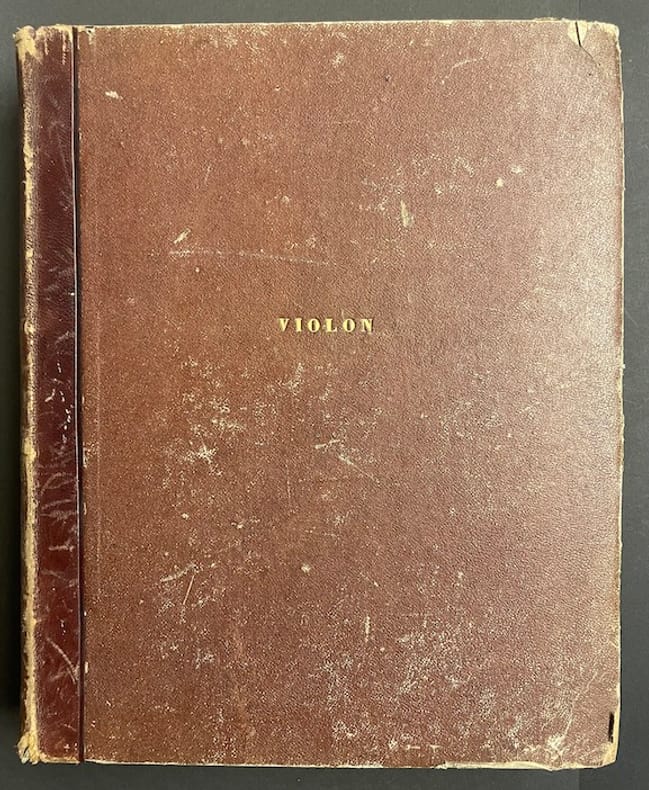
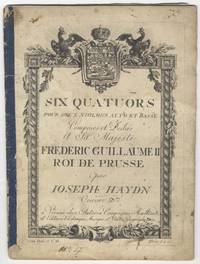
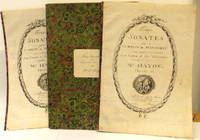
178740066Vienne: Artaria PN 109 1787. Folio. Sewn. <br /> <br /> Violino primo: 1f. recto title with elaborate engraved border incorporating coat of arms crowned eagles crown and floral and architectural motifs verso blank i blank 2-25 pp. <br /> Violino secondo: 1f. recto title verso blank i blank 2-21 i blank pp. <br /> Viola: 1f. recto title verso blank i blank 2-21 i blank pp. <br /> Violoncello: 1f. recto title verso blank i blank 2-21 i blank pp. <br /> Engraved throughout.<br /> <br /> Occasional fingerings in contemporary ink to first violin part.<br /> <br /> 19th century annotation: "Tenor - Fundament" and "Anton Kulhanek" to head of blank page preceding music to second violin part with hand-drawn stave and scale with note names and on the same page a small chart with note or string names and transpositions and the name "Franz Rücker." Some dynamics modified in ink in viola part transforming "f" to "sf." <br /> <br /> Somewhat worn foxed soiled and stained; spines reinforced with early dark blue paper tape; edge tears with minor loss to blank margins of first violin part; outer and lower margin of final leaf reinforced just touching staff lines. First Edition of the Prussian Quartets. Hob. III:44-49. Hoboken Catalogue Vol. 7 574. BUC p. 465. RISM H3494 two copies only in North America one in Britain and none in France or Italy. <br /> <br /> The fourth quartet in this group in F sharp minor is regarded as one of Haydn's finest. "It shows for the first time in the quartets Haydn's definite renunciation of tragic ends to sonata movements and his now typical association of the minor mode with a passionate somewhat blustering temper ending with a recapitulation in these circumstances regular in the tonic major so that everything turns out well. . In striking contrast to the happy end of the first movement the final fugue quietest and deepest of all the . instrumental fugues since Bach strikes a note so tragic that Beethoven's C sharp minor quartet is the first thing that one can connect with it." Tovey in Landon: Haydn Chronicle and Works II p. 627. Artaria [PN 109] unknown
a015.016GB: R T Birchall - Preston 326 x 255 mm. Old half dark green leather and marbled boards. Spines heavily decorated in gold and all lettered "HAYDN - BOOK C". Leather title labels on front covers. All with the large armorial bookplate of Frederick A Heygate Lambert with small Garratts Hall Library case label. PAGINATION ERRATIC THROUGHOUT but appear to be complete as issued. Salomon is in 7 sets of 16 pages whilst Hague is about 48 pages. All fairly clean tight and sound BUT some offsetting throughout and some occasional damp and other marks. A good working set but perhaps not for the collector. Hardback. Good. R T Birchall - Preston Hardcover
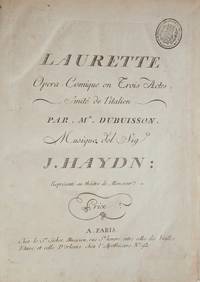
179140111Paris: Sr. Sieber Musicien rue St honoré entre celles des Vielles Etuve et celle D'orleans chez l'Apothiciare No. 92 PN 1171 1791. Folio. Ivory vellum-backed marbled boards dark red leather label to spine with titling gilt. 1f. recto title verso blank 254 pp. with "Personnages" to lower portion of p. 12 following overture. Engraved throughout.<br /> <br /> Overture and arias with spoken dialogue provided as text; "Laurette" was performed without recitatives. <br /> <br /> Handstamp of "Cercle des amateurs de musique Strasbourg" incorporating lyre and floral motif to upper outer corner of title and first page of music.<br /> <br /> Binding worn rubbed and bumped. Light uniform browning; occasional small stains and foxing; abrasion to p. 101 affecting several bars of music; price erased from title. First Edition. Hoboken Collection Vol. 9 1615. Lesure p. 299. RISM H2563<br /> <br /> Laurette to a libretto by Francesco Puttini was first performed on 25 April 1779. <br /> <br /> "Contrary to claims made by Haydn's early biographers insufficent evidence supports the hypothesis that Haydn wrote this opera to fulfill an imperial commission for Vienna. The libretto represents a considerably shortened version of Puttini's text for Anfossi 1776 Rome already somewhat condensed especially in Act 3 for performances later that year in Venice as La pescatrice fedele and in Vienna 1777. Andrea Totti who sang Count Errico in Venice also performed in Haydn's opera at Eszterháza. . The opera was subsequently performed as Der flatterhafte Liebhaber oder Der Sieg der or Die wahre Beständigkeit in Pressburg Bratislava 1786-7 Budapest 1789 Vienna 1790 and Brno 1792 and with numerous changes as Laurette in Paris 1791." Caryl Clark in Grove Music Online<br /> <br /> "La vera costanza 1778-9 is the subject of implausible and conflicting anecdotes in Griesinger and Dies according to which it was originally commissioned for the Burgtheater in Vienna but scuttled by intrigue neither Joseph II nor his musicians were well-disposed towards Haydn; in fact it had its première at Eszterháza on April 25 1779. It was lost in the fire that largely destroyed the Eszterháza opera theatre on November 18 1779; the surviving version represents Haydn's reconstruction of the work from 1785." Georg Feder and James Webster in Grove Music Online. Sr. Sieber, Musicien, rue St honoré entre celles des Vielles Etuve et celle D'orleans chez l'Apothiciare, No. 92 [PN 1171] unknown
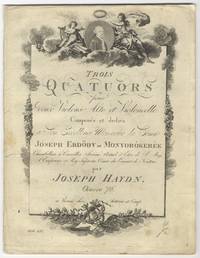
180040068Vienne: Artaria et Comp. PN 837 1800. Folio. Preserved in a custom-made full dark brown linen clamshell box with black leather label with titling gilt to spine. <br /> <br /> Violino primo: 1f. recto title verso blank 19 i blank pp. Title within elaborate border engraved by J. E. Mansfeld incorporating a portrait of Haydn at head a muse holding a flute and trumpet and an angel playing a lyre. <br /> Violino 2o.: 17 i blank pp. <br /> Viola: 17 i blank pp.<br /> Violoncello: 17 i blank pp.<br /> Engraved throughout.<br /> <br /> Slightly worn; occasional soiling and small stains primarily to blank margins; small tear to blank inner margin of title to first violin part extending slightly into border. First Edition with the famous title page incorporating a portrait of the composer. Hob. III:78-80. Hoboken Collection Vol. 7 647. BUC p. 466. RISM H3574. <br /> <br /> "The last of Haydn's six great E-flat quartets 1797 is perhaps - dare one compare on this level - the greatest of them all; in any case it is among the greatest of the his great quartets as well as being the very greatest of the 'celebrated' which status it no doubt again owes to its symmetrical themes - the only aspect of the work one is tempted to suggest which is not drastically innovatory. On hardly knows where to start when listing its lasting innovations . but inasmuch as they affect one's performance of the work one can concentrate on them with a quiet conscience." Keller: The Great Haydn Quartets p. 228. Artaria et Comp. [PN 837] unknown
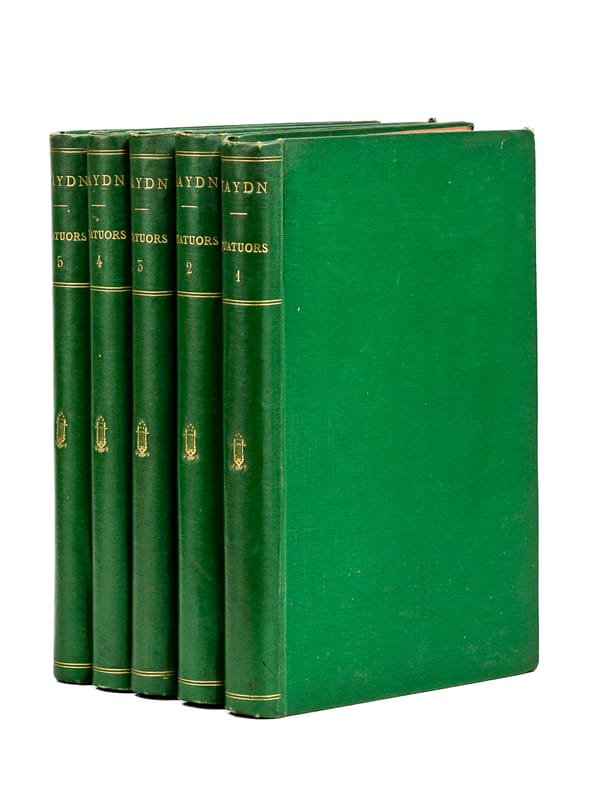
180369076Gravés par Lobry, 5 vol. in-12 cartonage bradel vert postérieur, collection "Bibliothèque Musicale", Chez Pleyel, Auteur et Editeur, Rue Neuve des Petits Champs n° 1286 ou n° 728, Chez Richault, (tome 7), Paris, s.d. [ 1803, vers 1810-1815 pour Richault pour le tome 7 ], Vol. I : portrait en frontispice, 2 ff., 126 pp., 3 ff., 124 pp. (Opus 76, Quatuors 1, 2, 3, 4, 5, 6); Vol. II : 2 ff., 130 pp., 2 ff., 116 pp. (Opus 20, Quatuors 1, 2, 3, 5, 4 et 6) ; Vol. III : 2 ff., 132 pp., 2 ff., 126 pp. (Opus 50, Quatuors 5, 2, 3, 6, 4, 1); Vol. IV : 1 f., 111 pp., 2 ff., 105 pp. (Opus 33, Quatuors 1, 2, 3, 4, 5, 6); Vol. V : 2 ff., 128 pp., 2 ff., 139 pp. (Opus 71, Quatuors 1, 2, 3 et Opus 74, Quatuor 1, 2, 3)
18354044Turin 1835. <p>Manuscript on paper. 4to binding size 264 x 197 mm. 26 pp. Contents: Fol. 1r title verso blank f. 2r-5v text La Creazione incipit: "Raffaele / Creò dapprima Iddio il ciel la terra; / Ma giaceva la terra informe e vuota" f. 6r half-title for Le quattro Stagioni 6v-13v text Le quattro Stagioni incipit: "Coro di Contadini e Contadine. / Vieni deh Flora vieni / Prezioso don del Ciel." Written in brown ink in an elegant Italian cursive on fine wove paper no visible watermarks. Three blank leaves at front and back the outermost being a wrapper of thicker paper second flyleaf at back adhered to the third the text block stitched into a Piedmontese case binding of gold-embroidered ivory silk over thin pasteboards both covers with outer border of a leafy scrolling vine with floral sprigs composed of gilt or silver-gilt appliqués of leaves blossoms and roundels on stems of couched silver-gilt thread a larger flowering branch at each corner at center of upper cover a large gilt monogram CF within a cartouche of repeated leaf appliqués with at top a closed crown at center of lower cover a large flowering plant of gilt appliqués couched thread sequins etc. turn-ins of upper cover unsewn dampstain within upper left quadrant of upper cover. <br /> <br /> A manuscript of excerpts from the librettos for Haydn's late oratorios the Creation Die Schöpfung first performed 1798 and the Seasons Die Jahreszeiten 1801 translated into Italian from the German of his librettist and patron Gottfried van Swieten 1733-1803. Bound in brightly gilt embroidered silk binding the manuscript was probably produced for a court or private musical event.<br /> <br /> Both librettos had an English origin. The Creation text based on Genesis and Milton's Paradise Lost was taken from a manuscript libretto by an unknown author originally intended for Handel given to Haydn by the English impresario Johann Peter Salomon and brought back by him from England in 1795. The Seasons was loosely based on extracts from James Thomson's poem of the same title 1730 but van Swieten had greater leeway in rearranging the text.<br /> <br /> It was still considered a given in the early nineteenth century that vocal compositions in languages other than Latin and Italian would be translated into the language of the audience. The Creation was first performed in Italian in Milan in 1810 using Giuseppe Carpani's verse translation of van Swieten's libretto first published in Vienna in 1801. The manuscript contains an abridged version of Carpani's text with some variants. The Quattro stagione is also abridged and seems to be based on portions of an anonymous translation first published in Dresden in 1802 and used for the oratorio's first performances in Italian in 1811 in Milan and Bologna cf. editions of Milan: Mussi 1811 and Bologna: Ramponi 1811.<br /> <br /> The manuscript was exhibited in Turin in 1998: cf. Francesco Malaguzzi Legature romantiche piemontese: legature del periodo romantico in raccolte private no. 67 and p. 30. Malaguzzi stated that the manuscript contains "watermarks of the Biella papermakers the brothers Avondo datable to the third decade of the 19th century" but this cataloguer failed to see any watermarks.</p> unknown
18354044Turin 1835. <p>Manuscript on paper. 4to binding size 264 x 197 mm. 26 pp. Contents: Fol. 1r title verso blank f. 2r-5v text La Creazione incipit: "Raffaele / Creò dapprima Iddio il ciel la terra; / Ma giaceva la terra informe e vuota" f. 6r half-title for Le quattro Stagioni 6v-13v text Le quattro Stagioni incipit: "Coro di Contadini e Contadine. / Vieni deh Flora vieni / Prezioso don del Ciel." Written in brown ink in an elegant Italian cursive on fine wove paper no visible watermarks. Three blank leaves at front and back the outermost being a wrapper of thicker paper second flyleaf at back adhered to the third the text block stitched into a Piedmontese case binding of gold-embroidered ivory silk over thin pasteboards both covers with outer border of a leafy scrolling vine with floral sprigs composed of gilt or silver-gilt appliqués of leaves blossoms and roundels on stems of couched silver-gilt thread a larger flowering branch at each corner at center of upper cover a large gilt monogram CF within a cartouche of repeated leaf appliqués with at top a closed crown at center of lower cover a large flowering plant of gilt appliqués couched thread sequins etc. turn-ins of upper cover unsewn dampstain within upper left quadrant of upper cover. <br /><br />A manuscript of excerpts from the librettos for Haydn's late oratorios the Creation Die Schöpfung first performed 1798 and the Seasons Die Jahreszeiten 1801 translated into Italian from the German of his librettist and patron Gottfried van Swieten 1733-1803. Bound in brightly gilt embroidered silk binding the manuscript was probably produced for a court or private musical event.<br /><br />Both librettos had an English origin. The Creation text based on Genesis and Milton's Paradise Lost was taken from a manuscript libretto by an unknown author originally intended for Handel given to Haydn by the English impresario Johann Peter Salomon and brought back by him from England in 1795. The Seasons was loosely based on extracts from James Thomson's poem of the same title 1730 but van Swieten had greater leeway in rearranging the text.<br /><br />It was still considered a given in the early nineteenth century that vocal compositions in languages other than Latin and Italian would be translated into the language of the audience. The Creation was first performed in Italian in Milan in 1810 using Giuseppe Carpani's verse translation of van Swieten's libretto first published in Vienna in 1801. The manuscript contains an abridged version of Carpani's text with some variants. The Quattro stagione is also abridged and seems to be based on portions of an anonymous translation first published in Dresden in 1802 and used for the oratorio's first performances in Italian in 1811 in Milan and Bologna cf. editions of Milan: Mussi 1811 and Bologna: Ramponi 1811.<br /><br />The manuscript was exhibited in Turin in 1998: cf. Francesco Malaguzzi Legature romantiche piemontese: legature del periodo romantico in raccolte private no. 67 and p. 30. Malaguzzi stated that the manuscript contains "watermarks of the Biella papermakers the brothers Avondo datable to the third decade of the 19th century" but this cataloguer failed to see any watermarks.</p> unknown books
180040445Vienne: Artaria et Comp. PN 837 1800. Folio. First violin part in early marbled wrappers with decorative cut-paper title label in manuscript to upper; other parts with thin strips of marbled paper reinforcing spines.<br /> <br /> Violino primo: 1f. recto title verso blank 19 i blank pp. Title within elaborate border engraved by J. E. Mansfeld incorporating a portrait of Haydn at head a muse holding a flute and trumpet and an angel playing a lyre. <br /> Violino 2o.: 17 i blank pp. <br /> Viola: 17 i blank pp.<br /> Violoncello: 17 i blank pp.<br /> Engraved throughout.<br /> <br /> Wrappers quite worn and torn at spine. Slightly worn foxed soiled and stained; old paper repair to inner margins of title and final leaf; margins of two leaves of first violin part trimmed with partial loss of plate number. First Edition with the noted title page incorporating a portrait of the composer. Hoboken 7 647. Hoboken Collection Vol. 7 647. BUC p. 466. RISM H3574. <br /> <br /> "The last of Haydn's six great E-flat quartets 1797 is perhaps - dare one compare on this level - the greatest of them all; in any case it is amongst the greatest of the his great quartets as well as being the very greatest of the 'celebrated' which status it no doubt again owes to its symmetrical themes - the only aspect of the work one is tempted to suggest which is not drastically innovatory. One hardly knows where to start when listing its lasting innovations . but inasmuch as they affect one's performance of the work one can concentrate on them with a quiet conscience." Keller: The Great Haydn Quartets p. 228. Artaria et Comp. [PN 837] unknown
178740113Venezia: Antonio Zatta e Figli 1787. Oblong folio. Sewn. Three parts each with identical title excepting instrument names. Engraved throughout. <br /> <br /> Violino: i title incorporating decorative engraved border with floral motifs and musical instruments including lute recorder trumpet and violin 15 pp. <br /> Viola: i title 14 i blank pp. <br /> Violoncello: i title 12 i blank pp. <br /> <br /> With "Proprietà di Bianconi de Valleta" in contemporary ink to lower outer corner of title to viola part: "Per uso di cancelled" and in another hand to lower outer corner of each title.<br /> <br /> Violin: Title detached soiled foxed and stained with some marginal dampstaining losses to edges and small holes; light dampstaining mainly to upper outer quadrant of first and final leaves; occasional small stains. <br /> Viola: Staining and soiling to title; stain to blank outer upper corner of all leaves; occasional stains and soiling.<br /> Violoncello: Some foxing and small stains mainly to blank margins; final blank leaf stained and soiled. First Edition. Rare. Hoboken 7 966. RISM H3816.<br /> <br /> Originally composed for baryton trio in 1768 during Haydn's period of service to Nikolaus I Prince Esterházy 1714-1790 here cast in a version for violin viola and cello. <br /> <br /> Antonio Zatta fl. late 18th century was an Italian printer and publisher. "He was in business with his sons under the name 'Antonio Zatta e figli Librai e Stampatori veneti' with premises in Venice 'al traghetto di S Barnaba'; theirs was the largest engraving works in the city their activity dating back to about 1750. . From 1786 the firm began printing on its own press from engraved plates a weekly piece of instrumental music for sale by subscription; in the following years this initiative expanded to include trios duos quartets symphonies or sonatas for various instruments and even vocal pieces issued on a monthly basis. In the letters circulated to 'professori e dilettanti di musica' inviting them to become subscribers the firm explained the preponderance of instrumental music by the fact that Italy 'abounds without doubt more in professional and amateur players than in singers.' Instrumental works by Corelli Bertoni Boccherini Capuzzi Andreozzi Cirri Cambini Pichl Fodor Stabinger Grazioli Haydn Mozart and Salieri and vocal pieces arias by Cimarosa Guglielmi Paisiello Anfossi Naumann Gazzaniga Borghi Traetta and Piccinni were printed and published. Many of Zatta's editions were reprints from German or Viennese publications especially of Hoffmeister's a publisher with whom Zatta had connections. Zatta also published didactic methods Pfeiffer La bambina al cembalo and music theory. After 1788 all editorial activity ceased but Zatta continued to trade in music publications. One of Antonio's daughters Marina married the publisher Sebastiano Valle who continued the work of the Zatta family until about 1806." Mariangela Donà in Grove Music Online. Antonio Zatta e Figli unknown
198265688Schloss Esterhazy. As New. 1982. Paperback. FREE UPGRADE to Courier/Priority Shipping Upon Request IN STOCK AND IMMEDIATELY AVAILABLE FOR SHIPMENT - AS NEW THE TEXT BLOCK IS PRISTINE CLEAN UNMARKED AND IN EXCELLENT CONDITION - - Text in German. 674 pp. With 86 ills. 30 col. . 24 x 21 cm. -- with a bonus offer-- . Schloss Esterhazy paperback
2009835101Collections. New. 2009. Hardcover. 187478017X . FREE UPGRADE to Courier/Priority Shipping Upon Request - IN STOCK AND IMMEDIATELY AVAILABLE FOR SHIPMENT - Flawless copy brand new pristine never opened -- INCLUDES CD-ROM. 452 pages; 690 illustrations. -- with a bonus offer-- . Collections hardcover
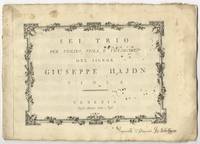
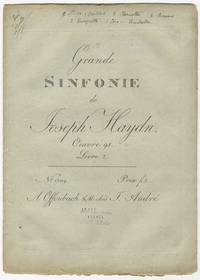
88358Offenbach I. André c. 1786. Folio. Engr. title 2-29 engr. pp.; engr. title 2-9 engr. pp.; engr. title blank 3-7 engr. pp. PN 121. The titles with engr. frames and vignettes. The clavicin part with paper repair on the title and with spotting on p. 3 slight spotting also to title to violoncell part. Sewn in somewhat later marbled paperboards with handwritten label the accompanying parts with contemporary marbled spine paper. Three volumes. RISM H3637 2 copies of which one is incomplete. Hoboken XV:3-5 I p. 683. Not in Sammlung Hoboken. First edition. hardcover
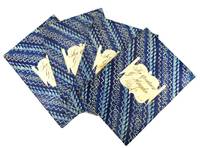
117604Berlin chez J. J. Hummel/ Amsterdam au Grand Magazin de Musique 1779. Folio. Engr. titlepage 2-22 engr. pp.; engr. titlepage blank 3-19 engr. pp.; engr. titlepage blank 3-19 engr. pp.; engr. titlepage 2-19 engr. pp. Platenumber 401. Sewn in very nice contemporary blue marbled stiff paper wrappers with handwritten titles in nicely cut paper labels. Four volumes. Owners signature â€Holterman†on all four title pages. Hoboken Sammlung 553 Hob III:31-36. RISM A/I H3471. Fine copy of the important Hummel edition of the so called â€Sonnenquartette†or â€Sun Quartets†opus 20!. The popular name come from the sun at the top of the engraved title pages to this edition. The quartets were composed between 1770 and 1772 and are considered a milestone in the history of composition. They were first printed by Chévardiere in 1774 without illustrated title pages.This set with its very fine marbled boards are probably from the library of Niclas Holterman 1758-1824 a merchant and amateur musician in Gothenburg in the late 18th century. hardcover
179940334Offenbach s/m: J. André PN 1369 1799. Folio. Unbound.<br /> <br /> Violino primo: 1 title 2-7 pp.<br /> Violino secondo: 1 blank 2-6 pp.<br /> Due viole: 4 pp.<br /> Basso e violoncello: 4 pp.<br /> Flauti: 4 pp.<br /> Oboe primo: 3 pp.<br /> Oboe secondo: 2 pp.<br /> Clarinetto primo: 2 pp.<br /> Clarinetto secondo: 2 pp.<br /> Fagotti: 3 pp.<br /> Clarino primo in D: 2 pp.<br /> Clarino secondo in D: 2 pp.<br /> Corno primo in D: 2 pp.<br /> Corno secondo in D: 2 pp.<br /> Timpani in D: 2 pp.<br /> Engraved throughout.<br /> <br /> Small binder's hole to upper inner margin; early manuscript note regarding instrumentation to upper margin of title with "Comptoir Général de Musique" stamps to lower margin; "Salomon's Concert" printed to foot of first page of music of each part. Early edition of Haydn's "Clock" symphony. Robbins Landon p. 772 10 giving precedence to the Artaria edition of Autumn 1799 as the first "authentic" edition and suggesting that the present edition was most probably derived from the first edition published by Gombart in 1798 or 1799. Hoboken Catalogue 6 266. RISM H3199 and HH 3199 no copies in the U.S. J. André [PN 1369] unknown
0198302444New. Brand new and still unused unknown
B08FCMBSVSNew. Brand new and still unused unknown
B01BNHQY62New. Brand new and still unused unknown
181041428Dublin Ireland: Hime at his Musical Circulating Library No. 34 College Green No 40 College Green 1810. Folio. ff. 25. Sheets: 12 3/4 x 9 inches. Plates: 10 3/4 x 7 1/2 inches. 25 copper-plated engraved pieces of sheet music printed in black. Most sheets hand-foliated in ink. With the ownership signature in ink on the back of songs 9 and 10 written "Susan Buchanan's." 9 of the pieces of sheet music are loose 16 are loosely bound together.<br/> <br/> Provenance: Family of Founding Father Francis Hopkinson<br/> <br/> 25 pieces of sheet music printed in Ireland by Hime at the end of the 18th century from the family collection of Francis Hopkinson America's first composer.<br/> <br/> "American society from about 1805 on was especially enamored of Irish and Scotch tunes particularly the Irish Melodies of Thomas Moore and other national music." - Richard J. Wolfe Early American Music Engraving and Printing Founding Father Francis Hopkinson 1737-1791 was a signatory for New Jersey to the Declaration of Independence and the first American to compose a song which he attested to himself: "I cannot I believe be refused the Credit of being the first Native of the United States who has produced a Musical Composition." Hopkinson published three of the earliest American song collections: Collection of Plain Tunes with a Few from Anthems and Hymns printed by Carr in 1763; America Independent or Temple of Minerva the first American opera printed by Carr in 1781; and Seven Songs for the Harpsichord or Forte Piano printed by T. Dobson in 1788. All sheets were printed by Hime. Hime was an English and Irish music publishing firm run by two brothers Humphrey and Morris. Hime began in Liverpool but moved to Dublin in 1790. The firm continued printing until the 1870s as Hime & Son. The Himes did the largest provincial trade in Britain at the end of the 18th century because English copyright law did not apply to Irish publishers so Hime could flood the English market with bootleg copies of popular songs. The song titles are: 1. "TEARS THAT EXHALE: An admired SONG in the PRISONER Composed by Mr. Attwood." 2. "I'D THINK on THEE MY LOVE. A Favorite NEW SEA SONG Composed by Mr. HOOK." 3. "HENRY's COTTAGEMAID." 4. "AS WRAPT IN SLEEP I LAY: A favorite Song sung by Mrs CROUCH in the Opera of The PIRATES Composed by STEPN STORACE." 5. "WINDS SOFTLY TELL MY LOVE: As Sung by Mrs MOUNTAIN in the Opera of the FARMER with uncommon Applause." 6. "THE MANSION OF PEACE: A Much Admired SONG Composed by Mr. WEBBE." 7. "THE NEW MANSION OF PEACE: A Favorite NEW SONG Composed by Mr. MOULDS." 8. "DEAR MARY TO THEE: A much Admired NEW Song Composed by Mr. HOOK." 9. "DEAR IMAGE OF THE MAID I LOVE: Composed by SIGr. GIORDANI." 10. "WHILST WITH VILLAGE MAIDS: A favorite Song in the Opera of ROSINA Sung by Mrs BILLINGTON." 11. "COME BLUSHING ROSE: Composed by Pleyel." 12. "EVENING: A Favorite BALLAD Composed by HAYDN: The WORDS by DOCr. JOHNSON." 13. "EDWIN AND ELLA: Composed by MR. HOOK." 14. "GO HAPPYGALES: A favorite SONNETT translated from PETRACH by Mr HOOK." 15. "ENCOMPASSED IN AN ANGELS FRAME: A much Admired Song." 16. "THE SHIPWRECK'D BOY. A Favorite NEW Song Written by Geo. Saville Carey." 17. "THERE THE SILVER'D WATERS ROAM: An admired Song in the PIRATES. Sung by Mr Sedgwick. composed by Sigr. STORACE." 18. "Charming Delia: A Favorite BALLAD Composed by Mr. PLEYEL." 19. "DIRE IS HIS GRIEF: An Admired Song in the new Historical Romance of the CRUSADE sung by Mr Incldeon." 20. "NOW THE WOODLAND CHORISTS SING: A Favorite PASTORAL BALLAD composed by J PLEYEL." 21. "O!EVER IN MY BOSOM LIVE: A favorite Duett in OSCAR and MALVINA sung by Mrs Mountain and Miss Keys." 22. "DEAR IS MY LITTLE NATIVE VALE: A favorite NEW Ballad." 23. "YOUNG JOCKEY TRIPT IT O'ER THE MEAD: An Admired BALLAD Composed by SIGr PLEYEL." 24. "BLOW HIGH BLOW LOW: A favorite SONG." 25. "WHEN FAIR SUSAN I LEFT: A much Admired SEA SONG." These scores were part of a Sammelband acquired at the Francis Hopkinson Family Americana Collection sale in June 2020.<br/> <br/> Wolfe Early American Music Engraving and Printing 1980. Hime at his Musical Circulating Library No. 34 College Green, No 40 College Green unknown
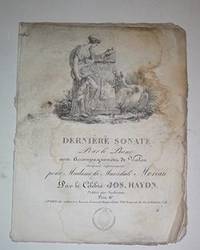
16-3934Paris: Chez Naderman circa 1820. 13 pages. 35.5 x 27 cm. Printed on laid rag paper Stained througout. Facsimile of letter from Haydn to Louise-Alexandrine-Eugénie Moreau the French-Creole wife of the famous general Jean Victor Moreau dated 1803.Dernière sonate pour le piano forte avec accompaniment de violonÀ Paris : publiée par Naderman circa 1820Expertise by Thierry BODIN - 01 45 48 25 31Syndicat Français des experts Professionnels en Oeuvre d'ArtStanford University Libraries Memorial Library of Music MLM 498:In advance of a visit to Paris in 1803 Prince Esterházy asked Haydn to compose a new piano sonata as a gift for Louise-Alexandrine-Eugénie Moreau the French-Creole wife of the famous general Jean Victor Moreau and hostess of an influential Paris salon. Haydn pleading illness sent instead a copy of the sonata for piano with violin and 'cello accompaniment HXV:31 minus the somewhat superfluous ‘cello part. In an accompanying letter to Madame Moreau Haydn apologizes for not composing something new due to his failing health and promises to fulfill his duties once he regains his strength.This two-movement work in the unusual key of E flat minor was originally composed for piano violin and ‘cello. Haydn wrote it soon after his return to Vienna from London in 1795 and in 1805 it was published for three instruments by several publishing houses. The autograph manuscript is in the Zweig Collection at the British Library. Dated 1795 Haydn wrote at the top of the second movement: “Jacobs Dream by Dr. Haydn 794†which indicates that the second movement was likely composed first.The piano part contains a good amount of virtuosic writing and like other keyboard works of the time seeks to exploit the expressive possibilities inherent in the new English grand pianos of which Haydn was enamored. The violin part also presents technical challenges. “Jacob’s Dream†alludes to the bible story in which Jacob dreams of a stairway to heaven effortlessly trafficked by angels. The work was apparently so named to tease a certain violinist intending to perform the piece whose technique often failed him but whose hubris did not when attempting to play in the upper registers. Haydn always the joker!The work was published postumously as a piano sonata with violin accompaniment by Nadermann in Paris 1820 and in partnership with Clementi in London 1821. The title page of the London edition which is in the Memorial Library of Music features a neoclassical lithograph of the muse Erato with her lyre accompanied by a swan placing a myrtle wreath on Haydn’s grave marker. Aslo included is Haydn's letter to Madame Moreau reproduced in facsimile. Paris: Chez Naderman, circa 1820 unknown