156 résultats
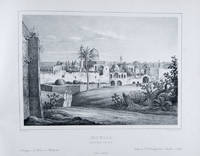
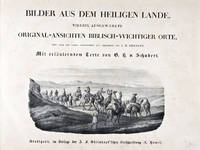
183931686Stuttgart: J.F. Steinkopf'sche Buchhandlung L. Hänel 1839. First edition. Hardcover. g. Oblong folio. Unpaginated. 3/4 cloth over marbled paper covered boards. Vignette on title page. Remarkable work on the land of the Bible exquisitely illustrated with a large fold-out panorama of Mount Sinai and 40 fine lithographs of biblical landscapes and monuments drawn from nature by J. M. Gernatz . Each plate is protected with a colored tissue guard and measures 9" x 12.5" image: 6.5" x 9". Moderate shelf wear. Tiny abrasion and minor scratches on covers. Previous owner's stamp on inside of title page. Moderate and sporadic foxing throughout. Text in German. Binding and interior in overall good condition. J.F. Steinkopf'sche Buchhandlung (L. Hänel) hardcover
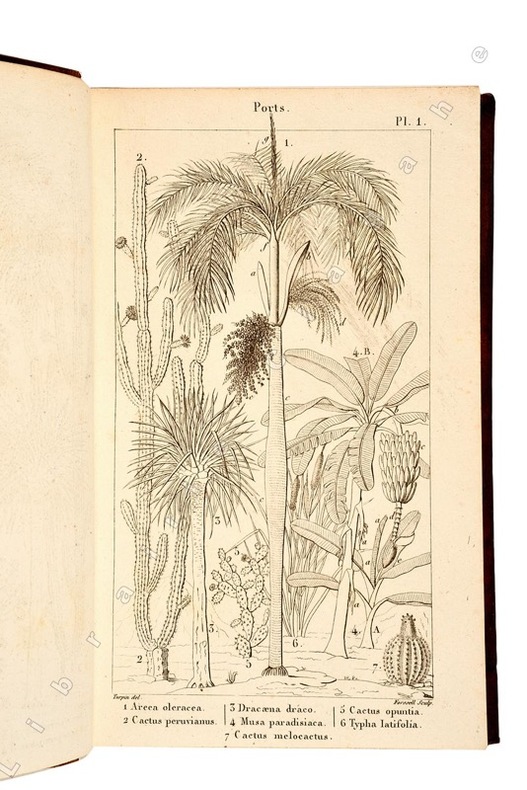
181521229Paris, Magimel (imp. Firmin Didot), 1815 ; 3 tomes (2 de texte et un recueil de planches) in-8, veau fauve raciné, dos lisse à faux nerfs dorés, jeux de croisillons et fleurons dorés, pièces vert empire, roulettes d’encadrement des plats et filet sur les coupes, tranches mouchetées (reliure de l’époque) ; [10], VIII, [2], 470 ; [6], pp. 471-924, [104], LII pp. ; 73 planches gravées y compris la page de titre et les tableaux chromatiques aquarellés dépliants, gravés par Forssell d’après Turpin, Brisseau-Mirbel, Schubert et Poiteau.
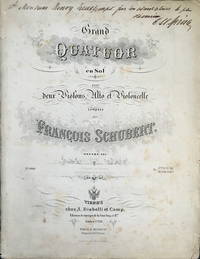
185213826Vienne: Diabelli 1852. First edition . Used; Like New/Used; Like New. Complete parts to Schubert's Quartet no. 15 op. 161 signed and inscribed on the Violino Primo title page by Diabelli publisher Carl Anton Spina to the important Belgian violinist Henri Vieuxtemps: "A monsieur Henry Vieuxtemps par son admirateur le plus dévoué - C.A. Spina." Four parts: 23; 19; 19; 19 pp. Engraved. PN 9099. Scattered foxing throughout small tears and chips around the edges/spine of first violin part overall very good. <br style=""><br style="">Schubert wrote his truly monumental quartet no. 15 in only ten days in 1826 and with it paved the way for his large-scale symphonic works. The piece was not performed in public in his lifetime and was first published posthumously in 1852 by Diabelli.<br style="">Anton Spina 1790-1857 started to work with the publisher A. Diabelli in 1824. He handled the commercial part whereas Diabelli cared for the artistic part of the company. In 1850 Carl Anton Spina 1827-1906 son of Anton became part of the firm as a third associate and soon led the company on his own after the retirement of his father and Diabelli in 1851. <br style=""><br style="">Vieuxtemps was one of the most important musicians of the 19th century. As one of the greatest of all violin virtuosos he was compared to Paganini by both Schumann and Berlioz. As a composer he was an important reformer of the concerto and in this regard according to Grove "can be compared to Liszt." At the time of the present publication and inscription the instrumental music of Schubert was largely untried on European concert stages. Vieuxtemps was an important early performer of some of the Schubert quartets in particular performing them in London and elsewhere. <br style=""> Diabelli unknown books
1849B3802Brussels: Dero-Becker c. 1849. A handsome copy boards slightly worn otherwise a very good copy with clean and crisp text and plates. Lacks 1 leaf of text pp.1-2. Binding: Recent half calf with contemporary red pebble paper boards spine with seven compartments of decorated raised bands and decorative gilt motifs gilt text on two original marbled endpapers. Size: Folio Illustration: With 16 large scale sepia-toned lithographs depicting the artistic and literary festival of Brussels in 1848. Also illustrated with a number of in-text woodcuts.<br>Title within red geometrical decorative design printed in blue and red.<br> Pages: P. coloured title leaf sepia title leaf dedication leaves 2 ff. 3-6 pp. 16 lithographic plates subscribers’ leaf prospectus 4to 1-4 pp. 2 ff. Category: Book Royalty;Book Plate Books General;Book Europe Benelux; Dero-Becker hardcover
183720190Wien, K. K. Österreichischer Generalquartiermeisterstab, 1837. Lithographierte Karte bestehend aus 16 auf Leinwand aufgezogenen gefalteten Blättern und einem Übersichtblatt (jeweils in Segmente unterteilt). Gesamtgröße: Ca. 180 cm x 165 cm. In Pp.-Schuber der Zeit (bestoßen und beschabt, Innenlasche defekt). [5 Warenabbildungen]
184018873Stuttgart: J. F. Steinkopf 1840. Fourth edition Ausgabe No. 4. Softcover. g to vg. Four volumes oblong quarto. Unpaginated. 18 21 20 23 leaves. Original printed wrappers. Volumes housed in a modern custom-made red cloth clamshell box with gold lettering on spine. Striking collection of 40 tissue-guarded engravings depicting views of important places mentioned in scripture and drawn from nature by Johann Martin Gernatz. Each plate measures appr. 6 1/2 x 9 2/8" and is accompanied with an original text by Gotthilf Heinrich von Schubert. Due to a printer's error the last plate mentioned in the first volume Berg Tabor is instead in the second volume. All plates are present including the large 3-page fold-out panoramic view of Mount Sinai. Sporadic rubbing and minor creasing along edges of wrappers. Some closed tears to spines. Minor and sporadic foxing throughout. Fold-out detached but present. Text in German. Clamshell box in overall very good wrappers in fair to good interior in good to good plates in very good condition. Gotthilf Heinrich von Schubert 1780-1860 was a "German physician and naturalist who began his studies with theology but turned to medicine and established himself as a doctor in Altenburg Saxe-Gotha-Altenburg. He soon gave up his practice however and devoted himself to research in Dresden. He gave renowned lectures on fringe science animal magnetism clairvoyance and dream and in 1819 he occupied the chair in natural history in Erlangen where he studied botany forestry mineralogy and geognosy. In 1827 he moved for the last time to Munich where he was appointed professor; it was here that the highly popular and friendly Schubert found an embittered opponent in Lorenz Oken. Schubert aimed to create a religiously-grounded interpretation of the cosmos. His masterpiece "Symbolism of Dreams" 1814 was one of the most famous books of its time exercising influence over E. T. A. Hoffmann and even Sigmund Freud and C. G. Jung. Schubert advocated an ecumenical "awakened Christianity" which found evidence for God both in Nature and in the human soul. Synthesising the Bible with the philosophy of Schelling he was a major figure in the "later Enlightenment". In his "History of the Soul" 1830 Schubert again attempted to fuse the philosophy of Herder and Schelling with the Christian tradition." From Wikipedia. J. F. Steinkopf unknown