Beethoven, Ludwig vanBiblio.com
3 080 résultats
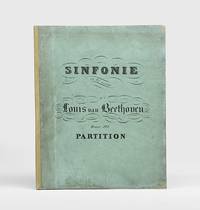
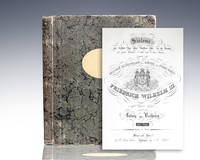
1826146837Mainz and Paris: B. Schotts Sohnen 1826. Exceptionally rare first edition first issue of one of the most frequently performed symphonies in the world containing the subscribers' list but not the composer's notorious metronome markings which were added in later issues. Quarto bound in nineteenth-century marbled boards with a blank label to the front panel all edges yellow printed with plate number 2322 subscribers' list present illustrated with a lithographic title page and engraved with music throughout. Inscribed by William Waterhouse on the front free endpaper "from Robert Hermann London." William Waterhouse was an English bassoonist and musicologist who played with notable orchestras in the twentieth century and recorded all the wind chamber music by Beethoven with the Melos Ensemble. In near fine condition with some rubbing to the extremities and traces of the original pale blue wrappers to outer pages no plate number to page 191 and blank final leaf missing. An excellent example with remarkably deep clean impressions. One of the great monuments of western civilization The Ninth Symphony was composed between 1822 and 1824 and performed in Vienna on 7 May 1824 at the Karntnertortheater. It was the first major symphony to include a choral finale and set the model for future large-scale choral symphonies. Published two years after its initial performance this score remains a constant fixture in the music world. B. Schotts Sohnen hardcover
18267053Mainz & Paris: B. Schotts Söhnen & Antwerp A. Schott 1826. First edition. Very Good. First edition of the full orchestral score for the Ninth Symphony first trade issue published 28 August 1826 without the list of names found in prepublication copies for subscribers and without the metronome markings added to copies from December onwards. Folio. Lithographic title page incorporating arms of Prussia 226 engraved plates. Without the two-page list of subscribers; plates numbered 2322 often corrected from 2321; plate number present on p. 172 and absent on p. 191; "Partition" printed on front wrapper. Original light blue wrappers printed in black rebacked and relined edges untrimmed. Housed in a custom green cloth solander box. Pencilled inscription "Coll. Jan. 1974" at head of title page. Wrappers a little rubbed and marked extremities restored first and last page of contents toned sporadic foxing. A Very Good copy.<br /> <br /> Beethoven's final complete symphony redefined the genre breaking new ground by incorporating vocal soloists and a chorus in its final movement. It was a model for Berlioz Bruckner Mahler Brahms and Wagner. He composed the symphony between spring 1823 and February 1824. Towards the end of the process he decided to incorporate Friedrich Schiller's "An die Freude" into the final movement - a poem that he had attempted to put into music since the early 1790s. The symphony premiered at the Theater am Kärntnertor Vienna on May 7 1824 marking a triumphant public return for Beethoven who had not appeared on stage in over a decade. At either the end of the scherzo or the symphony - accounts vary - Beethoven then almost completely deaf and unaware of the audience's reaction had to be gently turned around by the contralto Caroline Unger so he could see the enthusiastic applause. He died in March the following year.<br /> <br /> Fuld p. 563; Hirsch 395; Hoboken 502; Kinsky 813-832. Very Good. B. Schotts Söhnen & Antwerp, A. Schott unknown
180895829London: Lavenu Cianchettini & Sperati 1808-1810. First editions of the first printings of the full orchestral scores of the complete symphonies of Beethoven Mozart and Hadyn. Quarto two volumes bound in three quarters morocco over marbled boards wit gilt titles and tooling to the spine including A Complete Collection of Haydn Mozart and Beethoven's Symphonies Cianchettini and Sperati and A Complete Collection of <span class="match">Mozart</span> and Beethoven's <span class="match">Symphonies. </span>A Compleat Collection of Haydn Mozart and Beethoven's Symphonies contains the first appearance of the full scores of <span class="match">Mozart</span>'s Overture to the Marriage of Figaro <span class="match">Mozart</span>'s Symphony no. 40 and no. 41. Fuld The Book of World-Famous Music 564-567. A Complete Collection of <span class="match">Mozart</span> and Beethoven's <span class="match">Symphonies Lavenu contains the first appearance of the </span>full scores of <span class="match">Mozart</span>'s Symphony no. 39 no 13 and no. 38. In very good condition with light toning to the text. An exceptional collection of the utmost rarity. 1786 saw the successful premiere of Mozart's The Marriage of Figaro in Vienna. Its reception in Prague later in the year was even warmer and this led to a second collaboration with Da Ponte: the opera Don Giovanni which premiered in October 1787 to acclaim in Prague but less success in Vienna in 1788. The two are among Mozart's most important works and are mainstays of the operatic repertoire today. In 1787 the young Ludwig van Beethoven spent several weeks in Vienna hoping to study with Mozart. No reliable records survive to indicate whether the two composers ever met. Beethoven would go on to become a crucial figure in the transition between the Classical and Romantic eras in classical music he remains one of the most recognized and influential of all composers with his best-known compositions including 9 symphonies; 5 piano concertos; 1 violin concerto; 32 piano sonatas; 16 string quartets; a mass the Missa solemnis; and an opera Fidelio. Lavenu, Cianchettini & Sperati hardcover books
180895829London: Lavenu Cianchettini & Sperati 1808-1810. First editions of the first printings of the full orchestral scores of the complete symphonies of Beethoven Mozart and Hadyn. Quarto two volumes bound in three quarters morocco over marbled boards wit gilt titles and tooling to the spine including A Complete Collection of Haydn Mozart and Beethoven's Symphonies Cianchettini and Sperati and A Complete Collection of Mozart and Beethoven's Symphonies. A Compleat Collection of Haydn Mozart and Beethoven's Symphonies contains the first appearance of the full scores of Mozart's Overture to the Marriage of Figaro Mozart's Symphony no. 40 and no. 41. Fuld The Book of World-Famous Music 564-567. A Complete Collection of Mozart and Beethoven's Symphonies Lavenu contains the first appearance of the full scores of Mozart's Symphony no. 39 no 13 and no. 38. In very good condition with light toning to the text. An exceptional collection of the utmost rarity. 1786 saw the successful premiere of Mozart's The Marriage of Figaro in Vienna. Its reception in Prague later in the year was even warmer and this led to a second collaboration with Da Ponte: the opera Don Giovanni which premiered in October 1787 to acclaim in Prague but less success in Vienna in 1788. The two are among Mozart's most important works and are mainstays of the operatic repertoire today. In 1787 the young Ludwig van Beethoven spent several weeks in Vienna hoping to study with Mozart. No reliable records survive to indicate whether the two composers ever met. Beethoven would go on to become a crucial figure in the transition between the Classical and Romantic eras in classical music he remains one of the most recognized and influential of all composers with his best-known compositions including 9 symphonies; 5 piano concertos; 1 violin concerto; 32 piano sonatas; 16 string quartets; a mass the Missa solemnis; and an opera Fidelio. Lavenu, Cianchettini & Sperati hardcover
200912584AB2009. Leipzig 2009. 52 : 62 cm. Printed on hand made paper Portrait of Ludwig van Beethoven in heliography. Brilliant print from the old cooper-plates on hand-made paper. It shows the head of Ludwig van Beethoven surrounded by notes. unknown
190761279[Wien, Wiener Werkstätte, 1907]. 4°. Mit einem Holzschnitt-Titel u. 11 Orig.-Farbholzschnitten auf Japanbütten (alles unter Passepartout). Lose in Orig.-Kassette m. Tunkpapierbezug, goldgepr. Deckelvignette u. Kantenvergoldung (Innendeckel m. dem goldgepr. Stempel der Wiener Werkstätte sowie den goldgepr. Monogrammen von Josef Hoffmann [Entwurf] u. des Buchbinders C. Beitel).
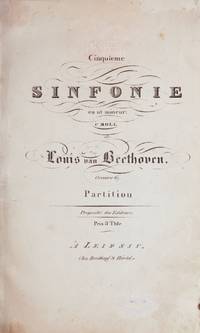
182640812Leipsic: Breitkopf & Härtel PN 4302 1826. Octavo. Contemporary marbled boards with dark blue paper title label to spine gilt. 1f. recto lithographic title verso blank 182 pp. Music engraved. <br /> <br /> With handstamp "Musikverein" to head of p. 85 and foot of final page. <br /> <br /> Early cancellation in black ink of two measures on p. 108 with notes to blank lower margin these two measures movement III between 237/8 were established as being superfluous by Mendelssohn in 1846. Del Mar Critical Report p. 30 Source E.<br /> <br /> Binding very slightly worn. Minor wear; occasional small stains and minor soiling; handstamps removed from blank upper and lower margins of title with repairs to blank verso; blank lower outer corner of first leaf reinforced. First Edition. LvBWV I p. 370. Hirsch IV 308. Hoboken 2 302. Fuld 5 p. 557. Weinhold-Dörfmuller p. 218. <br /> <br /> The Fifth Symphony is possibly the most recognizable of all of Beethoven's symphonies. It holds universal appeal and is one of the most popular works in the whole of symphonic literature. <br /> <br /> "Soon after the 'Eroica' Symphony the Fifth Symphony was conceived but somehow work got deflected into certain other C major and minor projects and things did not come together until late 1807 and 1808. More than any other piece of music the Fifth Symphony has come to typify the thematic unification or 'organicism' as the 19th century viewed it that Beethoven developed to such a high degree in these years. The famous opening motif is to be heard in almost every bar of the first movement - and allowing for modifications in the other movements." Joseph Kerman Alan Tyson Scott G. Burnham Douglas Johnson and William Drabkin in Grove Music Online<br /> <br /> "After some initial resistance to its unheralded rhythmic concentration economy of thematic material startling innovations - the little oboe cadenza in the first movement the addition of piccolo and double bassoon to the winds the "spectral" effects of the double basses in the scherzo and trio the trombones in the finale the return of the scherzo in the finale - the Fifth Symphony came to be regarded as the quintessential Beethoven symphony revealing new layers of meaning to each successive generation. . Twentieth-century criticism has tended to see the Fifth as "the consummate example of symphonic logic" as the ultimate expression of Classic rationality refusing to yield to the violent tremors of impending Romanticism. Audiences have learned to identify the work with public virtues the opening motif was a symbol of resistance to fascism during World War II." Solomon: Beethoven p. 205. Breitkopf & Härtel [PN 4302] unknown
18441165Paris, Jules Labitte, 1844 ; 2 vol. in-8 de [3] ff., 422 pp. ; [2] ff., 370 pp., 1 f. bl., reliures de l’époque maroquin à long grain cerise, double encadrement de filets dorés sur les plats, fleurons dans les angles, dos lisses ornés en long, roulette intérieure, tranches dorées.
181740817Wien: S. A. Steiner und Comp. PN S. et C. 2661 1817. Oblong folio. Modern quarter mid-tan morocco with marbled boards printed paper title label to upper. 1f. recto decorative series title engraved by A. Müller verso blank 1f. recto title verso blank i blank 2-19 i blank pp. Engraved throughout.<br /> <br /> Series title "Musée Musical Des Clavicinistes !Clavécinistes. Museum für Klavier-Musik. 1tes Heft. Wien bei S. A. Steiner und Comp." within decorative border.<br /> <br /> Indistinct contemporary annotation in manuscript to blank outer margin ".18/2. 54."<br /> <br /> Minor foxing primarily to blank lower and outer margins; small tear to blank lower margin of p. 2.<br /> <br /> An attractive wide-margined copy with strong impression on heavy quality paper. First Edition later issue with "im Verlag bei S. A. Steiner und Comp." in imprint rather than "bei S. A. Steiner und Comp." Without printed price and with a list of agents below imprint to title and without advertisement preceding first page of music. Rare. LvBWV I p. 640 later issue no. 2. Weinhold-Dorfmüller p. 225 and plate 8b. Hoboken 2 120. Hirsch IV 361. The first issue is distinguished by the printed "Musikalische Anzeige" to the recto of the first leaf of music.<br /> <br /> "Op. 101 is among the most difficult of the sonatas and Beethoven himself once described it as 'hard to play'. The challenge of this work lies not only in the complex polyphony of the march and finale but in the delicate narrative sequence of the whole. Twice we pass from spheres of dream-like reflection into the vigorous musical landscapes of the march and finale. . Few of Beethoven's pieces exerted such a strong spell on the Romantic composers as this A major Sonata. Mendelssohn imitated it in his op. 6 Sonata; Wagner found in its opening movement the ideal of his 'infinite melody;' Schumann was captivated by its march-like second movement. Along with the cello sonatas op. 102 and the song cycle An die ferne Geliebte the A major Sonata marks a major transition in Beethoven's style pointing unmistakably to the unique synthesis achieved in words of his last decade." Kinderman: Beethoven p. 197.<br /> <br /> ". spiritually Op. 27 and Op. 101 are as far apart as they are in years. In the later work all is expression nothing mere display or technical contrivance. There are difficulties demanding brilliant playing to be sure and the writing has the ingenuity of the completely self-possessed master; but it is due precisely to this self-possession that Beethoven is now able to concentrate his whole creative mind on emotional expression in the most poetical terms of which music is capable. The means by which this is attained through manipulation of the composer's craft and put into logical shape by his instinctive knowledge of how to handle and adjust form came to him quite naturally by this time provided that he was seized by the fever of irresistible inspiration as in this glorious work." Blom: Beethoven's Pianoforte Sonatas Discussed p. 195. S. A. Steiner und Comp. [PN S. et C. 2661] unknown
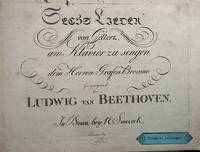
18033070In Bonn: bey N. Simrock 1803. Early Simrock edition. Title page without price plate number and the words “Zugeeignet von†in handwriting. In contemporary cardboard covered with marbled paper. Morocco title vignette on front panel. Friederike Friedmann’s ownership vignette on title page. Binding rubbed. Erroneous list of contents in contemporary hand probably Friedmann’s in ink on first free endpaper. Clusters of tiny brown spots on the title page occasional light stains throughout. Overall in very good condition. Early Simrock edition. Title page without price plate number and the words “Zugeeignet von†in handwriting. In contemporary cardboard covered with marbled paper. Morocco title vignette on front panel. 16 p. An early Simrock edition first by Artaria in the same year of Beethoven’s six settings for Christian Fürtegott Gellert poems. <br /> Friederike Friedmann’s copy. Friedmann was an early German translator of Longfellow Tennyson Byron and Scott. bey N. Simrock unknown
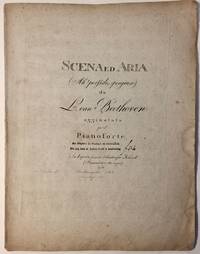
18051763In Lipsia Leipzig: presso Ambrogio Kühnel Bureau de Musique PN 401 1805. Title-edition Titelauflage a reissue of the plates of the first edition. Engraved music. Price above imprint on the title page in ink: fl. 4. Vignette mounted above imprint on the title page “Au Magasin de Musique en commission. No. 104 dans le Kalver-straat à Amsterdamâ€. Unbound as published. Light water stain at side margin foxing throughout otherwise in fine condition. Title-edition Titelauflage a reissue of the plates of the first edition. Engraved music. Price above imprint on the title page in ink: fl. 4. Vignette mounted above imprint on the title page “Au Magasin de Musique en commission. No. 104 dans le Kalver-straat à Amsterdamâ€. Unbound as published. 11 1 p. <p><br /> Reissue of the first edition of Ah! perfido one of Beethoven’s finest concert arias with a different title page.<br /> <p><p><br /> Ah! perfido is a concert aria for soprano and orchestra by Ludwig van Beethoven 1770–1827. The piece was written in the first months of 1796 and first performed on 21 November of the same year in Leipzig however it was not printed until nine years later in 1805 by the Leipzig Bureau de Musique Hoffmeister & Kühnel as a piano reduction with the soprano vocal part. The present score is a reissue of the plates of the original first edition by the legal successor of the publisher Ambrosius Kühnel printed most likely in 1806 see Hill p.121. <br /> <p><p><br /> Scarce no auction records on Rare Book Hub Americana Exchange and the original first edition is recorded only once Sotheby’s 2009. We could trace one copy in institutional holdings at the Beethoven-Haus in Bonn C 65 / 9; 5719.<br /> <p><p><br /> Ref. of the first edition: Kinsky p.155; Hoboken 294 <br /> <p><p><br /> Bibl.: Herttrich E.: Preface. In: Beethoven L. v: “Ah! perfido†für Sopran un Orchester. Opus 65. Klavierauszug. München: Henle 2010.; Hill R. S.: The Plate Numbers of C. F. Peters' Predecessors.†In: Papers Read by Members of the American Musicological Society at the Annual Meeting 1938 pp. 113–134.<br /> <p>. presso Ambrogio Kühnel (Bureau de Musique) [PN 401] unknown
1816276Vienna Wien Austria: S. A. Steiner und Comp 1816. First edition first printing first state. 1/4 cloth over marbled paper covered boards. Good. VERY RARE 1ST EDITION 1ST PRINTING UNRECORDED STATE OF BEETHOVEN'S 7TH SYMPHONY IN A MAJOR OPERA 92 PIANO 4-HANDS ARRANGEMENT - PUBLISHED CONCURRENTLY WITH THE FULL SCORE.<br /> <br /> RARITY<br /> This edition has only come to recorded auction one time that I can trace Sotheby's 1962. The full score scarcely comes to auction and typically sells between $8000 - $10000 meaning it would retail for 50% higher or more. I cannot find a true first edition copy of the full score of the 7th symphony nor any first edition arrangement currently for sale. WorldCat identifies only five institutions as having a first edition copy of the 4-hand single-piano duet arrangement including the British Museum Oxford and Harvard.<br /> <br /> Condition: Good<br /> <br /> BOOK INFO<br /> <br /> Published in 1816 by S.A. Steiner in Vienna Austria. Bound in contemporary 1/4 cloth over marble paper covered boards with cloth covered corners. All edges speckled. Paper label adhered to front cover hand-titled in pen. First edition first printing meeting all points as outlined by Kinsky-Halm 1955 p. 260:<br /> <br /> 1. Oblong folio format<br /> 2. Title Page showing Steiner imprint in Vienna<br /> 3. Title page lists correct distributors in Leipzig etc.<br /> 4. Dedication from Beethoven to Elisabeth Alexiewna<br /> 5. Plate inscription states C.D.A.S. 2566 referring to Chemical Printing House<br /> 6. Arranger is A. Diabelli engraver is A. Mueller.<br /> <br /> Oblong folio 13.25" x 10.25." Collation: 4 blank p. 1 2-79 1 pages. Page 1 is blank an error by the printer as it normally contains a music advertisement per Kinsky indicating this copy is an unrecorded state in bibliographic descriptions. It is unknown if this state would precede the copies with the advertisement on page 1. <br /> <br /> CONDITION REPORT<br /> <br /> The arrangement is in Good condition. Soiled and darkened cloth. Firm binding tight pages. Rubbed extremities bumped corners. Foxing and toned pages. Quite a bit of insect nibbling to bottom margin of multiple pages not affecting the musical notes or text heaviest to first two leaves. Signs of handling like some marginal paper creases bent corners a few stains. Former owner name inscription in a modern hand on FFEP and in a contemporary hand at bottom of title page. Small staple holes along gutter margin from where the pages were removed from the original wraps and rebound.<br /> <br /> BACKGROUND<br /> <br /> Beethoven composed his Seventh Symphony between 1811-1812. The first performance of the symphony occurred on December 8 1813 in the University Hall in Vienna. Beethoven was living in Vienna at the time. The full score consists of 224 engraved pages of musical notes. Long-time Beethoven publishing collaborator S.A. Steiner and Company bought the publishing rights from Beethoven in 1815 and published the full score along with multiple arrangements simultaneously in 1816 under the supervision and approval of Beethoven. An announcement by Steiner in 1816 stated "The work is being released simultaneously in arrangements for every conceivable format." Kinsky. <br /> <br /> PIANO FOUR HANDS ARRANGEMENTS<br /> <br /> This is a piano duet where two pianists play together on a single piano simultaneously using all four hands to navigate the keyboard. It was particularly popular in the 19th century because it allowed family members and friends to collaboratively play composed works or arrangements on the home piano. This format balances technical skill with the timing of melodic interplay. I encourage one to look up on YoutTube "Beethoven: 7th symphony 1st movement for 4 hands" to get an idea of how this arrangement would look and sound.<br /> <br /> All in all this is an exceptionally rare first edition first printing of a masterful Beethoven arrangement for his 7th symphony op. 92 for piano. It is also the only example I can find of an unidentified state in which the printer did not print the musical advertisement on page 1 leaving it blank instead. <br /> <br /> . S. A. Steiner und Comp unknown
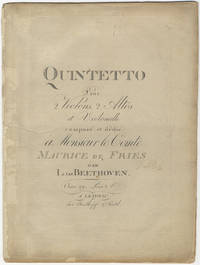
180226775Leipsic: Breitkopf & Härtel PN 94 1802. Folio. Unbound as issued. Preserved in a modern full dark green cloth folder with black leather label gilt to spine. 1 title 2-13; 9; 8; 8; 8 pp. Engraved. Early signature to title. <br/><br/>Slightly browned throughout; repairs to spine of first violin part with slight paper loss. First Edition. Rare. LvBWV v.1 p. 173. Hirsch IV 267. Dorfmüller-Weinhold p. 211. Hoboken 2 153. <br/><br/>"Between the Op. 18 Quartets and those of Op. 59 lie about six or seven years and the 'Eroica.' A whole world in Beethoven's terms. The bridge between the two worlds is built of works other than quartets and the only piece of chamber music for strings belonging to this interim stage is the splendid Quintet in C Op. 29 with two violas which lies nearer to the first than to the second period. This work which may be in some ways regarded as a crown to Op. 18 is still shamefully neglected. As a whole it has greater breadth and economy of line than even the F major Quartet Op. 18 No. 1. Although there is a sufficiency of accomplished five-part writing and one gets the strong impression for much of the time that the quintet is. an enriched quartet Beethoven contrives also to create from time to time an almost orchestral richness and weight especially in the vividly resourceful 'storm finale." Arnold and Fortune eds.: The Beethoven Reader p. 251. Breitkopf & Härtel [PN 94] unknown books
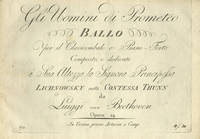
180122960Vienna: Artaria e Comp. PN 872 1801. Oblong folio. Contemporary stiff blue wrappers. 1f. recto title verso blank 1 blank 2-56 pp. Engraved. Printed price: "3 fr. 30" corrected in ink in "4 fr 20." Early owner's signature to upper wrapper in ink: "Wilhelmine Maurer." <br/><br/>Two leaves trimmed at lower margin with no loss to music.<br/><br/>A very good copy with a strong impression on quality paper. First Edition first issue. The full score was not published until 1864. LvBWV v. 1 p. 235. Hoboken 2 215 and plate 8. <br/><br/>First performed in Vienna at the Burgtheater on March 28 1801 to a libretto by the noted Italian choreographer and dancer Salvatore Viganò 1769-1821.<br/><br/>"Die Geschöpfe des Prometheus The Creatures of Prometheus was an important work for Beethoven in two respects. It was the first major stage work by a composer hitherto known for his chamber music a symphony and two piano concertos; and with ballet highly regarded in Vienna at that time it was a considerable honour for Beethoven to receive this commission. Secondly the subject matter concerned with heroic action was close to Beethoven's heart. It is an allegorical story enacted by gods and a hero the legendary Prometheus demonstrating the goodness of Nature the potential of man and the loftiness of his destiny . The ballet containing an Overture Introduction and sixteen numbers was favourably received with sixteen performances in 1801 and nine in 1802." Cooper: The Beethoven Compendium p. 249. <br/><br/>"In the finale Beethoven used a melody that evidently came to assume a certain emotional importance for him perhaps even embodying something of his spirit of determination and heroism in battling against difficulties for he used it again as the theme for two important and challenging sets of variations completed in 1802 and 1803: the op. 35 piano variations and the variation-finale of the 'Eroica' Symphony." Douglas Johnson Scott G. Burnham William Drabkin Joseph Kerman and Alan Tyson in Grove Music Online. Artaria e Comp. [PN] 872 unknown books
H502Wien Anton Straufl 1823. 8vo. 4 Bl. S.317-748 mit 18 kolorierten Mode-Tafeln davon 1 Mann 3 davon 1 gefalt. Tafeln und 1 gefalt Noten-Blatt. Sehr gesucht und selten wegen der schˆnen kolorierten Mode-Tafeln sowie der Notentafel die einen Canon zu sechs Stimmen von Ludwig von Beethoven mit Worten von Goethe. Weiteres Beschreibung der oper Othello von Rossini. Original-Pappband Rese von Klebespuren auf den Vors‰tzen. Ein gutes sauberes Exemplar. unknown
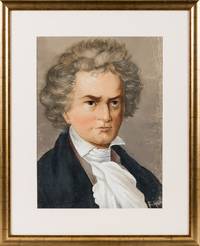
1897278AG1897. Germany 1897. Stunning original 19th century Gouache of Beethoven by E.F. Göbel; after a painting of Beethoven by Carl Jaeger 1833-1887 which is now in the possession of the Library of Congress. Beautifully Framed. Size of frame with Gouache: 53 cm x 65 cm. The Gouache itself measures: 48 cm x 345 cm. Outer margins slightly frayed only. Extraordinary 19th century painting with fresh impression of the signature-face of this timeless composer. Gouache also spelled guache is a type of paint consisting of pigment a binding agent usually gum arabic and sometimes added inert material designed to be used in an opaque method. It also refers to paintings that use this opaque method. The name derives from the Italian guazzo. Gouache differs from watercolor in that the particles are larger the ratio of pigment to water is much higher and an additional inert white pigment such as chalk is also present. This makes gouache heavier and more opaque with greater reflective qualities. Wikipedia. Ludwig van Beethoven baptised 17 December 1770 26 March 1827 was a German composer and pianist. A crucial figure in the transition between the Classical and Romantic eras in Western art music he remains one of the most famous and influential of all composers. His best known compositions include 9 symphonies 5 concertos for piano 32 piano sonatas and 16 string quartets. He also composed other chamber music choral works including the celebrated Missa Solemnis and songs. Born in Bonn then the capital of the Electorate of Cologne and part of the Holy Roman Empire Beethoven displayed his musical talents at an early age and was taught by his father Johann van Beethoven and Christian Gottlob Neefe. During his first 22 years in Bonn Beethoven intended to study with Wolfgang Amadeus Mozart and befriended Joseph Haydn. Beethoven moved to Vienna in 1792 and began studying with Haydn quickly gaining a reputation as a virtuoso pianist. He lived in Vienna until his death. In about 1800 his hearing began to deteriorate and by the last decade of his life he was almost totally deaf. He gave up conducting and performing in public but continued to compose; many of his most admired works come from this period. Wikipedia unknown
181540818Wien: S.A. Steiner PN S. et C. 2350 1815. Oblong folio. 1f. recto title verso blank i blank 2-16 pp. 1f. blank. Engraved throughout. <br /> <br /> With "6" in pencil to head of title. <br /> <br /> Occasional wear foxing soiling and staining.<br /> <br /> A very good copy overall with strong impression. First Edition second issue corrected with music newly engraved and without the plate number to page 9. LvBWV I p. 572. Hirsch IV 342 incorrectly describing the present issue as the first. Hoboken 2 386. Weinhold-Dörfmuller p. 223. <br /> <br /> "In dedicating this sonata to Count Lichnowsky Beethoven rallied that nobleman on the occasion of his engagement. Qualms were alleged to be represented in the vehemently pathetic first movement. It was with no intention of throwing light on that movement that Beethoven called it 'a contest between head and heart.' . The whole point of the sonata lies in the contrast between a movement full of passionate and lonely energy and a movement devoted to the utmost luxuriance of lyric melodies developed in Rondo form." Tovey: A Companion to Beethoven's Pianoforte Sonatas p. 208. S.A. Steiner [PN S. et C. 2350] unknown
182713367Paris, chez Benoît Ainé (pour les quatuors 1 à 9) et chez Maurice Schlesinger (quatuors 10 à 17), s.d. [Circa 1827]. 8 vol. grand in-4. Demie basane bleue, dos lisses ornés de quadruples filets et lettrines dorées, étiquettes de titre de maroquin rouge contrecollée au premier plat pour les quatuors 1 à 9.
182717431Vienna: N. Artaria 1827. First edition. Used; Like New/Used; Like New. Full score to Beethoven's String Quartet in B flat op. 130. PN M.A. 870. 67 pp. Wear to spine and edges; significant foxing and scattered water damage to the internal pages mostly around the margins but overall very good. Upright folio. 10.5 x 14 inches 26.5 x 36 cm.<br>First edition of the score of the quartet which was first performed on March 21 1826—the third and last of the great quartets commissioned by Nikolai Galitzin."After completing the Ninth Symphony in early 1824 Beethoven spent the two and a half years that remained to him writing. exclusively in the medium of the string quartet. The five late string quartets ops. 127 130 131 132 135 contain Beethoven's greatest music or so at least many listeners in the 20th-Century have come to feel." New Grove 2: 387. Kinsky-Halm 394-395<br> N. Artaria unknown books
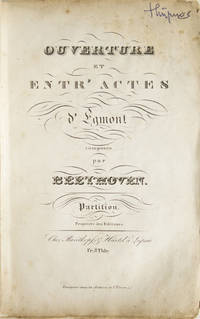
183126611Leipsic: Breitkopf & Härtel PN 5140 1831. Large octavo. Original publisher's yellow wrappers with titling within decorative border. 1f. title 164 pp. Title lithographed music engraved. In a full custom-made modern black linen clamshell box with printed title label to spine.<br/><br/>Previous owner's signature to upper outer corner of wrapper and title.<br/><br/>Wrappers soiled with professional repairs to margins and spine. Minor foxing heavier to some leaves; slight browning to blank margins; edges slightly dusty. Quite a good copy overall. First Edition. LvBWV v.1 p. 533. CPM 4 p. 222. Hoboken 2 no. 371. Dorfmüller p. 222.<br/><br/>Egmont was first performed on June 15 1810.<br/><br/>"It had been decided to furnish Goethe's Egmont with incidental music and Beethoven was invited to supply it; he completed it by June 1810 and it was immediately performed. Apart from the excitement of the plot itself in which Count Egmont foresees the liberation of the Netherlands from Spanish rule but dies as a result of his own brave stand it is possible to suggest a deeper reason behind Beethoven's heartfelt response to it: it may represent his own delayed reaction to the conquest and occupation of his adopted city by the French and his hopes of being delivered from them." Joseph Kerman Alan Tyson and Scott G. Burnham in Grove Music Online. Breitkopf & Härtel [PN 5140] unknown books
181152653St. Petersburg, 25. X. 1811. 2 1/2 S., Gr.-8°.
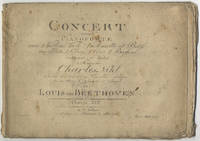
180633458Leipsic: chez A. Kuhnel PN 65 1806. Oblong folio. Unbound. 1 title 2-23 i blank pp. Engraved.<br/><br/>Outer leaves and margins quite soiled and with some staining split at head and tail with some paper loss to blank area; margins slightly frayed; minor foxing throughout.<br/><br/>Small circular publisher's blindstamp to first and last leaves. First Edition third issue distinguished from the first published in December 1801 in that the first line of the imprint "a Vienne chez Hoffmeister & Comp." has been deleted and "chez A. Kuhnel" added in its place. Rare. LvBWV v. 1 p. 114. Not in Hoboken or CPM. <br/><br/>Although Beethoven's first piano concerto the present concerto was published after the second. chez A. Kuhnel [PN 65] unknown books
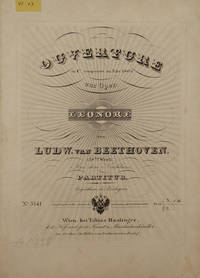
183823017Wien: Tobias Haslinger PN T.H. 5141 1838. Folio. Early stiff blue wrappers with octagonal label titled in manuscript to upper. 1f. title 48 ii blank pp. Engraved. Price: "f 3._C.M." above "Reichsthaler sign 2._". Rehearsal letters A to O added in pencil with numerous performance annotations in red crayon. Penciled inventory of parts to last page related to a performance on October 13 1892 and signed "Felchner." <br/><br/>Spine reinforced with black cloth tape. Handstamp "Musikbibliothek der Universität Gießen" to upper wrapper and first page of music. Small yellow sticker to upper left corner of title with manuscript shelfmark "VI. 13" with same shelfmark also added in manuscript to label on upper wrapper. Printed titling "Ouverture" to first page of music extended in pencil: "zu" crossed out "Ele" "Leonore." Some pages slightly skewed. Some soiling and foxing.<br/><br/>A very good copy overall. First Edition. Rare. LvBWV v. 1 pp. 436-437. Hoboken 2 537. Hirsch IV 419. Beethoven-Haus C 138/1 and Van der Spek collection. The misspelling "Archin" for "Archiv" on the title seems to have gone unnoticed by Beethoven bibliographers though the two copies held at the Beethoven-Haus carry it as well.<br/><br/>Gustav Adolf Felchner 1832-96 was music director at the University of Gießen Germany from 1874 to his death; some of the annotations are most likely in his hand. <br/><br/>This overture is generally known as "Leonore no. 1." It is now dated 1807 and is chronologically the third of the three "Leonore" overtures. It was not performed during Beethoven's lifetime. Tobias Haslinger [PN T.H.] 5141 unknown books
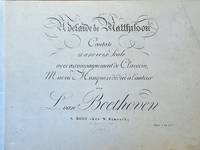
18052292À Bonn: chez N. Simrock 1805. Second Simrock edition. Spine and p. 9. firmed with paper stripe. Paper toned. Otherwise in fine condition. Second Simrock edition. Spine and p. 9. firmed with paper stripe. Paper toned. Otherwise in fine condition. 11 1 p. An early edition of the Beethoven’s composition to Friedrich v. Matthisson’s poem. First published by Artaria in Vienna in 1797. First edition by Simrock in 1803 this edition contains the text in German French and Italian. chez N. Simrock unknown
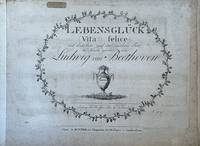
18032295Leipzig Amsterdam: bei Hoffmeister & Kühnel A. Kuntze 1803. First edition with Italian lyrics. Papered spine. Kuntze’s vignette mounted on the title page. Residue of a mounted vignette on title page at the upper edge. First and last pages are dusted paper tanned. Inner pages loose. Last leaf with restored closed tear. Otherwise in very good condition. First edition with Italian lyrics. Papered spine. Kuntze’s vignette mounted on the title page. First edition with Italian lyrics. First edition of Beethoven’s Das Glück der Freundschaft with the Italian lyrics Vita felice “Beato quei†from the same year as the real first edition by Joseph Eder in Vienna. bei Hoffmeister & Kühnel (A. Kuntze) unknown