1 340 résultats
19082388181231053G. Schirmer Inc 1908-01-01. Sheet music. Good. Nice looking book has minor edge wear. has small crease on cover. G. Schirmer Inc unknown
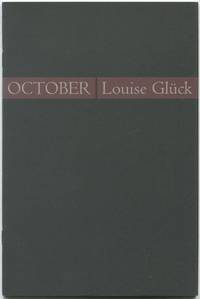
2004580622Louisville Kentucky: Sarabande Books 2004. Softcover. Near Fine. First edition. Stapled printed wrappers. Small creases at the bottom corner of wraps and pages near fine. Quarternote Chapbook Series #3. Sarabande Books unknown
20041397887Louisville Kentucky: Sarabande Books 2004. First Edition First Printing. Saddle-stitched. Octavo 20 pages. In Very Good condition. Wraps have mild rubbing wear along spine. Shelved Room C. 1397887. Special Collections. Sarabande Books unknown
2004613548Louisville Kentucky: Sarabande Books 2004. Softcover. Fine. First edition. Octavo. 20pp. Fine in stapled wrappers. Signed by the author. Quarternote Chapbook Series #3. Sarabande Books unknown
20048651Louiseville KY: Sarabande Books 2004. First Edition First Printing. Paperback. Fine. Thin octavo. 6 x 9 in. 20 pp. Fine in original stapled wrappers. Quarternote Chapbook Series #3. Sarabande Books paperback
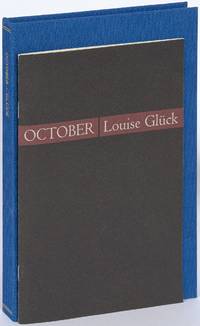
2004501002Louisville Kentucky: Sarabande Books 2004. Softcover. Fine. First edition. Stapled wrappers. Faintest bit of wear at the corners still easily fine. Inscribed on the title page: "for Ted with / good wishes / Louise Glück." Quarternote Chapbook Series #3. Housed in a fine custom royal blue clamshell case with the spine titled in gilt and the author's gilt facsimile signature on the cover. Glück received the 2020 Nobel Prize in Literature. Sarabande Books unknown
2004103501Sarabande Books 2004 Quarternote Chapbook Series #3. Clean text block.Saddle stitched booklet. This copy used to belong to National Book Award finalist and Brockport NY poet William Heyen.20 pages. 1st Edition. Soft cover. Near Fine/No Jacket. Sarabande Books paperback
2004Poetry-Office-1Sarabande Books Louisville 2004 First edition. First printing. Printed black wraps. States "First Edition". A fine copy flawless. Scarce in this first edition. 8vo 8" - 9" tall; 20 pages. Softcover. Quarternote Chapbook Series #3. A single poem by the winner of the 2020 Nobel Prize in Literature. 1st Edition. Soft cover. Fine/No Jacket. Sarabande Books, Louisville paperback
20041530452Sarabande Books April 2004. Staple Bound. VG-. clean chapbook with minimal wear. some light creasing at corners some scuffing to wraps mild edgewear. Sarabande Books unknown
2004208192Louisville KY: Sarabande Books 2004. First edition. Softcover. 20 pages. Quarternote Chapbook Series #3. A single poem by the winner of the 2020 Nobel Prize in Literature. A clean very near fine copy in stapled wrappers with some very minor wear. Signed by Gluck on the title page and with a laid in letter from Tree Swenson the executive director of The Academy of American Poets presenting this book. A somewhat uncommon book and especially signed. Sarabande Books unknown
2020628<p>Slovenian work by the Nobel Prize winner. Introduction and translation by Veronika Dintinjana. Fine copy contained in plastic seal.</p> Mladinska knjiga
2020706<p>A fine copy in sealed wrapping. Translated to Slovenia by Veronika Dintinjana.</p> Mladinska knjiga Publishing House paperback
1988556512Reinbek.: Rowohlt. 1988. Orig.kartoniert. Reichlich in Schwarzweiß illustriert. Herausgegeben von Attila Csampai und Dietmar Holland. 8°. Einband leicht berieben. Leichte Gebrauchsspuren. ISBN 3499183986. Rowohlt. unknown
033219874X.Ghardcover. Good. Access codes and supplements are not guaranteed with used items. May be an ex-library book. hardcover
1024053555.Ghardcover. Good. Access codes and supplements are not guaranteed with used items. May be an ex-library book. hardcover
1356126669.Ghardcover. Good. Access codes and supplements are not guaranteed with used items. May be an ex-library book. hardcover
1396656286.Ghardcover. Good. Access codes and supplements are not guaranteed with used items. May be an ex-library book. hardcover
1391335236.Gpaperback. Good. Access codes and supplements are not guaranteed with used items. May be an ex-library book. paperback
199036322<p>The book has 71 pages three fold-out sections. The text is printed on white hand-made Fabriano Umbria paper in black ink with headings printed in five colors and the three fold-out sections are printed on different pastel shades of MacGregor-Vinzani specially made for this edition. The various cutouts and collages are in different colors as well. Michael Alpert printed the book created and constructed all the various components of the book itself and its binding. The book is bound in a hand made paper wrappper and then inserted into a binding made of paper by MacGregor-Vinzani. The book is then placed in a cloth covered clamshell box with a paper spine label. </p><p>The book also contains the two-cd set of a recording of Gluck's opera laid into pockets at the back of the book. Number 16 of an edition of 90 copies. Signed by Alpert on the colophon. </p><p>Fine in a fine clamshell box. </p><p>Alpert and the Theodore Press have collaborated on other artists' books creations with Claire van Vliet and her Janus Press particularly with her production of King Lear. All of the various materials textures and colors come together in a beautiful production. Winner of the 1990 Stephen Harvard Prize for excellence in the Book Arts.</p> Theodore Press
1391870204.Ghardcover. Good. Access codes and supplements are not guaranteed with used items. May be an ex-library book. hardcover
1986Q-0793598125G. Schirmer Inc 1986-10-31. paperback. New. In shrink wrap. Looks like an interesting title! G. Schirmer, Inc paperback
1396174478.Ghardcover. Good. Access codes and supplements are not guaranteed with used items. May be an ex-library book. hardcover
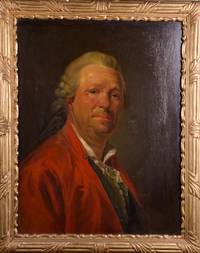
40422Paris 19th century. 61 x 47.3 cms with frame 69.5 x 56 cms.<br /> <br /> The composer is depicted bust-length turned 3/4 left facing forward wearing a red jacket blue waistcoat white collared blouse with lace and wig. For a fine full-page color illustration of the original held at the Louvre see MGG Vol. 5 plate 15.<br /> <br /> "Gluck was recognized as an extraordinary phenomenon in his lifetime as is evident from Burney's deferential treatment of the composer during his visit to Vienna in 1772. Shortly afterwards the controversy stirred in French journals resonated well beyond the capital to other countries. The daily cultural discourse of Paris concerned Gluck's 'musical revolution' a catch-phrase taken up by Gluck's opponents such as Jean-François Marmontel as well as by his defenders; in 1781 the 'revolution worked in music by M. le Chevalier Gluck' later dubbed the 'German Orpheus' was used as the title of a collection of pamphlets for and against Gluck with a heavy editorial bias in favour Lesure c1984. Although operas by Piccinni Salieri and especially Sacchini as well as French contemporaries such as Grétry continued alongside Gluck in the French repertoire beyond the Revolution and Empire revivals of Gluck constituted the principal touchstone of dramatic music into the 1820s when the last routine revivals were acclaimed by Berlioz. Opera composers including Salieri Lemoyne and Vogel in Paris were presented or presented themselves as his legitimate successors; elsewhere Mozart especially in Idomeneo and J.M. Kraus were strongly affected by Gluck's example in constructing scenes applying a dramatically motivated admixture of lyricism and more direct and declamatory vocal expression and sometimes in modelling as when the statue in Don Giovanni adopts the tone of the oracle in Alceste. After his death his direct effect can still be heard in Die Zauberflöte and in several French operas including those of Méhul Cherubini and Spontini.<br /> <br /> Among the Romantics he continued to inspire respect and from Berlioz and Wagner emulation. Berlioz supervised productions of Orphée and Alceste in Paris 1859 and 1866. In Orphée Berlioz created the basis for the version most used over the next century at least by restoring the Italian key-scheme in several scenes to accomodate the tessitura of the title role to a female singer; Pauline Viardot was the first in a line to include Giulia Ravoli Kathleen Ferrier Janet Baker and others although the French version with tenor retained some currency. Musicians close to Berlioz began to realize his ideal of a complete critical edition although only a handful of 'reform' operas were published. Wagner wrote about Gluck in Oper und Drama having learned much from deep study of Iphigénie en Aulide of which he made a modernized performing version Dresden 1847. In 1890 for Weimar Richard Strauss similarly adapted Iphigénie en Tauride. Such orchestrational revision and the melding of recitative and aria to blur Gluck's structure of closed forms represented a style of musical archaeology from which Handel and Mozart also suffered or in terms of public exposure benefited. The later 20th century witnessed not only numerous revivals of the reform operas some in musically authentic form and including the Vienna Orfeo but also a less one-sided critical view of Gluck became possible with the publication of a new critical edition and a revival of interest in works in other genres especially opéra comique and with Don Juan ballet. Winton Dean has observed that Gluck's compromise between the demands of words and music 'was one of the most satisfying and successful of all and has placed his greatest works beyond the reach of time' Grove6. None of Gluck's operas except Orfeo/Orphée is likely to become a staple work in the repertory; however to the extent that every production has the aspect of a revival continued interest in his achievement and consequently revival of an increasing proportion of his output is guaranteed so long as opera continues to occupy a central place in Western musical culture." Julian Rushton in Grove Music Online. unknown
192235997Paris France: Choudens. Spine has been taped with library-type tape but it has some wear along front hinge and a chunk missing top edge. A few 1" black marker lines at lower front cover. Prev. owner's name plate inside. Toning to pages due to age. Rough-cut pgs. 177 pgs. . Good. Paperback. 1922. Choudens paperback
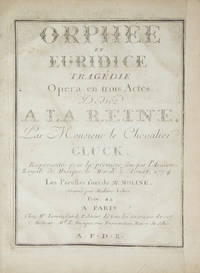
177429643Paris: Lemarchand 1774. Folio. 19th century quarter dark brown leather-backed marbled boards spine in decorative compartments gilt titling gilt. 1f. recto title verso publisher's catalogue 1f. recto dedication verso argument 217 pp. <br /> <br /> With an inscription signed by the Canadian conductor Wilfrid Pelletier 1896-1982 to Italian conductor Tullio Serafin 1878-1968 dated New York 1928 to front flyleaf.<br /> <br /> Bass figurings added in manuscript to pp. 10-12 Act I scene 1; final page of music signed by the publisher Lemarchand. <br /> <br /> Binding worn; edges rubbed; spine split at joints and hinges; chipped at head and tail. Slightly worn and browned; title soiled with outer edge reinforced with paper tape; some minor staining; several repairs to inner margins; occasional small holes. First Edition variant issue. Hopkinson 41Af. Wotquenne 41. Lesure p. 240. RISM G2852 not distinguishing among issues. <br /> <br /> First performed in Vienna at the Burgtheater on 5 October 1762 in Italian to a libretto by Ranieri de' Calzabigi and in Paris at the Opéra on 2 August 1774 in French to a libretto by Pierre Louis Moline after Calzabigi.<br /> <br /> "The classical orientation of Calzabigi evident in Orfeo ed Euridice from the moment the curtain rose on the almost archaeologically recreated ancient funerary ritual e.g. the threefold calling of the name of the deceased coloured the entirety of his collaboration with Gluck. Despite the ambiguous attributions of the prefaces signed by the composer it is clear that Gluck largely shared his librettist's classical enthusiasms . It is revealing that Gluck sought out subject matter from Greek tragedy independently of Calzabigi after the latter's departure from Vienna - most probably with his inner conviction mixing with a desire to exploit the goût grec then prevailing in France . Calzabigi's poetry was almost completely devoid of metaphors and similes and placed a mere three characters in a fluid context of dances and choruses or both simultaneously. The action was reduced to essentials: a demonstration of the persuasive powers of music and a cautionary tale on the dangers of curiosity with Orpheus bewailing the loss of his wife already as the curtain rose. Gluck's approach as composer was no less radical particularly in his near-complete elimination of coloratura and of opening ritornellos in the solo numbers. Above all the opera was remarkable in its emphasis on continuity which was achieved chiefly through the enchaining of harmonically open-ended sections of music and through the complete avoidance of recitativo semplice in favour of orchestrally accompanied recitatives so as to avoid sharp contrasts of texture with the set pieces. This continuity and the nearly syllabic vocal writing were calculated to prevent applause and thus also to promote the audience's absorption in the spectacle." Bruce Alan Brown and Julian Rushton in Grove Music Online. Lemarchand unknown