3 037 résultats
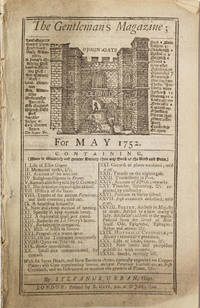
1757314545London 1757. May 1750 p 208; May 1752 pp 227-229; and January 1757 pp 22-23 respectively. 3 vols. 8vo. Disbound. Very good. May 1750 p 208; May 1752 pp 227-229; and January 1757 pp 22-23 respectively. 3 vols. 8vo. Franklin on Electrity. Three articles by Franklin relating to his experiments in electricity published in the Gentleman's Magazine. unknown books
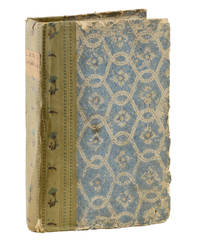
177919279Firenze Florence: Per Gaetano Cambiai Stamp. Granducale 1779. First edition in Italian of Cavallo's first book. Front hinge separated but cords are holding; some edge wear and rubbing to the boards; a good sound copy. 8vo contemporary decorated paper boards backed with contrasting block-printed paper and an autograph spine label xx 511 1 pages untrimmed. From this Italian-born English physicist the Italian translation of a work first published in London in 1777 as A Complete Treatise of Electricity in Theory and Practice; Cavallo includes suggestions to his translator in his prefatory note suggesting he was involved in the translation and revision of the work. This edition also includes a new dedication from the translator to the English Florentine expatriate George Clavering-Cowper dated 26 March 1779. Includes mention of Franklin and his lightning rods accounts of experiments conducted by Cavallo with Leiden jars and other apparatuses and experiments with medical treatment with electricity. With a folding table of experimental data bound after page 468 and three folding engravings of various pieces of electrical equipment bound in the rear. Per Gaetano Cambiai Stamp. Granducale, unknown books
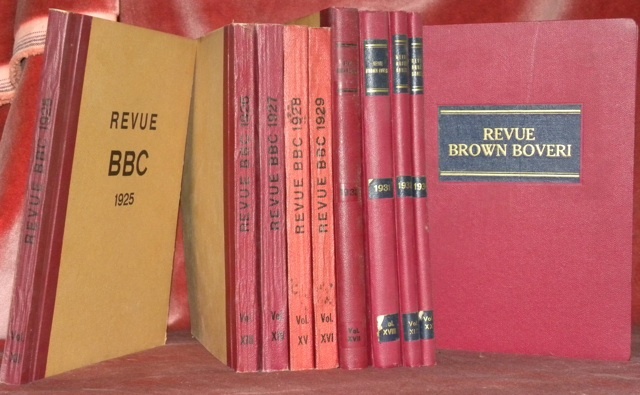
57800Baden, BBC 1925 - 1934, 280x210mm, cartonnage avec dos en percaline pour les 5 premiers volumes, et pleine percaline pour 5 autres volumes.
19312111902160304704Ministry of Railway Tokyo Electricity Office 1931. Soft Cover. Fine. Number of pages: 96 pages Size: 46 size horizontal length 80 Ministry of Railway Tokyo Electricity Office paperback
183448203Leipzig, Johann Ambrosius Barth, 1834. 8vo. Contemp. hcalf. Spine gilt and with gilt lettering. Spine slightly rubbed. In: ""Annalen der Physik und Chemie. Hrsg.von Poggendorff"", Bd. 35. X,630,(8) pp. a. 5 folded lithographed plates. (Entire volume offered). Faraday's papers: pp. 1-45 a. 222-226, 1 plate (8. Reihe) - pp. 413-444 (9. Reihe). Stamp to verso of titlepage and verso of plates. Clean and fine, printed on good paper.
183448203Leipzig Johann Ambrosius Barth 1834. 8vo. Contemp. hcalf. Spine gilt and with gilt lettering. Spine slightly rubbed. In: "Annalen der Physik und Chemie. Hrsg.von Poggendorff" Bd. 35. X6308 pp. a. 5 folded lithographed plates. Entire volume offered. Faraday's papers: pp. 1-45 a. 222-226 1 plate 8. Reihe - pp. 413-444 9. Reihe. Stamp to verso of titlepage and verso of plates. Clean and fine printed on good paper. <br/><br/><em>First appearance in German - prepared by Faraday himself for publication in Annalen - of two groundbreakings papers in chemistry and physiscs.In the FIRST PAPER 8. Reihe Faraday brings forth the idea "that the atoms of matter are in some way endowed or associated with electrical powers to which they owe their most striking qualities and amongst them their mutual chemical affinity." He showed how natural it is to suppose that the electricity which passes through the electrolyte is exact equivaklent of that which is possessed by the atoms separated at the electrode: which implies that there is A CERTAIN ABSOLUTE QUANTITY OF THE ELECTRIC POWER ASSOCIATED WITH EACH ATOM OF MATTER.- Faraday further verifies that the electricity of the violtaic pile is proportionate in its intensity to the intensity of the affinities concerned in its production. - Dealing with the the decompositions in electrolysis he shows that THE FORCES TERMED CHEMICAL AFFINITY AND ELECTRICITY ARE THE SAME.In the SECOND PAPER 9. Reihe Faraday independent of Henry's discovery of the same phenomena in 1832 discovers SELF-INDUCTION or the "extra current" and points out the importent influence it must have in the construction of electro-magnetic machines electro-motors."Faraday showed that the powerful momentary current which was observed when the circuit was interrupted was really an induced current governed by the same laws as all other induced currents but with this peculiarity that the induced and inducing current now flowed in the same circuit. In fact the current in its steady state establishes in the surrounding region a magnetic field whose lines of force are linked with the circuit; and teh removal of these lines of forcewhen the circuit is broken originates an induced current which reatly reinforces the primary current just before its final extinction."Whittaker in "A History of the Aether and Electricity""In the series of experiments which are detailed in this paper the author inquires into the causes of some remarkable phenomena relating to the action of an electrical current upon itself under certain circumstances wherby its intensity is highly exalted and occasionally increased to ten twenty or even fifty times that which it originally possessed."Abstract. </em> unknown
2602P., Desaint, 1787, un volume in 8 relié en demi-basane verte, dos orné de filets dorés, (reliure début XIXe), 17pp., 5pp., 238pp., 4 planches dépliantes
19622110502150411669Iwasaki shoten 1962. Soft Cover. Fine. Number of books: 7 Iwasaki shoten paperback
19302111902160500013Not Available 1930. Soft Cover. Fine. Number of pages: A4/B5 55-80p each with many tables attached Size: Age discoloration etc. Not Available paperback
First edition, [2], 80pp., folding engraved plate, closed tear in final leaf, expertly repaired and no loss of text. 2 works bound as one, 8vo (200 x 120 mm), modern vellum-backed marbled boards, spine lettered in gilt, a nice copy. Watson was the most distinguished name in this period of the history of electricity, and this was his principal work. He was the first to observe the flash of light attending the discharge of a Leyden jar, and he provided the first demonstration of the passage of electricity through a vacuum, and the plus and minus of electricity. Mottelay, pp.175-177; Baaken, p.115.
1804(LCPCSCI-0003)(Les différents appareils galvaniques et leurs utilisations dans un rare exemplaire en édition originale, tel que paru, avec un envoi autographe de l'auteur à un ami) IZARN Joseph. (Cahors, 1766 - Paris, 1847) "MANUEL DU GALVANISME OU DESCRIPTION ET USAGE DES DIVERS APPAREILS EMPLOYES JUSQU'A CE JOUR, TANT POUR LES RECHERCHES PHYSIQUES ET CHIMIQUES, QUE POUR LES APPLICATIONS MEDICALES". 1804, Paris, J.F. Barrau et Dumotiez. 1 volume in-8° (218x138 mm) (dimensions pages 218x138 mm) (2) ff. (faux-titre et titre), XXII pp. (dédicace et discours), 293, (1) pp. (errata), (4) ff. (table), (13) ff., 6 planches h.t. Brochure bleue-grise de l'époque. Etiquette avec titre imprimé sur le dos. Edition Originale, rare. Petites brunissures à quelques cahiers, petites traces de poussière dans les marges, mais très bel exemplaire tel que paru, à toutes marges, non rogné et complet de ses six planches h.t. Exemplaire avec un envoi autographe de l'auteur à un ami, E. Bonafons. Joseph Izarn (1766-1847) était médecin de l'armée française et professeur de physique. De 1811 à 1815 il fut inspecteur général de l'Université. Son ouvrage trace une histoire du galvanisme et, à partir des expériences de Volta, galvani, Aldini et d'autres, décrit les appareils galvaniques et les inventions de l'époque et leur possible utilisation dans la médecine. "... je mets le lecteur à portée de prendre le Galvanisme à son origine, de le suivre, pas à pas, d'expérience en expérience, de découverte en découverte, et de voir les modifications et les applications que l'on a su faire. Je lui montre les pierres d'attente qu'ont laissées nos prédécesseurs dans plusieurs points de l'édifice. Ce plan est donc, à la fois, celui d'une Histoire et d'un Traité Pratique du Galvanisme". "Le Galvanisme ne viendra pas renverser le cours de la nature... mail il peut être très utilement employé pour l'espèce humaine, dans beaucoup de circonstances qu'il ne s'agit que de bien observer pour bien décrire, pour les rendre faciles à reconnaitre, et pour les distinguer de celles ou il pourrait devenir très-nuisible". "... le Galvanisme, n'eut-il été jusqu'ici d'aucune utilité pour l'art de guérir, n'en sera pas moins encore le chemin de grandes découvertes et qu'il est impossible que les expériences se multiplient et soient variées dans des vues différentes, sans qu'elles donnent des résultats propres à étendre les bornes de nos connaissances physiques, chimiques et physiologiques". Provenance : Envoi autographe de l'auteur à un ami, E. Bonafons. Conservé à l'intérieur du livre un billet manuscrit de l'auteur avec une demande d'un petit prêt à l'ami. (Poggendorf, 1174) (LCPCSCI-0003) (550,00 €)
176646402817Paris, Le Mercier, Saillant, 1766 ; 2 tomes en 1 volume in-8, veau fauve marbré, dos orné, tranches rouges. (Reliure de l’époque) 2 ff., X pp., 1 f. de table, 172 pp., 7 ff. table. - 2 ff., X pp., 148 pp., 10 ff. n. ch. - 3 planches gravées.ÉDITION ORIGINALE. Une des planches montre l’auteur réalisant une expérience avec la “barre fulminante”, pendant laquelle il fut foudroyé, les 2 autres planches montrent des instruments propres à faire des expériences de phlogistique.Poncelet, religieux récollet et célèbre agronome est originaire de Verdun. On ne sait pas grand chose de sa vie. Dans son Dictionnaire, Rozier fait le plus grand éloge des services qu’il a rendus à l’agriculture, notamment par son célèbre traité sur le froment.Usure à l’extrême bord d’un plat, sinon bel exemplaire.
131266aafParis, Chez H.L. Guerin & L.F. Delatour, M. DCC. LXIV. / Tome 3) M. DCC. LXVII Chez Durand, 1764- 64- 67, pt. in-8°, XII + 251 p. / 8 ff. + 278 p. / XVI + 295 p. + 1 f. blanche, illustré d'au total 12 planches gravées repliées, qqs notices ms. d’époque sur les p. de garde, reliures en veau d’époque, tome 1 & 2 dos lisse richement orné or, tome 3 dos à 4 nerfs, ornements or diff., qqs traces de vers dans les charnières, bas du dos T. III avec pt. manque, coins touchés, tranches rouges.
189743448Leipzig, Johann Ambrosius Barth, 1897. No wrappers. In ""Annalen der Physik und Chemie, Neue Folge"", Bd. 60, No 3. Pp. 401-576, textillustr. and 2 folded plates. (the entire issue offered, ""Heft 3""). Braun's paper: pp. 552-559 a. 6 textillustrations (showing the Braun tube and its operations). Clean and fine.
189743448Leipzig Johann Ambrosius Barth 1897. No wrappers. In "Annalen der Physik und Chemie Neue Folge" Bd. 60 No 3. Pp. 401-576 textillustr. and 2 folded plates. the entire issue offered "Heft 3". Braun's paper: pp. 552-559 a. 6 textillustrations showing the Braun tube and its operations. Clean and fine. <br/><br/><em>First printing of this groundbreaking paper being the first description of the principles governing the "BRAUN TUBE" which moves the elctron beams of alternating voltage the principle on which ALL TELEVISON TUBES operate. - Braun shared the Nobel Prize for 1909 with Marconi "in recognition of their contributions to the development of wireless telegraphy"."Cold cathode tube with side anode annular diaphragm to control spot size and built-in fluorescent screen. Beam deflection by one external coil with the trace viewed indirectly in a rotating mirror or by two coils at right angles for direct viewing. Excitation by hand-drive influence machine friction generator or by an induction coil. This "indicator tube" which enabled Braun to demonstrate how a variety of periodic and transient electrical phenomena could be visually examined is the ancestor of electric oscilloscopes televison picture tubes and other electron-beam display devices." Shiers & Shiers "Early Televison. A Bibliography to 1940" No. 263."The first oscilloscope or Braun tube was introduced in 1897. In order to study high-frequency alternating currents Braun used the alternating voltageto move the electron beam within the cathode tube. The trace on the face of the cathode tube represented the amplitude and frequency of the alternating-current voltage. He then produced a graph of this trace by use of a rotating mirror. The Braun tube was a valuable laboratory instrument and modifications of it are a basic devise in electronic testing and research. The principle of the Braun tube moving a electron beam by means of alternating voltage is the principle on which all televison operate."DSB II pp. 427-428.In 1909 he shared the Nobel Prize for physics with Guglielmo Marconi for their development of wireless telegraphy. </em> unknown
8vo., Second Edition, with small illustrations in the text, faint bookplate scar on front paste-down, [signature] erasure on front free endpaper leaving three-inch tear (but endpaper wholly sound); strongly bound in contemporary half calf, marbled boards, back with flat bands ruled in gilt, second compartment with red leather label lettered in gilt, red sprinkled edges, neatly rebacked with old backstrip laid down, a remarkably bright, crisp, copy. Dedicated to the Duke of Somerset, President of the Royal Institution, this is Faraday's only complete work in book form. First published two years earlier, it includes an extensive index. An unusually well-preserved copy. Bolton I, 434; Duveen p.207.
174818288ABVenezia, Giambattista Pasqual, 1748. 8°. 554 ll. 5 stained plates (folded). Contemporary boards. + Wichtig: Für unsere Kunden in der EU erfolgt der Versand alle 14 Tage verzollt ab Deutschland / Postbank-Konto in Deutschland vorhanden +
178146402901Paris, Rue et Hôtel Serpente, 1781 ; in-8, veau fauve marbré, dos orné, tranches rouges. (Reliure de l’époque) XVI pp., 742 pp., 9 planches dépliantes.ÉDITION ORIGINALE. Sigaud de La Fond (Dijon 1740 - Bourges 1810) avait suivi dans sa jeunesse les leçons du physicien Nollet. Traité très complet sur les expériences électriques : les travaux de Gibert, les machines électriques de Nollet, Nairne, Gordon, Chaulnes, Franklin, les travaux de Wall, Grey, Dufay, Watson, les électrometres de Nollet, Henley, Canton, l’expérience de Leyde et la théorie de Franklin, etc.Les planches gravées par Sellier montrent les machines électriques.- Poggendorff II, p. 927 - Mottelay. Bibliogr. history of electricity p. 280 (qui ne connaît que l’édition de 1785) - Wheeler Catalogue 505 - D. S. B. p. 427.Bel exemplaire.
174818288ABVenezia, Giambattista Pasqual, 1748. 8°. 554 ll. 5 stained plates (folded). Contemporary boards.
42314aafParis, Des Ventes de la Doué, 1771, pt. in-8vo, 1 ff. + XXX + 413 p. + 3 p. + 12 planches repl. de figures, petit coin infér. de p. 413-414 arraché (perte de qqs lettres de l'approbation et de la table des mat.), exlibris ‘Ex Bibliotheca Josephi Schlemmer’, reliure en veau marbré à nerfs, dos orné en or, pièce de titre rouge au dos, accrocs aux coiffes, charnières avec fentes en haut (2, traces de vers ?) et en bas (1), lég. taches et inégalités sur le plat devant, bords qq peu frottés, tranches rouges, bon exemplaire.
17486432Paris, Sébastien Jorry, 1748. In-12 de [2]-VII-[3]-156-[2]-XII-141-[3]-VIII-112p., plein veau brun, dos à nerfs orné de filets et fleurons dorés, pièce de titre bordeaux, tranches rouges (coins et coiffes frottés, mors partiellement fendu). Intérieur propre, une planche ou deux mal pliées.
180243637Halle, Rengerschen Buchhandlung, 1802-(1803). Without wrappers as published in ""Annalen der Physik. Herausgegeben von Ludwig Wilhelm Gilbert"", Bd. 10, Viertes Stück. (The entire issue offered (= Stück 4). Titlepage to vol. 10. Pp. 389-512 a. 1 engraved plate. + Extract from Ergänzungsheft zum Jahre 1802. (=Zweite Abhandlung). Volta's papers: pp. 421-449 a. pp. 497-520. Very light browning to 2. Abhandlung.
180243637Halle Rengerschen Buchhandlung 1802-1803. Without wrappers as published in "Annalen der Physik. Herausgegeben von Ludwig Wilhelm Gilbert" Bd. 10 Viertes Stück. The entire issue offered = Stück 4. Titlepage to vol. 10. Pp. 389-512 a. 1 engraved plate. Extract from Ergänzungsheft zum Jahre 1802. =Zweite Abhandlung. Volta's papers: pp. 421-449 a. pp. 497-520. Very light browning to 2. Abhandlung. <br/><br/><em>First appearance in German of Volta's importent paper in which he describes the electrical forces that acts between the metal-plates in the Voltaic Pile. The German publication was printed in the same year as the Italian original "Sull' identita del Fluido Elettrico col Fluide Galvanico" 1802."A long memoir by Volta in two parts.reports that by measuring the electrometer deflections with different pairs of metals he found that the forces which drive the electric fluid.from the first metal to the second are: silver/copper 1 copper/iron 2 iron/thin 3 lead/tin 1 lead/zinc 5. Then the force for silver/zinc in immidiate contact is 12 12315 copper/tin 5 = 32 iron/zinc 9 513 etc. Thus 'the force or impulsion with which two metals act on the electric fluid is equal to the sum of the forces of the series of metals which stands between them and.the electric force is the same as that which arises when the two extreme metals have no effect on the force of the latter'. This is the first statement of what Maxwell called 'Volta'slaw of contact electricity'."Partington IV p.15. </em> unknown
3561P., Méquignon, 1780/1785, 3 mémoires reliés en un volume in 8, pleine basane marbrée, dos orné de fers dorés, tranches rouges, (reliure de l'époque, (coiffe légèrement usée), 6pp., 122pp., (1) ; (1), 312pp. ; (2), 50pp., 126pp.
1781159171781 1 volume, reliure de l'époque plein veau marbré havane in-8 (binding full calfskin in-octavo), dos à nerfs (spine with raised bands), entre-nerfs à fleuron au fer plein (between the raised bands floweret with full blocking stamp), titre frappé or (gilt title), pièce de titre sur fond havane (label of title) avec double filets or (label of title with double gilt line), toutes tranches lisses (all smooth edges), rouges (al red edges), orné de 9 planches dépliantes in-fine (9 folding copperplate engravings), cicatrices de mouillures marginales (margin scars of waterstains) aux premières pages, XVI-732 p.+12 pages tables + privilège + planches in-fine, 1781 Paris Rue et Hôtel Serpente Editeur,
_2.jpg)