3 037 résultats
189743448Leipzig Johann Ambrosius Barth 1897. No wrappers. In "Annalen der Physik und Chemie Neue Folge" Bd. 60 No 3. Pp. 401-576 textillustr. and 2 folded plates. the entire issue offered "Heft 3". Braun's paper: pp. 552-559 a. 6 textillustrations showing the Braun tube and its operations. Clean and fine. <br/><br/><em>First printing of this groundbreaking paper being the first description of the principles governing the "BRAUN TUBE" which moves the elctron beams of alternating voltage the principle on which ALL TELEVISON TUBES operate. - Braun shared the Nobel Prize for 1909 with Marconi "in recognition of their contributions to the development of wireless telegraphy"."Cold cathode tube with side anode annular diaphragm to control spot size and built-in fluorescent screen. Beam deflection by one external coil with the trace viewed indirectly in a rotating mirror or by two coils at right angles for direct viewing. Excitation by hand-drive influence machine friction generator or by an induction coil. This "indicator tube" which enabled Braun to demonstrate how a variety of periodic and transient electrical phenomena could be visually examined is the ancestor of electric oscilloscopes televison picture tubes and other electron-beam display devices." Shiers & Shiers "Early Televison. A Bibliography to 1940" No. 263."The first oscilloscope or Braun tube was introduced in 1897. In order to study high-frequency alternating currents Braun used the alternating voltageto move the electron beam within the cathode tube. The trace on the face of the cathode tube represented the amplitude and frequency of the alternating-current voltage. He then produced a graph of this trace by use of a rotating mirror. The Braun tube was a valuable laboratory instrument and modifications of it are a basic devise in electronic testing and research. The principle of the Braun tube moving a electron beam by means of alternating voltage is the principle on which all televison operate."DSB II pp. 427-428.In 1909 he shared the Nobel Prize for physics with Guglielmo Marconi for their development of wireless telegraphy. </em> unknown
9039aafLeipzig, W. Engelmann, 1891, in-8°, 87 S. + 1 Falttafel / 142 S. + 1 Tafel, Stempel ‘Dr. Ed. Marmier Ing.-chim.’, Original-Broschüre.
180243637Halle, Rengerschen Buchhandlung, 1802-(1803). Without wrappers as published in ""Annalen der Physik. Herausgegeben von Ludwig Wilhelm Gilbert"", Bd. 10, Viertes Stück. (The entire issue offered (= Stück 4). Titlepage to vol. 10. Pp. 389-512 a. 1 engraved plate. + Extract from Ergänzungsheft zum Jahre 1802. (=Zweite Abhandlung). Volta's papers: pp. 421-449 a. pp. 497-520. Very light browning to 2. Abhandlung.
185143324Leipzig, Johann Ambrosius Barth, 1851. Without wrappers as issued in ""Annalen der Physik und Chemie. Hrsg.von Poggendorff"", Bd. 83, Viertes Stück.(= Heft No. 8 of 1851). (The entire issue offered (Heft 2 of vol. 83 with titlepage to vol. 83). Pp.469-600 a. 2 engraved plates. Helmholtz's paper: pp. 505-540. Clean and fine.
185745075Leipzig, Johann Ambrosius Barth, 1857. Without wrappers. In ""Annalen der Physik und Chemie. Hrsg. von J.C. Poggendorff"", Bd. 100, No 2 . Pp. 177-252 a. 1 plate. (Entire issue offered). Kirchhoff's paper: pp. 193-217. With titlepage to volume 100.
185143324Leipzig Johann Ambrosius Barth 1851. Without wrappers as issued in "Annalen der Physik und Chemie. Hrsg.von Poggendorff" Bd. 83 Viertes Stück.= Heft No. 8 of 1851. The entire issue offered Heft 2 of vol. 83 with titlepage to vol. 83. Pp.469-600 a. 2 engraved plates. Helmholtz's paper: pp. 505-540. Clean and fine. <br/><br/><em>First appearance of this paper in which Helmholtz for the first time measures and gives the mathematical formula for the duration of induced electrical currents and thus distinguished with mathematical accuracy from those due to nerve-action."In the offered paper he begins by stating a mathematical law which he had verified by a long and difficult series of experiments. By means of this law F. neumann was enabled to solve the problem he had previously laid aside as to the distribution of current in a copper disk rotating below the two poles of a magnet.After Helmholtz had extended this exponiential law mathematically to divided circuits he tested it experimentally by means of a new type of galvanic contact-key which madeit possible to vary the interval between the opening and closing of any current as required."Koenigsberger "Hermann von helmholtz" pp. 79-80. </em> unknown
185745075Leipzig Johann Ambrosius Barth 1857. Without wrappers. In "Annalen der Physik und Chemie. Hrsg. von J.C. Poggendorff" Bd. 100 No 2 . Pp. 177-252 a. 1 plate. Entire issue offered. Kirchhoff's paper: pp. 193-217. With titlepage to volume 100. <br/><br/><em>First printing of an importent papers on the theory of electricity in conductors telegraph-cables etc. determining the velocity of the electrical propagation. He found that the propagation velocity of electricity to be "very close to the velocity of light in empty space"."The work of Thomson on signalling along cables was followed in 1857 the paper offered by a celebrated investigation by Kirchhoff's on the propagation of electrical disturbance along a telegraph wire of circular cross-section. Whittaker "A History of the Theories of Aether and Electricity" pp. 230 ff."The field was still open the nature of the electric current when Kirchhoff entered it in 1857 with his own general theory of the motion of electricity in conductors. His first paper in which he treated linear conductors from the same premises as Weber turned out to coincide in all essentials with an investigation carried out by Weber shortly before but delayed in publication. Both physicists noticed a remarkable implication of their theory: in a perfectly conducting circuit oscillating currents could be propagated with a constant velocity independent of the nature of the conductors and numerically equal to the velocity of light. Both Kirchhoff and Weber however pointing to the extreme character of the condition of infinite conductivity dismissed this result as a mere accidental coincidence."DSB </em> unknown
180243637Halle Rengerschen Buchhandlung 1802-1803. Without wrappers as published in "Annalen der Physik. Herausgegeben von Ludwig Wilhelm Gilbert" Bd. 10 Viertes Stück. The entire issue offered = Stück 4. Titlepage to vol. 10. Pp. 389-512 a. 1 engraved plate. Extract from Ergänzungsheft zum Jahre 1802. =Zweite Abhandlung. Volta's papers: pp. 421-449 a. pp. 497-520. Very light browning to 2. Abhandlung. <br/><br/><em>First appearance in German of Volta's importent paper in which he describes the electrical forces that acts between the metal-plates in the Voltaic Pile. The German publication was printed in the same year as the Italian original "Sull' identita del Fluido Elettrico col Fluide Galvanico" 1802."A long memoir by Volta in two parts.reports that by measuring the electrometer deflections with different pairs of metals he found that the forces which drive the electric fluid.from the first metal to the second are: silver/copper 1 copper/iron 2 iron/thin 3 lead/tin 1 lead/zinc 5. Then the force for silver/zinc in immidiate contact is 12 12315 copper/tin 5 = 32 iron/zinc 9 513 etc. Thus 'the force or impulsion with which two metals act on the electric fluid is equal to the sum of the forces of the series of metals which stands between them and.the electric force is the same as that which arises when the two extreme metals have no effect on the force of the latter'. This is the first statement of what Maxwell called 'Volta'slaw of contact electricity'."Partington IV p.15. </em> unknown
24760Paris, Dunod, 1954. 13 x 22, 223 pp., très nombreuses figures, broché, état moyen (3 cachets, couverture plastifiée).
97058Paris, Librairie Armand Colin 1933, 170x115mm, 216 + 12pages, reliure toile. Pièce de titre et d’auteur dorés au dos. Couvertures conservées. Très bel exemplaire.
100822aaf1881, in-4to, 4 p. autographiées, avec illustration du système ,Rappel sonnerie’, 1 feuille.
42077Paris, Librairie de l'Enseignement Technique, Léon Eyrolles, 1923. 16 x 24, 312 pp., 362 figures, dont 1 dépliante, reliure dos toilé, bon état.
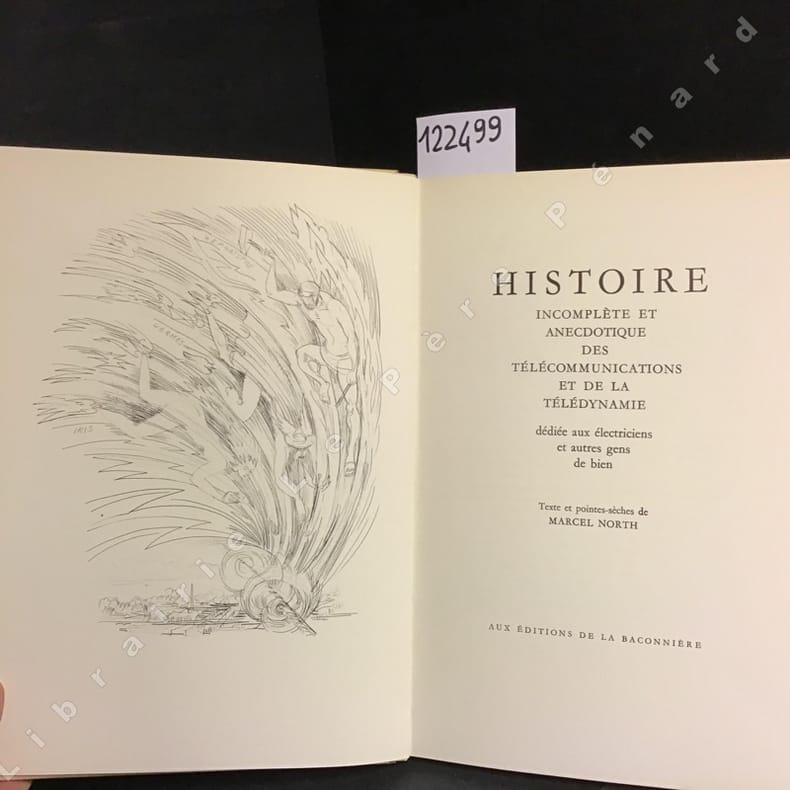
19541224991954 Editions de la Baconnière - 1954 - In-4, cartonnage neutre, couverture rempliée, sous papier cristal - 94 pages - Nombreuses illustrations en N&B in-texte
2094Neuchâtel, Baconnière,1954 ; 8°, cartonnage éditeur. Nombreux dessins de l'auteur.
1959ROD0125450RADIO BELVU. 1959. In-4. Broché. Etat passable, Tâchée, Dos satisfaisant, Fortes mouillures. Environ 17 pages augemntées de nombreux tableaux et illustrations en noir et blanc dans le texte.. . . A l'italienne. Classification Dewey : 537-Electricité
1925LFA01887Un ouvrage de 803 pages, format 195 x 275 mm, illustré, relié percaline, publié en 1925, Chambre Syndicale des Forces Hydrauliques, bon état, rare
121006aafPresses polytechniques romandes, 1981, in-4to, VII + 37 p., ill. de schémas n./b., brochure originale.
191212826Paris H. Dunod et E. Pinat 1912 Petit In-8 IX+276 pp, (.) Etude des machines électriques, propriétés, essais. Toutes tranches cirées, accroc sans manque en tête du dos.
1948101461Couverture souple. Broché. 234 pages. Papier bruni.
65978P., Dunod et Pinat (Bibliothèque de l'Enseignement Technique), 1912, in 8° relié pleine percaline verte de l'éditeur, X-276 pages ; 227 figures ; cachets ; cartonnage légèrement fané.
51948P., Dunod, 1935-1933, 2 volumes in 8° brochés, X-303 et VIII-317 pages ; quelques rousseurs et petites mouillures marginales ; galeries de vers dans les marges.
1911RO30340707H. Dunod et E. Pinat. 1911. In-8. Relié. Etat d'usage, Couv. légèrement passée, Dos frotté, Papier jauni. 238 pages. Tranches roses. Coins frottés. Ex-libris à l'encre en page de faux titre, de garde et 1er contre-plat. Quelques rousseurs.. . . . Classification Dewey : 537-Electricité
194234DjParis Dunod 1942 14x19 3 Volumes - manque le Tome 2 - 303 , 405 et 234 pages - nombreus schemas , planches depliantes et photographies - bon etat general