6 824 résultats
Hardcover. Jacket is slightly sunned and marked, with a hint of wear. Page block is tanned, with a few minor marks; pages are clean and sound, with clear text throughout. Introduction by Anthony Burgess. Very good in a good-plus jacket. TS Used
Michael E. Beall, Howard M. Fulmer AutoCad 14. Guida all'uso. , Apogeo 1997, Buono stato. Brossura editoriale con copertina con segni d'uso e difetti ai margini. Tagli pagina leggerissimamente bruniti. Illustrazioni in b/n. Informatica Michael E Beall Howard M Fulmer AutoCad 14 Guida all'uso Apogeo 1997 Informatica Buono (Good) . <br> <br> <br> <br> 8873033601
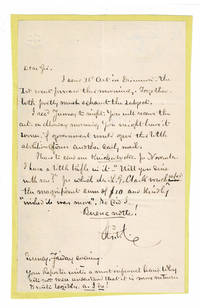
1860100131<p>Oct. 1860. Oct. 1860. Very good. - Over 115 words penned on 8 inch high by 4-7/8 inch wide creamy white paper with an embossed mark at top left. The abolitionist journalist C.T. Congdon writes that "I send the IIe Act in Disunion - the Ist went forward this morning. Together both pretty much exhaust the subject". He goes on to bemoan the delay "you might have it sooner if government would give this little abolition town another daily mail." He asks the recipient to please send him the "Knickerbocker for November. I have a little trifle in it - 'Will you dine with me'." Closing with the wishes "Buena notte!" Congdon signs himself with an abbreviated signature which one can only guess is "ChTC" and concludes with a postcript about the illegibility of another reporter's handwriting. The letter is mounted with glue from the verso onto a 8-1/4 inch high by 5-1/4 inch wide yellow paper. It is identified in an unknown hand on the verso: "C. T. Congdon / Oct 1860". Very good.</p><p>The journalist poet and abolitionist Charles Taber Congdon 1821-1891 started his career by cleaning floors and delivering newspapers for the New Bedford Courrier. He went on to work as a reporter for the Daily Register and an editor at Daily Bulletin and the Daily Mercury before Horace Greeley personally invited him to come work at the New York Tribune in 1857. He came to be known as "Greeley's right hand man" and was listed by Louis Star as one of the Tribune reporters who "lived to destroy slavery root and branch". While working at the Tribune Congdon also published articles in "Vanity Fair" the "North American Review" and the "Knickerbocker Magazine". Congdon published recollections as well as poetry including "The Warning of War" in 1862.</p><p>RARE.</p> [Oct. 1860].
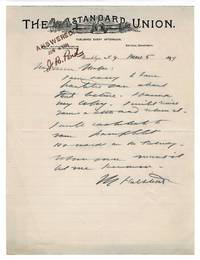
1894101010<p>Brooklyn NY June 5 1894. 1894. Very good. - Over 40 words in pencil on 10-1/2 inch high by 8 inch wide "The Standard Union" newspaper stationery. Apologizing about a lecture the American newspaper editor and war correspondent Murat Halstead offers to contribute an essay to the American impressario and lecture manager James B. Pond's pamphlet "I will contribute to your pamphlet 100 words on McKelway. When you receive it let me know." Signed "M. Halstead". Folded for mailing with minor creases and slight darkening along the bottom edge. Very good.</p><p>The American newspaper editor and magazine writer Murat Halstead 1829-1908 was a war correspondent during 3 wars. He started his career writing for "The Hamilton Intelligencer" and "The Roseville Democrat" at 18 years of age and went on to contribute to several other newspapers. He bought interest in the paper while working as a local reporter for Cincinnati's "Commercial". Halstead reported on several battles during the Civil War and was a war correspondent during the Franco-Prussian War. He took over controlling interest in the "Commercial" and became president of the company when the "Cincinnati Gazette" merged with his paper. Moving to Brooklyn in 1890 he edited the "Standard Union". He went to the Philippines as a war correspondent at the start of the Spanish-American War.</p><p>The article which Halstead mentions in his letter is about St. Clair McKelway the editor of "The Brooklyn Daily Eagle". Halstead's own paper the "Standard Union" was also in Brooklyn.</p> Brooklyn, NY, June 5, 1894.
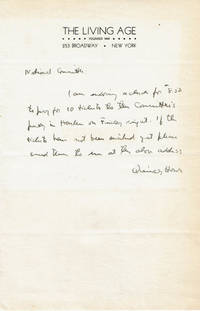
193096221New York: circa 1930s. 1930s. Very good. - 39 words penned on an 8-1/2 inch high by 5-1/2 inch wide sheet of The Living Age letterhead. Signed "Quincy Howe". The right edge & top edge of the letterhead are slightly darkened. Pieces of tape adhere to the verso where the item was removed from an album. Folded 3 times for mailing. Very good. <p>Howe writes to an unidentified committee about tickets to the committe's upcoming party in Harlem. Howe was an editor for The Living Age from 1923 to 1929 when the magazine was sold. After the sale the new owner rehired Howe as Editor-in-Chief.<p>An advocacy journalist in the tradition of New England liberalism Quincy Howe 1900-1977 helped bring food to striking miners in Harlan County Ky in 1932; opposed restriction of immigration; and was active in prison reform. As a director of the American Civil Liberties Union from 1932 to 1940 he fought against censorship. But it was in foreign policy matters that Howe drew the most attention in the thirties. A critic of dictatorships of the left and the right he was sympathetic to the rising nationalist movements in the colonial empires of the Old World. He was a member of the left-wing American League against War and Fascism. In his writings of that time he stressed the dangers of American intervention in another world war. New York: circa [1930s]. unknown
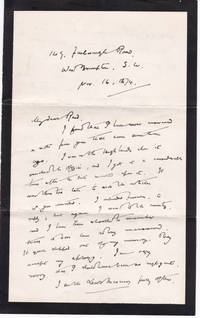
187435633London: November 16 1874. 1874. Very good. - Letter penned in black ink & filling both sides of a sheet of black-bordered 7 inch high by 4-3/8 inch wide cream paper. Signed "James Macdonell". Folded twice for mailing. Very good. <p>Macdonell writes to Thomas Wemyss Reid editor of the Leeds Mercury. He apologizes at length for not having answered a note from Reid which arrived while Macdonell was away in the Highlands. He goes on to describe his current busy life as a journalist mentioning "I am also gathering the material for a big book" probably his book on France. "But I have almost abandoned the hope of being able to write anything of that kind until I shall have freed myself from the shackles of my journalism."<p>Scottish journalist James Macdonell 1841-1879 began by writing for the Aberdeen Free Press in his native city and at the age of 22 became editor of the Northern Daily Express. He moved to London in 1865 to take up a staff position at the Daily Telegraph which he held until 1875 serving as special correspondent in France in 1870 and 1871. He became a leader writer on the Times of London in 1873. His posthumous "France since the First Empire" was incomplete at his death but yielded insights into the French politics of his time. [London]: November 16, 1874. unknown
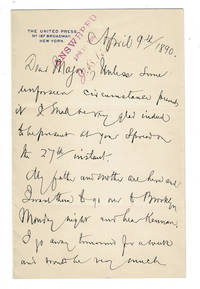
1890100212<p>New York April 9th 1890. 1890. Very good. - Two pages consisting of over 80 words penned on 2 faces of 8-1/8 inch high by 5-1/4 inch wide "The United Press" stationery with an integral attached leaf. In his letter addressed to American impressario and lecture manager Major James B. Pond Phillips informs him that "unless some unforeseen circumstance presents it I shall be very glad indeed to be present at your spread on the 27th instant." He writes that his mother and father are visiting and that he wants "them to go over to Brooklyn Monday night and hear Kennan" and asks Pond for the particulars regarding where "Kennan is to hold forth". Signed with his rapidly scribbled signature. Folded for mailing Pond has stamped that he has answered at the top left of the first page. Very good.</p><p>The American journalist telegrapher and inventor Walter P. Phillips 1846-1920 expanded telegraph codes with his Phillips Code which allowed for brevity by making use of such abbreviations as POTUS and SCOTUS. He was managing editor of the Providence Morning Herald and subsequently editor of the Providence Morning Star before becoming the head of The United Press.</p><p>George Kennan 1845-1924 to whose lecture Phillips refers was an American explorer noted for his travels in the Kamchatka and Caucasus regions of the Russian Empire.</p> New York, April 9th, 1890.
185935713New York: January 15 1859. 1859. Very good. - 34 words penned in black ink on a cream sheet of 9-3/4 inch high by 7-5/8 inch wide sheet of Times Office letterhead with a handsome engraving of the Times building at top left. Signed "W. J. Raymond". The bottom edge of the letter is slightly darkened with some light creasing. Once mounted into an album with paper remnants adhering to the corners of an integral attached blank leaf. A couple of small chips are torn from the corners of the blank. Folded 3 times for mailing. Very good. <p>Raymond writes agreeing to an exchange with another publication: "We shall be very happy to send you our semi-weekly Edition in Exchange for the W. & R. We would send the Daily but for the fact that our Exchange list is already inconveniently large."<p>Henry Jarvis Raymond 1820-1869 was an American journalist and politician and co-founder of the New York Times. Between 1841 and 1851 he worked as a journalist and associate editor for various newspapers including Horace Greeley's New York Tribune and James Watson Webb's Courier and Enquirer. In 1851 Raymond convinced George Jones who had also worked at the Tribune to become his partner and publish a new paper that would report the news in a neutral manner. They co-founded the New York Times and Raymond edited the paper until his death. Raymond was a member of the New York State Assembly in 1850 and 1851 and was elected Speaker in 1851. A member of the Whig party's northern radical anti-slavery wing he was nominated for Lieutenant Governor of New York in 1854 over Horace Greeley. He was elected and served from 1855 to 1856. Raymond has sometimes been called "the godfather of the Republican Party". He played a prominent role in the party's formation and drafted the Address to the People adopted by the Republican organizing convention in 1856. New York: January 15, 1859. unknown
cm. 17 x 24, vi-724 pp. con 14 tavv. f.t. Accademia toscana di scienze e lettere ?La Colombaria? - Serie Studi L?editto che Francesco Stefano di Lorena promulg? nel 1743 per disciplinare nel Granducato di Toscana l?esercizio dell?attivit? tipografica fu certamente innovativo e costitu? l?inizio di una evoluzione verso quella libert? di stampa che oggi viviamo. Da questa premessa prende avvio un puntuale e documentato excursus sui principali personaggi coinvolti in Toscana nella seconda met? del XVIII secolo. The edict proclaimed by Francesco Stefano di Lorena in 1743 to regulate the practice of the typographical activity in the grand duchy of Tuscany was definitely innovative and marked the beginning of an evolution towards that freedom of the press enjoyed today. The introduction gives way to a precise and well-documented excursus on the main characters involved in Tuscany in the second half of the 18th century. 1370 gr. vi-724 p.
Hardcover and jacket. First US edition, first printing. Small marker pen dot on page block foot, otherwise in excellent condition throughout. TS Used
AA.VV. AV and PRINTING: sul primo Qtr le printer in maglia rosa. Rivista. n.4 1998. , Tecnoimprese 1998, Ottimo stato. Brossura editoriale spillata. Copertina plastificata illustrata. Informatica AA VV AV and PRINTING: sul primo Qtr le printer in maglia rosa Rivista n 4 1998 Tecnoimprese 1998 Informatica Ottimo (Fine) . <br> <br> <br> <br>
197122484New York: Avant Garde Media 1971. First edition. Wraps. Publisher's pictorial wrappers. Very good/Near fine. 28.5 x 28 cm. 15 issues a complete set with 2 copies of issue No. 2 with cover illustration of Marilyn Monroe. A colorful potpourri on life during this period: drugs sexual mores politics cultural turmoil illustrated with photographs serigraphs and colorful graphics. Two issues feature Piccaso's erotic gravures and John Lennon's erotic lithographs plus contributions by Richard Lindner and Tom Wesselmann. Following is OCLC description: Quarterly ; Former: Bimonthly Four no. a year 1969- Five no. a year 1968. Description: No. 1 Jan. 1968-; Ceased in 1971.; 4 volumes. Spines chipped chipped to issues 10 and 14 balance of covers clean tight and square. Avant Garde Media unknown
0495821527New. Brand new and still unused unknown
0495821489New. Brand new and still unused unknown
J. POLY, P. POULAIN, P. COLACE AVVIAMENTO ALL'INFORMATICA. , Le Monnier 1978-07-01, Copertina ombrata, scolorita e leggermente rovinata ai margini Buono (Good) . <br> <br> <br> 410<br>
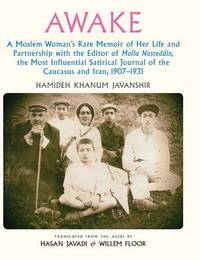
2016w240433093Mage Publishers 2016. 187pp. White hardback glossy boards b&w photo on front cover VG no DJ appendices footnotes b&w photos and illustrations A Moslem Woman's Rare Memoir of Her Life and Partnership with the Editor of Molla Nasreddin the Most Influential Satirical Journal of the Caucasus and Iran 1907-1931 . Hard Cover. Very Good. Mage Publishers Hardcover
Very Good English Paperback. Cr. 8vo. (20 x 14 cm). In Azerbaijaniani with Cyrillic. 110, [2] p. Azerinform: Ma'lumat verir, bildirir, tekzib edir. Azerinform: Reports, announces, rejects. A study on Azerinform. Azerinform is an information bureau of Azerbaijan recieving all information on events taking place in the world and mainly on the developments in the Azerbaijan Republic. Azad Sherifov, Azerinform director, has compiled this book. It contains truth and only the truth but sometimes it is bitter. The book narrates about the events taking palce in the republic, connected with the swollen problem of Nagorny Karabakh. Azerinform repots about what had happened with articles which had not been published in central press for some reasons. The book analyses the subjective and false information of the Soviet TV and central press, which infringes republic sovereignty, its integrity, future of the whole Azerbaijan nation who is carrying on a complicated ideological structure. CAUCASUS Turkology Azerbaijan Media Journalism Memoirs Corporate history.
Very Good English Paperback. 12mo. (17 x 12 cm). In English. 140 p. Azerinform: Ma'lumat verir, bildirir, tekzib edir. Azerinform: Reports, announces, rejects. A study on Azerinform. Azerinform is an information bureau of Azerbaijan recieving all information on events taking place in the world and mainly on the developments in the Azerbaijan Republic. Azad Sherifov, Azerinform director, has compiled this book. It contains truth and only the truth but sometimes it is bitter. The book narrates about the events taking palce in the republic, connected with the swollen problem of Nagorny Karabakh. Azerinform repots about what had happened with articles which had not been published in central press for some reasons. The book analyses the subjective and false information of the Soviet TV and central press, which infringes republic sovereignty, its integrity, future of the whole Azerbaijan nation who is carrying on a complicated ideological structure. CAUCASUS Turkology Azerbaijan Media Journalism Memoirs Corporate history Armenians International relations Nagorno-Karabakh Karabakh question.
B. Andreoli, Uomini nel Medioevo Studi sulla società, lucchese dei secoli VIII IX Pà,tron Editore, Bologna, 1983, cm. 21,5x14,5, pp. 164, timbro saggio campione gratuito in terza di copertina, cartoncino ed. ill. Condizioni di conservazione Volume in buono stato con leggere tracce d'uso, minima pieghetta e strappetto al dorso (vedi foto), interni con leggeri accenni di ingiallimento. SETT69.L19548 MT
B. Facinelli, Sindacalismo Soreliano Vallecchi Editore, Firenze, 1938, cm 19x13, pp. 167, br. ed. Condizioni di conservazione Esemplare in buone condizioni con leggere tracce d'uso, brossura editoriale con minime pieghette e macchiette (vedi foto), interni leggermente bruniti. SETT172.L15402 MT
305 p., illus. Hardcover Very good condition good
br. Macchinisti, fonici, producer, assistenti di varia natura, amministratori, videomaker, uomini di marketing, impiegati, scrittori freelance: sono figure che lavorano nell'industria dei media ma che di solito restano completamente invisibili ai lettori, agli spettatori, agli utenti. Professionisti che costituiscono la spina dorsale della produzione mediale, ma vivono e rimangono nel backstage, il settore non esposto al pubblico in cui si prepara per andare "in scena" o "in onda". Questo libro vuole aprire la "scatola nera" dei media e rivelarne appunto il backstage, la "cucina" dove si preparano i testi parte del nostro quotidiano. I contenuti e gli immaginari proposti dai mezzi di comunicazione italiani sono infatti sempre il risultato di scelte, decisioni, pratiche produttive, organizzazioni e attività molteplici, da indagare per meglio comprenderne l'impatto e il valore. Attraverso una serie di saggi dedicati a una varietà di media, di metodi e di oggetti di studio, il libro si occupa per la prima volta in modo compiuto della produzione mediale italiana e delle modalità con cui si può studiare.
1797123033.GaudioCD. Good. Access codes and supplements are not guaranteed with used items. May be an ex-library book. unknown
0710007922.Gpaperback. Good. Access codes and supplements are not guaranteed with used items. May be an ex-library book. paperback
1976Q-0710084897Routledge & K. Paul 1976-01-01. Hardcover. New. New. In shrink wrap. Looks like an interesting title! Routledge & K. Paul hardcover