Schubert, Friedrich Theodor VonBiblio.com
650 résultats
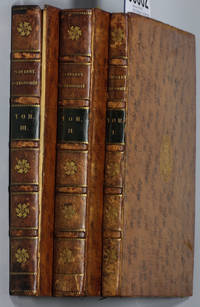
182235002St Petersbourg Russia: L'Academie Imp. Des Sciences. Good with no dust jacket. 1822. First Edition. Hardcover. Quite beautiful full calf leather. 10 folding engraved plates. 8 xvi 286; 4 x 568; 4 viii 524 pages including half-titles. 3 volumes. 4to 256x214 mm contemporary calf gilt with Signet Library arms on covers Volume 3 front cover detached others covers starting; minor foxing on Volume 1 opening leaves. St. Petersburg: Imprimerie de l'Académie Impériale des Sciences 1822. First edition in French of Schubert's 1798 Theoretische Astronomie. Houzeau & Lancaster 11811. Paper stamps inside front covers Libraire Alain Brieux withdrawn. According to Google this was a bookstore of Science and medicine. Printed in Russian Empire under the rule of Alexander I Tsar of Russia 18011825 who ruled during the chaotic time of the Napoleonic Wars. He died without issue and the Decembrist revolt of liberal army officers resulted in his brother Nicholas I being crowned. From the GUTZWILLER ASTRONOMY &SCIENCE BOOKS collection. . L'Academie Imp. Des Sciences hardcover
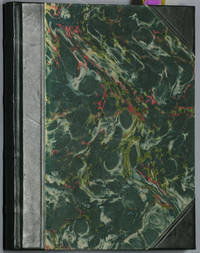
1789D16582Boston: B. Edes & Son 1789. First Edition. Hardcover. Good. 12mo. 19thcentury ¾ leather and marbled paper over boards. 16pp. Lacking the folding plate which holds the distinction of being the first chart of the solar system produced in the United States. Nevertheless a book that has become quite scarce on the market. Housed in a custom box with a reproduction of the lacking chart folded and laid in. <br/><br/> B. Edes & Son hardcover
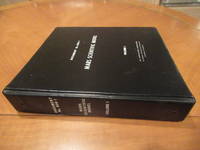
028785Pasadena: D. Lothrop And Company 1972. 1st Edition . Hardcover. Fine. Three Ring Binder Looseleaf 1 5/8" Thick Plus The Printed Binder Itself Six Sections Each Paginated Separately. Prepared By Members Of The Lunar And Planetary Science Section Under Nasa Contract Nas 7-100 To "Present An Up-To-Date Scientific Model Of The Planet Mars With Data Values Limitations And Sources And With A Limited Amount Of Interpretation Where Appropriate". The Manual Was Updated Later Notably In 1972 And 1977. A Wealth Of Information In Charts Transparent Overlays Maps Etc. Carefully Organized And Indexed With Large Folding Map And Separate Large Folding Planning Chart In The Pocket At Front With Two Copies Of The September 29 1972 Transmittal Memo For This Revision. Very Scarce <br/> <br/> D. Lothrop And Company hardcover
1882039051Washington: Bureau Of Navigation Navy Department. 1882. 1st Edition 1st Printing. Hardcover. Near Fine. Xiv 487 Pp. Clean Pages Slightly Aged In A Modern Sturdy Blue Cloth Binding Spine Gilt By Tassinari Bros. Of Indian Orchard Ma. Light Wear. Two New Hampshire Institutional Stamps. Simon Newcomb 1835 -1909 Was A Canadian-American Astronomer Applied Mathematician And Autodidactic Polymath. Newcomb Visited Paris France In 1870 Already Aware That The Table Of Lunar Positions Calculated By Peter Andreas Hansen Was In Error. While In Paris He Realized That In Addition To The Data From 1750 To 1838 That Hansen Had Used There Was Further Data Stretching As Far Back As 1672 And Newcomb Used The "New" Data To Revise Hansen's Tables. In 1878 Newcomb Started Planning For A New And Precise Measurement Of The Speed Of Light Using A Refinement Of The Method Of Léon Foucault. A Letter From Albert Abraham Michelson Began A Long Collaboration And Friendship. In 1880 Michelson Assisted At Newcomb's Initial Measurement But Michelson Left To Start His Own Project. Miichelson Published His First Measurement In 1880 Reprinted Here But Newcomb's Measurement Was Substantially Different And In 1883 Michelson Revised His Measurement To A Value Closer To Newcomb's. In 1881 Newcomb Discovered The Statistical Principle Now Known As Benford's Law Formulating The Principle That In Any List Of Numbers Taken From An Arbitrary Set Of Data More Numbers Will Tend To Begin With "1" Than With Any Other Digit. In 1891 Within Months Of Seth Carlo Chandler's Discovery Of The 14-Month Variation Of Latitude Now Referred To As The Chandler Wobble Newcomb Explained The Apparent Conflict Between The Observed Motion And Predicted Period Of The Wobble As Due To Elasticiity; He Used The Variation Of Latitude Observations To Estimate The Elasticity Of Earth Finding It To Be Slightly More Rigid Than Steel. He Wrote On Economics And His Principles Of Political Economy 1885 Was Described By John Maynard Keynes As "One Of Those Original Works Which A Fresh Scientific Mind Not Perverted By Having Read Too Much Of The Orthodox Stuff Is Able To Produce From Time To Time In A Half-Formed Subject Like Economics." He Was Credited By Irving Fisher With The First-Known Enunciation Of The Equation Of Exchange Between Money And Goods Used In The Quantity Theory Of Money. His Reputation Suffers From His Hostility To C. S. Pierce And Also From Newcomb's Disbelief In The Possibility Of Manned Flight. Source: Wikipedia. Albert A. Michelson 1852-1931 Performed Early Measurements Of The Velocity Of Light With Amazing Delicacy And In 1881 He Invented His Interferometer For The Purpose Of Discovering The Effect Of The Earth's Motion On The Observed Velocity. In Cooperation With Professor E.W. Morley And Using The Interferometer It Was Shown That Light Travels At A Constant Speed In All Inertial Systems Of Reference. The Instrument Also Enabled Distances To Be Measured With Greater Accuracy By Means Of The Length Of Light-Waves. At The Request Of The International Committee Of Weights And Measures Michelson Measured The Standard Metre In Terms Of Wavelength Of Cadmium Light. He Invented The Echelon Spectroscope And During His Wartime Service In The Navy He Performed Research Work On Devices For Naval Use - He Developed A Rangefinder Which Was Adapted As Part Of U.S. Navy Equipment. On His Return To Civilian Life Michelson Became More Interested In Astronomy And In 1920 Using Light Interference And A Highly Developed Version Of His Earlier Instrument He Measured The Diameter Of The Star Betelgeuse: This Was The First Determination Of The Size Of A Star That Could Be Regarded As Accurate. He Was The First American To Receive The Nobel Priize For Physics. Nobel Lectures Physics 1901-1921 Elsevier Publishing Company Amsterdam 1967. With 1985 Purchase Receipt Of Space Scientist Richard E. Bateman From Astronomy Book Dealer Paul Luther. <br/> <br/> Bureau Of Navigation, Navy Department. hardcover
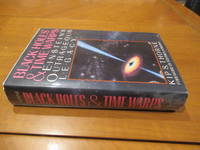
1994059827New York: Norton 1994. 1st Edition . Hardcover. Fine/Fine. 9 1/4" Tall. Drawings and Photographs Throughout. 619 Pp. Grey Cloth Spine Lettered In Silver Blue Boards. First Printing. A Fragile Binding For Unknown Reasons Often Found Near New But With Front Hinge Cracked Or Broken This Copy Not So Fine With Fine Dust Jacket Priced $30.00. This Copy Inscribed By Thorne On The Title Page. <br/> <br/> Norton hardcover
168035009Amsterdam:: Apud Janssonio-Waesbergios. Very Good with no dust jacket. 1680. Hardcover. B&W Illustrations; Numerous engraved and woodcut illustrations and diagrams. 8 309 7 pages. 4to 198x152 mm modern 1/2 green calf; scattered foxing title soiled and moderately wrinkled with small label remnant in gutter dampstaining in lower margins in second half of volume. PROVENANCE-Astronomy and Science Books from the Collection of Martin C. Gutzwiller. . Apud Janssonio-Waesbergios, hardcover
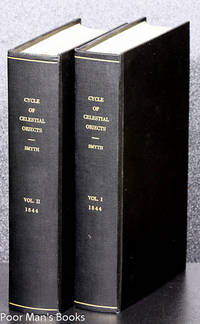
184433052London: John W. Parker. Very Good with no dust jacket. 1844. First English Edition. Hardcover. B&W Illustrations; 8vo 8" - 9" tall; viiii45164pp. ads; xx560 pages; Numerous text illustrations. Half-titles; publisher's 4-page catalogue at end of Volume 2. 2 volumes. 8vo modern gilt-lettered black cloth; old institutional stamps on titles. First edition of a classic guide to amateur astronomy. The first volume is a general introduction to the subject; the second known as the Bedford Catalogue records 850 objects seen from the author's private observatory at Bedford. A career naval officer Smyth 1788-1865 devoted his attention to astronomy from 1830 onward. One of his sons was Charles Piazzi Smyth 1819-1900 astronomer royal for Scotland. BEA page 1070. Illustrated with a large number of textural engravings and drawings. . John W. Parker hardcover
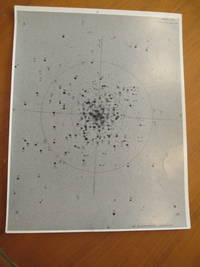
1950037416Circa 1950: Mt Wilson And Palomar Observatories 1950. Original Astronomical Photographs . No Binding. Near Fine/No Jacket. Original Astronomical Photograph Approximately 14" X 10 3/4". Fine. Black Images On Grey Background With Alignment Circles And Cross Lines. Annotated At Edges "4147 Center Red And P. E. Standards / 100" Astrophotometer Orientation" "N" At Top Of Astrophotograph Ink Quadrant Numbers And Also Ink Numbering Of Some Stars With Pencil Letters In Circles; All Annotations Appear To Be In Hand Of Edwin P. Hubble But Not Signed By Hubble. Stamp Of Mount Wilson And Palomar Obervatories On Verso "Object: Ngc 4147 / Enlargement 20X /Telescope Ph-707-S Remarks 100 200 Orientation". <br/> <br/> Mt Wilson And Palomar Observatories unknown
1950037420Circa 1950: Mt Wilson And Palomar Observatories 1950. Original Astronomical Photographs . No Binding. Near Fine/No Jacket. Original Astronomical Photograph Approximately 14" X 10 3/4". Fine. Black Images On Grey Background With Alignment Circles And Cross Lines.Annotated At Edges "Ngc 4147 Red P. E. Standards / 100" Astrophotometer Orientation" "N" At Top Of Astrophotograph Ink Quadrant Numbers And Also Black And Red Ink Hand Numbering Of Some Stars With One Unnumbered But Annotated "E" And "Var 1" With Arrow; All Annotations Appear To Be In Hand Of Edwin P. Hubble But Not Signed By Hubble. Stamp Of Mount Wilson And Palomar Observatories On Verso With Pencil Information Filled In "Object: Ngc 4147 / Telescope Ph-711-S Remarks 200 Orient". <br/> <br/> Mt Wilson And Palomar Observatories unknown
19868007575<p>Scotland: Pentland Press. Signed On Front End-Sheet By Author. Stated First Published In 1986 The Pentland Press Ltd. 1986 Blue Hard Covers Tiny Worn Speck On Bottom Edge Otherwise Sharp Corners And Edges Spine Square. Bright Silver Letters On Spine. 116 Thick Bright White Pages Are Tightly Bound. Approx. 45 Color Plates And Many B/W Illustrations Throughout. Appendix Bibliography And List Of Plates. Book Protected By Clear Protective Cover Over Boards. No Dust Jacket. See Photos 63-N . Very Good. Hardcover. 1st Edition. 1986.</p> Pentland Press hardcover
1915056314Washington: Carnegie Institution 1915. First Edition . Printed Grey Wrappers. Near Fine. Photographs. 99 Pp. Printed On Glossy Paper High Quality Plates. First Printing The Scarce Hardcover Issue 1915. Near Fine Gilt Brilliant No Stains Inscribed By Author To His Friend John Campbell Merriam; Documentation Of Their Relationship May Be Found In The Hale Papers At Caltech And In The Merriam Papers At The Library Of Congress. Per Wikipedia John Campbell Merriam 1869 - 1945 Was An American Paleontologist Educator And Conservationist. The First Vertebrate Paleontologist On The West Coast Of The United States He Is Best Known For His Taxonomy Of Vertebrate Fossils At The La Brea Tar Pits. In 1912 He Was Appointed Chairman Of The Department Of Paleontology At The University Of California. That Same Year He Began His Famous Studies Of Vertebrates At The La Brea Tar Pits. He And His Students Categorized Many Of The Vertebrate Fossils Found At The Site And Many More Were Placed In Storage. The Smilodon Was Later Established As The California State Fossil. In 1918 He Was Elected To The United States National Academy Of Sciences. That Same Year He Co-Founded The Save The Redwoods League Which Began Significant Preservation Efforts After Merriam Traveled The Redwood Areas Of Humboldt County California In 1922 Seeking To Spare Its Old-Growth The Effects Of Logging He Witnessed In Redwood Forests Closer To San Francisco. A Biography Which Details His Efforts To Preserve Wild Lands In California And Throughout The United States Was Published In 2005. In 1919 Merriam Served As President Of The Geological Society Of America. In 1920 He Was Appointed Dean Of Faculty At The University Of California Berkeley But He Left That Same Year To Become President Of The Carnegie Institution In Washington D.C. He Accomplishments As President Included Helping To Advance The Educational Programs Of The National Park Service As Well As Helping To Preserve The California Redwoods. He Was Elected To The American Academy Of Arts And Sciences In 1921. His Published Papers Are Collected In A Four-Volume Set Published In 1938 By The Carnegie Institution. Merriam Was A Founding Member Of The Galton Institute And A Cautious Political Supporter Of Eugenics. His Paternal First Cousin Frank Merriam The Eldest Child Of Civil War Veteran Henry C. Merriam Served As The 28Th Governor Of California Between 1934 And 1939 Having Defeated Upton Sinclair With The Aid Of Vicious Propaganda By Ultra-Conservative Interests. . <br/> <br/> Carnegie Institution unknown
1972020368San Francisco: W. H. Freeman and Company 1972. First Edition First Printing . Cloth. Near Fine/Near Fine DJ. 491 pp. Touch of wear at corners 1/2" closed tear at top and bottom of front spine edge of DJ small bump to lower spine edge of book indecipherable signature of previous owner hidden under front flap J--- M --- P-----. <br/> <br/> W. H. Freeman and Company hardcover
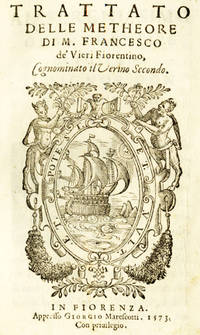
157319816Florence: Appresso Giorgio Marescotti. Very Good. 1573. First Edition; First Printing. Vellum. The first edition of the first comments on the first three books of "Meteorologica" of Aristotle in in the Italian language. Adams V714. Includes index and errata leaf errori occorsi nello stampare. Original limp vellum minor worming and soiling. Spine handlettered; With his commentary on the first three books of Aristotle's "Meteorologica" Francesco de Vieri Professor at the University of Pisa studied not only comets and meteors but also rainbows earthquakes the evaporation of water and the phenomenon of tides. The later edition in 1582 was enhanced with commentary on the fourth book on the inorganic material of the terrestrial sphere; Woodcuts; Small 8vo; 16 166 8 pages . Appresso Giorgio Marescotti hardcover
WB18616Italy ca mid-18th century. Hardcover. Very Good. 64 leaves 8vo 202 x 135 mm. In Italian. Written in cursive in brown ink on thick paper. With several ink diagrams tables head- and tail-pieces throughout. Some offsetting and a few stains. 18th-century sprinkled calf gilt some staining and repairs. Text opens: La Sfera che si spieghera si divide in Naturale et Artificiale; la Naturale compre de tutto lUniverso lArtificiale e un instrument fatto dallarte comprendere La Sfera Naturale e composta de diversi circoli. Describing the terrestrial sphere time signs of the zodiac the movements of the heavens the cycles of the moon and presenting propositions experiments and corollaries. <br/><br/> hardcover
1929025041Pasadena 1929. Original Drawing . No Binding. Near Fine. 13 3/4" x 12 1/4. Original Pencil Engineering Drawing Of Three Views Of A "Latitude Finder At Any Hour Angle With Three Reflections" Dated 1929 Signed Rwp. The Drawing Is 9 5/8" X 11 1/8" With Ample Margins. Porter Is Famous For His Prescient Pre-Construction Drawings Of The Palomar Observatory And Its Telescopes Machinery And Buildings So Well Visualized That They Were Used As Guides During Construction. <br/> <br/> unknown
1723030380Lugduni Batavorum Apud Petrum Vander Aa 1723. 1st Edition 1st Printing. Hardcover. Very Good. Seventeen Folding Plates. Title Page 16 413 Pp 15 Pp Catalogus Librorum Followed By 17 Folding Plates At End Each With Many Figures. Full Vellum Early 18Th Century Blind Stamped Design At Center Of Covers Spine Stamped In Gilt. Hand Marbled Papers On Pastedowns All Edges Colored Red. Text Block 17.5 Cm Tall. Latin Exposition Of Newtonian Philosophy Addressed To Students. A Very Nice Example In Original Vellum Light Wear At Spine Ends A Few Tiny Holes In Bottom Spine Edge Of Rear Cover And In Gutter Edge At Bottom Of Plates 16 And 17 Not Affecting Text Or Illustrations. Red Color Of Edges Of Page Blocks Is Almost Entirely Unfaded And Still Shiny. No Marks Or Bookplates. Per Wikipedia Willem Jacob 'S Gravesande 1688 - 1742 Was A Dutch Lawyer And Natural Philosopher Chiefly Remembered For Developing Experimental Demonstrations Of The Laws Of Classical Mechanics. As Professor Of Mathematics Astronomy And Philosophy At Leiden University He Helped To Propagate Isaac Newton's Ideas In Continental Europe. In 1715 'S Gravesande Visited London As Part Of A Dutch Delegation Sent To Welcome The Hanoverian Succession In Great Britain. In London 'S Gravesande Met Both King George I And Isaac Newton And Was Elected A Fellow Of The Royal Society.In 1717 He Became Professor Of Mathematics And Astronomy In Leiden. From That Position He Was Instrumental In Introducing Newton's Work To The Netherlands. 'S Gravesande's Main Scientific Work Is Physices Elementa Mathematica Experimentis Confirmata Sive Introductio Ad Philosophiam Newtonianam "Mathematical Elements Of Natural Philosophy Confirmed By Experiments; Or An Introduction To Newtonian Philosophy" Published In Leiden In 1720. In That Book He Laid The Foundations For The Teaching Of Newtonian Mechanics Through Experimental Demonstrations. He Presented His Work Before Audiences That Included Voltaire And Albrecht Von Haller. The Book Was Soon Translated Into English By John Theophilus Desaguliers Curator Of Experiments For The Royal Society. In 1722 He Published The Results Of A Series Of Experiments In Which Brass Balls Were Dropped From Varying Heights Onto A Soft Clay Surface. He Found That A Ball With Twice The Speed Of Another Would Leave An Indentation Four Times As Deep From Which He Concluded That The Correct Expression For The "Live Force" Of A Body In Motion What Is Modernly Called Its "Kinetic Energy" Is Proportional To Its Mass And The Square Of Its Velocity. <br/> <br/> Lugduni Batavorum Apud Petrum Vander Aa hardcover
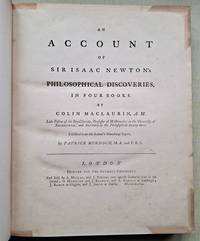
1748023048London: Printed for the Author's Children 1748. Large quarto pp 6 20 page subscriber's list xx 392 with six folding tables the title page with a little toning to the edges a few slight blemishes here and there but a remarkably clean copy overall internally contemporary half calf and marbled boards slightly rubbed and scuffed but a good sound binding. The RARE large paper copy measures 223mm x 290mm. Colin Maclaurin was a Scottish mathematician who made important contributions to geometry and algebra. He is also known for being a child prodigy and holding the record for being the youngest professor. A mathematician and younger contemporary of Newton's Maclaurin believed in Newton's theory of calculus and in the relationship between natural philosophy and mathematics. In this work which was published posthumously by subscription Maclaurin writes on Newton's discoveries and methods of investigation and also includes a long history of natural philosophy. "Though a number of other general expositions of Newton's thought were published during the eighteenth century MacLaurin's Account has long been recognized as the leading authoritative statement of mainstream Newtonianism" DNB. . First Edition. Half Leather. Very Good. Printed for the Author's Children Hardcover
1589354109Heidelberg: in Officina Sanctandreana H. Commelin 1589. Title with woodcut vignette 48 woodcut illustrations. Pp. 2 1-170; 1-302 2 First part in Greek and Latin second in Latin. 1 vols. 8vo. Old vellum spine titled in ink. Note on flyleaf in an early hand "cum notii MSS. Alb. Jac. Conradi" heavily annotated in the second part pages 1-156. Paper flaw with loss of page number at L6 p. 167/8. Very good. Title with woodcut vignette 48 woodcut illustrations. Pp. 2 1-170; 1-302 2 First part in Greek and Latin second in Latin. 1 vols. 8vo. Works by Proclus Aratus and Leontius Mechanicus in Greek with parallel Latin text; works by Aratus Cicero Avienus Germanicus Caesar and Hyginus in Latin. STC German 367 not in VD 16; Adams A-2076; Brunet I 533; Houzeau & Lancaster Bibliographie générale de l'astronomie 782; Schweiger I 353; Zinner 3356 in Officina Sanctandreana (H. Commelin?) unknown
ABAACali8<p>Witebergae Wittenberg Haeredes Johannis Cratonis 1580.</p><p>In-12 of 8 ll. 247 ll. decorated with numerous figures of which 2 with movable parts and 3 folding plates out of text.</p><p>Green vellum with small overlaps gilt filets around the covers fleur-de-lys at the corners coat of arms stamped in gold in the center flat spines traces of silk lakes. <em>Contemporary binding</em></p><p>153 x 83 mm.</p><p><strong>Rare edition of this astronomical work in which the scientific revolution will have its roots.</strong></p><p>"The <em>Theoricæ novæ planetarum</em> of Georg Peurbach 1423-1461 played a decisive role in the beginnings of the scientific revolution.</p><p>A considerable part of the work shows that the representation of the celestial universe elaborated by Peurbach contains an unprecedented innovation and allows to affirm that one century before Copernicus Peurbach had already completed his own astronomical revolution. Astronomy now changes its status: from being an abstract mathematical science it is about to become a science of celestial reality where mathematics assumes a new role. It becomes the foundation of a universe conceived as physically existing. The critical edition of the <em>Theoricæ novæ planetarum</em> accompanied by its French translation as well as a technical commentary allows the reader to measure in a well-founded way the innovative scope of the universe conceived by Peurbach.</p><p>The study of the diffusion of the <em>Theoricæ novæ planetarum</em> from 1454 to 1653 shows how Peurbach's universe aroused the interest of his contemporaries who immediately grasped its innovative scope. This gave life to a real movement of thought which extended for two centuries and influenced the astronomical thought of learned Europe. The result is that on the <em>Theoricæ novæ planetarum</em> a pre-Copernican astronomy was born and established endowed with its own identity and with characteristics that distinguish it from that of the past. In this pre-Copernican astronomy the scientific revolution has its roots". <em>Theoricæ novæ planetarum Georgii Peurbachii In the history of astronomy</em> Michela Malpangotto research director at the CNRS.</p><p><br /><strong>The work is decorated with 82 woodcuts in the text including three folded and two with movable parts.</strong></p><p><strong>A precious copy preserved in its contemporary green vellum with unidentified German arms.</strong></p><p><strong>FR</strong></p><p>Witebergae Wittenberg Haeredes Johannis Cratonis 1580.</p><p>In-12 de 8 ff. 247 ff. ornés de nombreuses figures dont 2 avec des parties mobiles et 3 planches dépliantes hors texte.</p><p>Vélin vert à petits recouvrements filets et fine roulette dentelée dorés encadrant les plats fleur de lys aux angles armoiries frappée or au centre dos lisse orné traces de lacs de soie. <em>Reliure de l'époque</em>.</p><p>153 x 83 mm.</p><p><strong>Rare édition de cet ouvrage d'astronomie dans lequel la révolution scientifique va plonger ses racines.</strong></p><p>" Aux <em>Theoricæ novæ planetarum</em> de Georg Peurbach 1423-1461 revient un rôle décisif dans les commencements de la révolution scientifique.</p><p>Une partie considérable du travail montre que la représentation de l'univers céleste élaborée par Peurbach comporte une innovation sans précédent et permet d'affirmer qu'un siècle avant Copernic Peurbach avait déjà achevé sa propre révolution astronomique. L'astronomie change désormais de statut : de science abstraitement mathématique elle s'apprête à devenir science de la réalité céleste où les mathématiques assument un rôle nouveau. Elles deviennent le fondement d'un univers conçu comme physiquement existant. L'édition critique des <em>Theoricæ novæ planetarum</em> accompagnée de sa traduction française ainsi que d'un commentaire technique permet au lecteur de mesurer de manière fondée la portée novatrice de l'univers conçu par Peurbach.</p><p>L'étude de la diffusion des <em>Theoricæ novæ planetarum</em> de 1454 à 1653 montre la façon dont l'univers de Peurbach a éveillé l'intérêt de ses contemporains qui en ont immédiatement saisi la portée novatrice. Ceci a donné vie à un véritable mouvement de pensée qui s'étend pendant deux siècles et influence la pensée astronomique de l'Europe savante. Il résulte ainsi que sur les <em>Theoricæ novæ planetarum</em> s'est engendrée et assise une astronomie pré-copernicienne dotée d'une identité propre et de caractères qui la distinguent de celle du passé. Dans cette astronomie pré-copernicienne la révolution scientifique plonge ses racines ". <em>Theoricæ novæ planetarum Georgii Peurbachii Dans l'histoire de l'astronomie</em> Michela Malpangotto directrice de recherche au CNRS.</p><p><strong>L'ouvrage est orné de 82 figures sur bois dans le texte dont trois repliées et deux à parties mobiles.</strong></p><p><strong>Précieux exemplaire conservé dans son vélin vert de l'époque aux armes allemandes non identifiées.</strong></p> hardcover
WB18617Italy ca 1790. Hardcover. Very Good. 182 leaves 8vo 220 x 158 mm. In Italian. Written in cursive in dark ink. Written in the right-hand column with notes and diagrams in pencil and ink in the left column. Fading to first part some minor staining a few quires becoming disbound. 18th-century paste-paper covered boards worn. <br/><br/>A series of astronomy lectures presumably in Orianis hand with a note on the front free endpaper from Professor Rossi attributing the manuscript to Oriani. Comprising some 36 lessons with additional information about physics and astronomy at the end likely delivered to his students at the college of Brera. Oriani studied astronomy under Joseph Louis Lagrange and was ordained a priest in 1776. He joined the Jesuit-operated Brera Observatory and was later appointed by Napoleon as director of the Milan Observatory in 1802. He used his calculations to prove that Uranus was a planet rather than a comet and was named a member of the French Academy of Science a Fellow of the Royal Society and a member of the Berlin Academy hardcover
1963003620<p>U.S. Government Printing Office. Fine. 1963. Original Wraps. A one-of-a-kind historical document for serious collectors on May 21 1963 the U.S. State Department sponsored a luncheon for astronaut Gordon Cooper in honor of his successful 22-orbit flight in Faith-7 on May 15-16 1963 this is the four-page program that was handed out at the event it is signed by six of the seven original astronauts on the front the second page contains a quote from President Kennedy and a list of the six Mercury flights page three contains the luncheon menu and the back page has a photograph of Cooper also included is the guest list which does not include astronaut John Glenn's name - proof that he wasn't there to sign it this event took place in the Benjamin Franklin Room and this unique document was obtained by us from a former State Department employee who personally obtained the signatures the program is printed on heavy-stock paper and is flawless it is housed in a manila State Department envelope the guest list is also flawless and all of the signatures are clean and legible. .</p> U.S. Government Printing Office
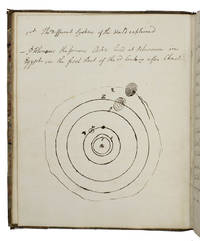
1820ABC_45977England 1820. Late 18th-century half calf marbled sides. 4to. Manuscript volume of notes on practical astronomy and mathematics in English written in ink on Dutch paper with a Maid of Dordrecht watermark without countermark. The leaves are numbered from the front 101 and 26 leaves of text and diagrams 39 blank leaves in the middle last 26 leaves in reverse order illustrated with several astronomical and mathematical diagrams including one of a solar system. A fascinating manual of astronomy written in English particularly as it relates to the form of the motions of the heavens dating from the period 1780-1825 probably from the beginning of that range. It is written in a single hand with the exception of one page though with some variations indicating that different parts of the MS were written at different times. The MS could have been prepared for personal use or as part of public tuition probably the former. The writer summarizes the subject matter of the manual on the first leaf: Astronomy is that part of Natural Philosophy which treats of the Phenomena of the heavenly Bodies. It is divided into 2 Parts Physical and Plain: by the latter we discover their Motions from the Apparent Motions; by the former the Causes of these real Motions. The manuscript comprises three parts with distinct subject matter. The first part covers the motion of the earth around the sun and its rotation about its axis with the consequences for the apparent motions of the sun and the heavens; with the moon and its phases and motion; and with lunar and solar eclipses. There are several references to John Keills An introduction to the true astronomy London 1721 or later editions. The second part principally discusses section 11 of Newtons Principia 1713 or later editions in particular as it relates to the motion of the moon. This part ends with a short section on algebra particularly polynomials which seems to have been composed more haphazardly than the remainder of the text. The third part which runs backwards starting from the end of the notebook gives demonstrations of various results in Book I of Principia notably the theorem that the orbits of the bodies in the solar system do not precess if and only if the central attractive force operating on them is exactly inverse-square. This is an important result not only for Newtons system of universal gravitation but also for the observational astronomy of the solar system which is discussed in the opening section of the book. Between the end of the second part and that of the third there are a few blank leaves and others have been torn out but the text appears to be complete.The manuscript appears to work through at least two different texts beginning with Keills on astronomy. There is a section devoted to what is called the precession of the equinoxes the westward drift of the points where the ecliptic and equator intersect due to the precession of the earths axis - the author notes that Sir Isaac Newton has demonstrated that it arises from the broad spheroidal figure of the earth. The author then turns to sunspots and the arguments for and against their being on the surface of the sun. Then comes a long discussion of the planets: the planes and periods of their orbits phases conjunctions retrograde motions apparent brightness and their distances from the sun. The second and third parts are notably more mathematical in nature than the first.The third part of the manuscript consists of a reading of various sections of Newtons Principia 1713 or later editions. Again it appears to work through and in some cases repeat Newtons proofs rather than representing a translation or paraphrase. It is not based on Mottes translation nor does it correspond with Thorps partial translation and edition. It does not appear to be based on any other intermediary between Newton and the writer such as Pemberton but to rely on Newtons Latin original here rendered in places pretty exactly into English. It renders propositions 43 to 59 of section 9 of book 1 of the Principia which concern the motion of bodies in moveable orbits and the motion of the apsides. This topic remains of considerable interest to astronomers and historians of astronomy. The manuscript hand remains fairly constant throughout the book: some variations more likely indicate the same writer at a different times or with a different pen than a different writer. The manuscript hand and paper together date the manuscript fairly securely to the period 1750-1825. If our hypothesis that the author used Thorps edition of Principia is correct that would date the manuscript no earlier than 1777. The section on the planets in the first part does not mention Uranus Georgium sidus discovered by William Herschel in 1781. Since the anonymous author seems to have followed astronomical discoveries closely this suggests a date no later than 1781. We therefore tentatively date the composition ca. 1777/81.We are indebted to Scott Mandelbrote for his assistance with the description of this notebook.Binding slightly rubbed. A couple pages have a tear at the foot and others are stained. Otherwise in very good condition. unknown
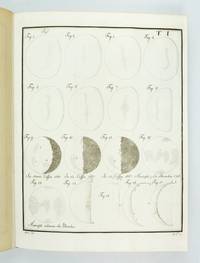
1796ST20813Helmstedt: Printed and commissioned by C. G. Fleckeisen 1796. FIRST EDITION. 275 x 225 mm. 10 3/4 x 9". XVI 250 2 pp. <br/> Contemporary brown paste paper boards smooth spine with red roan label. WITH 10 ENGRAVED PLATES one folding by "G. T." after Schröter. Honeyman 2825; de la Lande p. 635; Poggendorff II 846; cf. DSB XII p. 226 NDB XXIII 590 Schröter and 510 Schrader. See also Sheehan and Baum "Observations and inference: Johann Hieronymous Schroeter 1745-1816" Journal of the British Astronomical Association vol.105 no.4 p.171-175. Joints and extremities somewhat rubbed boards with a hint of chafing occasional very minor foxing including to the final plate half a dozen leaves with faint dampstain to head edge but a really excellent copy the other plates clean and bright the text especially clean and fresh and the binding entirely sound.<br/> <br/> This is a very rarely seen early work on the topography of Venus written by the astronomer who first observed the planet's so-called phase anomaly and illustrated with 10 folding plates. One of a series of "fragments" Schröter published--the others concerning the sun the moon Saturn and Mercury--"Aphroditographische Fragmente" discusses the author's observations of Venus' surface at the same time coining the term "Aphroditographie" in reference to the Greek version of the goddess' name. The most important observation contained in our work concerns the phases of Venus: like the moon Venus appears to wax and wane when observed through a telescope. However due to the thickness of its atmosphere the planet will always appear less full than mathematical calculations indicate it should be. This phenomenon known as Venus' phase anomaly--or the Schröter Effect--first observed by the man who gave it its name in 1793 is discussed in detail in this text which is accompanied by highly detailed plates. Eight of these are focused on Venus primarily depicting its phases; another is a diagram of the telescope; and the other depicts the Orion Nebula to which there is a short addendum. Schröter 1745-1816 built a state-of-the-art observatory at Lilienthal in Lower Saxony equipped with the largest telescopes available at the time. One such instrument which he built in his own workshop was an impressive 27-foot telescope discussed in the present work which has sometimes been incorrectly credited to Schröter's colleague William Herschel 1738-1822. Schröter made systematic long-term observations of the surfaces of the moon and planets something DSB tells us he was the first to do. Not everything he discovered or asserted turned out to be true. Based on his findings he posited the existence of a mountain range on Venus' surface and suggested a rotation period for the planet. Both subsequently were disproven modern scientists have suggested that Schröter's "mountain" may have been an overly optimistic observation of a cloud formation but like the rest of his work they demonstrated the commitment to observational astronomy that leads astronomy historians William Sheehan and Richard Baum to call Schröter "the man who laid the foundations of planetology and modern selenography." His long and impressive astronomical career came to an unfortunate end in 1813 when during the Napoleonic invasion the French reportedly set fire to his observatory. His library instruments unpublished notes and copies of many of his works which were published in small runs at his expense were said to have been destroyed in the fire a fact that may partly explain the current rarity of our book. We have been able to trace at auction only an ex-library copy of the book with significant condition problems that sold in 1981 for a hammer price of £260; the fact that such an unattractive copy came from the distinguished Honeyman collection reinforces how difficult the work is to obtain. Printed and commissioned by C. G. Fleckeisen unknown
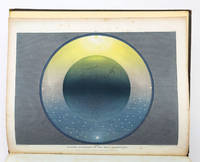
1846ST19286London: Printed by Catchpool & Trent for Simpkin Marshall & Co 1846. FIRST EDITION. 320 x 255 mm. 12 1/2 x 10". xiii 3 96 pp. <br/> Publisher's original blind-decorated dun-colored cloth gilt titling to upper cover smooth spine newer endpapers. WITH 11 COLOR ENGRAVINGS after Frost by W. P. Chubb & Son printed in oil colors by George Baxter all with original tissue guards. Front free endpaper with small ink signature of John Hill. See: Francis Reid "Isaac Frost's 'Two Systems of Astronomy' 1846: Plebeian Resistance and Scriptural Astronomy" in "The British Journal for the History of Science" Vol. 38 No. 2 Jun. 2005 pp. 161-177. Cloth rather spotted corners bumped but the binding solid with no wear to joints or hinges. A few spots of foxing to title page half of the tissue guards with overall very faint foxing/browning the illustrations with minor foxing at edges and in margins but the images themselves clean and bright and all in all a really excellent copy the text wide-margined and quite clean and fresh and the plates with rich coloring.<br/> <br/> Illustrated with beautiful color plates this anti-Newtonian work promotes a view of the universe based on the backward-looking beliefs professed by a Protestant sect known as the Muggletonians. Named after co-founder Lodowicke Muggleton the Muggletonians emerged in London in 1651 based on the claims of two tailors who professed to be the "Last Witnesses" described in the Book of Revelation. Rejecting the new directions in philosophical reason Muggletonians believed in a purely scriptural interpretation of the universe. According to E. P. Thompson's 1994 "Witness Against the Beast" the Muggletonians had curious notions quite contrary to other Protestant denominations: they believed that the soul is mortal that Jesus and God are one and the same that Heaven was left without divine supervision from Jesus' death until the day of judgment that Heaven resides six miles above the Earth that God stands between five and six feet tall and other unconventional things. Although the sect initially avoided both worship and evangelizing during the 19th century some followers became more outspoken about their beliefs and even published books appealing to the general public. Our author Isaac Frost 1793-1858 was a prominent Muggletonian and successful owner of a brass foundry who along with his brother Joseph invested large sums to promote their belief system--the present work being an especially notable example. Divided into two main sections the text first describes the Newtonian system of heliocentric astronomy and then turns to Frost's scriptural interpretation and geocentric views. As Reid tells us "According to Frost Scripture clearly states that the Sun the Moon and the Stars are embedded in a firmament made of congealed water and revolve around the Earth that Heaven has a physical reality above and beyond the stars and that the planets and the Moon do not reflect the Sun's rays but are themselves independent sources of light. Our book was apparently written as a reaction against the lecturers who expressed Newtonian astronomy--which was often for them and their audiences simply shorthand for heliocentrism." The 11 plates that illustrate these extraordinary ideas are the work of George Baxter a pioneering printer who revolutionized color printing techniques by combining metal engravings with woodblock printing using oil-based inks to produce high-quality affordable prints. The plates here are appropriately ethereal and otherworldly utilizing a beautiful palette with subtle gradations and esoteric figures to create memorable pseudo-scientific imagery. Although this work appears at auction with some regularity it is almost always incomplete no doubt because the attractiveness of its plates encourages harvesting. Useful price comparisons include a complete copy said to be in fine condition selling for £7500 in 2016 and six loose prints from the book fetching £6875 in 2015. [Printed by Catchpool & Trent for] Simpkin, Marshall, & Co unknown
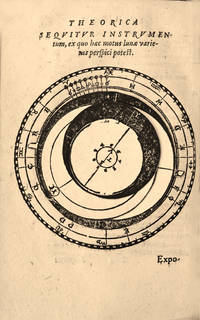
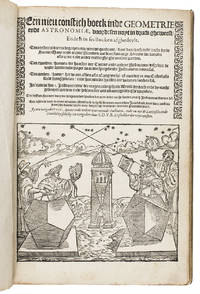
1608ABC_47602Colophon: Rees 1608. Folio 30 x 19.5 cm. Abraham Wijlicx Contemporary vellum sewn on four supports laced through the joints. With a half-page woodcut illustration and some decorations built up from typographic ornaments on the title page 74 woodcuts of various sizes in text many near full- and half-page with some woodcut decorated initials various series a headpiece built up from typographic ornaments and an ornamental woodcut tailpiece. 111 1 pp. A very rare early seventeenth-century Dutch book on astronomy compiling the knowledge of the German astronomer mathematician and cartographer Peter Apian 1495-1552. A great work on cosmography astronomy perspective and many related subjects. The book is subdivided into six parts highlighting the scales and course of planets the principles of the zodiac signs and their correct identification the calculation of heights and distances as well as the instruments used for calculation and measurement. All of this rendered in readable explanations and numerous clarifying woodcut illustrations. The book showcases marvelous woodcut illustrations of volvelles which are rotating parts of a paper construction known as a wheel chart used to illustrate the position and movement of celestial bodies. Volvelles are recognized as early versions of paper analogue computers and have been utilised in various fields for organization and calculation. The origins of volvelles can be traced back to astronomy books as well as certain Arabic treatises on humoral medicine and the Persian astronomer Abu Rayhan Biruni circa 1000 who played a significant role in their development. Throughout the book the author compiled images taken from Apians influential works. It is unclear who compiled this work as the title page states only the initials S.D.V.B. The work later found its way into the German language in an Ingolstadt edition from 1533 titles Instrument buch here clearly putting the emphasis on the tools rather than the calculations and practical astronomy.With the bookplate of Buijnsters-Smets on the front paste-down. The base of the spine is slightly damaged the boards are slightly dust-soiled internally very slightly browned and foxed throughout. Light damage to spine and book block slighty detached at bottom some browning and foxing. The first and last few leaves are slightly water stained. Otherwise in good condition.l Bierens de Haan 94; Hoogendoorn BSo1; Houzeau/ Lancaster 2909; STCN 86331306X 7 copies; USTC 1035104 6 copies; Van Ortroy Apian 114; WorldCat 65713062 10 copies. ABE CAT Astronomy & Cosmography hardcover