17 329 résultats
1881164054Berlin, Reimer, 1881. 1. Aufl., 8 Bde (inkl. Supplement). Frontispiz von Jacobi in Lichtdruck in Bd. 1, X, 546, 527, 612, 541, 515, 433, 440, 300 S. 4°, Halblederbände der Zeit. 1891.
2023059248Liveright Pub Corp 2023. 1st Edition 1st Printing. Hardcover. Fine/Fine. 255 Pp. Blue Cloth Large Format Oblong Hardcover. First Printing Indicated. Fine In Fine Dust Jacket Priced $50.00. Signed With Inscriptiojn By Both Thorne And Halloran. <br/> <br/> Liveright Pub Corp hardcover
180542389(London, W. Bulmer and Co., 1805). 4to. No wrappers as extracted from ""Philosophical Transactions"" 1805 - Part I. Pp. 31-64 and 1 engraved plate. Clean and fine.
180545883(London, W. Bulmer and Co., 1805). 4to. No wrappers as extracted from ""Philosophical Transactions"" 1805 - Part I. Pp. 31-64 and 1 engraved plate. Clean and fine.
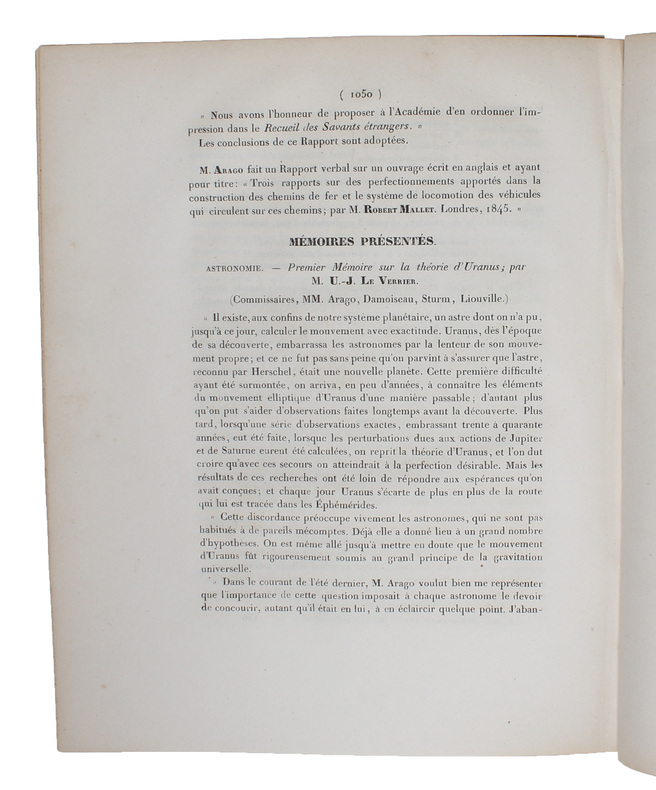
184548802(Paris, Bachelier), 1845. 4to. No wrappers. In: ""Comptes rendus hebdomadaires des séances de l’Académie des sciences"", Vol. 21, No 19. Pp. (1009-) 1082 (entire issue offered). With titlepage to vol. 21. Le Verrier's paper: pp. 1050-1055. Stamp to top of titlepage.
180542389London W. Bulmer and Co. 1805. 4to. No wrappers as extracted from "Philosophical Transactions" 1805 - Part I. Pp. 31-64 and 1 engraved plate. Clean and fine. <br/><br/><em>First appearance of an importent paper founding the metric of interstellar space.It was the contemporous discoveries of the first minor planets ceres in 1801 Pallas in 1802 and Juno in 1803 that prompted Herschel to investigate the origin of the spurious diameters of stars. "Were their apparent diameters as real as those of planets or spurious as for stars To address this question Herschel conducted an extensive series of experiments in his garden in Slough examining through his telescope small globules of differing sizes and materials placed in a tree some 800 ft ca. 244 m away Herschel 1805. His observations showed that for the smallest globules the diameters were all spurious and all of the same size. Furthermore he found that if just the inner part of the aperture of the telescope were used the spurious diameters whether of globules or of stars were larger. If the whole aperture was employed the diameters were smaller and if only an outer annular aperture was used the diameters were smaller still. This experimental discovery that unfilled apertures can be used to obtain high angular resolution remains today the essential basis for interferometric imaging in astronomy in particular Aperture Masking Interferometry. The theoretical justification of this result came with Airy's analysis of the diffraction pattern of a circular aperture 30 years later Airy 1835 and it took a further 30 years before the idea of using multiple apertures was developed. In an early study the Reverend W. R. Dawes noted that he had `frequently found great advantage from the use of a perforated whole aperture' and that when observing Venus this produced `a central image of the planet perfectly colourless and very sharply dened' Dawes 1866. But it was left to Fizeau in his submission to the Commission for the Prix Bordin the following year to remark on `une relation remarquable et n´ecessaire entre la dimension des franges et celle de la source lumineuse' and suggest that by using an interferometric combination of light from two separated slits `il deviendra possible d'obtenir quelques donn´ees nouvelles sur les diametres angulaires de ces astres' Fizeau 1868." </em> unknown
180545883London W. Bulmer and Co. 1805. 4to. No wrappers as extracted from "Philosophical Transactions" 1805 - Part I. Pp. 31-64 and 1 engraved plate. Clean and fine. <br/><br/><em>First appearance of an importent paper founding the metric of interstellar space.It was the contemporous discoveries of the first minor planets ceres in 1801 Pallas in 1802 and Juno in 1803 that prompted Herschel to investigate the origin of the spurious diameters of stars. "Were their apparent diameters as real as those of planets or spurious as for stars To address this question Herschel conducted an extensive series of experiments in his garden in Slough examining through his telescope small globules of differing sizes and materials placed in a tree some 800 ft ca. 244 m away Herschel 1805. His observations showed that for the smallest globules the diameters were all spurious and all of the same size. Furthermore he found that if just the inner part of the aperture of the telescope were used the spurious diameters whether of globules or of stars were larger. If the whole aperture was employed the diameters were smaller and if only an outer annular aperture was used the diameters were smaller still. This experimental discovery that unfilled apertures can be used to obtain high angular resolution remains today the essential basis for interferometric imaging in astronomy in particular Aperture Masking Interferometry. The theoretical justification of this result came with Airy's analysis of the diffraction pattern of a circular aperture 30 years later Airy 1835 and it took a further 30 years before the idea of using multiple apertures was developed. In an early study the Reverend W. R. Dawes noted that he had `frequently found great advantage from the use of a perforated whole aperture' and that when observing Venus this produced `a central image of the planet perfectly colourless and very sharply dened' Dawes 1866. But it was left to Fizeau in his submission to the Commission for the Prix Bordin the following year to remark on `une relation remarquable et n´ecessaire entre la dimension des franges et celle de la source lumineuse' and suggest that by using an interferometric combination of light from two separated slits `il deviendra possible d'obtenir quelques donn´ees nouvelles sur les diametres angulaires de ces astres' Fizeau 1868." </em> unknown
177644976(Paris, Imprimerie Royale, 1776). 4to. Extract from ""Mémoires de Mathematique et de Physique, Présentés à l'Academie des Sciences par divers Savans"", Année 1773. Pp. 503-540 a. 1 folded engraved plate. A few leaves with a faint dampstain in right margin. Otherwise fine and clean.
179560884Stockholm, J. P. Lindh, 1795. 8vo. Two volumes both uncut in the original blank wrappers. Light soiling to wrappers and a few tear with minor loss of paper to capitals. Previous owner's name to half titles and initials to title-pages. Two small stamps to title-pages. Internally with light occassional brownpostting. (4), XLIII, (1), 392 pp. + 3 folded engraved plates" 474, (7) pp. + 2 folded engraved plates.
182251130Berlin, G. Reimer, 1822. 2 contemp. hcalf. Gilt spine. Titlelabels with gilt lettering. A paperlabel pasted on top of spines. Stamps on both title-pages. VI,258"IV,356 pp. and 4 large folded engraved plates. Faint brownspots on first and last leaves.
(London, W. Bulmer and Co., 1805). 4to. No wrappers as extracted from ""Philosophical Transactions"" 1805 - Part I. Pp. 31-64 and 1 engraved plate. Clean and fine.
(London, W. Bulmer and Co., 1811). 4to. No wrappers as extracted from ""Philosophical Transactions"" Year 1811-Part II. With titlepage to vol. II. 269-336 and 2 engraved plates showing the shapes of 42 nebulae and star-clusters. Some brownspots to margins of the plates, otherwise clean and wide-margined.
(Paris, Bachelier), 1845. 4to. No wrappers. In: ""Comptes rendus hebdomadaires des séances de l’Académie des sciences"", Vol. 21, No 19. Pp. (1009-) 1082 (entire issue offered). With titlepage to vol. 21. Le Verrier's paper: pp. 1050-1055. Stamp to top of titlepage.
Hafniæ, Henrik Gøde, 1668. 4to. Samtidigt hpergament, manuskripttitel på ryg. Hjørner stødte. Lettere brugsspor. (32),432,(10) pp. Med en del træsnit i teksten, bl.a. Tycho Brahe's Hvenskort, hans store bogtrykkermærke, Uranienborg (plan og prospekt), Stjerneborg (plan og prospekt). De til værket hørende 5 plancher mangler. Indvendig ganske velbevaret og rent eksemplar. Har tilhørt historikeren Gustav Ludvig Wad.
(Paris, Imprimerie Royale, 1776). 4to. Extract from ""Mémoires de Mathematique et de Physique, Présentés à l'Academie des Sciences par divers Savans"", Année 1773. Pp. 503-540 a. 1 folded engraved plate. A few leaves with a faint dampstain in right margin. Otherwise fine and clean.
Berlin, G. Reimer, 1822. 2 contemp. hcalf. Gilt spine. Titlelabels with gilt lettering. A paperlabel pasted on top of spines. Stamps on both title-pages. VI,258 "IV,356 pp. and 4 large folded engraved plates. Faint brownspots on first and last leaves.
Frankfurt, Wolffgani Richteri, 1602. 8vo. In a later cardboard binding with title in contemporary hand to spine. Binding with wear, hindges very loose. Dampstain to first 40 pp. One folded plate missing upper outer corner. 378, (22) pp. + 3 folded plates.
Cm. 13, pp. (12) 370 (2). Con tre tabelle ripiegate f.t. Legatura coeva in pergamena floscia con bei titoli manoscritti al dorso. Un'antica firma occultata alla base del frontespizio. Esemplare genuino ed in ottimo stato di conservazione. Non comune edizione perugina di questo classico della letteratura scientifica stampato originariamente nel cinquecento.
176023211Leipzig, Breitkopf, 1760. Gestochenes Frontispiz von Bernigeroth nach Picart, 5 Bll., 724 SS., mit 5 Kupfertafeln (3 von Bernigeroth nach Picart) und 15 Textholzschnitte. Gr. 8°, Leder der Zeit über 5 Bünden mit reicher Rückenvergoldung in 5 Feldern, goldgepr. Rückenschildchen. Vorsätze zeitgen. Kleisterpapier. Der dekorative Einband etwas berieben und mit kleinen Wurmspuren.
1819173441819 1 volume, reliure plein veau havane moucheté (binding full calfskin) in-octavo, dos à nerfs (spine with raised band) - décoré or (gilt decoration), pièce de titre sur fond havane avec filet or (label of title with gilt line), dos à nerfs à caissons fleuris "or", filet sur les coupes (gilt line on the cuts), marque-page en tissu (bookmark in tissue), toutes tranches lisses rouges (all red smooth edges), pages de garde peignées à motif "caillouté" (painting flyleaf), orné de 16 planches dépliantes hors-texte in-fine gravées sur bois en noir par de la Gardette (contenant 132 figures gravées), XXXVI + 507 pages Avec privilège du Roi , 1774 Paris Vve Desaint Editeur,
36946HBo.J.
CZC-8784ou l'on traite de la structure du corps de l'homme, des élémens, des astres et de leurs divers effets. Frontispice et portrait + 29 planches h.-t. gravées en taille-douce dépliantes. Mathématicien hollandais né à Westgraafdyk, Nieuwendyt (1654-1718) soutint avec zèle les théories de Descartes. Il eut quelques débats avec Bernoulli et Leibniz à propos du calcul infinitésimal. L'Existence de Dieu démontrée, est un livre intéressant qui examine le monde du microcosme humain au macrocosme (les astres et leurs différents effets) en passant par les éléments du monde connu (eau, terre, air, feu). La traduction française est du médecin Noguez. Chateaubriand en cite un extrait dans son Génie du Christianisme. vol in4, 25x20, relié pleine basane époque, fendillements des mors, solide, bel état intérieur malgré des cahiers roussis, tranches rouges, 681pp. Amsterdam & Leipzig, chez Ankstee & Merkus, 1760
TWO VOLUMES BOUND TOGETHER of the astronomical work 'Yesod Olam', the best contribution on that subject to Hebrew literature much studied in the Middle Ages, written by the renowned medieval Spanish-Jewish astronomer Isaac Israeli ben Joseph in 1310 at the request of his teacher Asher ben Yehiel. The 'Yesod Olam' was first published at Berlin, in 1777, by Jacob Shklower, and a more complete edition was published with a preface by David Cassel, by B.Goldberg and L.Rosenkranz in 1846-48. Contains 4 b&w schemes and various illustrations throughout the pages, as well as a printed dedication to Moses and Judith Montefiore from the publishers. 42 last pages are b&w tables. 250x200mm. [XXXVIII+60] + 47 double pages & 42 pages. Quarter-cloth marbled Hardcover. Cover edges worn and bumped. Spine slightly stained. Ex-Libris of the Jewish National and University Library on front inner cover. Stamp on title page and between page 42 and schemes (not on text). Binding visible between pages 25-26 of the second volume. Pages yellowing, wavy and age-stained. [SUMMARY]: This extremely rare book is otherwise in good condition.
1820124645Leipzig, Paul Friedrich Vogel 1820. * Mit 11 kolorierten Figuren auf einer doppelblattgroßen, ausschlagbaren Kupferstich-Tafel. 31 Seiten. 19 x 11,5 cm. Halblederband der Zeit (leicht berieben) mit Marmorpapierbezug, späterem Rückenschild und rotem Farbschnitt. [3 Warenabbildungen]