13 972 résultats
4to. (8), 89, (13), 52, (8), 46, (10), 63, (13), 109, (17) pp., 1 blank f., 70, (10) pp. With engraved title page and 3 engraved plates (2 folding). - (Bound with) II: Welsch, Georg Hieronymus. Consiliorum medicinalium centuriae quatuor. Augsburg, Lorenz Kroniger / heirs of Gottlieb Göbel, 1698. (6), 496, (56) pp. Title printed in red and black. With engraved portrait frontispiece and 19 engraved plates (1 folding). - (Bound with) III: Welsch, Georg Hieronymus. Exotericarum curationum et observationum medicinalium chiliades duae. Ulm, [Christian Balthasar Kühn], 1676. (4), 484, (60) pp. - (Bound first) IV: Schroeck, Lucas. Memoria Welschiana, sive Historia vitae viri celeberrimi, Dn. Georgii Hieronymi Welschii, Augustani. Augsburg, Koppmayer for Theophil Göbel, 1678. 90 pp. With engraved portrait frontispiece. Contemporary full vellum. The principal medical writings of the German physician and oriental scholar Georg Hieronymus Welsch (1624-77), including his biography, published a year after his death. "The author [was] a learned German doctor and one of the earliest members of the 'Societas Naturae Curiosum'" (Duveen, p. 617). Welsch, the son of an Augsburg pharmacist, studied classical and oriental languages, philosophy and medicine in Tübingen, Strasbourg and Padua, during which time he visited Central Italy and Rome. He returned to Augsburg to practice medicine, but due to an illness (possibly a form of depression) he was unable to maintain a regular practice and instead shifted his efforts into the field of writing. A correspondent of Leibniz's, he is also remembered as a translator of Avicenna. - The "Sylloge", which had first appeared in the previous year, is an extensive collection of medical works by earlier writers, several here making their first appearance in print: treatises by Marcel Cumanus, Hieronymus Martius, Achilles Gasser (the supporter of Copernicus and Rheticus), Ulrich Rumler, and Hieronymus Reusner, as well as a another by Welsch himself. This is the second issue; although it ends with "Finis", it wants a final part (19, [8] pp.). - Bound with this is Welsch's massive two-part work "Consiliorum medicinalium" (a posthumous 1698 re-issue) and (with its own 1676 title-page and issued separately) "Exotericarum curationum". The first part contains four centuries of medical case studies, compiled and edited from manuscripts in the author's private library (including sources by Gasser, Rumler, Marquard Slegler, and many others). Welsch's knowledge of oriental medical science is evident from his copious learned footnotes, frequently quoting (in Arabic) the works of "Ebnsina" (Ibn Sina, Avicenna). It is also remarkable for its numerous engraved diagrams, still largely in an alchemical and astrological vein. The second part contains two thousand items of medical observations and cures, drawn from the same sources and similarly annotated by Welsch. - Prefixed to these is the Life of Welsch, written a year after his death by the respected Augsburg physician Lukas Schröck (1646-1730). - Some browning and brownstaining throughout as common due to paper, but well preserved. I: VD 17, 1:062768Y. Krivatsy 12934. Waller 9857. Jöcher IV, 1883. - II: VD 17, 547:693998F. Jöcher IV, 1883. Cf. Krivatsy 12923 (1676, counted as "Part 1" of a joint issue with the following). - III: VD, 17 12:188321G. Krivatsy 12923 (counted as "Part 2" of a joint issue with the previous). - IV: VD 17, 23:241931E. Krivatsy 10663. Waller 17972. Jöcher IV, 1883.
190360341Flint & Detroit MI: General Motors 1903-1938. Twelve vols. Oblong folio. 19 x 12.5 x approx. 2-3 in. per vol. 30 linear inches. 251; 278; 228; 84; 233; 312; 264; 140; 158; 160; 208; 212 leaves 11 of 12 vols. unnumbered. all silver gelatin Photostatic photo print positives on inconsistent quality papers either due to processing or washing process after being shot with the Rectigraph camera reproducing through a prism an image some w/ borders all featuring nine 4 x 6 in. data cards on recto of each leaf all identified w/in the original images some from photographs containing well over 20000 illustrations diagrams photographs and technical details roughness to some of the fore-edges photo textblock not cut or trimmed to size so rough cut at fore-edges occasional lifting from old wicking at fore-edges faint tidemark to lower fore-edges of a couple volumes. Uniformly bound in three-quarter maroon-coloured calf over black pebbled cloth on beveled boards Broun-Green Co. Safety Minute Book McMillan Patented post-binders with three metal posts and ring locking mechanism all leaves perforated at gutter margin for loading into the binders decorated endpapers thumb tabs at fore-edges demarcating the front of the binder gilt lettered title stamped on front covers of all some scuffing edgewear couple hinges starting or weakened occasional scuffing to back covers or to spines former owner’s labels attached to spines of a couple vols. still a VG set originally acquired by a collector when most of Harrah’s automobiles and other material were auctioned off in three separate sales in the mid-1980’s after efforts to preserve the collection failed following the acquisition of Harrah’s casino and hotel empire by Holiday Inns with their ownership stamps on flyleaves. Since Harrah mechanics had to maintain a fleet of over 1425 automobiles many of them exceedingly rare early Brass Era and foreign models these volumes provided invaluable mechanical details. This immense and unique reference set reproduces over 22000 well-illustrated index research cards on 2525 leaves prepared by General Motors for their engineering and technical staff tracking and recording the myriad of manufacturers and suppliers for automobiles trucks aircraft and marine craft from the Brass Era through the Great Depression. These prepared by the GM in-house technical periodical “Motor Vehicle Digest†provide essential visual and technical historical data for the development patent history engineering inventions of most of the major and minor national and international automobile manufacturers and parts suppliers for over three decades prior to World War II. Basically serving as the automotive industry’s equivalent of the National Union Catalogue or Acta Sanctorum these gigantic volumes trace the origins mechanical development devices and equipment on 1000’s of different manufacturers most having been lost now to the passage of time and the many shake-ups during the 20th Century. Not only do they serve as original reference from contemporary technical journals in German French Italian Norwegian Dutch and Danish all neatly translated into English but also offer a means to visually trace the development of the automobile. The four “Engine Parts†volumes include extensive sections on magnetos gasoline pumps accessory drive chains camshaft gears water pumps pistons crank shafts water pumps fuel systems fuel gauges carburetors throttle controls air filters fuel injection and even the 1937 introduction of the Down Draft Carburetor. Of notable interest is the extensive section on radiator badges or mascots and Motometer ornaments for the radiators including winged Gods & Goddesses animals and grille ornaments. The myriad of manufacturers represented is dizzying ranging from Mercedes to Packard Bugatti to Lejeuene Wolsely to Zenith with Napier Thornycroft Solex Rateau Mercedes Rickenbacker Stromberg & Locomobile thrown in. Electrical systems transmissions gears steering systems suspension shocks and more are all minutely detailed. The “Roadwheels†volume encompasses a wide range of companies and developments attempting to deal with the rough roads prior to the Good Roads Movement including spring types with internal springs against the axle tension types compression types and those specifically developed for electric vehicles and companies building electric motors for each wheel hub. The two “Internal Combustion Engines†volumes encompass not only 4-cylinder and 6-cylinder engines for automobiles but also diesel or modified engines stationery engines submarine diesel engines ocean liner and locomotive engines rotary engines for aircraft and marine applications two-cycle or two-stroke engines developed for early motorcycles and motorcycle cars and even the innovative sleeve valve motors from Willys-Knight. Engine manufacturers range from Delahaye to Bentley Buda to Humboldt-Deutz along with Mianus Alpha Northill out of Los Angeles California Coventry-Victor Tuxham Plenty & Son and Brooke. The “Final Drives or Transmissions†volume examines drive axles front brakes and other systems for Tatra Bugatti Benze & Lorelei while “Electrical Systems & Parts†details nearly 35 years of spark plug priming plug and ignition apparatus from early Brass Era and efforts of Champion Milla Strumpell Helwig Mosler and others. Interestingly the volumes focus primarily on GM competitors inventions technology & development and much of the data drawn from often obscure contemporary automakers’ journals would have proven invaluable especially as before the internet global searches and other digital reference guides there would have been nearly no comparable cross-reference to foreign technology. Lord 1858-1929 was a Princeton alumni having graduated 1879 worked in cattle ranches and gold mining in Arizona spent several years as an insurance broker in New York and Spain worked for the US Secret Service and served during the Spanish-American War in the Army Commissary Dept. in Cuba. After working in advertising and newspapers in Seattle and assistant to the Univ. of Washington he was contracted by General Motors to oversee and compile their in-house “Motor Vehicle Digest†until his death. The GM MVD should not be confused with the many different “Motor Vehicle Digest†laws and subject volumes issued by various states in the first half of the 20th Century and the only extant set of the original in-house printed journal NOT these unique volumes is recorded at the General Motors Institute Collection in Flint MI. The Rectigraph Co. was bought out by Haloid in 1937 and later became Haloid-Xerox in 1958 and their process was also used by Photoclerk and Dexigraph of Remington Rand. These still offer essential technical reference as frequently many of the magazines in the collection have never been digitized for use or are largely unavailable other than through in-person visit to special collections libraries or museum references. No copies located in Worldcat the GM Institute or Henry Ford; See: George P. Hanley The Collection of Industrial History The Society of Automotive Historians Newsletter Issue No. 63 June 1979 pp. 3-5; Frank Howard Lord Obituary The Princeton Alumni Weekly Vol. XXX No. 1 1929 pp. 40-43. General Motors, hardcover
8vo. IV, 500 pp. With 6 numbered engraved folding plates. Contemporary giltstamped full calf with gilt title-label to spine. 2 gilt labels with the arms of the Russian Empire and the monogram "CT" or "CP" to spine. Leading edges gilt, gilt inner dentelle. Marbled pastedowns. All edges marbled. Seminal work, written by "the first woman in the Western world who can accurately be called a mathematician" (DSB), from the library of Catherine the Great, Empress of Russia, with the Romanovs' arms to the spine. - Agnesi's work, which treats differential and integral calculus, is considered "the best introduction extant to the works of Euler" (A'Becket). The French Academy of Sciences regarded this manual the clearest, most methodological and most comprehensive work of its kind, and commissioned this French translation after the publication of the Italian original ("Instituzioni analitiche") in 1748, when the author - a child prodigy - was only 30 years old. - Binding very slightly rubbed, spine-ends chipped. Later library stamp to lower flyleaf, along with some ballpoint and pencil annotations. A fine copy of this outstanding work. DSB I, 75. Riccardi I, 1, 8, 3. A'Becket, "Maria Gaetana Agnesi", Catholic Encyclopedia (1913). OCLC 963682985.
8vo. X, 462 pp. With woodcut illustrations in text. Contemporary full calf with spine gilt in six compartments, giltstamped green spine label, gilt inner dentelle, leading edges gilt. Marbled endpapers; all edges marbled. First edition. - Presentation copy from the library of the British architect William Cecil Marshall (1849-1921), inscribed to him on the half-title ("From the Author") by a clerk at the publisher's, and with Marshall's autograph ownership above that. Darwin and Marshall had corresponded over insectivorous plants the previous year (cf. Darwin Correspondence Project no. 9627F, letter dated 7 Sept. [1874]). In 1876 Darwin would engage the architect's services to build an extension to Down House on the north side (a billiard room with dressing room and bedroom above). - Extremeties worn; front marbled flyleaf weakened. Still an appealing copy.
32 geheftete Lieferungen in den originalen Lieferungsumschlägen. 5 Teile mit zus. 124 chromolithogr. Tafeln. XXVI, 162 SS. 112 SS. 36 SS. 32 SS. 8, 8 SS. (2) SS. Gr.-4to (250 x 325 mm). Vollständiges Exemplar des prachtvollen pomologischen Kompendiums von Äpfeln (60 Tafeln, 162 SS.), Birnen (36 Tafeln, 112 SS.), Kirschen (8 Tafeln, 36 SS.), Pflaumen (12 Tafeln, 32 SS.), sowie Aprikosen und Pfirsichen (8 Tafeln, 8+8 SS.). Durchwegs in deutscher und französischer Sprache. Auf den 124 aufwändig gestalteten chromolithographischen Tafeln sind je zwei Ansichten und ein Querschnitt, bei Steinobst auch Kerne und Laub von zwei bis vier Obstsorten abgebildet. Das Titelblatt, die Widmung an den niederländischen König WiIlhelm III., eine Vorrede des Botanikers Karl Heinrich Koch (1809-79) und ein Vorwort des textverantwortlichen Boskooper Vereins zur Bestimmung und Veredelung der Obstsorten zu den ersten vier Teilen des Kompendiums sind der 2. Lieferung eingebunden (I-XXIV); ein zusätzliches Vorwort zu Aprikosen und Pfirsichen (XXV-XXVI) ist in der 23. Lieferung enthalten. Die 32. Lieferung enthält einen Index der Pflaumen, Aprikosen und Pfirsiche (2 SS.). - Der verantwortliche Lithograph Guillaume Severeyn (1830-1909) war Mitglied der Königlichen Akademie in Brüssel und ausgewiesener Spezialist für botanische Illustration. Sybolt Berghuis (1820-96) wirkte in Groningen als Maler, Zeichner und Aquarellist. - Provenienz: Bibliothek der evangelischen reformierten Hochschule in Budapest; als Doublette verkauft mit durchgestrichenem Bibliotheksstempel und Ausscheidungsstempel auf der 1. Tafel der 1. Lieferung (recto). - Die 1. Lieferung mit altem Wasserschaden auf dem Umschlag und allen Blättern. Die Bindungen meist lose, teils leicht braunfleckig und angeschmutzt, mit kleineren Randläsuren bzw. geknickten Seiten. Beiliegend eine Verlagsankündigung (in der 4. Lieferung) sowie ein Verlagsprogramm und drei Rechnungen von 1865 und 1868 des bedeutenden Pester Buchhändlers und Verlegers Károly Grill (in der 32. Lieferung). Vgl. Nissen, BBI 2221 (niederländ. Ausgabe).
Gest. Frontispiz, (10), 398, (2) SS. Mit 116 teils mehrf. gefalteten Kupfertafeln. Halblederband der Zeit mit gepr. Pergamentrückenschildchen und reicher, teils oxydierter Goldprägung in den Rückenfeldern. Qu.-4to. Das seltene, reich illustrierte Werk zur Festungsbaukunst handelt davon, "wie man die Royal-Vestungen und Cittadelle, Auxiliar-Wercke und Contra-Approschen, Retrenchementer und Feld-Schantzen, auff alten und neuen Plätzen, regular und irregular, in Eyl und mit Weile, mit kleinen als auch ansehnlichen Unkosten, aus siben wichtigen approbirten Militarischen Haubt-Maximen, dergestalten disponiren, erbauen und verthaidigen möge, daß ein darfür attaquirender Feind ehender ermüden müsse weder obsigen könne." - Borgsdorff "war kaiserl. Oberingenieur und trat in der Folge auf Befehl Kaiser Leopolds in den Dienst Peters des Großen. Hier leitete er 1696 die 2-jähr. Belagerung v. Asow, wie Glaser sagt, 'auf eine außerordentliche Weise', indem er eine besondere, sonst außergewöhnliche Art, zu approchiren angebe, weil denen solcher Arbeit noch unerfahrnen Russen die gewöhnliche Art in kurtzer Zeit nicht begreiflich zu machen war: die Erd-Waltzen genannt. Nach Eroberung dieses wichtigen Platzes baute er 1698 einige gantz neue Fortressen in selbiger Gegend" (Jähns). Eine lateinische Ausgabe hatte er bereits 1694 veröffentlicht. - Die 1693 gegründete Offizin des aus dem Kanton Schwyz zugewanderten Schlegel ist die jüngste der sieben alten Universitätsbuchdruckereien Wiens. - Ausgabe in einem Band; Pohler zitiert die nach S. 240 geteilte Ausgabe. - Stellenweise gering braunfleckig. Die Lagen Ccc und Bbb gegeneinander verbunden, jedoch komplett. Einbanddecken fachmännisch restauriert, Vorsätze erneuert, sonst gutes, kaum gebräuntes Exemplar. Jähns II, 1711 und 1380f. Pohler III, 699 (s. v. “Burgsdorf”; in 2 Bdn.). Michigan Military Books 223 (m. Abb.). Kat. KA I, 795. Mayer, Wr. Buchdr.gesch. II, 11.
4to (176 x 217 mm). (2), 20, 322, (2), 16, (4) pp. Title-page printed in red and black. With 4 folding plates. Contemporary Austrian full calf binding, covers ruled in blind, spine richly gilt, with two red leather labels. Marbled endpapers. All edges red. One of the fundamental books in the history of scientific thought, in which Boscovich developed his theory of "points" which are the first elements of all matter. Second edition, published a year after the first. - Concerning himself with the elementary constitution of matter, the nature and behaviour of physical forces, light, and atoms, Boscovich anticipated many of the features of the atomic and nuclear physics of our own times, and was the true creator of atomic physics as we understand it today. He predicted the penetrability of matter by high-speed particles and the possibility of states of matter of exceptionally high density. "The Theory of Natural Philosophy is now recognized as having exerted a fundamental influence on modern mathematical physics. As the title of his book implies, [Boscovich] considered that a single law was the basis of all natural phenomena and of the properties of matter; that the multiplicity of physical forces was only apparent and due to inadequate mathematical knowledge" (PMM). - Born at Dubrovnik in 1711, Boscovich became a Jesuit and spent most of his career in Italy as professor of mathematics at Rome and Pavia and as director of the observatory at Milan; he also taught in Vienna and Paris. Although then regarded as highly speculative, his "Theoria" enjoyed an immediate success in scientific circles across Europe, and its influence was felt and acknowledged for generations to come by such giants as Joseph Priestley, Michael Faraday, James Clerk Maxwell, Lord Kelvin, J. J. Thomson, and Niels Bohr. - This edition was released in 1759, to compete with the re-issue produced that same year by Kaliwoda, the Viennese printer of the first edition, and all three early Vienna editions are extremely rare. The earliest edition usually encountered is that printed in Venice in 1763, which is the one that J. M. Child reprinted and translated into English in 1922. - Includes the "Adnotanda et corrigenda" as well as the "Monitum" leaves, both frequently lacking. The 16-page "Epistola ad Carolum Scherffer" is bound after the "Finis". Occasional light brownstaining. Traces of a removed bookplate on the front pastedown. In all a very appealing copy. VD 18, 14408716-008. Cf. PMM 203. Poggendorff I, 246. Norman 277. Riccardi I, 1870, 53. De Backer/Sommervogel I, 1840. DSB II, 326.
4 vols. bound in 2 and plate volume. (2), XL, 318 pp. (4), 296, (4) pp. (2), XX, 368 pp. (4), VIII, 333, (3) pp. Plate vol.: 24, 12 pp. With 17 (12 coloured) plates. Contemp. cloth with giltstamped red spine labels. 8vo and 4to. Second edition of Goethe's principal scientific work, the "Farbenlehre" (Sämmtliche Schriften, vols. XX-XXIII, with half titles), including the quarto-sized "Erklärung der zur Goethe’s Farbenlehre gehörigen Tafeln" and the "Anzeige und Übersicht", which is also usually found missing. "Goethe's first publication on optics culminated in his 'Zur Farbenlehre', his longest and, in his own view, best work, today known principally as a fierce and unsuccessful attack on Newton's demonstration that white light is composite" (DSB V, 445). In 1810-17, Geistinger published a pirated edition of Goethe's works; the "Farbenlehre" was issued both separately with its own title page and as part of the collected works. The scarcity of Geistinger's edition (the only one published during the author's lifetime to include the "Farbenlehre") is dicussed by K. Dorn in his article "Habent sua fata libelli", in: Aus dem Antiquariat 1988, p. 379f. Goethe counted this edition of his works among the good ones, but himself owned only an incomplete copy. - Much rarer than the edition published in 1810: not in ABPC auction records since 1975; OCLC lists only two copies (Johns Hopkins Univ., San Diego Univ.). - Slightly browned and brownstained; plate volume foxed; plates trimmed and mounted on backing paper. A very nice copy with old ownership stamp from a school in Tulln/Donau on flyleaf of plate volume. Hagen 348, 348 b-c. Kippenberg 387 & 388. Goedeke IV/3, 583, 46 a 1. Schmid 68-71 & 77-79.
8vo. VI, 160 pp. - (Bound with) II: Johnson, James. The Influence of Civic Life, Sedentary Habits, and Intellectual Refinement, on Human Health, and Human Happiness, Including an Estimate of the Balance of Enjoyment and Suffering in the Different Gradations of Society. London, (W. Thorne for) T. & G. Underwood et al., 1818. VIII, 93, (1) pp. Contemporary full green straight morocco (bound by Charles Hering, Jr., of London) with gilt spine title and the gilt arms of the Earls of Harrington on both covers. Leading edges gilt; gilt inner dentelle. Matching green endpapers. Green silk ribbon. All edges gilt. First edition of this rare and early vegetarian work. J. F. Newton (1767-1837) sought to popularise the vegetable and distilled water diet of the physician and veganism pioneer William Lambe, whose patient he was. In his book, Newton promoted his own "regimen of distilled water and vegetable diet" (p. 66), believing vegetables to be the natural food of man and animal flesh unhealthy and unnatural. It was Newton who converted Percy B. Shelley to a vegetarian lifestyle, and his book influenced the poet's 1813 pamphlet on vegetarianism and animal rights, "A Vindication of Natural Diet". - Bound with this is a rare hygienic work by the surgeon J. Johnson (1777-1845), physician to the Duke of Clarence (afterward King William IV). - Interior very slightly browned, but a fine specimen, beautifully bound by Charles Hering for the library of Charles Stanhope, Viscount Petersham and afterwards the 4th Earl of Harrington (1780-1851). Known as "Beau" Petersham, the eccentric but much-imitated gentleman was a close friend of the Prince Regent George, who emulated his mannerisms in clothing, tea mixes, and consumption of snuff. Lord Petersham designed many of his own clothes and his fashions were quickly copied; he made famous the "Harrington" hat and the "Petersham" overcoat. The final pages of the present volume contain contemporary handwritten annotations about the poisonous effects of a fruitarian diet of (quoted from Jacques de Sade's "Mémoires pour la vie de Pétrarque") and about the high regard in which Galen and Hippocrates held water and abstinence, very likely in Petersham's own hand.
13 pp. Disbound. First edition of Thomas Paine's final work: his essay on the cause of yellow fever, written during the summer of 1805 while Paine was at New Rochelle. "As he explained, 'the fever breaking out in the city prevented my sending it for publication'. Although he had intended to let his house in New Rochelle 'to some New Yorker for the summer', the outbreak of fever in New York led to his spending most of the latter half of 1805 and the first half of 1806 at home" (Speck, A Political Biography of Thomas Paine, p. 190f.). Paine held that the illness (now known to be transmitted by the yellow fever mosquito) was generated by "the impure air or [pernicious] vapour [issuing] from the [...] new made earth, raised on the muddy and filthy part of the river". - One of the Founding Fathers of the United States, Paine in 1776 authored the electrifying pamphlet "Common Sense", inspiring Americans to declare independence from Britain. The present treatise, first published in newspapers in 1806, bears witness to the strong scientific interests that Paine maintained beyond his many political activities. He died in 1809, his health having been failing for some time. - Very rare: WorldCat records only eight copies worldwide (seven in the U.S. and one in the National Library of Australia); no copy in British Library or COPAC. This copy removed from the Norwich & Norfolk United Medical Book Society (their stamp on title page), inscribed in a contemporary hand above the title: "Presented by the Hospital Medical Board". Sabin 58232. Not in Wellcome, Waller or Osler.
Folio. (12), 708, (28) pp. With the title-page in a border built up from cast fleurons and 5 engraved plates. Contemporary sheepskin parchment; recased, with later endpapers. Rare third edition of a work on pharmaceutical chemistry written by the Spanish apothecary Félix Palacios (1677-1737). When the Palestra pharmaceutica appeared in 1706, it was the first work on the subject written in the Spanish language. Even though the book became widely accepted and used in Spain, Palacios met strong resistance from his colleagues because he rejected the galenic, or plant based, medicines in favour of chemical medicines. With this he rejected the ideas of Galen, Mesue and Dioscorides, which were still the standard in most parts of Europe and the Middle East. The work starts with a preliminary text, followed by a chapter on the general principles of pharmacy and chemistry in the form of questions and answers. The other four chapters deal with the ingredients and making of the medicines. It discusses distillation and calcination methods with the engraved plates showing various tools and instruments: pots, furnaces, alambics etc. - First few leaves slightly damaged along the extremities, waterstains throughout and binding soiled, worn and recased; a fair copy. Blake, p. 336. Palau 209403. Wellcome IV, p. 286 (incomplete). WorldCat (6 copies).
Folio (224 x 335 mm). 5 parts in one volume. Each with a title-page in red and black, 2 [part III: 3] letterpress pp. and 18 numbered engraved plates. In total 90 engraved plates. Contemporary full calf with giltstamped red and green labels to prettily gilt spine. All edges red. First edition. - This "masterpiece" (cf. Cobres) by the German engraver and publisher is considered the "most extensive and widely useful collection, owing its existence solely to him [Ridinger]" (cf. Thienemann). It includes a sequence of zoologically themed plates which "are highly sought after and often copied" (cf. Thienemann), showing animals in their characteristic actions and surroundings. Part one presents sporting dogs, while part two treats wild animals, such as lions, tigers and aurochs. Parts three and four cover "principal animals of the chase" (Schwerdt), namely aurochs, bears, stags, boars, deer, ibexes, chamois, lynxes and wolves. "Lesser animals of the chase" (Schwerdt), like foxes, rabbits, badgers, otters, beavers and squirrels are included in the fifth part. Two additional parts, showing horses, mules and donkeys, would be issued until 1755. - Contemporary bookplate of Count Ladislaus Kemeny to the patterned pastedown. A few notes in ink, mostly stating animals' Latin names. Binding and pastedowns slightly wormed. Top spine end missing, lower one scuffed. A few pages brownstained, plate 86 waterstained, a small tear in plate 81 (not touching image). From the library of the Viennese collector Werner Habel, with his signed and stamped ownership, dated 1979, to the flyleaf. VD 18, 90195426. Thieme/Becker 28, 309. Thienemann 391-480. Nissen 3406. Schwerdt III, 141. Cobres 307, 4.
2 Bde. XVI, 512 SS. (8), 456, (38) SS. Mit 2 gefalt. Kupfertafeln. Zeitgenöss. Interimspappbände mit hs. Rückentitel. 8vo. Erste deutsche Ausgabe des erstmals 1782 in Stockholm erschienenen Werks, eines der maßgeblichen metallurgischen Kompendien des vorindustriellen Zeitalters. Der Bergbauexperte, Mineraloge und Chemiker Rinman (1720-92) gilt als "Vater der schwedischen Eisenindustrie" und war lange Jahre als Direktor mehrerer Bergwerke und Eisenhütten tätig; er hatte großen Einfluss auf die Entwicklung der schwedischen Stahlproduktion. Die Übersetzung stammt von dem vor allem durch seine Berichte über seine Reisen in Russland bekannten Apotheker und Chemiker Johann Gottlieb Georgi (1729-1802). - Die Tafeln zeigen die Verfertigung eines Stahlmagneten sowie das Gerben des Roh- und Messerstahls. Einbände berieben und bestoßen; innen etwas gebräunt bzw. stockfleckig. Aus der Bibliothek des Schlosses Pfannberg in der Steiermark mit Stempel des österreichischen Industriellen Franz Freiherr Mayr v. Melnhof (1810-89, Eigentümer des Eisenwerks in Donawitz und Errichter der Gussstahlfabrik in Kapfenberg) am Spiegel und Titelblatt. Poggendorff II, 646. Ronalds 431. Engelmann (Bibl. mech.-techn.) 306. ADB VIII, 713. NDB VI, 242f.
4to. (16), 170, (20) pp., final blank. With engraved vignette to title, printed in red an black. (With:) Ettmüller, Michael. De virtute opii diaphoretica dissertatio. Leipzig & Jena, Krebs for Bielcke, [1682]. 48 pp. Contemporary marbled half vellum. Second edition of this early monograph on the pharmacological and therapeutic aspects of opium. "The main text is a reissue of the 1674 edition" (Krivatsy). Wedel not only evaluates the medical literature but also all available travel reports. The chapter entitled "An aphrodisiacum sit opium & mulierem excitet?" provides an overview of the various opinions, including Saar's account from his East Indian journeys noting the use of opium in Batavian brothels, as well as Garcia's contradictory information that opium leads to infertility and impotence (p. 128f.). The title vignette depicts a Turkish opium picker: scratching the poppy seed capsule with his knife, he collects the sap. The appendix contains the first printing of a dissertation on the qualities of opium, written by Michael Ettmüller (d. 1683), who dedicated his work to his colleage Wedel. - G. W. Wedel (1645-1721) was one of the principal physicians of his age. He authored 49 books and was the teacher of several progressively minded medical men. He is credited with the timeless aphorism that "medicine is nothing but the incessant renewal of ignorance." His "Opiologia" won him admission to the Academy of Naturalists, the still-extant "Leopoldina" in Halle. "Wedel stood midway between medieval and modern world views, defending astrology and alchemy and championing iatrochemistry" (DSB XIV, 212). "Wedel appears to have been one of the first to employ the word physiology in its present restricted sense" (Thorndike VIII, s. v.). - Evenly browned throughout; binding slightly rubbed. A fine copy. VD 17, 12:166680Q. Krivatsy 12664. Pritzel 10054. Ferchl 570. Hirsch/H. V, 875.
8vo. (2), 34 pp. Original printed wrappers. Offprint from the "Klinisches Jahrbuch", bearing Ehrlich's autograph inscription to the mayor of Frankfurt, Franz Adickes ("in vorzüglichster Hochachtung gewidmet") on the upper wrapper cover. - "This was the beginning of the concept of biological standardization. The first exposition of Ehrlich's side-chain theory appeared in this paper" (Garrison/M.). Ehrlich's famous paper describes how diphtheria toxin and antitoxin interact and the method of their measurement. "Not only did he postulate that immunological specificity was due to a unique stereochemical relationship between the active sites on antigen and antibody, he introduced also the concepts of affinity and of functional domains on the antibody molecule. This work provided the taproot from which the field of immunochemistry later grew; he would be famous for this contribution alone. But Ehrlich also appended to this study a theory of the basis for antibody formation, an inclusion that assured the report a unique position in the history of immunology" (Silverstein, A History of Immunology, p. 65). Paul Ehrlich shared the Nobel Prize in Medicine or Physiology in 1908 with Elie Metchnikoff "in recognition of their work on immunity". - Light fingerstains and dustsoiling; remains of a shalfmark label; stamp to verso of title-page. Garrison/Morton 5064.
19360008066WASHINGTON DC. Very Good. 1936. On offer is the original design study for a major dam project in the United States. The study is comprised of 2 documents. The main document is 10 inches by 8 inches contains 123 pages and is in excellent condition. The second document is a technical specifications document that contains 37 pages. It too is in excellent condition. The Savage River Reservoir is a 360 acre storage reservoir in northwest Maryland. It was completed in 1952 by the U.S. Army Corps of Engineers which also currently maintains it. The reservoir was formed by the Savage Dam which impounds the Savage River. The reservoir is used for flood control and municipal drinking. The Savage River Dam is a rock-fill earthen dam 184 feet high 1050 feet long and drains an area of 105 square miles. The dam was modified in 1980 and is owned by the Upper Potomac River Commission. The Savage River is a major wilderness recreation area and the river has been the site of U.S. Olympic trials for canoeing and international canoeing slalom championships. It is reputed to be one of the best wild trout streams in the mid-Atlantic United States. The reservoir is a major supplier of fresh water to Washington DC. Although completed in 1952 planning had begun in the 1930's. Construction began in 1939 but was suspended in 1942 due to U.S. entry into WWII. Construction resumed in 1946. The Savage River Dam Analysis of Design document is dated 1937. This 123 page document is the end result of several years of study and then the application process for funding. The project was initiated by the Upper Potomac River Commission and undertaken by the U.S. Army Corps of Engineering. It was funded by a grant from the Works Progress Administration WPA. The WPA was Franklin Roosevelt's grand scheme to help deal with the massive unemployment stemming from the Great Depression. It was the largest and most ambitious American New Deal agency employing millions of people to carry out public works projects including the construction of public buildings and roads. The Savage River Dam Analysis of Design contains general descriptions design criteria and illustrations technical specifications drawing maps and charts. There are numerous detailed fold-out engineering drawings bearing the U.S. Engineer Office stamp and signatures of the 3 signing engineers - Tippietts Schmitt and Luplow. Since its construction there has been subsequent work over the decades. Although there may be some copies of the model studies for this major dam project this appears to be the original design document. The second document is a technical memorandum entitled Spillway For Savage River Dam - Hydraulic Model Investigation. It is dated 1954. The purpose of this memorandum was to verify the data regarding flow rates and impacts as a result of additional flood control alterations having been made. The document contains 37 pages of charts diagrams and analysis. A researcher looking at the underlying studies that led to the decision to build this important dam would find this study to be a goldmine of information. Environmentalists could see the state of conservation thinking at the time. The area is under active threat today 2018 from creeping urban spread and natural gas drilling. This document shows the original thinking and work that went into the creation of the reservoir and the Savage River system.; Manuscript; 4to - over 9¾" - 12" tall; KEYWORDS: HISTORY OF 20TH CENTURY; 1930S; GREAT DEPRESSION; NEW DEAL; FRANKLIN DELANO ROOSEVELT; UNITED STATES MARYLAND SAVAGE RIVER; SAVAGE RIVER DAM; SAVAGE RIVER RESERVOIR; SAVAGE RIVER STATE FOREST; WORKS PROGRESS ADMINISTRATION; WPA; UPPER POTOMAC RIVER COMMISSION; US ENGINEERING OFFICE; U.S. ARMY CORPS OF ENGINEERING; SCIENCE AND TECHNOLOGY; DAM CONSTRUCTION FLOOD CONTROL DAM DESIGN; HYDROLOGY; DRAWINGS; MAPS; CHARTS; W. D. LUPLOW; ERNEST F. TIPPETS SCHMITT; AMERICANA HANDWRITTEN MANUSCRIPT DOCUMENT LETTER AUTOGRAPH WRITER HAND WRITTEN DOCUMENTS SIGNED LETTERS MANUSCRIPTS DIARY DIARIES JOURNALS PERSONAL HISTORY SOCIAL HISTORY HISTORICAL HOLOGRAPH WRITERS AUTOGRAPHS PERSONAL MEMOIR MEMORIAL ANTIQUITÉ CONTRAT VÉLIN DOCUMENT MANUSCRIT PAPIER ANTIKE BRIEF PERGAMENT DOKUMENT MANUSKRIPT PAPIER OGGETTO D'ANTIQUARIATO ATTO VELINA DOCUMENTO MANOSCRITTO CARTA ANTIGÜEDAD HECHO VITELA DOCUMENTO MANUSCRITO PAPEL . unknown
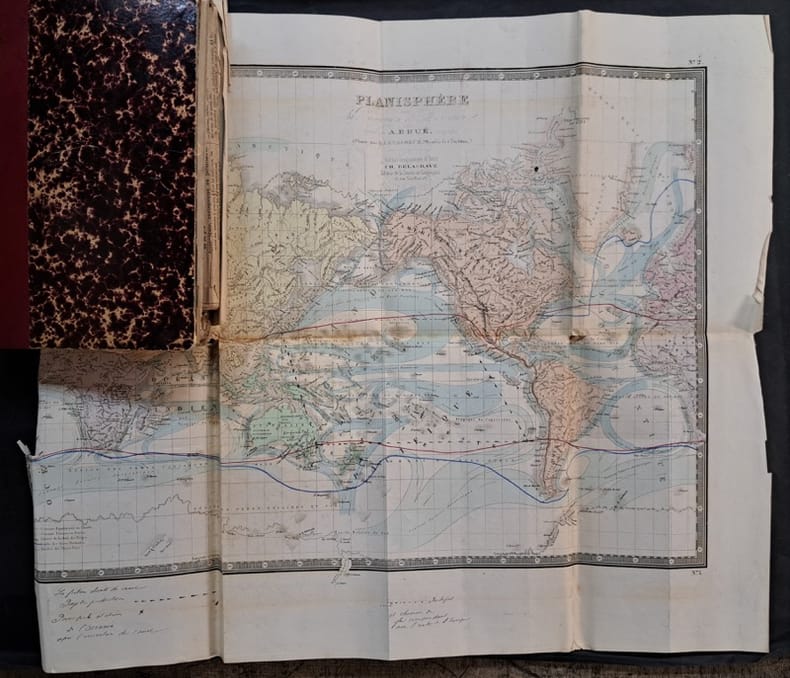
1886127543Paris, Challamel 1886 In-8 23 x 13,5 cm. Reliure demi-chagrin rouge, dos à nerfs, couverture conservée, VIII-84 pp., 1 panorama en couleurs 80 x 30 cm repliée in fine, table des matières. Joint la 1re épreuve corrigée par A. Garçon. Nombreux documents joints lettres de remerciement diverses, cartes de visite, coupures de presse dont 3 lettres autographes de Ferdinand de Lesseps et 2 de Victor de Lesseps.
4to. (16), 392 pp. (12), 188 pp. With one engraved frontispiece, 40 engraved folding plates, and several illustrations in the text. Later marbled wrappers. The first two volumes of the "Miscellanea Berolinensia", the scientific periodical of the Berlin Academy of Sciences (vol. 1, first issued in 1710, is present in the 1749 reprint). Bound in a single volume, they contain remarkable contributions by Gottfried Wilhelm Leibniz, among which is his "Brevis descriptio machinae arithmeticae", the description of Leibniz's famous calculating machine: the first stepped-drum calculator, being the first machine that could perform multiplication and division - an invention of major importance in the history of computing. Further, this issue includes a notable treatise on the game Go, also by Leibniz, illustrated by a folding plate showing two Japanese men playing this game. - Among the other contributors are the mathematicians Jakob Hermann and Philipp Naudé the younger, as well as the astronomers Johann Wilhelm Wagner, Christoph Langhansen and Gottfried Teuber. - The plates show Leibniz's calculating machine as well as fossils, celestial bodies and eclipses, a threshing machine, medals, and calculations with geometrical sketches. - Somewhat browned throughout. Old bookseller's ticket of Sifton, Praed & Co., London, to verso of first title-page. A fine copy of two publications reflecting the active academic scene of Berlin.
8vo. (10), 143, (9) pp. With fine woodcut frontispiece showing saw and pruning knife, 1 engraved folding plate, and 30 woodcut text illustrations. Contemporary half calf and speckled boards, spine richly gilt with gilt lettered label. The first western book on the cultivation of dwarf trees, or "bonsai". Georg Liegelsteiner was court gardener to the Archbishop of Salzburg in Austria, Count Franz Anton Harrach. His book on dwarf trees, although now largely forgotten and overlooked in botanical and horticultural literature, proved extraordinarily successful in its day, achieving six editions including the original edition of 1705. Liegelsteiner "writes about dwarfing trees so that they look like a very beautiful big tree, but only much smaller. He understands tree physiology like only a small minority of bonsai enthusiasts today. He explains in detail how to shorten roots and transplant trees often, how to shorten branches, how to correct a one-sided tree. He explains how to cut back a tree to a stump, let the new shoots grow, cut them back at strategic points, let the new shoots grown again and cut them back. It is exactly the 'Chinese' clip-and-grow technique. He makes drawings which explain the development of a dwarf tree in a way that could not be improved" (Walter Pall, Dwarf Trees of George Liegelsteiner, in: Bonsai Magazine 3 [2000]). The edition offered here is the final one, published after the death of its author, with a very interesting new preface which attempts to sketch a history of dwarf trees in Europe. It suggests that the art of growing Bonsai trees came to Versailles in the late 17th century. One of the Versailles gardeners, Grottendorf, settled in Berlin and experimented more on it. Eventually he was appointed head gardener to the wealthy merchant and Councillor Georg Bose's garden, the "Kleinbosischer Garten", in Leipzig. Liegelsteiner received advice from Grottendorf about the art of growing dwarf trees. - OCLC locates the 2 copies in US: Berkeley and National Agriculture Library; also: Berkeley (1703 ed.); Delaware, Agricult. Library, and Berkeley (1716); Berkeley and Cincinnati Museum Centre (1725)]; COPAC locates only British Library (1702 ed.) and Kew Gardens (1702 ed., their 1716 ed. 'is lost at binders' ). A very good copy. Not in Dochnahl, Hunt, Lindley Lib., Nissen, Plesch, Pritzel, Oak Sprink Sylva.
8vo. 16 pp. Original printed wrappers, bound within modern boards. With the author's three-line-autograph inscription to his friend Friedrich Schwandner, with whom he had studied at Tübingen and formed an illicit students' union, the "Corps Guestphalia", for which reason the two had been arrested in 1837. Both works, "Über die Torricellische Leere" and "Über Auslösung", were separately published in 1875 and 1876 within the "Beilage des Staatsanzeigers für Württemberg". Eisert 29.
Large 4to. 2 parts in one volume. (8), XXXIX, (1), 307, (1) pp. (4), 309-633, (3) pp. With woodcut vignette to both title pages, several woodcut illustrations in the text, and printer's device on last leaf. Fine contemporary French éventail leather binding. Wants ties. Second, posthumous edition. Previously, Montebruni (1597-1644) had published his "Ephemerides" for the years 1640-45 and 1645-60. "D'apres les tables de Lansberg, pour le méridien de Bologne. Dans la part I de la publication, il y a un catalogue d'étoiles, réduites à 1630" (Houzeau/L.). - Edges, corners and spine-ends professionally restored. Sumptuous giltstamped éventail-style binding: double borders of a narrow zig-zagging design and a wider rosette-and-flower-design within floral braces and double fillets enclose a large central compartment, the corners of which are occupied by round-headed pointillé fans emanating from tendril corner stamps. The same éventail stamps form an elaborate central rosette with tendril stamps at top and bottom ends. The empty space in between in filled in by intricate tendril and dentelle blindstamping. The various elements of the design are starkly set off by empty quarter-inch fillet borders enclosing the corner éventails with quadrants and the central rosette with a lozenge; the tendril infilling is structured by the same blank borders forming a cross, thus dividing the cover into four richly tooled, mirroring quarters. The spine is framed by the same zigzag and floral borders as the covers, enclosing a narrow blank border and a finely tooled dentelle and semi-rosette design echoing the cover infilling. - Title page bears 1772 ms. note of ownership by the Capuchin monk Giovanni da Cento, who introduced the volume to his monastery's library in Cento (Emilia-Romagna). Later in the library of the Swedish collector Thore Virgin (1886-1957) with his repeated signature (dated Stockholm, 16 May 1914) and his bookplate (dated 1911) and collection stamp ("Bibliotheca Qvarnforsiana"). Additional bookplate of Rolf Wistrand. Riccardi II, 180, 2. Houzeau/Lancaster 15161. OCLC 68956764. Lalande 211 ("1640").
4to. 2 vols. (out of 10). XVI, 222 pp. IX, (1), 256 pp. With 2 hand-coloured, engraved title pages and 225 hand-coloured, engraved plates (some folding), numbered 1-222, with a/b numbers for 114, 172, 198). Contemporary half calf with giltstamped green spine labels. Marbled endpapers. All edges sprinkled in red. The first two volumes of this rare work of decorative plates showing flowers and other plants, including fruits. Contains the first 225 of a total of 1090 engravings published until 1820. The Viennese physician Vietz, who combined artistic talent with a penchant for botany, began publication of this monumental ten-volume work in 1800; only the first three volumes were edited by him personally. The Natural History Museum, London, described its own copy thus: "Today, the work appears to be of extreme rarity, not being held in any other of the United Kingdom's national or public library collections. Only three copies have been found in North American libraries, of which two are certainly fragile and in need of conservation. One copy is in the Austrian National Library" (Great Flower Books [1990], p. 147). - Clean and well-preserved throughout. Nissen, BBI 2062. Stafleu/Cowan 16.153. Pritzel 9764. Wurzbach 50, 282f.
Folio (200 x 323 mm). 2 parts in one vol., with appendix. (14), 516, 40, (4) pp. Title-page printed in red and black. With engraved title by R. Hooghe and 111 (instead of 114) engraved plates after Witsen (1 folded). Contemporary full calf over wooden boards with giltstamped borders, spine, and spine-title. First edition. The standard work on shipbuilding by a Dutch author - the leading nation in naval architecture in the early modern period. This seminal work contains detailed descriptions and illustrations as well as an account on the history of navigation and ship building since antiquity, discussing construction techniques, different types of ships, and naval architecture from across the world as observed by the author during his travels. - Nicolas Witsen (ca. 1640-1717) was mayor of Amsterdam 13 times between 1682 and 1706. In 1693 he became administrator of the Dutch East India Company (VOC). In his free time he was a cartographer and maritime writer, as well as an expert on Russian affairs. - Binding somewhat rubbed; front hinges broken. Title-page waterstained; upper portion of the gutter waterstained in entire first half of the volume; occasional marginal tears, browning and light fingerstaining. Still a good working copy of the classic that in 1697 inspired Tsar Peter the Great to a four-month training period at the Dutch East India Company shipyards organised by Witsen. Landwehr, Romeyn de Hooghe 16. NNBW IV, 1473. Cf. Poggendorff II, 1344 (Latin title).
19972080502106907340Not Available 1997. Soft Cover. Fine. The book is in fine condition. Not Available paperback
Very Good Turkish, Ottoman (1500-1928) Original full dark brown leather bdg. Decorated borders on boards, five compartments on the spine, second lettered gilt in the title. Cr. 8vo. (19 x 14 cm). In Ottoman script (Old Turkish with Arabic letters). 294 p., 17 folded engraved plates, and richly engraved illustrations. Early edition of this extremely rare encyclopedic book of the first comprehensive Ottoman engineering including the firsts in Ottoman literature of science, especially on various subjects of modern physics and mechanics, cartography, map making, surveying, arrangement of army camps, construction of pulleys, cannon shooting, etc. This book was written by Hüseyin Rifki, who was the chief professor of the Mühendishâne [i.e. Ottoman Engineering School] and was assigned to Medina, Arabia in 1816 to repair the holy buildings in Medina, Arabia. Another important aspect of the book is that it contains the ratios between the measurements used in various European countries before the meter system and the Ottoman measurements, as well as French measures and scales. Early typographic imprint on European paper with a watermark. Hüseyin Rifki translated the ancient mathematician Euclid's book Elements, in which he laid the foundations of geometry, from the English original of the English mathematician John Bonnycastle (1760-1821) in 1789, into Turkish with the name of "Usul-i Hendese", together with Selim Efendi, a converted English engineer. He was appointed as "Engineering-i Berri-i Hümâyûn Serhocasi" [i.e. The Chief Professor of the Engineering School] after the Code of Engineers was put into effect in 1806. He served as the chief teacher between 1806 and 1816. He was sent to the Balkans in 1816 and then was assigned to repair the holy buildings in Medina, Arabia. He died in 1817, just after returning from Mecca to Medina. Özege 12620.; TBTK 14349.; This edition is not located in OCLC.