11 908 résultats
192025766a4 plus no spine grubby NB I: National Confectionery Industry Ltd 1920. Paperback. Used: Acceptable. Paperback in average condition not dated but circa 1920 pages a little grubby as is cover some small tears staples rusting but all intact. National Confectionery Industry Ltd paperback
17874368Lisbon: press of the Royal Academy of Sciences 1787. Narrow 4to 209 x 118 mm. 8 xiii 3 175 pages. Title-leaf fol. 2 present in duplicate. Folding engraved plate of a mechanical silk loom; titles with woodcut arms of the Portuguese Royal Academy of Sciences woodcut and typographic headpieces occasional slight discoloration small wormtrack in the folding plate. Contemporary cat’s-paw polished sheep covers with gilt border spine in six gold-tooled compartments the second gilt lettered edges gilt and gauffered recased endpapers renewed defect in top spine compartment a dozen small wormholes. Provenance: António Romão dos Passos 1866-1951 signature in ink Antonio Passos / agronomo or Anto R. Passos scrawled across both titles the first with price note and on six text leaves. <br /> <br /> Only edition of a comprehensive overview of the Portuguese silk industry by the judicial magistrate of the Moncorvo district and author of several works on political economy and history of law. José Antonio de Sá d. 1819 a native of Bragança was an important proponent of modernization of the industry and later served as director of the Royal Silk Factory Real Fábrica das Sedas founded in 1802 in Lisbon. He was one of the earliest members of the Academia Real das Sciencias of Lisbon.<br /> <br /> Silkworms were raised in Portugal as early as the 13th century. Sericulture and silk production were concentrated in the northeastern province of Trás-os-Montes its largest center being the city of Bragança which from the 15th to 17th century was known throughout Europe for its luxurious velvets. Because of the lack of government support for industry frequent wars and above all the persecutions of the Inquisition which decimated an industry in all sectors of which Jews or converted Jews cristãos-novos played a major role Portuguese silk production suffered from intermittent crises and was even periodically decimated. Starting in the 1770s efforts to revive the industry began to have an effect: <br /> <br /> “By the end of the 18th century the Trás-os-Montes silk industry had dragged itself out of the crisis that had begun in 1750-1755 coinciding with the last incursion of the Inquisition into Bragança and embarked upon a period of great development accompanying the industrial expansion that was then taking place not only in that particular region but throughout the Portuguese kingdom. After the Inquisition’s systematic persecution of businessmen weavers and throwers had finally come to an end the continuity and expansion of the silk industry seemed to be a viable prospect. In the last two decades of the 18th century a remarkable process of modernization took place thanks to the efforts of the businessmen involved in this economic activity such as António José Lopes Fernandes who installed 200 silk looms in Bragança magistrates such as José António de Sá and Pereira de Barros and politicians such as Martinho de Melo e Castro and Rodrigo de Sousa Coutinho the latter being the Portuguese ambassador to Piedmont Italy. These efforts included the adoption of Piedmontese methods and techniques namely the organzine mill and the spinning-jenny the most advanced ones at that time in Europe in an operation led by experts coming to Portugal from that Italian region.†Sousa p. 6<br /> <br /> Sá’s work is in three parts. The first part comprises an overview of the history of silk production starting with Antiquity and summaries of the industry and government policies toward it in other countries followed by a detailed recommendation with responses to projected objections that the Portuguese government undertake a campaign to plant mulberry trees and promote the industry generally. Part two is a treatise on the silkworm and part three a technical survey of “the art of silk spinning.†Explained in the text pp. 142-148 is the letter- and number-keyed engraving of a rather fanciful machine showing a vat for softening the cocoons heating on the left from which a thread-unwinding mechanism feeds a loom on the right. <br /> <br /> The reason for the duplicated title-leaf in this copy is not clear. Perhaps one functioned as an upper wrapper — but as both titles are preceded by a half-title that appears unlikely. The book collector Antonio Romão dos Passos b. February 28 1866 was an engineer and agronomist. Other books from his library all on practical subjects are recorded; four are digitized by the Biblioteca Nacional Digital de Portugal. One a treatise on hemp has a similar indelicately scrawled signature across the title. <br /> <br /> OCLC gives six US locations. Innocencio Diccionario bibliographico portuguez IV: 246 no. 2658; Kress Luso-Brazilian Economic Literature Before 1850 p. 4. Cf. F. Sousa “The Silk Industry In Trás-Os-Montes During The Ancient Regime†E Journal of Portuguese History Vol. 3 no. 2 Winter 2005 digitized. press of the Royal Academy of Sciences unknown
Milano, Italica Editoriale, (1935) imperial folio (cm. 38 x 53) brossura, con nastro di cotone, pp. 62 + 114 + 35. Seconda edizione con tre frontespizi xilografici a colori di straordinaria qualità così come num. tav. xilografiche originali (tutte sempre di G. Peroli). Il vol. é dedicato all'Italia Settentrionale e vuole essere un'esaltazione di personaggi ed industrie; é corredato di numerosissime tavole fotografiche illustranti le varie attività descritte : Arte : Giannino Castiglioni, Milano (sculture) - F.lli Barovier, Murano (vetrerie) - Rizzarda, Faccioni, Milano (ferri battuti) - Salviati, Venezia (decorazioni). Scienza : Alessandro Bruschettini - Sport : Theo Rossi Conte di Montelera (motonautica) - Ippica: (razze 'Lady Victoria', 'Oldaniga' e 'R. Gualino' di Torino. Lavoro : S.A. Ing. Pizzigoni (acciai) Branca (liquori), Banco, Filippa, Oriani, Lodigiani, Scheidler, Bonfiglio, Cottini, Dell'Acqua & Martini, Baldi, Marchioro, ecc (costr. edili) - Costr. meccaniche : Carminati & Toselli, Offic. di Crema, Ajolfi ecc. - Alimentazione : Venchi, Wamar, Oleificio Costa, Caffé Franck - Aviazione, automobilismo : Aeron. d'Italia, Torino, Navig. Aerea Ital. Genova, Alfa Romeo, Fiat.
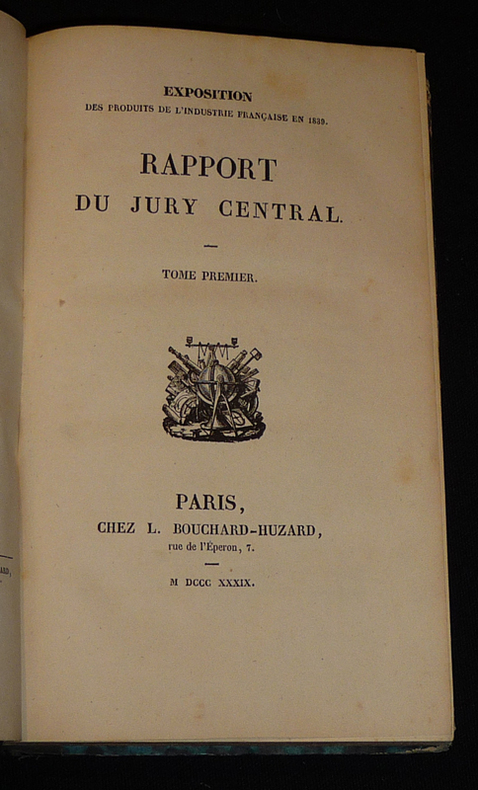
1839zy108Paris, chez L. Bouchard-Huzard Relié 1839 RARE. Trois volumes in-8 (14,2 x 22 cm), reliure demi-basane, dos lisses ornés de filets dorés, lv-544, 531 et 568 pages, ces trois tomes comprennent les arts industriels suivants (liste non exhaustive) ; Tome 1 : Tissus (laines et lainages, soies et soieries, fils et tissus de coton, de lin et de chanvre) - Métaux (fonderies, fer, acier, limes, enclumes, outils, plomb, cuivre, chaudronnerie, coutellerie, quincaillerie, marbres, bitumes, stucs, ciment, ardoise, etc.) // Tome 2 : Machines et ustensiles agricoles (machines à élever l'eau, soufflets, appareils de filtrage, outils de sondage, machine pour fabriquer les tissus, grands mécanismes, constructions navales, machines hydrauliques, barrages, chemins de fer et routes, machines-outils, carrosserie, serrurerie, instruments aratoires, semoirs, faux et faucilles, machines à battre, etc.) - Instruments de précision et instruments de musique (horlogerie, pendules, dynamomètres, balances, baromètres, thermomètres, globes terrestres, éclairage, instruments de musique à cordes, archet, vent, cuivres, etc.) // Tome 3 : Beaux-arts (peinture sur verre, fonderie, bronzes d'art, billards, bijouterie, sculpture, orfèvrerie, dorure sur bois, parquets et mosaïques, gravure, imprimerie, typographie, librairie, reliure, lithographie, zincographie, calligraphie, ébénisterie, etc. - Arts céramiques (terre cuite, faïence, porcelaine, verrerie) - Arts divers (peaux et cuirs, papier peint, chapellerie, chaussures, ganterie, sellerie, instruments de chirurgie, gymnastique, dessin, etc.) ; coiffes et coupes frottées, usures du papier reliure aux plats, assez bon état général. Livraison a domicile (La Poste) ou en Mondial Relay sur simple demande.
1995ZB2633771995-2001. volumes 1-7 partly bound ex library PRICE IS FOR THE LOT. - If you are reading this this item is actually physically in our stock and ready for shipment once ordered. We are not bookjackers. Buyer is responsible for any additional duties taxes or fees required by recipient's country. Photos available upon request. unknown
19312080202106300479Not Available 1931. Soft Cover. Fine. Number of books: 1 Not Available paperback
19752090202120807145Not Available 1975. Soft Cover. Fine. Volume: 1 Not Available paperback
1970100790BBDüsseldorf, Art-Press Verlag, 1970. 4°. [108] Bl. mit 194 Schwarz-Weiß-Fotografien auf Tafeln. OLn. mit illustr. OU. [3 Warenabbildungen]
2080302106803683Not Available N.A. Soft Cover. Fine. The book is in fine condition. Not Available paperback
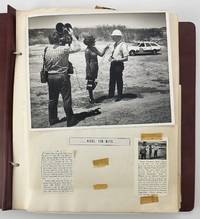
12998Various locations mostly Phoenix AZ 1980. 24 leaves illustrated with twenty-three mounted photographs plus dozens of mounted ephemeral items including letters documents certificates newspaper clippings and more plus a folder laid in containing television prompt copies. Folio. Contemporary brown vinyl scrapbook string tied. Minor overall wear some old tape stains to most items some items apparently re-mounted likely by a later friend or family member. Overall very good. A wonderful scrapbook celebrating the professional career of Evelyn Lorraine Thompson 1948-2005 on-air reporter and news anchor for KOOL-CBS Radio and Television and KTVK-TV in Phoenix Arizona in the 1970s. Thompson worked for KOOL straight out of college after graduating from Boston University in 1972. She was hired as a writer-producer for morning newscasts then worked as a full-time news reporter. Unusual for the era Thompson also served as KOOL's weekend sports reporter. She later moved to KTVK-TV also in Phoenix where she worked as a news anchor. We could find no other information about Thompson following about 1980 except for her brief obituary in the Arizona Republic.<br /> <br /> The present scrapbook provides a valuable snapshot of Thompson's life and early career through a range of original photographs showing her as a child but with the majority showing her during her working years at KOOL and KTVK. The album also includes numerous letters to Thompson from a variety of correspondents thanking her for stories congratulating her for her positions at the news news releases and other documents announcing her personal appearances newspaper clippings when Thompson appeared in the paper either for a story or as the subject of a story and so forth. The scrapbook even includes the prompt copy of a speech given by her before sorority students at Northern Arizona University. For a deeper look at her life as a reporter or anchor a number of additional prompt copies of some of Thompson's stories are gathered in a manila envelope laid into the scrapbook. The scrapbook also includes award certificates most notably her award as one of the "Outstanding Young Women of America" in 1973. Altogether a unique assemblage of original materials documenting a trailblazing Black reporter and news anchor in the contemporary American West. unknown
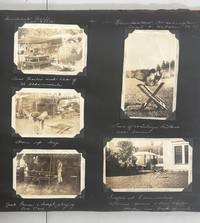
1932234061932. New Deal-era western construction and industrial expansion across California Oregon and Washington recorded in an extensive family photo album with inscribed dates locations and details. The album records the surge of dam bridge road harbor and flood-control work that followed Franklin Roosevelt's New Deal public works programs. The photographs record the individual impact of the 1935 Emergency Relief Appropriation Act the Works Progress Administration and earlier Public Works Administration funding which helped push thousands of men into construction work is documented. This album's years align with the federal agencies and private contractors shift to reshape western rivers harbors roads and transportation infrastructure.<br /> <br /> Photo archive of 469 photographs mostly silver gelatin photos and with some real photo postcards ranging from 2.5 x 4 to 5 x 7 inches California Oregon and Washington Arizonia 1932-1938. The album includes extensive handwritten captions identifying Monterey California breakwater work in 1932 Azusa road construction in San Gabriel Canyon in 1933 Bonneville Oregon in 1934 Monterey Bay dragline work in 1934 San Francisco and Oakland Bay views Hansen Dam shovel work and family travel between Encinal Washington and Oakland. Monterey pages record a shovel loading rock trucks lined for breakwater work a first load of rock dumping rock from a pier and Monterey Pier from the water. Azusa pages show a slide covering a shovel a truck being let down a steep hill by cable road cuts through canyon rock and named men beside heavy trucks. Bonneville pages show "Dolph & a new Mack truck" four new Mack trucks a new car beside a shovel men standing inside a shovel bucket and a "50 B drag line" on the Columbia River. Additional construction scenes show electric shovels steam shovels loading trucks workers in quarries tug crews draglines extending over water trestle rail lines partially framed industrial buildings in San Francisco in 1937 and captioned men including Key Dolph Bill Reid Pat Al Bow Irving Pinky Hamlistall and George Lamblet. Travel and family pages add a 1936 Oldsmobile camp trailers ferries Treasure Island and the Bay Bridge Oakland camps Warrendale and Bonneville family portraits sailors at a beer hall Columbia River Highway views and domestic scenes that place construction labor inside a wider pattern of westward automobile mobility. This album records the overlap between large-scale public works and ordinary itinerant life: heavy machinery quarry crews draglines trestles cofferdams dump trucks travel trailers and family stops all appear. Many photographs document domestic life from family gatherings to celebrations of new born babies. <br /> At its core this album depicts regional power planning flood control military and commercial harbors and the creation of automobile infrastructure which permanently altered the West Coast and Columbia River basin. Bonneville and Grand Coulee brought hydroelectric capacity irrigation planning and federal power policy into the center of Northwest development while the Bay Bridge and related Oakland-San Francisco work changed metropolitan circulation around the bay. The captions repeatedly tie people to machines and locations suggesting a family or work circle moving through construction jobs rather than a tourist album with incidental industrial views. Edge wear chipping album leaves worn spine and many loose pages; images remain clear captions remain legible and securely mounted or associated with their original pages. Overall in good condition. This archive documents the New Deal-era western construction through quarry faces truck yards draglines ferry crossings trailers named workmen and families following the work from site to site spanning the Bay Bridge to Hansen Dam. unknown
026695Book. Fine. card cover>. Folio - over 12" - 15" tall. Philips Electronics Canada Promotional "Record Album" featuring rare silkscreen of Robert Goulet c. 1958 This attractive and imaginative promotional package was used by sales reps to entice store owners to stock Philishave products notably the new Philishave rotary electric Speedshaver. The format is a brown leatherette "record album" with five sleeves containing advertising material instead of vinyl lp recordings. The covers feature the title of a "musical" -- Oh What A Wonderful Feeling" -- within an oval design in gold. The front endpaper is a woodgrain pattern with a short text that describes the campaign as an "exciting happy-go-lucky advertising idea". The first item in the album is a full-colour silkscreen on heavy cardstock of a cheerful "Bob Goulet: Outstanding Singing Star of Television and the Canadian Stage" wearing Western garb using the shaver. The five sleeves are each titled "The Star" "Record Breaking Performance" etc.; each includes a silkscreened cardboard replica of an lp with text that refers to the title of that sleeve the first for instance begins "Here's the Star "" with the "lp" label titled "Overture to Comfort" with a drawing of the shaver; the second "lp" is titled The Shaver with the Hinge on Top". The third sleeve contains two attached "lps" that open to reveal details of the advertising campaign which included double-page ads in Canadian magazines newspaper ads and television spots "on 44 stations". The ads featured Goulet and other TV and stage stars. The final sleeve has on the back a pocket titled "Here are the Props" that includes numerous colourful promotional items: images of store displays a poster order form two "tickets" to the premiere of the "musical" and two advertising lists showing when and where ads were to be placed. The overall condition of the album and contents is excellent with some wear to the cover: some scuffing to cover edges and spine; a snall stain on front a bit of buckling on back and places along spine edge where paper has separated. Inside there are offset marks from the album bolts and the sleeve pocket printing onto the back end paper the two ad lists are scuffed at the top and the silkscreen of Goulet has several small scuffs. Colours throughout are bright and there is no chipping or wear to the paper contents. This is a wonderful example of 1950s advertising. Paperback
1 volume in-4°, pp. (8), XIV, 8], xvi, 427, (1), con 18 tavole incise e ripiegate al fondo; solida legatura ottocentesca in mezza pelle titolo in oro su elegante tassello blu al dorso. Bell'esemplare marginoso e candido, minimali tracce d'uso al dorso. Seconda edizione più pregiata della precedente, la prima con le utili note del Manfredi, successore di Guglielmini nell'incarico di soprintendente alle acque di Bologna. Opera scientificamente insuperata per oltre un secolo. Gamba 1940; Ricciardi I, 643.
Milano, SNEP (Società Nazionale Editrice Propaganda Anonima, 1933 e 1936, due volumi in-4to (cm. 34 x 25) legatura originale rivestita in velluto marrone, pp. 973 + 432 con ritratti a piena pagina di Mussolini, Antonio Stefano Benni e Gino Olivetti, imponente opera completamente illustrata da fotografie relative alle industrie cotoniere, laniere, seriche, canapifici, jutifici, linifici, industrie tessili varie, meccaniche, metallurgiche, siderurgiche, navali, ferro-tramviarie, automobilistiche e aeronautiche, elettriche, banche, istituti di credito e assicurazioni, industrie della gomma, alimentari, dei liquori e della birra, industrie edilizie, della ceramica e dei laterizi, dei colori e delle vernici, del vetro, industrie chimiche e profumiere, cartiere, de cuoio e affini, ecc. ecc. Legature un po’ allentate ma integre, qualche lieve traccia d’uso ma nel complesso buon esemplare. Il libro descrive il resoconto di quanto fatto dall'industria italiana (suddivisa in tutte le sue varie sezioni) a vantaggio delle classi lavoratrici, prima e durante il Regime Fascista, curata dalla Confederazione Generale Fascista degli Industriali Italiani. I dati raccolti descrivono con foto e didascalie le attività svolte nelle aziende a favore degli operai. Prefazione dell'On.Antonio Stefano Benni, Presidente della Confederazione Generale Fascista dell'Industria Italiana, corredata da pensieri del Duce Benito Mussolini. Sono presenti le maggiori Industrie italiane come la Fiat e la Pirelli, e ampio spazio viene dato alle aziende tessili biellesi dell'epoca.
3065P., Librairie des dictionnaires, 1881-1888 (8 premiers volumes), 1891 (premier supplément) 1892 (circa ; deuxième supplément), 10 FORT VOLUMES GRAND IN 8 RELIES EN DEMI-MAROQUIN MARRON, TRANCHES JASPEES (Reliures de l'époque), T.1 : (4), 7pp., 1029pp., T.2 : (4), 944pp., T.3 : (4), 1198pp., T.4 : (4), 1087pp., T.5 : (4), 984pp., T.6 : (4), 960pp., T.7 : (4), 964pp., T.8 : (4), 1138pp., 6pp., Premier supplément : (4), 1392pp., Deuxième supplément : (4 dont UN PORTRAIT DE LAMI), 1428pp., TRES NOMBREUX BOIS GRAVES DANS LE TEXTE REPRESANTANT LES MACHINES ET LES TECHNIQUES DE L'EPOQUE
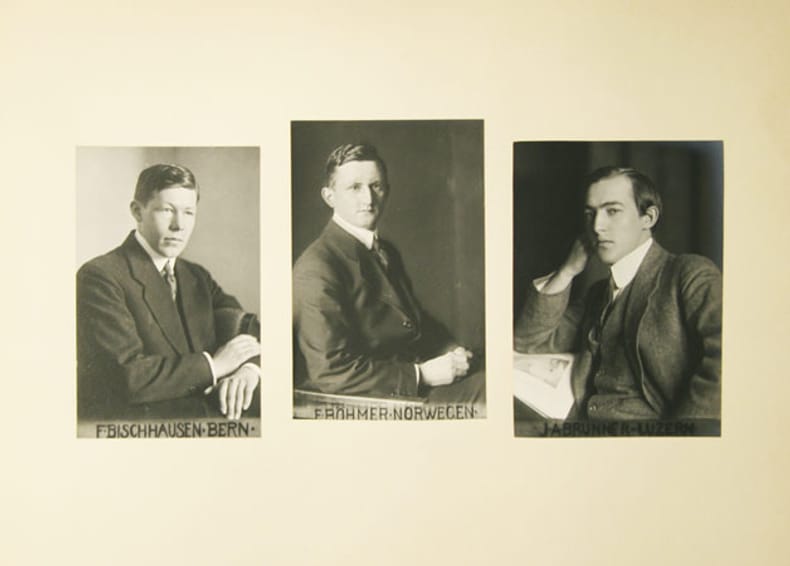
85672aaf1914, in-folio, queroblong, 31 Bl. festes beiges Photoalbumpapier d. Z., mit insgesamt 82 original s/w-Photos (wohl von Fr. Schmelhaus, Zürich-Pfauen), davon 11 Aufnahmen der Schulgebäude und Werkstätten im Format 14x22 cm (1 gr. Ansicht der ETH) und 11x15 cm, der Rest sind Porträtaufnahmen im Format 15,5x10,5 cm (11 Professoren), 11x7 cm (61 Diplomanwärter und 1 Abwart), Albumseiten und Fotografien in sehr gutem Zustand, Papp-Fotoalbumeinband d. Z., Albumseiten mit zweifarbiger Leinenschnur zusammengehalten, Vorderdeckel mit geprägtem Titel, rückseitig der Herstellername Fr. Schmelhaus), Ecken etwas eingeknickt, ansonsten sehr guter Zustand.
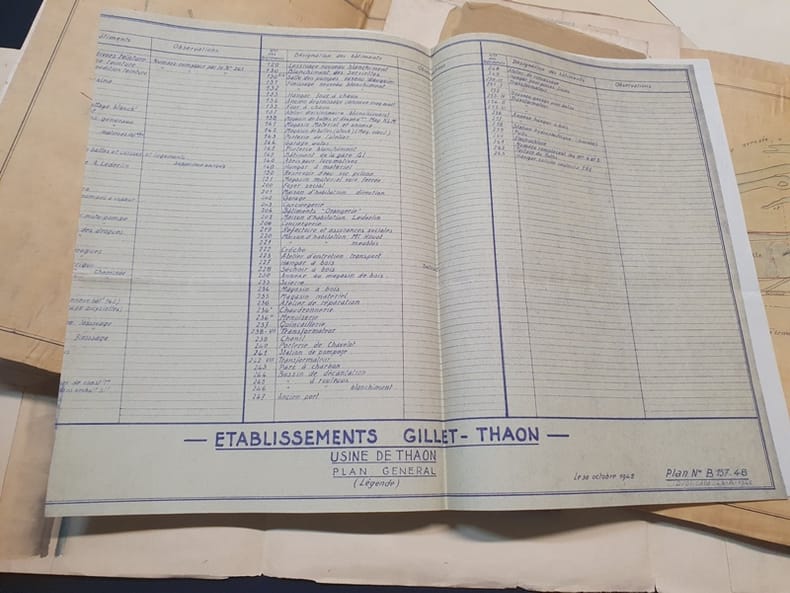
Yb250 Nombreux plans aquaréllés la plupart sur papier fort , certains sur calque - Quelques uns imprimés - Plans concernant les terrains dévolus a l'entreprise , ou aux projets de développement de la B.T.T, a des travaux d'aménagement , quelques plans concernant des machines de l'entreprise . Plans de diverses tailles . La B.T.T. fut fondée après la guerre de de 1870 par Jules Fabre et Charles Laererich , tous deux propriétaires d'une entreprise similaire dans la vallée de la Moselotte . L'usine démarrera fin 1873 , son directeur en sera Armand Lederlin . Elle sera florissante jusque dans les années 1950 mais ne survivra pas a la crise du textile Vosgien .
19342092902137702459Not Available 1934. Soft Cover. Fine. The book is in fine condition. Not Available paperback
1973239951973 Gravures et typographies de Robert Blanchet. Boulogne-Sur-Seine, Robert Blanchet, 1973, 2 volumes in-8 carré, en feuilles, sous couverture rempliée, sous chemise-étui à rabats de l'éditeur, sous étui toilé bleu, 48 pages, avec sa matrice, bois gravé.
85282aafo.J. (um 1965), quer in-Folio, 19 Bl. festes Albumpapier mit 17 Fotos im Format 21x16 cm (davon 10 in Farbe) und zahlreichen farbigen Original-Tuschezeichnungen, Titelseite und auch Beschriftungen der Bilder in kalligrafischer Goldschrift von Hand gezeichnet, guter Zustand, Orig.-Halbleinenfotoeinband mit Ecken u. Leinenschnur, Vorderdeckel mit Kratzspuren, sonst guter Zustand.
Lotto di 18 annate (consecutive) complete della rivista quindicinale, stampata a Biella, dedicata, principalmente, all'industria tessile. Ogni annata è stata rilegata in un unico volume (in questo modo ciascun tomo fa riferimento ad una singola annata). Annate complete presenti: 1924, 1925, 1926, 1927, 1928, 1929, 1930, 1931, 1932, 1933, 1934, 1935, 1936, 1937, 1938, 1939, 1940, 1941. Nell'ultimo tomo, in aggiunta all'annata 1941 (completa), sono stati rilegati anche i primi 8 numeri (fino al 30 aprile) dell'anno 1942. L'Operaio è una rivista tecnica dedicata, quasi totalmente, al mondo dell'industria tessile. Stampata a Biella, fu fondata nel1920 da Vincenzo Ormezzano. I vari numeri presentano al loro interno, belle incisioni in nero (raffiguranti macchinari e telai), illustrazioni e tabelle. Alcuni articoli pongono, specificatamente, l'attenzione sull'industria tessile del Biellese (esempio: un articolo sul telaio per tessuti costruito dalla ditta Giovanni Colongo di Cossato, o l'articolo dedicato a Erminio Forno di Mosso: il biellese che impiantò la prima fabbrica di stoffe in Bolivia o, ancora, il trafiletto per Bartolomeo Boggio: biellese che introdusse in Perù l'industria tessile, alcuni altri titoli: "L'indistria meccanica nel biellese", "Perfezionamenti alle macchine tessili dovuti a tecnici del biellese"). Gli articoli pubblicati su questa rivista, pur incentrandosi sul tema della tessitura e dell'indistria tessile, sono molto eterogenei e spaziano dall'analisi di temi più "generali" a quelli più pratici e tecnici. Al fondo di ciascun tomo è rilegato l'indice dell'intera annata. Numero di pagine di ciascun tomo: annata 1924: 480 pagine annata 1925: 484 pagine + 7 di indice annata 1926: in questo tomo la numerazione delle pagine riprende per ogni singolo numero della rivista. Ogni numero consta di circa 20 pagine. annata 1927: 530 pagine + VI (indice) annata 1928: 577 pagine + VI (indice) annata 1929:560 pagine + VI (indice) annata 1930: 576 pagine + VI (indice) annata 1931: 466 pagine + VI (indice) annata 1932: 424 pagine (indice compreso nella numerazione) annata 1933: 296 pagine (indice compreso nella numerazone) annata 1934: 295 pagine (indice compreso nella numerazione) annata 1935: 296 pagine (indice compreso nella numerazione) annata 1936: 295 pagine (indice compreso nella numerazione) annata 1937: 296 pagine (indice compreso nella numerazione) annata 1938: 296 pagine (indice compreso nella numerazione) annata 1939: 296 pagine (indice compreso nella numerazione) annata 1940: 296 pagine (indice compreso nella numerazione) annata 1941 - 1942: 274 (anno 1941) + 60 (primi 4 mesi del 1942). Dimensioni di ciascun tomo: 17 x 24 cm circa. Stato di conservazione: In generale si può parlare di un lotto decisamente ben conservato. Si segnala una leggera piega trasversale dei vari numeri (causata, presumibilmente, dal fatto che questi venivano spediti in abbonamento piegati) e qualche leggero alone / scoloritura e superficiale piccola abrasione sulle copertine. Nello specifico, si segnalano alcuni leggeri difetti (davvero minimi): - Nell'annata 1924, il numero 5 è stato rilegato successivamente al numero 6. - annata 1925: si segnala un piccolo strappetto senza mancanza sul margine bianco inferiore del foglio che contiene le due pagine 127 - 128. - annata 1926: sono presenti alcuni piccoli segni di utilizzo: un piccolo strappetto senza mancanza sul margine bianco superiore del foglio che contiene le due agine 15-16 del numero 1; una sottolineatura (a pastello rosso) di riga di testo sulla pagina 19 del n. 3; un segno a pastello (blu) su pagina 13 del numero 20; un segno a margine a pastello (blu) su pagina 4 e 5 del numero 21; un appunto a penna sul margine di pagina 19 del numero 21. - annata 1928: è presente un piccolo aline marrone sul margine bianco verticale delle pagine 117 - 121; un difetto di natura editoriale ha causato una piega sulle pagine 277 - 284. - annata 1930: una piccola rottura (senza mancanza) sul foglio che contiene le due pagine 493 - 494. - annata 1935: il fascicolo composto dalle 4 pagine 251 - 254 si è staccato dalla rilegatura ma è comunque integro e presente. - annata 1941: si segnala un segno a pastello blu, a margine di un paragrafo su pagina 110 e pagina 111 e un errore (di natura editoriale) relativo alla stampa della numerazione delle pagine: dalla 168 si passa alla 179 (ma si tratta di un errore editoriale non di una mancanza in quanto la pagina 168 è quella conclusiva del numero 13-14 e lapagina 179 è la prima del numero 15-16. I 18 tomi che compongono questo lotto presentano tutti la stessa rilegatura con piatti cartonati rigidi e titoli in oro sui dorsi. Non sono state rilegate le copertine dei singoli numeri. Sul retro dei piatti anteriori di quasi tutti i volumi sono applicati EX LIBRIS appartenenti tutti alla medesima persona. Molto curioso anche l'evolversi dell'ex libris durante gli anni: nel 1937 esso cambia immagine per la prima volta, per poi cambiare nuovamente nel 1939. Gli ultimi due raffigurano immagini relative al mondo dell'industria tessile (un uomo che lavora ad un telaio) e sul secondo è presente anche un motto: "tanto mi muoverò che la tela sia finita". I volumi relativi alle annate 1931, 1932, 1933 e l'ultimo volume (1941-42) non presentano ex libris ma solo una firma a matita del proprietario (sul margine superiore del primo numero). Lotto da collezione. Insieme di numeri consecutivi di non facile reperimento. Per far capire la prestigiosità e la grande completezza (ed eterogeneità) degli argomenti trattati relativi al mondo tessile, riportiamo, a titolo esemplificativo, il titolo di alcuni articoli presenti in questi numeri: - Costruzione di telai per la tessitura meccanica - Tintura della mezza lana al monocromo - L'arte della tintura attraverso i secoli - Colori e tessuti - La sbianca del cotone con l'acqua di cloro - Tintura delle matasse di lana - Un terribile nemico del cotone - L'industria laniera in Italia - Bestiame lanuto - Le teorie del Dott. Voronof e le loro relazioni coll'indistria laniera - Importanza della chimica applicata all'industria tessile - Estetica scientifica dei colori - nero su lana con l'"Ematol" - Note sulmontaggio e sull'assitenza dei telai meccanici per tessuti in lana - Diversi procedimenti per la tintura della yuta - Lavorazione di effetti diversi sui nastri operati - Asciugamento della lana del cotone ed altro materiale in fiocco - Carbonizzazione dei tessuti di lana - L'acido formico nell'industria - La seta di Bisso - La seta Bemberg; - La lavorazione della setra artificiale "viscosa" - La lavorazione della seta tratta e dei suoi cascami - Oliatura della lana - lavatura e sgrassatura della lana - La bruciatura del pelo nella finitura dei tessuti - Impianto per stampa Vigoureux - Il telaio automatico Northrop per laniere . Guida pratica per l'assistente telai - Scoperta tedesca per la difesa dei tessuti di lana dalle tarle - Candeggio dei tessuti di cotone secondo il procedimento Mohr - Sbianca dei tessuti di cotone - Classificazione dei cascami e degli stracci usati nella lavorazione della lana - Il telaio automatico per lana di L. Schonherr - La macchina da cucire - Damaschi e montature per damaschi - Lane d'Italia filabili - Appunti di tessitura - Il lino e i suoi caratteri generali - Effetti bouclés nei tessuti - Fibre tessili e loro proprietà -I filati di canutiglia - Come si traducono i prezzi in pence per libbra inglese in prezzi in lire per chilogramma - Sul peso specifico dei prodotti tessili - Delle innovazioni moderne apportate ai filatoi continui ad anallo (rings) - Come riscaldare la fabbrica - Illuminazione e produttività delle officine - Mordenti e colori minerali - Asciugatoi per materie tessili - I calcoli di riduzione dei tessuti - Numerazione filati (Tavola di rapporto) - La filatura del cotone - Intrecci per tessuti di lana - Alcuni esempi di intrecci usati in laneria - Intrecci a rigature ed a filetti per ordito - La ramì - Cotone e proprietà del cotone - Cimosse buone e cimosse cattive - Degli effetti di luce ottenuti col disegno nattè Fabbricazione dei cappelli di lana - Morfolofia della lana - Le gabardine - L'utilizzazione del vapore nelle tintorie - Prodotti chimici per tintoria - L'orditura e gli orditoi moderni - Studio di un tessuto di lana. Imitazione velour cisélé - Preparazione alla filatura del pettinato di lana - Lane da carda, lane da pettine e loro prodotti - I materiali tessili derivati dal regno delle piante - Il bestiame lanare nel Perù - Difetti che possono presentare le fibre della lana - Lavaggio della lana - Stiro progressivo dei filati di lana cardata nel selfacting - Tintura, in bagno unico, di cotone e seta viscosa - Regolazione dell'introduttore nelle carde a cappelli per cotone - I nemici del cotone - l'impermeabilizzazione dei tessuti - Incombustibilità dei tessuti - Sulla follatura dei tessuti - Tessuti elastici per bretelle e giarrettiere - La torsione dei filati - Trattamenti antipieghe dei etssuti - Comandi nella Jacquard - Come si candeggiano i tessili - .... - ....Diverse anche le inserzioni pubblicitarie d'epoca tra le quali si segnalano alcune pubblicità locali (del Piemonte) come quella della macchina per scrivere Olivetti. Accattivanti, le pubblicità della Ercole Marelli e quelle (anche su due pagine frontali) de "Ateliers H. Duesberg Bosson Verviers (Belgio) che presentano fotografie in nero dei vari macchinari.
In 8o (cm 16 x 23,5), pp. 114 con illustrazioni fotografiche nel testo e copertina di Albe Steiner. Brossura editoriale. Illustrata da un'iconica immagine grafica, "la copertina di Steiner con diversi livelli di trasparenza, mostra il meccanismo dei tasti, occupando la prima e la quarta di copertina". Rara edizione originale, restituisce in modo dettagliato l'attivita' della fabbrica d'Ivrea, dove tutti i reparti e le relative fasi produttive vengono descritti dalle parole di Fortini e Brizzolara, e corredati da immagini con buona probabilita' opera di Steiner. Emergono anche diversi aspetti dell'architettura industriale degli stabilimenti, per la maggior parte realizzati su progetti di Figini e Pollini, quasi a voler comporre una sequenza filmica, dove l'estensione dell'immagine coincide con il campo di ripresa. In contrappunto, i ritratti di operai e di operaie, mentre in didascalia, testimonianze in prima persona tra aspirazioni, desideri e paure. Si tratta di un tentativo di umanizzazione della fabbrica, forse non riuscito alla perfezione, ma decisamente innovativo, se paragonato a prodotti nazionali di quegli stessi anni. Cfr. C. C. Fiorentino, "Millesimo di millimetro...", Bologna, il Mulino, 2014, p. 208.
1960304171Bayer, Leverkusen ohne Jahresangabe (ca. 1960). nicht durchgehend paginiert (ca. 300 Seiten je Band, 8°, Original-Kunststoff-Ringordner, insgesamt gute und innen saubere Exemplare,
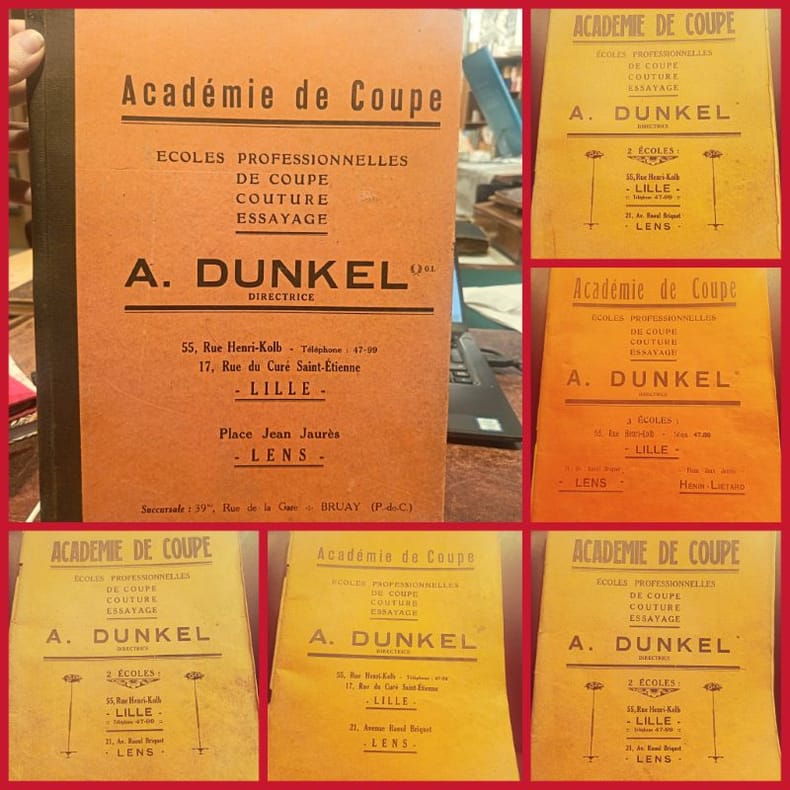
LCI-6309Lille, Circa 1925-35 6 in folio Broché [ARCHIVES EXCEPTIONNELLES] Fonds de 6 Cahiers Manuscrits - Académie de Coupe Dunkel (Lille, Lens, Hénin-Liétard) Période : Années 1920-1930.Description : Collection complète et rarissime de 6 volumes manuscrits constituant l'intégralité du cursus de formation d'une future couturière au sein de l'Académie Dunkel. Ce fonds documentaire unique offre une immersion totale dans les méthodes de coupe du Nord de la France durant l'entre-deux-guerres.Contenu de l'ensemble :Tracés de Coupe : Des centaines de planches géométriques dessinées avec une précision chirurgicale.Croquis à la main : Illustrations de mode au crayon et à la plume, capturant l'élégance et la silhouette de l'époque.Collages de Mode : Chaque leçon est enrichie de modèles découpés dans la presse de mode de l'époque, créant un dialogue fascinant entre la technique et le style.Géographie du Savoir : Mentions explicites des centres de Lille, Lens et Hénin-Liétard, ancrant ces documents dans le patrimoine industriel et artisanal de la région.État de conservation :Série homogène et complète.Reliures d'origine saines et solides.Intérieurs d'une fraîcheur remarquable.