32 618 résultats
188739042Torino, Bocca, 1887 + 1888. Royal 8vo. Bound uncut w. the original wrappers of both works in one very nice a bit later (ab. 1920) red hcalf w. five raied bands to back. Single gilt lines to raised bands and gilt title on spine. A bit of soiling to wrappers, which have minor lacks to the inner hinges, where they are mounted onto hinge-strips. Front-wrappers w. stamp from ""Fratelli Bocca Editori"". A bit of brownspotting, mainly to first work. A very fine and attractive copy of these two works, very finely bound together. XII, 334, (2) + X, (2), 170, (2) pp.
Torino, Bocca, 1887 + 1888. Royal 8vo. Bound uncut w. the original wrappers of both works in one very nice a bit later (ab. 1920) red hcalf w. five raied bands to back. Single gilt lines to raised bands and gilt title on spine. A bit of soiling to wrappers, which have minor lacks to the inner hinges, where they are mounted onto hinge-strips. Front-wrappers w. stamp from ""Fratelli Bocca Editori"". A bit of brownspotting, mainly to first work. A very fine and attractive copy of these two works, very finely bound together. XII, 334, (2) + X, (2), 170, (2) pp.
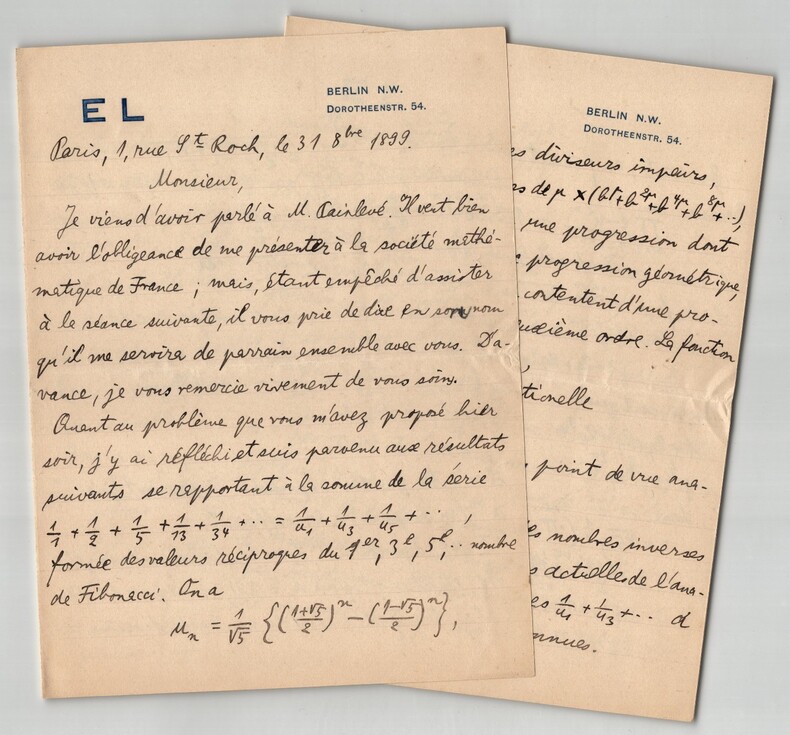
1899boz_006267Longue lettre autographe signée, Mathématiques FIBONACCI Laisant Painlevé, 1899 Mathématicien allemand Exceptionnelle et très longue lettre autographe signée d'Edmund LANDAU, adressée au mathématicien français Charles-Ange LAISANT, datée du 31 Octobre 1899 à Paris. Rédigée à l'encre noire sur deux doubles feuillets de papier vélin, avec ses initiales gaufré bleues en entête. Cette lettre ne constitue pas une simple correspondance de courtoisie, mais un remarquable manuscrit mathématique préparatoire, qui documente la phase de recherche ayant conduit à la publication de 1899. En 1899, Charles-Ange Laisant pose le problème de la détermination de la somme des inverses des nombres de la suite de Fibonacci. Edmund Landau, alors jeune docteur de 22 ans à l'aube d'une carrière qui fera de lui l'un des plus grands théoriciens des nombres du siècle, s'empare de la question. Dans cette lettre, Landau répond directement à Laisant ( "Quant au problème que vous m'avez proposé hier soir, j'y ai réfléchi et suis parvenu aux résultats suivants..." ) et lui livre l'intégralité des calculs qui jetteront les bases directes de son article devenu une référence classique dans l'étude de cette série : "Sur la série des inverses des nombres de Fibonacci" , publié la même année dans le Bulletin de la Société Mathématique de France (Tome 27, p. 298-300). En introduction, Landau évoque ses démarches pour entrer à la Société Mathématique de France (SMF), révélant un double parrainage d'une immense distinction : Paul Painlevé et Charles-Ange Laisant lui-même. "Je viens d'avoir parlé à M. Painlevé. Il veut bien avoir l'obligeance de me présenter à la société mathématique de France ; mais, étant empêché d'assister à la séance suivante, il vous prie de dire en son nom qu'il me servira de parrain ensemble avec vous." Landau déploie une démonstration magistrale pour ramener la somme des inverses aux indices impairs de la suite de Fibonacci à des fonctions connues. Il utilise et cite explicitement : - La formule de Binet pour les termes de Fibonacci (un). - La transformation de la série en produits et sommes infinies complexes. - Les fonctions Thêta (ϑ) de Heinrich Weber ("les fonctions désignées par ϑ00(0) et ϑ10(0) dans le traité de M. Weber") . - La célèbre formule de produit infini de Gauss ("en faisant usage de la formule de Gauss..."). Landau conclut avec une remarquable lucidité sur les limites de l'analyse de son époque concernant les indices pairs : "l'étude de la somme des nombres inverses [pairs] semble dépasser les moyens actuels de l'analyse, tandis que celle des nombres 1/u11/u3... a été ramenée à des fonctions connues." Dimensions : 13 x 17,2 cm État : Très bel état de conservation. Voir photos et description pour plus de détails. Nombre de pages : 7 pages
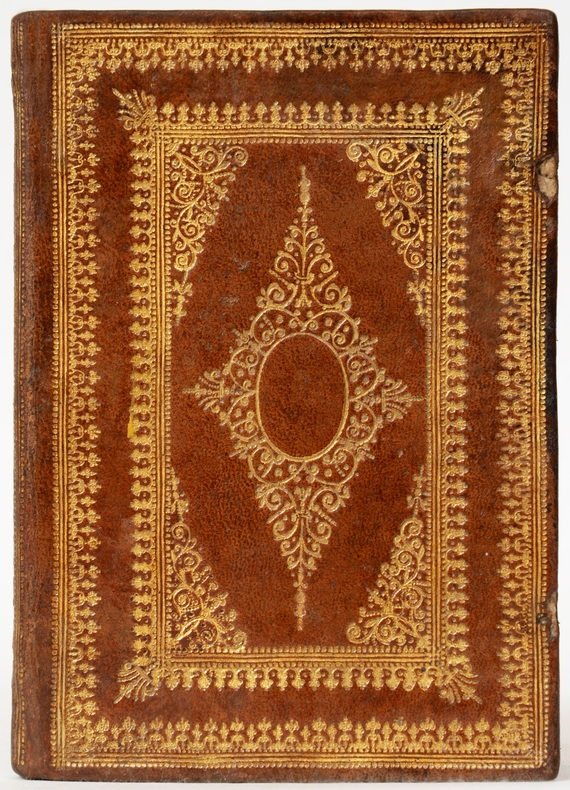
163615266Sans lieu, , 1636-1637. 2 parties en 1 vol. in-12 de (15) pp. et (1)-55-17 pp. mal chiffrées, gravées et encadrées, maroquin brun, large décor doré à petits fers sur les plats dans un double encadrement de frises, écoinçons et roulettes, traces de fermoirs, dos lisse orné, tranches dorées (reliure de l’époque).
Paris, Courcier, 1807. 4to. (252x197mm). Nice recent half morocco over marbled boards. First and last leaves brownspotted, and even, light browning throughout. XX,(2),502 pp. (including half-title and errata). Interleaved with contemporary handwritten notes (and computations) in French.
184135935Paris, Académie des Sciences, 1841 (submitted 1826). 4to. (257x197mm). Extract from: 'Mém. Acad. d. Sciences de Paris', 1841, pp.176-264. Contemporary half calf with gilt spine lettering. Spine with a little wear. Some light brown spotting throughout. Otherwise fine and clean.
183449559Kazan, 1834. 8vo. Contemporary blank, blue wrappers (original?). A closed tear and a bit of staining to back wrapper and some tears and scratches to spine. Internally very nice and clean. Presumably not an off-print, as there are stitching-holes to the margins, indicating that it has been removed from a volume, although the wrappers could look original, certainly contemporary. With the original title-page for Book 11 of the ""Uchenye zapiski"" + pp. (167)-226.
174039297Paris, De Bure, 1740. 4to. Contemporary half calf, raised bands, richly gilt spine and and red speckled edges. Leather title-label to spine. Corners neatly repaired. Title in red/black. (2), III-XXX, (2) Errata, 148 pp., many diagrams. The ""Preface"" and the first 18 leaves of the text with a foxing to lower margin and right corners. The ""Preface"" is an historical account of Newton's method ""la sublime méthode"", written by Buffon. Without the leaf ""Extrait des Registres"".
179758364Kiøbenhavn, Johan Rudolph Thiele, (1797) 1799. 4to. Uncut and unopened in original blue boards. Published in: ""Nye Samling af det Kongelige Danske Videnskabernes Selskabs Skrifter."" Vol. V. Wessel's paper: pp.469-518 and 3 folded engraved plates (the last plate inserted at p. 463). The whole volume V offered in its original binding. Engraved titlevignette. XII,670 pp., 15 engraved plates. 4 leaves with upper right corners gone, not affecting Wessel's paper.
168361341Basel, Brandmylleri, 1683. 4to. In a contemporary Cambridge-style mirror binding with five raised bands and richlt gilt spine. Small paper-label pasted on to top of spine. Head of spine chipped, showing headbands. Small repair to spine. Lower outer corner of back board with large scratch showing the board underneath. Four-line note in contemporary hand to front free end-paper. Previous owner's name in contemporary hand to title-page. Internally fine and clean. (18), 354, 121, (1) pp. + 1 folded plate.
Paris, Académie des Sciences, 1841 (submitted 1826). 4to. (257x197mm). Extract from: 'Mém. Acad. d. Sciences de Paris', 1841, pp.176-264. Contemporary half calf with gilt spine lettering. Spine with a little wear. Some light brown spotting throughout. Otherwise fine and clean.
The Association for Symbolic Logic, 1936-1938. Royal8vo. In: Journal of Symbolic Logic, Volume 1-3. The three entire volumes bound in one offered here. Contemporary full cloth with silver gilt spine lettering. Provenance: Exlibris from the Rockefeller Institute for Medical Research, New York. A fine and completely clean copy.
Leipzig, Grosse & Gleditsch, 1691. 4to. Contemp. full vellum. Faint handwritten title on spine. a small stamp on titlepage. In: ""Acta Eruditorum Anno MDCLXXXXI"". (8),590,(6) pp. and 13 (of 15) folded engraved plates. The 2 first plates lacks, but they do not belong to the papers listed.Leibniz' papers: pp.277-281 a. 1 plate, pp. 435-439. Johann Bernoulli: pp. 274-276 a. 1 plate. Huygens: pp. 281-282. - Jacob Bernoulli: pp. 282-290 a. 1 plate.
Kazan, 1834. 8vo. Contemporary blank, blue wrappers (original?). A closed tear and a bit of staining to back wrapper and some tears and scratches to spine. Internally very nice and clean. Presumably not an off-print, as there are stitching-holes to the margins, indicating that it has been removed from a volume, although the wrappers could look original, certainly contemporary. With the original title-page for Book 11 of the ""Uchenye zapiski"" + pp. (167)-226.
Paris, De Bure, 1740. 4to. Contemporary half calf, raised bands, richly gilt spine and and red speckled edges. Leather title-label to spine. Corners neatly repaired. Title in red/black. (2), III-XXX, (2) Errata, 148 pp., many diagrams. The ""Preface"" and the first 18 leaves of the text with a foxing to lower margin and right corners. The ""Preface"" is an historical account of Newton's method ""la sublime méthode"", written by Buffon. Without the leaf ""Extrait des Registres"".
Kiøbenhavn, Johan Rudolph Thiele, (1797) 1799. 4to. Uncut and unopened in original blue boards. Published in: ""Nye Samling af det Kongelige Danske Videnskabernes Selskabs Skrifter."" Vol. V. Wessel's paper: pp.469-518 and 3 folded engraved plates (the last plate inserted at p. 463). The whole volume V offered in its original binding. Engraved titlevignette. XII,670 pp., 15 engraved plates. 4 leaves with upper right corners gone, not affecting Wessel's paper.
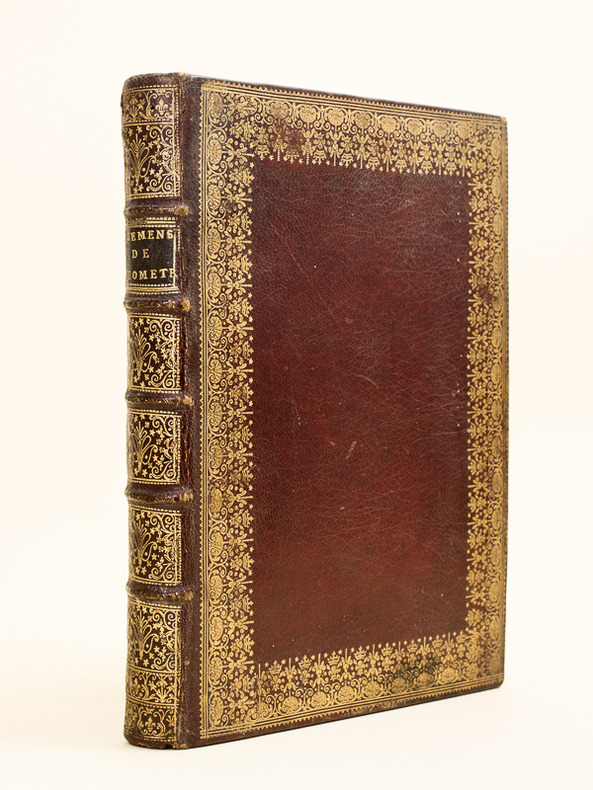
1700390861 vol. in-4 reliure d'époque plein maroquin rouge, dos à 5 nerfs doré orné, large roulette d'encadrement aux plats, coupes et chasses ornées, toutes tranches dorées, texte manuscrit, 3 ff. blancs, 258 pp. et 1 f. blanc avec 25 planches dépliantes dessinées à la plume
163734701Uppsala, Eschillus Matthiæ, 1637. Small 4to. Cont. full vellum over wood. Spine ends worn, tears to hinges, but not broken, lower edges of boards with old repairs. Some old ink annotations on boards. Inside frontcover and on title many old owner names, small wholes cut in titel without loss of letters. First ab. 20 leaves with a faint dampstain in upper margin, inkspots on last page. Internally clean. (24),350,(2) pp., numerous geometrical diagrams in the text.
169446773Paris, Jean Jombert, 1694. 8vo. 2 contemp. full calf. Raised bands. Richly gilt spines with gilt lettering. Light wear to spine top of spines. 2 very small nicks to lower compartment of volume 2. Small crack to one hinge on volume 2, but in no way loosening. (32),400""(16),303,(1) pp. + ""Horloges"" separately paginated (8),163,(5) pp. With in all 84 engraved plates, some with many figs. Internally clean and fine.
Uppsala, Eschillus Matthiæ, 1637. Small 4to. Cont. full vellum over wood. Spine ends worn, tears to hinges, but not broken, lower edges of boards with old repairs. Some old ink annotations on boards. Inside frontcover and on title many old owner names, small wholes cut in titel without loss of letters. First ab. 20 leaves with a faint dampstain in upper margin, inkspots on last page. Internally clean. (24),350,(2) pp., numerous geometrical diagrams in the text.
Paris, Jean Jombert, 1694. 8vo. 2 contemp. full calf. Raised bands. Richly gilt spines with gilt lettering. Light wear to spine top of spines. 2 very small nicks to lower compartment of volume 2. Small crack to one hinge on volume 2, but in no way loosening. (32),400" "(16),303,(1) pp. + ""Horloges"" separately paginated (8),163,(5) pp. With in all 84 engraved plates, some with many figs. Internally clean and fine.
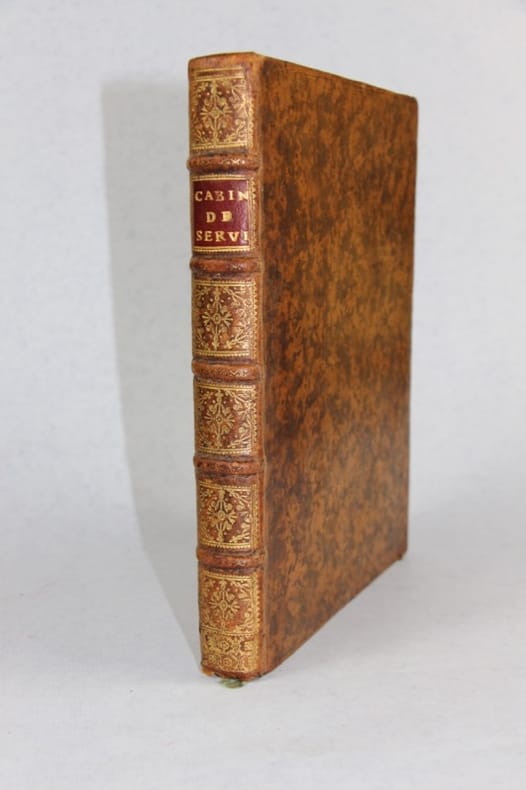
1733129299Lyon, David Forey, 1733 In-4, basane marbree, dos orne, tranches jaspees Reliure de l'époque, 12ff. n.ch. 152 pp. & 4ff. n.ch. 93 planches hors texte de machines gravees en taille-douce par Étienne-Joseph Daudet, ainsi qu'un bandeau aux armes du duc d’Orleans par André Houat. Trois piqures de ver sur un caisson, rares petites rousseurs éparses.
1977ZB252490North Holland 1977. volumes 19-24 27-28 30 32 34 41-43 45-47 1977-1998 mostly original paper wrappers ex library good price is for the lot. - If you are reading this this item is actually physically in our stock and ready for shipment once ordered. We are not bookjackers. Buyer is responsible for any additional duties taxes or fees required by recipient's country. Photos available upon request. North Holland unknown
1760607455Amsterdam, Mortier, 1706-1760. M. gest. Tit.-Vign. u. Front. u. zahlr. Kpfr.-Taf. Versch. geb. (Prgt., Ldr. d. Zt.), wenige brosch. Einbde. teils berieben, bestoßen u. angeschmutzt, wenige leicht beschäd. u. m. Rsign. Teils m. St. Gebräunt bzw. braunfl.
"In-4°, (16 cc inclusi l’occhietto e il frontespizio inciso), 338 pp, (3). Con una carta n.n. contenente uno spartito musicale tra pag. 122 e 123, e diversi diagrammi incisi su legno nel testo. Pelle coeva francese, dorso in oro, nervature, timbro della ‘Bibliothéque d’artillerie’ su occhietto e frontespizio, copia in buono stato. Edizione unica. “René Ouvrard (Chinon 1624-Tours 1694) fu un teorico, musicista, ecclesiastico e letterato francese. Da giovane Ouvrard si formò in teologia e musica a Tours. Intorno al 1657 fu maître de chapelle alla cattedrale di Bordeaux, intorno al 1660 chef de la maîtrise alla cattedrale di St. Just, Narbonne e dal 1653 all'ultimo maître de musique alla Sainte-Chapelle fino a quando nel 1679 si ritirò a Tours come canonico presso chiesa di San Gatien. Ouvrard ha scritto ampiamente sulla teologia, sulle arti e sulla scienza. Era attivo sia nei circoli accademici che musicali, specialmente a Parigi, e corrispondeva con importanti personalità sia della chiesa che laici. Anche se le sue composizioni sembrano non essere sopravvissute, è noto per aver favorito lo stile italiano (in particolare mottetti e oratori nello stile di Carissimi), per il quale ha sviluppato il gusto durante la visita in Italia nel 1655. I suoi scritti contengono contributi significativi a una conoscenza della teoria musicale, sia attraverso la sua presentazione completa che attraverso i suoi tentativi di metterla in relazione con altre attività intellettuali dei suoi tempi "". (Grove). ""Nel 1679, quando era maître de chapelle alla Saint-Chapelle a Parigi, Ouvrard pubblicò presso La Caille un'opera intitolata Architecture harmonique ... Non era al suo primo lavoro sulle proporzioni, poiché due anni prima aveva presentato un'opera sull'Art et la Science des nombres, in cui aveva già notato il legame tra proporzioni armoniche e speculazioni matematiche. Consiglia al lettore ""che si deve supporre la dottrina delle proporzioni, stabilita nel libro L'art et la science des nombres, soprattutto nel sesto libro di Arithmétique harmonique, per comprenderne appieno la dimostrazione ... Questi pochi elementi permettono di collocare René Ouvrard tra il neoplatonismo che animava una parte delle strutture interiori della realtà. Scriveva nella prefazione de L'Art et la science des nombres che ""l'aritmetica è come la chiave di tutte le altre scienze"" e che in questo ordine di idee, Platone può essere preso come modello, poiché ha trasformato ""gli uomini in Dio"" mentre insisteva sulle arti e sulle scienze. E’ un neo-platonismo nel senso che la ragione non basta, sebbene gli uomini siano in possesso dei veri principi della natura nel mondo fisico. Ouvrard usa quindi una dialettica i cui poli sono la ragione e la pratica sperimentale, formate come osservazioni ben concepite”(Vendrix). Cioranescu 51683; Wellcome II, p. 275; The New Grove (1980) XIV, p. 32; P. Vendrix (Proporzioni armoniche e proporzioni architettoniche dan la théorie française des XVII et XVIIIe siècle, International Review of the Aesthetics and Sociology of Music 20 (1), June 1989), pp. 3-10 In-4°, 16 unn. ll. (including additional engraved title and half-title), 338 pp, 3 unn. ll.. With one unnumbered leaf containing music scores between pages 122-123 and several woodcut diagrams in the text. Contemporary French calf, spine gilt. Stamp of the “Bibliothèque d’Artillerie” on half-title and title, a very good copy. Only edition. “René Ouvrard (Chinon 1624-Tours 1694) was aFrench theorist, musician, ecclesiastic and man of letters. As a youth Ouvrard trained in theology and music in Tours. About 1657 he was maître de chapelle at Bordeaux cathedral, about 1660 chef de la maîtrise at th St. Just cathedral, Narbonne and from 1653 at the latest maître de musique at the Sainte -Chapelle until in 1679 he retired to Tours as canon at the church of St. Gatien. Ouvrard wrote widely on theology and on arts and science. He was active both in academic and musical circles, especially in Paris, and corresponded with leading church and lay figures. Although his compositions semm not to have survived, he is known to have favored the Italian style (especially motets and oratorios in the style of Carissimi), for which he developed a taste while visiting Italy in 1655. His writings contain significant contributions to a knowledge of music theory, through both his comprehensive presentation of it and his attempts to relate it to other intellectual pursuits of his day”. (Grove). “In 1679, when he was maître de chapelle at Saint-Chapelle in Paris, Ouvrard published at La Caille a work titled Architecture harmonique...He was not at his first work on proportions, as two years before he presented a work on Art et la Science des nombres, in which he already noticed the link between harmonic proportions and mathematic speculations. He advices the reader ‘that one must suppose the doctrine of proportions, established in the book titled L’art et la science des nombres, especially in the sixth book of Arithmétique harmonique, in order to fully understand the demonstration...These few elements allow to place René Ouvrard among the neo-platonism which surrounded a part of the inner structures of reality. He wrote in the preface of L’Art et la science des nombres that ‘arithmetics is like the key of all the other sciences’ and that in this order of ideas, Platon can be taken as a model, as he transformed ‘men into God’ while insisting on arts and sciences. It is a neo-platonism in the sense that the reason is not enough, although men are in possesion of nature’s real principles in the physic world. Ouvrard then uses a dialectic whose poles are the reason and the experimental practice, shaped as well-planned observations” (Vendrix). Cioranescu 51683; Wellcome II, pag.275; The New Grove (1980) XIV, pag. 32; P.Vendrix (Proportions harmoniques et proportions architecturales dan la théorie française des XVII et XVIIIe siècle, International Review of the Aesthetics and Sociology of Music 20(1), June 1989), pag.3-10"