414 résultats
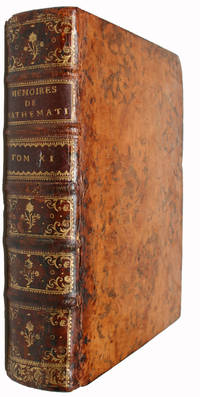
178644923Paris, Moutard, 1786. 4to. Contemp. full sprinckled calf with 5 raised bands on spine. Richly gilt compartments, title-and tomelabels with gilt lettering. A small nich to leather at middle of front hinge. A small tear to rear hinge at upper compartment. ""Mémoires fe Mathematique et de Physique, Présentés à l'Academie des Sciences par divers Savans"", Tome XI. (4),198,682 pp. Wide-margined, fine and clean.
178644923Paris Moutard 1786. 4to. Contemp. full sprinckled calf with 5 raised bands on spine. Richly gilt compartments title-and tomelabels with gilt lettering. A small nich to leather at middle of front hinge. A small tear to rear hinge at upper compartment. "Mémoires fe Mathematique et de Physique Présentés à l'Academie des Sciences par divers Savans" Tome XI. 4198682 pp. Wide-margined fine and clean. <br/><br/><em>This collective work is the French Academy's monumental treatise on the chemistry and the production of Salpetre a topic of great importence for the war-industry in making gunpowder. The volume contains papers by Macquer Darcy Lavoisier Sage Baumé de la Rochefoucault Clouer and an anonymous report on experiments made in England CAVENDISH'S on the composition of nitric acid.papers by Cornette Thouvenel and Thouvenel Le Lorgna Gavinet and Chevrand de Beunie Romme Clouet and Lavoisier de Rochefoucault etc.Partington III p. 467 n."The Regie des Poudres et Salpetres had the monopoly of refining salpetre from 1775 until it was suppressed during the Revolution. Until his retirement in 1791 the leading light in it was Lavoisier who seems to have written its publications. - In 1775 the Academy offered a prize of 4000 livres for a process for procuring an abundant supply of salpetrethe announcement being written by Lavoisier. Altogether 66 papers were received and the prize was finally awarded in 1782 to the brothers Thouvenel who gave a full account of nitre plantations. The material was published in 1786 in one volume by the Academy. In it Lavoisier describes 'Experiences sur la décomposition du nitre par le charbon' said to have been made in 1784."Partington III pp. 466 ff."Peu de temps après que Lavoisier eut été nommé régisseur des poudres et salpêtres il suggéra à Turgot alors contrôleur général des finances l'idée de charger l'Académie des sciences de décerner un prix au meilleur mémoire sur la formation du salpêtre. 'Académie nomma une commission dont Lavoisier fut le rapporteur ; c'est lui qui examina tous les mémoires présentés au concours en fit l'analyse et quand l'Académie publia en 1786 un volume contenant l'histoire du prix du salpêtre et les mémoires présentés au concours c'est encore Lavoisier qui en fut le rédacteur. Ce volume fait partie du Recueil des mémoires de mathématiques et de physique présentés à l'Académie royale des sciences par divers savants et lus dans ses assemblées tome XI contenant le Recueil des mémoires sur la formation et la fabrication du salpêtre à Paris de l'imprimerie Moutard DCCLXXXVI. Sauf les mémoires des concurrents et un mémoire du duc de la Rochefoucault ce volume est tout entier de la main de Lavoisier. Il est formé de deux parties ; la première est intitulée : Histoire de ce qui s'est passé relativement au prix proposé sur la formation du salpêtre ; la seconde partie comprend les mémoires présentés au concours ainsi que des mémoires de Lavoisier et Clouet un mémoire sans signature mais qui appartient à Lavoisier le manuscrit autographe a été conservé le mémoire du duc de La Rochefoucault et les expériences de Lavoisier sur la décomposition du nitre par le charbon." </em> hardcover
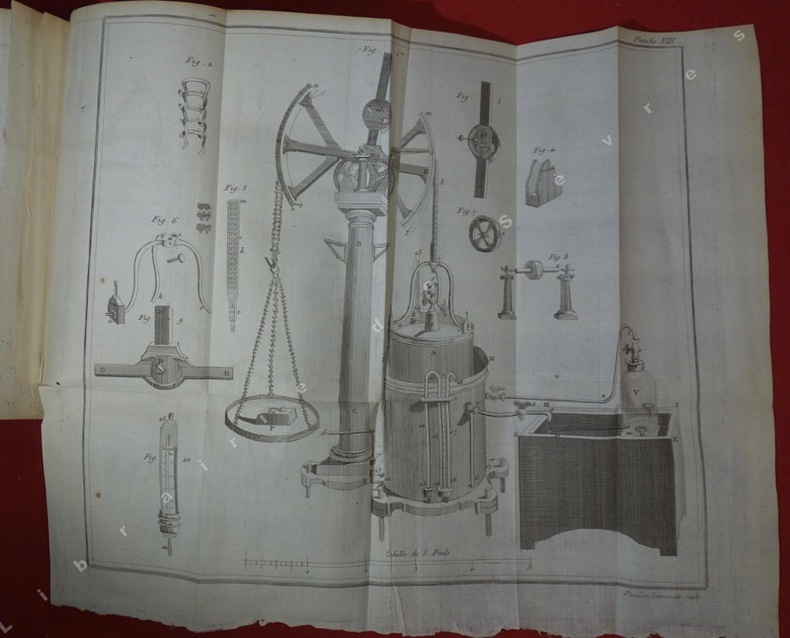
1789187081789 Paris, Cuchet (de l'imprimerie de Charde), 1789, 2 tomes en 1 vol. in-8 de XLIV-322 pp. - VIII pp., puis paginé de la p. 323 à la p. 653 - (2) pp. d'errata, rel. d'ép. de plein veau brun granité, dos à nerfs orné de fers dorés, pièce de titre de veau marron, habiles restaurations anciennes, le faux-titre du tome 1 manque, comme à bon nombre d'exemplaires, la planche II est en double exemplaire, bon ex.
178717876Paris, (Chardon für) Cuchet, 1787. 2 Bll., 314 S. mit Titelholzschnitt-Vignette. 6 mehrfach gefalt. Kupfertafeln und 1 mehrfach gefalt. Tabelle. 8°. HLdr. des 20. Jahrhunderts mit Rückenschild (leicht berieben und bestoßen). [5 Warenabbildungen]
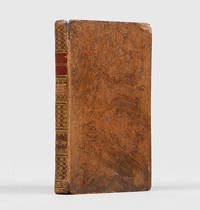
3154P., Durand, 1774, un volume in 8 relié en pleine basane marbrée, dos orné de fers dorés, tranches rouges (reliure de l'époque), (léger manque à la partie inférieure du dos, coiffe & coins légèrement émoussés), 1pp.(titre), 30pp.(épitre + avertissement + table), 1 feuillet non chiffré(faux-titre), 436pp., 3 PLANCHES DEPLIANTES
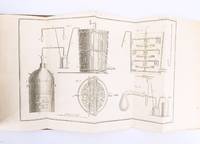
31600P., Cuchet, 1787, un volume in 8 relié en pleine basane, dos orné de fers dorés, filets dorés sur les plats (reliure de l'époque), (minime accroc à la coiffe, quelques rousseurs), (2 - faux-titre + titre)), 314pp., 1 GRAND TABLEAU DEPLIANT, 6 PLANCHES DEPLIANTES
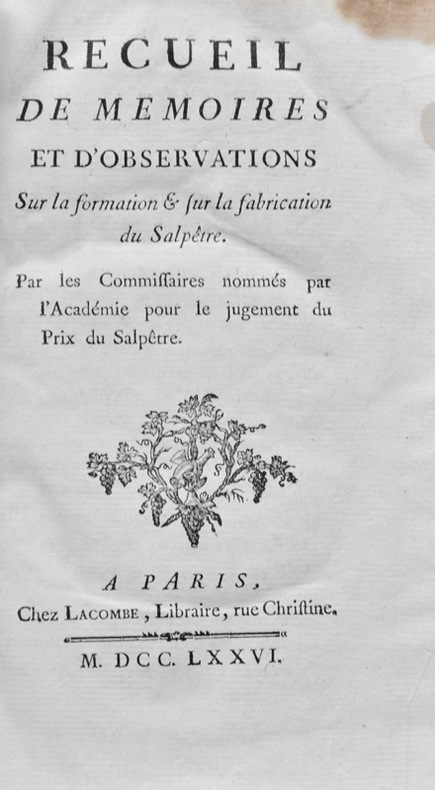
177667051Paris: Chez Lacombe 1776. Fine. Chez Lacombe Paris 1776 12.50 x 20 cm relié Recueil de Mémoires et d'Observations sur la formation & sur la fabrication du salpêtre Observations on the Formation and Fabrication of Saltpeter Chez Lacombe Paris 1776 8vo 12.5 x 20 cm 622 pp 2 contemporary sheep First edition of this memoir Duveen ascribing it to Lavoisier. With three folding plates. Contemporary light brown marbled sheep spine in five compartments with gilt compartments and fleurons black morocco title label gilt arms to foot joints skilfully repaired all edges speckled blue. A few small wormholes to first compartments of spine. The upper quarter of the half-title cut away presumably to remove traces of a former owner. One faint dampstain to inside margin of final gatherings not serious. A very good and rare copy. Chez Lacombe unknown
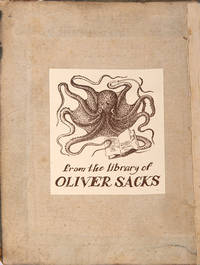
116617Edinburgh for William Church and sold by G.G. & J. Robinsons and T. Kay 1796. . Third English language edition; 8vo; 2 folding tables 13 engraved folding plates bookplate of Oliver Sacks contemporary ownership signature to title a little toning and occasional small spots to the text plates possibly added from another volume with some dampstain and tanning; original blue boards rebacked to style with printed paper label to spine boards worn very good condition; 592pp.<br /> Third English language edition of Traité Élémentaire de Chemie the text that revolutionised chemistry. From the library of Dr. Oliver Sacks with his octopus bookplate. Though best known as a neurologist Sacks had a lifelong interest in chemistry. As recounted in the book Uncle Tungsten: Memoirs of a Chemical Boyhood he spent much of his childhood performing his own experiments and reading classic chemistry texts and his thoughts on Lavoisier and Traité Élémentaire de Chemie comprise chapter ten.<br /><br />Lavoisier's remarkable experimental program elucidated several major interrelated aspects of chemistry. It 'finally established the modern conception of elements as substances which cannot be further decomposed' and the fact that matter is conserved in chemical processes i.e. elements change their arrangements but are not themselves created or destroyed. This was connected with his discovery that respiration and combustion are similar processes in which oxygen is taken from the air and added to another substance. He was therefore able to explain 'many cyclical processes in animal and vegetable life and to carry out the earliest biochemical experiments' Printing and the Mind of Man 238. <br /><br />As Sacks writes in Uncle Tungsten 'All of Lavoisier's enterprises - the algebraic language the nomenclature the conservation of mass the definition of an element the formation of a true theory of combustion - were organically interlinked formed a single marvellous structure a revolutionary refounding of chemistry. The path to his revolution was not easy or direct even though he presents it as obvious in the Elements of Chemistry. There had been violent disputes and conflicts during the years in which Lavoisier was slowly gathering his ammunition but when the Elements was finally published - in 1789 just three months before the French Revolution - it took the scientific world by storm. It was an architecture of thought of an entirely new sort comprable only to Newton's Principia'.<br /> Printing and the Mind of Man 238; Hook & Norman The Norman Library of Science and Medicine 1295 all for the first edition. Edinburgh, for William Church, and sold by G.G. & J. Robinsons, and T. Kay, 1796. hardcover
17894282Paris, Chardon for Cuchet, 1789. 1789 2 vol. in-8° reliés en 1 (205 x 125 mm.) de : XLIV; 653 pp.; VIII; 2 pp.; quelques tableaux dans le texte dont 1 dépliant ; 13 planches dépliantes. Demi basane d'époque, dos lisse orné, titre de maroquin rouge, plats recouverts de papier bleuté. (Coiffes supérieur restaurée, rousseurs).
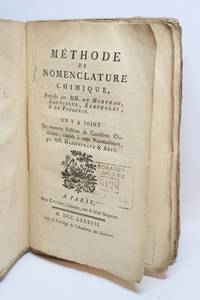
1792One large folding printed table & six folding engraved plates. 2 p.l. 314 pp. 8vo cont. mottled calf foot of one joint repaired. Paris: Cuchet 1787. First edition second issue of one of the key books in the history of modern chemistry. Lavoisier's discoveries made a new and rational chemical nomenclature imperative. Initiated by Guyton de Morveau still an adherent of the phlogiston theory the project was taken up by Lavoisier who soon convinced Guyton of the truth of his system. They entered into collaboration with Berthollet and Fourcroy. The result of their combined efforts is contained in the present volume the most important milestone in the development of chemical nomenclature. The new nomenclature with only slight modifications is still the basis of the language of modern chemistry. In the second printing of the first edition the following pages are misnumbered: 241-56 instead of 257-72. Very good copy. ❧ Cole 566. Duveen & Klickstein 129. Sparrow Milestones of Science p. 27 and plate 113. unknown books
177667051Chez Lacombe | Paris 1776 | 12.50 x 20 cm | relié
1764000594Lipsiae Gleditsch 1764
177615781Paris, Lacombe, 1776. In-8, 55-(1)-622-(2) pp., 3 planches repliées, table, veau marbré, dos orné à nerfs, pièce de titre en maroquin rouge, tranches marbrées (reliure de l'époque).
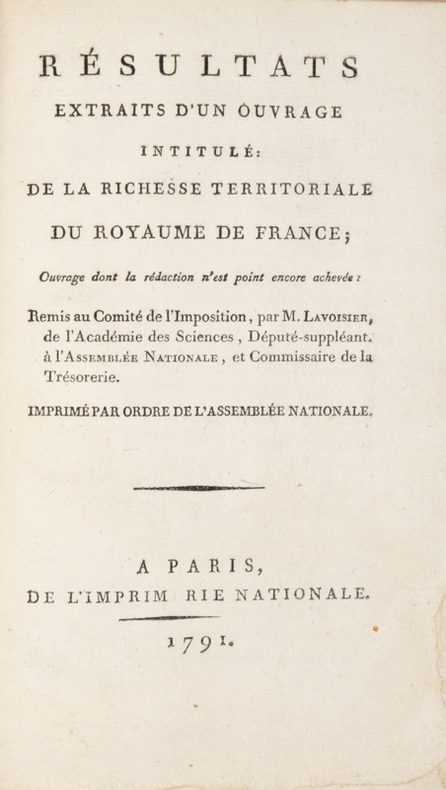
179141023Paris, Imprimerie Nationale, 1791. In-8 de (2)-48 pp., demi-maroquin rouge à grains longs, dos lisse, titre doré en long, non rogné (reliure moderne).
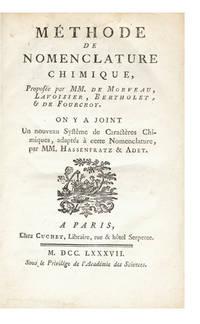
1787S9953Paris:: Chez Cuchet 1787. 1787. 8vo. iv 314 pp. Half-title woodcut title-page vignette headpiece tailpieces 6 folding tables of chemical symbols 1 folding plate; page 1 of the text trimmed at top margin and mounted on a stub foxed. Contemporary full mottled calf red leather spine label gilt-stamped spine; foot of spine chipped corners of read cover chewed. Ownership signature on title. Very good. FIRST EDITION second issue second printing with the flowered vase on the title-page previously a cherub and no colophon on page 314. Lavoisier's new terminology of chemistry was an important part of his reforms in the science and it has been in use with some modifications ever since its introduction. "The merits of the new nomenclature are even today more than evident since with only slight modification it is still the basis of the language of modern chemistry." Duveen & Klickstein pp. 119-126. Louis Guyton de Morveau was trained as a lawyer who taught himself the subject of chemistry. From 1776-1789 he taught public courses in chemistry at the Dihon Academy. He was professor of chemistry at the Ecole Polytechnique from 1794-1811 twice serving as its director. Blake/NLM p. 191 2nd printing; Cole Chemical literature 566; DSB Vol. V. pp. 600-604; Duveen Bibliotheca alchemica et chemical p. 340; Duveen & Klickstein 130; Gascoigne 7150.4; Partington A history of chemistry Vol. III p. 372; Poggendorf Vol. I col. 981; Wellcome III p. 185. Chez Cuchet, 1787. hardcover books
1783EBS100454Warrington: Printed by W. Eyres for J. Johnson 1783. 1st Edition. Hardcover. Very Good/No Jacket. FIRST COLLECTED EDITION of this group of papers which Lavoisier published in the Mémoires of the Académie Royale des Sciences; there is no equivalent edition in French. <br /> <br /> The first paper is the first edition in English of his Expériences sur la respiration des animaux in which he asserted that respiration involved only the air éminement respirable i.e. oxygen and that the remainder of the air is purely passive entering and leaving the lungs unchanged. This began his first serious studies of respiration which were to culminate in 1785-1789 in his classic investigations on the subject see Fulton Selected readings in the history of physiology. <br /> <br /> Other papers are on combustion and on the analysis of acids including his paper read to the Académie in 1779 which contains the first appearance of the word oxygen in chemistry although the translator uses the usual term for time dephlogisticated air and Lavoisier's original definition of it. <br /> <br /> In the eighth essay pp. 96-118 of this important work Lavoisier proposes his theory that oxygen is an essential constituent of all acids and he remarks: Here therefore we have a new road opened in chemistry. p. 115. <br /> <br /> BOOK DETAILS AND CONDITION: 8vo xx 142 pp. Without half-title and advert leaf; Bound in recent half calf and marbled paper over boards; Early leaves foxed as usual. VG <br /> <br /> RARITY: A relatively rare book. Has sold five times at auction in the last century RBH. OCLC reports 32 copies in the worlds libraries / ESTC T63988 shows 30 copies. <br /> <br /> PROVENANCE: Ex-library Franklin Institute See Duveen and Klickstein pp 368-370. From the Arthur C. Greenberg History of Chemistry Library. <br /> <br /> REFERENCES: Blake p.258; Cole 761. Duveen p. 340. Neville II p. 17. Duveen & Klickstein 336. Warrington: Printed by W. Eyres, for J. Johnson hardcover
1819123040Paris: Madame Huzard 1819. Second edition first 1791 of Lavoisier's most important contribution as an economist "a milestone in the history of economic science and national statistics and accounting" Poirier p. 266. The work was reprinted after the Terror to which Lavoisier famously fell victim in Collection de divers ouvrages d'Arithmétique politique 1797. "De la richesse territoriale. de France which was printed in 1791 by order of the National Assembly constitutes an extract from a larger work on which Lavoisier had been engaged since 1784 in an effort to complete and verify an analysis of national income undertaken by Dupont de Nemours. Lavoisier's main argument is that the monetary valuation of national income from different sources leads to double counting; that the only method exempt from such difficulties is that based on an estimate of annual consumption since exports and imports in France balance one another; and that in estimating consumption allowance must be made for the variation in the budgets of different social classes. Thus he estimated that the annual per capita income of the poorest families is from 60 livres to 70 livres but he set the value of average per capita income at 110 livres a figure admittedly similar to that of Quesnay in his Philosophie rurale 1763. The net national income computed by estimating the net revenue in the various branches of agriculture he put at only 1200000000 of which half goes to the treasury in the form of taxes and the rest constitutes the landowners' rent" ESS p. 200. The three works bound in after De la richesse territoriale are: a CHÂTEAUVIEUX Frédéric Lullin de. Lettres de Saint-James. Geneva: J. J. Paschoud 1820. Pp. 103 1. 1 folding plate. First edition of the first of five "Letters" by the influential Swiss agronomist; the remaining four were published between 1821-26. b FAURE Louis-Etienne-Baptiste. Mémoire sur les prairies artificielles. Paris: Fantin & Madame Huzard 1814. Pp. 30. First edition. Faure was the administrator of Hautes-Alpes at the time of the Revolution; in later life he devoted his time to agricultural improvements in Briançonnais. Quérard III p. 71. c LEVAVASSEUR Bernard-Marie-Francis. Mémoire sur les chemins vicinaux adressé A.S.E. le ministre de l'intérieur. Paris: Didot 1819. Pp. 46. A few small ink annotations to the text. First edition; WorldCat and Library Hub locate copies at two institutions the BnF and the University of Michigan. Bound first in a vol. of 4 related works octavo 201 x 125 mm pp. 66. Contemporary tree calf red morocco spine label spine elaborately tooled in gilt with hand written paper label "Lavoisier Richesse territoriale" to third compartment marbled endpapers and edges red bookmarker. Spine ends and corners worn corners bumped head and foot of front joint starting inner hinges cracked but firm contents lightly tanned with occasional spotting and a few leaves thinned overall a very good copy. Martin & Walter 19846; Perrot Histoire intellectuelle de l'Économie politique p. 435; Quérard IV p. 642; cf. INED 2690-1; not in Goldsmiths' or Kress. Jean-Pierre Poirier Lavoisier: Chemist Biologist Economist 1996. unknown
178990025Paris: Rue et Hôtel Serpente 1789. Fine. Opening run of the journal ""Annales de chimie"" vehicle of ""The New Chemistry"" founded and directed by Antoine de Lavoisier Rue et Hôtel Serpente Paris 1789-1792 12.8 x 19.6 cm Relié First edition highly sought after in the 19th century comprising 14 of the first 15 volumes published between 1789 and 1792 of the first series of the celebrated French scientific periodical Annales de chimie. Volume 10 missing. Contemporary full brown calf spines smooth with gilt fillets brown morocco lettering-piece and green morocco numbering-piece blind-ruled border to covers red speckled edges bookplate of P. H. Chavoix to front pastedown of each volume. Volumes 1 and 11 numbered in Roman rather than Arabic numerals. Overall discreet restorations corners rubbed occasional light foxing and browning some worming to bindings not affecting text head and tail of headcaps worn on volumes 7 13 14 and 15. The complete first series of the Annales de chimie published between 1789 and 1815 runs to 96 volumes. From 1793 to 1797 publication was suspended following the arrest of Antoine Lavoisier the journal's treasurer and in Édouard Grimaux's words its ""true director."" The opening run here contains nearly all the issues produced under the direction of and with contributions from the chemists Antoine de Lavoisier and Baron Philippe Frédéric de Dietrich. Both were condemned to the guillotine during the Reign of Terror in 1794 and 1793 respectively. This set is further illustrated with 12 scientific plates including two by the engraver Sellier as well as a map of the county of Bigorre. The majority of the articles and essays are first editions written by distinguished French and foreign chemists and physicists who helped disseminate ""The New Chemistry"": in order of appearance Louis-Bernard Guyton de Morveau Antoine de Lavoisier Gaspard Monge Claude-Louis Berthollet Anne-François Fourcroy Philippe-Frédéric de Dietrich Jean Henri Hassenfratz Pierre-Auguste Adet Jean-Antoine Chaptal Martin Heinrich Klaproth Johann Georg Albrecht Höpfner Christoph Girtanner Johann Christian Wiegleb Jacques-Anselme Dorthes Johann Friedrich Westrumb Armand Seguin Henry Cavendish William Austin Martin van Marum l'abbé René Just Haüy Peter Jacob Hjelm Jan Ingenhousz Isaac Milner Johan Gadolin James Watt Lorenz Florenz Friedrich von Crell Charles Blagden Jean Senebier Jean d'Arcet William Higgins Nicolas-Louis Vauquelin Nicolas Joseph Thiéry de Ménonville Dom Michel Rubin de Celis Jacques Louis Schurer Augustin-François de Silvestre l'abbé Claude Chappe Antoine Augustin Parmentier Nicolas Deyeux Bertrand Pelletier Charles-Augustin Coulomb Joseph Priestley Richard Kirwan Jean André de Luc Jean-François Clouet chevalier Marsilio Landriani Jean-Noël Hallé François Pierre Nicolas Gillet de Laumont Georges-Charles Bartholdi Alexandre Brongniart Jean-Michel Haussmann Henri Reboul François René Curaudau Thomas Henry Jean-Anthyme Margueron Nicolas Leblanc Johann Rudolph Deiman Pieter Nieuwland Pierre de Ribaucourt Pissis fils Jean-Baptiste Van Mons ou encore Louis François Antoine Arbogast. In 1816 the Annales de chimie was retitled Annales de chimie et de physique. In 1913 the journal split into two separate publications Annales de chimie and Annales de physique. The titles have undergone further changes up to the present day. A collection of 14 volumes from the opening run of the prestigious French scientific periodical Annales de chimie containing numerous essays and articles most in first edition published under the editorship of distinguished figures: Antoine de Lavoisier Louis-Bernard Guyton de Morveau Gaspard Monge Claude-Louis Berthollet Anne-François Fourcroy Philippe-Frédéric de Dietrich Jean Henri Hassenfratz and Pierre-Auguste Adet. Rue et Hôtel Serpente unknown
178773124à Paris: Chez Cuchet 1787. Fine. Chez Cuchet à Paris 1787 13.50 x 21 cm broché Second printing of the first edition: pages 257 to 272 are misnumbered 241-256 Duveen and Klickstein. Illustrated with a large chart and 6 folding plates at rear. Library stamp of Laboratoires Lumière on the half-title title page and several other pages. Another stamp ""G. Chicanuard"" appears on the half-title; we have found no information about this person. Temporary binding in full marbled paper. Handwritten title on spine. Some small paper losses in places and joint on second board cracked but still sound. Copy as issued with full margins. The Méthode forms a manifesto for a revolution in the world of chemistry and the birth of modern chemistry a chemistry that resolutely turns its back on the past by becoming scientific. It was Lavoisier the most influential scientist at the Academy of Sciences who brought together around his theory and to support it decisively the greatest French chemists: Fourcroy Berthollet Adet Hassenfratz and Guyton de Morveau whom the already formed group welcomed to Paris in February 1787. The latter joined them with an advanced chemical nomenclature which would be revised by Lavoisier who demanded that Morveau abandon his phlogistic theory principle of a combustible element in air dating from the 17th century since he had discovered the role of oxygen. It was at this price that he was entrusted with presenting the new nomenclature. It was in the session of May 2 1787 at the Academy of Sciences that the terms ""oxygen"" ""hydrogen"" and ""carbon"" were pronounced for the very first time. Adet and Hassenfratz were responsible for proposing symbols for ""new characters to be used in chemistry"" which would not have much success but was destined for a great future. The entire project was placed under the authority and will of Lavoisier and the decision that Morveau should carry the project was a political decision intended to ensure better reception among foreign scientists. No one was deceived because it was Lavoisier who would be attacked by Western science. Very important work that marks the birth certificate of scientific chemistry. Chez Cuchet unknown
1793EBS100381Paris: Cuchet 1793. 1st Edition. Hardcover. Very Good/No Jacket. AUTHORIZED SECOND EDITION OF LAVOISIER'S KEY WORK. This is authorized Chardon issue; 1st 1793 issue was pirated; 3rd 1793 issue was improved version of pirated issue by authorized publisher. Like the original 1789 edition the plates bear the signature of Madame Lavoisier."Although it does not show any material changes in the text nor any additions all the errata are here corrected and the plates are the original ones with Madame Lavoisier's signature. It is difficult to explain now the reasons why this edition was put out in the same year but it might be assumed that Lavoisier and Cuchet wanted to counteract the distribution of the books which had been fraudulently issued by printing an authoritative edition" Duveen & Klickstein. BOOK DETAILS AND CONDITION: 2 Vols 8vo 2 folding tables 13 fine folding copperplates by Mme Lavoisier Second ed second issue 8vo 19th cent. half calf VG See A. Greenberg From Alchemy to Chemistry in Picture and Story John Wiley & Sons New York 2007 pp 313 315 316 335 PROVENANCE: Professor A. Bernardes de Oliveira of Sao Paolo Brazil bookplate a well-known science book collector and Arthur C. Greenberg an author and expert on the history of chemistry. REFERENCES: Duveen et Klickstein 157; PMM 238 for the Paris 1789 edition. Paris: Cuchet hardcover
thl52Paris: Deterville 1801. Third Edition Corrected and Enlarged of “one of the most important books in the history of chemistry which finally freed the science from its phlogiston chains and formed the starting point of its modern progress. It may be said to have done almost as much as for chemistry as Newton’s ‘Principia’ did for physics.†Zeitlinger quoted in Duveen Lavoisier’s ‘Traité’ “was a decisive move in the final overthrow of alchemy and the phlogiston theory introduced by Stahl a century earlier. By the use of the balance of weight determination at every chemical change and the building of a rational system of elements Lavoisier laid the foundation of modern chemistry. He introduced a modern definition of element and compound explained burning and rusting as a chemical combination with oxygen and included emission and absorption of heat in his chemical system. His concepts of the principles of the indestructibility and conservation of matter guided him in formulating his methods of organic analysis.†Dibner cfDibner 43. cfDuveen p. 340. cfGrolier 64. cfHoneyman 1939. cfPrinting and the Mind of Man 238. cfSparrow 127. cfFerguson II p. 12. cfNeu 2253-54. 2 Volumes. pp. lxiv 386; vii 1 377 1errata 2publisher’s catalogue. with half-titles. index. 13 engraved plates. 2 folding tables. contemporary quarter calf head of spine of Vol. II chipped upper rear joint starting light dampstain to several leaves in Vol. II else very good. thl52 Paris: Deterville, 1801 unknown
176844940Paris, L'Imprimerie Royale, 1768. 4to. Extract from ""Mémoires fe Mathematique et de Physique, Présentés à l'Academie des Sciences par divers Savans"", Tome V. With tittlepage to vol. 5. Pp. 341-357. Clean and fine.
176844940Paris L'Imprimerie Royale 1768. 4to. Extract from "Mémoires fe Mathematique et de Physique Présentés à l'Academie des Sciences par divers Savans" Tome V. With tittlepage to vol. 5. Pp. 341-357. Clean and fine. <br/><br/><em>First appearance of Lavoisier's FIRST PUBLISHED CHEMICAL PAPER introducing quantitative methods in chemistry and in which he for the first time brought a hydrometer in use to measure the specific gravities of components of a chemical solutions. Lavoisier defended the originality of his approach in the following words: "It is to the art of combination that the knowledge of the specific gravities of fluids can bring most light. This aspect of chemistry is much less advanced than we thought we possess barely the rudiments of it." "This first paper which in so many respects embodies the quantitative methods Lavoisier was to employ in his later work had in fact been largely anticipated by others notably by Marggraf who had already discovered the composition of gypsum and shown that it contained water phlegm. Yet Lavoisier’s work was more through; and his paper his first contribution to the Academy of Sciences read to the Academy on 25 February 1765 appeared in 1768. The paper offered. - Lavoisier’s earliest chemical investigation his study of gypsum was mineralogical in character; begun in the autumn of 1764 it was intended as the first paper in a series devoted to the analysis of mineral substances. This systematic inventory was to be carried out not by the method of J. H. Pott "who exposed minerals to the action of fire" but by reactions in solution by the "wet way." "I have tried to copy nature" Lavoisier wrote. "Water this almost universal solvent "is the cheif agent she employs; it is also the one I have adopted in my work." Using a hydrometer he determined with the care the solubility of different samples of gypsum samples of selenite or lapis specularis some supplied by Guettard and Rouelle. He made similar measurements with calcined gypsumplaster of paris. Analysis convinced him that this gypsum was a neutral salt a compound of vitriolic sulfuric acid and a calcareous or chalky base. Not content with having shown by analysis the composition of the gypsum Lavoisier completed his proof by a synthesis following as he said the way that nature had formed the gypsum. He further demonstrated that gypsum when transformed by strong heating into plaster of Paris gives off a vapor which he showed to be pure water making up about a quarter of the weight of gypsum. Conversely when plaster of Paris is mixed with water and turns into a solid mass it avidly combines with water. Using the expression first coined by Rouelle he called this the "water of crystallization." DSB.Partington III pp. 378-79. - </em> unknown