LAVOISIER, M; HENRY, Thomas [Trans]Biblio.com
414 résultats
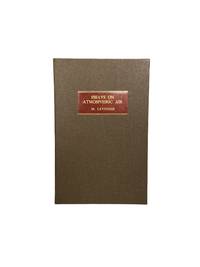
17833925London: Warrington Printed by W. Eyres for J. Johnston 1783. First English Language Edition. Octavo : pp. vii viii 2 141 3 List of Books lately published by J. Johnston : now custom clamshell box with red leather title panel lettered in gilt. DUVEEN 336<br /> <br /> Lacks covers and half title; toned foxed and brittle; title page detached; thereafter first gathering detached; chips and water stains. Antoine Lavoisier often referred to as the Father of Modern Chemistry and his wife Marie-Anne Pierrette Paulze Lavoisier later Countess von Rumford were eighteenth century French chemists responsible for overthrowing the "false doctrine of Phlogiston". Lavoisier relied on Paulze's translation of foreign works to keep abreast of current developments in chemistry. In the case of phlogiston it was Paulze's translation of Richard Kirwan's 'Essay on Phlogiston and the Constitution of Acids - with her own footnotes critiquing his errors - that convinced him the idea was incorrect ultimately leading to his studies of combustion and his discovery of oxygen gas. <br /> <br /> Lavoisier was a victim of The Terror of 1794 and guillotined in Paris. "It took but a moment to cut off his head; it will take a century to produce another like it" mourned his friend Lagrange the mathematician. The Autobiography of Science p.228.<br /> <br /> The collected essays show the development of Lavoisier's thinking and in the penultimate essay VIII the term "oxyginous principle" principe oxygin i.e. oxygen appears for the first time in chemistry p.98 This paper was first submitted to the Academie in 1777 and read in 1779. DUVEEN 49. Warrington, Printed by W. Eyres for J. Johnston unknown
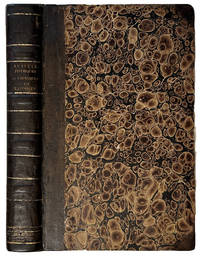
1787612Paris: Cuchet 1787. 1st. Full mottled calf with gilt tooling along the edges gilt spine compartments with floral ornaments and leather spine label. Contemporary binding with rubbing and wear along the spine and corners. Boards show mottling and fading with some scuffing. Pages exhibit foxing toning and occasional spotting consistent with age. Folding tables are intact and legible though with some creasing and edge wear. Features: Marbled edges; multiple large folding tables and engraved charts; decorative typographic ornaments. Overall good. <p data-start="251" data-end="727">Méthode de Nomenclature Chimique Paris: Cuchet 1787 is the groundbreaking work that introduced the modern system of chemical nomenclature marking a turning point in the history of science. Written collaboratively by Morveau Lavoisier Berthollet and Fourcroy—four of the most influential chemists of the 18th century—this treatise sought to replace centuries of inconsistent and confusing chemical terminology with a rational systematic method of naming substances.</p> <br /> <p data-start="729" data-end="1178">The work introduces a new nomenclature rooted in clarity precision and universality laying the foundation for the modern language of chemistry. Included are detailed explanations of the logic behind the naming system as well as extensive tables of elements and compounds that illustrate the method in practice. The treatise also contains supplementary sections by Hassenfratz and Adet who proposed a symbolic notation for chemical substances.</p> <br /> <p data-start="1180" data-end="1537">Lavishly produced the book features large folding tables and engraved charts including the famous “Tableau de la Nomenclature Chimique†which visually organizes the new classification of substances. These elements highlight both the pedagogical and scientific ambitions of the project: to unify chemists under a single coherent system of communication.</p> <br /> <p data-start="1539" data-end="1749">This volume is considered a cornerstone of the Chemical Revolution appearing just two years before Lavoisier’s Traité élémentaire de chimie 1789 and cementing his role as the father of modern chemistry.</p> . Cuchet unknown
178990025Rue et Hôtel Serpente | Paris 1789-1792 | 12.8 x 19.6 cm | Relié
178773124Chez Cuchet | à Paris 1787 | 13.50 x 21 cm | broché
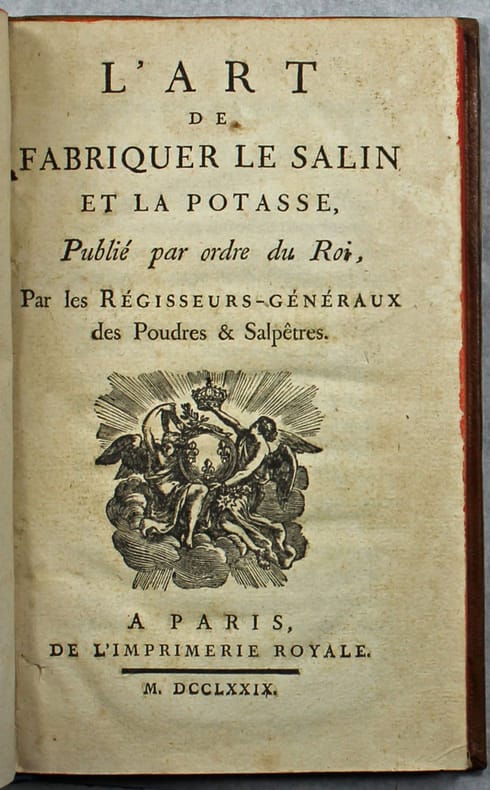
14207Paris, Imprimerie royale, 1779.
178949404Paris, Cuchet, 1789, in-8, IV, 259, (1bl)pp, 1 tabl, demi-veau moucheté, dos plat orné de filets dorés. (Rel. de l'ép.), Deuxième édition, second tirage. Grand tableau dépliant de la nouvelle nomenclature chimique formé de deux parties collées; détail bien conforme à l'avis au relieur que cite Duveen. C'est le tableau inchangé de la première édition de 1787. Ouvrage capital dans lequel les grands chimistes de l'époque mettent au point une nouvelle manière de dénommer les éléments et ouvrent ainsi la voie à la chimie moderne la dégageant pour toujours de la lourdeur héritée du langage des alchimistes. Notons au passage que pour cette édition les planches ne furent pas réimprimées. Bon exemplaire Couverture rigide
17781465Paris: De l'Imprimerie Royale 1778. 1st Edition. FIRST EDITION LAVOISIER'S OFFICIAL EASTER MEMOIR ON THE COMPOSITION OF AIR. <br /> <br /> In this work Lavoisier proposed that ordinary air is composed of two different gases one "highly respirable" that he named "oxygen" and the other later named nitrogen that was unable to support combustion or respiration. This work is commonly referred to as Lavoisier's "Easter Memoir" because he presented an earlier version to the Academy around Easter of 1775; as this is the 1778 revised version historians regard it as Lavoisier's "official" Easter Memoir Wikipedia. We offer the 1780 edition separately.<br /> <br /> In April 1778 "Lavoisier read for a second time the memoir in which he had originally demonstrated in April 1775 that mercury precipitate reduced without charcoal disengages not fixed air but the ‘air itself entire' or ‘the purest portion of the air'. He made some revisions in the text that have attracted widespread attention from historians" Holmes Lavoisier 137. <br /> <br /> In the time between 1775 and 1778 Lavoisier repeated some of performed some new experiments of his own and repeated some of Priestley's. In the 1778 ‘official' version Lavoisier "altered the language in which he had described that air calling it now ‘the most salubrious the most pure portion of the air' and air ‘in an eminently respirable state'. Fastening on to this last phrase he again referred to the air later in his memoir as ‘eminently respirable air'. At the same time he deleted references to it in the original version as ‘common air' and eliminated the experimental description that it reacted to the nitrous air test in the same manner as common air. <br /> <br /> "Historians have tended to treat with suspicion the textual changes Lavoisier made. The implication seems to be that he sought to represent himself as having clearly understood in 1775 that the air released from the mercury calx is a specific portion of the atmosphere when in fact he had then still not distinguished it unambiguously from ordinary air. If one couples this suspicion with acceptance of Priestley's charge that Lavoisier had obtained the idea for the experiment from him in the first place then one creates an image of Lavoisier as one who is known to have had an ‘occasional tendency to allow the work of others to pass as his own'. <br /> <br /> "There is however no solid evidence that in making these changes he was attempting to rewrite history. His motivation was probably simple. By the spring of 1778 when his new theoretical edifice had solidified the experiments on mercury calx would have come to appear to him as one of the decisive experimental foundations on which he had erected it. Yet when he looked back on the paper which reported these experiments from the vantage point he had since attained the descriptions of the air he had identified in it would have appeared confused ambiguous and inconsistent. <br /> <br /> "The embarrassment of allowing such flaws to remain in what he could now anticipate might someday be regarded as a classic paper is obvious. Since the paper had yet to appear in the Memoirs of the Academy chronically two to three years late in publication he had a convenient opportunity to avoid that outcome" Holmes. <br /> <br /> ALSO INCLUDED: An important paper by P. S. Laplace introducing the concept of the "Coriolis effect" fifty years before Coriolis. Euler had also written about the effect in 1749. "Recherches sur plusieurs points du système du monde" in Mémoires de l'Académie des Sciences Année 1775 pp. 75-182 1778. This is part one of a two part paper. CONDITION: Paris: De l'Imprimerie Royale. 4to 10.5 x 8.25. 11 folding engraved copperplates. Prior ownership name 'Bernardi' on front free endpaper. Contemporary full leather binding. Front joint between spine and boards cracking but solid. Handsome wide margins throughout. Slight toning throughout otherwise bright and very clean. Very good condition. De l'Imprimerie Royale hardcover
1771Three folding engraved plates. xxx 2 443 pp. Two parts in one vol. 8vo cont. half-sheep & speckled boards flat spine gilt blue morocco lettering piece on spine. Paris: Deterville 1801. Second edition of this "pioneer work in which Lavoisier first gives a historical survey of previous workers' efforts and then describes his own experiments on gases and the conclusions to be derived from them."-Duveen & Klickstein p. 94. "The genuine second edition in which Deterville has reprinted the entire book with the errata corrected in the text and with the plates reengraved by Tardieu senior. Another so-called seconde edition published in 1801 is merely a reissue of the first edition with the replacement of the dedication leaf to Trudaine de Montigny by a half title and a new title page and with the same plates as the 1774 issue. The present edition is the first new printing of the Opuscules since Lavoisier's death in 1794."-Neville II p. 19. A very fine copy. ❧ Cole 769. Duveen & Klickstein 123. Neville II p. 19-"It exerted a tremendous influence on Continental chemists and set the stage for Lavoisier's overthrow of the phlogiston theory.". hardcover books
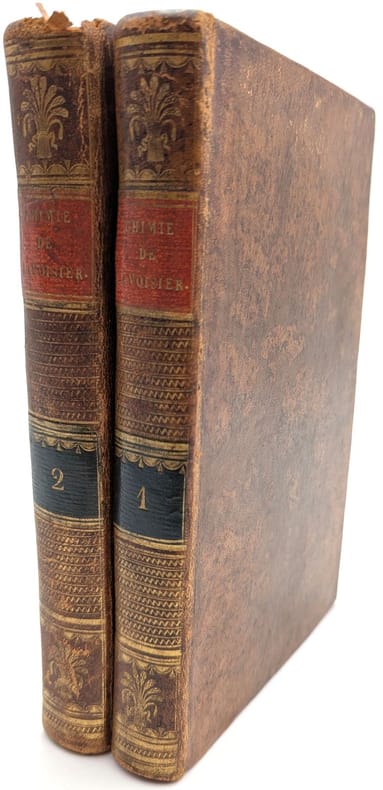
1778Two folding printed tables & 13 folding engraved plates drawn & engraved by Madame Lavoisier. xliv 322 pp.; viii 331 pp. Two vols. 8vo antique sheep-backed marbled boards some foxing flat spines gilt. Paris: Cuchet 1793. Although described as the "seconde édition" on the title this seems to follow a pirated "seconde édition" printed by de Boiste earlier in the same year. Our edition was printed by Chardon. "One of the great milestones in the history of chemical literature. By common consent modern chemistry begins with this work 'which finally freed the science from its phlogiston chains and formed the starting point of its modern progress. It may be said to have done almost as much for chemistry as Newton's Principia did for physics' Zeitlinger. Lavoisier used the balance to demonstrate the weight of matter at every chemical change defined the terms element and compound explained combustion and the rusting of metals as a chemical combination with oxygen and through his concept of the conservation of matter developed methods of chemical analysis. The book contains the first list of twenty-three chemical elements and their compounds."-Neville II p. 21. Very good set. ❧ Cole 778. Duveen & Klickstein 157. Neville II p. 23. hardcover books
1787S14078Paris :: Chez Cuchet 1787. 1787. 8vo. iv 314 pp. PAGINATION NOTE: pages 257-272 are mis-numbered 241-256 Duveen. Half-title woodcut title-page vignette headpiece tailpieces 6 folding tables of chemical symbols 1 folding plate; page 1 of the text trimmed at top margin and mounted on a stub foxed. Contemporary full mottled calf red leather spine label gilt-stamped spine; foot of spine mended with kozo patch upper joint cracked corners of read cover chewed. Ownership signature on title under the vignette. Very good. 264 FIRST EDITION second issue second printing with the flowered vase on the title-page previously a cherub and no colophon on page 314. Lavoisier's new terminology of chemistry was an important part of his reforms in the science and it has been in use with some modifications ever since its introduction. "The merits of the new nomenclature are even today more than evident since with only slight modification it is still the basis of the language of modern chemistry." Duveen & Klickstein pp. 119-126. Louis Guyton de Morveau was trained as a lawyer who taught himself the subject of chemistry. From 1776-1789 he taught public courses in chemistry at the Dihon Academy. He was professor of chemistry at the Ecole Polytechnique from 1794-1811 twice serving as its director. ALL AUTHORS: LAVOISIER Antoine Laurent 1743-1794 ; Louis Bernard GUYTON DE MORVEAU 1737-1816 ; Claude-Louis BERTHOLLET 1748-1822 ; Antoine-Francois de FOURCROY 1755-1809 ; Jean Henri HASSENFRATZ 1755-1827 ; Pierre-Auguste ADET 1763-1834. PROVENANCE: Emile on title. REFERENCES: Blake/NLM p. 191 2nd printing; Cole Chemical literature 566; DSB Vol. V. pp. 600-604; Duveen Bibliotheca Alchemica et Chemica p. 340; Duveen & Klickstein 130; Gascoigne 7150.4; Partington A history of chemistry Vol. III p. 372; Poggendorf Vol. I col. 981; Wellcome III p. 185. Chez Cuchet, 1787. hardcover
1768EBS100145In: Mémoires de Mathématique et de Physiques Présentés à l Académie Royale de Sciences par divers Savans & lûs dans ses Assemblées; Pp 341-366 in Volume 5 1768. 1st Edition. Hardcover. Very Good/No Jacket. FIRST EDITION JOURNAL ISSUE OF LAVOISIER'S FIRST CONTRIBUTION TO THE ACADEMY OF SCIENCES. "Lavoisier's earliest chemical investigation his study of gypsum was mineralogical in character; begun in the autumn of 1764 it was intended as the first paper in a series devoted to the analysis of mineral substances. 'I have tried to copy nature' Lavoisier wrote. 'Water this almost universal solvent. is the chief agent she employs; it is the one I have adopted in my work.'. Analysis convinced him that this gypsum was a neutral salt a compound of vitriolic sulfuric acid and a calcareous or chalky base. He further demonstrated that gypsum when transformed by strong heating into plaster of Paris gives off a vapor which he showed to be oure water making up about a quarter of the weight of gypsum. This first paper which in so many respects embodies the quantitative methods Lavoisier was to employ in his later work had in fact been anticipated by others." DSB. Other essays in the Mémoires include works by Chevalier Muller and Boucher. The entire volume is illustrated with 20 engraved folding plates. See Duveen and Klickstein p 14Paris: De L Imprimerie Royale 1768Large 4to Complete Volume 5 bound in cont. leather spine raised bands in compartments folding plates; Also chemical papers by Cadet 2 de Cortanvaux 2 Baumé 2 Bomare 1 plus others; VG. In: Mémoires de Mathématique et de Physiques Présentés à l Académie Royale de Sciences, par divers Savans & lûs dans ses hardcover
a108438Paris. "An III de la Republique" publisher: "Chez Fugs Libraire au coin des rues de Hurpoix & Gille-Coeur." The landmark paper which set the foundation for modern chemistry appeared in the "Tome Premier" of 1789. The text of this volume is exactly the same as the 1789 edition of the Annales except for the titlepage publisher and date. Lavoisier paper is on pp.19-30 . The volume as a whole has 313p. and includes articles by Girtanner Klaproth M. Berthollet others. In French. Small octavo. Volume's original boards are gone but text block is strongly and securely bound text has no wear or tear and is almost entirely clean except for a very few spots of soiling; light foxing on initial and final pages. Text lightly evenly toned. There is an old red oval institute stamp on tp and a black ink number on tp. Blue marbled end papers original Our binder will put a plain paper cover on the book on request and free of charge or book can be purchased "as is" for customer to arrange for recovering. The book would make a beautiful volume in fine leather. Antoine Lavoisier was tragically guillotined in May of 1794 by the radical government during the French Revolution. Pictures of the book available on request. Essential article in history of Chemistry. . hardcover
98489Paris, chez Cuchet, an II [1794], in-12, VIII-96 pp 4 pl, Demi-basane blonde, dos lisse orné de filets dorés et à froid, tranches mouchetées, Seconde édition, la première dans ce format, illustrée de 4 planches dépliantes gravées par Delettre. Épidermures et frottements, minuscules rousseurs éparses. Couverture rigide
1793103006Paris, Cuchet, 1793, in-8, 2 vol. in-8: XLIV-322 pp, 2 tabl. dép. + VIII-327 pp. 13 pl, Basane marbrée havane, dos long orné de filets et fleurons dorés, pièce de titre rouge, pièce de tomaison verte, tranches jaunes mouchetées, Édition ornée de belles planches dépliantes gravées au nombre de 13, gravées sur cuivre par Madame Lavoisier et 2 tableaux dépliants. Cette édition imprimée par Chardon et indiquée seconde, est en réalité la troisième (les deux précédentes ayant paru la même année, en 1789). Lavoisier y expose sa découverte de la nature de l'air. En mettant fin à la "théorie du phlogistique", il sépara définitivement la chimie de Stahl de celle de son époque. Bien complet des deux pages de faux-titre. Ex-libris héraldique Dyon [?]; livre de prix offert à Augustin Legros; ex-libris manuscrit d'Adèle Legros. Petites rousseurs, quelques taches, petit trou sans atteinte aux ff. A1 à A4, déchirure sans manque au f. F1, pâles décharges, petites épidermures. Cole n° 778 ; Duveen & Klickstein n° 157. Couverture rigide
1776EBS100409Chez Lacombe Libraire rue Christine 1776. 1st Edition. Hardcover. Very Good/No Jacket. First Edition 8vo: Marbled endpapers 55 pp including ½ title; titlepage 622 pp 3 folding plates. Slight wrinkling of some wrinkled; pp 289-296 edges somewhat oxidized. Neville II: p 20: A valuable collection of memoirs on the production of saltpeter for the manufacture of gunpowder. This extensive survey of the literature comprises extracts from the earlier works of Glauber and Stahl as well as more recent papers by Lavoisier Louis Lemery and others A rare book Duveen who lists it under Montigny. New full goatskin. VG-. From the Arthur C. Greenberg History of Chemistry Library. Chez Lacombe, Libraire, rue Christine hardcover
88774aafParis, Lacombe, (Imprimerie de Demonville), 1776, in-8vo, 622 p., (faux titre et titre inclus) + 1 ff. (d’Extrait des registres), + 3 planches dépl. reliure en veau originale. Dos richement orné, tranches rouges. Bel exemplaire.
14427Paris, Londres, Hotel Serpente [Panckoucke], J. de Boffe, 1789-1791, (1795).
17801466Paris: Hotel de Thou rue des Poitevins 1780. LAVOISIER'S OFFICIAL EASTER MEMOIR ON THE COMPOSITION OF AIR. THIS IS THE 1780 edition. WE OFFER THE 1st 1778 EDITION SEPARATELY. <br /> <br /> In this work Lavoisier proposed that ordinary air is composed of two different gases one "highly respirable" that he named "oxygen" and the other later named nitrogen that was unable to support combustion or respiration. This work is commonly referred to as Lavoisier's "Easter Memoir" because he presented an earlier version to the Academy around Easter of 1775; as this is the 1778 revised version historians regard it as Lavoisier's "official" Easter Memoir Wikipedia. <br /> <br /> In April 1778 "Lavoisier read for a second time the memoir in which he had originally demonstrated in April 1775 that mercury precipitate reduced without charcoal disengages not fixed air but the ‘air itself entire' or ‘the purest portion of the air'. He made some revisions in the text that have attracted widespread attention from historians" Holmes Lavoisier 137. <br /> <br /> In the time between 1775 and 1778 Lavoisier repeated some of performed some new experiments of his own and repeated some of Priestley's. In the 1778 ‘official' version Lavoisier "altered the language in which he had described that air calling it now ‘the most salubrious the most pure portion of the air' and air ‘in an eminently respirable state'. Fastening on to this last phrase he again referred to the air later in his memoir as ‘eminently respirable air'. At the same time he deleted references to it in the original version as ‘common air' and eliminated the experimental description that it reacted to the nitrous air test in the same manner as common air. <br /> <br /> "Historians have tended to treat with suspicion the textual changes Lavoisier made. The implication seems to be that he sought to represent himself as having clearly understood in 1775 that the air released from the mercury calx is a specific portion of the atmosphere when in fact he had then still not distinguished it unambiguously from ordinary air. If one couples this suspicion with acceptance of Priestley's charge that Lavoisier had obtained the idea for the experiment from him in the first place then one creates an image of Lavoisier as one who is known to have had an ‘occasional tendency to allow the work of others to pass as his own'. <br /> <br /> "There is however no solid evidence that in making these changes he was attempting to rewrite history. His motivation was probably simple. By the spring of 1778 when his new theoretical edifice had solidified the experiments on mercury calx would have come to appear to him as one of the decisive experimental foundations on which he had erected it. Yet when he looked back on the paper which reported these experiments from the vantage point he had since attained the descriptions of the air he had identified in it would have appeared confused ambiguous and inconsistent. <br /> <br /> "The embarrassment of allowing such flaws to remain in what he could now anticipate might someday be regarded as a classic paper is obvious. Since the paper had yet to appear in the Memoirs of the Academy chronically two to three years late in publication he had a convenient opportunity to avoid that outcome" Holmes. CONDITION: Paris: Hotel de Thou rue des Poitevins. 8vo. 6.5 x 4. 12 folding engraved copperplates. Marbled endpapers. Contemporary full leather binding. Chipped in several places. Internally fine. Hotel de Thou, rue des Poitevins hardcover
60048Paris, 23 janvier 1880, in-8, 2 page 1/2 (126 x 220), , Passionnante lettre du petit-fils du peintre Louis David, Jules David, au Comte Bérard de Chazelles. David, alors que sa biographie et son catalogue raisonné des oeuvres de son aïeul sont "en ce moment sous presse", vient d'apprendre grâce à "Monsieur Dumas, membre de l'Institut" que l'original du seul portrait connu de Lavoisier réalisé sur le vivant par Louis David est détenu par la famille Bérard de Chazelles [comme bien d'autres objets ayant appartenu à Lavoisier, notamment ses instruments de chimie et sa bibliothèque]. Ainsi le petit-fils de David écrit à "Monsieur le Comte" afin de lui demander "quelques renseignements" : "la dimension, la date et la signature ; la grandeur des figures et s'il est peint sur toile ou sur bois". Il lui demande aussi s'il peut "avoir un dessin ou une photographie de ce tableau" afin d'enrichir la "suite d'Eaux-fortes des Oeuvres du Maitre" qu'il est en train de constituer. Jules David précise, qu'à l'époque, "cette toile est presque inconnue des amateurs". Belle lettre-enquête sur un des plus beaux portraits français de scientifique du XVIIIe siècle, acheté en 1925 par Rockfeller et acquis en 1977 par le Metropolitan Museum of Art de New York où il est exposé aujourd'hui. Couverture rigide
179061775[Paris, Clouiser, 1790, in-8, de 32 pages, exemplaire broché, sous couverture de papier marbré, Rare plaquette. Critiquant à la fois les positions de Talleyrand et celles de Mirabeau, le célèbre chimiste, député suppléant du bailliage de Blois, membre de la Société de 1789, propose, en compagnie de ses amis modérés comme La Rochefoucauld, La Fayette ou Bailly, une limitation de l'émission des assignats. Premiers et derniers feuillets roussis. Couverture rigide
1801866Paris: Chez Deterville 1801. Second edition. <br /> <br /> A significant early collected work by Antoine-Laurent Lavoisier the founder of modern chemistry bringing together a series of his shorter but influential papers on physics and chemistry. Opuscules Physiques et Chimiques reflects the transitional moment in late 18th-century science when experimental chemistry began to replace older speculative systems. The volume includes studies on elastic fluids gases combustion fermentation and chemical decomposition illustrating Lavoisier’s role in redefining chemical processes through quantitative experimentation and precise observation.<br /> <br /> This 1801 second edition is particularly notable for its historical context: as stated in the prefatory note the work was printed during Lavoisier’s imprisonment amid the French Revolution shortly before his execution in 1794. As such the book stands not only as a scientific milestone but also as a poignant artifact of Enlightenment science disrupted by political upheaval. The inclusion of engraved folding plates depicting experimental apparatus underscores the practical and experimental nature of the work offering insight into early laboratory techniques that helped establish modern chemical methodology.<br /> <br /> Condition & Binding: Bound in contemporary full calf with an elaborately gilt-decorated spine and a central gilt armorial device on the boards likely institutional or academic possibly French reading “Collegium Lugdunense†or similar. Spine with gilt compartments and red morocco title label; some rubbing and wear to extremities including minor loss at head of spine. Boards show scuffing and surface wear but remain solid and attractive. Internally text is generally clean with light to moderate foxing and toning throughout. Overall- very good. Chez Deterville unknown
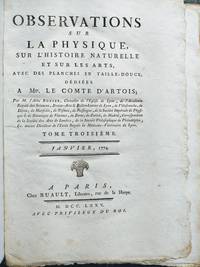
17756424Paris: Chez Ruault 1775. Original edition. Very Good. 2 volumes Quarto 28 cm; 464; 504 pages 25 engraved plates some folding and folding table. Engraved headpieces. Many pages unopened. In stiff paste paper paper labels on spine titled in manuscript and with volume numbers in ink. Old bookplate. References: For Lavoisier Duveen 24-27. <br /><br />Volumes 3 and 4 comprising the year 1774 of the lively forum for the publication of advancements in physics natural history and in mechanical arts. Electricity was in the air that year and indeed Monsieur Franklin figures heavily in reports letters addressed to him and in many articles that refer to him. While experiments with electricity are everywhere the obstetrician Sigaud de Lafond sees gold turn purple in response to a current of electricity; a Monsieur Bajon describes his research on electric eels subjects range widely. Lavoisier contributes research on white lead and other metals. Other articles investigate bird song British leather dressing rainbows epsom salts fish glue a hermaphroditic ass the Philadelphian method of drying figs and the effects of a strong dose of opium. Chez Ruault hardcover
1793051313Chez Cuchet. Good with no dust jacket. 1793. Second Edition. Hardcover. Hardcover 2 volumes. Written in French no translations. Elementary Treatise on Chemistry Presented in a new order and According to Modern Discoveries. Beautiful matching mottled leather boards worn and frayed at edges some bumping. Soil and rubbing. Title labels on spines between worn raised bands. Spine ends frayed. Light foxing/soil/creasing to text. 2 fold out charts in volume 1 and 13 plates in volume 2 are all in nice condition a few rough edges from improper folding. ; 8vo 8" - 9" tall . Chez Cuchet hardcover
1801S8896Paris:: Deterville An IX 1801. 1801. 8vo. 197 x 122 mm xxx 2 443 pp. Three folding engraved plates. Speckled edges; paper flaws in K2 and O5 affecting text. Quarter-bound in 19th century half calf over brown marbled boards raised bands gilt-stamped title and gilt-rules on spine; covers off. Housed in a custom folding chemise and red quarter morocco and cloth slipcase raised bands gilt rules and gilt-stamped titles; light shelf wear. Second edition second issue. "An entirely different issue of the usual 'Seconde edition.' Deterville has reprinted the entire book with the errata corrected in the text and the plates re-engraved by Tardieu l'aine Rue de Sorbonne No. 385. In the original edition the engraver had been de la Gardette who incidentally engraved Lavoisier's book-plate. The half-title with the titre de relais is present as before. The remark which appears at the end of the prior issue 'Le Privilege du Roi se trouve aux Memoires de l'Academie Royale del Sciences' is here omitted." Duveen & Klickstein. This is Lavoisier's first major work. In this work on combustion and calcination which first appeared in 1774 Lavoisier first published his investigations into the nature and properties of gases in connection with numerous experiments and laid the basis of his antiphlogistic theory. Lavoisier gives a history of gases and a detailed account of his experiments. It was in this pioneer work that he broke ground that was new to him and asserted himself on an important question that was in controversy. The Opuscules one of Lavoisier's four major works resulted from his study on combustion and experiments with phosphorus and sulfur and the conversion of calces into metals. The work consists of a historical section and an introduction on gases; the second part describes his experiments dealing with the problems of combustion calcination and air fixation. "Although Priestley isolated oxygen it was Lavoisier who discovered its real significance. He showed the true nature of the interchange of gases in the lungs and exploded Stahl's phlogiston theory." Garrison and Morton. A native Parisian Lavoisier was one of the most important scientists of the 18th century. Because of his loyalty to the Ancien Regime Lavoisier fell into disfavor with the ruling National Assembly. He and his father were both arrested on 24 December 1793 tried on 8 May 1794 and executed by guillotine the same day. As the apocryphal story goes Lavoisier appealed at his trial for time to complete some scientific work at which the presiding judge replied "The Republic has no need of scientists." Authentic however is the remark attributed to Lagrange the day after Lavoisier's execution: "It took them only an instant to cut off that head and a hundred years may not produce another like it." The titre de relais reads: "Cet ouvrage a l'exception des tables fut imprime pendant la detention du citoyen Lavoisier. Il ne faut donc pas etre surprise si l'edition n'en est pas belle; on se rappelera sans peine qu'a cette epoque les matiepremieres manquoient pour l'impression." trans.: "This work with the exception of the tables was printed during the detention of Citizen Lavoisier. One should not be surprised if the edition is not beautiful; one will note without sorrow that this impression is without the errors of the first edition.". Provenance: From the Robert Honeyman IV library sold at auction by Sotheby Park Bernet & Co. May 12 1980 Part V Lot # 1933. References: BM Readex Vol. 14 p. 998; Cole 770; DSB Vol. VIII pp. 66-91; Duveen p. 342; Duveen & Klickstein 123; Norman 1288 1st ed.; Partington III 372 V; Poggendorff I 1392. Deterville, An IX [1801]. hardcover books
1801S14204Paris :: Deterville An IX 1801. 1801. 8vo. 197 x 122 mm xxx 2 443 pp. Three folding engraved plates. Speckled edges; paper flaws in K2 and O5 affecting text. Quarter-bound in 19th century half calf over brown marbled boards raised bands gilt-stamped title and gilt-rules on spine. Housed in a custom folding chemise and red quarter morocco and cloth slipcase raised bands gilt rules and gilt-stamped titles; light shelf wear. PROVENANCE: Robert Honeyman's copy. 261 Second edition second issue. "An entirely different issue of the usual 'Seconde edition.' Deterville has reprinted the entire book with the errata corrected in the text and the plates re-engraved by Tardieu l'aine Rue de Sorbonne No. 385. In the original edition the engraver had been de la Gardette who incidentally engraved Lavoisier's bookplate. The half-title with the titre de relais is present as before. The remark which appears at the end of the prior issue 'Le Privilege du Roi se trouve aux Memoires de l'Academie Royale del Sciences' is here omitted." Duveen & Klickstein. / This is Lavoisier's first major work. In this work on combustion and calcination which first appeared in 1774 Lavoisier first published his investigations into the nature and properties of gases in connection with numerous experiments and laid the basis of his antiphlogistic theory. Lavoisier gives a history of gases and a detailed account of his experiments. It was in this pioneer work that he broke ground that was new to him and asserted himself on an important question that was in controversy. The Opuscules one of Lavoisier's four major works resulted from his study on combustion and experiments with phosphorus and sulfur and the conversion of calces into metals. The work consists of a historical section and an introduction on gases; the second part describes his experiments dealing with the problems of combustion calcination and air fixation. / "Although Priestley isolated oxygen it was Lavoisier who discovered its real significance. He showed the true nature of the interchange of gases in the lungs and exploded Stahl's phlogiston theory." Garrison and Morton. / A native Parisian Lavoisier was one of the most important scientists of the 18th century. Because of his loyalty to the Ancien Regime Lavoisier fell into disfavor with the ruling National Assembly. He and his father were both arrested on 24 December 1793 tried on 8 May 1794 and executed by guillotine the same day. As the apocryphal story goes Lavoisier appealed at his trial for time to complete some scientific work at which the presiding judge replied "The Republic has no need of scientists." Authentic however is the remark attributed to Lagrange the day after Lavoisier's execution: "It took them only an instant to cut off that head and a hundred years may not produce another like it." / The half-title reads: "Cet ouvrage a l'exception des tables fut imprime pendant la detention du citoyen Lavoisier. Il ne faut donc pas etre surpris si l'edition n'en est pas belle ; on se rappelera sans peine qu'a cette epoque les matieres premieres manquoient pour l'impression. trans.: "This work with the exception of the tables was printed during the detention of Citizen Lavoisier. One should not be surprised if the edition is not beautiful; one will note without sorrow that this impression is without the errors of the first edition. ". PROVENANCE: From the celebrated Robert Honeyman IV library sold at auction by Sotheby Park Bernet & Co. May 12 1980 Part V Lot # 1933. REFERENCES: BM Readex Vol. 14 p. 998; Cole 770; DSB Vol. VIII pp. 66-91; Duveen p. 342; Duveen & Klickstein 123; Norman 1288 1st ed.; Partington III 372 V; Poggendorff I 1392. Deterville, An IX [1801]. hardcover