Lavoisier, Antoine-Laurent DeBiblio.com
213 résultats
1021591513.Gpaperback. Good. Access codes and supplements are not guaranteed with used items. May be an ex-library book. paperback
1020112956.Ghardcover. Good. Access codes and supplements are not guaranteed with used items. May be an ex-library book. hardcover
1018718117.Gpaperback. Good. Access codes and supplements are not guaranteed with used items. May be an ex-library book. paperback
3382203987.Gpaperback. Good. Access codes and supplements are not guaranteed with used items. May be an ex-library book. paperback
186225309Paris: Imprimerie Imperiale 1862. 6 volumes 4to 54 plates many folding and 2 double-p. tables; contemporary quarter brown morocco gilt-lettered direct on spine; ex-Northwestern University small labels on each spine perforated stamp on first leaf of text pocket at rear of each volume with withdrawn stamp; some wear to bindings; small tide-marks in the lower blank margins of most leaves also on some of the plates. The monumental collected edition of Lavoisier's works. "So many of the papers written by Lavoisier remained unpublished during his lifetime and can only be found in the Oeuvres particularly those of his earlier periods." Duveen & Klickstein pp. 377-456. Imprimerie Imperiale unknown
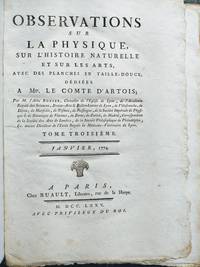
17756424Paris: Chez Ruault 1775. Original edition. Very Good. 2 volumes Quarto 28 cm; 464; 504 pages 25 engraved plates some folding and folding table. Engraved headpieces. Many pages unopened. In stiff paste paper paper labels on spine titled in manuscript and with volume numbers in ink. Old bookplate. References: For Lavoisier Duveen 24-27. <br /><br />Volumes 3 and 4 comprising the year 1774 of the lively forum for the publication of advancements in physics natural history and in mechanical arts. Electricity was in the air that year and indeed Monsieur Franklin figures heavily in reports letters addressed to him and in many articles that refer to him. While experiments with electricity are everywhere the obstetrician Sigaud de Lafond sees gold turn purple in response to a current of electricity; a Monsieur Bajon describes his research on electric eels subjects range widely. Lavoisier contributes research on white lead and other metals. Other articles investigate bird song British leather dressing rainbows epsom salts fish glue a hermaphroditic ass the Philadelphian method of drying figs and the effects of a strong dose of opium. Chez Ruault hardcover
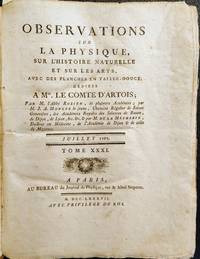
17876426Paris: Au Bureau du Journal de Physique 1787. Original edition. Very Good. Quarto 28 cm; 480 pages 12 engraved plates. Engraved headpieces. Many pages unopened. In stiff paste paper paper label on spine titled in manuscript and with volume number in ink. Old bookplate. <br /><br />Volumes 31 comprising the issues for August through December 1787 of the lively forum for the publication of advancements in physics natural history and in mechanical arts. The "Journal de Physique as it was known published monthly unlike the annals of the Royal Academy which published annually. Consequently it was able to publish innovative papers and reports of lectures given at the Academy long before their "official" appearance. The rapidity of this channel from research to publication remains a remarkable achievement. Among the papers published in this six-month period are two by Lavoisier one on oxydation one on chemical nomenclature and a letter from Benjamin Franklin to David Le Roy. Au Bureau du Journal de Physique unknown
1167047192.Gpaperback. Good. Access codes and supplements are not guaranteed with used items. May be an ex-library book. paperback
1120747015.Gpaperback. Good. Access codes and supplements are not guaranteed with used items. May be an ex-library book. paperback
1120856221.Ghardcover. Good. Access codes and supplements are not guaranteed with used items. May be an ex-library book. hardcover
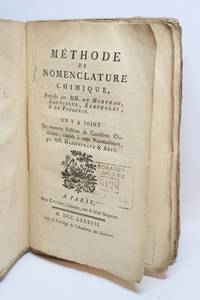
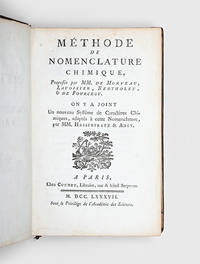
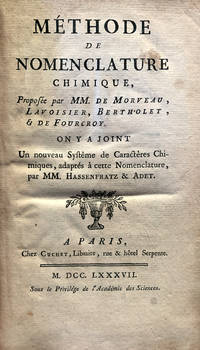
1787EBS100301Chez Cuchet Paris 1787. 1st Edition. Hardcover. Very Good/No Jacket. A landmark publication in chemistry where four French scientists presented a new systematic way of naming chemical substances laying the foundation for modern chemical nomenclature still used today. <br /> <br /> The late 18th century witnessed considerable debates over the theory and practice of chemistry. The chief theoretical shift was the identification of oxygen in place of the hypothesized phlogiston which led many contemporaries to view the existing chemical terminology as outdated and confused. <br /> <br /> This move was largely driven by Lavoisier 1743-1791 and his fellow authors of the Méthode Louis Bernard Guyton de Morveau 1737-1816 Claude-Louis Berthollet 1748-1822 and Antoine-François de Fourcroy 1755-1809. In the Méthode they develop a systematic nomenclature largely derived from oxygen theory arguing that chemical substances should be named according to their constituents. Simple substances should receive simple names and compounds should receive complex names deriving from their constituents. "The new terms were soon translated and adapted into other languages and became the basis of the modern nomenclature of inorganic chemistry. In the purely pragmatic terms of the terminology used modern chemistry therefore starts in 1787" Crosland p. 411. There were two issues of the first edition: this second is identified by misnumbering pages 258-9 262-3 266-7 and 270-1. <br /> <br /> The first edition itself there were two in 1787 is identified by the woodcut on the title page depicting a cherub supervising distillation. Duveen & Klickstein 126; Norman 1291. Maurice Crosland "Chemistry and the chemical revolution" in The Ferment of Knowledge: Studies in the Historiography of Eighteenth-century Science 1980. <br /> <br /> BOOK DESCRIPTION AND CONDITION: First Ed First Printing Second Issue Duveen and Klickstein pp 119-126 8vo 314pp huge folding table of Nomenclature six folded tables of chemical symbols; cherub & distillation apparatus on title page colophon p. 314. Mod. marbled boards. Very good condition throughout. The folding tables outline the first taxonomic system of chemical substances arranged according to their composition a system which proved immediately influential; even established figures like Priestley felt obliged to adopt the new terminology.<br /> <br /> PROVENANCE: From the Arthur C. Greenberg Chemical History Library. Presentation copy to Thomas Wedgwood Junior the eldest son of Thomas Wedgwood and older brother of the more well-known Isaiah Wedgwood from his cousin Thomas Byerley in 1787; T. Wedgwood Jr. and Byerley manufactured their own line of porcelain. Chez Cuchet (Paris) hardcover
178773124à Paris: Chez Cuchet 1787. Fine. Chez Cuchet à Paris 1787 13.50 x 21 cm broché Second printing of the first edition: pages 257 to 272 are misnumbered 241-256 Duveen and Klickstein. Illustrated with a large chart and 6 folding plates at rear. Library stamp of Laboratoires Lumière on the half-title title page and several other pages. Another stamp ""G. Chicanuard"" appears on the half-title; we have found no information about this person. Temporary binding in full marbled paper. Handwritten title on spine. Some small paper losses in places and joint on second board cracked but still sound. Copy as issued with full margins. The Méthode forms a manifesto for a revolution in the world of chemistry and the birth of modern chemistry a chemistry that resolutely turns its back on the past by becoming scientific. It was Lavoisier the most influential scientist at the Academy of Sciences who brought together around his theory and to support it decisively the greatest French chemists: Fourcroy Berthollet Adet Hassenfratz and Guyton de Morveau whom the already formed group welcomed to Paris in February 1787. The latter joined them with an advanced chemical nomenclature which would be revised by Lavoisier who demanded that Morveau abandon his phlogistic theory principle of a combustible element in air dating from the 17th century since he had discovered the role of oxygen. It was at this price that he was entrusted with presenting the new nomenclature. It was in the session of May 2 1787 at the Academy of Sciences that the terms ""oxygen"" ""hydrogen"" and ""carbon"" were pronounced for the very first time. Adet and Hassenfratz were responsible for proposing symbols for ""new characters to be used in chemistry"" which would not have much success but was destined for a great future. The entire project was placed under the authority and will of Lavoisier and the decision that Morveau should carry the project was a political decision intended to ensure better reception among foreign scientists. No one was deceived because it was Lavoisier who would be attacked by Western science. Very important work that marks the birth certificate of scientific chemistry. Chez Cuchet unknown
1787173027Paris: Chez Cuchet 1787. Modern chemistry therefore starts in 1787 First edition second issue of the work which introduced modern chemical terminology among the most fundamental scientific texts of the 18th century. The folding tables outline the first taxonomic system of chemical substances arranged according to their composition a system which proved immediately influential; even established figures like Priestley felt obliged to adopt the new terminology. The late 18th century witnessed considerable debates over the theory and practice of chemistry. The chief theoretical shift was the identification of oxygen in place of the hypothesized phlogiston which led many contemporaries to view the existing chemical terminology as outdated and confused. This move was largely driven by Lavoisier 1743-1791 and his fellow authors of the Méthode Louis Bernard Guyton de Morveau 1737-1816 Claude-Louis Berthollet 1748-1822 and Antoine-François de Fourcroy 1755-1809. In the Méthode they develop a systematic nomenclature largely derived from oxygen theory arguing that chemical substances should be named according to their constituents. Simple substances should receive simple names and compounds should receive complex names deriving from their constituents. "The new terms were soon translated and adapted into other languages and became the basis of the modern nomenclature of inorganic chemistry. In the purely pragmatic terms of the terminology used modern chemistry therefore starts in 1787" Crosland p. 411. There were two issues of the first edition: this second is identified by misnumbering pages 258-9 262-3 266-7 and 270-1. The first edition itself there were two in 1787 is identified by the woodcut on the title page depicting a cherub supervising distillation. Octavo 185 x 120 mm pp. 4 314. With 7 folding tables woodcut title page vignette head- and tailpieces. Contemporary mottled sheep spine with foliate decoration in gilt brown calf label lettered in gilt raised bands covers with single fillet border in blind marbled endpapers edges red pink silk bookmarker. Later pencil annotation to upper margin of p. 9. Light bumping and rubbing minor stripping to covers tail of front joint neatly repaired front inner hinge split but holding firm loss to lower outer corner of half-title inner margin of leaf G7 and outer margin of rear free endpaper none affecting text a couple of closed tears to initial folding table contents otherwise clean: a very good copy. Duveen & Klickstein 126; Norman 1291. Maurice Crosland "Chemistry and the chemical revolution" in The Ferment of Knowledge: Studies in the Historiography of Eighteenth-century Science 1980. hardcover
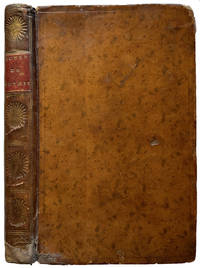
1787612Paris: Cuchet 1787. 1st. Full mottled calf with gilt tooling along the edges gilt spine compartments with floral ornaments and leather spine label. Contemporary binding with rubbing and wear along the spine and corners. Boards show mottling and fading with some scuffing. Pages exhibit foxing toning and occasional spotting consistent with age. Folding tables are intact and legible though with some creasing and edge wear. Features: Marbled edges; multiple large folding tables and engraved charts; decorative typographic ornaments. Overall good. <p data-start="251" data-end="727">Méthode de Nomenclature Chimique Paris: Cuchet 1787 is the groundbreaking work that introduced the modern system of chemical nomenclature marking a turning point in the history of science. Written collaboratively by Morveau Lavoisier Berthollet and Fourcroy—four of the most influential chemists of the 18th century—this treatise sought to replace centuries of inconsistent and confusing chemical terminology with a rational systematic method of naming substances.</p> <br /> <p data-start="729" data-end="1178">The work introduces a new nomenclature rooted in clarity precision and universality laying the foundation for the modern language of chemistry. Included are detailed explanations of the logic behind the naming system as well as extensive tables of elements and compounds that illustrate the method in practice. The treatise also contains supplementary sections by Hassenfratz and Adet who proposed a symbolic notation for chemical substances.</p> <br /> <p data-start="1180" data-end="1537">Lavishly produced the book features large folding tables and engraved charts including the famous “Tableau de la Nomenclature Chimique†which visually organizes the new classification of substances. These elements highlight both the pedagogical and scientific ambitions of the project: to unify chemists under a single coherent system of communication.</p> <br /> <p data-start="1539" data-end="1749">This volume is considered a cornerstone of the Chemical Revolution appearing just two years before Lavoisier’s Traité élémentaire de chimie 1789 and cementing his role as the father of modern chemistry.</p> . Cuchet unknown
thl53Paris: Cuchet 1787. First Edition First Issue of this important collaborative work which established the first systematic method of chemical nomenclature that is still in use today. “Originally suggested by Guyton de Morveau to eliminate the confused synonymy of chemistry and prefaced by a memoir of Lavoisier it emerged as a complete break with the past. In effect the scheme was based upon the new anti-phlogiston discoveries and theories…In a series of tables the ‘Nomenclature’ listed the elements substances non décomposées that is those bodies that had not been or perhaps could not be decomposed. Fifty-five in number these simple bodies included light and Lavoisier’s “matter of fire†now called “caloricâ€; the elementary gases: oxygen nitrogen azote and “inflammable air†now called hydrogen; carbon sulphur and phosphorus; the sixteen known metals; a long list of organic “radicals†i. e. accidifiable bases; and the as yet undecomposed alkaline earths and alkalis. Compounds were designated as chemists have done ever since so as to indicate their constituents." DSB VIII p. 80. Honeyman 1936. Neu 1791. Sparrow 126. 8vo. pp. 2 p.l. 256 241-256 273-314. with half-title. 6 folding engraved tables & 1 folding engraved plate. woodcut title vignette of a cherub supervising distillation. contemporary sprinkled calf gilt back small chip to head of spine short cracks in joints light dampstain to some leaves & first table stain on last leaf. thl53 Paris: Cuchet, 1787 unknown
178718453Paris: Chez Cuchet 1787. FIRST EDITION. With half-title 6 large folding copperplates and 1 large folding table title vignette woodcut headpiece above first text leaf pages 257-272 misnumbered. Contemporary tree calf spine label very small crack at top of spine and rear cover otherwise an excellent copy printed partially on blue paper from the library of Melchet Court Romsey and a small book label with the heraldic motto “virus in arduis†on the paste-down. First edition of one of the most important works in the history of modern chemistry. Lavoisier’s discoveries brought about a critical need to develop a new chemical nomenclature. Its importance was first recognized by Guyton de Morveau an adherent of the phlogiston theory. De Morveau was invited to join a group of the leading anti-phlogistonists to discuss the possibility of applying his nomenclature to Lavoisier’s chemistry and in the process was converted to Lavoisier’s doctrines. The result of this collaboration of Bertholet Fourcroy de Morveau Lavoisier and others is contained in this volume and marks the foundation of modern chemical nomenclature.<br /> <br /> Cole Chemical Literature 1700-1860 566C under Guyton de Morveau; Duveen 126; Duveen & Klickstein p. 127; Norman 1291; see Printing & the Mind of Man 238; Sparrow Milestones of Science 125. Chez Cuchet unknown
1787655401787. Paris: Chez Cuchet 1787 8° IV 314 pp. 6 gefalt. Kupfertafeln Ledereinbnand. d.Zt.; Falttabll fehlt; Rücken restauriert; feines Expl. FIRST EDITION first issue of one of the key books in the history of modern chemistry. This copy has all the features mentioned for the first issue such as the figurative title vignette and the misnumbered pages: 242/34 instead of 258/% 246/7 instead of 262/3 291 instead of 266/7 254/5 instead of 270/1. Unfortunately the table opposite page 100 is missing. Lavoisier's discoveries made a new and rational chemical nomenclature imperative. Initiated by Guyton de Morveau still an adherent of the phlogiston theory the project was taken up by Lavoisier who soon convinced Guyton of the truth of his system. They entered into collaboration with Berthollet and Fourcroy. The result of their combined efforts is contained in the present volume the most important milestone in the development of chemical nomenclature. The new nomenclature with only slight modifications is still the basis of the language of modern chemistry. The table of contents: 1 Mémoire Sur la nécessité de réformer & de nomenclature de la Chimie lu à l'Assemblée publique de l'Académie Royale des Sciences du 18 Avril 1787; Par M. Lavoisier pp. 1-25 This is the first appearance of this memoir in print. It was never published in the Mém. Acad. R. Sci. The contents are discussed in the introduction to this section. Lavosier revised the memoir and used it again for the "discours préliminaire" of this 'Traité Elementaire de Chemie. 2 Mémoire sur le développement des principes de la Nomenclature méthodique lu à l'Académie le 2 Mai 1787; Par M. de Morveau pp.26-70. 3 Appendice Contenant la nomenclature de quelques substances composées qui s ; combinent quelquefois à la manière des corps simples pp.70-74. 4 Mémoire Pour servir à l'explication du Tableau de Nomenclature. Par M. de Fourcroy pp.75-100. 5 Avertissement Sur les deux Synonimies pp.101-106. 6 Synonimie Ancienne & novelle par ordre alphabétique pp.107-143. 7 Dictionnaire Pour la nouvelle Nomenclature Chimique pp.144-237. 8 Rapport Sur la nouvelle Nomenclature pp.238-252. 8 Mémoire Sur de nouveaux Caractères à employer en Chimie. Par MM. Hassenfratz pppp.253-270. 9 IIe Mémoire Sur de nouveaux Caractères à employer en Chimie & l'arrangement que doivent avoir ces nouveaux Caractères afin de leur faire exprimer les rapports de quantité des substances simples contenues dans les mixtes. Par MM. Hassenfratz & Adet pp.271-287. As a complement to he new nomenclature Hassenfratz and Adet devised a system of symbols straight lines. Half -circles squares triangles lozenges and circles in different positions and combinations which as they intended should make possible an immediate understanding of chemical substances and their nature the world over. Ingenious though their methods seemed this sign language proved unsatisfactory and it has long been discarded. 10 Rapport Sur les nouveau Caractères chimiques pp.288-312. This memoir was never published in the Mém. Acad. R. Sci. H.F. Norman Lib. Cat. 1291. Duveen & Klickstein 126. Duveen p. 340. D.S.B. 8: 80. Cole 566. Bolton I. 58. Partington III. 372.VI. Smith Coll. p.209. Edelstein 1361. Milestones of Science 126. First issue not in Neville. Duveen-Klickstein 126 unknown
0282325808.Gpaperback. Good. Access codes and supplements are not guaranteed with used items. May be an ex-library book. paperback
0484786008.Ghardcover. Good. Access codes and supplements are not guaranteed with used items. May be an ex-library book. hardcover
0353839000.Ghardcover. Good. Access codes and supplements are not guaranteed with used items. May be an ex-library book. hardcover
179246020Paris Rue et Hôtel Serpente 1792-93. No wrappers. In: "Annales de Chimie ou Recueil de Mémoires concernant la Chemie" Tome 15 December issue Tome 16 January issue entire issues offered. Pp. 224-266 pp. 297-316 Resultat. pp. 3-39 a. 1 large folded table. <br/><br/><em>First printing of two importent memoirson the Salpetre industry. </em> unknown
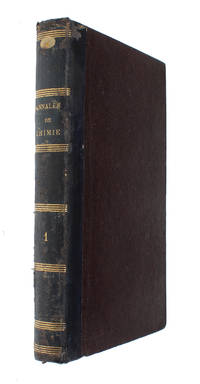
178943634Paris Rue et Hotel Serpente 1789. 8vo. Contemporary half calf. Gilt spine slightly rubbed light wear to spine ends. "Annales de Chimie: ou Recueil de Mémoires Concernant la Chimie et les Arts qui en Dépendent. Par MM. de Morveau Lavoisier Monge Berthollet De Fourcroy le Baron de Dietrich Hassenfratz & Adet." Tome Premier. 23122 pp. The entire volume offered. Some scattered brownspots. A small wormtract to upper margin of ab. 20 leaves no loss of letters. <br/><br/><em>First edition of the first volume of this very important journal founded by Lavoisier and his friends collaborating in establishing THE NEW SCIENCE of Anti-Phlogistic theory in chemistry. Crosland in "The two French Revolutions" and "The Imperial Despotism of Oxygen" claims that for a clear understanding of the CHEMICAL REVOLUTION THE NEW JOURNAL of ANNALES DE CHIMIE can be rightly considered as FUNDAMENTAL as the "Traite élementaire de Chimie"."A third and most important instrument was the establishment of a new scientific journal edited - and dominated - by the votaries of the "new chemistry". The first number of this journal of the Annales de chimie appeared in 1789 the year of the Revolution. Its editors were besides Lavoisier his early disciples - Guyton Berthollet Fourcroy and Monge - with the addition of three new recruits: the Strassbourf metallurgist the Baron de Dietrich Jean-henri Hssenfratz and Pierre Auguste Adet."DSB VIII p.81.LAVOISIER'S paper on COMBUSTION pp. 19-30 contains his important interpretation of the phenomena of combustion in air making the fundamental distinction between burning and combustion. By this "Lavoisier gave to the study of chemistry a new life a new direction and a wider outlook." Alexander Findley."The Lavoisierian memoir on combustion of iron stood out among the large number of interesting papers discussed in the first volume of the "Annales". In his account Lavoisier sustained that in nature combustion without flames did occur. Thus he clarified the distinction between ordinary burning and combustion: an issue on which the majority of traditional chemists were confused. The need for accuracy and precision in laboratory practices was emphasised in his study as it was a means to determine quantities rather than assuming them."Angela Bandinelli in "Scientific Communication During a Major Change .Empirical Research: Annales de chimie vs Obs. sur la physique/ Journal de physique 1789-1803.The volume furthermore contains important papers by: Adet Fourcroy 3 papers Berthollet 3 papers Chaptal Hassenfratz 5 papers Baron de Dietrich 2 papers Klaproth 2 papers Girtanner Dollfuss Bonz de Ettingen Crell De Morveau. </em> unknown
46368Cuchet - edition originale premier tirage In-8 iv-314pp. un grand tableau depliant 6 planches et tableaux depliants in-fine reliure demi-basane de l'epoque dos orne fers et filets dores piece de titre vert emeraude legeres usures aux coiffes ex-libris manuscrit Nb-0107 Publiee en Aout 1787 cette premiere edition regroupe et fait la synthese des differents memoires publies sur les nouvelles denominations chimiques et ses nouveaux symboles depuis 1780 habituellement attribuee a Lavoisier. unknown
1787S14078Paris :: Chez Cuchet 1787. 1787. 8vo. iv 314 pp. PAGINATION NOTE: pages 257-272 are mis-numbered 241-256 Duveen. Half-title woodcut title-page vignette headpiece tailpieces 6 folding tables of chemical symbols 1 folding plate; page 1 of the text trimmed at top margin and mounted on a stub foxed. Contemporary full mottled calf red leather spine label gilt-stamped spine; foot of spine mended with kozo patch upper joint cracked corners of read cover chewed. Ownership signature on title under the vignette. Very good. 264 FIRST EDITION second issue second printing with the flowered vase on the title-page previously a cherub and no colophon on page 314. Lavoisier's new terminology of chemistry was an important part of his reforms in the science and it has been in use with some modifications ever since its introduction. "The merits of the new nomenclature are even today more than evident since with only slight modification it is still the basis of the language of modern chemistry." Duveen & Klickstein pp. 119-126. Louis Guyton de Morveau was trained as a lawyer who taught himself the subject of chemistry. From 1776-1789 he taught public courses in chemistry at the Dihon Academy. He was professor of chemistry at the Ecole Polytechnique from 1794-1811 twice serving as its director. ALL AUTHORS: LAVOISIER Antoine Laurent 1743-1794 ; Louis Bernard GUYTON DE MORVEAU 1737-1816 ; Claude-Louis BERTHOLLET 1748-1822 ; Antoine-Francois de FOURCROY 1755-1809 ; Jean Henri HASSENFRATZ 1755-1827 ; Pierre-Auguste ADET 1763-1834. PROVENANCE: Emile on title. REFERENCES: Blake/NLM p. 191 2nd printing; Cole Chemical literature 566; DSB Vol. V. pp. 600-604; Duveen Bibliotheca Alchemica et Chemica p. 340; Duveen & Klickstein 130; Gascoigne 7150.4; Partington A history of chemistry Vol. III p. 372; Poggendorf Vol. I col. 981; Wellcome III p. 185. Chez Cuchet, 1787. hardcover
17781465Paris: De l'Imprimerie Royale 1778. 1st Edition. FIRST EDITION LAVOISIER'S OFFICIAL EASTER MEMOIR ON THE COMPOSITION OF AIR. <br /> <br /> In this work Lavoisier proposed that ordinary air is composed of two different gases one "highly respirable" that he named "oxygen" and the other later named nitrogen that was unable to support combustion or respiration. This work is commonly referred to as Lavoisier's "Easter Memoir" because he presented an earlier version to the Academy around Easter of 1775; as this is the 1778 revised version historians regard it as Lavoisier's "official" Easter Memoir Wikipedia. We offer the 1780 edition separately.<br /> <br /> In April 1778 "Lavoisier read for a second time the memoir in which he had originally demonstrated in April 1775 that mercury precipitate reduced without charcoal disengages not fixed air but the ‘air itself entire' or ‘the purest portion of the air'. He made some revisions in the text that have attracted widespread attention from historians" Holmes Lavoisier 137. <br /> <br /> In the time between 1775 and 1778 Lavoisier repeated some of performed some new experiments of his own and repeated some of Priestley's. In the 1778 ‘official' version Lavoisier "altered the language in which he had described that air calling it now ‘the most salubrious the most pure portion of the air' and air ‘in an eminently respirable state'. Fastening on to this last phrase he again referred to the air later in his memoir as ‘eminently respirable air'. At the same time he deleted references to it in the original version as ‘common air' and eliminated the experimental description that it reacted to the nitrous air test in the same manner as common air. <br /> <br /> "Historians have tended to treat with suspicion the textual changes Lavoisier made. The implication seems to be that he sought to represent himself as having clearly understood in 1775 that the air released from the mercury calx is a specific portion of the atmosphere when in fact he had then still not distinguished it unambiguously from ordinary air. If one couples this suspicion with acceptance of Priestley's charge that Lavoisier had obtained the idea for the experiment from him in the first place then one creates an image of Lavoisier as one who is known to have had an ‘occasional tendency to allow the work of others to pass as his own'. <br /> <br /> "There is however no solid evidence that in making these changes he was attempting to rewrite history. His motivation was probably simple. By the spring of 1778 when his new theoretical edifice had solidified the experiments on mercury calx would have come to appear to him as one of the decisive experimental foundations on which he had erected it. Yet when he looked back on the paper which reported these experiments from the vantage point he had since attained the descriptions of the air he had identified in it would have appeared confused ambiguous and inconsistent. <br /> <br /> "The embarrassment of allowing such flaws to remain in what he could now anticipate might someday be regarded as a classic paper is obvious. Since the paper had yet to appear in the Memoirs of the Academy chronically two to three years late in publication he had a convenient opportunity to avoid that outcome" Holmes. <br /> <br /> ALSO INCLUDED: An important paper by P. S. Laplace introducing the concept of the "Coriolis effect" fifty years before Coriolis. Euler had also written about the effect in 1749. "Recherches sur plusieurs points du système du monde" in Mémoires de l'Académie des Sciences Année 1775 pp. 75-182 1778. This is part one of a two part paper. CONDITION: Paris: De l'Imprimerie Royale. 4to 10.5 x 8.25. 11 folding engraved copperplates. Prior ownership name 'Bernardi' on front free endpaper. Contemporary full leather binding. Front joint between spine and boards cracking but solid. Handsome wide margins throughout. Slight toning throughout otherwise bright and very clean. Very good condition. De l'Imprimerie Royale hardcover