[EINSTEIN] Henri BERGSONBiblio.com
1 506 résultats
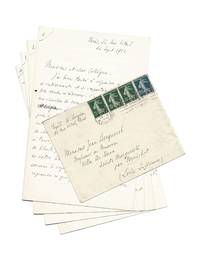
1922Bergson2<p><strong>EINSTEIN BERGSON Henri 1859-1941</strong></p><p>Autograph letter signed " Henri Bergson " to Jean Becquerel<br />Paris 24 September 1922 16 pages in-8° with envelope<br />Some typographic pencil notes</p><p><strong>A highly significant letter on the issues and interpretation of the theory of relativity</strong><br /><strong>This intervention of the philosopher continues up to this day to create multiple controversies</strong></p><p><u>We transcribe here only a few fragments of this letter which although known in its substance has remained unpublished to this day</u></p><p><em>" Monsieur et cher collègue</em><br /><em>J'ai bien tardé à répondre à la lettre si intéressante et si importante que vous avez bien voulu m'adresser. C'est qu'elle est allée me chercher de divers côtés et m'a atteint en Suisse à un moment où j'étais pris à Genève par le travail de " Coopération intellectuelle " qui nous avait été confié par la Société des nations. Me voici de retour à Paris ; je profite de mes premiers instants de liberté pour vous écrire. Le passage essentiel de votre lettre est naturellement celui qui concerne le voyage en boulet. Laissez-moi reprendre ce que j'ai dit dans mon livre</em> Durée et simultanéité paru à l'été 1922 <em>en y joignant quelques explications complémentaires.</em><br /><em>Il y a d'abord deux remarques importantes à faire.</em><br /><em>1° <strong>Si l'on se place en dehors de la Théorie de la Relativité on conçoit un mouvement absolu et par là même une immobilité absolue ; il y aura dans l'univers des systèmes réellement immobiles. Mais si l'on pose que tout mouvement est relatif que devient l'immobilité </strong> Ce sera l'état du système de référence je veux dire du système où le physicien se suppose placé à l'intérieur duquel il se voit prenant des mesures et auquel il rapporte tous les points de l'univers.</em> …<br /><em>2° Si l'on se place en dehors de la Théorie de la Relativité on conçoit très bien un personnage Pierre absolument immobile au point A à côté d'un canon absolument immobile ; on conçoit aussi un personnage Paul intérieur à un boulet qui est lancé loin de Pierre se mouvant en ligne droite d'un mouvement uniforme absolu vers le point B et revenant ensuite en ligne droite et d'un mouvement uniforme absolu encore au point A. <strong>Mais du point de vue de la Théorie de la Relativité il n'y a plus de mouvement absolu ni d'immobilité absolue</strong></em> … <em>Paul une fois lancé dans l'espace n'est plus qu'une représentation de l'esprit une image — ce que j'ai appelé un " fantôme " ou encore une " marionnette vide ". C'est ce Paul en route ni vivant ni conscient n'existant plus que comme image qui est dans un Temps plus lent que celui de Pierre.</em> … <em>Le Paul qui sort du boulet au retour du voyage le Paul qui fait de nouveau partie alors du système de Pierre est quelque chose comme un personnage qui sortirait en chair et en os de la toile où il était représenté en peinture : c'était à la peinture et non pas au personnage c'était à Paul référé et non pas à Paul référant que s'appliquaient les raisonnements et les calculs de Pierre pendant que Paul était en voyage.</em> … <strong><em>Je ne voudrais pas clore sans saisir l'occasion qui s'offre à moi de vous dire combien m'a intéressé et instruit votre beau livre sur " Le principe de relativité " et la " Théorie de la gravitation " – livre indispensable à tous ceux qui ont le souci d'approfondir la théorie d'Einstein.</em></strong><em> Veuillez Monsieur et cher collègue agréer l'expression de mes sentiments les plus distingués et dévoués</em><br /><em>H. Bergson "</em></p><p>In publishing <em>Durée et simultanéité</em> published by Alcan in the summer of 1922 Bergson was taking a risk that he probably did not measure himself. The purpose of this essay was to discuss the philosophical issues of the theory of relativity. The criticism of his scientific colleagues was not long in coming. Those of Einstein in the first place deploring the "blunders" or "dumplings" of the philosopher. In France it was Jean Becquerel who opened fire with a letter addressed directly to the author and of which this document constitutes the reply.<br />At the time Becquerel held a chair of applied physics at the Museum of Natural History. He wrote a textbook entitled <em>Le Principe de relativité et la théorie de la gravitation</em> Gauthier-Villars 1922 which made him one of the first introducers of Einsteinian theory in the French context. Two sources give an idea of the content of Becrerel's letter: his article published the following year "Critique de l'ouvrage durée et Simultaneity de M. Bergson"<em> Bulletin scientifique des étudiants de Paris</em> 10 2 March-April 1923 and the extract given by Bergson himself in the first of three appendices added to the 1923 edition of <em>Durée et simultanéité</em> – appendix which also contains with a few lines the entirety of his answer. Bergson then chose to preserve the anonymity of his correspondent in order to avoid giving the impression of a "polemic" according to the interview of December 30 1923 with Jacques Chevalier. He merely evokes "a letter very interesting which was addressed to us by a most distinguished physicist."<br />The discussion crystallizes on a specific point: the interpretation of the slowdown of moving clocks predicted by the theory. The famous "twin paradox" attributed to Paul Langevin provides a pictorial version of the problem as part of a Jules Verne-style narrative: an astronaut here "Paul" embarked on a "ball journey" would find himself on his return younger than his twin brother who remained on Earth here "Pierre" as if time had passed less quickly for him! In his letter Becquerel insists on the fact that the theory of relativity speaks of time actually measured on both sides by observers in relative motion. Bergson repeats by clarifying it the argument developed in his book namely that the differences relate less to real times than to fictitious times that is to say times attributed to other observers who acquire at the same time the status of simple images or "ghosts". Thus the "dilation" of durations associated with the slowing down of moving clocks is only a "perspective effect". Bergson is led to this conclusion by a strict interpretation of the principle of relativity: between two observers in relative motion there is a "perfect symmetry" each can consider itself motionless or mobile with respect to the other. Multiple empirical confirmations have since objectively proved the philosopher wrong but the question of the status of time in relativity as well as that of the relevance of the arguments exchanged continues to fuel contemporary philosophical debates. In that sense that letter constitutes a key part of the case.</p><p>We thank Mr. Elie During for the information he kindly communicated to us</p>
191426027AB1914. Berlin Arthur Tetzlaff 1914. 8°. 4 230 2 Seiten. Hardcover / Library Binding. Bibliotheksbindung. Ehemaliges Exemplar der Harvard College Library. Mit dem Besitzvermerk von Prof. Gerald Holton. Die private Bibliotheksbindung mit mehreren Defekten. Vorsatzblatt lose und stark angerändert. Mit zahlreichen handschriftlichen Annotationen Holton's im Beitrag von Joseph Petzoldt: "Die Relativitätstheorie der Physik". Holton verweist in einem Absatz auf eine Peinlichkeit in Petzoldt's Aeusserung und merkt dazu an: "Embarrassing no wonder AE refused P invite to join Blackmore H. J. T. Blackmore and K. Hentschel" / Former copy of Harvard College Library with ownership-stamp of Nobel Laureate Prof. Gerald Holton. Several annotations in pencil by Holton in Joseph Petzoldt's contribution on the "Theory of Relativity of Physics". Holton notes for instance: "Embarrassing no wonder AE refused P invite to join Blackmore H. J. T. Blackmore and K. Hentschel" Zeitschrift für positivistische Philosophie. 2. Band. hardcover
1993LFA-126742384Hors-série N° 16 - Août 1993 : revue de 96 pages, format 210 x 285 mm, illustré, broché couverture couleurs, bon état
1921015388Paris Directeur: Florent Fels. 1921 In-8 Broché Edition originale
1992LFA-126742551Une revue de 164 pages, format 170 x 240 mm, illustrée, brochée couverture couleurs, bon état
19772080202103703852Asahi 1977. Soft Cover. Fine. Page size: 36 13 p. Size: 19 cm B6 Asahi paperback
19842-8875921334Ricordi 1984. Paperback. New. French language. 9.37x6.30x1.42 inches. Ricordi paperback
19872083002116406316David company 1987. Soft Cover. Fine. The book is in fine condition. David company paperback
1920015068Friedrich Cohen, Bonn 1920. Vierte Auflage Broschur Zufriedenstellend
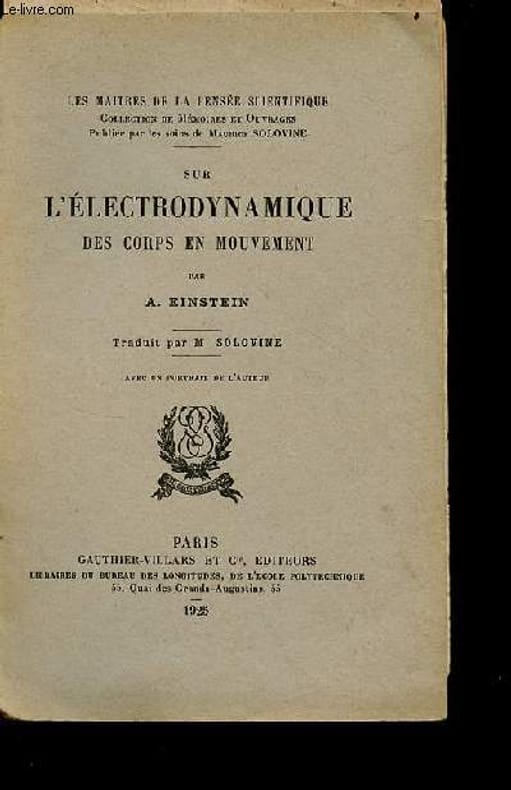
1925R160222037Gauthier-villars et cie. 1925. In-12. Broché. Etat d'usage, 1er plat abîmé, Coiffe en pied abîmée, Papier jauni. 56 pages - portrait en noir et blanc de l'auteur en frontispice - coiffes abîmées - 1er plat désolidarisé - tampon sur la page de faux titre.. . . . Classification Dewey : 530-Physique
2000x-0312231024Palgrave Macmillan 2000. Hardcover. New. 253 pages. 9.00x5.75x1.00 inches. Palgrave Macmillan hardcover
1979N2216Braunschweig / Wiesbaden: Fiedr.Vieweg & Sohn 1979. Original Cloth with d/j. Near Fine. 8vo. XV22pp. A fine copy with fine DJ. <br/> <br/> Fiedr.Vieweg & Sohn hardcover
191083637Zurich 21 juin 1910 | 9 x 14 cm | une carte postale
193481265Flammarion | Paris 1934 | 12 x 19 cm | relié
193491810Flammarion | Paris 1934 | 13 x 19.5 cm | Broché
1983056774France Loisirs Jaquette en très bon état reliure Rigide Décorative Paris 1983 320 pages en format 14 -21 cm - dessins - reliure rigide en percaline avec dessins en dorure 2-7242-4426-5
1948500223125Flammarion 1948 1948.
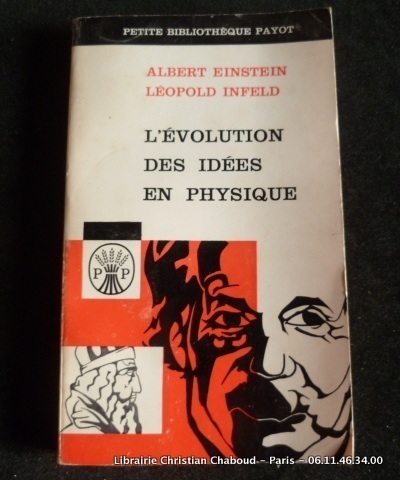
196326910Paris, Petite Bibliothèque Payot, 1963, poche, broché, 280 pages. Bon état.
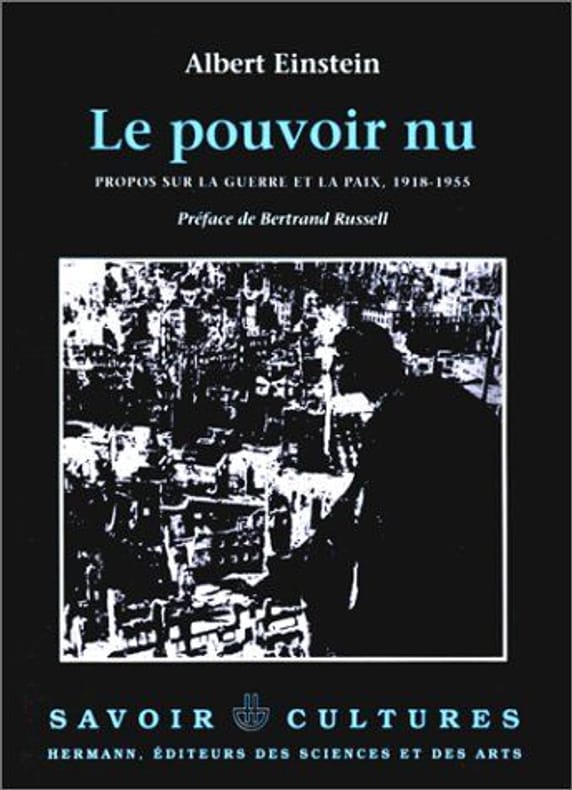
1991509015Editions Hermann 1991 222 pages 21x15x1cm. 1991. Broché. 222 pages.
193391965Hermann & Cie | Paris 1933 | 16 x 25 cm | Broché
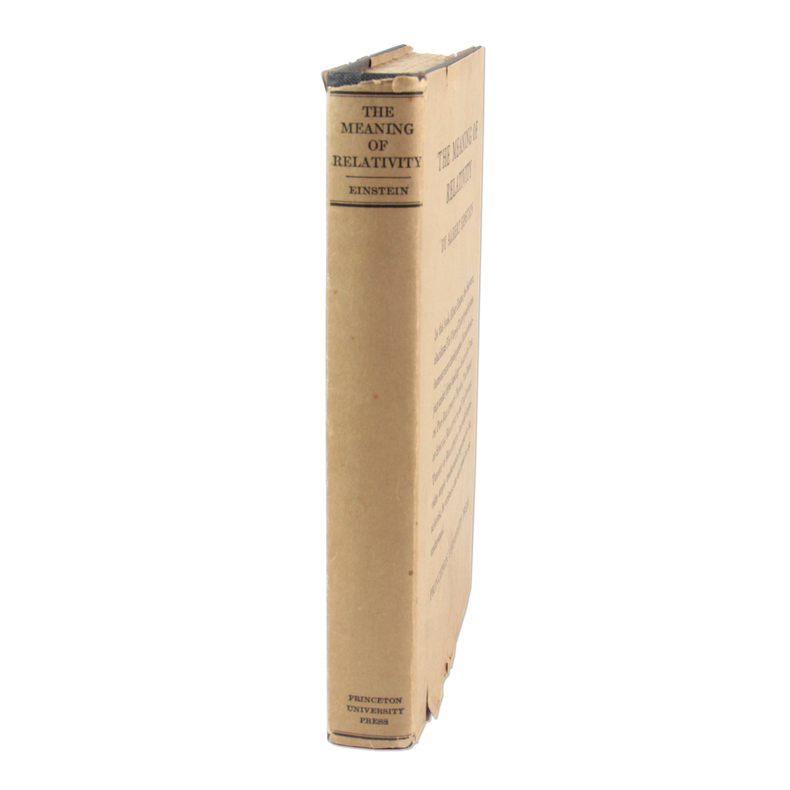
19237645Rare édition originale de ces quatre conférences données par Albert Einstein à l'université de Priceton. Il s'agit de la première communication faite par le physicien directement à un public profane.
19941596653539Easton Press 1994. Unknown. Like New. Pages are clean and are not marred by notes or folds of any kind. ~ ThriftBooks: Read More Spend Less.A clean copy in excellent condition appears unread. Sealed in plastic for shipping. Secure packaging for safe delivery.Dust jacket quality is not guaranteed. Easton Press unknown
1930021309London: The Soncino Press 1930. 1st Edition . Hardcover. Fair/Fair. Hardcover book in fair condition. Dust jacket included in poor to fair condition showing toning light staining and tears. Book dampstained closer to spine crack to binding starting at middle. A few instances of marked lines in the margins not affecting text. An excellent resource copy of this scarce first edition. Questions welcome. We ship internationally from the United States and Canada every week. If buying internationally please be aware that additional charges may apply for heavier books. We guarantee a safe quick and secure transaction. 10 years in online bookselling experience. <br/> <br/> The Soncino Press hardcover
19811-0691023689Princeton Univ Pr 1981. Paperback. New. 167 pages. 8.00x5.25x0.50 inches. Princeton Univ Pr paperback
1949343971949. <blockquote><p>On scientists and military work: “The majority of really good scientists in this country have withdrawn from military work…The young ones who cannot lean upon a standing of their own have generally given in to the almost irresistible pressure. One cannot expect it to be any different.""</p><p> </p><p>Einstein and other scientists faced the harsh reality of the product of their work after the war and the bombing of Japan; Here Einstein in a way grapples with his own role</p></blockquote><p> </p><blockquote><p>On the timeless nature of fighting for what you believe: “The truth appears foolish to the insane.Lost people are content to find themselves in agreement with the masses.""</p></blockquote><p><img class=""alignnone wp-image-34606 size-post-window"" src=""https://cdn.raabcollection.com/wp-content/uploads/20251001204256/Einstein_Letter_11-1-1600x897.jpg"" alt="""" width=""1600"" height=""897"" /></p><p>Although Albert Einstein’s participation in the production of the atomic bomb was limited the public perceived his role as crucial and he was in fact the face of the project to many. The reasons were that although he did not work on the Manhattan Project the US effort to build the bomb his famous equation E=mc2 provided the theoretical basis for understanding the immense energy released in nuclear fission which is the process that powers the bomb. And his 1939 letter to President Roosevelt co-signed by Leo Szilárd alerted the US government to the potential of nuclear weapons and prompted the start of research that eventually led to the Manhattan Project. Feeding the public perceptions of his responsibility were publications like The Smyth Report a history of the development of the bomb published the day after the bombing of Nagasaki which ascribed great historical weight to Einstein’s 1939 letter to President Franklin D. Roosevelt in catalyzing the development of the bomb. In 1946 Time magazine published the famous cover featuring Einstein’s portrait backgrounded by an enormous mushroom cloud emblazoned with “E=mc2†and the accompanying article by Whittaker Chambers referred to him as “the father of the bomb†a title which resonated in the popular imagination. A March 1947 Newsweek cover featured Einstein above the headline “Godfather of the Atomic Bombâ€. Einstein was hounded by the association throughout the rest of his life culminating in his November 1954 admission to Linus Pauling “I made one great mistake in my life when I signed the letter to President Roosevelt recommending that atom bombs be made….â€</p><p>Albert Einstein was known for his dedication to morality which he said was “of the highest importance†as well as beliefs that stemmed from morality like pacifism anti-militarism and loyalty to the facts taught by science. He viewed morality as fundamentally human and believed that ethical behavior should form a basis for both individual well-being and the collective good of humanity. Thus for Einstein the pursuit of morality was the most vital human endeavor essential for bringing beauty and dignity to life and ensuring the survival and thriving of the human race. He shared these beliefs with Dr. Herbert Jehle.</p><p>Dr. Jehle was a pioneering theoretical physicist whose work spanned quantum field theory biophysics and astrophysics. He was a student and friend of Einstein in the 1920s in Germany; and a disciple and friend of Dietrich Bonhoeffer. At Princeton in 1947 he provided Richard Feynman with the spark which would lead to his path integral formulation. Einstein had left for the United States in 1933 the same year that Jehle received his doctorate from the Technische Hochschule Berlin. In the same year Dietrich Bonhoeffer Jehle's friend and mentor stepped down from his professorship at Berlin in protest of the Nazi ascent to power. In 1940 Jehle refused to assist in the German armament and atomic project and was interned in concentration camps. Escaping in 1941 with the help of Quaker and Christian relief organizations Jehle made his way to the United States where he took a position at Harvard University until leaving for Princeton in 1947. At Princeton Jehle's pacifist beliefs coincided with Einstein's own and they reconnected bonding over shared views of social responsibility and ethics in science and playing music together regularly Einstein on violin Jehle on the piano.</p><p>Jehle was also the editor of the Society for Social Responsibility in Science newsletter of which Einstein was a member. Jehle additionally submitted articles to other science publications. During the 1950s Jehle collaborated with Linus Pauling on DNA research as well as advocating with Pauling for peace. In the early 1960s Jehle worked as a consultant to Marshall Nirenberg at the NIH on DNA-coding for which Nirenberg also won a Nobel Prize for in 1968.</p><p>Jehle's 1949 article ""For a Universal Morality"" asserted that ""participation in war preparations posed a challenge to man's conscience under any circumstances. and urged that scientists refuse to participate in war work under any government democratic or totalitarian"" see Nathan & Norden Einstein on Peace p 514. The editor of the Bulletin Eugene Rabinowitch rejected the article in a letter to Einstein to which Einstein replied advocating Jehle's position praising Jehle for not being “deterred by taboos†and then sent this letter to Jehle.</p><p>It is interesting to think how time and war had affected Einstein's thinking. Where his letter did much to advance the nuclear militarization and as a scientist he felt a need to intervene here is advocating the opposite.</p><p><strong>Autograph letter signed</strong> on paper watermarked <em>""Whiting Mutual Bond Rag Content""</em>Princeton 1949 to Herbert Jehle endorsing the article by Jehle that had been submitted to the Bulletin of Atomic Scientists on the topics of science and morality and cautioning Jehle on the complications of his position in the post-war world. <em>“I have read your article several times and find that it agrees exactly with my thinking. In accordance with your wishes I am sending your paper with my recommendation to the Bulletin of Atomic Scientists in the hope that they will publish it.</em></p><p><em>“I doubt however that the effect will correspond with the good intentions of the article. The truth appears foolish to the insane. He suspects disloyal intent and revolts against the thought that the 'foreigner' considers himself a better judge of what Americans should do. There are after all few who think and feel in a supra-national manner. Lost people are content to find themselves in agreement with the masses.</em></p><p><em>“The majority of really good scientists in this country have withdrawn from military work more so than it was ever the case in Germany. The young ones who cannot lean upon a standing of their own have generally given in to the almost irresistible pressure. One cannot expect it to be any different since few are born to be martyrs - if no mass movement drives them in that direction. I see the real justification of your approach in the attempt to help generate such a mass movement.</em></p><p><em>“The predicament in which we are is in a certain sense timeless. The public institutions necessarily represent a rather low moral level as do the men who stand behind these institutions. The individual is at the mercy of these institutions the standards of which he must recognize to be low if he is conscientious and not completely without ideas. He is thus forced into some compromise since he sees that that kind of necessarily imperfect institution cannot be dispensed with.</em></p><p><em>“If those who see the light do not stand honestly and courageously for the good the world will get deeper and deeper into the morass. In expressing my joy that you have acted in this way and continue to do so I remain with friendly greetings. Yours A. Einstein.â€</em></p><p>With: <strong>Autograph statement</strong> as a PS from Einstein in German with Jehle's autograph English translation beneath and annotations above transcribing his recommendation for Jehle which Einstein sent to the editor of the Bulletin. <em>“I am sending you this book article. It comes from a younger physicist who is courageous enough to simply say what is evident without being deterred by taboos. I hope that his note can be published in the Bulletin.â€</em></p><p>An important letter reflecting Einstein's post-war advocacy for morality and peace and assessments of the place of scientists in the moral sphere as well as realistic observations on and understanding of world politics.</p><p>We obtained this letter directly from the Jehle family.</p><p><img class=""alignnone wp-image-25018 size-post-window"" src=""https://cdn.raabcollection.com/wp-content/uploads/20231204144051/Folder-site-11-1600x1327.jpg"" alt="""" width=""1600"" height=""1327"" /></p> unknown