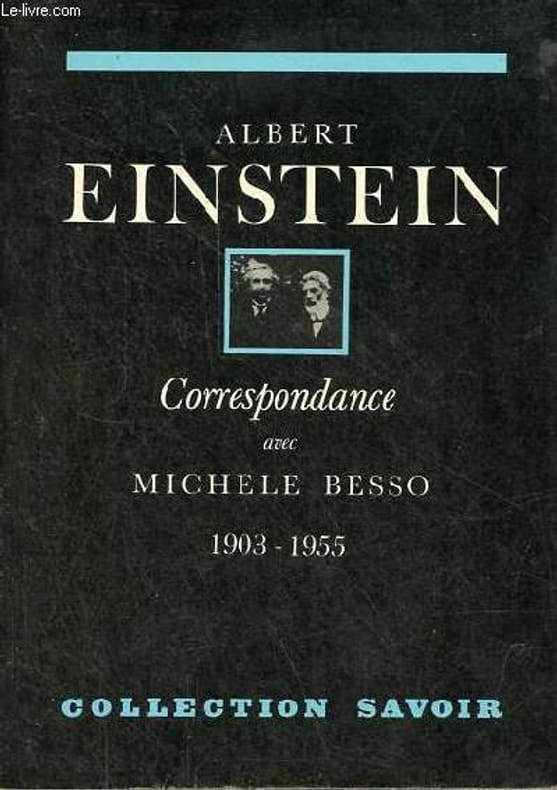
Einstein Albert & Besso MicheleLivre Rare Book
1 451 résultats
1979R100067671Hermann. 1979. In-8. Broché. Bon état, Couv. convenable, Dos satisfaisant, Intérieur frais. LXIII+327 pages.. . . . Classification Dewey : 830-Littératures des langues germaniques
192820896Ohne Ort, 1928. 11,5 cm x 8,5 cm (Fotografie).
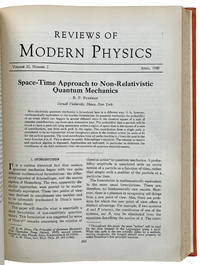
1948S10249Lancaster:: American Physical Society 1948. 1948. Large 8vo. 266 x 205 mm. iv 728 pp. Frontis. port. of Robert Andrews Millikan photos figs. tables. Later orange cloth gilt-stamped spine title; spine faded. Very good. TWO PAPERS FROM THE TWO GIANTS OF 20TH CENTURY PHYSICS AS THEY WERE ORIGINALLY PUBLISHED IN ONE COLLECTED VOLUME. Einstein's "Generalized Theory of Gravitation" is considered the last principal work issued by the 20th Century's premiere scientist. Schilpp-Shields. <br /><br /> Einstein: "A new presentation. . . which constitutes a certain progress in clarity as compared with previous presentations." from the Introduction. Feynman: "At first Feynman's fundamental article RMP 1948 did not arouse much interest among theoretical physicists who were not familiar with Feynman's new approach to doing quantum mechanics. As Feynman recalled: 'At the Shelter Island Conference. . . they asked me if I would explain my path-integral method for doing quantum mechanics so I did. I must have been preparing the manuscript for my paper RMP 1948 so that everything was organized and I explained it. It's hard to pay attention to some new idea and they didn't pay much attention to it.' However nowadays Feynman's RMP 1948 paper is one of the most well-known and widely cited papers; it is one of the cornerstones of modern theoretical physics." Mehra. <br /><br /> "It is a curious historical fact that modern quantum mechanics began with two quite different mathematical formulations: the differential equation of Schroedinger and the matrix algebra of Heisenberg. . . This paper will describe what is essentially a third formulation of non-relativistic quantum theory. This formulation was suggested by some of Paul Dirac's remarks concerning the relation of classical action to quantum mechanics. A probability amplitude is associated with an entire motion of a particle as a function of time rather than simply with a position of the particle at a particular time." from the Introduction. Provenance: David Middleton b. 1920 noted pioneer in the field of statistical communication theory last name gilt-stamped on spine. Einstein: Boni-Russ-Laurence 258; Schilpp-Shields 308 also see p. 758; Wasson Nobel Prize Winners p. 289-294; Weil 222 marked with asterisk by Weil. Feynman: Gleick Genius: The Life and Science of Richard Feynman p. 249; Mehra The Beat of a Different Drum: The Life and Science of Richard Feynman p. 200; Wasson Nobel Prize Winners p. 316-319. American Physical Society, 1948. hardcover books
1988S4425In:: American Scientist Vol. 76 No. 2 March-April 1988. 1988. 277 x 211 mm. 4to. 154-158 pp. 4 figs. Pictorial wrappers Einstein and Chaplin. Fine. American Scientist, Vol. 76, No. 2, March-April 1988. unknown books
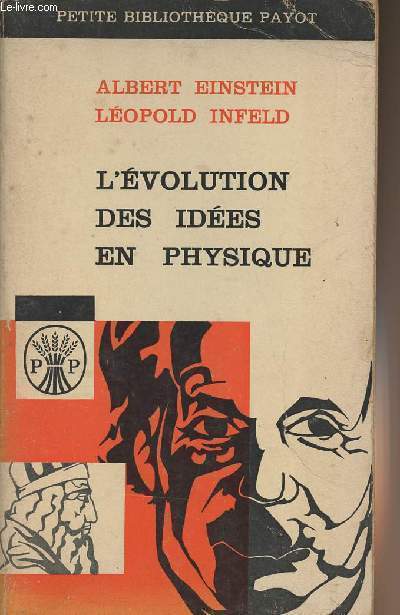
1968R240149329Payot. 1968. In-12. Broché. Etat d'usage, Couv. légèrement pliée, Dos plié, Papier jauni. 280 pages.. . . . Classification Dewey : 530-Physique
1993R300280486Flammarion. 1993. In-12. Broché. Bon état, Couv. convenable, Dos satisfaisant, Intérieur frais. 280 pages - quelques illustrations en noir et blanc dans le texte.. . . . Classification Dewey : 530-Physique
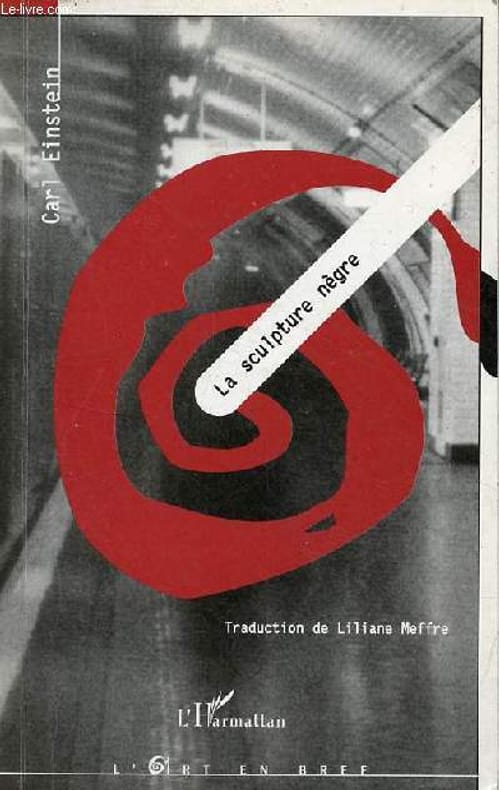
1998R100058125L'Harmattan. 1998. In-8. Broché. Bon état, Couv. convenable, Dos satisfaisant, Intérieur frais. 123 pages - dédicace de Liliane Meffre sur la page de garde (photo disponible) - nombreuses photos en noir et blanc hors texte - quelques annotations et quelques phrases soulignées au crayon à papier à l'intérieur du livre ne gênant pas la lecture - étiquette collée sur le 2ème plat.. . . . Classification Dewey : 97.2-Dédicace, envoi
199533314ABBraunschweig [u.a.], Vieweg (= Facetten), 1995. 8°, XVI, 299 S. mit einigen s/w-Abb., original Pappband mit illustr. original Schutzumschlag, der Umschlag leicht berieben, sonst ein schönes, textsauberes Exemplar (L)
1918005931Leipzig: Johann Ambrosius Barth 1918. Contemporary half cloth boards. Joints repaired slightly worn; book plate; ink stamp on front flyleaf and title. First Edition. About Very Good. Johann Ambrosius Barth hardcover
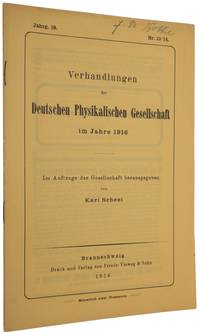
19166164Braunschweig: Druck und Verlag von Friedr. Vieweg and Son 1916. First edition. <p>First edition complete journal issue in original printed wrappers inscribed by Einstein to fellow Nobel Laureate Walther Bothe. "This work represents a major step forward in quantum theory" Calaprice p. 297. It introduced the concept of stimulated emission of radiation the theoretical basis for the laser; it also contained a new derivation of Planck's radiation law which provided as a by-product a justification of the frequency rule forming the basis of Bohr's theory of atomic spectra.</p>. DISCOVERY OF STIMULATED EMISSION OF RADIATION<br /> THE PRINCIPLE OF THE LASER<br /> INSCRIBED BY EINSTEIN TO A FELLOW NOBEL LAUREATE. <p>First edition complete journal issue in original printed wrappers inscribed by Einstein to fellow Nobel Laureate Walther Bothe. "This work represents a major step forward in quantum theory" Calaprice p. 297. It introduced the concept of stimulated emission of radiation the theoretical basis for the laser; it also contained a new derivation of Planck's radiation law which provided as a by-product a justification of the frequency rule forming the basis of Bohr's theory of atomic spectra. "According to Albert Einstein when more atoms occupy a higher energy state than a lower one under normal temperature equilibrium it is possible to force atoms to return to an unexcited state by stimulating them with the same energy as would be emitted naturally" Britannica. This is 'stimulated emission.' "To claim that Einstein almost invented the laser would be an exaggeration but the laser's underlying mechanism stimulated emission of radiation was a creation of his radiation theory" Kleppner pp. 32-33. "During the summer of 1916 less than a year after he had completed the general theory of relativity Einstein made a new major contribution to the quantum theory. The two papers he wrote then deal with the quantum theory of radiation by arguments that do not depend on the classical electromagnetic theory as had all earlier treatments of Planck's radiation law . When Einstein returned to the radiation problem in 1916 the quantum theory had undergone a major change. Niels Bohr's papers had opened a new and fertile domain for the application of quantum concepts - the explanation of atomic structure and atomic spectra. In addition Bohr's work and its generalizations by Arnold Sommerfeld and others constituted a fresh approach to the foundations of the quantum theory of matter" DSB. In this paper "Einstein considers a system of atoms in equilibrium with an external radiation field. An atom can change its internal energy state by absorbing or emitting radiation. Einstein introduces three basic assumptions about these exchanges of energy between matter and field. First the probability of absorption of radiation is proportional to the radiation density. Second there are two kinds of emission processes: one - spontaneous - following a law like that of radioactive decay; the other - stimulated - induced by the radiation field and with probability proportional to the radiation density. Third at equilibrium the atoms are distributed among their internal states according to the Boltzmann distribution law. From these assumptions Planck's law follows in a simple way. Einstein was very pleased with his derivation which he characterized in a letter to Besso: 'An amazingly simple derivation of Planck's formula I should like to say the derivation.' As a bonus from his derivation Einstein found that the energy difference between two internal energy states of the atom had to be equal to hv with v the frequency of the radiation absorbed or emitted in transitions between these two states thus confirming one of the postulates of Niels Bohr's theory of spectra" Papers 6 xxiii-xxiv. "Einstein meant the second part of this study a proof of the oriented character of the emission process to be his most essential contribution to quantum radiation theory this second paper was published later in 1916 as 'Zür Quantentheorie der Strahlung'. Instead Bohr gave more importance to the new deduction of the blackbody law; for this deduction reinforced the basic assumptions of his atomic theory and completed them with a statistical description of radiation processes" Darrigol p. 120. </p> <br /> <p>Provenance: Inscribed by Einstein on front wrapper "für. Dr Bothe" i.e. Walther Bothe 1891-1957. "In 1929 in collaboration with W. Kolhörster Bothe introduced a new method for the study of cosmic and ultraviolet rays by passing them through suitably arranged Geiger counters and by this method demonstrated the presence of penetrating charged particles in the rays and defined the paths of individual rays. For his discovery of the 'method of coincidence' and the discoveries subsequently made by it which laid the foundations of nuclear spectroscopy Bothe was awarded jointly with Max Born the Nobel Prize in Physics 1954" .</p> <br /> <p>While Einstein commended Planck's epoch-making derivation of his radiation law in 1900 which ushered in the quantum era he had also noted its limitations. Einstein also saw inconsistencies in Planck's derivation of his law. For Einstein this inconsistency was no reason to reject Planck's quantum theory but it was a reason to study the foundations of traditional radiation theory and if needed revise them. </p> <br /> <p>"As Einstein had noted in 1906 Planck's derivation of the Rayleigh-Jeans law</p> <br /> <p>uν = 8πν2/c3 kT</p> <br /> <p>between average resonator energy uν and radiation spectrum ν only applied to classical resonators T is the temperature k is Boltzmann's constant. A new quantum-theoretical picture of the interaction between matter and radiation was needed. Einstein found it in the summer of 1916 after the completion of his general theory of gravitation left him more time for quantum meditation.</p> <br /> <p>"The new picture presumably emerged from a combination of three elements: Einstein's derivation of the law of photochemical equivalence his analogy between quantum states and chemical species and Niels Bohr's theory of atomic spectra. According to Bohr atoms and molecules can only exist in a series of quantum states S0 S1 . . . Sn . . . with well-defined energies E0 E1 . . . En . . . Their interaction with radiation occurs through quantum jumps with characteristic values of the frequency of the emitted or absorbed radiation. Regarding the quantum states as chemical species and remembering his photochemical reasoning Einstein knew that he could derive Wien's law by balancing the absorption process Sn hν → Sn1 with the emission process Sn1 → Sn hν and by making the probability of the first reaction proportional to the density of radiation at frequency ν. Something in this reasoning needed to be altered in order to get Planck's law instead of Wien's. </p> <br /> <p>"At this point Einstein appealed to an analogy between classical and quantum theory. According to classical theory an oscillating dipole spontaneously emits radiation whether or not radiation is initially present in its surroundings. When external radiation encounters this dipole it may either be absorbed if the phase of the incoming wave agrees with that of the oscillator or it may be amplified in the contrary case. In the quantum theory of radiation Einstein similarly admitted the existence of three kinds of processes: spontaneous emission Ausstrahlung absorption negative Einstrahlung and stimulated emission positive Einstrahlung. The modern terminology is Bohr's. For the probability per time unit of the respective sorts of quantum jump Einstein assumed the forms</p> <br /> <p>Anm ÏνBnm ÏνBmn</p> <br /> <p>where n is the upper quantum state m the lower one and Ïν is the density of radiation at the frequency ν.</p> <br /> <p>"Einstein did not say much on the nature of the probabilities he thus introduced. He only commented that his theory had the weakness to leave to chance the instant and direction of the spontaneous emission of light. He also noted the similarity between spontaneous emission and radioactive decay. Undoubtedly he would have preferred a theory in which the emission and absorption probabilities were deduced from an underlying deterministic theory. He nonetheless expressed his 'full trust in the present way of reasoning'. The probabilistic description of the interaction was a natural counterpart of the discrete character of quantum states: if a quantum system evolves mostly through quantum jumps then the probability of a quantum jump obviously is the main quantity of physical interest. Instead of speculating on the precise timing and fine structure of the jumps Einstein proceeded to show what could be done by means of the new probability coefficients.</p> <br /> <p>"At thermal equilibrium Einstein reasoned statistical mechanics requires the number of atoms in a quantum state n to be proportional to exp−En /kT. The kinetic equilibrium between the atoms and surrounding radiation further requires that the number of quantum jumps from m to n should be equal to the number of reverse jumps:</p> <br /> <p>ÏνBnm exp−Em /kT = ÏνBnm Anm exp−En /kT.</p> <br /> <p>In the high temperature limit for which Ïν → ∞ this condition gives</p> <br /> <p>Bnm = Bmn.</p> <br /> <p>Therefore the equilibrium value uν of the density Ïν is given by</p> <br /> <p>uνexpEn − Em/kT - 1 = Anm / Bnm.</p> <br /> <p>According to a thermodynamic theorem by Wien uν/ν3 must be a function of ν/T only. Hence En − Em must be proportional to ν. Einstein thus derived Bohr's strange frequency rule ΔE = hν with complete generality and without recourse to any of the empirical laws of spectra. He then required the expression of uν to agree with the Rayleigh-Jeans law in the low-frequency limit. The outcome was Planck's law as well as the relation</p> <br /> <p>Anm / Bnm = 8Ï€hν3/c3</p> <br /> <p>between Einstein's two probability coefficients .</p> <br /> <p>"Einstein's new theory of radiation is now remembered for the introduction of stimulated emission which famously permitted the conception of masers and lasers. For Einstein and for his contemporaries the importance of these memoirs lay elsewhere. First Einstein filled an important gap in the derivation of Planck's law by means of a simple statistical description of radiation processes. Second he corroborated two basic assumptions of Bohr's atomic theory: the existence of stationary states and the frequency rule. In this regard it should be emphasized that before Einstein's and Sommerfeld's contributions of 1916 Bohr believed that his frequency rule only applied to strictly periodic systems. For instance he regarded the Zeeman effect as a violation of this rule. Einstein's new considerations established its complete generality" Darrigol in Cambridge Companion to Einstein pp. 134-136.</p> <br /> <p>"The implication of Einstein's theory of stimulated emission was that if one arranges for a large number of atoms to be in identical excited states a stray photon of the right energy can stimulate one atom to emit another photon which stimulates another. and all the atoms release their excess energy in a sudden cascade. What's more the photon released by stimulated emission will be in phase - coherent - with the one that stimulated it and so all the light produced in the cascade will be coherent.</p> <br /> <p>"In 1955 American physicist Charles Townes of Columbia University in New York an expert in molecular spectroscopy and his co-workers showed how stimulated emission could be used to make a device for generating or amplifying microwaves which they called a maser microwave amplified stimulated emission of radiation. Three years later Townes and Arthur Schawlow explained how to extend the idea to visible and infrared frequencies to make an 'optical maser' - in effect the laser.</p> <br /> <p>"They proposed using ordinary incoherent light to pump atoms into an excited state setting up the 'population inversion' in which the atoms are primed to return to their ground state by emitting photons. And their design used an optical cavity - basically two mirrors between which photons would bounce - to trap the emitted photons while they stimulated more emission. The device they explained would generate 'extremely monochromatic single-wavelength and coherent light'. Theodore Maiman of the Hughes Research Laboratories in Malibu California described such a device using a ruby crystal already used for masers as the lasing medium in 1960" 'A century ago Einstein sparked the notion of the laser' Physics World History Blog 31 August 2017.</p> <br /> <p>Weil 85. Calaprice An Einstein Encyclopedia 2015. Darrigol From c-numbers to q-numbers 1992. Kleppner 'Rereading Einstein on radiation' Physics Today 58 2005 pp. 30-33. Pais Subtle is the Lord 1982.</p> <br/> <br/> 8vo 228 x 154 mm pp. 315-332. Original printed wrappers. A fine copy. Druck und Verlag von Friedr. Vieweg and Son unknown
191250338Leipzig: Johann Ambrosius Barth 1912. Einstein Albert 1879-1955. 1 Lichtgeschwindigkeit und Statik des Gravitationsfeldes pp. 355-369. Weil 47 Boni 43. 2 Zur Theorie des statischen Gravitationsfeldes pp. 443-458. Weil 48 Boni 44. 3 Nachtrag zu meiner Arbeit: "Thermodynamische Begrundung des photochemischen Aquivalentgesetzes" pp. 881-885. Weil 46 Boni 42. 4 Antwort auf eine Bemerkung von J. Stark: "Uber eine Anwedung des Planckschen Elementargesetzes" pp. 888. Weil 49 Boni 45. 5 Relativitat und Gravitation. Erwiderung auf eine Bemerkung des Hrn. A. Einstein pp. 1059-1064. Weil 50 Boni 46. In Annalen der Physik 38 1912. Red cloth with gilt lettering on the spine. Whole volume: 1064 pp. 8 plates. Text-figs. 210 x 130 mm. Very good copy. <br /> <br /> <p>Approximate English translations of titles with brief explanations of referenced paper if available:<br> 1 "The speed of light and the statics of the gravitational field." "Further exploring his studies of gravitation based on the equivalence principle Einstein sees with growing clarity that gravitation is intimitely linked with the problem of the measurement of space and time" p. 292. Calaprice Kennefick & Shulmann. An Einstein Encyclopedia. 2015.;<br> 2 "On the theory of the static gravitational field." "Einstein more closely analyzes the equations of motion stated in no. 1 above concluding that those equations cannot be reconciled with the given field equations for c . . . because the principle of "action equals reaction" is violated. p. 290. Calaprice Kennefick & Shulmann. An Einstein Encyclopedia. 2015.;<br> 3 "Addendum to my work: 'Thermodynamic justification of the photochemical equivalent law' "; <br> 4 "Answer to my remark by J. Stark: "On an application of Planck's elementary law' ";<br> 5 "Relativity and gravitation. Response to a remark by Mr. A Einstein".</p> <br /> <br /> <p>Weil's Einstein Bibliography nos. 47 48 46 49 and 50. <br> Boni's Einstein Checklist nos. 43 44 42 45 and 46. </p> . Johann Ambrosius Barth unknown
19162859Wien; Wien-Berlin-London, Alfred Hölder; Verlag für Fachliteratur Ges. M. B. H. 1910; 1916. mit 3 Tafeln; 7 Abbildungen, Am Umschlag gedruckt "Überreicht vom Verfasser", darüber handschriftlich in Tinte "hochachtungsvollst". 52, 24 S., 3 Bände. Original-Broschuren mit Deckeltitel. ZUSTAND +1, verlagsfrisch. Aus den Sitzungsberichten, der kaiserl. Akademie der Wissenschaften in Wien. Mathem.-naturw. Klasse; Bd. CXIX. Abs. Iia.
193869317-A-65099Amsterdam: D.B. Centen 1938. Linnen gebonden. Met prospectus van het boek gevouwen a-4. 319 pp. ills. -Schutbladen verkleurd wat roestvlekken op de snee onderstrepingen in potlood verder in goede staat. D.B. Centen unknown
196048436Paterson (New Jersey), Pageant Books, 1960. Gr.-8°. Mit 3 ganzs. Portraits. 6 Bll., 84 S., OLwd.
196857192New Haven CT: Yale University Press 1968. good fair. 269 illus. biographical directory bibliography of Lewis Einstein's published writings index front DJ flap price clipped. Raised stamp on half title DJ worn and discolored small edge tears and chips to DJ edges discoloration inside front and rear boards and flyleaves. Foreword by George F. Kennan. Lewis Einstein 1877-1967 entered the diplomatic service in 1903; serving for 25 years he was possibly the first American of the 20th century to perceive the meaning of the emerging role of the United States in the world balance of power. There are references to Presidents Theodore Roosevelt and William Howard Taft in the index. Yale University Press hardcover
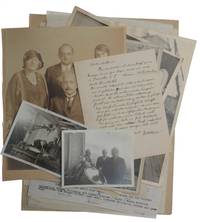
193160051931. First edition. <p>An important group of photographs documenting Einstein's visit to Caltech. The main purpose of the visit was to discuss Edwin Hubble's observations made in 1929 with the 100-inch telescope at the Mount Wilson Observatory which showed that light from distant nebulae galaxies was red-shifted indicating that the universe was expanding. Einstein had believed that the universe is static and had introduced his 'cosmological constant' into his equations of general relativity to allow for a static solution. When Einstein met Hubble at the Mount Wilson Observatory in January and February 1931 he was visibly moved with Hubble's discovery and reportedly said with tears in his eyes that "It was the most beautiful and satisfying interpretation of astronomical science." In light of the new evidence Einstein published a paper two months later renouncing the concept of a cosmological constant whose invention Einstein denounced as "the greatest blunder of my life."</p>. 'the greatest blunder of my life'. <p>An important group of photographs documenting Einstein's second visit to America and his first to the California Institute of Technology which began at the end of December 1930. The main purpose of the visit was to discuss Edwin Hubble's observations made in 1929 with the 100-inch telescope at the Mount Wilson Observatory then the largest telescope in the world which showed that light from distant nebulae galaxies was red-shifted indicating that the universe was expanding. Einstein had believed that the universe is static and had introduced his 'cosmological constant' into his equations of general relativity to allow for a static solution. When Einstein met Hubble at the Mount Wilson Observatory in January and February 1931 he was visibly moved with Hubble's discovery and reportedly said with tears in his eyes that "It was the most beautiful and satisfying interpretation of astronomical science." In light of the new evidence Einstein published a paper two months later renouncing the concept of a cosmological constant whose invention Einstein denounced as "the greatest blunder of my life." Einstein was accompanied on his visit by Walther Mayer 1887-1948 who had been appointed as his mathematical assistant in 1929. Mayer and Einstein worked together on several approaches towards a unified field theory. "On the way over Einstein and his mathematical calculator Walther Mayer holed up working on revisions to his unified field theory in an upper-deck suite with a sailor guarding the door" Isaacson p. 368. Two of the photographs are of Einstein at Mount Wilson one with Mayer and the observatory's director Walter Adams 1876-1956 who had confirmed Einstein's prediction of the gravitational red-shift although his observations were later shown to be faulty; the other with Mayer and solar physicist Charles St. John 1857-1935 who had assisted Hubble with his red-shift observations. Another photograph shows Einstein between fellow Nobel Laureates Albert Michelson 1852-1931 and Robert Millikan 1868-1953 Caltech's "chairman of the executive council" effectively its president. Together with Edward Morley Michelson had in 1887 carried out the famous Michelson-Morley experiment which failed to detect evidence of the existence of the luminiferous ether; this provided crucial evidence for the early acceptance of special relativity. On this trip Einstein "paid tribute to the aging Michelson carefully praising his famous experiments that detected no ether drift without explicitly saying that they were a basis for his special theory of relativity" Isaacson p. 372. </p> <br /> <p>"In the early 1930s Einstein came to California specifically to consult with scientists at the California Institute of Technology. Few members of the general public understood the nature of his visits but they idolized him all the same. From the moment his boat docked in San Diego on December 31 1930 the reception accorded him by Californians was one part show business one part hero worship and one part genuine affection. Groups of children dressed in blue and white middies serenaded him and thrust wreaths of flowers into his hands two bands struck up tunes and in Los Angeles a theatrical group the Yale Puppeteers opened a play called Mr. Noah in which the ark landed on Mt. Wilson instead of on Mt. Ararat .</p> <br /> <p>"As early as 1913 Einstein was looking for experimental verification for the correctness of his theory of general relativity and he had been in correspondence with Caltech's George Ellery Hale asking him to make an astronomical measurement. He was anxious to know if Hale could detect the influence of the sun's gravitation field upon a light ray. Hale replied that in order to try he needed a solar eclipse. The experiment was finally carried out in 1919 by two British expedition teams and again in 1922 by an American team of astronomers - and it did confirm the theory of general relativity.</p> <br /> <p>"There were cosmological implications in this theory and they attracted a lot of attention in the 1920s and 1930s - nowhere more than at Caltech. Millikan had been urging Einstein to visit the campus for some time and in the fall of 1930 he agreed to spend the winter quarter in Pasadena. Not only would he be able to discuss his theory and its interpretation with distinguished scientists; he would also be meeting old friends again - Richard Tolman the cosmologist; Paul Epstein the theoretical physicist; and Theodore von Karman the aerodynamicist .</p> <br /> <p>"The new Athenaeum at Caltech was the setting for many dinners to honor Einstein. At the first on January 15 1931 the guests included the physicist and Nobel Laureate A. A. Michelson and 200 members of the California Institute Associates. Several weeks later a second dinner was held at which all the astronomers from the Institute and the Mt. Wilson Observatory were present. Edwin Hubble was there as was Charles E. St. John who verified the third prediction of the theory of general relativity the gravitational red-shift. Colleagues came from Berkeley including Tolman's close friend and co-author G. N. Lewis who wrote to say he was coming with a friend - though not without some mildly humorous trepidation. As he put it in his letter to Tolman: 'I have just accepted an invitation from Oppenheimer to drive me down. Do you think I should take out accident insurance'</p> <br /> <p>"Einstein was not without a sense of humor himself. At a farewell luncheon in his honor on February 24 1931 which was sponsored by the Pasadena Chamber of Commerce he said: "I want to thank the extraordinary group of scholars in the fields of physics and astronomy who have afforded me glimpses of their work. They have conducted me not only into the world of atoms and crystals but also to the surface of the sun and into the outermost depths of space. There I saw worlds which are flying away from us with incomprehensible rapidity in spite of the fact that their inhabitants do not know us well enough to justify any such action'" Goodstein.</p> <br /> <p>"Millikan was a physicist who had won the Nobel Prize in 1923 for having 'verified experimentally Einstein's all-important photoelectric equation.' He likewise verified Einstein's interpretation of Brownian motion. So it was understandable that as he was building Caltech into one of the world's pre-eminent scientific institutions he worked diligently to bring Einstein there.</p> <br /> <p>"Despite al they had in common Millikan and Einstein were different enough in their personal outlooks that they were destined to have an awkward relationship. Millikan was so conservative scientifically that he resisted Einstein's interpretation of the photoelectric effect and his dismissal of the ether even after they were apparently verified by his own experiments. And he was even more conservative politically. A robust and athletic son of an Iowa preacher he had a penchant for patriotic militarism that was as pronounced as Einstein's aversion to it" Isaacson p. 373. </p> <br /> <p>"To physics posterity Viennese mathematician Walther Mayer is mostly known as 'Einstein's calculator'. He had apparently been called that at the California Institute of Technology in Pasadena which Einstein and Mayer visited together in the winter of 1930/31. It is true that in order to advance in his studies to construct a unified field theory Einstein relied on the expertise of mathematicians. With his unified field theory Einstein attempted to formally join his own theory of general relativity with Maxwell's electromagnetism.</p> <br /> <p>"When Einstein was looking for a new mathematics assistant in 1929 Mayer was hired on the recommendation of eminent mathematician Richard von Mises. Like Einstein von Mises at that time held a professorship in Berlin. Walther Mayer then served as private lecturer at the University of Vienna finishing the second volume of a very well received textbook series on differential geometry which he co-authored with fellow Viennese mathematician Adalbert Duschek. Subsequently Mayer and Einstein worked together on several approaches towards a unified field theory consisting of 1 the analysis of solutions to Einstein's so-called distant teleparallelism approach 2 the invention of a variant of the Kaluza-Klein theory in which not space-time but attached vector spaces are 5-dimensional and finally 3 the construction of a formalism they referred to as "semi-vectors" for interpreting Dirac-spinors in simpler classical field-theoretical terms and reformulating the Dirac equation accordingly. Their joint work was published in 7 papers over a period of roughly four years 1930-1934 .</p> <br /> <p>"While being humbly appreciative of the vital improvement that Einstein brought to his career Mayer was at the same time also quite unhappy about his role as Einstein's 'appendage'. Einstein however was aware of and respected this sentiment of Mayer's: When he bargained his Princeton position with Abraham Flexner a founding director of Princeton's Institute for Advanced Study he insisted on an independent professorship for Mayer as well. After some back and forth this was indeed granted at the last minute. However the question of Mayer's legitimacy as an independent professor at Princeton surfaced again after their arrival. Feeling unwelcomed and not sufficiently supported by Einstein Mayer finally ended their collaboration after just one further joint paper in 1934. He felt that his career would be advanced best if from now on he would focus entirely on his own studies in pure mathematics. In the end Mayer was able to retain his tenure at Princeton for the rest of his life but he subsequently appeared to have wished to no longer be associated with work on unified field theory. On the outside Einstein and Mayer remained in friendly contact while Einstein found new collaborators. The ones immediately succeeding Walther Mayer at Princeton were Boris Podolsky and Nathan Rosen" Lessel.</p> <br /> <p>The photographs are accompanied by a number of letters from Mayer to his brother Arthur in Austria discussing Einstein's work Hitler and the Nazis. Mayer was Jewish and it was only through Einstein's intervention that he was given the title of professor at the University of Vienna. Mayer immediately took a leave of absence from this position to continue his collaboration with Einstein when he had returned to Berlin.</p> <br /> <p>At a press conference on his arrival in New York Einstein was asked "'What do you think of Adolf Hitler' Einstein replied 'He is living on the empty stomach of Germany. As soon as economic conditions improve he will no longer be important'" Isaacson p. 369. "On the day he left New York Einstein revised slightly one of the statements he had made on his arrival. Asked again about Hitler he declared that if the Nazis were ever able to gain control he would consider leaving Germany" ibid. p. 371. In April 1933 Einstein discovered that the new German government had passed laws barring Jews from holding any official positions including teaching at universities. He left Germany in summer 1933 and took up a position at the Institute for Advanced Study in Princeton despite Millikan's efforts to lure him to Caltech. He remained at the Institute until his death in 1955.</p> <br /> <p>Goodstein 'Albert Einstein in California' Engineering and Science May-June 1979 pp. 17-19 - Isaacson Einstein. His Life and Universe 2007. Lessel 'Walther Mayer - more than 'Einstein's calculator'' - ;/span></p> <br/> <br/> . unknown
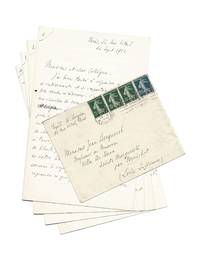
1922Bergson2<p><strong>EINSTEIN BERGSON Henri 1859-1941</strong></p><p>Autograph letter signed " Henri Bergson " to Jean Becquerel<br />Paris 24 September 1922 16 pages in-8° with envelope<br />Some typographic pencil notes</p><p><strong>A highly significant letter on the issues and interpretation of the theory of relativity</strong><br /><strong>This intervention of the philosopher continues up to this day to create multiple controversies</strong></p><p><u>We transcribe here only a few fragments of this letter which although known in its substance has remained unpublished to this day</u></p><p><em>" Monsieur et cher collègue</em><br /><em>J'ai bien tardé à répondre à la lettre si intéressante et si importante que vous avez bien voulu m'adresser. C'est qu'elle est allée me chercher de divers côtés et m'a atteint en Suisse à un moment où j'étais pris à Genève par le travail de " Coopération intellectuelle " qui nous avait été confié par la Société des nations. Me voici de retour à Paris ; je profite de mes premiers instants de liberté pour vous écrire. Le passage essentiel de votre lettre est naturellement celui qui concerne le voyage en boulet. Laissez-moi reprendre ce que j'ai dit dans mon livre</em> Durée et simultanéité paru à l'été 1922 <em>en y joignant quelques explications complémentaires.</em><br /><em>Il y a d'abord deux remarques importantes à faire.</em><br /><em>1° <strong>Si l'on se place en dehors de la Théorie de la Relativité on conçoit un mouvement absolu et par là même une immobilité absolue ; il y aura dans l'univers des systèmes réellement immobiles. Mais si l'on pose que tout mouvement est relatif que devient l'immobilité </strong> Ce sera l'état du système de référence je veux dire du système où le physicien se suppose placé à l'intérieur duquel il se voit prenant des mesures et auquel il rapporte tous les points de l'univers.</em> …<br /><em>2° Si l'on se place en dehors de la Théorie de la Relativité on conçoit très bien un personnage Pierre absolument immobile au point A à côté d'un canon absolument immobile ; on conçoit aussi un personnage Paul intérieur à un boulet qui est lancé loin de Pierre se mouvant en ligne droite d'un mouvement uniforme absolu vers le point B et revenant ensuite en ligne droite et d'un mouvement uniforme absolu encore au point A. <strong>Mais du point de vue de la Théorie de la Relativité il n'y a plus de mouvement absolu ni d'immobilité absolue</strong></em> … <em>Paul une fois lancé dans l'espace n'est plus qu'une représentation de l'esprit une image — ce que j'ai appelé un " fantôme " ou encore une " marionnette vide ". C'est ce Paul en route ni vivant ni conscient n'existant plus que comme image qui est dans un Temps plus lent que celui de Pierre.</em> … <em>Le Paul qui sort du boulet au retour du voyage le Paul qui fait de nouveau partie alors du système de Pierre est quelque chose comme un personnage qui sortirait en chair et en os de la toile où il était représenté en peinture : c'était à la peinture et non pas au personnage c'était à Paul référé et non pas à Paul référant que s'appliquaient les raisonnements et les calculs de Pierre pendant que Paul était en voyage.</em> … <strong><em>Je ne voudrais pas clore sans saisir l'occasion qui s'offre à moi de vous dire combien m'a intéressé et instruit votre beau livre sur " Le principe de relativité " et la " Théorie de la gravitation " – livre indispensable à tous ceux qui ont le souci d'approfondir la théorie d'Einstein.</em></strong><em> Veuillez Monsieur et cher collègue agréer l'expression de mes sentiments les plus distingués et dévoués</em><br /><em>H. Bergson "</em></p><p>In publishing <em>Durée et simultanéité</em> published by Alcan in the summer of 1922 Bergson was taking a risk that he probably did not measure himself. The purpose of this essay was to discuss the philosophical issues of the theory of relativity. The criticism of his scientific colleagues was not long in coming. Those of Einstein in the first place deploring the "blunders" or "dumplings" of the philosopher. In France it was Jean Becquerel who opened fire with a letter addressed directly to the author and of which this document constitutes the reply.<br />At the time Becquerel held a chair of applied physics at the Museum of Natural History. He wrote a textbook entitled <em>Le Principe de relativité et la théorie de la gravitation</em> Gauthier-Villars 1922 which made him one of the first introducers of Einsteinian theory in the French context. Two sources give an idea of the content of Becrerel's letter: his article published the following year "Critique de l'ouvrage durée et Simultaneity de M. Bergson"<em> Bulletin scientifique des étudiants de Paris</em> 10 2 March-April 1923 and the extract given by Bergson himself in the first of three appendices added to the 1923 edition of <em>Durée et simultanéité</em> – appendix which also contains with a few lines the entirety of his answer. Bergson then chose to preserve the anonymity of his correspondent in order to avoid giving the impression of a "polemic" according to the interview of December 30 1923 with Jacques Chevalier. He merely evokes "a letter very interesting which was addressed to us by a most distinguished physicist."<br />The discussion crystallizes on a specific point: the interpretation of the slowdown of moving clocks predicted by the theory. The famous "twin paradox" attributed to Paul Langevin provides a pictorial version of the problem as part of a Jules Verne-style narrative: an astronaut here "Paul" embarked on a "ball journey" would find himself on his return younger than his twin brother who remained on Earth here "Pierre" as if time had passed less quickly for him! In his letter Becquerel insists on the fact that the theory of relativity speaks of time actually measured on both sides by observers in relative motion. Bergson repeats by clarifying it the argument developed in his book namely that the differences relate less to real times than to fictitious times that is to say times attributed to other observers who acquire at the same time the status of simple images or "ghosts". Thus the "dilation" of durations associated with the slowing down of moving clocks is only a "perspective effect". Bergson is led to this conclusion by a strict interpretation of the principle of relativity: between two observers in relative motion there is a "perfect symmetry" each can consider itself motionless or mobile with respect to the other. Multiple empirical confirmations have since objectively proved the philosopher wrong but the question of the status of time in relativity as well as that of the relevance of the arguments exchanged continues to fuel contemporary philosophical debates. In that sense that letter constitutes a key part of the case.</p><p>We thank Mr. Elie During for the information he kindly communicated to us</p>
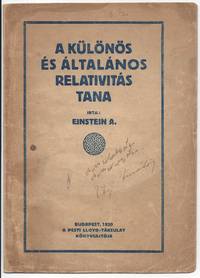
19201870Budapest: A Pesti Lloyd-Társulat Könyvsajtója 1920. First separate edition. Offprint of Természettudományi Közlöny. In publisher’s printed wrappers. Cover chipped at extremities. Restored rear panel replaced with cardboard similar to original. Old ownership inscriptions on front panel. Contemporary notes and underlines throughout in pen and pencil. Pages discolored due to the acidic paper. Overall in good condition. First separate edition. Offprint of Természettudományi Közlöny. In publisher’s printed wrappers. 2 19 1 p. <p><br /> First Hungarian edition of Einstein’s Über die spezielle und allgemeine Relativitätstheorie Braunschweig 1917 published as an extract.<br /> <p><p><br /> Offprint of Természettudományi Közlöny. One of the earliest Hungarian publications of Einstein’s works. <br /> <p>. A Pesti Lloyd-Társulat Könyvsajtója unknown
1953GB0000CIJJXI3N01Cassell 1953. Hardcover. Good. Missing dust jacket; Pages can have notes/highlighting. Spine may show signs of wear. ~ ThriftBooks: Read More Spend Less.Dust jacket quality is not guaranteed. Cassell hardcover
1987Q-0880290978Hippocrene Books 1987-03-01. Hardcover. New. In shrink wrap. Looks like an interesting title! Hippocrene Books hardcover
1937264078New York: Alfred A. Knopf 1937. First American Edition. Hardcover. Good/Good. Alfred A. Knopf 1937; stated First American Edition no additional printings indicated same date on title and copyright pages; x 253 xii 1pp. Binding is tight sturdy and square; light wear light foxing to edges of tan cloth boards magenta and brown stamped title and decoration on spine and front board remains bright and bold; text very good throughout. Unclipped $2.50 dust jacket is edge-worn and age-toned with several small closed tears one chip at head of spine; light foxing to jacket as well. A presentable First American printing of Einstein's classic work of music history and criticism. From a private collection. Ships from Dinkytown in Minneapolis Minnesota. Alfred A. Knopf hardcover
19852-019318513XOxford Univ Pr 1985. Paperback. New. 2nd edition. 274 pages. 8.25x6.50x0.50 inches. Oxford Univ Pr paperback
1920188923Rostock, 1920. 15 S. OBr. im Pp.-Schutzumschl. M. wenigen Anstreich.
1930021309London: The Soncino Press 1930. 1st Edition . Hardcover. Fair/Fair. Hardcover book in fair condition. Dust jacket included in poor to fair condition showing toning light staining and tears. Book dampstained closer to spine crack to binding starting at middle. A few instances of marked lines in the margins not affecting text. An excellent resource copy of this scarce first edition. Questions welcome. We ship internationally from the United States and Canada every week. If buying internationally please be aware that additional charges may apply for heavier books. We guarantee a safe quick and secure transaction. 10 years in online bookselling experience. <br/> <br/> The Soncino Press hardcover
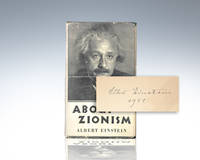
1931146050New York: The MacMillan Company 1931. First edition of this volume of Einstein's speeches and letters concerning his views on Zionism. Octavo original cloth. Boldly signed and dated in the year of publication on the front free endpaper "Albert Einstein 1931." Near fine with light toning to the endpapers in the scarce original dust jacket which is in good condition with some wear. Translated and edited with an introduction by Leon Simon. Exceptionally rare signed. Einstein was a prominent supporter of both Labor Zionism and efforts to encourage Jewish-Arab cooperation. He supported the creation of a Jewish national homeland in the British mandate of Palestine but was opposed to the idea of a Jewish state "with borders an army and a measure of temporal power." In a letter to Jawaharlal Nehru dated June 13 1947 he asserted "Long before the emergence of Hitler I made the cause of Zionism mine because through it I saw a means of correcting a flagrant wrong.The Jewish people alone has for centuries been in the anomalous position of being victimized and hounded as a people though bereft of all the rights and protections which even the smallest people normally has.Zionism offered the means of ending this discrimination." Einstein's speeches lectures and letters concerning Zionism were first published in 1930 by The Soncino Press and eleven of these essays were later collected in The World as I See It published in 1933 which Einstein dedicated "to the Jews of Germany". The MacMillan Company hardcover