Einstein, AlbertBiblio.com

1 198 résultats
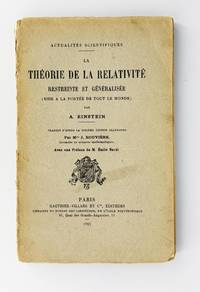
19211014Paris: Gauthier-Villars 1921. 1st Edition. FIRST FRENCH EDITION OF A 1921 LECTURE BY EINSTEIN ON THE "GEOMETRIZATION OF PHYSICS AND RELATIVITY AND THE RELATION OF MATHEMATICS TO THE EXTERNAL WORLD" Dictionary of Scientific Biography 4 330. WEIL 115b. French translation by Maurice Solovince. <br /> <br /> In the same year in which he won the Nobel Prize 1921 Einstein delivered this paper as a lecture at "a commemorative session of the Prussian Academy of Sciences in honor of Frederick the Great" Calaprice Einstein Almanac 65. In "Geometrie und Erfahrung" Geometry and Experience Einstein advances his theory that space conforms to non-Euclidean principles of geometry -- a corollary of the Theory of Relativity - and as stated generally sums up his views on the "geometrization of physics and relativity and the relation of mathematics to the external world" DSB. <br /> <br /> It is in this lecture that Einstein also provides his famous answer to the puzzling question of why mathematics should be so well adapted to describing the external world: "Insofar as the laws of mathematics refer to the external world they are not certain; and insofar as they are certain they do not refer to reality" ibid. Calaprice put it like this: "He questioned whether human reasoning even without direct experience could lead to an understanding of the properties of real things merely through thought" Calaprice 1921. CONDITION & DETAILS: Paris Gauthier-Villars. 8vo. 9 x 5.75 inches; 225 x 143mm 2 19 1. Two in-text illustrations. Very slight soiling to the front wrap. Minor chipping lower right corner. Bright and clean throughout. See photos. Gauthier-Villars unknown
19502946629Buenos Aires.: Emecé. 1950. Hardcover. Cubierta deslucida. Good. 19 cm. 215 p. Encuadernación en tapa dura de editorial. Cubierta deslucida. Física.530.12 530 Emecé. hardcover
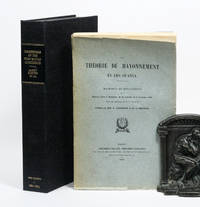
19122508Paris: Gauthier-Villars 1912. First edition. Original wrappers custom box. Very Good. RARE FIRST EDITION IN ORIGINAL WRAPPERS OF THE REPORTS FROM THE HISTORIC FIRST SOLVAY CONFERENCE "THE FIRST INTERNATIONAL CONFERENCE IN PHYSICS EVER ORGANIZED" AND A CRITICAL MOMENT IN THE BIRTH OF QUANTUM PHYSICS. In the short time that followed Planck's hypothesis of the universal constant that would bear his name the greatest minds in physics were largely at a loss about how to deal with the bizarre theoretical results that followed let alone the experimental results which confirmed them!. Much of the focus at the time was on black-body radiation including work by Planck himself as well as Lorentz Rayleigh and Jeans. However shortly before the first Solvay conference a young Einstein had also started investigating the related question of materials' specific heat. Kuhn. "The purpose of the first Solvay Conference was thus two-fold: first there was the need to examine whether classical theories molecular-kinetic theory and electrodynamics could in some undiscovered ways provide an explanation of the problem of black-body radiation and of the specific heat of polyatomic substances at low temperatures; secondly to consider phenomena in which the theory of quanta could be successfully used." Mehra.<br /> <br /> Underlying these questions was the more fundamental mystery of how to interpret the existence of the Planck constant. There were two camps both of which were represented at the conference. Planck's took the constant to indicate some fundamental constraint on the radiative processes of emission and absorption. For example "Sommerfeld introduced a version of the quantum hypothesis which he considered to be compatible with classical electrodynamics. He postulated that in 'every purely molecular process' a quantized quantity of action is exchanged." Staumann. Einstein's camp on the other hand took the quantum of action to represent the physicality of a perhaps pseudo-corpuscular theory of energy exchange - his photons of light.<br /> <br /> Although the debates that followed the lectures included in the proceedings did not rise to the famous heated exchange that Einstein would have with Bohr at the 1927 Solvay conference we do see some of the young Einstein's hotheadedness as he opens the debate following Planck's plenary lecture: "What I find strange about the way Mr. Planck applies Boltzmann's equation is that he introduces a state probability W without giving this quantity a physical definition. If one proceeds in such a way then to begin with Boltzmann's equation does not have a physical meaning." As translated by Straumann.<br /> <br /> It would take another 14 years for quantum mechanics to be fully formalized but the first Solvay conference represents a pivotal point in quantum history:<br /> <br /> "During 1911 the situation changed quickly. Articles that applied the quantum to other topics then outnumbered those on blackbody radiation for the first time and some were backed by impressive experimental evidence. In part because of that evidence physicists like Planck and Lorentz who had previously taken the constant h to be characteristic only of the radiation problem began to consider additional areas in which others had earlier staked quantum claims." Kuhn.<br /> <br /> Albert Einstein and the Solvay Conference:<br /> <br /> Among the most renown scientists of the day - including Ernest Rutherford Marie Curie and Max Planck - Einstein made quite an impression. At age 32 he was the second youngest participant in the conference. The youngest was British physicist Frederick Lindemann later to become scientific adviser to Winston Churchill.<br /> <br /> Although "Einstein had already published so many masterpieces none had actually been put to the test and his theories were looked on rather as tours de force than as definitive additions to knowledge. But his pre-eminence among the twelve greatest theoretical physicists of the day was clear to any unprejudiced observer." Frederick Lindemann quoted in Brian.<br /> <br /> References: Headline quote from the Solvay Institute website. Kuhn T. 1978 Black Body Theory and the Quantum Discontinuity 1894-1912. University of Chicago Press. Mehra J. 1975 The Solvay Conferences on Physics: Aspects of the Development of Physics Since 1911. Straumann N. 2011. On the first Solvay Congress in 1911. The European Physical Journal H 363 379-399. Denis Brian Einstein: A Life p.82.<br /> <br /> Paris: Gauthier-Villars 1912. Octavo original wrappers; custom box. Splits to top and bottom joint of upper wrapper two creases to front wrapper. Text in fine condition largely unopened. <br /> <br /> FIRST PRINTINGS IN ORIGINAL WRAPPERS ARE EXTREMELY SCARCE. Gauthier-Villars unknown
1921009633Paris: Gauthier-Villars 1921 12mo 19 cm XXII 120 pp. Printed wrappers wrappers slightly stained and frayed; small portions of paper missing from the spine; paper toned inside. Early French edition of Einstein's celebrated popular exposition of the theory of relativity intended to make the fundamental ideas of both the special and the general theory accessible to non-specialists. With a preface by the renowned mathematician Émile Borel who emphasizes the scientific importance of Einstein's work and its profound implications for modern physics. Einstein's text explains the essential concepts of space time motion gravitation and the structure of space-time in clear largely non-technical language presenting the empirical and conceptual foundations of relativity to a broad readership. The French translation was prepared by Maurice Solovine one of Einstein's close early collaborators and an important mediator of his ideas to the French-speaking public. Boni-Russ-Laurence 91.B. Gauthier-Villars paperback
1993R3215France: Éditions du Seuil Collection Science ouverte 1993 ÉPUISÉ mais DISPONIBLE. « La correspondance du couple s'étend de 1897 à 1903 peu après leur mariage. Ces lettres révèlent un Einstein peu connu optimiste confiant et heureux malgré les difficultés familiales et professionnelles qu'affronte le jeune couple. Mileva y montre une forte personnalité - « mon égal » dit Einstein qui admire sa maturité affective et intellectuelle. Elle contribuera de façon essentielle aux succès scientifiques d'Einstein.». Couverture souple. Comme neuf. Éditions du Seuil (Collection Science ouverte) paperback
1912011596Leipzig: Johann Ambrosius Barth 1912. In bound volume of Annalen der Physik. Vierte Folge Band 38 pp. 355-69. Volume also includes 1 Einstein "Nachtrag zu meiner Arbeit:: 'Thermodynamische Begrundung des photochemischen Aquivalentgesetzes" pp. 881-84; 2 "Antwort auf eine Bermerkung von J. Stark p. 888; and 3 "Relativitat und Gravitation Erwiderung auf eine Bermerkung von M. Abraham" pp. 1059-64. Paper label on spine top of which is worn; library bookplate; perforated stamp on half-title and title page. First Edition. Library Buckram. Good. Johann Ambrosius Barth Hardcover
1912008413Leipzig: Johann Ambrosius Barth 1912. Small pieces missing from spine; rear wrapper carefully reattached; ink stamp on front wrapper; small piece of paper stuck to first page. . First Edition. Original Printed Wrappers. Good. Johann Ambrosius Barth Paperback
191229311Leipzig Barth 1912. 8vo. Orig. printed wrappers. Backstrip taped. Kept in a cloth-box. In: "Annalen der Physik IV Bd. 38" pp. 355-369 and pp. 443-458. The whole issue present= Bd. 38 Heft 2 pp.249-472. <br/><br/><em>Both papers in first edition and they are considered as the first appearance of a Nonlinear Field Equation for Gravitation. - "Einstein published two remarkable memoirs in 1912 which were efforts to construct a complete theory of gravitation incorporating the equivalence principle. In these memoirs Einstein supposed that the gravitational field can be characterized completely by one function the local speed of light analogous to the Newtonian description where only the gravitational potential appears. By an extraordinary argument he extended the potential equation of Newton.In his second Memoir in 1912 he used the equivalence principle to show the influence of a static gravitational field on electromagnetic and thermal processes." DSB IV p.320 ff. - Weil No. 47 and 48. </em> hardcover
191249779Leipzig Barth1912. 8vo. No wrappers. In: "Annalen der Physik IV Bd. 38" No 7. Pp.249-472 a. 3 plates. Entire issue offered. Einstein's papers: pp. 355-369 and pp. 443-458. Clean and fine. <br/><br/><em>Both papers in first edition and they are considered as the first appearance of a Nonlinear Field Equation for Gravitation. "Einstein published two remarkable memoirs in 1912 which were efforts to construct a complete theory of gravitation incorporating the equivalence principle. In these memoirs Einstein supposed that the gravitational field can be characterized completely by one function the local speed of light analogous to the Newtonian description where only the gravitational potential appears. By an extraordinary argument he extended the potential equation of Newton.In his second Memoir in 1912 he used the equivalence principle to show the influence of a static gravitational field on electromagnetic and thermal processes." DSB IV p.320 ff. - Weil No. 47 and 48. </em> unknown
1954195551954. in German black ink. Signed “A. Einsteinâ€. A poem written by Einstein to his colleague and collaborator Ernst Straus and his son Daniel.<br /> <br /> “Dear Strausse both!<br /> <br /> My best wishes and greetings in poetic form.<br /> <br /> It brings even more happiness<br /> If it has been anticipated for so long<br /> also in one’s circle of friends<br /> the event is doubly appreciated. <br /> <br /> This is what I wish:<br /> Let Daniel be like his father<br /> thoroughly intelligent and not less joyous<br /> so few humans are like that.<br /> <br /> Many - alas - are born<br /> few are chosen<br /> to bring light and joy.<br /> Let such gift be his drive.<br /> <br /> Yours A. Einsteinâ€<br /> <br /> In German “Strauss†means bunch bouquet etc. or ostrich and “Strausse†is plural.<br /> <br /> Ernst G. Straus 1922-1983 was a mathematician who helped found the theories of Euclidean Ramsey theory and of the arithmetic properties of analytic functions. He was Einstein’s assistant and collaborator both at Princeton and afterwards when he moved to become a professor of mathematics at UCLA. His son Daniel is a professor of chemistry at Cal State San Jose. unknown
19539553SCPrinceton NJ: Princeton University Press 1953. 165 pp. Original gray cloth covers w/ gilt title on spine. Light pencil notes on pp. 1-5. Previous owner's name in pencil on fpde. DJ has some wear to edges. Light stains to front cover. Includes an index. Hard Cover. Very Good/Good-. Princeton University Press Hardcover
19698990293Cassell & Company 1969. This is an ex-library book and may have the usual library/used-book markings inside.This book has hardback covers. Clean from markings. In good all round condition. No dust jacket. Please note the Image in this listing is a stock photo and may not match the covers of the actual item750grams ISBN:0304924830 Cassell & Company hardcover
1920194005Munchen: Wolff 1920. Hardcover. Very Good. Cover has general wear. Bookblock has age toning. Interior pages have age toning. German language text. Green boards. 108 pgs illustrations. Wolff hardcover
1928374181928. Weil 162. Offprint from S. preuss. Akad. Wiss. unknown
192822775Berlin 1928. Orig. printed wrappers. Spine strengthend with matching paper. Fresh copy. Offprint/Sonderabdr. aus "Sitzungsberichte". pp. 1-6. <br/><br/><em>First edition. Weil No. 162. </em> unknown
192828363Berlin Gruyter u. Co. 1928. 4to. Orig. printed orange wrappers. Offprint/Sonderabdruck aus Sitzungsberichten.pp. 1-6. Fine fresh copy. <br/><br/><em>First edition in the rare Offprint still called "Abdruck" but having separate printed title and separate pagination. See Weil: 162 where this is not mentioned.Weil No. 162.The early Offprints from "Sitzungsberichten." are called "Sonderabdruck" up to Weil No.165 including this. From Weil 166 they are called "Sonderausgabe.". - Before 161 up to 160 the Offprints do not have separate title and pagination the pagination follows the numbering in the periodical. From 166 the Offprint has both separate printed title and pagination. - So Weil Nos 161-165 is still "Abdruck" but with separate title and pagination. These facts are not mentioned in the bibliographies. </em> unknown
192746076HB1927. Berlin Springer 1927. 4°. 1 Porträt S. 273-276. Original-Broschur geringfügig gebräunt. Kleine Rostflecken im Bund durch die Klammerheftung. Durchgehend schwacher Wasserrand in der unteren Außenecke. Sonst innen sauber und gut erhalten. Das Heft enthält außerdem den Erstdruck von Max von Laue: Aus Newtons Optik sowie weitere Beiträge. unknown
192746968Berlin Julius Springer 1927. Lex8vo. In "Die Naturwissenschaften" 15. jahrgang 1927. Entire volume offered bound in contemporary half calf with gilt lettering to spine. Minor wear to upper capitals otherwise a fine and clean copy. Einstein: Pp. 273-76; Born: Pp. 238-42; Planck: Pp. 529-31; Sommerfeld: Pp. 825-32; Frisch: Pp. 321-326; pp. 963-968. Entire volume: XXV1100016 pp. <br/><br/><em>First edition of all papers. The Einstein paper is his contribution to the Anniversary volume of Newton's death. Frisch received the Nobel Prize for his works on animal psychology and behaviour in 1975.Weil No 158. - Planck: Akademie No. 165 - K. v. </em> unknown
192746484Berlin Julius Springer 1927. 4to. Orig. printed wrappers. In "Die Naturwissenschaften" Heft 12 Fünfzehnter Jahrg. Seite 273-296 textillustrations. Einstein's paper pp. 273-276. With one plate portrait of Newton. Clean and fine. <br/><br/><em>First appearance of Einstein's Newton-paper which was later included in "Mein Weltbild" and its translation in "In the World as I see it"- Weil: 158 - Boni: 166.The issue contaions also a first-printing by Max von Laue "Aus Newtons Optik" pp. 276-280 textillustr. </em> unknown
192738844Berlin Julius Springer 1927. 4to. Contemp. hcloth. Spine a bit worn. "Die Naturwissenschaften. Hrsg. von Arnold Berliner. 15. jahrgang" XXIV1000 pp. Einstein paper: pp. 273-276 and 1 portrait of Newton. - Born Paper: pp. 238-242. - Planck paper: 529-531. - Sommerfeld paper 825-832 - von Frisch papers: pp. 321-326 and pp. 963-968. The whole volume offered. <br/><br/><em>All papers in first edition. The Einstein paper is his contribution to the Anniversary volume of Newton's death. - Weil No 158. - Planck: Akademie No. 165 - K. v. Frisch received the Nobel Prize for his works on animal psychology and behaviour in 1975. </em> hardcover
1923433181923. Offprint from Zeitschrift für Physik 16 1923. Single sheet unpaginated. 230 x 155 mm. One corner creased but very good. First edition offprint issue. Einstein's second response to Friedmann's groudbreaking paper on equations governing the expansion of space which made a valuable contribution to Einstein's theory of relativity and admitted the possibility of an expanding universe. Einstein at first believed that Friedmann's reasoning was incorrect then corrected his own objection in the present brief "Notiz" and called Friedmann's results "clarifying." Pais Subtle is the Lord p. 288. Weil Albert Einstein Bibliography 130. unknown
192349811Berlin Vieweg u. Sohn 1923. 8vo. Bound in contemporary full cloth. In "Zeitschrift für Physik. Hrsg. von Karl Scheel. 16. Band" entire volume offered. Embossed stamp to title page. P. 228. Entire volume: IV 2 409 pp. <br/><br/><em>First printing of Einstein commentary to Friedman's seminal papers in which he "introduced into cosmology two concepts of revolutionary importance the age og the world and the creation of the world"Kragh Cosmology and Controversy. Also contained in the volume are:BOTHE W.: Eichmethoden für Emanationselektrometer Über eine neue Sekundärstrahlung der Röntgenstrahlen. - First appearance of Bothe's early paper on the Compton effect which together with his later paper in Bd 32 Zeitschrift für Physik awarded him the Nobel Prize in Physics "for the coincidence method and his discoveries made therewith".PAULI JR. W. : Über die Gesetzmässigkeiten des anomalen Zeemaneffektes. LANDÉ A.: Zur Theorie der Röntgenspektren.HEISENBERG W. M. BORN.: Die Elektronenbahnen im angeregten Heliumatom.Weil 122 </em> hardcover
1915432951915. <p>Einstein Albert 1879-1955 and Wander Johann de Haas 1878-1960. Notiz zu unserer Arbeit "Experimenteller Nachweis der Ampèreschen Molekularströme." Offprint from Verhandlungen der Deutschen Physikalischen Gesellschaft 17 1915. 1 sheet p. 420. 228 x 156 mm. Original printed wrappers. Fine copy.</p> <p>First Edition Offprint Issue. In 1915 Einstein and Dutch physicist Wander Johannes de Haas conducted gyromagnetic experiments leading to the discovery of the Einstein-de Haas effect which corresponds to the mechanical rotation induced in a ferromagnetic cylinder suspended inside a coil when an impulse of electric current is sent through the coil. Einstein was very enthusiastic about the experimental results stating that he and de Haas had "given firm proof of the existence of Ampère's molecular currents" quoted in Pais Subtle is the Lord pp. 245-246. Einstein and de Haas published their results in a paper published earlier in 1915 see Weil 73; the present "Notiz" is a response to a communication from American physicist Samuel Jackson Barnett who had begun performing similar experiments in 1909 and obtained results complementing those of Einstein and de Haas. Weil Albert Einstein Bibliography 73n.</p> . unknown
192237430Berlin: Slowa 1922. 51 5pp. Original printed wrappers faded front hinge weak tears at spine. First edition in Russian of Weil 111; see Weil 111e. Slowa unknown
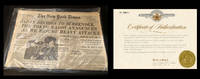
19451437New York: The New York Times 1945. 1st Edition. First edition of the August 14th 1945 issue of the New York Times complete with "Certificate of Authentication" by the Historic Newspaper Archives. The certificate is #379910; it is signed and includes the seal of the archive. Einstein's article appears in Calaprice's Einstein Almanac No. 244. The certificate will accompany the paper. <br /> <br /> Most assume that Einstein received the Nobel Prize for his theory of relativity and his famous equation E=mc2. However it was for neither. In 1921 Einstein won the Nobel Prize for discovering the photoelectric effect in 1905. This principle states that when sunlight shines on a metal it emits electrons from the surface of the material. The energy from sunlight photons then transfers to the atoms' electrons and knocks them loose. This discovery was so significant that it has influenced the development of many types of technology from electron microscopes to modern solar cells as we know them today. <br /> <br /> ALSO INCLUDED: An article by Lewis headlined: "Atoms Not Occult Einstein Declares; Physicist Explains Nuclear and Solar Energy but Refuses to Discuss Use in Bomb" <br /> <br /> ALSO INCLUDED: New York Time's announces Japan's surrender in 3 line large headline "Japan Decides To Surrender The Tokyo Radio Announces As We Resume Heavy Attacks". CONDITION: Historic Newspaper Archives see above has placed the issue in archival plastic and then into an Archive snap close bag. see photo By any measure this complete issue appears in very good condition. The New York Times unknown